
Short answer: Yes if you’re heading to Tokyo Station, or you have a JR Pass (the pass covers it, reserved seat included). No if you’re staying in Ueno, Asakusa or Akihabara, where the Skyliner is faster and cheaper, or if you’re on a tight budget, because the ordinary JR rapid train runs the same route for ¥1,408 (≈$9), just 32 minutes slower. Details, prices and the traps are below.
Prices are in yen, with rough dollar figures at about ¥154 to the dollar (September 2026). Exchange rates move, so treat the dollars as a ballpark.
You’ve just landed at Narita after twelve hours in the air, and the first thing Japan asks you to do is pass a test: N’EX, Skyliner, two kinds of cheap train, a bus, and a taxi counter, all competing for your attention through a fog of jet lag.
I’m YUU, a Japanese mom, and I’ve watched travelers stand frozen in that arrivals hall more times than I can count. The honest answer is that every one of those options is right for somebody — and at least one of them is wrong for you. This guide helps you work out which option fits your trip, with real prices, the traps nobody mentions, and the one comparison where the standard advice is simply incorrect.
One thing to do before any of this: get your arrival paperwork out of the way. I walk through it in my Visit Japan Web guide, so you can leave the airport with your QR code already scanned instead of filling out forms at a standing counter.

Disclosure: This article contains affiliate links. If you book through one, I may earn a small commission at no extra cost to you.
In a hurry? Everything in this guide, in one list:
- Skyliner tickets on Klook — via Ueno, the fast rival
- Private airport transfer — door-to-door for families with luggage
Prices change by date — check yours before you fly.
- Quick Answer: Is the Narita Express Worth It?
- Narita Express Cost vs the Four Other Ways to Reach Tokyo (2026 Fares)
- N’EX or Skyliner? Your Hotel Decides
- If You Have a JR Pass, the Math Changes Completely
- Where to Buy: Official Site or Klook?
- The Case for Not Having to Think After You Land: Private Transfers
- Traveling with Kids: The Hardest Passenger Isn’t Your Suitcase
- Can You Just Tap Your Suica and Ride?
- Narita Airport Transfer FAQ
- Final Thoughts
Quick Answer: Is the Narita Express Worth It?
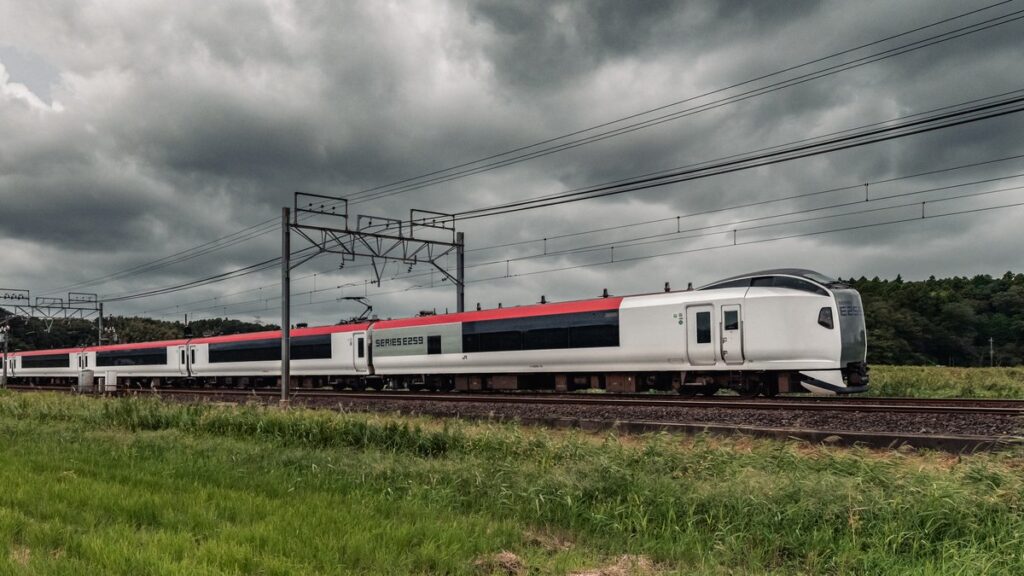
Photo: jason199567, CC BY-SA 2.0, via Wikimedia Commons (cropped)
 Here’s something that surprises most first-time visitors: the Narita Express and the ordinary JR rapid train charge you exactly the same base fare. Both cost ¥1,408 (≈$9) from Narita Airport to Tokyo Station when you pay with an IC card. What you’re actually paying extra for is the ¥1,730 (≈$11) limited express charge stacked on top, which brings the N’EX to ¥3,138 (≈$20) with Suica — or ¥3,140 (≈$20) if you buy paper tickets.
So the real question isn’t “is ¥3,138 (≈$20) a lot for a train ride?” It’s this: is it worth paying ¥1,730 (≈$11) extra to save 32 minutes and guarantee yourself a seat?
Because that’s the whole trade. The N’EX reaches Tokyo Station in 56 minutes. The JR rapid train — same tracks, no transfer, no reservation needed — takes 1 hour 28 minutes. You’re buying back half an hour, plus a reserved seat with room for your suitcase instead of standing in a doorway with two bags and a tired four-year-old.
If you’re landing after a long flight, that’s usually money well spent. But not always, and I want to be straight with you about when it isn’t.
Skip the N’EX if you’re staying in Ueno, Asakusa, or Akihabara. The Keisei Skyliner gets you to Ueno in 41 minutes for ¥2,470 (≈$16) — faster and cheaper than the N’EX, because the N’EX doesn’t serve that side of the city well.
 Check Skyliner ticket prices on Klook →
Skip it if you’re travelling light and watching every yen. That ¥1,408 (≈$9) rapid train runs direct to Tokyo Station with no transfer at all. Most budget guides never mention it.
Take the N’EX if you’re heading to Tokyo Station and you’d rather not change trains. For Shinjuku, the answer is less obvious than most guides suggest — I’ll show you why below.
Take it if you have a Japan Rail Pass. Your pass covers the N’EX, reserved seat included — so it costs you nothing extra.
And if you’re returning to Narita at the end of your trip, there’s a round-trip ticket that changes the math entirely. I’ll get to that below.
Narita Express Cost vs the Four Other Ways to Reach Tokyo (2026 Fares)
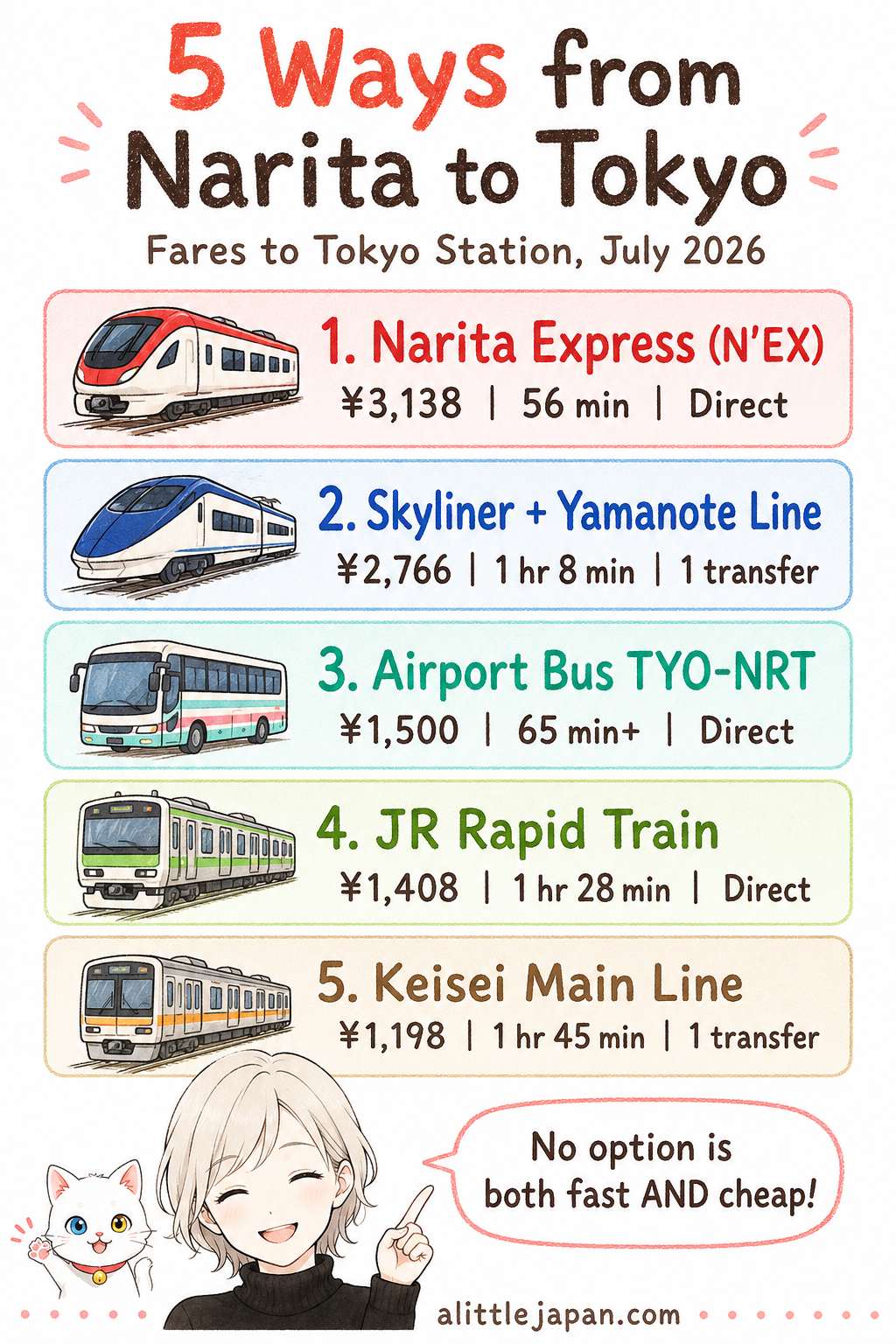
 Narita Airport isn’t in Tokyo. It’s in Chiba Prefecture, and the Narita Express covers 78 kilometres of track before it reaches Tokyo Station. That distance is the reason there’s no option here that’s both fast and cheap — every choice below trades one for the other.
| Option | Fare | Time on board | Transfers |
|---|---|---|---|
| Narita Express (N’EX) | ¥3,138 (≈$20) | 56 min | None |
| Keisei Skyliner + Yamanote Line | ¥2,630 (≈$17) | 1 hr 8 min | 1 (at Nippori) |
| Airport Bus TYO-NRT | ¥1,500 (≈$10) | from 65 min | None |
| JR rapid train (Narita Line) | ¥1,408 (≈$9) | 1 hr 28 min | None |
| Keisei main line | ¥1,198 (≈$8) | 1 hr 45 min | 1 (at Keisei-Funabashi) |
Two things this table doesn’t show, and both of them cost you time.
The first is the walk. None of these clocks start at the arrivals gate. From your terminal to the platform is roughly ten minutes, and that’s before you’ve worked out which machine sells which ticket. Add it to every row.
 The second catches budget travellers specifically. Terminal 3 — the LCC terminal, so this is you if you flew Jetstar, Peach, or Spring Japan — has no train station of its own. You need to walk or take the free shuttle to Terminal 2 first — and neither is as quick as it sounds. The covered walkway takes about 13 minutes from the Terminal 3 arrivals information counter to the ticket gates at Airport Terminal 2 Station. The shuttle bus ride is only about three minutes, but you’ll want to allow time to reach the stop and wait for it.
And if Tokyo Station isn’t where you’re going, the ranking changes. Heading to Ueno or Asakusa, the Skyliner runs 41 minutes for ¥2,470 (≈$16) and the N’EX doesn’t really compete. Heading to Shinjuku, the Skyliner plus the Yamanote Line comes to ¥2,820 (≈$18). For destinations the N’EX serves directly, the calculation may swing back — but not always, as the Shinjuku comparison in the next section shows.
N’EX or Skyliner? Your Hotel Decides
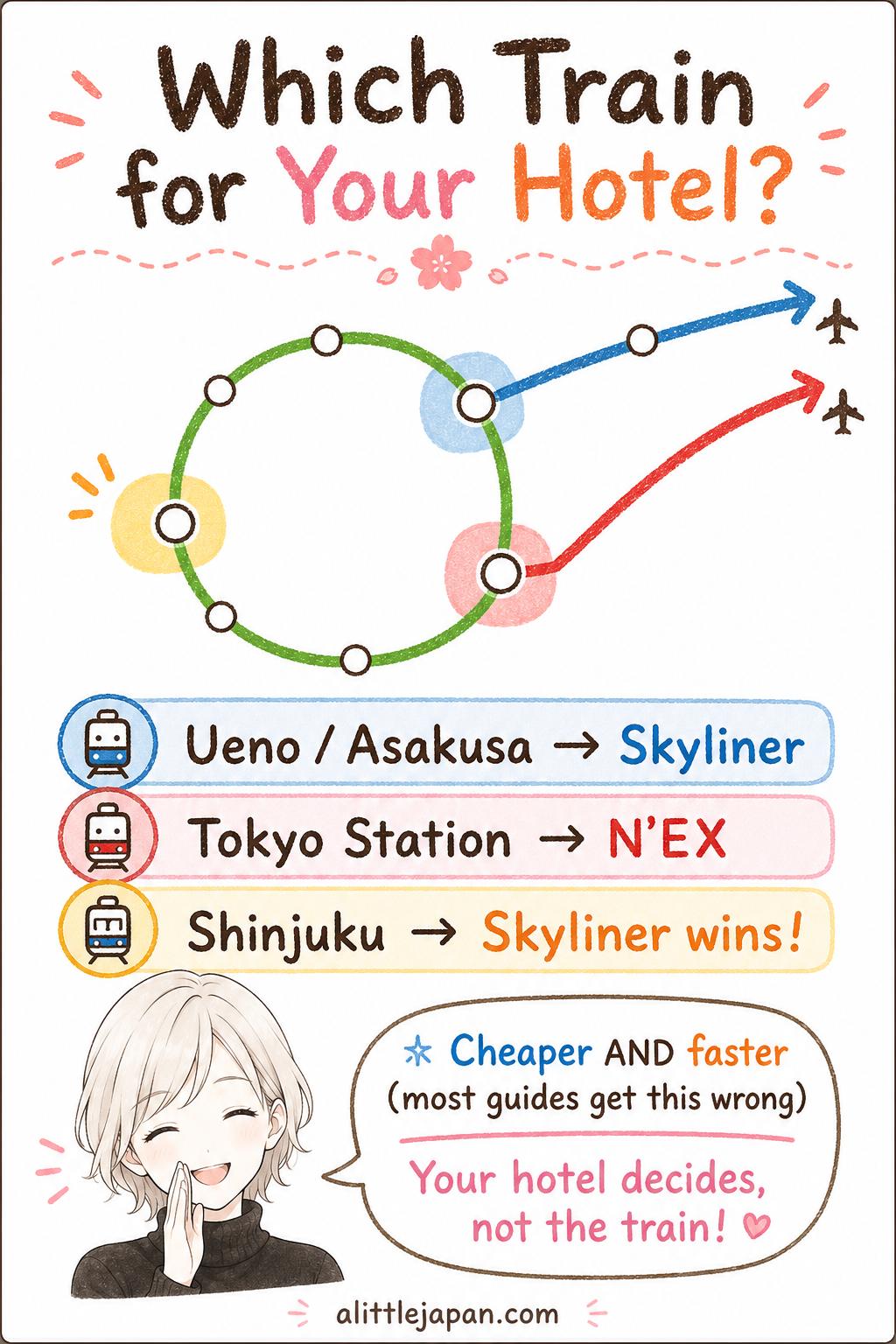
 Most guides will tell you the N’EX is for JR stations and the Skyliner is for Ueno. That’s roughly true, but it skips the part that actually costs you money. So here are the three cases, with the numbers.
Staying in Ueno, Asakusa, or Akihabara
Take the Skyliner. It reaches Keisei-Ueno in 41 minutes for ¥2,470 (≈$16), and the N’EX doesn’t serve that side of the city — you’d end up transferring anyway. This is the clearest case where the cheaper train is also the faster one, so there’s very little to weigh up.
Staying near Tokyo Station
Here the N’EX earns its fare. It runs direct in 56 minutes for ¥3,138 (≈$20). The Skyliner route works out to ¥2,630 (≈$17) but takes about 1 hour 8 minutes and adds a transfer at Nippori. You’re paying ¥508 to save twelve minutes and skip changing platforms with your bags — reasonable, and I’d pay it after a long flight.
Staying in Shinjuku
This is where the usual advice falls apart. The N’EX to Shinjuku costs ¥3,325 (≈$22) and takes around an hour and a half, because it loops through Tokyo Station on the way. The Skyliner plus the Yamanote Line costs ¥2,820 (≈$18) and gets you there in about an hour and twenty.
Cheaper and faster. The N’EX has exactly one advantage left on this route, and it’s the transfer — or rather, not having one.
Which is worth something, to be fair. Changing at Nippori with two suitcases and a child who fell asleep somewhere over Siberia is not free, even if the ticket says it is. But that’s the honest trade: on the Shinjuku run you’re spending ¥505 purely to stay in your seat. (Shibuya, by the way, stays in the N’EX’s favour — the direct train gets there a few minutes faster than the Skyliner route, so the usual advice holds there.)
So the question was never “which train is better.” It’s where you’re sleeping tonight — and on one of these three routes, the answer isn’t the one everybody repeats.
 If your hotel is still undecided, choose the neighbourhood before you choose the train — as you can see above, the area you sleep in picks the ride for you, not the other way round. Compare Tokyo hotels on Agoda.
If You Have a JR Pass, the Math Changes Completely
 Everything above assumes you’re paying cash. If you’re travelling on a Japan Rail Pass, throw the comparison out — the N’EX is a JR limited express, so your pass covers it, and the reserved seat costs nothing extra. JR’s own rules say it plainly: there is no additional charge for making seat reservations.
If your pass is already active, the N’EX costs nothing extra — and the Skyliner can’t compete with a ride that’s already included.
One thing worth doing anyway: reserve your seat before you board. It costs nothing extra and guarantees you a specific seat. You can ride without one — you’d take a vacant seat in an Ordinary Car — but if the passenger who reserved it turns up, you move. Reserve at the JR EAST Travel Service Center on B1, the station level of your terminal — open until 8pm at Terminals 2 and 3, and 7pm at Terminal 1, with a ticket office covering early mornings and late evenings — at one of the reserved-seat machines, or online before you fly if you bought your pass on the official site.
What your pass will not cover is the Skyliner, the Keisei lines, or any of the buses. Those are private companies, and the pass has nothing to do with them.
But please don’t buy a pass just for this ride
I want to be careful here, because this is where a lot of travellers lose money. A nationwide JR Pass costs far more than a return trip to Narita, and it only pays for itself if you’re making several long-distance journeys — a single Tokyo–Kyoto round trip alone doesn’t get you there. If your trip is Tokyo and the area around it, the pass is a bad deal no matter how nice a free N’EX sounds. I’ve run the numbers on that in a separate guide, and the honest answer surprises a lot of people.
There is a middle option, though. The JR TOKYO Wide Pass costs ¥16,000 (≈$105) for three days, covers the N’EX, and extends to places like Nikko and the Fuji area. If you’re staying in the Kanto region rather than crossing the country, that one’s worth a look before the full pass.
Where to Buy: Official Site or Klook?

 I’ll save you the suspense: neither one wins across the board. I checked both trains, and they gave opposite answers — which is why “just book everything on Klook” is advice that quietly costs people money.
The Skyliner: book ahead, wherever you book
The one thing you shouldn’t do is buy at the counter. Keisei sells the Skyliner at ¥2,580 (≈$17) one way if you walk up, but they run their own discount for overseas visitors at ¥2,310 (≈$15) — and a round trip drops from ¥5,160 (≈$34) to ¥4,500 (≈$29). Children aged 6 to 11 pay ¥1,150 (≈$7.50) one way on the same discount.
When I checked in July 2026, Klook was running a summer sale that worked out to roughly ¥1,930 (≈$13), which undercut even Keisei’s own discount by about ¥380. Sale prices move, though, so treat that gap as a snapshot rather than a rule. Check both before you book — the ¥270 you save going through Keisei directly is guaranteed, and anything beyond that is a bonus.
Klook isn’t the only place selling these, by the way. KKday, GetYourGuide, Rakuten Travel Experiences, and Keisei’s own e-ticket site all carry the Skyliner, and their prices move independently — one platform’s sale is another’s regular week. I link to Klook here because it’s the one I use, and it was the cheapest option when I checked — but if you have two minutes, compare it against one other before you pay.
Compare the Skyliner price on Klook →
One thing no platform’s sales page tells you clearly: most e-tickets don’t skip the line. What you buy through a third party is usually a voucher, and you exchange it for the actual seat ticket at a machine or the counter once you land. Keisei’s own Face Check in Go e-ticket is the exception — you register your face after paying and board without exchanging anything — so check the instructions for the exact ticket you buy.
The N’EX: buy from JR, not from a reseller
Here it flips, and not by a little. JR sells the N’EX TOKYO Round Trip Ticket for ¥5,200 (≈$34), valid for 14 days, which works out to ¥2,600 (≈$17) each way compared with ¥3,138 (≈$20) when using Suica for the base fare, or ¥3,140 (≈$20) with paper tickets. If you’re flying in and out of Narita, that’s about ¥1,080 (≈$7) saved for doing nothing differently.
Klook lists a N’EX round trip too, and even on sale it came to about ¥5,790 (≈$38) when I looked — more expensive than JR’s own ticket, and its list price was higher still. So for this one, go straight to JR.
| Ticket | Official | Klook (July 2026) | Cheaper |
|---|---|---|---|
| Skyliner, one way | ¥2,310 (≈$15) | approx. ¥1,930 (≈$13) | Klook, for now |
| N’EX, round trip | ¥5,200 (≈$34) | approx. ¥5,790 (≈$38) | Official |
I mention this because I use Klook myself and recommend it elsewhere on this site, so it would be easy to just tell you it’s always cheapest. It isn’t. On the Skyliner it was cheaper when I checked; on the N’EX round trip, JR beat it outright. Two minutes of checking both is worth more than any blanket rule I could give you.
The Case for Not Having to Think After You Land: Private Transfers

 On pure price, two people will always ride cheaper on the train — that part isn’t up for debate. But price is only one of the reasons people book a transfer, and I want to be fair to another important one, because it’s the reason I’d consider it myself: you’ve just landed in a country where the signs and the transport system may still feel unfamiliar, and someone is standing at arrivals with your name on a board. No ticket machines to decode, no transfer to find, no dragging a big suitcase through a station while jet-lagged. For some couples that certainty is worth more than the fare difference, and I don’t think they’re wrong.
Then there’s the family case, where even the price argument starts to wobble. A private transfer is priced per car, not per person. Four N’EX tickets — two adults and two children aged 6 to 11 — come to about ¥9,400 (≈$61), since children ride half price. A transfer from Narita to central Tokyo starts at around US$67 per vehicle — per car, not per person — though a family of four will need the larger 7-seater class, which costs more. Depending on the vehicle, the gap can narrow to roughly the price of a family lunch — and the car stops at your hotel’s front door, not at a station you still have to navigate away from.
To be honest with you, if it were only about money, I’d still say take the train. What you’re really buying is the hour you don’t spend shepherding jet-lagged children through ticket machines, transfers, and a walk from the station with everyone’s bags. Add that the driver tracks your flight and waits at no extra charge if you land late, and that you can request a child seat when you book — two things no train will ever offer — and the price difference starts looking very different at 9pm with a four-year-old asleep on your shoulder.
The booking trap: a “4 seater” carries three people
One thing to watch when you book. On Klook, a “7 seater” carries six passengers, not seven — the seat count includes the driver’s seat. Which means the cheapest “4 seater” option takes just three passengers, and a family of four needs a 7 seater no matter how little luggage you bring. Check the passenger number on the booking page, not the number in the car’s name.
 Check private transfer prices for your dates on Klook →
What about a regular taxi?
Regular taxis at Narita run on a fixed-fare system for trips into Tokyo: a flat rate by zone — Shinjuku and Shibuya sit in one zone, the Tokyo Station area in another — with expressway tolls added on top and a late-night surcharge between 10pm and 5am. No reservation needed; you just ask at the taxi stand. The catch is that Narita is 60-plus kilometres out, so the flat rates run around ¥25,000–30,000 (≈$165–195) to central Tokyo before tolls — comfortably more than the pre-booked transfer above. For a pre-agreed price in writing, the private transfer above is the same idea with less guesswork.
Traveling with Kids: The Hardest Passenger Isn’t Your Suitcase
 Here’s something I learned raising two kids in Japan: a suitcase rolls in the direction you pull it. A toddler does not.
People plan this trip worrying about luggage, but luggage is the manageable part. The real variable is what stage your child is in. A baby in a carrier is honestly the easy era — they’re attached to you, your hands stay free, and any of the trains in this guide will do. It’s the newly-walking stage that rewrites the plan: someone who has just discovered running, on a crowded platform, while you’re also steering the bags. When my kids were at that age, I’d have told you the suitcase was the easy passenger.
If that’s your situation, the single best thing you can buy isn’t a faster train — it’s fewer moments where everything happens at once. That means zero transfers if you can manage it: the N’EX direct to your hotel’s nearest station, the bus that swallows your bags underneath, or the private transfer from the section above. A small time saving is worth very little if it requires chasing a toddler through Nippori with a suitcase in one hand.
The stroller dilemma, honestly
I wish I had a clean answer here, but I’ll give you the honest one instead: the stroller is a dilemma with no perfect solution. Keep it open on a crowded train and you’re in everyone’s way — Japanese parents usually fold theirs when it gets packed, one of those unspoken rules you pick up living here. Fold it, and now you’re carrying a stroller, a child, and a bag with only two hands. Leave it at home, and every other part of the trip gets harder.
What actually helps is picking trains where the stroller can stay open without bothering anyone. A reserved seat changes everything here: on the N’EX or Skyliner you have your own space and a luggage rack — the N’EX racks even have dial locks, and they don’t need reserving. The N’EX also carries a multi-purpose room and a wide accessible toilet with a baby bed; the Skyliner answers with luggage space at the end of every car, power at every seat, and a baby bed in car 5’s restroom. Either way, it’s more than you can say for a rush-hour local train.
One more thing from experience: every station in this guide has elevators, but finding them is its own small job — they’re often at the far end of the platform, nowhere near where you got off. In Tokyo that’s a detour. Head into the countryside later in your trip, and the elevator hunt becomes a real part of the schedule. Something to remember when you plan your day trips.
Or send the suitcase ahead and walk in free
And if you want the version of this trip where nobody is steering anything: Japan has same-day and next-day luggage delivery, and it works beautifully. Counters in the arrivals lobby — Yamato Transport and JAL ABC, at both Terminal 1 and 2 — will take your suitcase and send it to your hotel from around ¥2,500 (≈$16) per bag, typically arriving the next day (hand it over by mid-morning and same-day is possible). Pack a small overnight bag for the first night and travel to the city with one hand free for each child. Coming from someone who tries to pack light every single trip and fails every single trip — because with kids, the bag always wins — this service is the closest thing to cheating that Japanese travel offers.
Can You Just Tap Your Suica and Ride?
 Short answer: on the cheap trains, yes. On the fast ones, only halfway.
The JR rapid train and the Keisei main line are ordinary commuter trains — tap in with Suica or Pasmo, tap out, done. That’s the entire transaction.
The N’EX and the Skyliner are a different animal. Your IC card only covers the base fare — the express charge is a separate ticket that no amount of tapping replaces. For the N’EX you need a limited express ticket on top of your Suica fare, and that comes in two forms: a reserved seat, or JR East’s Limited Express Unreserved Seat Ticket, which lets you take any vacant seat in an Ordinary Car (Green Cars excluded). With the unreserved version, if the passenger who reserved that seat arrives, you move — so reserving is still the easiest option, and it costs nothing extra. The Skyliner is stricter: every seat is reserved, so you need the seat reservation.
Don’t have an IC card yet? It’s worth sorting out at the airport anyway, because you’ll use it every day of your trip for everything from the subway to vending machines. I’ve written a full guide to choosing between Suica and Pasmo — including the tourist versions and the phone-app route — so I won’t repeat it here.
Narita Airport Transfer FAQ
I land late at night. Can I still get into Tokyo?
Mind the clock: the last N’EX leaves around 9:45pm, while the Skyliner holds out until about 11pm. After that, your options are the late-night buses (which charge more than the daytime ¥1,500 (≈$10)) and taxis or pre-booked transfers, which don’t care what time it is. If your flight lands after 10pm, consider booking a transfer before you fly — especially with children or heavy luggage — and turn a problem into a non-event.
Do I need to book the N’EX days in advance?
Usually no — buying at the airport on the day is normal. If you want certainty, JR’s online reservation system (JR-EAST Train Reservation) lets you book ahead, and JR Pass holders who bought on the official site can reserve seats before they even fly.
Do children pay full fare?
No. Children aged 6 to 11 pay half price on both railways — that covers the N’EX’s express surcharge too, and on the Skyliner’s overseas-visitor discount a child’s one-way ticket is ¥1,150 (≈$7.50). Children under 6 ride free on a parent’s lap; the one catch is that on all-reserved trains, a toddler who takes their own seat needs a child ticket.
Are there power outlets on the N’EX?
The N’EX has a power outlet at every seat, in ordinary cars too, plus luggage racks with dial locks and announcements in four languages. After a long flight with a phone at 8%, that outlet is worth more than the seat.
What about Haneda? Is it the same story?
Different airport, completely different story — Haneda sits far closer to the city, so it’s cheaper and quicker across the board. That comparison deserves its own guide.
Final Thoughts
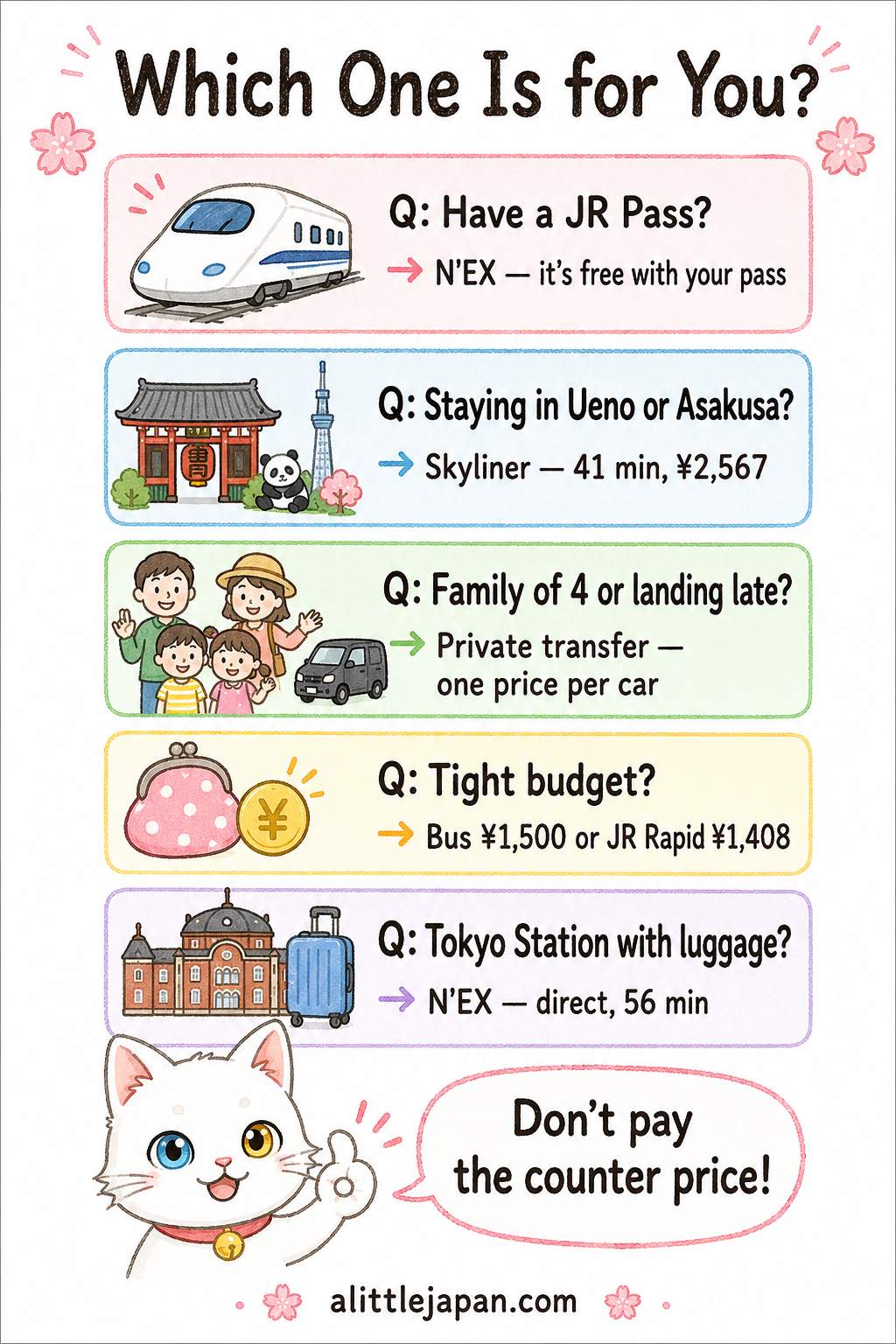
So, is the Narita Express worth it? For the right trip, absolutely: Tokyo Station with luggage, any trip on a JR Pass, or the round-trip ticket at ¥5,200 (≈$34). For the wrong trip — Ueno hotels, Shinjuku in a hurry, tight budgets — better answers exist, and now you know exactly which ones.
If you remember nothing else, remember this: check the official online discounts before paying a walk-up fare at the counter, and don’t judge any option by its sticker price alone. The cheapest ride that leaves you lost, exhausted, or chasing a toddler across a platform wasn’t cheap.
Check Skyliner prices on Klook
How does it work in your country — is the airport train the obvious choice, or the tourist trap? Tell me in the comments. I read every one, and honestly, I’m curious.
I hope this guide has answered one of your questions and helped you feel a little closer to Japan. May your Japan journey be filled with wonderful discoveries and memories you’ll treasure for years to come.
See you in the next guide. 
Check Tokyo Hotel Prices on Agoda
What to Read Next
- Is the JR Pass Worth It in 2026?
- Suica vs Pasmo for Tourists
- Best eSIM for Japan: Tested & Compared
- Visit Japan Web: Step-by-Step for Families
- Sending your suitcase ahead instead of carrying it on the train? Luggage Forwarding in Japan: Is It Worth It?
That is the short answer. What it does not tell you is whether the N’EX is even the right train for where you are staying — the Skyliner is cheaper and faster to Ueno, and holding a JR Pass changes the maths completely. The table below puts all five routes side by side with 2026 fares and journey times, and the sections after it work through which one fits your hotel.



Comments