You step outside in Tokyo in December and think, “This isn’t so bad.” Then evening arrives, your hands get cold, and the scarf at the bottom of your bag suddenly makes sense. If you’re wondering what to wear in Japan in December, the honest answer depends on three things: where you’re going, which winter month you’re visiting, and how much time you’ll spend indoors.
December in Tokyo can feel like the tail end of autumn. January in Sapporo is a completely different winter. Tokyo, Kyoto, and Osaka are usually cold without requiring snow-country gear, while Hokkaido calls for proper insulation and shoes made for frozen ground.
A common packing mistake is not simply underdressing for the cold. It is relying on one heavy outfit that becomes uncomfortable on a heated train or inside a department store. This guide will help you pack layers you can adjust, choose shoes that work in Japan, and prepare differently for December, January, February, and Hokkaido.

Disclosure: This article contains affiliate links. If you book or buy through one, I may earn a small commission at no extra cost to you.
In a hurry? Everything in this guide, in one list:
Pack before you fly:
- Thermal base layer set — the foundation of every winter outfit
- Packable puffer jacket — warm but suitcase-friendly
- Touchscreen gloves — maps without frozen fingers
- Merino wool crew socks — warm feet, long walking days
- Hokkairo stick-on body warmers (30 pack) — Japan’s winter secret weapon
- MegRhythm steam eye masks — warm 20-minute reset after a cold day
Book ahead (winter tours fill up):
- Otaru & snow park day tour — Hokkaido’s postcard winter day
- Hakuba ski package — lift ticket + equipment rental in one
- Snow Monkey Park bus tour — the famous hot-spring monkeys, no driving
Already in Japan? The warmers and eye masks are in every drugstore — the links are for stocking up from home.
- Japan Winter Weather at a Glance: December vs. January & February
- December: Autumn’s Tail With Cold Nights
- January & February: The Real Winter
- The Layering Formula That Actually Works
- Outside Is Cold, Inside Is Hot: The Part Nobody Warns You About
- Tokyo, Kyoto & Osaka vs. Hokkaido: Two Different Winters
- Shoes and Socks: You’ll Be Taking Them Off
- Don’t Overpack: Buy It in Japan
- Winter in Japan with Kids
- What Japanese People Actually Wear in Winter
- New Year Closures and Winter Events Worth Dressing For
- Japan Winter Packing Checklist
- FAQ
- YUU’s Final Thoughts
Japan Winter Weather at a Glance: December vs. January & February
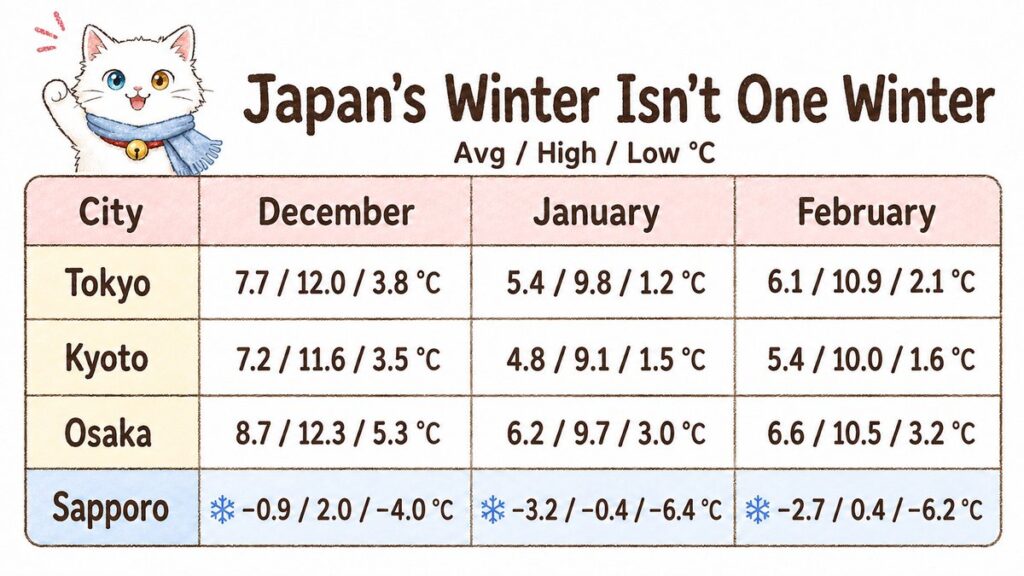
 Japan doesn’t have one winter. The difference between Tokyo and Sapporo is large enough that copying a single “Japan winter outfit” from social media can leave you carrying unnecessary boots in Osaka or shivering on an icy street in Hokkaido.
The table below uses Japan Meteorological Agency climate normals for 1991–2020. Each cell shows the monthly average, the average daily high, and the average daily low in Celsius.
| City | December: avg / high / low | January: avg / high / low | February: avg / high / low |
|---|---|---|---|
| Tokyo | 7.7 / 12.0 / 3.8°C | 5.4 / 9.8 / 1.2°C | 6.1 / 10.9 / 2.1°C |
| Kyoto | 7.2 / 11.6 / 3.5°C | 4.8 / 9.1 / 1.5°C | 5.4 / 10.0 / 1.6°C |
| Osaka | 8.7 / 12.3 / 5.3°C | 6.2 / 9.7 / 3.0°C | 6.6 / 10.5 / 3.2°C |
| Sapporo | −0.9 / 2.0 / −4.0°C | −3.2 / −0.4 / −6.4°C | −2.7 / 0.4 / −6.2°C |
For Tokyo, Kyoto, and Osaka, the daytime highs tell one story and the early mornings tell another. A midday temperature around 10–12°C can feel manageable in the sun, but lows around 1–5°C make a long wait on a platform or an evening walk much colder than the same day’s lunchtime.
December is also meaningfully milder than January in these cities. Tokyo’s average December low is 3.8°C, about 2.5°C warmer than January’s. That is why early December can still feel connected to late autumn, especially during the day.
 Tokyo’s normal first-snow date is January 3. A forecast can always surprise you, but most December visitors to Tokyo don’t need to plan their whole suitcase around snow. If you’re arriving in late November or crossing from autumn into winter, the seasonal handover is covered here: my guide to what to wear in Japan in October and November.
Kyoto deserves a little extra care even though its figures look close to Tokyo’s. It sits in a basin, and the cold can settle in during mornings and evenings. If your day begins at a quiet temple and ends after dinner, dress for the colder edges of the day rather than the warmest hour.
 Sapporo is the outlier. Its December average is already below freezing, and its January average daily high is −0.4°C. In other words, your Tokyo layers are the starting point in Sapporo, not the finished outfit.
December: Autumn’s Tail With Cold Nights
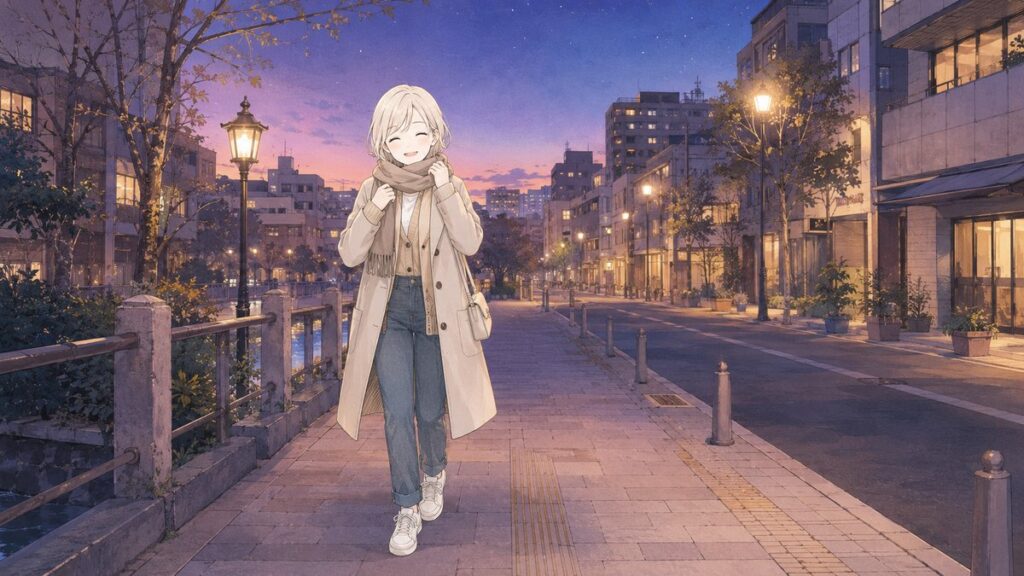
In Tokyo, Kyoto, and Osaka, a December daytime outfit can often begin with a long-sleeved top and a light coat. Add a knit or thin insulating layer if you get cold easily, but don’t assume you need your heaviest coat from breakfast until dinner. The sun and all the walking may make it feel milder than the thermometer suggests.
Then the light fades, and the same outfit can feel too thin. Evening illuminations are a perfect example: you may stand outdoors instead of moving, often after the daytime warmth has gone. A scarf, gloves, and a warmer removable layer earn their space in your bag on those nights.
People coming from tropical climates often feel the cold more sharply at first. If that sounds like you, start with the extra layer rather than trying to prove you can manage without it. You can always take something off after you learn how the weather feels to your body.
 Our family is a good reminder that there is no universal December uniform. I’m sensitive to cold and usually start wearing down around the beginning of December, while my husband and sons may still be comfortable in lighter outerwear. We live in the same house and walk into the same weather, yet we don’t dress the same.
I also carry a thin cardigan throughout the year. In summer it protects me from aggressive air-conditioning; in autumn and winter it becomes the small adjustable layer between outdoors and heated interiors. It isn’t dramatic, but it solves the temperature gap more often than a beautiful coat that only works in one setting.
So what should you wear in Japan in December? For the major cities, start with a long-sleeved base, an optional knit or cardigan, and a coat you can open or remove easily. Pack the scarf and gloves for nights, then upgrade the whole outfit if Hokkaido or a snow activity is on your itinerary.
January & February: The Real Winter
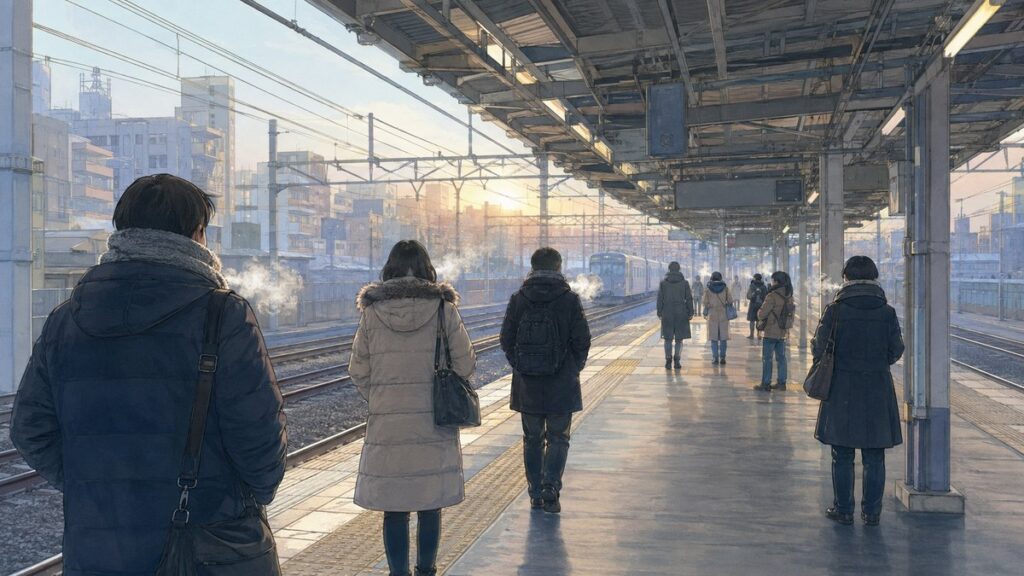
January is when winter settles properly into Tokyo, Kyoto, and Osaka, and February remains close behind. Tokyo’s average lows are 1.2°C in January and 2.1°C in February. Kyoto’s are 1.5°C and 1.6°C, so changing the page on the calendar doesn’t suddenly make mornings feel like spring.
This is the point where I would pack an insulated coat or down jacket, a knit or fleece, a long-sleeved top, and, if you get cold easily, a thin insulating base. The individual pieces matter less than the fact that you can remove them separately. A cold station platform and a heated restaurant ask for different versions of the same outfit.
Winter air in the major cities can feel dry, and static electricity becomes part of everyday life. Lip balm and moisturizer are practical additions, not luxury extras. You may notice the dryness after a full day of walking between outdoor air and heated rooms.
Snow is possible in Tokyo in January and February, but its timing, accumulation, and how long it remains vary from one weather system to another. The normal first-snow date given above is climate context, not a forecast for a particular trip. Pack primarily for cold city walking and heated indoor spaces, then check the short-term forecast for snow or ice.
If you’re deciding what to wear in Japan in January or what to wear in Japan in February, don’t build a single sealed outfit. Build a small system: insulating base, everyday top, mid-layer, and an insulated coat or down jacket, with a scarf and gloves you can remove quickly. That system will carry you from a cold morning to a heated afternoon without forcing you to choose between shivering and sweating.
The Layering Formula That Actually Works
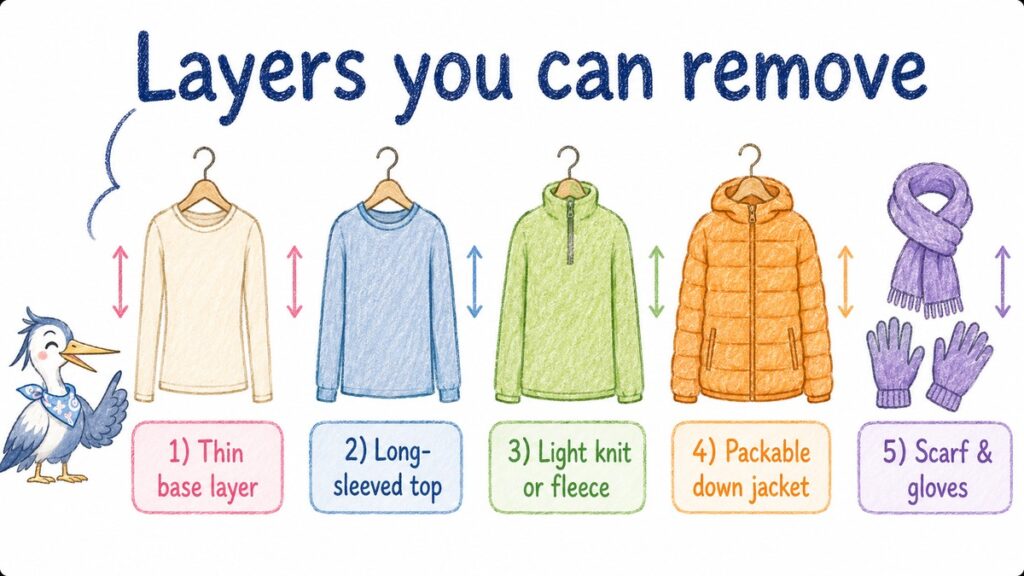
The most useful winter outfit in Japan is not the warmest one you can create. It is the one you can change while standing beside a station locker, entering a crowded shop, or sitting down for lunch. You need warmth outside and an escape route inside.
Start with a thin base layer, including a heat-generating style if it suits you. Over that, wear a long-sleeved top, then a light knit or fleece. Finish with an outer layer that opens easily and, ideally, can be folded into your bag when you no longer need it.
A scarf does more work than many travelers expect. It warms the exposed area around your neck outdoors, then comes off in seconds when you enter a train. Gloves are similarly easy to add without committing your whole body to a heavier outfit.
 One enormous coat over a thin shirt can work while you’re outside, but it gives you almost no middle setting. Remove it in a museum and you’re suddenly underdressed; keep it on in a department store and you may be uncomfortable. Layers work like the volume buttons on your phone—you can adjust them instead of jumping between mute and maximum.
In our house, my husband and I prefer Uniqlo Heattech Extra Warm as our base layer and keep three in rotation. That’s our family preference, not a rule for every traveler. Different warmth levels are available, and you may want a lighter one if you run hot or spend most of your day shopping indoors.
My children prove the point. They prefer Airism tank tops even in winter because they move constantly and get warm faster than I do. Dressing every family member in the same thickness may look tidy on a packing list, but bodies don’t cooperate with tidy lists.
Before leaving your hotel, ask yourself a more useful question than “Will I be warm enough?” Ask, “Which piece can I remove first?” If the answer is only your one giant coat, add a lighter middle layer and give yourself another setting.
Outside Is Cold, Inside Is Hot: The Part Nobody Warns You About
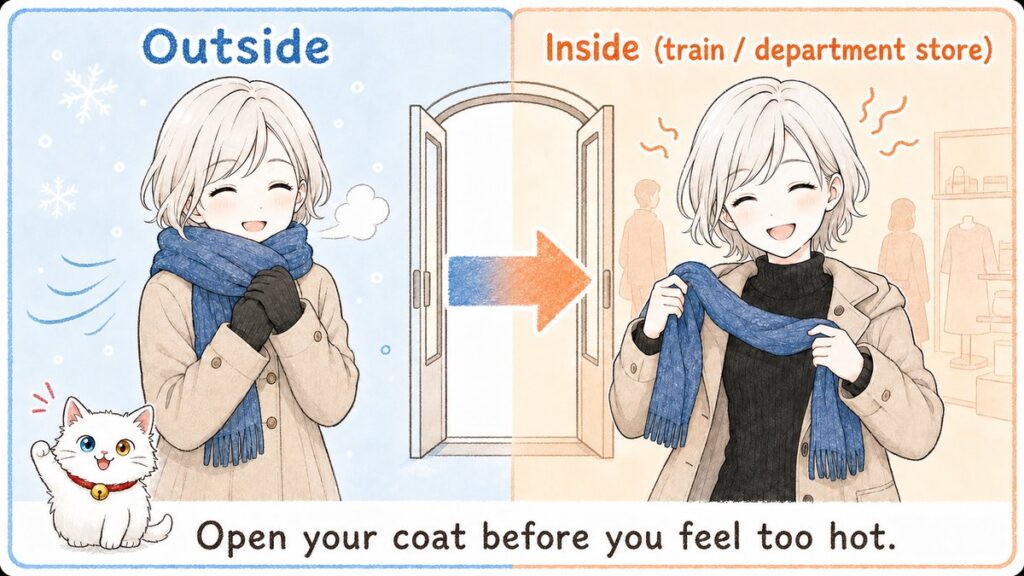
Winter in Japan can feel like changing seasons every time a door opens. Trains, department stores, convenience stores, supermarkets, and restaurants are often heated enough that your carefully bundled outfit becomes too much. Then you go back outside while warm or sweaty and feel the cold more sharply.
 I notice this contrast in ordinary places such as supermarkets and conveyor-belt sushi restaurants. The outside temperature tells me to wear down, but the indoor temperature tells me to unzip it almost immediately. This is why I keep returning to removable layers rather than one piece chosen only for the weather forecast.
Open your coat before you feel overheated. Take off your scarf when you enter the station, and choose a down layer thin enough to carry if your day includes long indoor stops. Small adjustments made early are easier than wrestling with a heavy coat after you’ve become uncomfortable on a busy train.
Accommodation can create the opposite surprise. In my experience in Kansai, many homes heat rooms individually rather than using whole-house heating. Older homes, vacation rentals, and some traditional-style accommodations can therefore feel cold in hallways or rooms away from the heater.
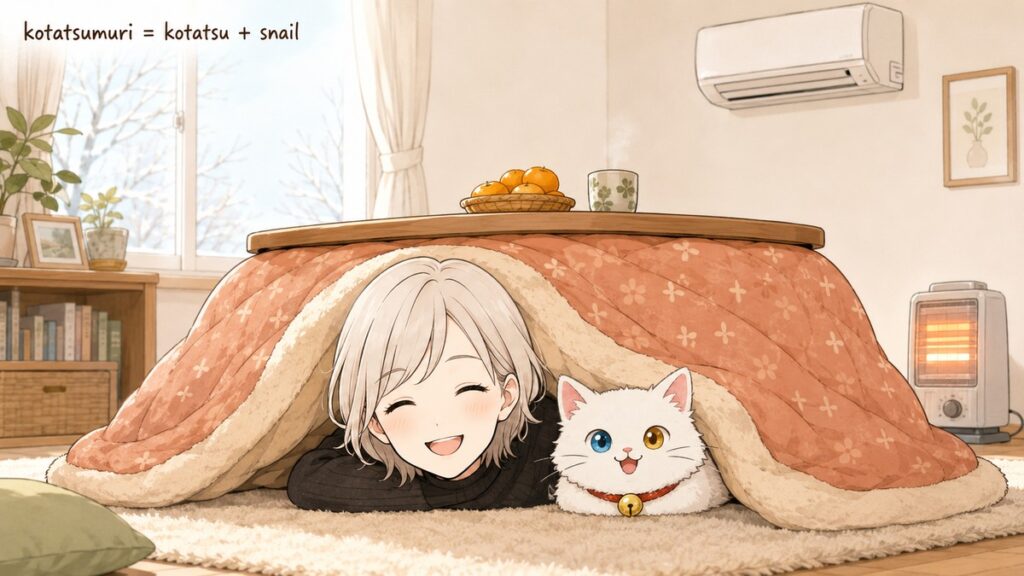
At home, we use air-conditioning for heat, a spot heater, and a kotatsu—a low table with a heater underneath and a blanket around it. The kotatsu is non-negotiable for me. Japanese even has the joke word kotatsumuri, a blend of kotatsu and katatsumuri, meaning snail: once you crawl under the blanket, you become a “kotatsu snail” that doesn’t want to leave its shell.
Another local winter helper is kairo, a disposable heat pack sold at drugstores and convenience stores. Some types stick to clothing, while others sit in a pocket. I like placing the adhesive type over clothing near my lower back or abdomen; follow the package instructions and don’t attach it directly to bare skin.
Kairo is useful when your itinerary includes an illumination, a long outdoor queue, or a cold temple morning. It should support sensible clothing rather than replace it, especially in snow country. Think of it as the quiet backup you buy after arrival, not something that must fill half your suitcase.
Tokyo, Kyoto & Osaka vs. Hokkaido: Two Different Winters
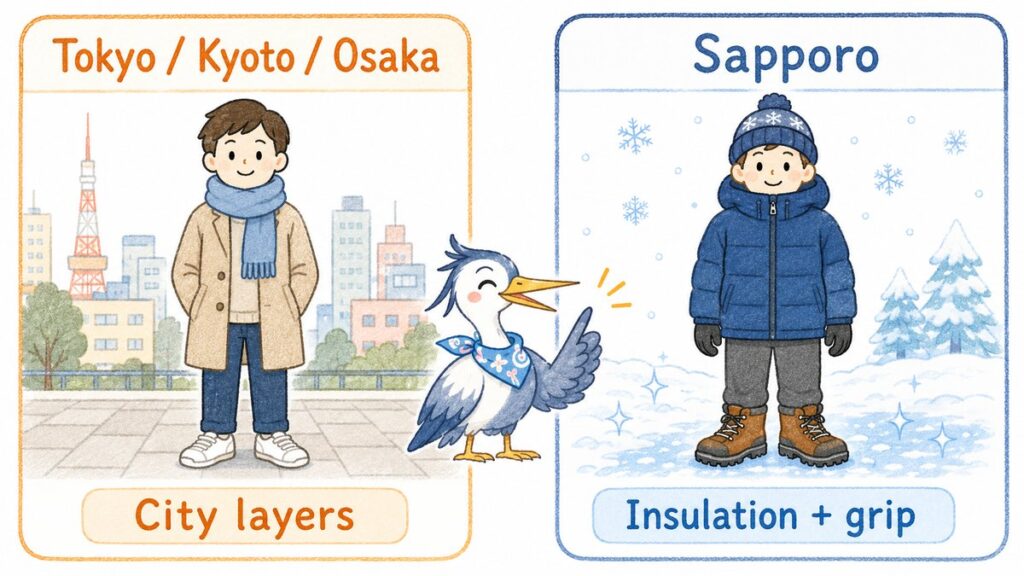
Tokyo, Kyoto, and Osaka belong in one packing conversation; Sapporo belongs in another. For the three major cities, the adjustable formula above—a thin base, top, mid-layer, insulated coat or down jacket, scarf, and gloves—covers most winter sightseeing. Dedicated snow gear usually isn’t necessary unless the forecast or a specific excursion says otherwise.
Kyoto may feel more severe in the morning and evening because cold air settles in its basin. Temple visits also involve time outdoors, stone paths, and periods of slower walking, so don’t judge your Kyoto outfit only by the afternoon high. A scarf and warm socks can make more sense than simply choosing the bulkiest coat.
Sapporo’s figures change the plan. December averages −0.9°C, with an average low of −4.0°C. January’s average daily high is −0.4°C, which means even daytime sits around freezing or below.
If you’re researching what to wear in Hokkaido in winter, prioritize a properly insulated outer layer, a warm base and mid-layer, gloves, a hat that covers well, and footwear designed to grip frozen surfaces. Snow can hide ice, and a boot that looks suitably wintry isn’t automatically slip-resistant. Check the sole, or consider removable traction aids made for shoes.
Sapporo has underground walking spaces that locals and visitors use to avoid some outdoor exposure. They help, but they don’t remove the need for proper clothing because your route will still include entrances, crossings, attractions, and time outside. Dress for the coldest part of your planned day, then use zippers and removable accessories when you move underground.
I live in Kansai and haven’t taken my family to Hokkaido or another snow-country destination, so this section is not based on personal experience. It uses official climate data and practical winter-safety guidance instead. That distinction matters because city-winter experience in Osaka is not the same as experience on Sapporo’s snowy and icy streets.
The same upgrade applies to snow activities elsewhere in Japan. A trip to Hakuba needs waterproof outerwear and suitable footwear even if the rest of your itinerary is in Tokyo. Pack for the activity, not merely the city where your hotel is located.
 Planning a snow day from Sapporo? A guided day tour to Otaru and a snow park is one way to see whether your boots and gloves are really up to Hokkaido.
For a snow day from Tokyo, a Hakuba Happo-one package with bus, lift ticket and equipment rental saves you from packing ski gear into a city suitcase.
Shoes and Socks: You’ll Be Taking Them Off
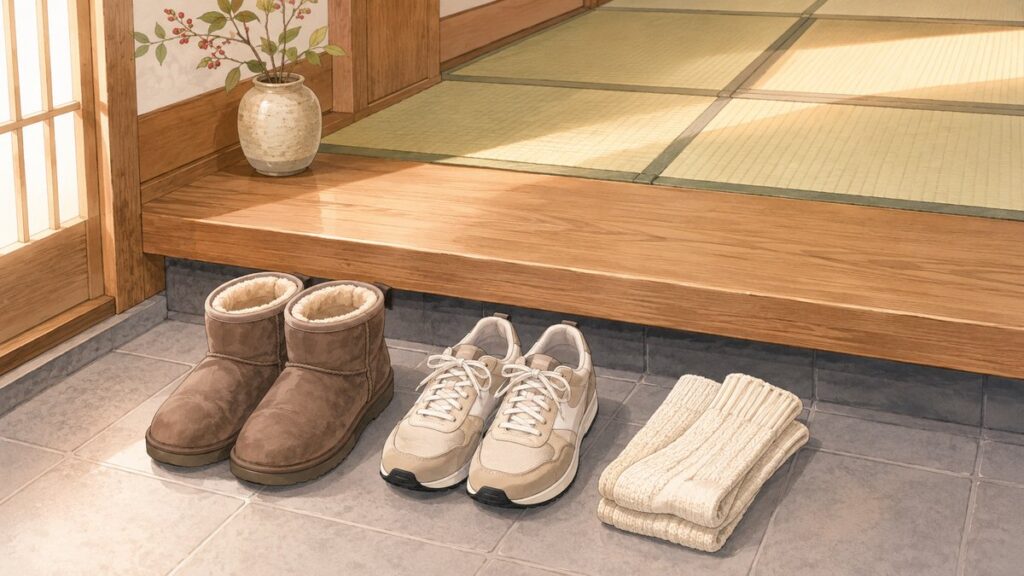
Your winter shoes need to handle two Japanese realities: a lot of walking and more shoe removal than you may be used to. You may take them off at a ryokan, in a tatami room, at some restaurants and sightseeing facilities, and in parts of certain temples. Warm socks without holes are not a minor packing detail here.
For Tokyo, Kyoto, and Osaka, comfortable walking shoes with some rain resistance are usually more useful than snow boots. A waterproofing spray can help with wet days, provided it is suitable for the shoe material. Choose a sole with reasonable grip, especially if a cold forecast follows rain.
I wear sheepskin-style or short boots because my feet get cold easily. My husband and sons often wear ordinary sneakers through winter. You can see the same kind of variety on city streets: not everyone changes into boots simply because it is December.
Boots do have a disadvantage. Laces, tall shafts, and tight openings slow you down when you’re standing at an entrance trying to remove your shoes without blocking anyone. If you love boots, a short pair that comes off easily is often kinder to both your feet and the people waiting behind you.
In Sapporo and other snowy areas, grip becomes more important than quick removal. Look for slip-resistant winter footwear or shoe traction aids and walk carefully on frozen sections. Fashion comes after staying upright.
Socks should be warm enough for outdoor walking but comfortable inside heated buildings. Avoid bringing only your thickest pairs if they make your shoes tight, because compressed toes and hours of walking are a miserable combination. Try the actual shoes and socks together before your trip.
If sore feet are already on your mind, this guide covers the recovery items and hotel routine I use: my guide to sore feet after a Japan trip. And because footwear rules matter at hot springs too, read this before your first visit: my onsen guide for first-timers.
Because you will be taking your shoes off more often than you expect, socks stop being invisible here. Bring a few pairs that are warm, in good condition, and free of holes — merino wool crew socks stay warm without adding bulk inside your boots.
Don’t Overpack: Buy It in Japan
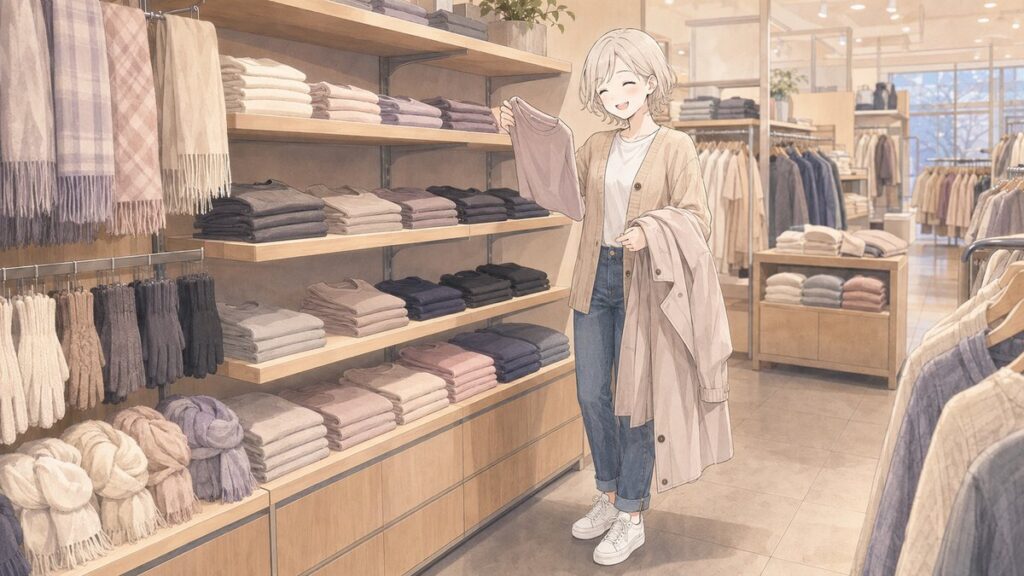
You don’t need to solve every possible winter problem before boarding your flight. Stores such as Uniqlo, GU, and Montbell are useful places to look for thermal base layers, light insulated jackets, gloves, scarves, and some children’s winter items. Product ranges and sizes vary by brand and store, so check current stock if you need a specific item.
This approach works especially well for small adjustable items. A scarf or warmer base layer is easy to add after your first day. Replacing unsuitable shoes after your feet hurt is harder, so bring reliable walking shoes and treat local shopping as a way to fine-tune warmth.
Winter basics may still be available in March, but timing, stock, and size availability vary by brand and store. If you need a specific size or a specialized snow-country item, buy it before you urgently need it and check store inventory online when possible.
Drugstores and convenience stores cover the smaller winter problems. You can buy adhesive and non-adhesive kairo, moisturizer, and lip balm without dedicating suitcase space to a large supply. It is one of those reassuring details that lets you pack for your likely needs rather than every imaginable discomfort.
In our family, my husband and I bring enough of our preferred base layers to rotate, while the children choose lighter innerwear. My sons would be unhappy if I packed them as though they had my body temperature.
Bulky winter clothing also becomes inconvenient when you move between hotels. Japan’s luggage-forwarding services can send a suitcase ahead, letting you travel with a smaller bag and the layers needed for the next part of the trip: my guide to luggage forwarding in Japan.
The useful rule is simple: pack the pieces that must fit well, then leave room to adjust. Your suitcase shouldn’t become a mobile closet built around a worst-case forecast.
Kairo is cheaper bought in Japan, so there is no need to fly a supply in.
And if you are not making the trip this winter? The same Japanese items ship to you at home:
- Hokkairo stick-on body warmers (30 pack) — the adhesive kind described above, the ones that go on your undershirt rather than your skin
- MegRhythm steam eye masks — a winter staple on Japanese drugstore shelves
Winter in Japan with Kids
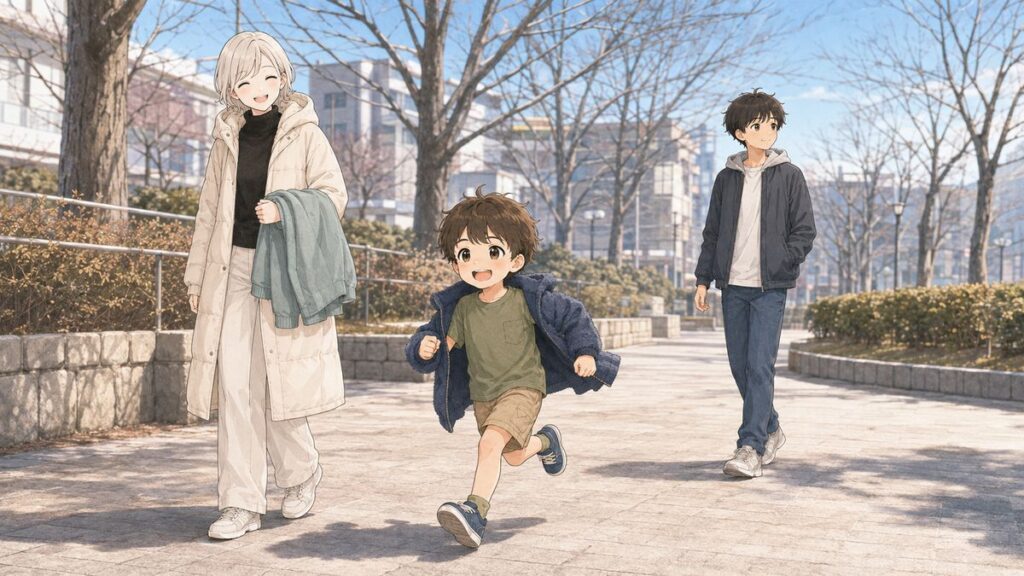
Children who are active may warm up faster than adults, but cold tolerance varies. Dress each child in removable layers, check whether they are hot or cold, and carry one easy extra layer for slower periods and evenings.
My younger son doesn’t like long sleeves very much. Even in winter, he may prefer a short-sleeved top with something he can put on when he finally says he is cold, so I carry that outer layer for him. My older son manages his own clothing choices now, which is a useful reminder that age and activity matter as much as the forecast.
I don’t force the family into matching thermal wear. A child who is comfortable will enjoy the day more than a child dressed for the parent’s temperature.
For ordinary city sightseeing, choose layers that can go on and off without a full costume change. A zippered fleece or cardigan works better than something that requires removing a coat, backpack, and hat in the middle of a station. Keep gloves and scarves identifiable so they don’t disappear into the wrong family bag.
Snow country changes the children’s kit. Waterproof outer layers, snow-appropriate footwear, and spare gloves become practical because snow play turns dry clothing wet. A child may happily keep playing while a damp glove makes the next part of the day unpleasant.
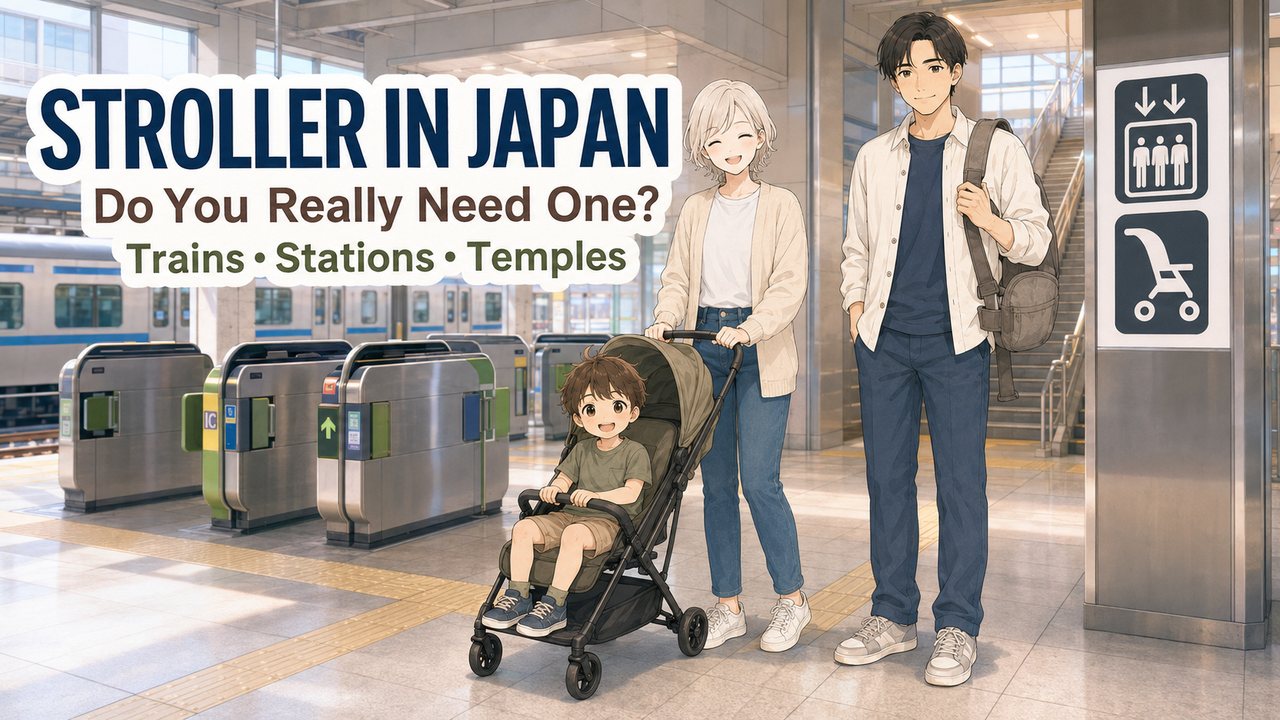
Frozen or deeply snowy pavements can also make a stroller difficult or unsafe to handle. A baby carrier may be more practical for some routes, provided you can use it safely with your winter clothing and luggage. This guide explains the wider stroller tradeoffs for a Japan trip: my guide to using a stroller in Japan.
As a mother, I would rather carry one light layer that goes unused than make a child wear it all morning “just in case.” The goal isn’t to keep every piece on. It is to have the right piece available when the pace slows and the temperature drops.
What Japanese People Actually Wear in Winter
If you’re worried about standing out, you don’t need a special “Japanese” wardrobe. In winter, many people wear practical layers in black, navy, beige, and gray, often with a neat coat, sneakers, short boots, or leather shoes. These colors are common because they mix easily, not because brighter colors are forbidden.
 There are no colors tourists must avoid. Wear the red coat you love or the bright scarf that helps your family spot you in a crowd. You may notice more muted outfits around you, but personal style varies widely, especially in large cities.
The detail that helps you blend in is less about color and more about how the outfit functions. People remove or open outerwear indoors, carry scarves and gloves, and choose shoes they can walk in. A polished coat over comfortable basics will look entirely normal.
Masks are also a familiar sight in winter. Some people wear them, others don’t, and you don’t need to treat one choice as a dress rule. It is simply part of the everyday winter street scene you may notice.
If you’re visiting a temple, a smart restaurant, or a traditional inn, clean and tidy clothing is a safe choice. That doesn’t mean formal clothing, and it certainly doesn’t mean sacrificing warm socks or walking shoes. Japan asks much more of your feet than of your fashion credentials.
So pack colors you already wear and pieces you can combine. Looking comfortable and put together is easier when nothing in your suitcase requires a special outfit to make it work.
New Year Closures and Winter Events Worth Dressing For
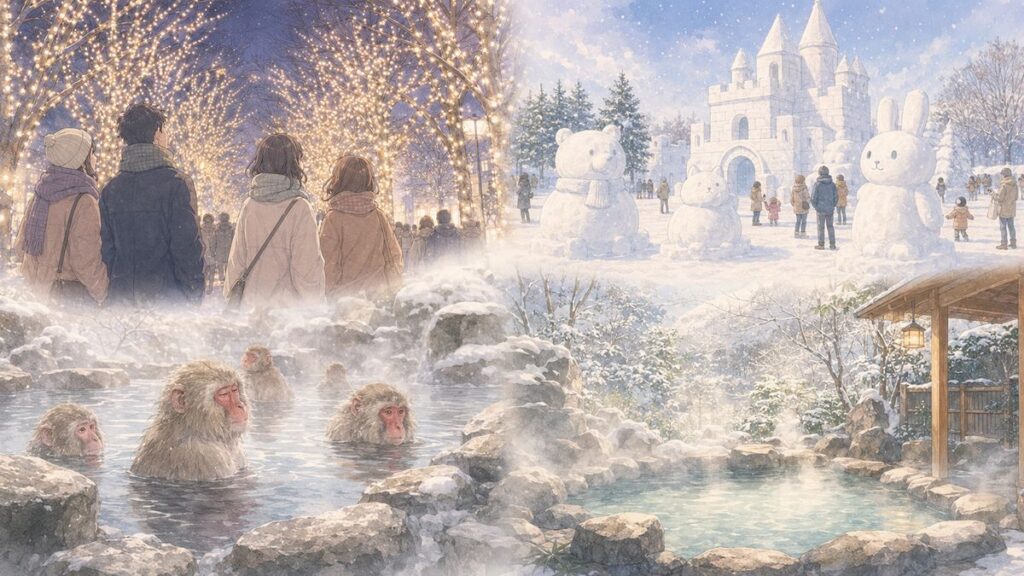
Winter clothing decisions change when your itinerary includes standing outdoors rather than walking between shops. Illuminations, snow festivals, mountain paths, and open-air baths all keep you outside long enough for gloves, warm socks, and a proper outer layer to matter. Dress for the event, not only the city average.
Tokyo winter illumination dates vary widely by venue and year, so check the official event page before you go. Because you may stop to look rather than keep walking, dress more warmly than you would for daytime shopping. A removable heat pack can also be useful on a long outdoor evening.
The 2027 Sapporo Snow Festival is scheduled for February 4–11 at Odori and other venues. Sapporo’s February average is −2.7°C, with an average low of −6.2°C, so this is not the place to rely on a stylish city coat with exposed ankles. Insulation, gloves, a hat, and footwear for icy ground belong in the basic plan.
Jigokudani Yaen-Koen in Nagano brings a different clothing problem. The park says the walk from Kanbayashi Onsen is about 2 km and takes around 30 minutes, on a trail with unpaved sections, stairs, uneven ground, and slopes. For winter visits it recommends rubber boots or snow boots, and suggests buying simple crampons in advance. Shoes with grip matter more here than creating a beautiful snow-monkey outfit.
If the monkeys are on your list, a day bus tour to Snow Monkey Park from Nagano or Tokyo handles the travel so you can concentrate on your footing.
A winter onsen can be wonderfully warming, but you still need easy layers for the journey and the transition between changing areas and outdoor spaces. Keep your post-bath clothing simple to put on, and don’t underestimate cold feet on the way back.
And because the rules matter before you undress, read my first-timer’s guide to Japanese onsen before your first bath.
New Year affects plans as well as clothes. Convenience stores and some chain businesses may stay open, but holiday hours vary. Many restaurants, museums, attractions, independent shops, and some larger shopping facilities close or shorten their hours during the New Year period. Some department-store sales begin in early January, but the dates vary. Check the official website for every place that matters to your itinerary.
From my experience as a resident, Japan does not feel completely shut down, but the holiday requires more planning than an ordinary week. Our family spends New Year together, and I would check the exact holiday hours of any restaurant, museum, or shop I did not want to miss.
Japan Winter Packing Checklist
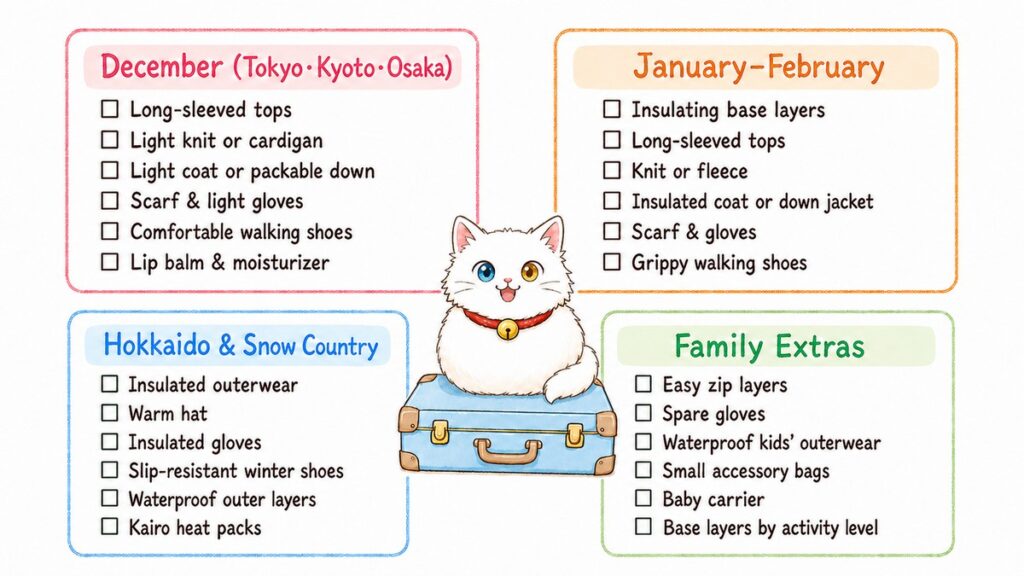
Use this Japan winter packing list as a starting point, then remove anything that doesn’t match your route. A December trip to Osaka and a February trip to Sapporo should not produce the same suitcase.
December in Tokyo, Kyoto, and Osaka
| Pack | Why it helps |
|---|---|
| Long-sleeved tops | Comfortable base for mild afternoons and cold evenings |
| Light knit, fleece, or cardigan | Adds warmth without locking you into a heavy outfit |
| Light coat or packable down | Easy to open or carry in heated spaces |
| Scarf and light gloves | Useful after dark and during illuminations |
| Comfortable walking shoes | More valuable than snow boots for a city route |
| Warm everyday socks | Practical for walking and shoe-removal settings |
| Lip balm and moisturizer | Helpful in dry outdoor air and heated rooms |
January–February in Tokyo, Kyoto, and Osaka
| Pack | Why it helps |
|---|---|
| Thin insulating base layers | Warmth without excessive bulk |
| Long-sleeved tops | Everyday layer over the base |
| Knit or fleece mid-layer | Removable warmth for cold mornings |
| Insulated coat or down jacket | Choose the warmth level for your cold tolerance and time outdoors |
| Scarf and gloves | Easy temperature adjustment outdoors |
| Grippy walking shoes | Useful on wet or occasionally icy surfaces |
| Foldable tote or day bag | Holds the layers you remove indoors |
Hokkaido and Snow-Country Add-ons
| Add | Why it helps |
|---|---|
| Insulated winter outerwear | City layers alone may not be enough below freezing |
| Warm hat | Protects exposed areas during long outdoor periods |
| Insulated gloves | Needed for cold streets and snow activities |
| Slip-resistant winter footwear | Prioritizes grip on snow and frozen ground |
| Removable shoe traction aids | Useful when compatible with your footwear and route |
| Waterproof outer layers | Important for snow play and ski areas |
| Kairo heat packs | Convenient backup warmth when used as directed |
Family Extras
| Add | Why it helps |
|---|---|
| Easy zip or button layers | Faster changes when a child gets hot or cold |
| Spare gloves for snow days | Wet gloves can spoil the rest of an outing |
| Waterproof children’s outerwear | Keeps snow play from soaking everyday clothes |
| Separate small bags for accessories | Helps prevent lost gloves and scarves |
| Baby carrier for suitable snowy routes | May be more practical than a stroller on frozen ground |
| Base layers by activity level | Match insulation to the child’s activity level and cold tolerance |
Pack outfits that share layers rather than complete looks that only work once. If a top, knit, and coat can all combine with the rest of your suitcase, you can adapt without bringing a separate answer for every forecast.
If you are buying before you fly, these four cover most of the checklist above:
- Thermal base layer set — the layer that does the most work
- Packable puffer jacket — folds down small on the days you do not need it
- Touchscreen gloves — you will have your phone out for maps and train times
- Merino wool crew socks — warm, and fine to be seen when your shoes come off
FAQ
How cold is Japan in December?
It depends strongly on the city. Tokyo averages 7.7°C in December, with an average high of 12.0°C and low of 3.8°C; Osaka is slightly milder at an 8.7°C average, while Kyoto averages 7.2°C. Sapporo is already a snow-country winter, averaging −0.9°C with a low of −4.0°C.
For Tokyo, Kyoto, and Osaka, expect manageable afternoons and much colder mornings and nights. Long sleeves, an adjustable middle layer, and a coat work well, with scarf and gloves for evening plans. For Sapporo, pack insulated winter clothing and footwear for frozen surfaces.
Do I need snow boots for Tokyo in winter?
Usually, no. Comfortable walking shoes with grip and some water resistance are more useful for a typical Tokyo itinerary, and you can check the short-term forecast for any unusual snow risk. Snow boots may be excessive inside heated trains and shops and can be awkward when you need to remove your shoes.
Hokkaido and snow activities are different. There, choose winter footwear for warmth and traction rather than assuming your ordinary Tokyo sneakers will be enough.
What should I wear in Japan in January or February?
In Tokyo, Kyoto, and Osaka, start with a long-sleeved top, a removable knit or fleece, and an insulated coat or down jacket suited to your cold tolerance. Add a thin insulating base, scarf, and gloves for cold mornings, evenings, and long outdoor stops. Keep the pieces removable because trains, shops, and restaurants can feel much warmer than outside.
In Sapporo, upgrade to insulated outerwear, a warm hat and gloves, and slip-resistant winter footwear. January’s Sapporo average is −3.2°C, and the average daily high is −0.4°C, so the city requires a genuine snow-country outfit.
Is Kyoto colder than Tokyo in winter?
Their climate normals are close, and the answer changes by month. Kyoto averages 7.2°C in December compared with Tokyo’s 7.7°C; in January, Kyoto averages 4.8°C and Tokyo 5.4°C. Kyoto’s basin setting can make mornings and evenings feel particularly cold, especially during outdoor temple visits.
You don’t need a completely separate wardrobe for the two cities. Keep the same layer system, but carry the scarf, gloves, and warmer middle layer on early or late Kyoto days.
What do Japanese people wear in winter?
Many people wear neat layers in neutral shades such as black, navy, beige, and gray, paired with sneakers, short boots, or leather shoes. Down jackets, wool-style coats, scarves, and gloves are all ordinary. There is no forbidden winter color, so you don’t need to replace bright clothes you already enjoy.
Japanese people also vary as much as my own family does. I may be in down while my husband and sons are still in lighter outerwear. Dress for your body and itinerary rather than trying to copy one imagined local uniform.
Do I need a down jacket in Japan in December?
Not always. In Tokyo, Kyoto, and Osaka, some travelers are comfortable with a light coat plus a removable knit or fleece, while cold-sensitive visitors may prefer a light down jacket. Bring something you can open or remove easily, and upgrade to properly insulated outerwear for Hokkaido, snow activities, or a colder forecast.
Can I buy winter clothes in Japan?
Yes. Stores such as Uniqlo, GU, and Montbell may have thermal base layers, insulated jackets, gloves, scarves, and children’s winter items. Availability changes by brand, store, size, and season, so check current stock and buy specialized snow-country gear before you urgently need it.
Drugstores and convenience stores often carry kairo heat packs, moisturizer, and lip balm. Bring well-fitting walking shoes from home, then use local shopping to adjust your warmth after you learn how Japan’s winter feels to you.
YUU’s Final Thoughts
If you take three things from this guide, take these. Japan doesn’t have one winter — December in Tokyo and January in Sapporo ask for different suitcases. The layer you can remove matters more than the warmest coat you own, because the cold street and the heated train are ten seconds apart. And the rest can be bought after you land, once you know how this winter actually feels on your own skin.
As for me, I’m the one in down while the rest of my family is still in light jackets — and the kotatsu wins every evening.
Check Snow Monkey Park tours on Klook
 Now I’m curious about your side of the world — how cold does it get where you live, and do your buildings run hot or cold in winter? Tell me in the comments below. I read every single one!
I hope this guide has answered one of your questions and helped you feel a little closer to Japan. May your Japan journey be filled with wonderful discoveries and memories you’ll treasure for years to come.
See you in the next guide. 
Comments