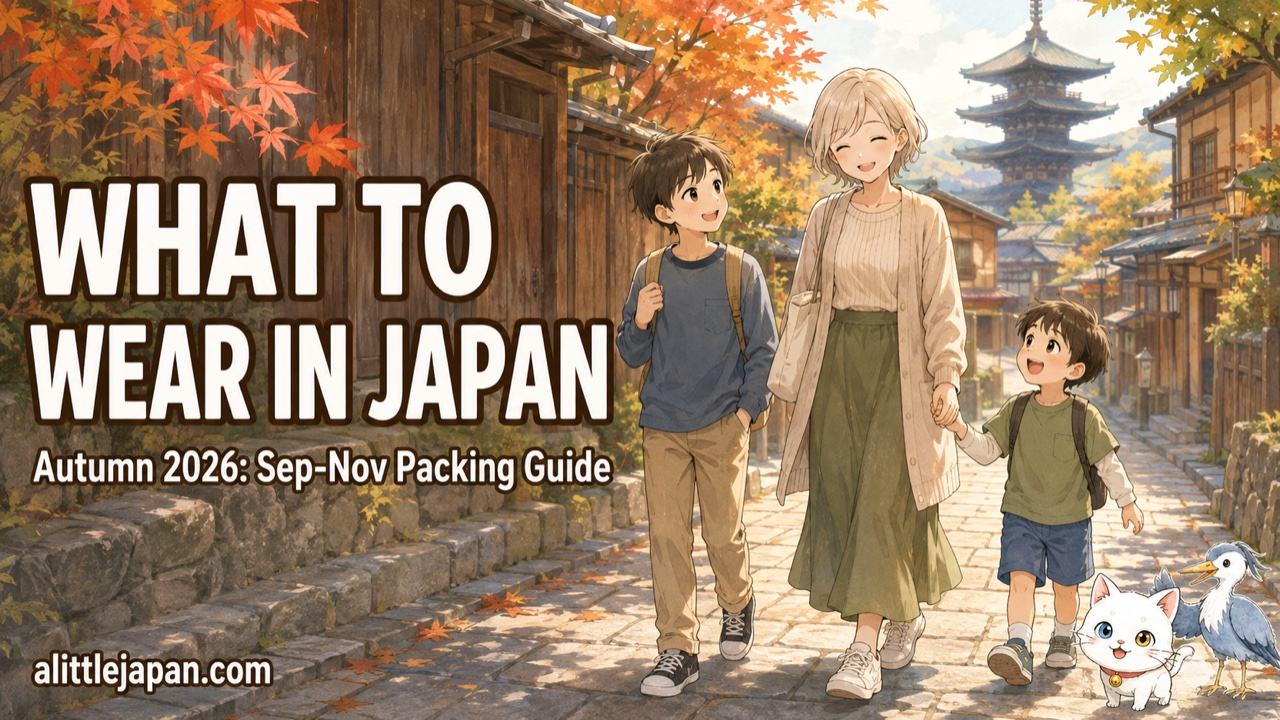
Packing for Japan in October sounds simple until you actually open your suitcase. A T-shirt may feel perfect in the afternoon, then the air turns cool while you’re waiting for a train after sunset. September can still feel like summer in Tokyo, Kyoto, and Osaka, while late November calls for knitwear and a light down jacket. There isn’t one perfect “autumn outfit.” What works best is a small, flexible set of layers.
As a Japanese mom living in Japan, my practical advice is to pack for the time of day as well as the month. Bring clothes you can remove easily, comfortable shoes, and one outer layer that fits into your day bag. This guide covers September through November, with extra detail for October, plus a Japan autumn packing list for adults and families. You’ll also see what people commonly wear in Japan, what you can buy after you arrive, and how autumn-leaf season changes what you may need.
Quick answer: In October, most travelers in Tokyo, Kyoto, and Osaka will be comfortable in a T-shirt or light long-sleeved top with full-length bottoms and a cardigan or thin jacket. Bring a removable layer for cool mornings and evenings, especially in late October.

Disclosure: This article contains affiliate links. If you book or buy through one, I may earn a small commission at no extra cost to you.
In a hurry? Everything in this guide, in one list:
Pack before you fly:
- Windproof compact travel umbrella — for autumn’s rainy spells
- Packable puffer jacket — chilly November evenings
- Thermal base layer set — thin layers beat bulky coats
- Packing cubes — fits the whole layering system in one suitcase
- MediQtto sleep compression socks — for legs that walked 20,000 steps
Book ahead (autumn-leaves season sells out):
- Nikko Pass — train + bus for the foliage day trip
- Hakone Free Pass — ropeway and boat included
- Haruka Express from Kansai Airport to Kyoto — the direct train to the foliage, with fares and whether it beats the alternatives
- Sagano Romantic Train — Kyoto’s most popular foliage ride
- Arashiyama & Kiyomizu-dera half-day tour — the two must-see spots in one afternoon
- Kyoto kimono rental — autumn photos in the leaves
- Kyoto hotels for late November — rooms near the famous temples go first; many listings allow free cancellation, so booking early is low-risk
Already in Japan? You’ll find similar items in any Japanese store — the links above are for packing from home.
- Japan Autumn Weather at a Glance
- September: It’s Still Summer
- What to Wear in Japan in October
- What to Wear in Japan in November for Autumn Foliage
- What Japanese People Actually Wear in Fall
- Don’t Overpack: Buy It in Japan
- Autumn in Japan with Kids
- Chasing the Autumn Leaves: When & Where
- What to Pack for Japan in October (September and November Too)
- FAQ
- Is October a good time to visit Japan?
- Do I need a jacket in Japan in October?
- Can I wear shorts in Japan in September?
- When is the best time to see autumn leaves in Japan?
- Is Japan cold in November?
- Is it cold in Japan in October?
- What should I wear in Japan in October?
- How many outfits should I bring for two weeks in Japan?
- Final Thoughts: What to Wear in Japan in October
Japan Autumn Weather at a Glance
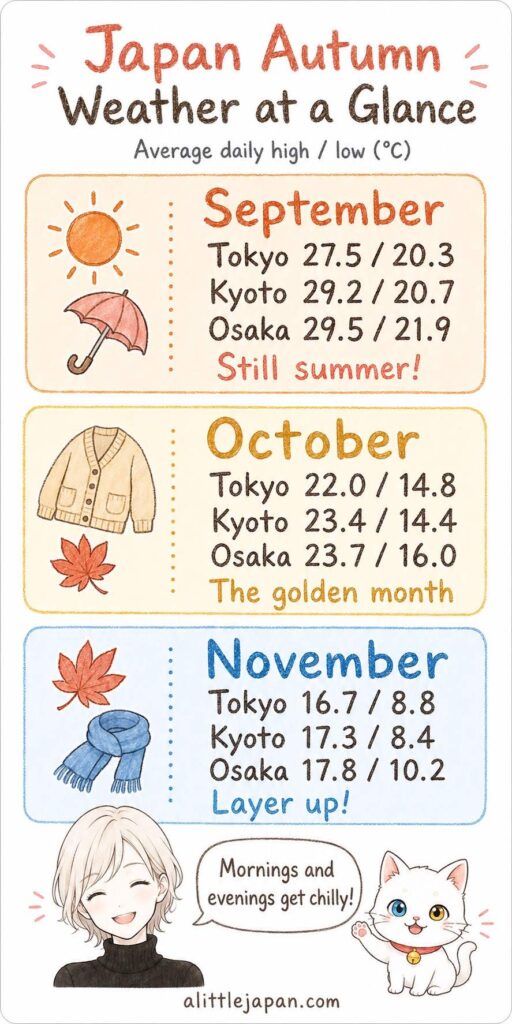
Japan’s autumn doesn’t begin everywhere at once. In the major sightseeing cities, September is often an extension of summer, October brings the most comfortable balance of warm days and cool evenings, and November starts to feel like winter is approaching, especially in the morning and after dark.
The table below shows the average daily highs and lows for Tokyo, Kyoto, and Osaka. These are climate normals, not a promise for every day, but they give you a much more useful starting point than a single description such as “mild” or “cool.”
| City | September High / Low | October High / Low | November High / Low |
|---|---|---|---|
| Tokyo | 27.5°C / 20.3°C | 22.0°C / 14.8°C | 16.7°C / 8.8°C |
| Kyoto | 29.2°C / 20.7°C | 23.4°C / 14.4°C | 17.3°C / 8.4°C |
| Osaka | 29.5°C / 21.9°C | 23.7°C / 16.0°C | 17.8°C / 10.2°C |
For September, think breathable summer clothes with rain protection. In October, a short-sleeved or light long-sleeved top plus a cardigan, overshirt, or thin jacket is the easiest combination. By November, you’ll probably want knitwear or a warmer mid-layer, especially if your trip falls near the end of the month.
Kyoto deserves a little extra attention. Because it sits in a basin, the temperature can feel quite different between daytime and early morning or evening. You may be comfortable walking in the sun, then wish for another layer as soon as you sit outside or wait at a bus stop. If Kyoto is on your itinerary, don’t judge your whole day’s outfit by the temperature when you leave the hotel.
Sunset gets noticeably earlier too. In Tokyo, it shifts from 18:09 on September 1 to 17:27 on September 30, then to 16:47 on October 31 and 16:28 on November 30. That matters because many travelers are still sightseeing when the sun disappears. A jacket that felt unnecessary during lunch may become the layer you reach for while walking back from a garden, temple, or observation deck.
 So the basic rule for autumn in Japan is simple: dress for the afternoon, but keep one layer ready for the morning and evening. That small habit will make your suitcase lighter and your days much more comfortable.
September: It’s Still Summer
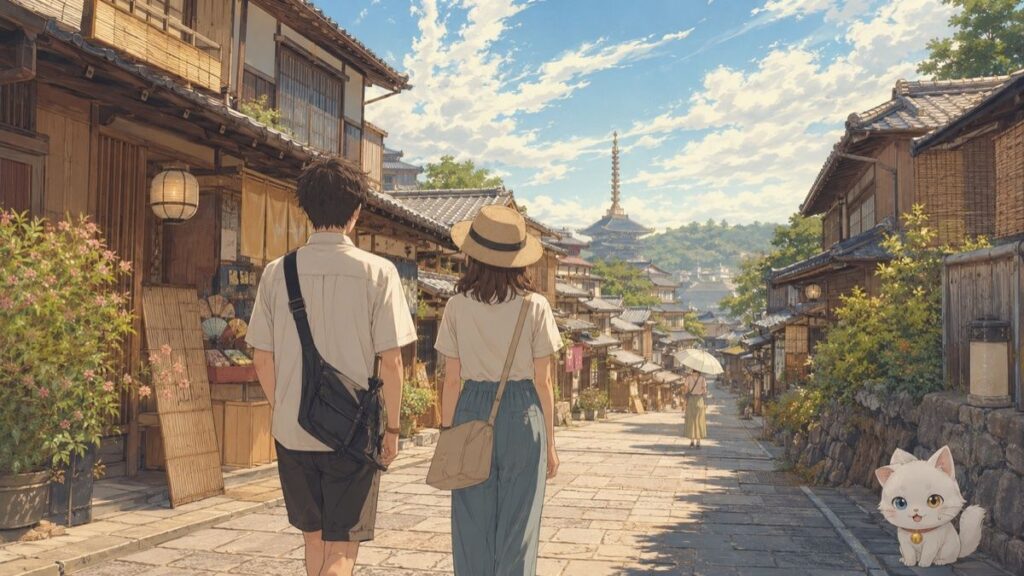
If you’re coming to Japan in September, don’t pack as if you’re visiting a country already deep into sweater season. Early September in Kyoto and Osaka still has normal highs above 31°C: Kyoto moves from 31.3°C in early September to 26.8°C late in the month, while Osaka moves from 31.4°C to 27.3°C. Tokyo also shifts from 29.6°C to 25.1°C. The month changes noticeably, but the beginning can still feel like summer.
For the warmer part of September, choose breathable tops, loose trousers or skirts, and comfortable shoes that can handle long, warm days. A thin overshirt is useful for strongly air-conditioned trains, shops, and restaurants, but a heavy autumn coat will usually spend more time in your luggage than on your body. If your trip is late in the month, add a light cardigan or jacket for evenings rather than replacing all your summer clothes.
The lows tell the same story. Early September lows are 22.3°C in Tokyo, 22.6°C in Kyoto, and 23.7°C in Osaka. By late September, they fall to 18.0°C, 18.6°C, and 19.9°C. That drop is why two travelers visiting in the same calendar month may give you completely different packing advice. Check whether your dates are at the beginning or the end, not just whether your booking says “September.”
 September is also part of typhoon season. On average, 3.3 typhoons approach Japan in August, 3.3 in September, and 1.7 in October. This doesn’t mean a typhoon will affect your trip, but a compact umbrella is useful for ordinary rain, and some flexibility in your schedule is sensible. Do not use an umbrella in strong winds. If severe weather is forecast, stay indoors when advised and follow official weather and transport updates rather than trying to keep every outdoor plan.
Rain can be an issue in both September and October because of typhoons and seasonal autumn rain, while November becomes much drier. Tokyo’s normal precipitation is 224.9 mm in September, 234.8 mm in October, and 96.3 mm in November. A lightweight rain shell is more practical than a thick jacket because it packs easily and can also block cool wind.
Sun protection still belongs in your bag too. A cloudy or slightly cooler day can make it easy to forget, especially when you’re walking between outdoor sights for hours. If you’re deciding what to bring, my guide to Japanese sunscreens covers the ones I actually use at home. If you’ve already narrowed it down to the two most famous names, my Anessa vs Biore UV comparison settles that match-up.
What to Wear in Japan in October
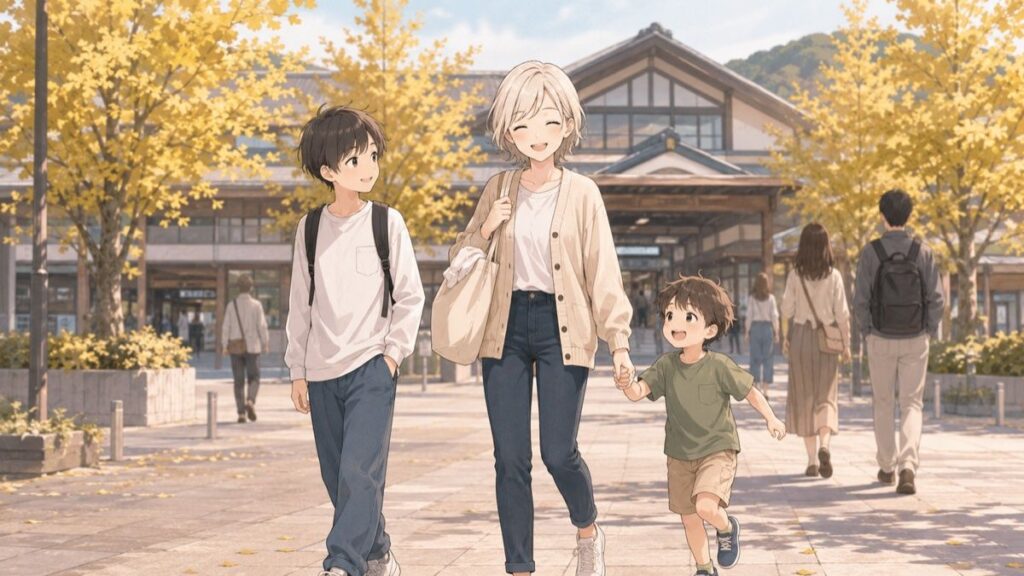
October is the easiest autumn month for many travelers, but it still rewards good layering. Normal daily highs are 22.0°C in Tokyo, 23.4°C in Kyoto, and 23.7°C in Osaka, with lows of 14.8°C, 14.4°C, and 16.0°C. In practical terms, that often means a light top feels right while you’re moving around in the daytime, and an extra layer feels right after sunset.
The most reliable starting outfit is a T-shirt or light long-sleeved top with a cardigan, overshirt, or thin jacket. Pair it with full-length trousers, a midi skirt, or any other bottoms you can walk in comfortably. You don’t need to build a complicated travel wardrobe. You need pieces that work together when one layer comes off and goes into your bag.
Early October and Late October Feel Different
Tokyo’s normal high and low move from 23.7°C / 16.7°C in early October to 20.4°C / 12.8°C late in the month. That’s enough of a change to affect what feels comfortable before breakfast and after dinner. Someone arriving early may use a cardigan only in the evening, while someone visiting near the end may start the day in a jacket and keep it on longer.
 This is where packing advice online can become frustrating. One person tells you October is warm; another insists you need a coat. Both may be describing their own dates accurately. Look at your exact travel period, your destinations, and how early or late you plan to be outside.
If your route includes Tokyo, Kyoto, and Osaka, you don’t need a separate wardrobe for each city. The normal October temperatures are close enough that the same layering system works. Kyoto’s basin climate can make its mornings and evenings feel sharper, so keep your outer layer with you even if the afternoon is pleasant.
The Morning-to-Afternoon Problem
Autumn days often begin with the question, “Will I regret leaving this jacket behind?” If you head out in the cool morning, the jacket feels like the right choice. After walking through a station, climbing stairs, and standing in a sunny sightseeing area, you may be carrying it by midday.
Choose an outer layer that is light enough to fold, tie around your shoulders, or fit into a tote or backpack. A beautiful but bulky coat can become annoying when you’re also carrying a phone, water, tickets, and anything you buy during the day. A cardigan, packable jacket, or unlined coat is easier to manage.
The layer underneath matters just as much. If you wear a thick sweater with nothing comfortable below it, you can’t adjust when the day warms up. A T-shirt, thin knit, or light long-sleeved top gives you another option. The goal isn’t to feel perfectly warm at every second; it’s to be able to adjust your outfit without returning to the hotel.
Trains and Shops Can Feel Warmer Than You Expect
One of the less obvious problems in October is the difference between the street and indoor spaces. A cool platform can make you zip up your jacket, then a crowded train or busy shop feels warm once you’ve been standing inside. Some indoor spaces may also use heating when the outdoor air starts to cool.
This indoor-outdoor temperature swing is common in Japan. People open coats, remove scarves, or carry a cardigan rather than wearing one heavy layer all day. If you’re changing trains at a large station, the walking alone can be enough to make you feel warmer. That’s why breathable layers usually work better than one thick sweater or insulated coat.
Light, washable fabrics are practical, especially if you’re traveling between cities and wearing the same pieces more than once. You don’t need special travel clothing, but avoid anything that becomes uncomfortable as soon as you warm up. If a top already feels stuffy while you’re packing at home, it probably won’t become more comfortable in a crowded station.
A Simple October Outfit Formula
For a typical sightseeing day, start with a breathable top, add a removable mid-layer, and bring a thin outer layer if your dates are later in the month or your plans continue into the evening. Wear full-length bottoms and walking shoes. Add a light scarf only if you know you get cold easily; otherwise, it may be one more item to carry.
For a nicer dinner, you don’t need formal clothes unless the venue says so. A neat cardigan, simple blouse or shirt, clean trousers or skirt, and tidy shoes will fit naturally in many settings. Japan’s everyday autumn style often looks polished because the pieces are clean and coordinated, not because people are dressed for a special occasion.
If you’re planning a full day outdoors — exploring gardens, walking along a river, or visiting a temple district — prioritize comfort over creating a different outfit for every photo. Your shoes matter more than a second jacket. You can make simple clothes look intentional by keeping the colors easy to combine and choosing one neat outer layer.
What My Family Actually Does
 Here’s what this looks like in my house. We carry a thin cardigan all year round — yes, even in midsummer. Air conditioning in Japan can be strong: a conveyor-belt sushi restaurant or a supermarket in August can feel genuinely cold after the heat outside. So the one-light-layer habit never really leaves our bags.
In October, that same cardigan simply changes jobs. Instead of protecting us from the air conditioning, it covers the cool mornings, the evening walk back to the station, and everything the forecast didn’t mention. If you build your packing around one light layer you’re happy to carry every day, you’ll be using the same practical approach that works for my family.
What About Shorts, Sandals, and Bare Legs?
Shorts may still feel comfortable on a warm early-October afternoon, especially if you run hot, but they are less flexible once the evening cools. They can also make your outfit feel more summery than what many local people are wearing. This isn’t a strict rule or a social mistake. It is simply worth knowing if your goal is to feel comfortable and blend in.
Sandals have the same limitation. They may work on a warm day, but closed shoes are more useful across changing weather, long walking distances, and places where you remove your shoes. If you love wearing a skirt or dress, tights or socks give you an easy way to adjust later in the month without changing your whole outfit.
People tolerate cool weather differently. If you usually feel cold before everyone else, pack the warmer version of the suggested layers. If you heat up quickly while walking, make sure every outer layer is easy to remove. Personal comfort is more useful than trying to copy a perfect seasonal outfit.
What to Pack for October
A compact October wardrobe could include breathable tops, light long-sleeved tops, one cardigan or overshirt, one thin jacket, full-length bottoms, comfortable closed shoes, and a compact umbrella. Later in the month, add a light knit or packable down layer if you get cold easily. Keep the colors compatible so you can repeat pieces without feeling as though you’re wearing the same complete outfit every day.
Pack for change, not extremes.
What to Wear in Japan in November for Autumn Foliage
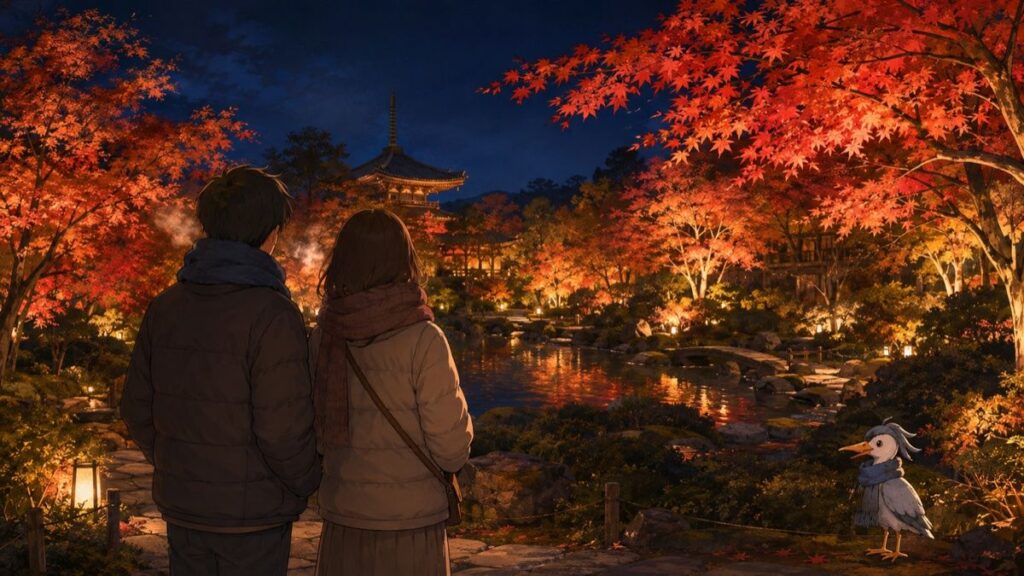
November is peak koyo — autumn foliage — season in many popular sightseeing areas, and it feels noticeably cooler than October. In Tokyo, the normal high and low change from 18.6°C / 10.6°C in early November to 14.9°C / 7.1°C late in the month, so an outfit that works at the start of the month may feel too light at the end. In early November, a long-sleeved top, a cardigan or knit, and a light jacket are usually enough for daytime sightseeing; later in the month, a light down jacket, a scarf, and warmer socks earn their place, especially after sunset and at evening illuminations, where you stand still for long stretches.
Because November deserves more than one section, I’ve written a separate, more detailed guide: What to Wear in Japan in November. It covers early versus late November in numbers, five cities from Sapporo to Fukuoka, the layering formula, heated trains and shops, and a November packing list. If your trip runs past the leaves and into the cold, my winter guide picks up where this one ends.
What Japanese People Actually Wear in Fall
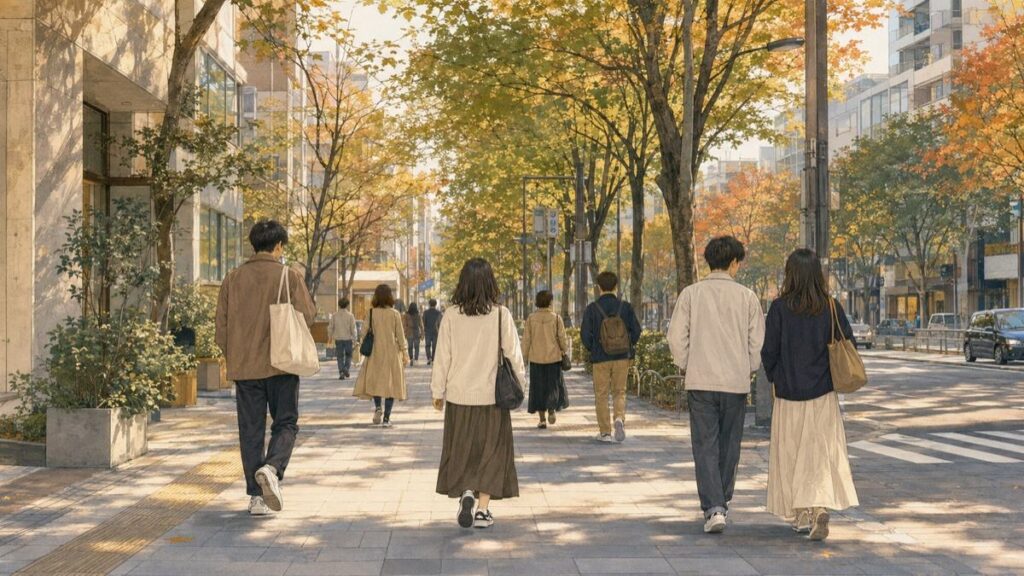
If you’d like your clothes to feel in step with everyday style in Japan, focus less on a particular trend and more on looking neat, practical, and seasonally appropriate. In autumn, many people wear simple layers: a shirt or light knit, cardigan or jacket, full-length trousers or a longer skirt, and clean sneakers or other comfortable closed shoes.
You don’t need to dress conservatively everywhere, and tourists aren’t expected to copy local fashion. Still, very beach-like clothing can feel out of place once the calendar and local mood have shifted into autumn, even on a warm afternoon. A lightweight overshirt, cardigan, or simple jacket makes a casual outfit look more finished without making it formal.
Sneakers are completely normal in Japanese cities. People walk to stations, change trains, climb stairs, and cover a lot of ground during an ordinary day, so practical shoes are not a tourist-only choice. The difference is often condition rather than style: clean, well-kept sneakers blend in more easily than shoes that look ready for a muddy trail.
Shoes Matter at Temples, Traditional Rooms, and Some Restaurants
You may need to remove your shoes inside some temple buildings, at a traditional inn such as a ryokan, in a tatami room, or at certain restaurants. Choose shoes you can take off and put on without turning the entrance into a small packing project. Complicated laces, high boots, or footwear that needs a long adjustment can become tiring when you visit several places in one day.
 Wear socks without holes. It sounds like a tiny detail, but your socks may suddenly become part of your visible outfit. In cooler weather, clean socks also make wooden floors and unheated entrance areas much more comfortable than bare feet.
At temples and shrines, modest, tidy clothing is a respectful choice. You don’t need special ceremonial clothes. Avoid treating a place of worship like a costume backdrop, follow signs, and cover up more if your outfit is very revealing. A light layer makes that easy without requiring a separate temple outfit.
A Local Manners Tip from YUU: In Japan, removing your shoes is not only about keeping the floor clean. It marks the boundary between outside and inside. Pause at the entrance, check what other visitors are doing, and place your shoes neatly where indicated. Slip-on shoes and clean socks make the whole moment easier for you and everyone waiting behind you.
“Neat” Doesn’t Mean Uncomfortable
You can still wear leggings, jeans, hoodies, and casual clothes. The easiest way to make them feel natural in Japan is to combine them thoughtfully: leggings with a longer top or coat, jeans with a clean knit, or a hoodie under a simple jacket. Comfort and polish are not opposites.
Neutral colors are common because they make layers easy to coordinate, but there is no rule against color. If you enjoy bright clothes, wear them. The useful lesson from local autumn dressing is to choose pieces that work together and suit the setting, not to remove your personality from your suitcase.
A full day outdoors calls for a different approach. For a hike, rural walk, or wet-weather plan, safety and suitable footwear come first. You can keep a neater city outfit for another day. Dressing appropriately for the activity will always look more natural than forcing one stylish outfit to do everything.
Don’t Overpack: Buy It in Japan

You don’t have to predict every cool day before you fly. If your suitcase is already full, bring the essentials and leave room to buy an extra layer in Japan. Basic clothing stores are easy to find in major cities, and a practical piece can become something you continue using at home.
 UNIQLO is especially useful for simple autumn layers. HEATTECH innerwear can add warmth without taking much suitcase space, while an Ultra Light Down jacket is easy to carry when you don’t need it. Cardigans, socks, and basic long-sleeved tops are also straightforward purchases if the weather feels cooler than you expected.
This approach works best when you arrive in a city and have time to shop before heading to a colder area. It is less sensible to depend on buying everything after arrival if your first plan is a long outdoor day or a rural destination. Bring enough to be safe and comfortable on your first day, then adjust once you understand how the weather feels to you.
Another useful local item is a disposable pocket warmer, called kairo in Japanese. You can place one in a pocket for extra warmth during a cold evening. Follow the package instructions, avoid placing it directly against bare skin, and remember that you may not need one during the milder part of autumn.
Buying a layer locally can reduce overpacking, but don’t use it as an excuse to fill the suitcase again. Choose something that solves a real gap: a warmer inner layer, a packable jacket, or dry socks after unexpected rain. One useful item is better than several rushed purchases.
If you plan to shop during your trip, check the current tax-free shopping rules and eligibility before assuming every purchase will qualify.
Autumn in Japan with Kids
If USJ is on your autumn list, one thing to check before you book: the park runs Halloween Horror Nights from September 11, and the street zombies come out at 18:00 every evening. There are age limits worth knowing about in advance — I’ve covered them, and how families can plan around them, in my USJ Halloween guide.
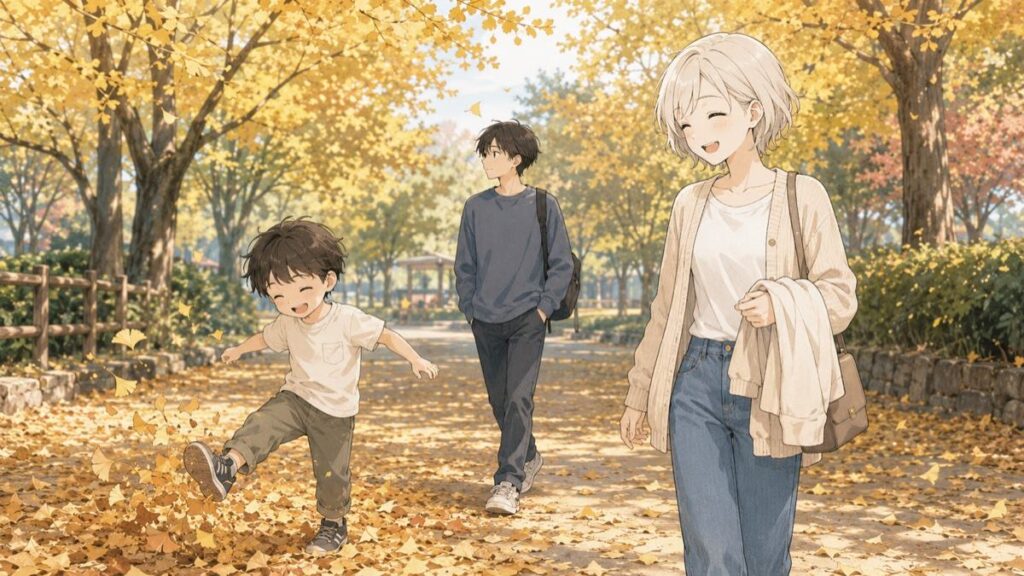
Children need the same autumn strategy as adults, but their layers should be even easier to remove. A child who feels cold while waiting outside may be warm five minutes after running through a park or climbing station stairs. Dress them in several light, manageable pieces rather than one outfit that has only “coat on” and “coat off” settings.
Start with a comfortable top, add a sweatshirt or cardigan, and use a light jacket that can go into the stroller basket or a parent’s bag. By late November, a warmer outer layer may be needed, particularly in the morning and at evening illuminations. The best layer is one the child will actually keep on and that an adult can handle quickly.
Choose clothes that work for toilets, naps, snacks, and sudden weather changes. A beautiful outfit becomes much less useful if it is difficult to remove in a small restroom or uncomfortable when a child falls asleep in a stroller. As a mom, I would always prioritize an easier day over an elaborate travel outfit.
For babies and younger children in a stroller, start thinking about extra warmth in November. They are sitting still while adults are walking, so they may feel cold sooner. A removable stroller blanket or warm cover can help, but check the child regularly when you move indoors or onto a heated train. A bundled child can become too warm without being able to tell you clearly.
Pack a spare top and socks where you can reach them. Rain, spilled drinks, and puddles don’t care that you carefully planned a capsule wardrobe. You don’t need a complete second outfit for every hour; you need a simple backup that prevents one wet item from ending the day.
One more tip for theme-park families: October and November are Halloween season at Universal Studios Japan, and long outdoor queues are exactly where kids get cold fastest. Shorter waits help more than an extra layer, so if USJ is on your plan, my USJ Express Pass guide explains which pass actually saves time.
Shoes should already be comfortable before the trip. Autumn is not the time to discover that a child’s new shoes rub after a long station transfer. Closed shoes with socks are versatile for cities, temples, and cooler evenings, while a waterproof option is useful if sustained rain is forecast.
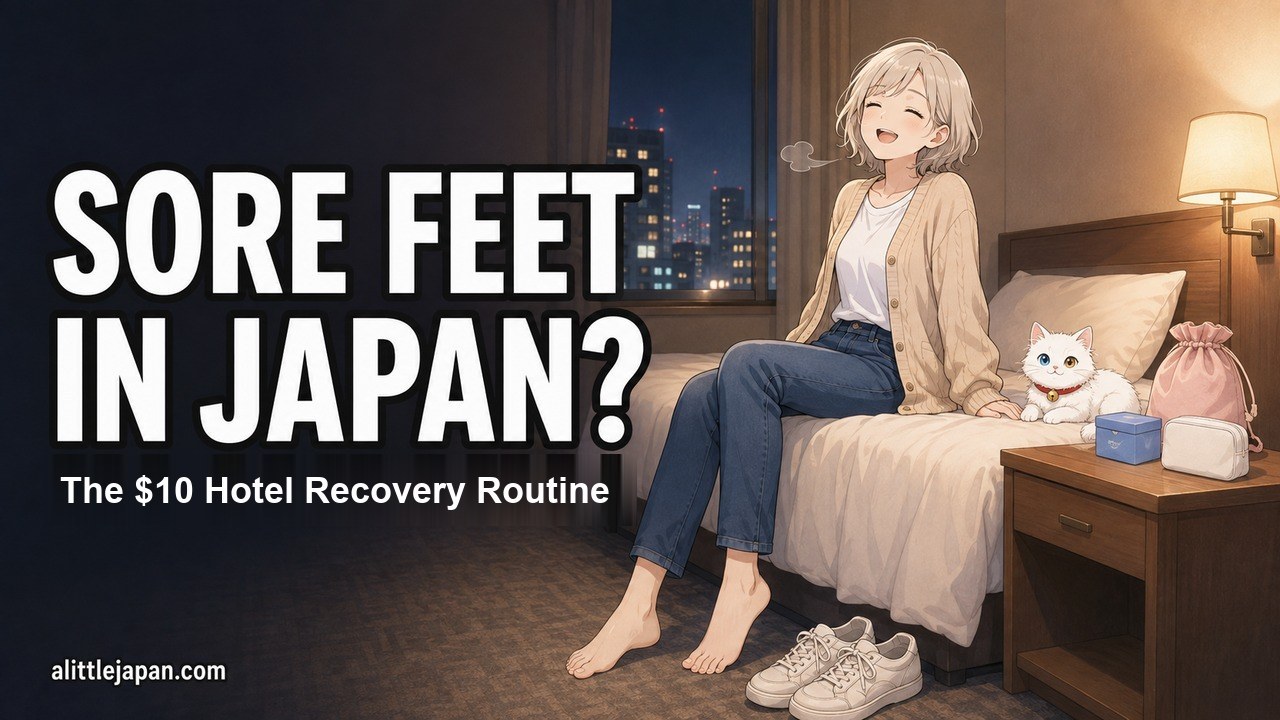
And when comfortable shoes still aren’t enough — after a 20,000-step day, they often aren’t — here’s the hotel recovery routine I use in the evening.
 My two boys are a good example of how different children can be. My younger son is four and doesn’t really like wearing long sleeves, so I keep a light layer with me for the moment he tells me he’s cold. My older son is twelve and manages his own clothes now — short or long sleeves, his call. The system works for both personalities because someone is always carrying the extra layer.
Chasing the Autumn Leaves: When & Where
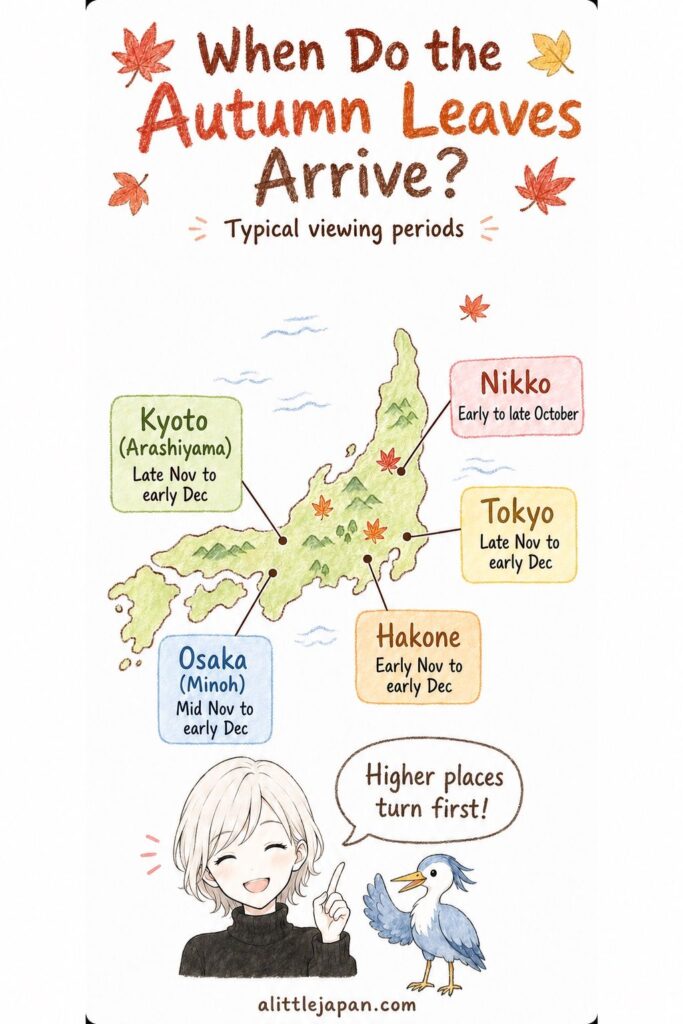
Autumn leaves don’t reach peak color in every destination at the same time. Elevation, location, and the year’s weather all affect the timing, so a single “Japan fall foliage date” can be misleading. It is better to choose places that fit your travel dates and check updated forecasts close to your trip.
At Nikko’s Irohazaka, the usual viewing period runs from early to late October. In Hakone, the colors generally move from higher to lower elevations: Lake Ashi and Sengokuhara usually begin changing in early November, followed by Gora in mid- to late November and Hakone-Yumoto from late November to early December.
 Check the Nikko Pass (train + bus from Tokyo) on Klook →
 Check the Hakone Free Pass (ropeway + boat included) on Klook →
Central Tokyo and Kyoto’s Arashiyama usually reach their best color from late November to early December. Minoh in Osaka typically follows from mid-November to early December. These windows are useful for planning, but they are not guarantees for a particular day.
 The first 2026 foliage forecast was released on September 2 by Japan Meteorological Corporation. Autumn temperatures are expected to stay above normal across the country, so peak color should arrive on schedule or a little later than usual. Maple peak is forecast for around November 29 in Tokyo, December 11 in Kyoto, and December 4 in Osaka, with Kyoto running about six days behind its long-term average. The next update is due in early October. Before you commit to a long day trip, check the latest forecast and official local updates on your phone — my Japan eSIM comparison covers the easiest way to stay connected.
Your clothing should match the kind of leaf-viewing day you have planned. A city park visit is different from a mountain route, and a sunny afternoon is different from an evening illumination. For Nikko or a higher-elevation area, don’t use central Tokyo’s temperature as your only guide. Check the destination forecast and bring an outer layer suitable for the colder setting.
Peak foliage also brings crowds. Popular trains, limited-entry attractions, and tours may be easier to manage when booked ahead, especially if you have only one possible day in your itinerary. A reservation doesn’t control the leaves, but it can remove one source of uncertainty.
Check Sagano Romantic Train tickets on Klook →
See Arashiyama & Kiyomizu-dera half-day tours on Klook →
Try not to build your entire trip around one tree or one predicted peak date. Autumn in Japan is beautiful in transition too: early color, mixed green and gold, and fallen leaves each create a different atmosphere. A flexible route gives you a better chance of enjoying the season instead of chasing a perfect forecast.
Hotels sell out before the leaves turn. Kyoto in mid-to-late November is the tightest week of the year for rooms, and Tokyo and Osaka fill up around the long weekends too. If your dates are fixed, lock in a room now and adjust later — many listings allow free cancellation: Kyoto hotels · Tokyo hotels · Osaka hotels
What to Pack for Japan in October (September and November Too)
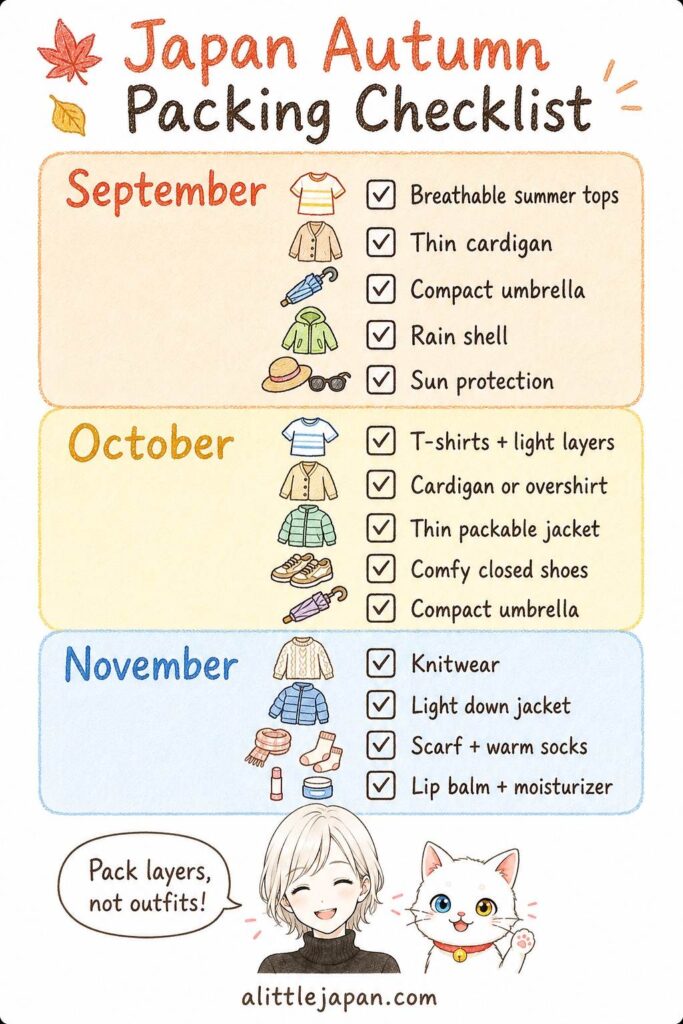
Use this Japan autumn packing list as a base, then adjust it for your dates, destinations, and sensitivity to cold. You don’t need every item in every month. The point is to build outfits from a few compatible layers rather than pack a separate look for each possible temperature.
September
- Breathable short-sleeved tops
- Lightweight long-sleeved shirt or overshirt
- Loose trousers, skirts, or other warm-weather bottoms
- Comfortable walking shoes
- Compact umbrella
- Lightweight rain shell
- Sun protection
- Thin cardigan for air-conditioned spaces and late-month evenings
For early September, let summer clothes do most of the work. For late September, keep the same base and add a light layer rather than jumping straight to heavy knitwear.
October
- T-shirts and light long-sleeved tops
- Cardigan or overshirt
- Thin, packable jacket
- Full-length trousers or midi skirt
- Comfortable closed shoes
- Socks suitable for shoe-removal settings
- Compact umbrella
- Light scarf if you get cold easily
- Foldable tote or day bag for removed layers
If you’re visiting late in October, add a light knit or packable down layer based on the forecast and your own comfort. Make sure you can wear the warm pieces together without feeling restricted.
November
- Long-sleeved tops
- Knitwear, sweatshirt, or warm cardigan
- Light down jacket or other warmer outer layer
- Full-length bottoms
- Comfortable closed shoes and warmer socks
- Scarf for cooler dates and evening plans
- Lip balm and moisturizer
- Packable rain protection
- An extra warm layer for autumn illuminations
For a trip that crosses from early to late November, pack for the colder part and remove layers when the day is mild. If you are heading to a mountain or higher-elevation destination, check that location separately rather than relying on the city table above.
Family Extras
- Easy-to-remove layers for children
- Spare top and socks in the day bag
- Stroller blanket or warm cover for November
- A bag with room for jackets the children remove
- Familiar, already-broken-in walking shoes
Lay everything out before closing the suitcase and check whether each top works with more than one bottom and more than one layer. If an item only works in one exact outfit, it may not deserve the space. Leave a little room for something useful you discover in Japan.
How Many Outfits Do You Need for 10 Days or Two Weeks in Japan?
You don’t need one outfit for every day. For a 10-day or two-week trip, pack a small set of clothes you can mix and match, then plan to wash them once during your stay. The suitcase can be almost the same for either trip length.
A practical starting point is five tops, three bottoms, two mid-layers, one outer layer, and one pair of everyday shoes. Keep the colors compatible so every top works with more than one bottom. Number-based systems such as the 3-3-3 rule or the 5-4-3-2-1 rule are useful starting points, but autumn in Japan needs one adjustment: make room for an extra removable layer for cool mornings and evenings.
This gives you variety without filling your suitcase with complete outfits you may never wear. Repeat the same pieces in different combinations, and save space for anything you buy in Japan. Once your clothes are sorted, use my 10-day Japan itinerary with real 2026 prices to plan what those travel days can look like.
Autumn is kimono season in Kyoto — the maple colours and temple grounds make it the best time of year to wear one. Rental shops handle everything for the day, so it is something to book, not something to pack.
Book a Kyoto kimono rental on Klook
Want the basics sorted before you fly? These are the kinds of items from the packing list above — all available on Amazon. You don’t need all five; pick only what fits your travel dates and plans.
- Windproof compact travel umbrella — handy for ordinary autumn rain. (In strong winds or when a typhoon is approaching, don’t use an umbrella at all.)
- Packable puffer jacket — a light extra layer for late October, November, or anyone who feels the cold easily — especially for mountain foliage spots or evening illuminations. It packs into its own pouch. (I linked the women’s version; there’s a men’s one too.)
- Thermal base layer set — a handy option if you’d rather arrive with warm innerwear than shop for HEATTECH after landing.
- Packing cubes — they keep your layers organized and make repacking easy as your luggage grows during the trip.
- MediQtto sleep compression socks — designed for bedtime after a long day of walking, at home or on a trip. I wear these myself, and the next morning my legs feel much lighter. You can find imported pairs on Amazon. More ideas in my guide to sore feet after a day in Japan.
FAQ
Is October a good time to visit Japan?
Yes, October is a very comfortable time for sightseeing in Tokyo, Kyoto, and Osaka. Normal daily highs range from 22.0°C to 23.7°C across those cities, while the lows range from 14.4°C to 16.0°C. That makes long outdoor days easier than in summer, as long as you bring a layer for mornings and evenings.
Early and late October don’t feel identical. Tokyo moves from a normal 23.7°C / 16.7°C early in the month to 20.4°C / 12.8°C late in the month. Check your exact dates and pack a T-shirt or light long-sleeved top with a cardigan or thin jacket you can remove. If you’re still building your route, my 10-day Japan budget itinerary shows what a full autumn trip can look like.
Do I need a jacket in Japan in October?
Bring one, but it doesn’t need to be a heavy winter coat for Tokyo, Kyoto, or Osaka. A thin jacket, cardigan, or overshirt is usually the most flexible choice, especially early in October. Later in the month, a light knit or packable down layer may be useful if you get cold easily.
Keep the jacket with you when your plans continue after sunset. Tokyo’s sunset is 16:47 by October 31, and the air can feel cooler once the sun disappears. Choose something that fits into your bag when you’re warm on a train or during an afternoon walk.
Can I wear shorts in Japan in September?
Yes. September can still feel like summer, particularly at the beginning of the month. Normal early-September highs are 29.6°C in Tokyo, 31.3°C in Kyoto, and 31.4°C in Osaka, so breathable summer clothes can be the right choice.
Late September becomes milder, with normal highs of 25.1°C in Tokyo, 26.8°C in Kyoto, and 27.3°C in Osaka. You may still be comfortable in shorts during the day, but bring a light layer and consider full-length bottoms for cooler evenings or settings where you want a neater look.
When is the best time to see autumn leaves in Japan?
It depends on where you go. Nikko’s Irohazaka usually has its viewing period from early to late October. Foliage timing in Hakone varies by elevation from early November through early December, while central Tokyo and Arashiyama in Kyoto are usually at their best from late November to early December. Minoh in Osaka typically reaches peak color from mid-November to early December.
The first 2026 forecast, released on September 2, points to a normal or slightly late season because of a warm autumn: Tokyo around November 29, Osaka around December 4, and Kyoto around December 11. Treat the usual periods as planning guides, then check the updated forecast close to your trip.
Is Japan cold in November?
November can feel cold in the morning and evening, especially late in the month, but conditions vary by date and city. Tokyo’s normal high and low move from 18.6°C / 10.6°C early in November to 14.9°C / 7.1°C late in the month. Kyoto and Osaka show a similar cooling pattern.
Pack long sleeves, a warm mid-layer, and a light down jacket or similar outer layer for colder dates. If you’re going to an evening illumination or standing outside for a long time, dress more warmly than you would for an afternoon walk. Indoors and crowded trains may feel warmer, so keep every layer easy to remove.
Is it cold in Japan in October?
Not usually during the day in Tokyo, Kyoto, or Osaka. Average October highs are around 22–24°C, while lows are around 14–16°C, so afternoons can feel warm but mornings, evenings, and the end of the month are cooler. It often feels less like winter cold and more like you’re missing one light layer.
What should I wear in Japan in October?
Wear a T-shirt or light long-sleeved top with full-length trousers or a midi skirt. Add a cardigan or thin jacket that you can remove and carry when the afternoon warms up.
How many outfits should I bring for two weeks in Japan?
Pack pieces you can combine instead of 14 separate outfits. Five tops, three bottoms, two mid-layers, one outer layer, and one pair of everyday shoes can work if you plan to wash clothes during the trip.
Final Thoughts: What to Wear in Japan in October
For most trips to Tokyo, Kyoto, and Osaka in October, the simplest answer is a breathable top, full-length bottoms, comfortable walking shoes, and one light layer you can carry during the day. September needs more summer clothing and rain protection, while late November calls for warmer knitwear or a light down jacket.
Check the forecast for your exact dates and destinations, especially if you are heading to Nikko, Hakone, or another higher-elevation area. Pack for change rather than every possible scenario, and remember that you can always buy one practical extra layer after you arrive in Japan.
Now I’m curious about your side of the world — what does autumn feel like where you live? Do you get the same big gap between warm afternoons and chilly evenings, or is your season completely different? Tell me in the comments below. I read every single one!
I hope this guide has answered one of your questions and helped you feel a little closer to Japan. May your Japan journey be filled with wonderful discoveries and memories you’ll treasure for years to come.
See you in the next guide. 
Sources: Temperature, precipitation, and typhoon normals (1991–2020) from the Japan Meteorological Agency. Sunset times (Tokyo, 2026) from the National Astronomical Observatory of Japan. Typical foliage periods based on the Hakone Tourism Association and major Japanese weather services.
What to Read Next
- What to Wear in Japan in December & Winter
- Japan on a Budget: 10-Day Itinerary & Real Costs
- Japanese Onsen Guide for First-Timers
- Visit Japan Web: Step-by-Step for Families
- Japan Tax-Free Shopping Guide
Tokyo in October: What to Wear
Tokyo averages 22.0°C by day and 14.8°C at night in October, and that gap is the whole story. A short-sleeved top with a light jacket or overshirt covers almost every day of the month. What catches visitors out is the evening: by the end of October the sun is gone before 17:00, and the wide avenues and riverside paths get windy in a way the temperature reading doesn’t warn you about. If you’re going up a tower or walking back from Asakusa after dark, take the extra layer with you.
Kyoto in October: What to Wear
Kyoto is warmer by day than Tokyo at 23.4°C, but it drops to 14.4°C, and because the city sits in a basin, mornings and evenings feel colder than the number suggests. Temple gardens are the specific problem: you end up sitting still on a wooden veranda in the shade, sometimes with your shoes off. A cardigan you can pull out of a bag beats a jacket you have to carry all afternoon. Socks are worth a thought too, since several temples ask you to take your shoes off at the door.
Osaka in October: What to Wear
Osaka is the mildest of the three, 23.7°C by day and 16.0°C at night, so the evening chill is the gentlest. Early October can still feel like late summer here, especially in the covered shopping arcades and around Dotonbori where the crowds hold the heat. Plan for a short-sleeved top most days and keep the extra layer light — plenty of visitors carry a jacket around Osaka without ever putting it on.

Comments