
You’ve probably had this exact moment: you’re planning your Universal Studios Japan day, you see the Express Pass price — sometimes higher than the park ticket itself — and you honestly can’t tell whether it’s a rip-off or the best decision of your whole trip. I visit USJ about twice a year, and here’s my short answer: it depends on your dates, your group, and your style as much as your budget. In this guide I’ll walk you through the 2026 passes with typical price ranges in yen, the one line in the fine print that decides everything, and a full battle plan for the day if you’d rather not pay at all.

Disclosure: This article contains affiliate links. If you book through one, I may earn a small commission at no extra cost to you.
In a hurry? Everything in this guide, in one list:
- USJ Studio Pass on Klook — park entry, QR code direct entry
- USJ Express Pass on Klook — skip the longest lines
Popular dates sell out — check yours before anything else.
- Do You Actually Need an Express Pass? (The Quick Answer)
- What the Express Pass Is — and What It Isn’t
- Express Pass 4 vs 7 vs Premium: The 2026 Lineup and Prices
- The Deciding Factor: Guaranteed Entry to Super Nintendo World
- Reading the Crowds Like a Local
- How and When to Buy (Before It Sells Out)
- The No-Pass Battle Plan
- Quick Questions, Quick Answers
- So, Worth It? Here’s My Take
Do You Actually Need an Express Pass? (The Quick Answer)
You’ve booked your days in Osaka, you’ve promised yourself (or your kids) a day at Super Nintendo World — and then you open the ticket page. Suddenly you’re staring at Express Pass 4, Express Pass 7, Premium, each with themed variations and prices that change by the date. It’s a lot, isn’t it?
Here’s the honest answer up front: not everyone needs one. On a genuinely quiet day, you can cover most of the park without paying extra. But I’ll be honest with you — those quiet days are getting harder to find. Lately even weekdays can be surprisingly packed, and on a Saturday in August a single popular ride can swallow two hours of your day.
So here’s my personal rule: I buy an Express Pass even when there’s only one ride on it I actually want. Why? Because I hate standing in line, and the hours it saves me go straight into the fun parts — a slow lunch, a café break, wandering the shops. Time is the real currency at USJ.
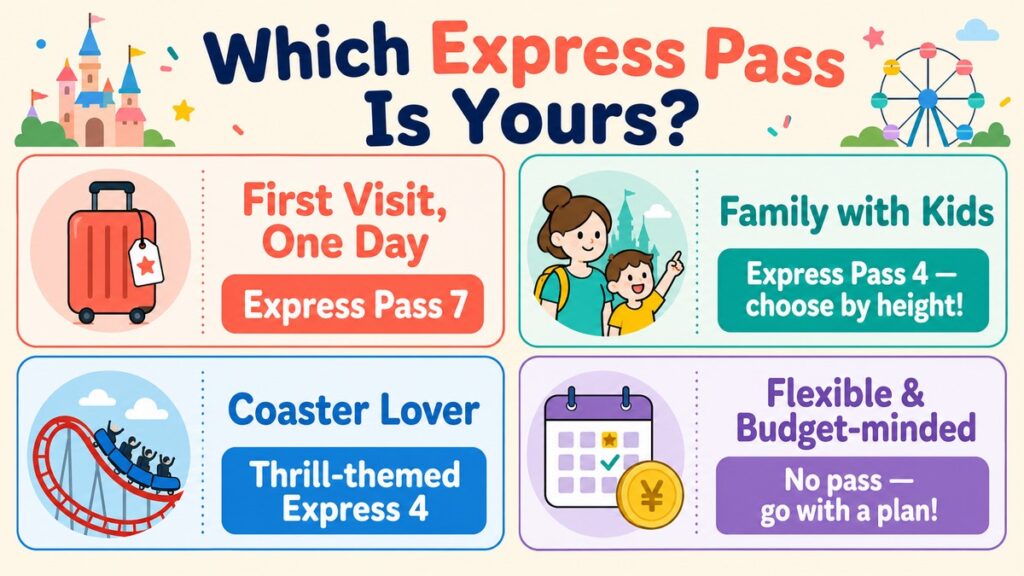
 So let me help. Find yourself in this chart, and the rest of the guide will fill in the details.
| Your situation | Short answer |
|---|---|
| First visit, only one day, busy season | Look at Express 7 — and pick a version that specifically includes entry to Super Nintendo World and the rides you want |
| Family with younger kids | Express 4 — but choose by height limits, not by price (see the FAQ below) |
| Here for the coasters | A thrill-themed Express 4 covers the big drops for less money |
| Flexible dates, weekday visit, tight budget | Skip it — use the no-pass battle plan at the end of this guide |
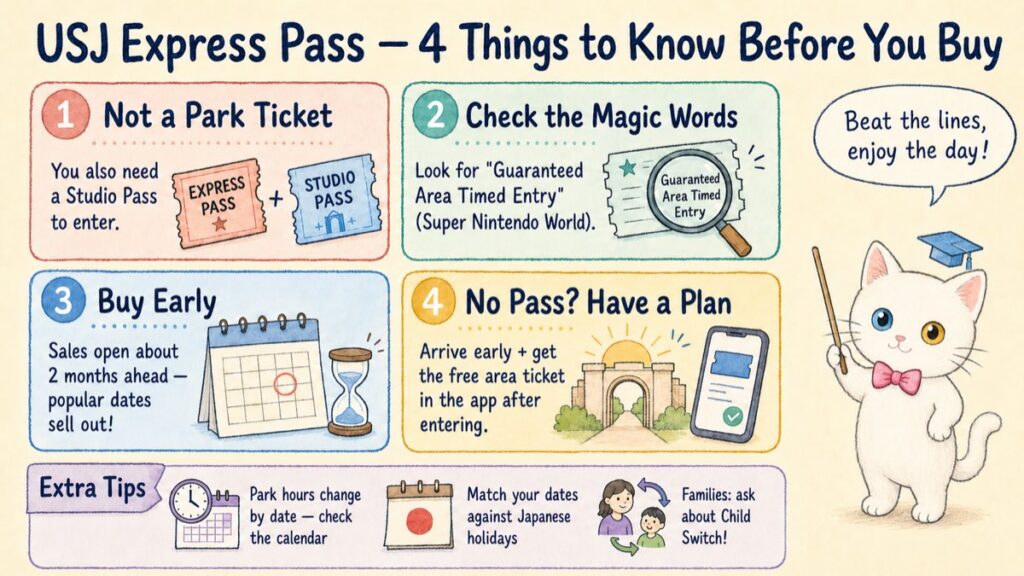
 One thing before we go on: an Express Pass is not an admission ticket. You’ll need a Studio Pass to get through the gate either way — more on that next.
 Check current Studio Pass prices on Klook.
What the Express Pass Is — and What It Isn’t
The Express Pass is a paid ticket that lets you skip the regular line — once at each of a set number of rides. That’s the whole idea: Express Pass 4 covers four rides (one priority ride on each), Express Pass 7 covers seven, and the top-tier Premium covers the most — around thirteen, though the exact lineup varies by date.
Two things trip up first-timers, so let’s clear them both right now.
First, it’s not an admission ticket. You still need a Studio Pass (from around ¥8,400 (≈$55) depending on the date) to get into the park — the Express Pass sits on top of that. It’s also tied to a specific date, and changes or refunds are generally restricted — check the cancellation terms shown by your seller before you pay.
Prices are in yen, with rough dollar figures at about ¥154 to the dollar (September 2026). Exchange rates move, so treat the dollars as a ballpark.
Second, it’s not “use anytime”. For the most popular rides, your pass comes with a time slot — say, Mario Kart between 14:00 and 14:30. This sounds restrictive, but in practice it works in your favor: your must-ride moments are locked in, and everything in between becomes free time. For me, that free time is exactly the point — it’s when lunch and coffee happen.
 There’s one more layer that catches people out. Each tier comes in several themed variations — Express Pass 7: Adventure & Donkey Kong, Express Pass 4: Thrills, and so on — and the lineup changes with the season. The number tells you how many rides you’ll skip; the theme tells you which ones. Picking by number alone is the classic mistake, and it’s exactly what we’ll untangle next.
Express Pass 4 vs 7 vs Premium: The 2026 Lineup and Prices
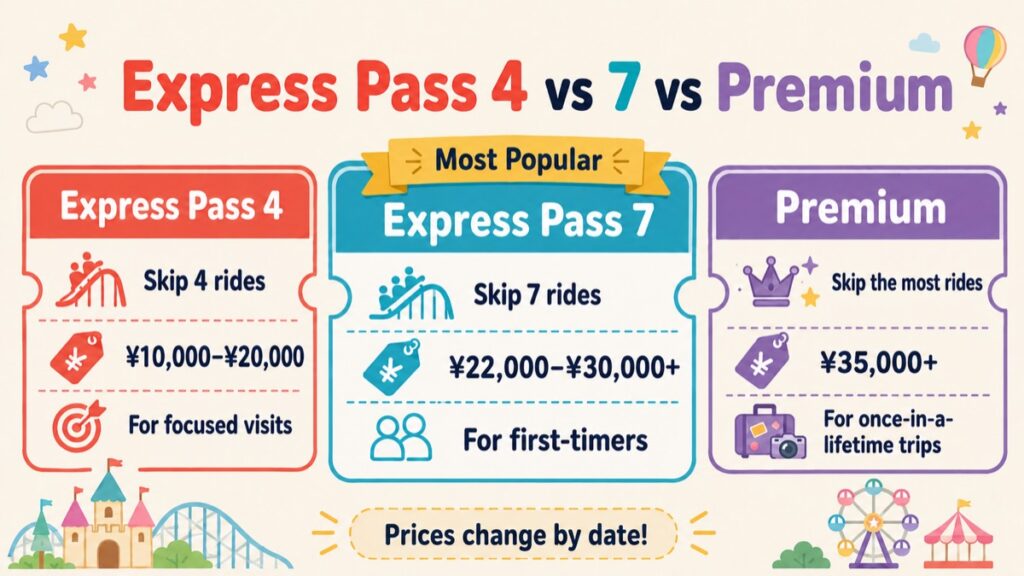
Here’s the lineup at a glance. For most visitors the real choice comes down to Express 4 vs Express 7 — versions like Express 5 and 8 appear seasonally as in-betweens, and Premium is the “skip everything” luxury tier.
| Pass | Rides you skip | Price range (varies by date) | Best for |
|---|---|---|---|
| Express Pass 4 | 4 | roughly ¥10,000–¥20,000 (≈ $65–$130) |
Focused visits: you know the handful of rides you want |
| Express Pass 7 | 7 | roughly ¥22,000–¥30,000+ (≈ $143–$195+) |
First visit, one day, want to cover the park’s greatest hits |
| Express Pass Premium | Around 13 rides — varies by date | roughly ¥35,000–¥50,000+ (≈ $227–$325+) |
Once-in-a-lifetime trips where money matters less than time |
Prices in yen, per person, on top of your Studio Pass — the dollar figures are rough conversions, so check today’s rate. And yes, those ranges are wide. USJ prices everything by demand now, so the same pass can cost far more on a high-demand date than on a quiet one. Treat the numbers above as a compass, not a promise, and check the price for your date before deciding.
Now, about those themed variations. The theme names tell you where the pass is pointing. A few examples from the 2026 lineup: Express Pass 7: Adventure & Donkey Kong leans toward Super Nintendo World, while Express Pass 4: Flying Dinosaur & Jurassic Park — often one of the least expensive in the lineup — is built for coaster lovers. Before you buy, open the pass details and read the actual ride list. It takes two minutes and prevents the single most common regret: paying to skip lines on rides you never planned to ride.
And one line in those details matters more than all the others — whether your pass guarantees entry to Super Nintendo World. That’s the next section, and it’s the one I’d read twice.
The Deciding Factor: Guaranteed Entry to Super Nintendo World
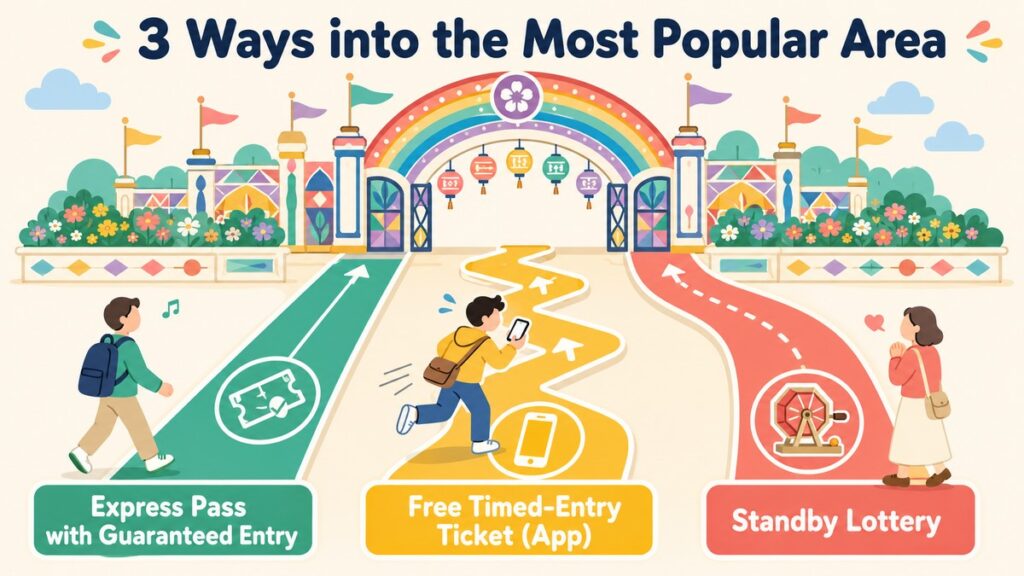
Here’s the part that surprises people the most: on busy days, having a park ticket doesn’t mean you can walk into Super Nintendo World. The area itself has capacity control. When the park is crowded, you need an area timed-entry ticket — free, issued on the day through the official app — and on the busiest days the available times can fill up quickly. Miss them, and you’re left with a standby lottery and crossed fingers.
This is why the most important line in any Express Pass description is whether it includes Guaranteed Area Timed Entry for Super Nintendo World. With that guarantee, you skip the whole morning scramble: your entry time comes with your pass, and you stroll into the area. One nuance to know: the guarantee covers entering Super Nintendo World — rides inside still have their own lines unless they’re covered by your pass. (And Donkey Kong Country is an extension inside Super Nintendo World, so one entry covers both.)
Some Express Passes include this guarantee — sometimes for the Harry Potter area as well — and others don’t. The lineup varies by pass and by date, and that’s exactly where a “cheap” pass can turn expensive: you save a few thousand yen, then can’t get into the one area you crossed an ocean to see.
So when you compare passes, don’t start with the price. Open the details and look for the words “Guaranteed Area Timed Entry.” If Super Nintendo World is the heart of your trip, treat any pass without it as simply not an option.
 And if you’re not buying a pass at all — truly, don’t panic. The free ticket route works; it just demands an early start and quick thumbs. I’ll walk you through it step by step in the no-pass section.
Reading the Crowds Like a Local
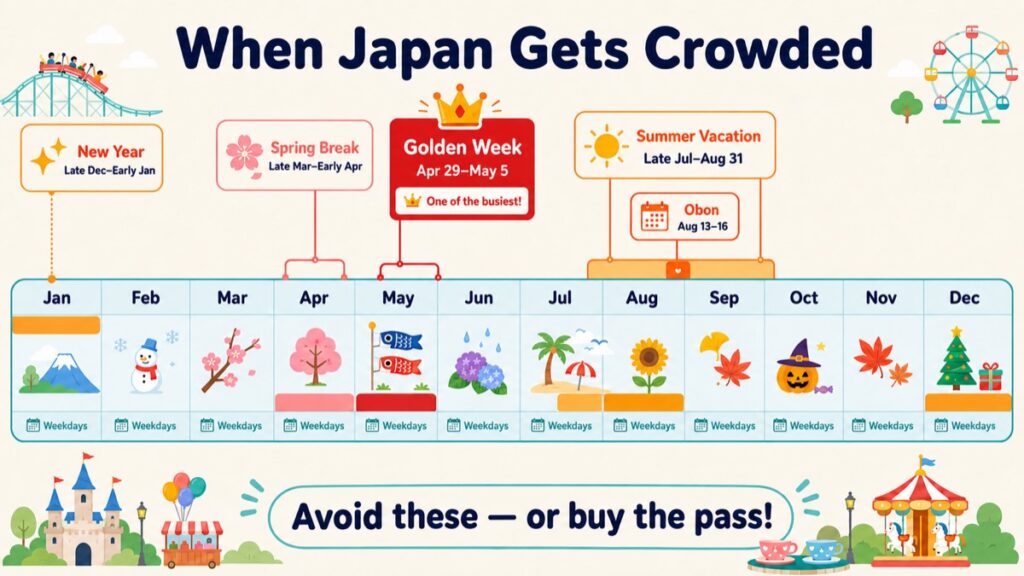
Most crowd-calendar advice online is written by people guessing from outside Japan. So let me give you the local version — this is the same calendar I use to plan my own visits.
The golden rule: avoid overlapping with a Japanese school holiday or a national holiday cluster whenever your schedule allows. These are the periods when the whole country moves at once:
| Period | What it is | Crowd level |
|---|---|---|
| Late Mar – early Apr | Spring break | Very high |
| Apr 29 – May 5 | Golden Week — a chain of national holidays | One of the very busiest of the year |
| Late Jul – Aug 31 | School summer vacation | Very high |
| Around Aug 13–16 | Obon — Japan’s summer homecoming week | Peak of summer |
| Mid-Sept – early Nov (weekends) | Halloween Horror Nights — the park’s biggest seasonal event | Very high on weekends, peaking late October |
| Late Dec – early Jan | New Year holidays | Very high |
| Any 3-day weekend | National holidays often land on Mondays | High |
One trap for international visitors: Japanese holidays don’t line up with yours. Christmas Day isn’t a national holiday in Japan — though late December still gets busy with school breaks and year-end travel — while a random-looking Monday in mid-July is a national holiday (Marine Day), and the park will feel it. Before you lock in your dates, spend one minute checking them against a Japanese holiday calendar. It’s the cheapest crowd-avoidance tool that exists.
Now, the honest update for 2026: the old wisdom of “just go on a weekday” is fading. USJ’s international popularity means even ordinary weekdays can be seriously crowded — I’ve seen it shift over my own visits these past few years. A weekday still beats a Saturday, but it’s no longer a guarantee of an easy day.
Which leads to a simple two-line strategy. If you can choose your dates: pick a plain weekday outside every period in that table, and an Express Pass becomes a comfort, not a necessity. If your dates are locked onto a busy period: that’s when the pass earns its price many times over — and when it sells out fastest, which is our next topic.
How and When to Buy (Before It Sells Out)
One seasonal note: if your trip falls between September 10 and November 8, the calculation changes. Halloween brings its own Express Pass sets, and a standard Pass 7 won’t get you into the horror attractions. I’ve worked through that separately in my guide to USJ Halloween and which Express Pass you need.
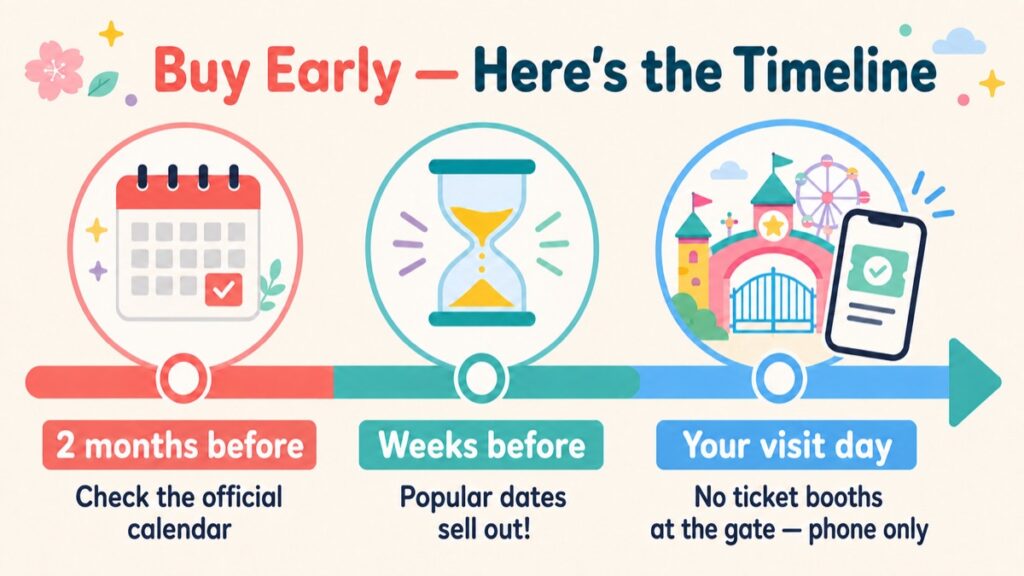
Many Express Passes are released around two months before each entry date — but exact sale dates and times vary by product, so check the official ticket calendar for your date. What doesn’t vary: for popular dates — weekends, holidays, school-break season — they genuinely sell out, sometimes weeks in advance. If your visit lands anywhere near the busy calendar from the last section, find out when your date goes on sale and buy early. This is not a “decide at the gate” purchase. Halloween season deserves its own warning: Express Passes for popular Halloween dates — especially the weekends near the end of October — can sell out three to six weeks ahead.
Where to buy is its own small adventure. The official ticketing site works in English, but some international travelers report card payments failing at checkout with foreign-issued cards. If it happens to you, there’s often no obvious fix beyond trying another accepted payment method — or buying through an authorized seller instead.
One more thing that catches travelers off guard: USJ no longer sells tickets at the entrance gate. There are no walk-up ticket booths — your Studio Pass also needs to be bought before you arrive. Keep all your tickets somewhere easy to find on your phone, and save the complete ticket screens in advance — USJ asks you to show the whole ticket screen, not just the QR code.
 That’s why many international visitors find an authorized reseller easier. Klook is the one I’d point you to first: it’s an authorized USJ ticket seller, the whole flow is in English, foreign cards are accepted, and your pass arrives on your phone — nothing to print, nothing to collect.
Check Express Pass dates and prices on Klook — and remember you’ll also need a Studio Pass (park admission), since the Express Pass doesn’t include entry.
Before you tap “buy,” slow down for one minute and check three things: the date (passes are date-locked), the ride list, and the guaranteed-entry line we talked about. Remember — changes and refunds are generally restricted, and ordinary rain doesn’t get your money back.
A quick “before your visit” checklist, from one planner to another:
- Every rider needs their own Express Pass — one per person, kids included.
- Arrive within your ride’s time slot; if you miss it, you may lose that ride.
- Save the full ticket screens for everyone in your group before you leave your hotel.
- Register everyone’s Studio Pass in the official app (one phone can hold the whole family’s tickets — more on this in the next section).
- The app needs a reasonably recent phone and an internet connection at the park.
And if your date is already sold out? Don’t buy a pass you don’t want just because it’s the last one left. Shift your visit by a day if you can — even one day off-peak changes everything. If your dates are fixed, take a breath: the next section is written exactly for you.
The No-Pass Battle Plan
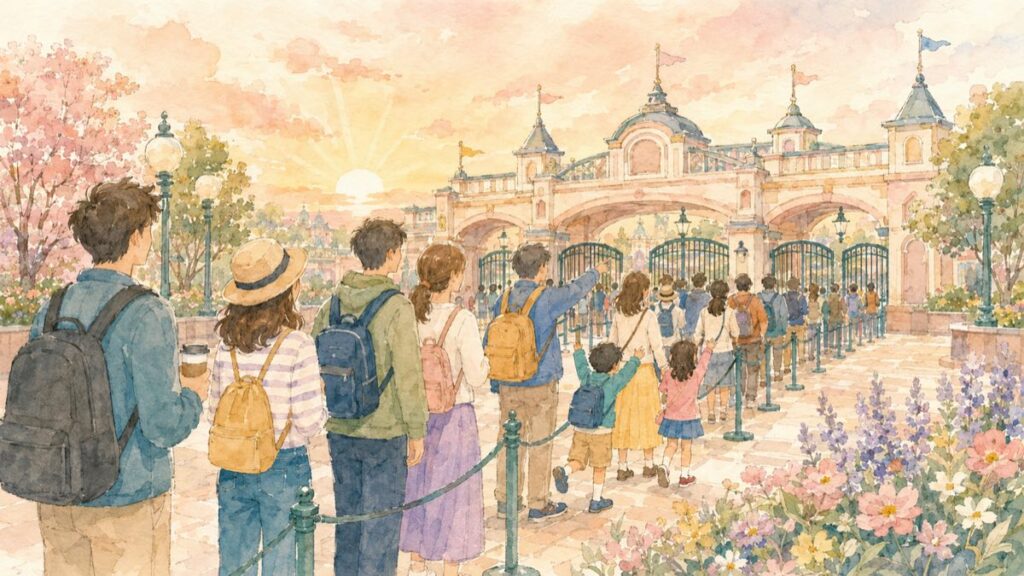
No Express Pass — whether by choice or by sell-out? You can still have a wonderful day. You just need a plan and an early alarm.
Step 0: Check the park hours for your exact date. Here’s something almost nobody warns you about: USJ’s hours change constantly, and some dates keep the park open hours longer than others. Check the official calendar when you plan, and again the week you go — it can genuinely change your ride count for the day.
Step 1: Arrive 60–90 minutes before the posted opening. USJ sometimes begins letting guests in before the posted time — it’s a day-by-day decision and never guaranteed, but when it happens, the people near the front of the line are the ones who benefit. Depending on that morning’s operations, early guests can sometimes enter Super Nintendo World without a timed-entry ticket. Don’t rely on it, though — check the app as soon as you’re safely inside.
Step 2: Master the app, before you fly. Download the official USJ app and register everyone’s Studio Pass in it while you’re still at home — one phone can hold the whole family’s tickets. Here’s the part most people get wrong: the free Area Timed Entry Ticket can only be requested after your whole group has entered the park. So once you’re all through the gate, step out of the flow of people, find a safe spot, and apply right away — on crowded days the popular time slots go fast. (As of January 5, 2026, the in-park ticket machines are retired: same-day free timed-entry and standby tickets now come only through the app. Advance entry to the area also comes with certain Express Passes and travel packages.)
Here are the direct links so you don’t have to hunt: App Store / Google Play. One quirk worth knowing: if the app appears in Japanese, check your phone’s system language — USJ says the app displays in English whenever the system language is set to anything other than Japanese.
Step 3: Don’t write off the evening. Everyone fights over the morning slots. On one of my visits, I found a late entry time still available close to closing — it can happen, and the area after dark, once the lights come on, is genuinely magical. But be honest with yourself about the risk: on busy days, tickets can be gone long before evening, so treat a late entry as a lucky bonus, not a strategy. And if you’re not a coaster person (I’m not), gentle rides like Yoshi’s Adventure — I’ve ridden it myself, and it’s a cheerful, zero-drama kind of fun — make an evening visit every bit worth it.
Step 4: Use the single rider lines. If your group doesn’t mind riding separately, several big rides have single-rider lines that can be considerably shorter than the regular queue — though not always, and you’ll be seated apart. For us line-haters, it’s usually a trade worth taking.
 Is a no-pass day as smooth as an Express Pass day? Honestly, no — it’s more footwork and more alarm clock. But plenty of visitors do exactly this and go home happy. The pass buys comfort, not the only path in.
That 60 to 90 minute head start is far easier on everyone if you sleep close by. The hotels in the Universal City area are a short walk from the gate, and if you would rather stay in the middle of the city, the ride out from Osaka Station takes about fifteen minutes. Compare Osaka hotels on Agoda.
Quick Questions, Quick Answers
Q1. Is Klook the only place to buy?
No — USJ tickets are also sold through other travel agencies such as KKday, Rakuten Travel Experiences and GetYourGuide. Before buying anywhere, check that the seller is currently recognized by USJ. The one hard rule: never buy resold passes from auction or resale sites — that’s against USJ’s terms, and with a date-locked, non-refundable ticket, it’s not a gamble worth taking.
Q2. My kids aren’t tall yet — which pass makes sense?
Measure them before you buy, seriously. Here are the key numbers:
| Ride | Minimum height | Adult required until | Maximum height |
|---|---|---|---|
| Yoshi’s Adventure | 92 cm | 122 cm | — |
| Mario Kart | 107 cm | 122 cm | — |
| Mine Cart Madness (Donkey Kong) | 107 cm | 122 cm | — |
| The Flying Dinosaur | 132 cm | — | 198 cm |
If your child is under 107 cm, most of Super Nintendo World’s rides are out — so a pass built around them loses its value, and a cheaper pass plus a relaxed day in the Wonderland kids’ area may serve your family better. Match the pass’s ride list to your child’s height, not to the pass’s popularity.
One more family secret: the Child Switch system. If someone in your group can’t ride — a small child, or honestly anyone who’d rather not — tell the crew member at the ride entrance and you’ll get a Child Switch card. Your family queues once, one adult rides while the other waits with the child at a designated spot, then you swap. One wait, both parents ride. It’s available at many participating attractions — ask the crew at the entrance, since the procedure and waiting location can vary by ride.
In our family, the youngest is still too small for most rides, so we use this every single visit: big brother rides once with Dad, then once with me. Two rides for him, zero extra queueing for us — and he thinks the system was invented just for him. (That’s how the crew handled it on our visits — do ask before joining the queue, as the details can differ.)
Q3. What happens if it rains?
Ordinary rain won’t get you a refund — plan on that. The consolation: several headliners (Mario Kart, Forbidden Journey, Minion Mayhem) are fully indoors, while outdoor coasters may pause in rough weather. Exceptional situations like full-day closures are handled under your seller’s ticket terms.
Q4. Can I decide on the day?
Only if luck is on your side. If your date hasn’t sold out, you can still buy online that morning — but remember, there are no ticket booths at the gate anymore, so everything happens on your phone. On quiet dates this works; on busy dates, the passes were gone weeks ago.
So, Worth It? Here’s My Take

Let’s land this. The Express Pass is worth it when your time at USJ is scarce and precious — one day, a busy season, kids with limited patience, or simply a person (like me) who’d rather spend an hour in a café than in a queue. It’s skippable when your dates are flexible and land on genuinely quiet days.
If you take nothing else from this guide, take these:
- Not sure? Start with the chart at the top — your situation decides as much as the price.
- Read the ride list and the “Guaranteed Area Timed Entry” line before you pay.
- Check your dates against the Japanese holiday calendar — it’s the cheapest trick in this whole article.
- Buy early. Sales often open about two months ahead, and popular dates don’t wait.
- No pass? Early alarm, app ready before you fly, and apply for the area ticket right after you’re all inside.
Book your USJ tickets on Klook →
Planning the rest of your Japan trip? I did the same honest math for the Japan Rail Pass — that guide is here.
Flying into Kansai Airport? My Rapi:t airport train guide covers how to get from the airport to Namba.
Now I’m curious about your side of the world — do theme parks in your country sell line-skipping passes too? Do you buy them, or do you tough it out in the queue? Tell me in the comments below. I read every single one!
I hope this guide has answered one of your questions and helped you feel a little closer to Japan. May your Japan journey be filled with wonderful discoveries and memories you’ll treasure for years to come.
Building USJ into a longer trip? Here’s my full 10-day Japan itinerary with every cost attached, USJ day included.
See you in the next guide. 

Comments