
- The Short Answer: 3 Questions Decide Your Base
- Which Trip Are You? Your Base by Trip Style
- Kyoto vs Osaka Side by Side: The Daily Details
- “It’s Only 30 Minutes” — The Door-to-Door Trap
- How Many Nights Where? A Guide by Trip Length
- If You Split: Which City First + Your Luggage
- With Kids: Fewer Moves, Easier Days
- Cherry Blossom or Autumn Leaves: Book Early
- Where to Book: 5 Easy Station Areas
- How We Would Choose for Our Own Trip
- FAQ
The Short Answer: 3 Questions Decide Your Base
“What do you want to see most?”
That’s the first question I’d ask if you were a friend trying to decide between staying in Kyoto and Osaka. It’s a surprisingly difficult choice, especially when you’ve been reading travel forums and every answer seems to contradict the last one.
Here’s the good news: there’s no single right answer. Both cities can be wonderful bases for your first Kansai trip, but the better choice depends on how you want your days to feel.
Disclosure: This article contains affiliate links. If you book through one, I may earn a small commission at no extra cost to you.
Quick booking list: one hotel to start with in each station area
 Hotel Granvia Kyoto (Kyoto Station)
 Mitsui Garden Hotel Kyoto Shijo (Shijo / Kawaramachi, Kyoto)
 Hotel Hankyu RESPIRE OSAKA (Umeda, Osaka)
 remm Shin-Osaka (Shin-Osaka)
 Hotel Keihan Namba Grande (Nankai Namba, Osaka)
Compare the same dates in Kyoto and Osaka before you book.
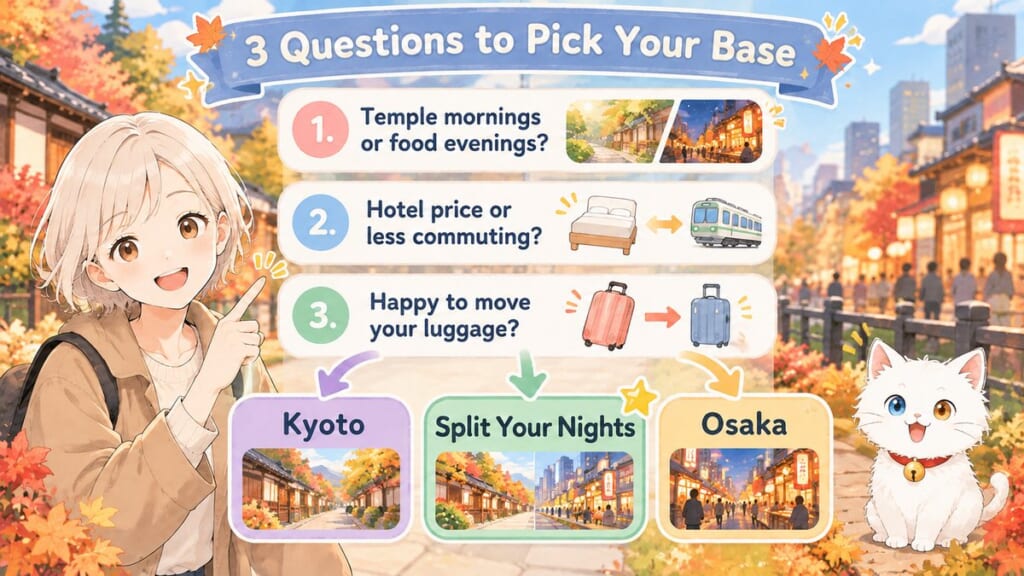
Before you book anything, ask yourself three questions.
1. Do you want quiet temple mornings or lively food-filled evenings?
If you’ve been dreaming of reaching Kyoto’s temples before the busiest sightseeing hours, staying in Kyoto gives you a head start. If you’re more excited about exploring Osaka’s food streets after dark, sleeping in Osaka lets you enjoy the evening without planning a train ride back.
2. Which matters more: your hotel budget or avoiding the daily commute?
An Osaka hotel might look more appealing when you compare room options. But if you travel to Kyoto every day, remember to include the train fares, local transportation, and time spent getting from your hotel to each attraction.
3. Are you comfortable moving your luggage between hotels?
Splitting your stay means you can enjoy mornings and evenings in both cities. It also means packing up, checking out, traveling with your belongings, and checking in somewhere new.
 Here’s how I’d narrow it down.
- Choose Kyoto if temples, traditional streets, and early starts are the heart of your trip.
- Choose Osaka if nightlife, food, USJ, and convenient day trips are your priorities.
- Split your nights if you have enough time to enjoy both cities and don’t mind changing hotels once.
You don’t need to make every part of your Kansai trip perfect. You just need a base that fits the experiences you’re most excited about.
And if you’re still putting the rest of your itinerary together, my How to Plan Your First Trip to Japan: 7 Steps guide can help you plan around that decision.
Which Trip Are You? Your Base by Trip Style
Your travel style tells you more about where to stay than the number of attractions on your itinerary.
Someone who wants to spend every morning at a different Kyoto temple has different needs from someone planning Universal Studios Japan, late dinners, and day trips to neighboring cities. Even two families traveling with children might make opposite choices.
Start with the row that sounds most like you.
| Your trip style | Suggested base | Why it fits | Might not suit you if… |
|---|---|---|---|
| First Kansai trip, with early Kyoto temples as the priority | Kyoto | You can start sightseeing without traveling from Osaka first. | Most of your plans are actually outside Kyoto. |
| Evening food adventures, shopping, and USJ | Osaka | You can spend more of your evenings near your hotel. | You want to explore Kyoto’s temples at the start of several days. |
| Day trips to Nara, Kobe, and Himeji | Osaka | Major rail connections give you several directions to explore from one city. | Your itinerary is mainly focused on Kyoto. |
| Budget-conscious travelers | Osaka as a starting point | It’s worth comparing a wider range of available hotel options. | Repeated Kyoto commutes would outweigh the hotel savings. |
| Four or more nights, with plenty to see in both cities | Split Kyoto and Osaka | You can experience mornings and evenings in each city without commuting every day. | You dislike packing and changing hotels. |
| Families with children or babies | One base first; split only if useful | Fewer hotel changes can make daily routines simpler. | Your planned activities are spread across both cities and justify the move. |
 For my own family, I’d lean toward Osaka. Given the choice between an early Kyoto temple morning and an evening enjoying Osaka’s food streets, I’d choose the food.
That’s our preference, though. If you look at the first row and immediately think, “That’s exactly the Kyoto trip I want,” I’d take that feeling seriously.
There’s also a difference between visiting a city and enjoying it as your home for a few nights.
- Stay overnight if you want rest breaks at your hotel, dinner without a train ride back, or an early start the next morning.
- A day trip is enough if you only plan one Kyoto sightseeing day—there’s no need to change hotels just to say you’ve stayed in both cities.
Travelers on Reddit share different preferences about this decision. Some say they wish they’d spent more nights in Kyoto, while others are happy using Osaka as a base for day trips. Those are personal experiences, not rules for your itinerary.
The useful question isn’t which city other travelers liked more. It’s which daily routine you’d enjoy living with.
Kyoto vs Osaka Side by Side: The Daily Details
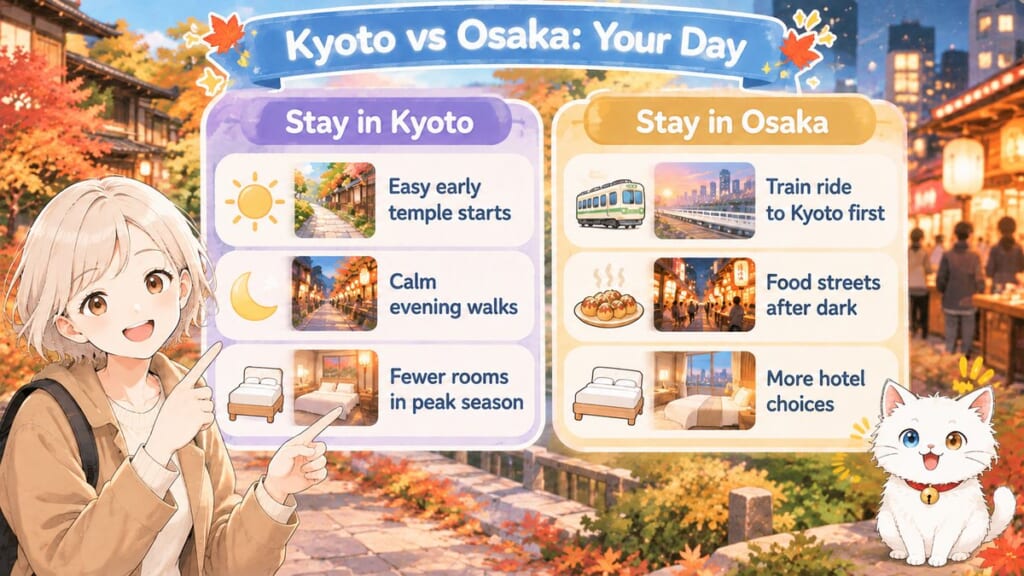
Kyoto and Osaka aren’t just two places to sleep. They can shape the beginning and end of every day of your trip.
A hotel that’s convenient for an early Kyoto morning might be less convenient for your Osaka dinner plans. And a hotel that looks like a bargain can become less appealing when you add several days of transportation.
Here’s how the practical differences look.
| What matters | Staying in Kyoto | Staying in Osaka |
|---|---|---|
| Early temple visits | Easier to start in Kyoto before the main daytime sightseeing crowds, depending on each site’s opening hours. | Requires traveling into Kyoto before reaching your first destination. |
| Evenings | Good for enjoying Kyoto’s restaurants, illuminated streets, and slower evening walks. | Good for food streets, shopping areas, and spending the evening near your hotel. |
| Hotel availability in autumn | On a November Saturday, Agoda showed about one-tenth of the listings it shows on a quiet January weekday. | About one-eighth of its quiet-season listings were still showing—about 1.6 times Kyoto’s count. |
| Same hotel’s seasonal rates | A Kyoto Station hotel we checked cost about three times as much for its cheapest room on that November Saturday as on the January weekday. | Compare actual rates for your dates rather than assuming a fixed difference. |
| Traveling to Kyoto attractions | No Osaka-to-Kyoto journey, but local trains, buses, and walking may still be needed. | Multiple railway choices, with additional travel after arriving in Kyoto. |
| Kansai Airport and Shinkansen | Kyoto Station connects with the Tokaido Shinkansen and HARUKA airport express. | Shin-Osaka connects with the Shinkansen; Osaka and Namba offer different airport rail options. |
| Changing hotels | One Kyoto base avoids moving your luggage. | One Osaka base avoids moving your luggage. |
Agoda search on October 27, 2026: one night for two adults on Saturday, November 21, 2026, compared with Wednesday, January 20, 2027, using the same search conditions in each city. These are listings shown by Agoda, not hotel occupancy rates. The same-hotel rate comparison was checked on October 22, 2026.
What stands out is how much both cities had filled up for that holiday weekend. Osaka still showed about one-eighth of its January listings, while Kyoto showed only about one-tenth. It’s a useful snapshot, though not proof of which city’s hotels booked up first.
 I would compare the same dates in both cities before making a decision based on hotel availability.
Tip: enter your dates and number of guests first — Agoda only shows rooms and prices after that.
Tip: enter your dates and number of guests first — Agoda only shows rooms and prices after that.
There’s one more part of the comparison that’s easy to miss: the journey you make every morning and evening.
If Osaka has a room you like and you’re visiting Kyoto only once, the commute might be a perfectly reasonable trade-off. If you’re planning three consecutive days around Kyoto attractions, those journeys deserve a closer look.
“It’s Only 30 Minutes” — The Door-to-Door Trap
“It’s only 30 minutes from Osaka to Kyoto!”
You’ve probably seen that advice while planning your trip. And yes, some train journeys between the cities are quick.
But those minutes don’t necessarily begin at your hotel door or end at the temple you want to visit.
Imagine staying in Osaka and planning a morning at a temple in eastern Kyoto. You first need to reach the right Osaka station, find your train, travel to Kyoto, and then reach the temple by another train, bus, or walk.
One traveler on Reddit reported that trips from an Osaka base to Kyoto took around an hour and a half each way.
And if you’ve promised yourself an early start, all those little steps happen before the sightseeing even begins. Thirty minutes? The train might agree. Your entire morning might have a different opinion.
I remember how crowded Kyoto felt when I visited during peak cherry blossom or autumn foliage periods. The buses, temples and shrines, stations, and trains were all so busy that getting around was genuinely exhausting.
 That experience makes me especially cautious about telling someone to choose a base using only the intercity train time.
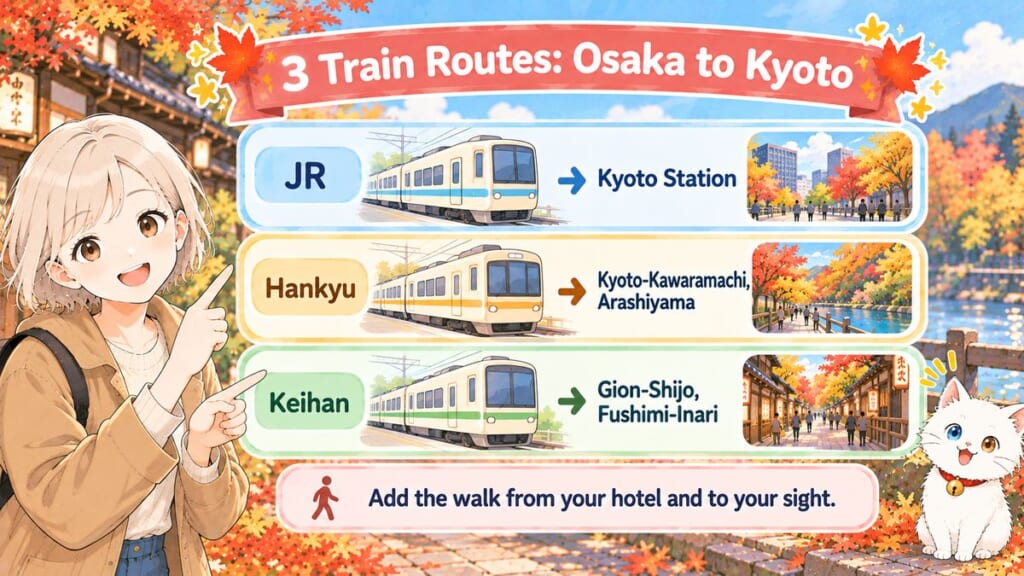
Three railway routes, three different parts of Kyoto
You have three useful main railway choices between Osaka and Kyoto, but they don’t all take you to the same place.
JR: Useful for Kyoto Station
JR’s Special Rapid services connect Osaka Station and Kyoto Station. This is a useful option if your Kyoto plans begin near Kyoto Station or you need to connect with other JR services.
Hankyu: Useful for central Kyoto and Arashiyama
Hankyu’s limited express runs from Osaka-Umeda to Kyoto-Kawaramachi in approximately 43 minutes. It reaches Katsura in approximately 35 minutes, where you can transfer toward Arashiyama.
This route can make sense when your Kyoto plans focus on Kawaramachi, the nearby shopping streets, or Arashiyama.
Official source: Hankyu Railway (English)
Keihan: Useful for Gion and Fushimi Inari
Keihan connects the Osaka side, including Yodoyabashi and Kyobashi, with eastern Kyoto destinations such as Gion-Shijo and Fushimi-inari.
The daytime journey from Yodoyabashi to Demachiyanagi, the end of the line a few stops past Gion-Shijo, takes approximately 54 minutes. Fushimi-inari Station is served by express, sub-express, and local trains, but not limited express trains; Fushimi Inari Shrine is about a five-minute walk from the station.
Official source: Keihan Electric Railway (English)
Why Japan does it this way
 One reason the route can feel confusing is that JR, Hankyu, and Keihan are separate railway operators with different networks and stations. They’re not three names for the same Osaka–Kyoto train. That means the most convenient route changes depending on which part of Kyoto you want to explore, so checking your actual destination matters more than memorizing one intercity travel time.
Your Osaka hotel location matters, too.
If you stay near Umeda, JR and Hankyu connections are useful starting points. If you stay near Yodoyabashi or Kyobashi, Keihan may fit your Kyoto plans better; from Namba, you’ll need to consider how you reach your chosen intercity line.
For the detailed differences between Osaka’s hotel areas, see my Namba vs Umeda vs Shin-Osaka guide.
One more thing: check the return journey
If you plan a late dinner or evening event in Kyoto before returning to Osaka, look up the last train for the exact direction and station you need. Don’t assume the final service is the same on JR, Hankyu, and Keihan.
For a trip centered on Kyoto mornings, a Kyoto hotel is often simpler. For occasional Kyoto day trips, staying in Osaka can work well. You get to decide whether that extra journey is worth it.
How Many Nights Where? A Guide by Trip Length
You don’t need to split your stay evenly just because Kyoto and Osaka are both on your itinerary.
Think about how many nights you actually have, then consider where most of your activities are. A four-night trip with three Kyoto sightseeing days calls for a different arrangement from four nights filled with Osaka attractions and one Kyoto visit.
These are starting points, not fixed schedules.
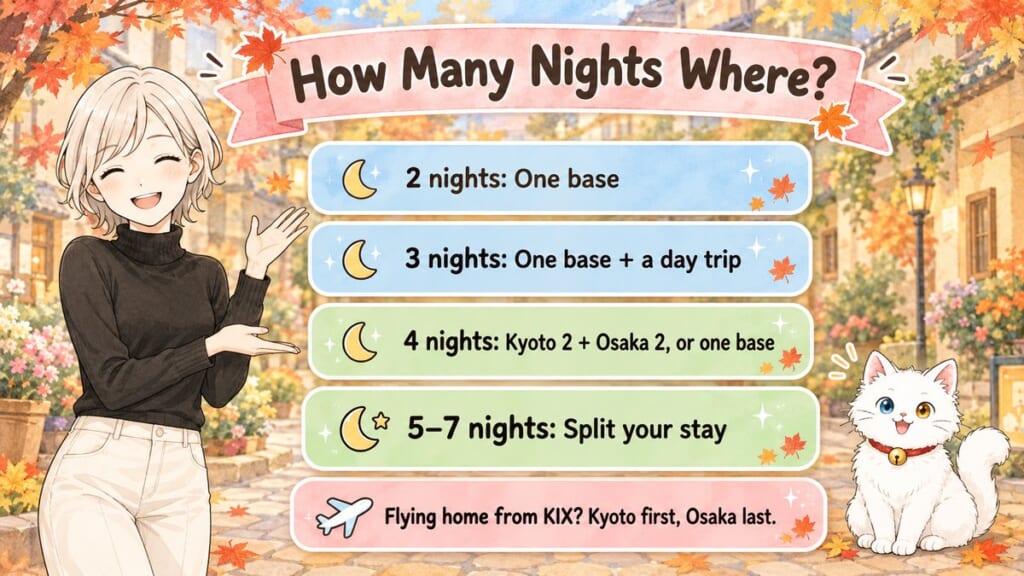
| Total nights | Suggested arrangement | Why |
|---|---|---|
| 2 nights | One base: Kyoto or Osaka | Moving hotels would take time from an already short stay. |
| 3 nights | One base, with a day trip if needed | Easier to settle in and enjoy your chosen city. |
| 4 nights | Kyoto 2 + Osaka 2, or one base | A split works if you have meaningful plans in both cities. |
| 5–7 nights | Consider splitting: 2 + 3, 3 + 3, or 3 + 4 | Enough nights to enjoy both cities without moving every day. |
| Any length, flying home from KIX | Consider Kyoto first, Osaka last | Your final accommodation may be better positioned for your airport journey. |
For two or three nights, I would usually start by looking for one hotel. Even when the cities are close, changing hotels takes time that could otherwise go toward sightseeing.
Four nights is where splitting becomes more tempting. Kyoto for two nights and Osaka for two nights gives you evenings and mornings in both places.
But there’s no reason to split if almost everything you want to do is in one city.
With five to seven nights, you have more room to choose. A temple-focused trip might deserve more Kyoto nights, while a trip with USJ, shopping, and surrounding cities might benefit from more Osaka nights.
You can even use your most important activities to count backward. Place those activities on your calendar, see where they naturally fall, and then choose which city should come first.
The arrangement that feels easiest on paper is worth considering, but your actual sightseeing priorities should make the final decision.
If You Split: Which City First + Your Luggage
Splitting your stay can be lovely, but I’d plan the hotel-change day before booking either hotel.
You don’t need a complicated system. Just decide which city makes sense at the beginning, where you’ll go afterward, and what happens to your luggage in between.
Kyoto first or Osaka first?
Kyoto → Osaka often makes sense if you’re flying home from Kansai International Airport (KIX).
You can start with Kyoto’s temples and traditional streets, then move to Osaka for the later part of your trip. This arrangement can be particularly convenient if your final Osaka hotel has a straightforward airport connection.
For example, Nankai Railway connects Namba with Kansai Airport. The rapi:t limited express takes as little as 34 minutes, and the Airport Express about 44 minutes.
Those are station-to-station timings, so add the journey from your hotel and the walk through the airport.
Official source: Nankai Railway: Kansai Airport access (Japanese)
Osaka → Kyoto can be just as sensible if you’re arriving at Kansai Airport and want to enjoy Osaka first, especially if you’re continuing to another destination afterward.
If you’re coming from Tokyo by Shinkansen, you can arrange the order around Kyoto Station or Shin-Osaka and your sightseeing plans. There’s no need to force Kyoto first if your itinerary works better in reverse.
For visitors eligible for JR West’s HARUKA One-way Ticket, the prices for purchases from November 1, 2026, are:
- Kansai Airport → Kyoto: ¥2,700 (about $17).
- Kansai Airport → Osaka or Shin-Osaka: ¥1,900 (about $12).
- Kansai Airport → Tennoji: ¥1,600 (about $10).
These discounted tickets are available only to eligible travelers holding a foreign passport and entering Japan with Temporary Visitor status. The eligibility rules matter, so check them before planning your airport transfer around the discounted fare.
Official source: JR West: HARUKA One-way Ticket
If you have a very early flight from Kansai Airport, I’d also consider spending the final night in Osaka or near Rinku Town rather than making a long journey from Kyoto that morning.

Early Flight From Kansai Airport: Where to Stay the Night Before
For more on choosing the route from the airport, see my Kansai Airport to Osaka, Kyoto and Nara guide.
What happens to your suitcase on hotel-change day?
I’ve changed hotels during a trip before, and I moved with my suitcase rather than using a delivery or storage service.
That meant my luggage came with me on the day I changed hotels. It’s manageable if you’re happy carrying everything, but it certainly makes you think about how many times you want to pack and move.
If you’d rather keep your hands free, you have a few alternatives.
Option 1: Crosta Kyoto’s luggage delivery service
Crosta Kyoto operates from the basement level of Kyoto Station, below the JR conventional-line Central Gate. It’s open from 8:00 a.m. to 8:00 p.m.
Its carry service offers several useful routes:
- Kyoto Station → Osaka Station or Shin-Osaka Station: ¥2,500 (about $16) per item. Drop off by 1:00 p.m.; collect between 5:00 and 8:00 p.m.
- Kyoto Station → participating Osaka city hotels: ¥2,500 (about $16) per item. Drop off by 1:00 p.m.; delivery from 7:00 p.m.
- Participating Kyoto hotels → participating Osaka city hotels: ¥2,500 (about $16) per item. Arrange drop-off at the Kyoto hotel by 10:00 a.m.; delivery from 7:00 p.m.
Not every hotel participates, and you can’t choose an exact hotel delivery time. Check the participating properties before depending on the service, particularly if you need anything from your suitcase before evening.
Official source: JR West: Hands-Free Travel (Crosta Kyoto)
Option 2: Yamato Transport’s same-day service within Kyoto
Yamato offers same-day luggage delivery from designated Kyoto branches to accommodation in four central Kyoto wards: Shimogyo, Nakagyo, Minami, and Higashiyama.
At its Kyoto Station branch, the drop-off deadline is 10:00 a.m., with the branch opening at 8:00 a.m. No advance reservation is required for the counter service.
For Kyoto city same-day delivery, listed prices range from ¥1,240 (about $8) for a 60 cm parcel to ¥2,860 (about $18) for a 160 cm parcel, with size and weight limits. The service is useful for moving luggage within Kyoto, rather than automatically assuming it covers every Kyoto-to-Osaka hotel transfer.
Official source: Yamato Transport: baggage delivery in Kyoto
Option 3: Leave your luggage at Kyoto Station
If you’re sightseeing around Kyoto before heading to Osaka, luggage storage may be enough.
Crosta Kyoto offers temporary storage for ¥1,000 (about $6) per item per day during its 8:00 a.m.–8:00 p.m. opening hours. This is an option if you’re returning to Kyoto Station to collect your belongings later.
Kyoto Station also has coin lockers inside the station and in the surrounding buildings.
You can find the detailed process in my luggage forwarding guide.
One practical suggestion: keep your passport, medication, valuables, and anything you’ll need that evening in a smaller bag when using luggage delivery.
 Changing hotels doesn’t have to be difficult, but it’s still an extra travel day to organize. If you dislike that kind of logistics, staying in one city is a perfectly reasonable choice.
With Kids: Fewer Moves, Easier Days
With children, I’d pay more attention to how often you need to move than to which city looks better on a map.
Packing up a family hotel room, gathering everyone’s belongings, checking out, and getting to another hotel can take a surprising amount of energy. If your children are still small, you also have meals, rest breaks, and bedtime to think about.
That doesn’t mean you should automatically choose Osaka.
If your family loves temples, gardens, and quieter evenings, Kyoto can be a comfortable base. Children who go to bed early might not need a neighborhood full of late-night activities, and staying in Kyoto can remove the morning journey from Osaka.
On the other hand, if your plans include USJ, Osaka attractions, and evening food stops, Osaka may be easier for your daily schedule.
There’s another reason I’d think carefully before splitting a short family trip: crowded trains.
During busy travel periods, carrying luggage while keeping children together adds work to a journey that’s already tiring. One hotel for several nights can give everyone a familiar place to return to.
If you do want to stay in both cities, I’d consider longer stretches in each rather than changing hotels repeatedly. Two nights in Kyoto and three in Osaka, for example, gives your family some time to settle into each place.
Families of four should also check room occupancy before choosing a hotel. A room described as suitable for two adults may not work for your whole family, and children’s ages can affect booking rules.
I’ve put together separate starting points for family rooms in my Kyoto hotels for a family of 4 and Osaka hotels for a family of 4 guides.
For the bigger picture of planning a Japan trip with children, see my Japan with kids guide.
Your family’s energy matters just as much as the sightseeing list. If fewer moves help everyone enjoy the trip, I’d prioritize that over squeezing in an extra hotel.
Cherry Blossom or Autumn Leaves: Book Early
If you particularly want to stay in Kyoto during cherry blossom or autumn foliage season, I’d check Kyoto hotel availability early.
These are popular sightseeing periods, and the experience on the ground can be very busy. As I mentioned earlier, peak-season Kyoto can be tiring to get around, so I wouldn’t plan those days assuming every journey will be quick or comfortable.
Hotel availability deserves the same attention.
In the same Agoda check, on that November Saturday:
- Kyoto was down to about one-tenth of its quiet-season listings.
- Osaka still showed about one-eighth—about 1.6 times Kyoto’s count.
This doesn’t mean Kyoto will always have fewer rooms available for your dates. Hotel inventories, search conditions, and property counts can vary, so compare the actual options before making your choice.
If staying in Kyoto is part of the experience you want, search there first. If suitable Kyoto hotels are unavailable, an Osaka hotel with a convenient railway connection may give you a practical alternative.
For cherry blossom season in particular, remember that a hotel showing no availability may not have released its rooms for your future dates yet. Check the property’s booking window rather than assuming every missing result is sold out.
You can explore Kyoto accommodation options for that season in my Kyoto cherry blossom hotel guide.
Tip: enter your dates and number of guests first — Agoda only shows rooms and prices after that.
I’d rather you choose a hotel that works for your real itinerary than feel pressured into booking a Kyoto room just because it’s peak season.
Where to Book: 5 Easy Station Areas
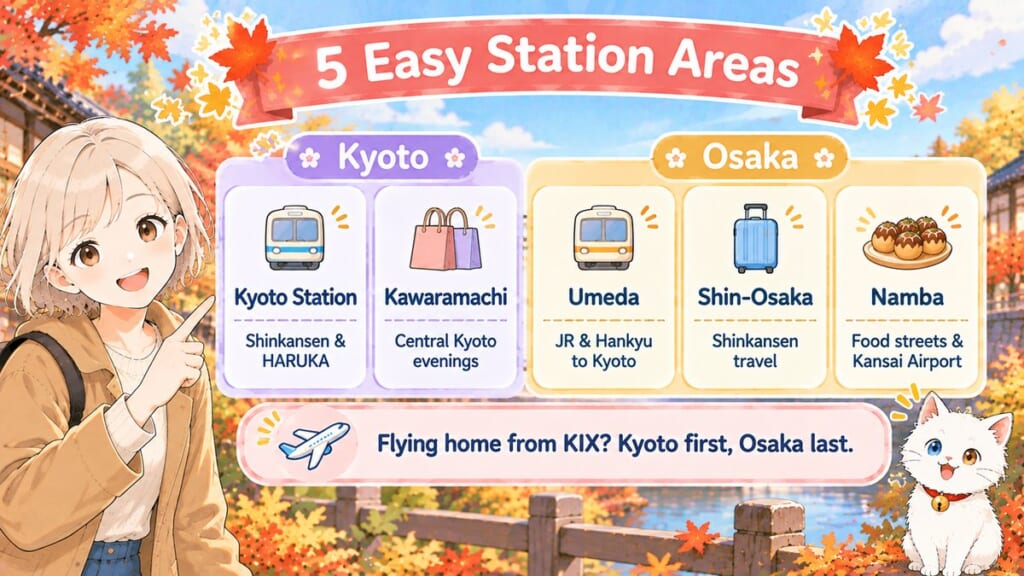
Once you’ve decided which city suits your trip, the next choice is the station area.
You don’t need to research every neighborhood in Kyoto and Osaka right now. Start with these five areas, depending on your arrival route and what you plan to do most.
Kyoto Station: For Train Connections and Early Departures
Kyoto Station is a practical starting point if you’re arriving by Shinkansen, using HARUKA from Kansai Airport, or taking JR trains during your stay. It’s worth considering if easy arrivals and departures matter more to you than having your hotel in the middle of Kyoto’s historic shopping streets.

One hotel to start with: Hotel Granvia Kyoto (Kyoto Station)
Kawaramachi: For Central Kyoto Evenings
Kawaramachi is worth looking at if you want restaurants, shopping, and access to central Kyoto on foot. It also works well with Hankyu connections from Osaka, making it an appealing choice if you want to enjoy Kyoto’s evenings without returning to another city afterward.

One hotel to start with: Mitsui Garden Hotel Kyoto Shijo (Shijo / Kawaramachi)
Umeda: For Osaka and Kyoto Rail Connections
Umeda is a useful Osaka base when your trip includes Kyoto day trips alongside Osaka sightseeing. You can consider both JR and Hankyu connections while keeping Osaka’s shopping and dining options nearby.

One hotel to start with: Hotel Hankyu RESPIRE OSAKA (Umeda)
Shin-Osaka: For Shinkansen Travel
Shin-Osaka makes sense if you’re arriving from Tokyo by Shinkansen or planning another long-distance train journey. It’s a practical place to start when railway access is high on your priority list.

One hotel to start with: remm Shin-Osaka (Shin-Osaka)
Namba: For Food Streets and Kansai Airport
Namba is an appealing choice if Osaka’s evening food scene is high on your list. It also offers Nankai Railway connections to Kansai Airport, so it’s worth considering for the final part of a trip before flying home.

One hotel to start with: Hotel Keihan Namba Grande (Nankai Namba)
These are starting points, not five hotel areas you need to visit.
For a closer look at which Osaka station area fits your itinerary, see my Osaka station area guide. For Kyoto accommodation during the spring peak season, see my Kyoto cherry blossom hotel guide.
Choose the city first, then look for a hotel near the transport and activities you’ll actually use. That’s a much simpler way to narrow the search.
How We Would Choose for Our Own Trip
If I were choosing a Kansai base for my family, Osaka would probably win.
I’d rather plan our evenings around food and walking through the city than organize several early temple starts. That’s the kind of trip I can picture enjoying with my family.
But if you told me your biggest dream was seeing Kyoto’s temples early in the morning, I’d suggest looking at Kyoto first.
And if you had several nights to spare, with plenty of things you wanted to do in both cities, I’d seriously consider splitting the stay.
 So I’m returning to the question I started with:
What do you want to see most?
Not what everyone else thinks you should see. Not which city gets more recommendations on a travel forum. The experience you’re most excited to have.
Once you know that, choosing where to sleep becomes much easier.
FAQ
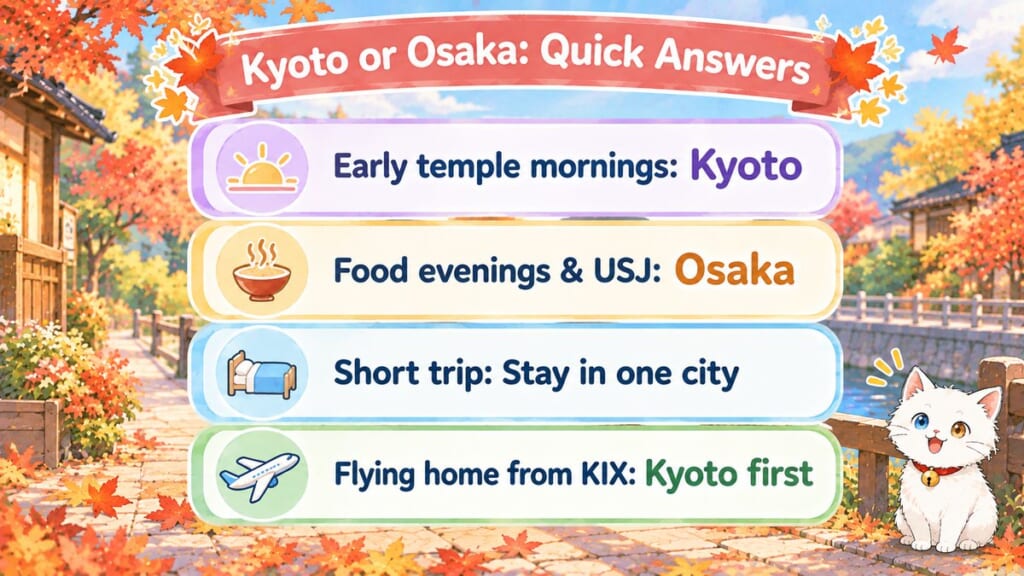
Is it better to stay in Kyoto or day trip from Osaka?
Stay in Kyoto if you want several early temple visits or enjoy spending your evenings there. Day-tripping from Osaka can work well if you’re visiting Kyoto for a day or two and most of your other plans are based around Osaka.
Is Osaka or Kyoto cheaper for hotels?
Osaka usually shows more hotel listings than Kyoto, which gives you more choice across budgets, but that doesn’t guarantee a lower rate for your dates. Compare the same travel dates, room requirements, and cancellation conditions in both cities, then add the cost of any daily transportation to Kyoto.
Should I do Kyoto or Osaka first?
If you’re flying home from Kansai Airport, Kyoto first and Osaka last can be a convenient arrangement. If you’re arriving by Shinkansen or have specific dates for USJ and other attractions, choose the order that fits your actual plans.
How many days to split between Osaka and Kyoto?
For four nights, two in Kyoto and two in Osaka is a reasonable starting point. With five to seven nights, consider giving the extra nights to whichever city has more of your priority activities, rather than forcing an even split.
Is Osaka or Kyoto better with kids?
Both can work well for families, so I’d choose based on your children’s routines and the activities you want to do. If your trip is short, staying in one city can save the effort of packing and changing hotels, while a longer trip may make a split more comfortable.
If you’re planning the rest of your visit, my Plan Your Japan Trip page has more guides to help you put the pieces together.
Have you decided on Kyoto, Osaka, or a little of both? I’d love to hear what you’re planning, so tell me in the comments!
I hope this guide has answered one of your questions and helped you feel a little closer to Japan.
May your Japan journey be filled with wonderful discoveries and memories you’ll treasure for years to come.
See you in the next guide.
Comments