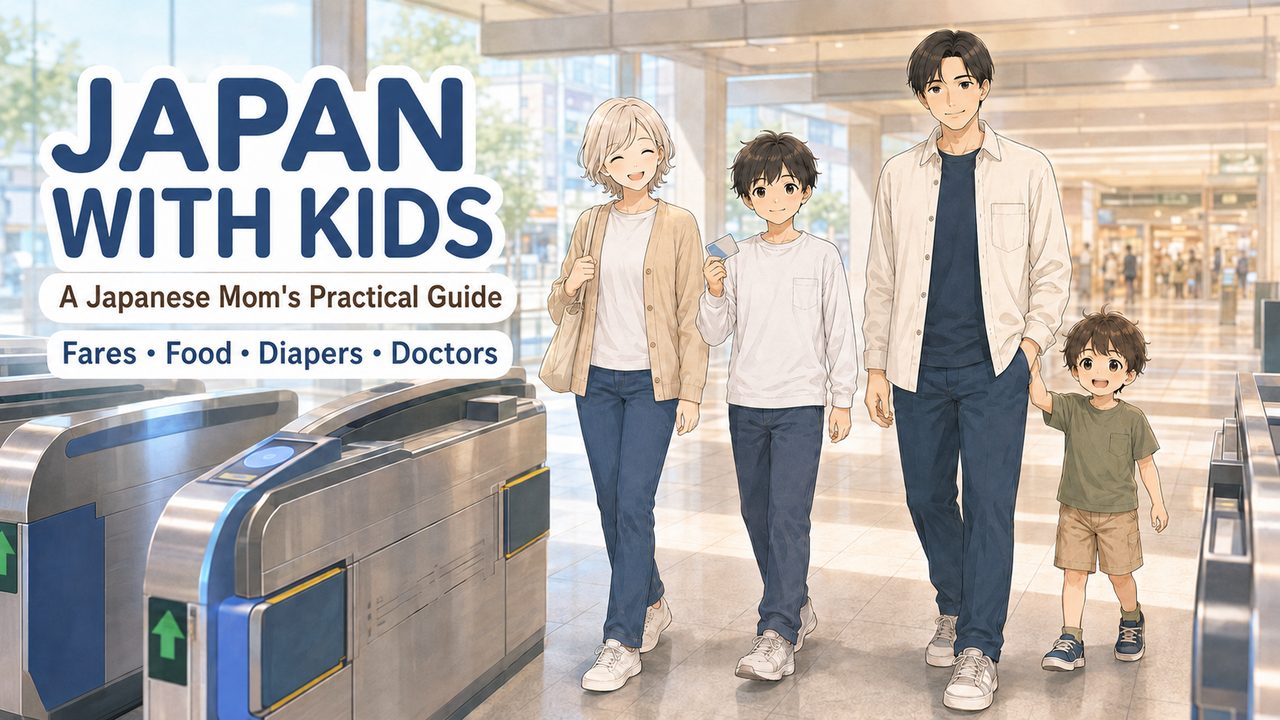
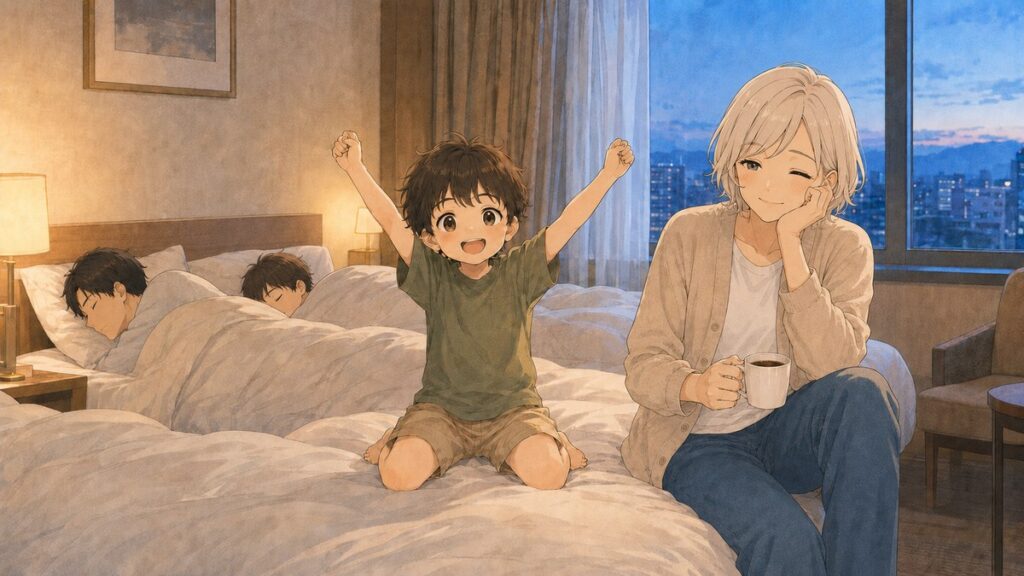
It’s 6 a.m., your toddler has been awake since 3, and the hotel breakfast doesn’t open until 7. Welcome to your first morning in Japan with kids.
I do think Japan is a kid-friendly country. Trains are clean, changing tables are easy to find in cities, and many everyday restaurants are used to serving families. But “kid-friendly” doesn’t always mean “works the same way as home.” A preschooler may ride a train free but need a child ticket if you want a reserved seat. A convenience store may save breakfast, yet it probably won’t save you when you run out of diapers. A hotel may allow free co-sleeping, but its age limit could mean preschoolers only or children through elementary school.
I’m YUU, a Japanese mom raising two boys in Japan. My older son is in his final year of elementary school, while my younger son is four and has recently moved beyond the toddler stage. In this guide, I’ll explain the details parents actually need: child fares, restaurants, diapers and formula, nursing rooms, medical help, hotel bed-sharing rules, and attraction age categories. Japan is welcoming to families — you just need to know where its everyday rules differ from yours.

Disclosure: This article contains affiliate links. If you book through one, I may earn a small commission at no extra cost to you.
In a hurry? Everything in this guide, in one list:
- USJ tickets on Klook — the family favorite
- teamLab Planets tickets — the other kid-magnet
Both sell out on school-holiday dates — book before you fly.
- Is Japan Kid-Friendly? An Honest Answer (and Why Jet Lag Comes First)
- Kids’ Train, Bus & Taxi Fares — the Rules Nobody Explains
- Trains, Tantrums & Manners
- Eating Out with Kids: Which Restaurants Actually Work
- Diapers, Formula, Baby Food & Nursing Rooms
- When Your Child Gets Sick in Japan
- Hotels: Co-Sleeping Rules & Where a Family of Four Fits
- Toilets, Changing Tables & Family Restrooms
- What to Pack vs. What to Buy in Japan (Kids Edition)
- Kid-Friendly Places & Age Tiers (Read Before You Buy Tickets)
- FAQ About Visiting Japan with Kids
- Final Thoughts
Is Japan Kid-Friendly? An Honest Answer (and Why Jet Lag Comes First)
Yes, Japan is worth visiting with children. Streets and public transportation generally feel safe and orderly, public toilets are common, and changing tables appear in many stations, shopping centers, department stores, and multipurpose restrooms. At family-oriented restaurants, children’s cups, bowls, cutlery, and chairs are ordinary rather than unusual requests.
 The harder part is often not Japan itself. It’s trying to make a child follow an adult sightseeing schedule while their body still thinks it’s nighttime. If you’re arriving after a long flight, leave the first two or three days lighter than the rest of your trip. A convenience-store breakfast, a nearby park, and an early dinner can be a successful day.
I would also leave one low-pressure day every two or three days, especially when traveling in Japan with a toddler. It doesn’t need to mean sitting in the hotel all day. It can mean waking without an alarm, doing laundry, eating somewhere close, and choosing one small outing only if everyone still has energy. That empty space works like a shock absorber when sleep, weather, or moods don’t follow the plan.
 And please don’t build your itinerary around the idea that Japanese children are somehow born quiet. They aren’t. My children can sit calmly on a train, and they can also get tired and grumpy like children anywhere else. The practical advantage is that Japan gives parents plenty of ordinary places to pause: a department-store baby room, a family restaurant, a food court, or simply the next train station.
Kids’ Train, Bus & Taxi Fares — the Rules Nobody Explains
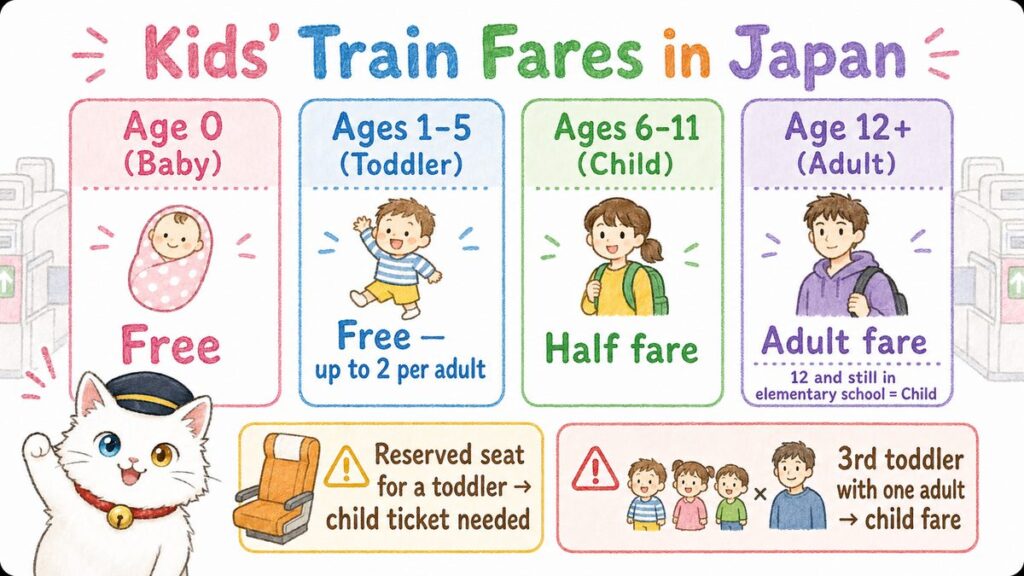
Child train fare in Japan looks simple until age, school grade, and seat use overlap. The first rule to remember is that the railway definition of “child” follows school status, not only the number of birthdays: a 12-year-old who is still in elementary school is treated as a child, not an adult.
| Passenger category | Age or school status | Basic railway rule |
|---|---|---|
| Adult | Age 12 or older | Adult fare, except a 12-year-old still in elementary school |
| Child | Elementary-school-age children, generally ages 6–11, plus 12-year-olds still in elementary school | Basic fare, limited express fare, express fare, and ordinary reserved-seat fare are generally about half the adult amount; the exact fare and rounding method depend on the operator and payment method |
| Infant / toddler | Preschool-age children, generally ages 1–5 | Usually free when accompanied, up to two per accompanying fare-paying passenger |
| Baby | Age 0 | Usually free when accompanied |
A six-year-old who has not yet started elementary school may still be treated as a preschooler under the operator’s rules. When a child is close to the school-year boundary, check the railway’s official age guidance rather than relying on age alone.
 The phrase “children under six ride free” is only a shorthand version of the rule. Up to two preschool-age children may usually travel free with one accompanying fare-paying passenger. A third preschool-age child, or a preschool-age child traveling alone, generally needs a child fare. A six-year-old who has not yet started elementary school may still fall into the preschool category, depending on the operator’s rules.
Seat use matters too. If a baby or preschooler occupies a reserved seat on a Shinkansen or limited express train, you need the applicable child ticket and seat reservation. The same applies when a young child uses a Green Car reserved seat or a bed. Green Car charges themselves aren’t discounted for children. If your child sits on your lap in unreserved seating, the usual accompanied-child rule applies.
At ordinary ticket gates, a baby or preschooler without a ticket goes through with the accompanying adult. A school-age child uses a child ticket or a child IC card. Apple Pay PASMO supports adult fares only, so don’t create a regular digital PASMO on your child’s phone and assume it will charge the child fare. Buy a child PASMO or Suica through an eligible station counter or machine, with proof of age if requested, or use paper child tickets. If you’re deciding which IC card to buy, I compare them here: Suica vs. PASMO.
Bus systems set their own fares, so check the operator when planning a route. The general age categories may look familiar, but the exact child fare and the number of free preschoolers can differ from the railway rule. If you don’t want to work it out at the bus stop with a tired child, ask the driver or station staff before boarding.
 Taxis can be a useful reset button for a family of four, especially for a short trip with bags or a sleeping child. Japanese law exempts taxis and buses from the requirement to provide a child seat for children under six, so families may ride without one. That is a legal exemption, not a statement that restraints don’t matter; if a child seat is important to you, arrange one in advance with a suitable service.
For stroller access, elevators, station transfers, and when a baby carrier is easier, I have a separate practical guide. The short version is to allow more transfer time than a route app suggests. The full version is here: do you really need a stroller in Japan?
Trains, Tantrums & Manners
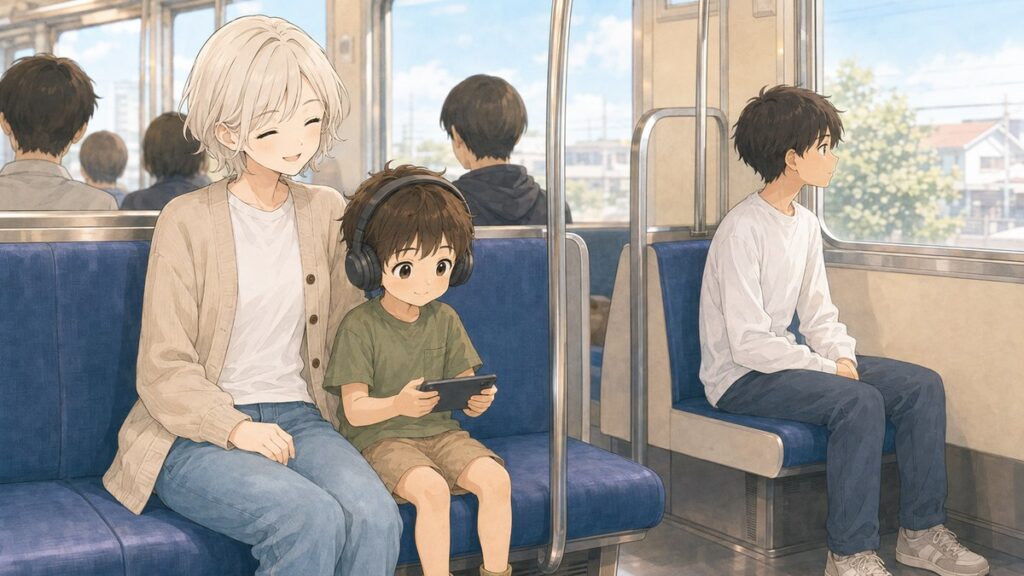
Japanese commuter trains are usually quiet, but parents aren’t expected to perform magic. A baby may cry and a preschooler may complain. What people notice most is whether the adult is making a reasonable effort, not whether the child stays silent for the entire ride.
If crying becomes intense and you aren’t on a reserved long-distance train, many parents step off at the next station, calm the child on the platform, and take a later train. You don’t have to jump off after one small sound. Think of it as an option when both you and your child need the pressure to drop.
Look for cars marked with priority seating or stroller symbols, but don’t assume those spaces will always be empty. Keep the stroller brake on, avoid blocking the doors, and move when people need to pass. During a crowded commute, folding a stroller may be helpful if you can do it safely, though managing a child, bags, and a folded stroller at once isn’t always realistic.
 My boys are usually calm on trains. When my younger son starts getting restless, though, the thing that works best for us is YouTube — with headphones or the sound turned off. It isn’t a poetic parenting secret, but it can make the difference between a peaceful ride and everyone reaching their limit.
What normally helps your child through a long ride: a snack, a small toy, a window seat, or a screen? Bring that familiar tool instead of hoping the excitement of Japan will carry them through every transfer. Travelers often say people around them were more understanding than they had feared, but basic consideration still goes a long way.
Eating Out with Kids: Which Restaurants Actually Work
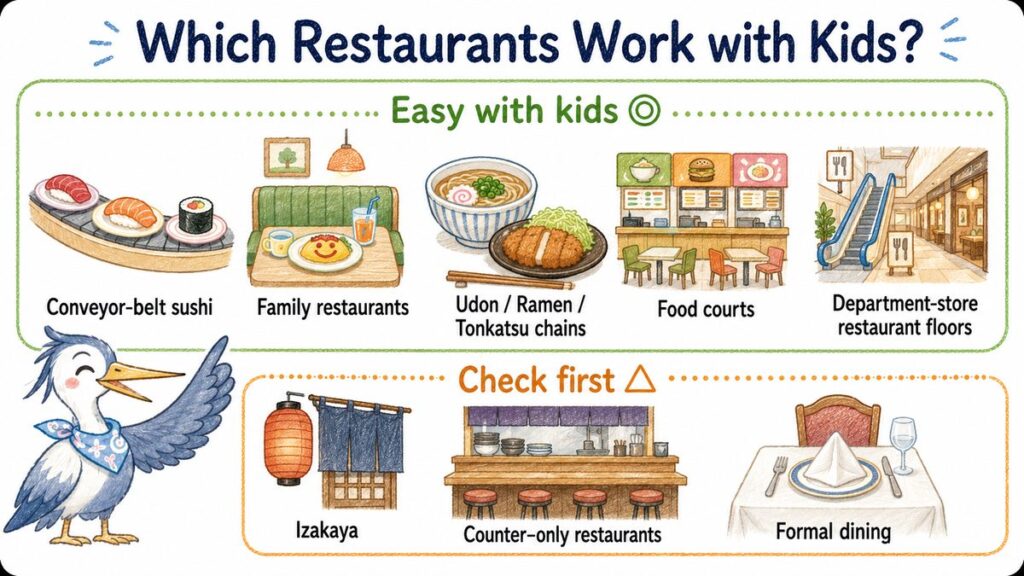
The answer to “Do restaurants in Japan have high chairs?” depends less on the city and more on the type of restaurant. Family restaurants, conveyor-belt sushi chains, food courts, and department-store restaurant floors are built for a broad mix of customers. A tiny counter restaurant or formal dining room may have no child chair, no space for a stroller, and no children’s menu at all.
| Restaurant type | What families can commonly expect | What to check first |
|---|---|---|
| Conveyor-belt sushi chains such as Sushiro, Kura Sushi, and Hama Sushi | Booth seating, small dishes, and a casual atmosphere | High-chair availability at that branch and wait time |
| Family restaurants such as Gusto, Jonathan’s, Coco’s, Bikkuri Donkey, and Royal Host | Children’s dishes, child chairs, and family-friendly seating are common | Menu and allergen information for the specific chain |
| Udon, ramen, and tonkatsu chains | Quick meals and familiar choices for many families | Counter-only seating, spice level, and child chairs |
| Food courts | Each family member can choose a different meal | Shared seating and busy periods |
| Department-store restaurant floors | Several restaurant choices in one building, often near good restrooms | Peak-hour queues and each restaurant’s child policy |
| Izakaya, counter-only restaurants, and formal restaurants | Facilities vary widely; some aren’t suitable for young children | Whether children are admitted, table seating, and high chairs |
Our family often chooses conveyor-belt sushi, udon, ramen, or a tonkatsu chain. These places commonly have the child menu, chair, and tableware that make a meal easier. The sushi circles past, everyone can order at their own pace, and a child choosing fries at a sushi restaurant doesn’t cause a crisis.
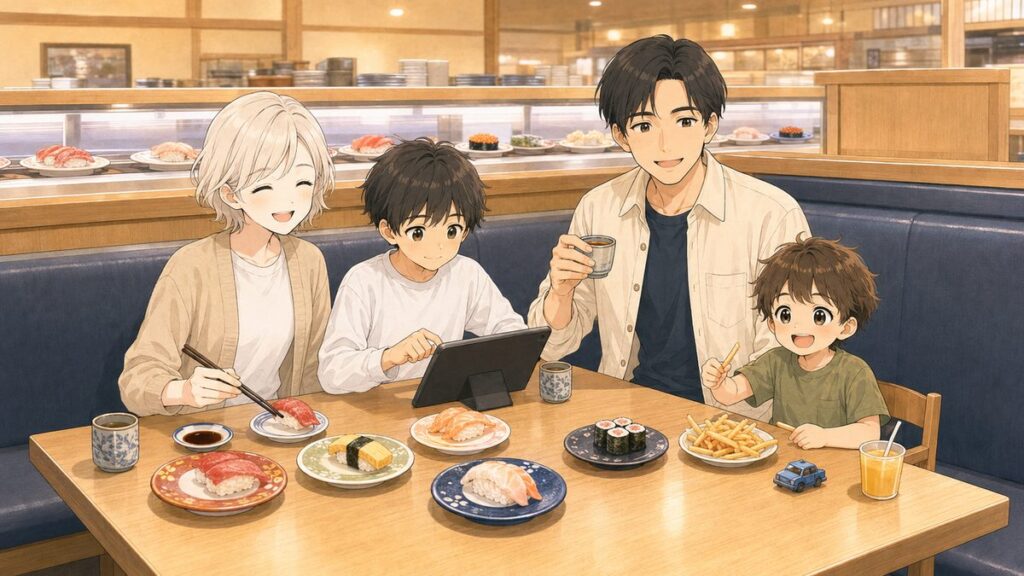
My four-year-old doesn’t always eat much. But when a kids’ plate comes with juice or a small toy, he gets excited and sometimes eats more than usual. If the adults want spicy food he can’t eat, a food court solves the argument before it starts: each person chooses from a different counter, then everyone sits together.
 Outside food is generally not appropriate in a restaurant, while food courts are designed for meals bought from different vendors in the shared area. Baby-food policies vary. Many casual family restaurants are accommodating, but ask staff before opening your own food instead of assuming. An allergy card written in Japanese and English is also useful because it gives staff something clear to read rather than relying on a hurried spoken explanation. If you want the wider table manners picture before you go, start with my guide to restaurant etiquette in Japan.
Convenience stores are another quiet hero for families, even though they aren’t restaurants. We often buy breakfast there and eat it as a picnic by the sea; sometimes that relaxed breakfast becomes lunch too. Rice balls, bread, yogurt, fruit, and simple drinks let you feed everyone without waiting for a table, although you should eat in an appropriate place rather than while walking through a crowded street. There are a few unwritten rules worth knowing, and I cover them in my convenience store guide.
Diapers, Formula, Baby Food & Nursing Rooms
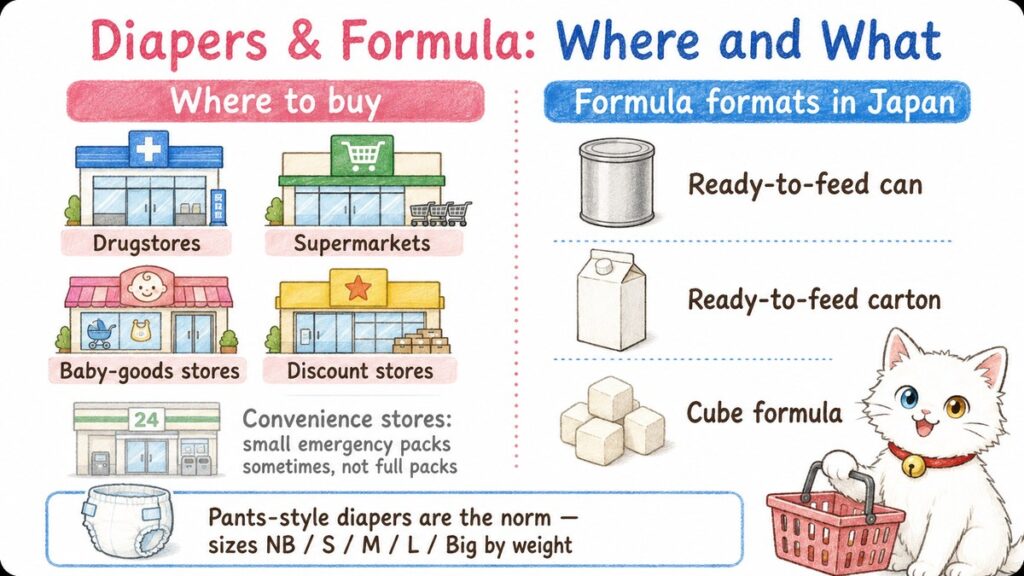
If you’re wondering where to buy diapers in Japan, don’t make the convenience store your main plan. Most convenience stores don’t routinely stock full packs. Start with a drugstore, supermarket, or baby-goods store instead.
| What you need | Places most likely to carry it | Useful names to recognize |
|---|---|---|
| Diapers and wipes | Drugstores, supermarkets, Nishimatsuya, Akachan Honpo, Babies“R”Us, Don Quijote | Merries, Moony, Pampers, GENKI |
| Liquid or powdered baby formula | Drugstores, supermarkets, and baby-goods stores | Meiji Hohoemi Raku Raku Milk, Glico ICREO Akachan Milk |
| Cube formula | Drugstores, supermarkets, and baby-goods stores | Meiji Hohoemi Raku Raku Cube |
| Baby food | Drugstores, supermarkets, and baby-goods stores | Wakodo, Kewpie, Pigeon |
| Nursing and changing facilities | Department stores, shopping malls, large stations, Akachan Honpo, multipurpose restrooms | Mamamap / ママパパマップ and Baby map |
Drugstore chains include Matsumoto Kiyoshi, Welcia, Sundrug, Tsuruha, and Cocokara. Aeon and Ito-Yokado supermarkets can also be practical because you can buy baby supplies, food, and drinks in one stop. Akachan Honpo offers tax-free shopping at participating stores for eligible visitors, so check the store and purchase conditions rather than assuming every purchase qualifies. The conditions are explained in my tax-free shopping guide.
When my children wore diapers, I bought them at Nishimatsuya, drugstores, and our local supermarket. I used the supermarket most often because some stores carried larger packs. On trips, I have occasionally found small packs containing only a few diapers at convenience stores, and they were useful — but availability is too inconsistent to rely on.
Pull-up or pants-style diapers are especially common in Japan. Packages use labels such as NB, S, M, L, and Big, with a weight guide printed on the package. Don’t choose by the letter alone; compare your child’s weight and body shape with the chart because sizing can feel different from the brand you use at home.
Baby Formula You May Not Know About
Japanese baby formula isn’t limited to a large tin of powder. Meiji Hohoemi Raku Raku Milk comes in ready-to-feed cans that can be stored at room temperature, while Glico ICREO Akachan Milk comes in a ready-to-feed paper carton. Meiji Hohoemi Raku Raku Cube is solid cube formula, so you don’t have to measure loose powder.
These formats can be helpful in a hotel room or during a travel day, but switching formula may not suit every baby. If your baby relies on a particular brand or has allergies or feeding needs, bring an adequate supply from home and ask a medical professional before making a change. Japan’s tap water is generally safe to drink. When preparing powdered formula, follow the instructions on the specific package, including its directions for water temperature, mixing, and cooling. Do not assume that bottled water or previously boiled water changes those preparation instructions.
For baby food, look for Wakodo pouches, cups, and freeze-dried products, along with Kewpie jars and Pigeon products. Check the age guidance, texture, ingredients, and allergen information on each package. A translation app can help with the label, but it shouldn’t replace careful checking when an allergy is involved.
Nursing Rooms and Baby Rooms
Department stores, shopping malls, large stations, and baby-goods stores are the most reliable places to look for a nursing room in Japan. Facilities vary, but listings may show changing tables, private nursing spaces, hot water, a microwave, or a stroller rental. Multipurpose toilets often include a changing table or baby chair, though they aren’t the same as a full baby room.
When my boys were babies, I planned outings around places with good facilities, especially Aeon and other shopping malls. That was easier than waiting until someone was hungry or needed changing and then searching under pressure. Mamamap, also called ママパパマップ, and Baby map can help you check facilities in advance; Mamamap listings may include photos and details such as hot water or a microwave.
When Your Child Gets Sick in Japan
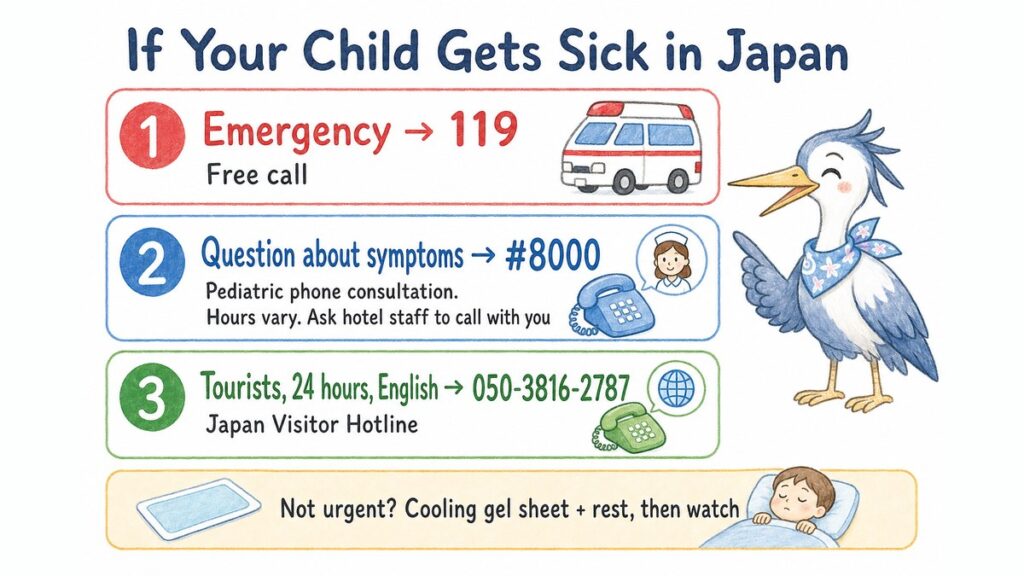
If your child has a medical emergency in Japan, call 119 for an ambulance or the fire service. The call is free. If you cannot explain the location or situation in Japanese, ask a hotel employee, station worker, or nearby person for help as quickly as possible.
For a non-emergency question about a child’s symptoms, Japan has the pediatric emergency telephone consultation line #8000. Nurses or doctors provide guidance, especially outside ordinary clinic hours, but operating times differ by prefecture and English service isn’t guaranteed. A hotel staff member may be able to call with you or on your behalf.
International visitors can also call the Japan Visitor Hotline at 050-3816-2787. From outside Japan, use +81-50-3816-2787. It operates 24 hours a day, 365 days a year, with support in English, Chinese, and Korean for illness, accidents, emergencies, disasters, and general tourist information.
If the situation isn’t urgent, the hotel front desk or visitor hotline can help you find a clinic. A large hospital emergency department may be appropriate when urgent care is needed, but don’t choose a facility based only on size; ask for help matching the situation to a service that is open and able to assist. Without insurance coverage, you may need to pay the full cost yourself, so travel insurance details should stay accessible rather than buried in a suitcase.
When one of my children develops a fever away from home, I first look at how he is doing overall and seek medical advice if I am unsure. If there are no signs that it is an emergency, I may also buy a cooling gel sheet such as Netsusama Sheet or a cold pillow similar to an Ice Non product to help him feel more comfortable. I don’t casually buy medicine just because it is on a drugstore shelf. Cooling products may provide comfort, but they don’t treat the cause of a fever.
Japanese drugstores do sell children’s over-the-counter medicines. You may see an acetaminophen product such as Bufferin for Kids or a children’s cold syrup such as Kodomo Pabron. Don’t choose by the familiar-looking box alone: confirm the child’s age on the package and ask the pharmacist or a doctor if you are unsure. You may not find the same children’s Tylenol product you use at home, so the ingredient name acetaminophen is more useful than relying on a brand name.
Travelers may bring up to a two-month supply of ordinary over-the-counter medicines into Japan without prior permission. For regular medication, allergy treatment, or anything essential to your child’s care, bring the product you already know, keep it in its original packaging, and check Japan’s current import rules before departure.
Hotels: Co-Sleeping Rules & Where a Family of Four Fits
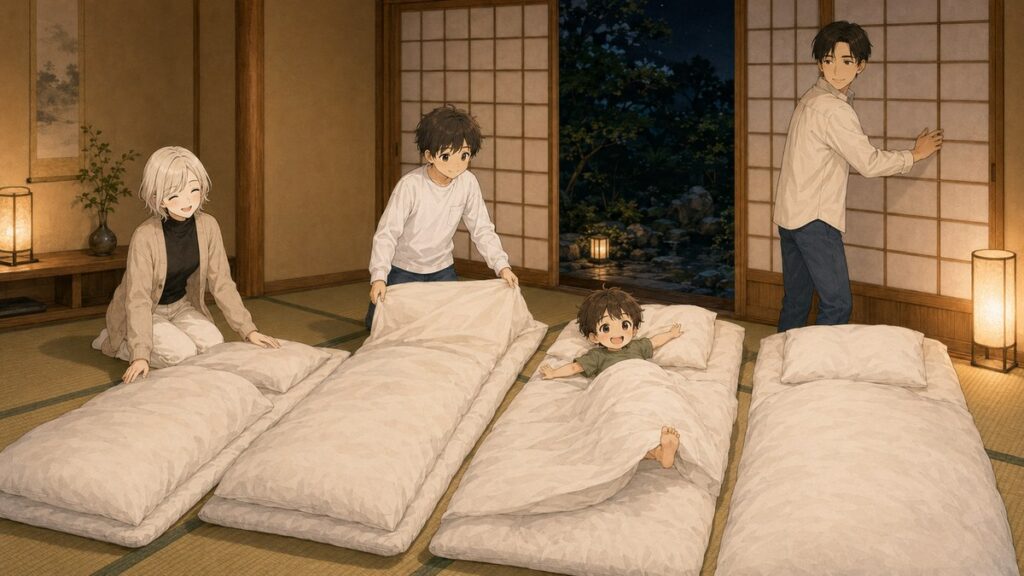
Japan hotel co-sleeping rules can make a family stay less expensive, but the words “children stay free” are never enough by themselves. The usual concept is soine, or bed-sharing: a child stays without a separate bed and may be free under that property’s age and occupancy rules. The upper age, number of children per bed, breakfast, towels, and amenities can all differ.
| Hotel example | Published bed-sharing age rule | What the rule does not automatically promise |
|---|---|---|
| APA Hotel | Preschool-age children may share a bed free | A separate bed, meals, or extra amenities |
| Toyoko Inn | Children of elementary-school age or younger may share a bed free | More than one child per bed or a separate bed |
| Comfort Hotel | Children through the sixth grade of elementary school may share a bed free | A larger room or extra bedding |
These hotel names are examples of different policies, not recommendations. Always read the rule for the exact property and room you are booking. On a reservation site, wording such as “Child, no bed, no meal” usually means the child is included under a bed-sharing plan without separate bedding or food. It doesn’t mean you can quietly add a child to a room that exceeds occupancy limits.
A standard double room can feel much smaller once two adults, a child, a stroller, and open suitcases are inside. For a family of four, look for a Japanese-style room with futons, a family room, an apartment hotel, or a ryokan whose stated capacity fits everyone. Check the room size, bed configuration, and bed-sharing limit before paying.
For our family, a Japanese-style room with futons is the easiest choice. Nobody is going to roll out of a high bed, and we can rest without trying to divide four people between beds that weren’t meant for us. Futons also let the room work differently during the day and at night — but children must still be included honestly in the reservation.
Toilets, Changing Tables & Family Restrooms
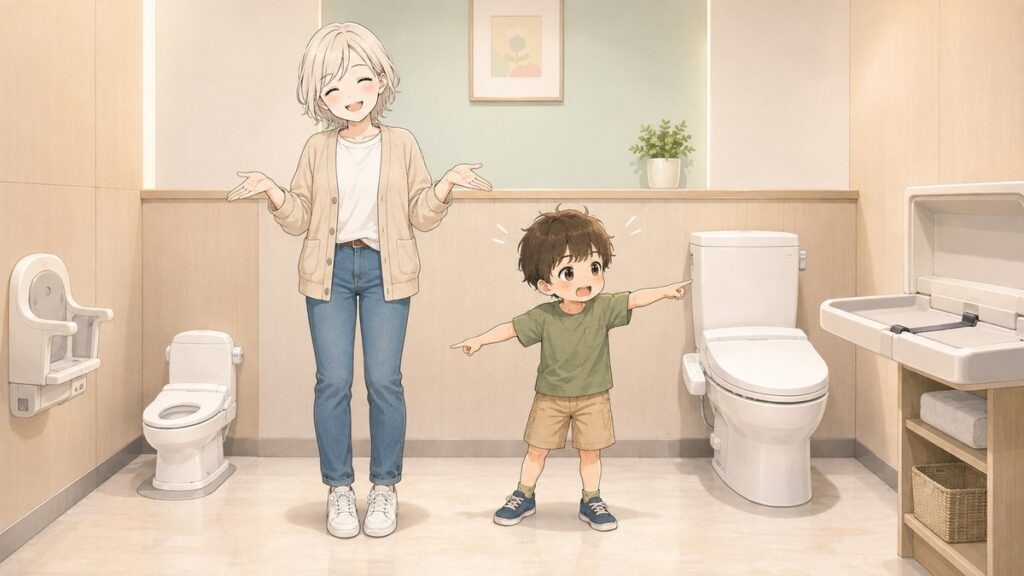
Public toilet access is one of the parts of family travel that Japan handles well. Large stations, department stores, shopping malls, highway service areas, and many attractions have multipurpose or family restrooms. You may find a changing table, a fold-down baby chair, more floor space, and sometimes a child-size toilet or urinal.
The wording and icons vary. Look for “multipurpose toilet,” “accessible toilet,” a wheelchair symbol, a baby symbol, or a family icon. Use the room when you need its facilities, but remember that people with disabilities may rely on it because an ordinary stall isn’t usable for them. If a standard restroom has the equipment your family needs, that may be the more considerate choice during a queue.
Department-store and shopping-mall baby rooms are better for a full stop. They may combine changing tables, nursing spaces, sinks, and feeding equipment in one area, while a station restroom may offer only a changing table. If you’re planning a long city day with a baby, mark one good shopping center on your map before you leave the hotel.
 Shopping malls sometimes have tiny toilets sized for children, and I think they’re genuinely convenient. My younger son disagrees. He wants to use the same toilet as an adult, which is a useful reminder that a child-friendly facility is only helpful if your particular child accepts it.
Then there are the washlet buttons. A control panel beside the toilet looks irresistible to many children, so show them the flush symbol before they start testing everything else. It can prevent a surprise spray and a wet parent standing in a very clean restroom.
What to Pack vs. What to Buy in Japan (Kids Edition)
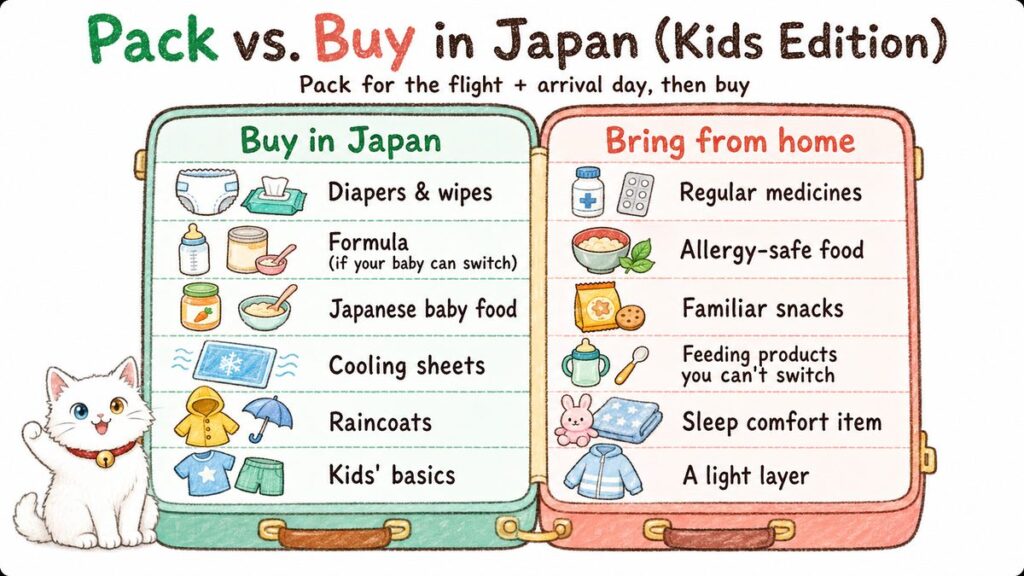
You can buy many bulky everyday items after arrival, but “available in Japan” doesn’t mean “available in the first shop beside your hotel.” Pack enough for the flight, your arrival day, and an unexpected delay. Then buy replacements at a drugstore, supermarket, or baby-goods store once you have settled in.
| Usually reasonable to buy in Japan | Better to bring from home |
|---|---|
| Diapers and wipes | Prescription and regular medicines |
| Liquid, cube, and powdered formula, if your baby can use Japanese products | Allergy-safe food your child depends on |
| Japanese baby food, after checking ingredients and age guidance | A small supply of familiar snacks |
| Children’s cooling sheets | Any feeding product your baby cannot easily switch |
| Raincoats | Comfort item for sleep or long journeys |
| Children’s basics from stores such as Uniqlo or GU | A light layer for strong indoor cooling or heating |
For diapers, formula, and baby food, don’t arrive with nothing. A late check-in, closed drugstore, or unfamiliar label can turn a simple purchase into the hardest part of the day. A small buffer gives you time to compare packages calmly.
The items in the right-hand column are less about what Japan lacks and more about avoiding an unnecessary experiment during a trip. A child who rejects every unfamiliar snack at home may not become adventurous after a long flight. Familiar medication, food, and one sleep item can be a small bridge between home and a completely new room.
If buying supplies makes your suitcase grow during the trip, luggage forwarding can keep station transfers manageable. For clothing, check the season-specific guide rather than packing for “Japan” as though the entire country has one temperature. Sending bags ahead is easier than most visitors expect — here is how luggage forwarding works. For clothing, check the season you are actually visiting: autumn and winter.
Kid-Friendly Places & Age Tiers (Read Before You Buy Tickets)
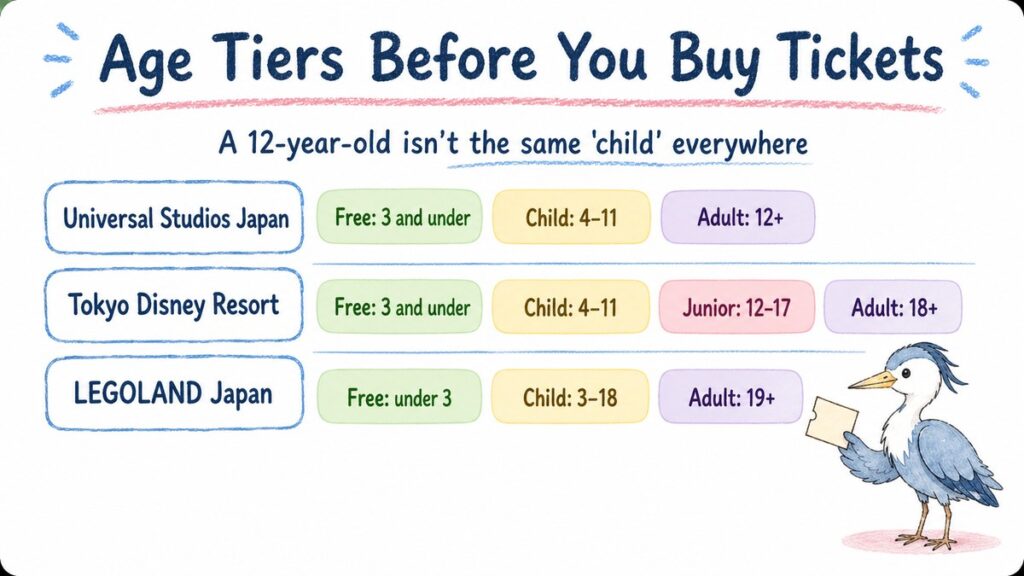
There isn’t one national definition of a child ticket. A 12-year-old may still count as a child on a train or at Universal Studios Japan while in elementary school, but as a junior at Tokyo Disney Resort. Each operator and attraction uses its own wording, so age alone does not always tell you which ticket to buy. Read the age category for every attraction before buying tickets, especially when an older child is close to a boundary.
| Attraction | Free admission category | Child or junior category | Adult category |
|---|---|---|---|
| Universal Studios Japan | Age 3 and under | Child: ages 4–11, plus 12-year-olds still in elementary school | Adult: age 12 and older once in junior high school |
| Tokyo Disney Resort | Age 3 and under | Child: ages 4–11; Junior: ages 12–17 | Adult: age 18 and older |
| LEGOLAND Japan | Under age 3 | Child: ages 3–18 | Adult: age 19 and older |
USJ specifically notes that a 12-year-old who is still in elementary school is eligible for the child price. Because ticket wording and conditions can change, check the official ticket page on the day you book rather than relying on the age number alone.
My older son is 12, so this shift from elementary-school rules to junior-high rules is very real in our family. The number on his birthday doesn’t produce the same category everywhere. Before I buy, I check the attraction’s wording instead of carrying the railway rule over to the theme park.
Age is only the first filter. Attraction height requirements, fear level, walking distance, naps, and the child’s actual interests matter more than a list calling somewhere “kid-friendly.” A preschooler who loves vehicles and an older child who wants thrill rides can have completely different versions of a good day. Universal Studios Japan tickets on Klook and teamLab Planets tickets are two easy ones to book in advance. If Universal Studios Japan is on your list, I also explain whether the Express Pass is worth it.
FAQ About Visiting Japan with Kids
Is Japan worth visiting with kids?
Yes. Japan combines reliable transportation, many public toilets, family-oriented restaurants, and attractions for different ages. The trip works best when you plan fewer fixed activities than you would for adults and leave room for sleep, meals, and unplanned breaks.
What’s the best age to take kids to Japan?
There is no single best age. A baby may be portable but needs feeding and changing facilities; a toddler needs naps and space to move; a school-age child can participate more but may have stronger preferences. Choose the age when the trip feels manageable for your family, then build the pace around the child you actually have.
Which part of Japan is most kid-friendly?
Large cities make everyday logistics easier because stations, malls, drugstores, hospitals, and family restaurants are close together. Smaller destinations can be calmer, but transportation and baby facilities may require more planning. The most kid-friendly base is often the one that reduces daily transfers and keeps food and supplies near your accommodation.
Is Japan good with a baby under one?
Japan can work well with a baby, especially when you plan around department stores, shopping malls, large stations, and baby-goods stores with nursing and changing facilities. Bring the formula, medication, and allergy-safe food your baby depends on, and use an app such as Mamamap to check facilities before leaving the hotel.
Do kids ride trains free in Japan?
Babies and preschool-age children usually ride free when accompanied, but only up to two preschool-age children per accompanying fare-paying passenger. School-age children pay a child fare, and a baby or preschooler needs a child ticket when using their own reserved seat. A six-year-old who has not yet started elementary school may still be treated as a preschooler, while a 12-year-old still in elementary school is treated as a child under the railway rule.
Can I buy diapers and formula in Japan?
Yes. Drugstores, supermarkets, Nishimatsuya, Akachan Honpo, and other baby-goods stores commonly carry diapers, formula, and baby food. Convenience stores usually aren’t reliable for diapers, although an individual branch in a travel area may sometimes have a small emergency pack.
Final Thoughts
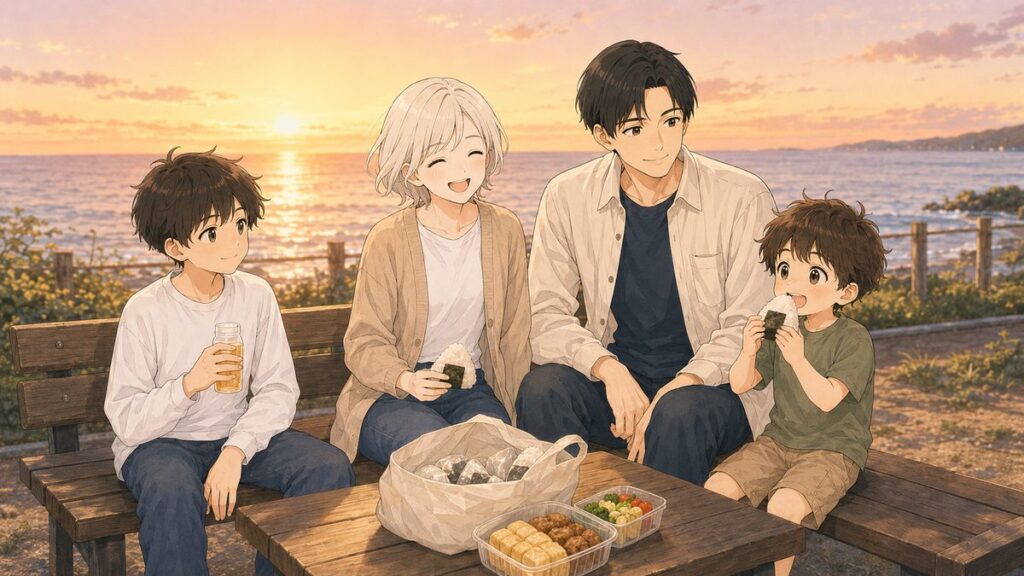
I think Japan is a kid-friendly country. Not because children never cry or every doorway fits a stroller, but because ordinary life gives families many workable options: a food court when everyone wants something different, a shopping-mall baby room, a clean place to change a diaper, or a Japanese-style room where four people can sleep on futons.
The trip becomes easier once you stop expecting the rules to match home. Check the seat rule as well as the child’s age, shop for diapers by store type, read the hotel’s bed-sharing limit, keep 119 and the visitor hotline accessible, and leave enough blank space in the itinerary for your child to be tired.
 In our family, convenience-store picnics, casual chain restaurants, and Japanese-style rooms aren’t backup plans. They’re often the parts that make a family day work. What is eating out with children like in your country — and which ordinary family habit would you bring with you to Japan? Tell me in the comments below. I read every single one!
Check Universal Studios Japan tickets on Klook
I hope this guide has answered one of your questions and helped you feel a little closer to Japan. May your Japan journey be filled with wonderful discoveries and memories you’ll treasure for years to come.
See you in the next guide. 
Comments