You have probably found completely different answers while comparing Airalo and Ubigi for Japan. One traveler says Airalo worked perfectly. Another insists that Ubigi is the safer choice. Both may be telling the truth.
The reason is that the brand name is only part of the connection. Airalo and Ubigi use different combinations of Japanese mobile networks, and the difference becomes more important once you leave Tokyo, Kyoto, and Osaka.
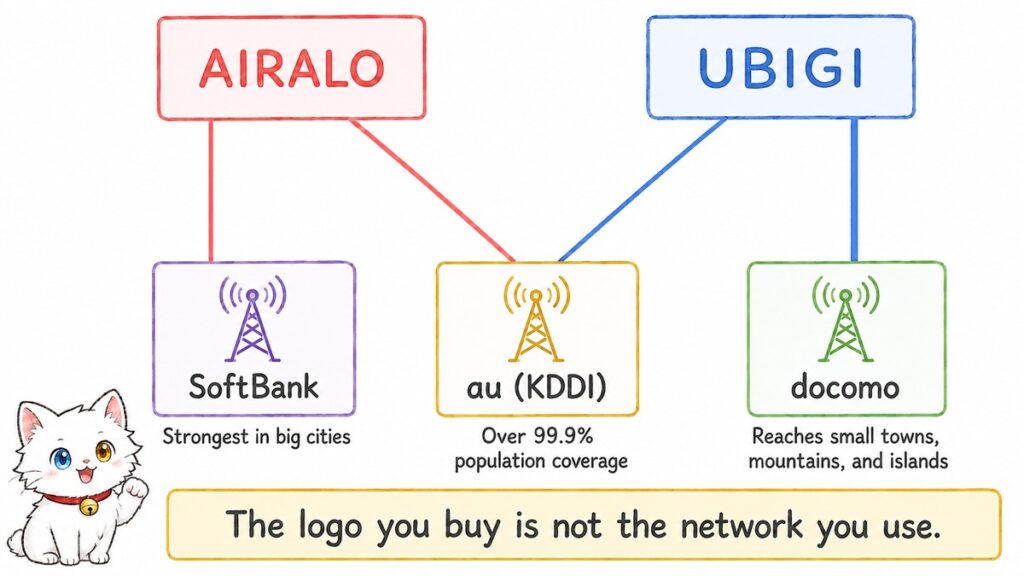
So this comparison starts with the network underneath the eSIM—not the app logo. Airalo uses SoftBank and KDDI, while Ubigi uses NTT Docomo and KDDI.
I live in Japan, but I have not personally used either Airalo or Ubigi. What I can explain is how Japan’s mobile networks differ in cities and rural areas—and why that matters when your map, train information, or last bus time depends on having a signal.

Disclosure: This article contains affiliate links. If you book through one, I may earn a small commission at no extra cost to you.
In a hurry? Everything in this guide, in one list:
- Airalo Japan eSIM plans — the bigger name
- Ubigi Japan eSIM plans — the data-value pick
- Klook Japan eSIM listing — the third option to price-check
They all work — the comparison below shows which fits your trip.
- Quick Answer: Which One Should You Buy?
- What Brand Comparisons Don’t Tell You
- Where That Difference Actually Shows Up
- Price: What Each One Actually Costs
- Airalo vs Ubigi Plans Side by Side
- When Should You Activate Your eSIM?
- If It Doesn’t Work When You Land
- “They’re All the Same”—Is That Actually True?
- What About Holafly? (And What to Use Instead)
- What About Klook or a Pocket Wi-Fi?
- Airalo vs Ubigi Japan FAQ
- Final Thoughts: Airalo or Ubigi for Japan?
Quick Answer: Which One Should You Buy?
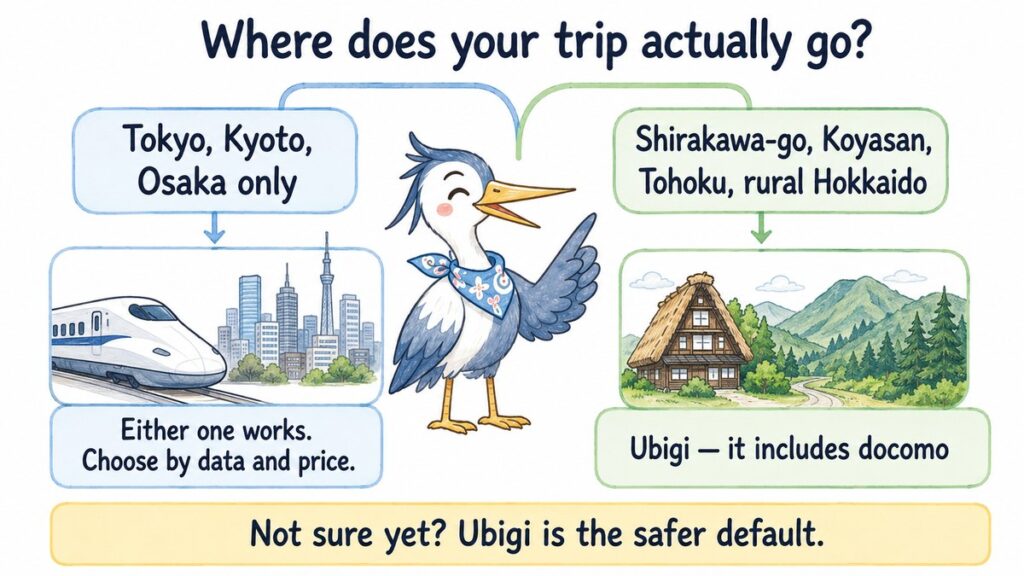
If your Japan trip stays mainly in Tokyo, Kyoto, Osaka, and other major cities, Airalo is a perfectly good choice. You do not need to abandon it just because another traveler says Ubigi has better rural coverage.
Airalo’s Japan eSIM—often referred to as Moshi Moshi in older reviews and comparison guides—uses SoftBank and KDDI. Both have extensive coverage in Japan’s large cities, so Airalo should handle the things most travelers need: Google Maps, translation apps, train searches, messages, and restaurant bookings.
The choice changes when your itinerary leaves the major tourist corridor.
Choose Airalo for a city-focused trip
Airalo makes sense if your trip is built around places such as Tokyo, Kyoto, Osaka, Yokohama, Kobe, or central Fukuoka. SoftBank is particularly strong in populated areas, and au also has broad nationwide coverage.
That does not mean your signal will be perfect inside every basement restaurant, subway tunnel, or crowded station. No travel eSIM can promise that. But for a typical city itinerary, the difference between Airalo and Ubigi is unlikely to be large enough to change your decision on that factor alone.
Airalo is also a reasonable choice if you already know the app, prefer its multilingual support, or find a plan that matches your data needs at a good price.
Choose Ubigi if rural Japan is on your itinerary
If you are going to Shirakawa-go, Koyasan, rural Tohoku, the outskirts of Hokkaido, a small island, or a mountain area, I would lean toward Ubigi.
Ubigi connects through docomo and au. The important addition is docomo, which has traditionally been the network many people in Japan look to when coverage outside major cities matters.
This is not a promise that Ubigi will work everywhere. Mountains, tunnels, remote coastlines, and sparsely populated areas can defeat any mobile connection. Ubigi simply gives you access to a network combination that offers a better safety margin once you leave the cities.
For a first trip to Japan, Ubigi is the safer default
Plans for a first trip to Japan often change after you arrive. You may add a day trip, visit a smaller town, take a rural bus, or stay somewhere farther from a station than expected.
That flexibility is why Ubigi is my default pick for a first trip when the route is not completely fixed. Airalo may be the more familiar name and is still a good choice, especially if support is what makes you feel comfortable. But if I had to choose without knowing where your plans might take you, I would rather have docomo available.
The short version is simple: Airalo is fine for the cities. Ubigi gives you a little more reassurance when your trip goes beyond them.
Holafly is known for its unlimited data plans, but its Japan page does not publish the local network, any fair-use threshold, or Japan-specific hotspot-sharing rules. That makes it difficult for me to recommend Holafly to travelers who want those details clearly explained before they pay.
Check current Airalo Japan eSIM plans
Check current Ubigi Japan eSIM plans
What Brand Comparisons Don’t Tell You
Most Airalo vs Ubigi comparisons start with prices, app ratings, and customer support. Those things matter, but they skip the first question I would ask in Japan:
Which Japanese network is underneath the eSIM?
Airalo and Ubigi are travel eSIM providers, not separate nationwide mobile networks with their own towers across Japan. They arrange access through Japanese carriers. That underlying network helps decide where your phone can find a signal.
Every travel eSIM borrows a Japanese network
Japan’s major mobile networks include docomo, au by KDDI, and SoftBank. Travel eSIM providers sell convenient short-term access to one or more of those networks.
That is why two eSIM brands can work almost identically in Shibuya but behave differently after you take a bus into the mountains. The logo in the app is not what reaches your phone. A local carrier’s network does.
The local network is not the only factor. Roaming routes, congestion, phone compatibility, APN settings, and the provider’s technical arrangements can also affect performance. Still, the network list is the most useful starting point when you are comparing geographic coverage.
Ubigi uses docomo and au in Japan
Ubigi officially lists NTT Docomo and KDDI as its two network partners in Japan.
Docomo is the part that makes Ubigi especially relevant for rural travel. Its network has long been built with smaller towns, outlying areas, and regional travel in mind. Au provides another broad network alongside it; KDDI states that au’s population coverage exceeds 99.9%.
Population coverage is not the same as covering 99.9% of Japan’s land. Japan has large mountainous and sparsely populated areas where every carrier has gaps. Think of au as a strong middle ground, not a guarantee that every hiking trail or remote road will have data.
Airalo’s Japan eSIM uses SoftBank and KDDI
Airalo’s Japan eSIM—often referred to as Moshi Moshi in older reviews and comparison guides—uses SoftBank and KDDI. Both supported networks offer 5G access with the current plans.
Airalo also explains that the eSIM may switch between the two networks depending on their availability and speed. If necessary, you can change the selected network manually through your phone’s settings.
That flexibility is useful in cities. One network may be stronger inside a particular station, building, or neighborhood, and the eSIM is not permanently limited to only one of the two.
SoftBank is particularly strong in populated areas, while KDDI’s au network has broad nationwide reach. This makes Airalo a solid choice for Tokyo, Kyoto, Osaka, and other city-focused itineraries.
The difference from Ubigi is docomo. Ubigi gives you access to NTT Docomo and KDDI, while Airalo gives you SoftBank and KDDI. Both are good travel eSIM options, but they do not use the same combination of Japanese networks.
Where That Difference Actually Shows Up
For most travelers, the network question does not matter every minute of the trip. It matters at the moment when coverage becomes difficult.
In the center of Tokyo, you may never notice which carrier is underneath your eSIM. At a rural bus stop, that detail can decide whether you can open the timetable at all.
Tokyo, Kyoto, Osaka, and major train routes
If you are visiting Tokyo, Kyoto, Osaka, and traveling between them on major railway routes, both Airalo and Ubigi are sensible choices.
Japan’s main urban areas are well covered by docomo, au, and SoftBank. You may see speed differences from one station or neighborhood to another, but the brand winner can change by location, time of day, crowd size, and even which side of a building you are standing on.
Underground spaces need the same honesty. Mobile service is available in many Japanese subway stations and underground shopping areas, but tunnels, deep platforms, basement restaurants, and crowded commuter periods can still cause slowdowns or temporary disconnections. Ubigi does not make underground signal problems disappear, and Airalo does not automatically fail there.
The same applies to the shinkansen. Both can work along much of the route, but tunnels and fast movement between coverage areas can interrupt service. Download tickets, hotel addresses, and anything you cannot afford to lose before boarding.
Rural destinations are about signal, not speed
Once you move into a mountain area or a sparsely populated region, comparing speed-test numbers becomes less useful.
The practical question is not whether one eSIM downloads a photo two seconds faster. It is whether one network still has a signal while another shows no service.
That matters in places where buses are infrequent, signs may have limited English, and the next connection cannot be checked by simply walking into a cafe. A weak but usable signal can still open a map, load a bus timetable, or send a message. With no signal, none of that is possible.
Ubigi’s access to docomo gives it the stronger case here. That does not mean every Ubigi user will always connect, or that Airalo will fail as soon as you leave Kyoto. It means that when your itinerary includes rural Japan, the possibility of staying connected matters more than saving a small amount per gigabyte.
A local note from YUU
The countryside where my family is from has weak reception to begin with. Even there, docomo still gets a signal.
I want to be precise about what that means. I am not saying the connection is always fast or comfortable. I am not saying docomo works everywhere in Japan. The area has weak reception, full stop.
What matters is that the difference there is often not “fast versus slow.” It is “a signal versus no signal.”
That is why I would not choose a rural Japan eSIM by app popularity or speed claims alone. If your route includes remote towns, mountain roads, small islands, or places where the last bus matters, look first at whether the eSIM gives you access to a network that is likely to stay available.
Neither Airalo nor Ubigi can eliminate Japan’s coverage gaps. Ubigi simply gives me more confidence for that kind of itinerary because docomo is one of its Japanese partners.
Price: What Each One Actually Costs
Airalo and Ubigi can change their prices, and Airalo sets a separate price for each currency instead of converting one base price. The figures below are the US dollar prices shown on each provider’s own store in August 2026, so check the total in your own currency at checkout before you pay.
The honest price conclusion has three parts:
- If you need only 1GB for a very short trip, Airalo is the cheapest entry point at $4.00.
- At around 3GB, the prices are almost identical. The real difference is validity: 15 days with Ubigi versus three or seven days with Airalo.
- At around 10GB, Ubigi is slightly cheaper at $16.50 versus Airalo’s $18.00, but the Japanese network and support should make the final decision.
A very light user can start cheaper with Airalo
Airalo’s smallest fixed-data plan is 1GB for three days at $4.00. This is the lowest entry price between the two providers.
It can work for an extremely light user taking a short stop in Japan—someone who needs occasional maps and messages, keeps photo backups on Wi-Fi, and does not stream video.
But three days is a short validity period, and 1GB does not leave much room for mistakes. Automatic photo uploads, social media video, or tethering can use that allowance quickly.
Airalo does not currently offer 1GB for seven days in its Japan fixed-data range. Its seven-day plans begin at 3GB.
For 3GB, the price is almost identical—what differs is time
Airalo offers 3GB for three days at $7.50 or seven days at $8.00. Ubigi offers the same 3GB for 15 days at $7.50.
| Provider | Data | Validity | Price |
|---|---|---|---|
| Airalo | 3GB | 3 days | $7.50 |
| Airalo | 3GB | 7 days | $8.00 |
| Ubigi | 3GB | 15 days | $7.50 |
The most meaningful comparison is the two $7.50 plans. The data allowance is identical, but Ubigi gives you 15 days instead of three—five times as long.
Even compared with Airalo’s seven-day plan, the price difference is only $0.50. That is too small to be the main reason to choose one provider over the other. The more useful difference is that Ubigi gives you eight additional days to use the same 3GB.
Airalo is still a reasonable choice for a short, city-focused trip, especially if you prefer its app or multilingual support. But if your trip lasts longer than one week—or you simply want more room in case your dates change—Ubigi’s 15-day validity gives you the more flexible plan.
At around 10GB, choose by network and support
The price difference becomes less important around 10GB.
Airalo offers 10GB for 30 days at $18.00. Ubigi’s price is $16.50 for 10GB over 30 days.
Ubigi remains the cheaper option, but the gap is no longer large enough to make price the only decision.
At this level, ask what your itinerary needs. Choose Airalo if your trip is city-focused and you value its app and multilingual support. Choose Ubigi if your plans include rural areas and you want access to docomo alongside KDDI.
| Provider | Data | Validity | Price | Best reason to choose it |
|---|---|---|---|---|
| Airalo | 10GB | 30 days | $18.00 | City travel and multilingual support |
| Airalo | 20GB | 30 days | $25.00 | Heavier fixed-data use |
| Ubigi | 10GB | 30 days | $16.50 | A mixed urban and rural itinerary |
| Ubigi | Unlimited | 15 days | $39 | 30GB at full speed, then 2Mbps |
| Ubigi | Unlimited | 30 days | $65 | 60GB at full speed, then 2Mbps |
| Ubigi | Unlimited monthly | Monthly | $45/month | 60GB at full speed, then 2Mbps; three-month minimum |
Ubigi’s unlimited plans remain connected after the full-speed allowance is used, but speeds are reduced to 2Mbps. The monthly plan renews automatically and cannot be canceled until after three months.
Airalo also sells different data amounts for three, seven, 15, and 30 days. Do not compare only the large “from” price on either website. Match the data amount and validity period to your actual trip.
For a family, remember that eSIM prices are generally per phone. Four inexpensive plans can still add up. Consider whether everyone needs independent data or whether some devices will normally share a connection.
▶ Japan with Kids: A Japanese Mom's Practical Guide
Airalo vs Ubigi Plans Side by Side
Here is the full comparison in one table.
| Feature | Airalo Japan eSIM | Ubigi |
|---|---|---|
| Best for | Major cities, flexible trip lengths, and multilingual support | Rural travel and itineraries that may change |
| Smallest plan | 1GB / 3 days / $4.00 | 3GB / 15 days / $7.50 |
| 3GB comparison | 3GB / 7 days / $8.00 | 3GB / 15 days / $7.50 |
| 10GB comparison | 10GB / 30 days / $18.00 | 10GB / 30 days / $16.50 |
| Larger option | 20GB / 30 days / $25.00 | Unlimited plans: 15 days / $39 with 30GB at full speed; 30 days / $65 with 60GB at full speed; monthly / $45 with 60GB at full speed and a three-month minimum. Speeds are reduced to 2Mbps after the full-speed allowance. |
| Japanese networks | SoftBank + KDDI | NTT Docomo + KDDI |
| 5G | Available on both supported networks | Available on supported networks |
| Network switching | May switch according to network availability and speed; manual selection is also possible | Connects through its available Japanese partner networks |
| Japanese phone number | No | No |
| Calls and SMS | Data apps only | Data apps only |
| Tethering | Allowed; shared data comes out of the same allowance | Data sharing allowed |
| Main advantage | A strong city option with several trip-length and data choices | docomo access and longer validity for the 3GB plan |
| Main limitation | Data-only; no Japanese phone number | Data-only; no Japanese phone number |
Choose Airalo if you need only 1GB for three days, your trip is city-focused, or you value its range of durations and multilingual support.
Choose Ubigi if you want the longer 15-day validity on the 3GB plan or will travel outside Japan’s major cities.
Neither provider gives you a Japanese phone number. You can use WhatsApp, LINE, FaceTime, and other internet calling apps, but ordinary calls to Japanese phone numbers are not included.
If you need a voice plan or want to compare more providers, see my complete Japan eSIM guide.
Check current Airalo Japan eSIM plans
Check current Ubigi Japan eSIM plans
▶ Best eSIM for Japan in 2026: A Japanese Local's Honest Comparison
When Should You Activate Your eSIM?
Buy your eSIM before your flight, but check its validity policy before installing it. Some plans start only when they connect to a supported network in Japan; others start at installation.
That distinction can save you from losing part of a seven-day plan before you even reach Japan.

Prepare it before you leave home
Use stable home Wi-Fi to buy the eSIM and save its installation instructions. Before installing it, check the plan’s validity policy as explained below. Do not wait until you are standing in an airport arrivals hall with tired children, luggage, and a train to catch.
Before flying, confirm that your phone supports eSIM and is carrier-unlocked. Save the QR code, order confirmation, installation instructions, APN information, and customer-support details somewhere you can open offline. A screenshot is fine.
Give the new line a clear label such as “Japan Airalo” or “Japan Ubigi.” Keep your home SIM selected for calls and texts if you need to receive verification messages, but turn off data roaming for your home line unless your carrier has confirmed that it will not charge you.
Do not switch your mobile data line to the Japan eSIM too early unless the provider’s instructions tell you to do so.
▶ How to Plan a First Trip to Japan: 7-Step Guide (2026)
Check the validity rule for the exact plan you bought
Ubigi states that the validity period begins automatically when you arrive in an area covered by the plan. If you are already in a covered area when you buy it, the plan starts immediately.
Airalo works differently depending on the package. Most Airalo packages begin when the eSIM connects to a supported network, but some begin at installation—even if you are still at home. The rule for your specific package is shown in the Airalo app under My eSIMs, then DETAILS, then SHOW MORE, where it appears as VALIDITY POLICY.
The safe order is simple: buy the plan while you still have reliable Wi-Fi, open My eSIMs > DETAILS > SHOW MORE, and read the VALIDITY POLICY before installing it. If validity starts when the eSIM connects to a supported network, you can install it at home. If it starts at installation, wait until the timing stated for your plan. Do not copy instructions from a different Airalo destination or an old screenshot.
If It Doesn’t Work When You Land
A connection problem after landing feels much bigger than it is. You need your hotel address, train route, and booking details at the exact moment your phone decides not to cooperate.
Give the eSIM a few minutes first. A first connection can take longer than reconnecting to a network you have already used.

Run this five-minute connection check
Work through these steps in order:
- Turn airplane mode on, wait briefly, and turn it off again.
- Confirm that the eSIM line is switched on.
- Select the Japan eSIM as the line for mobile data.
- Turn on data roaming for the travel eSIM if the provider’s instructions require it.
- Check that network selection is set as instructed, then restart the phone.
- Compare the APN with the instructions in the Airalo or Ubigi app.
Do not keep changing several settings at once. If the connection begins working, you will not know which setting fixed it.
Also check that your home SIM has not remained selected for mobile data. That mistake can leave the travel eSIM unused and, in the worst case, create roaming charges on your regular line.
Don’t delete the eSIM—use Wi-Fi and contact support
Do not delete the eSIM while troubleshooting unless the provider specifically tells you to. An eSIM QR code may not be reusable, and deleting the profile can turn a small settings problem into a replacement problem.
Use airport Wi-Fi to open the provider’s app or help page. Take screenshots of any error messages before changing more settings.
If you still cannot connect, use your hotel Wi-Fi and contact support. You can also buy another eSIM online once you have Wi-Fi. That is frustrating, but it is a real escape route—you are not permanently stranded with the first plan you chose.
Airalo’s official Japan page advertises 24/7 multilingual support. That can be valuable if this is your first eSIM and you are nervous about troubleshooting. Ubigi also provides online assistance, but whichever one you choose, save its support page before departure.
Save the first hour of your trip offline
The best troubleshooting plan begins before anything goes wrong.
Save your hotel address in both English and Japanese. Screenshot the route from the airport, the train name, the platform information you already have, and the booking confirmation for your first night. Download an offline map covering the airport and your destination.
Complete or prepare your arrival information before flying, and keep the necessary confirmation accessible without mobile data.
▶ Visit Japan Web Guide 2026: Step-by-Step for Families
If you are traveling from Narita Airport, save your train details before landing:
▶ Narita Airport to Tokyo: Is the Narita Express Worth It? (2026 Fare Guide)
For Kansai Airport and Kyoto:
▶ Kansai Airport to Kyoto: Is the Haruka Express Worth It? (2026 Fare Guide)
A failed connection is inconvenient. It becomes a travel emergency only when every important detail is trapped behind it.
“They’re All the Same”—Is That Actually True?
The claim is partly true, but it is not useful enough to make your decision.
Airalo and Ubigi are both data-only travel eSIM services. Neither owns a separate nationwide tower network in Japan. Both depend on access to Japanese carriers, and both may work perfectly for an ordinary city trip.
That is the part people mean when they say the big eSIM brands are all the same.
The claim is partly true
In central Tokyo, the difference may feel almost invisible. You buy data, switch on the eSIM, and use the same maps and messaging apps either way.
Many travelers will return home happy without ever knowing whether their phone connected through SoftBank, au, or docomo. For a short city trip, price, app design, and support may genuinely matter more.
That experience does not prove the services are identical. It only shows that several networks cover the easy parts of the itinerary well.
The Japanese network underneath is not always the same
Ubigi officially works with docomo and KDDI in Japan. Airalo’s Japan eSIM uses SoftBank and KDDI.
Those are not identical combinations.
The overlap is au. The difference is docomo versus SoftBank. In a city, that difference may be minor. In an area where reception is already weak, it can become the difference between finding a signal and seeing “No Service.”
Network, routing, price, and support all matter
The underlying carrier is not the only reason two travel eSIMs can behave differently.
Data may be routed differently. Congestion can affect travel eSIM users. One provider may offer clearer setup instructions or faster support. Validity rules, top-ups, tethering, and fair-use limits can also change the experience.
So “they are all the same” is too broad. A better rule is:
For a city trip, choose a reputable provider with the right amount of data, a fair price, and support you can use. For a rural trip, check the Japanese network first.
What About Holafly? (And What to Use Instead)
What Holafly actually sells
Holafly takes a different approach from the fixed-data plans many travelers compare. Every Holafly plan for Japan is sold as unlimited data, and the price is set by the number of days you choose — starting at $3.90 for a single day, and costing less per day the longer you stay:
- 7 days: $27.50
- 15 days: $50.50
- 30 days: $73.90
Those were the US dollar prices shown on August 31, 2026, and eSIM pricing moves often, so check the current figure before you buy. The plan begins when you arrive in Japan and switch on the eSIM. Holafly also says refund requests can be submitted for up to six months after purchase, subject to its refund conditions.
Holafly includes a feature called Always On. When your unlimited data ends, it activates automatically and provides 1GB of backup data per month so you can remain connected.
The three things Holafly doesn’t tell you
The main issue is not what Holafly promises. It is what you cannot confirm before buying. On its Japan page and FAQ, Holafly does not publish three details that can affect how the eSIM fits your trip:
- The Japanese network: Holafly does not name docomo, au, or SoftBank as its local network partner in Japan.
- The fair-use threshold: Holafly does not state how many gigabytes you can use before speeds may be reduced.
- The hotspot rules: Holafly does not publish a Japan-specific tethering or hotspot-sharing allowance.
Always On makes the second point especially important. Holafly says the 1GB backup activates when your unlimited data ends, but it does not give a gigabyte figure for that boundary. You can see how many days you are buying, but you cannot confirm whether a separate data-use threshold applies during those days.
That does not make Holafly a bad choice. It means you must be comfortable buying without knowing the local network, the full-speed data boundary, or how much data you can share with another device.
So which one should you use instead?
If you want an unlimited plan but also want the limit explained before you pay, Ubigi is the clearer alternative. It publishes that you receive 5GB per day at full speed, followed by unlimited data at 1Mbps with no cutoff. It uses docomo and au in Japan and allows up to 6GB of data sharing.
Choose Airalo instead if you have a short, city-focused trip and keeping the cost down matters more than having unlimited data. Airalo uses SoftBank and au, lets you switch between them in your phone’s settings, and allows up to 3GB of data sharing per day.
If neither option matches your itinerary, my complete guide to choosing an eSIM for Japan compares more providers and plan types.
What About Klook or a Pocket Wi-Fi?
Airalo and Ubigi are not your only choices. They are simply the two this article is designed to compare.
If neither feels right, do not force the decision.
Klook is a marketplace, not one mobile network
Klook sells Japan eSIM options, but “Klook eSIM” does not always mean one fixed Japanese carrier. The network can depend on the specific product or plan type.
Read the network and fair-use details for the exact plan at checkout. A low price is less helpful if the plan uses a network that does not fit your route or slows down after an allowance you did not notice.
Klook can still be convenient if you already use the app for attractions, trains, or tours. Just check what is under the listing before buying.
See the Klook Japan eSIM listing
Pocket Wi-Fi can work well for families
A pocket Wi-Fi router may be more practical if several family members stay together and need to connect multiple phones or tablets.
The tradeoff is that the group depends on one device. Someone has to carry it, charge it, and remember to return it. If one parent takes the router while another goes elsewhere with the children, the second group loses the connection.
Buying separate eSIMs costs more, but it lets family members split up without losing maps and messages. There is no universal winner here; it depends on how your family travels.
▶ Japan with Kids: A Japanese Mom's Practical Guide
Compare all seven options in the full guide
If you need a Japanese phone number, unlimited data, a local Japanese provider, or a different network combination, Airalo and Ubigi may not be your final two.
My complete Japan eSIM guide compares seven main providers and also explains when a pocket Wi-Fi or voice SIM makes more sense.
▶ Best eSIM for Japan in 2026: A Japanese Local's Honest Comparison
Airalo vs Ubigi Japan FAQ
Does Airalo work in Japan?
Yes. Airalo sells a Japan eSIM that is often referred to as Moshi Moshi in older reviews and comparison guides, although the current official page labels it simply as a Japan eSIM.
For a trip centered on Tokyo, Kyoto, Osaka, and other large cities, Airalo is a sensible choice. Its lack of docomo access becomes more relevant when your itinerary includes mountain areas, small towns, or other places where coverage is harder.
Is Ubigi better than Airalo in Japan?
Not for every traveler.
Ubigi is my stronger choice for rural travel because it connects through docomo and au. Airalo is a good choice for a city-focused trip, especially if you prefer its app, multilingual support, or current plan selection.
The better option depends on where you are going, not which brand is more famous.
Do Airalo or Ubigi give you a Japanese phone number?
No. The Japan plans compared here are data-only.
You can use WhatsApp, LINE, FaceTime, and other internet-based services, but you will not receive a Japanese phone number for ordinary calls or SMS. That can matter for some restaurant bookings, local contact forms, and emergency calling.
See the full comparison if a Japanese phone number is important:
▶ Best eSIM for Japan in 2026: A Japanese Local's Honest Comparison
Can you use tethering with Airalo and Ubigi?
Yes, with both.
Ubigi officially states that data sharing is allowed, and its help centre explains how to share the connection from supported iOS and Android devices.
Airalo also supports personal hotspot use and does not set a separate tethering cap or device limit.
The important part is that shared data is not extra data. On Airalo’s unlimited plans, tethered use counts toward the daily high-speed allowance. Ubigi’s Japan unlimited plans use a total full-speed allowance—30GB on the 15-day plan and 60GB on the 30-day and monthly plans—before speeds are reduced to 2Mbps. A laptop, an automatic photo backup, or a child watching video can use several gigabytes far faster than maps and messages alone.
Which eSIM is better for rural Japan?
Between these two, I would choose Ubigi for rural Japan.
The reason is not that Ubigi guarantees a fast connection everywhere. It does not. The reason is that Ubigi includes docomo alongside au, giving you a better network combination for places where the real question is whether a signal remains available at all.
Download offline maps even if you choose Ubigi. No Japanese carrier covers every mountain, tunnel, island interior, or remote road.
Is Holafly better than Airalo or Ubigi in Japan?
Ubigi is the better choice if you want the network and the usage limits stated before you pay: docomo and au, 5GB per day at full speed, then 1Mbps with no cutoff. Airalo suits a short, city-focused trip. Holafly sells unlimited data priced by trip length, but its Japan page does not publish its network, its fair-use threshold, or its hotspot rules — so you are buying without those details.
Final Thoughts: Airalo or Ubigi for Japan?
Airalo is a good Japan eSIM. If you are visiting Tokyo, Kyoto, Osaka, and the usual route between them, you do not need to worry that you have chosen the wrong brand.
Ubigi becomes my pick when the trip includes rural Japan—or when a first-time itinerary is still flexible enough that it might.
For an ultra-light three-day trip, Airalo’s 1GB plan is the cheapest way to start. At 3GB, Airalo costs $7.50 for three days or $8.00 for seven days, while Ubigi costs $7.50 for 15 days. The real difference is validity, not price. At around 10GB, the price gap becomes small enough that the Japanese network and support should make the decision.
Most importantly, do not compare only the logos. Ask which Japanese network will be underneath your eSIM where you are going.
Check current Airalo Japan eSIM plans
Check current Ubigi Japan eSIM plans
▶ Best eSIM for Japan in 2026: A Japanese Local's Honest Comparison
Check Current Ubigi Japan eSIM Plans
Now I’m curious about your trip: are you staying mainly in Tokyo, Kyoto, and Osaka, or are you heading into rural Japan too? Tell me in the comments below. I read every single one!
I hope this guide has answered one of your questions and helped you feel a little closer to Japan. May your Japan journey be filled with wonderful discoveries and memories you’ll treasure for years to come.
 See you in the next guide.



Comments