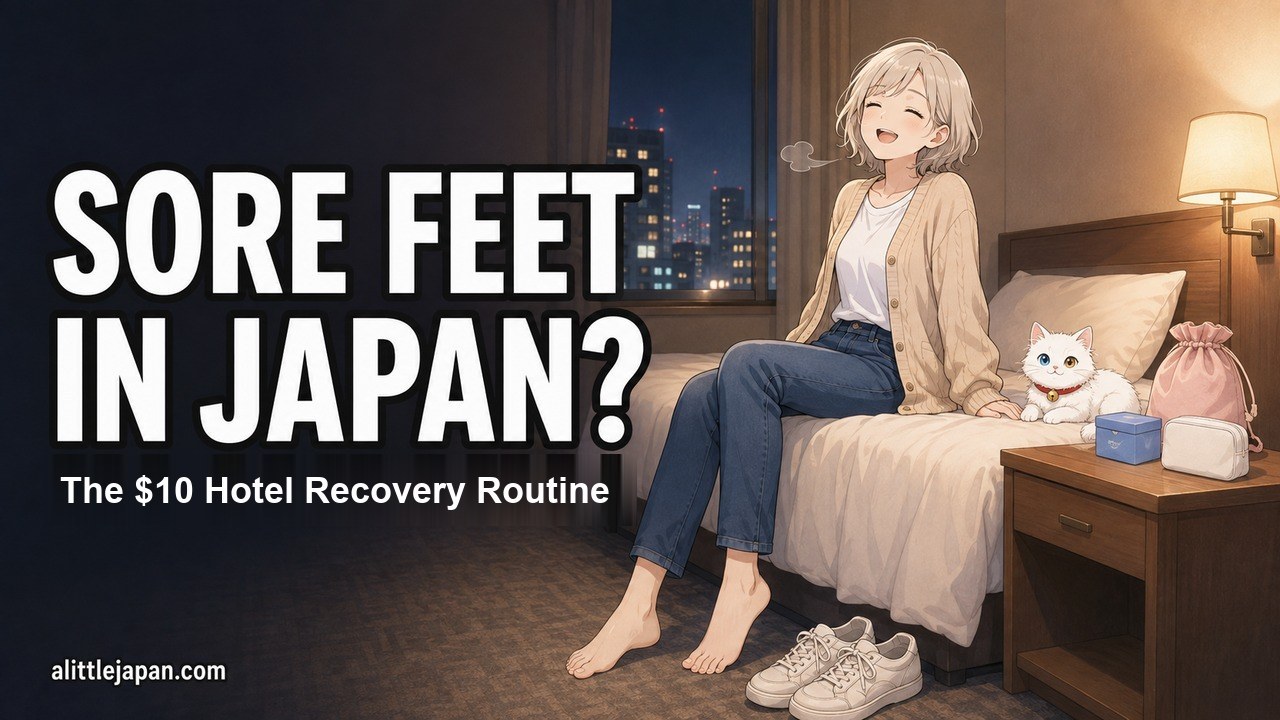
You’ll sit down on the hotel bed, pull off your shoes, and realize that standing up again feels like work. Even travelers who pack sensible sneakers and do everything right can end up with sore feet in Japan. Stations are bigger than they look, transfers add corridors and stairs, and a “short walk” to a temple can end on gravel.
So before your feet start complaining, give yourself a plan for the evening. Three things from a well-stocked Japanese drugstore — starting at around ¥1,500 (about $10) for all three — turn the end of a long sightseeing day into something gentler: cooling Kyusoku Jikan foot sheets, a warm MegRhythm steam eye mask, and a Japanese sheet mask. You may be able to find all three at the airport, too — stock varies by branch.
Thirty quiet minutes, in the room you’re already in. That’s the whole routine. And I’ll show you how to recognize the eye mask after its 2025 name and package change — something many older English guides still don’t reflect.
Quick answer: For ordinary end-of-day soreness, stop walking, take a bath or shower, put water beside the bed, and use cooling foot sheets if they feel comfortable. The sheet mask and steam eye mask are optional additions that turn those basic steps into a calmer hotel-night routine. This is a comfort routine, not a treatment for injuries or severe pain.

Disclosure: This article contains affiliate links. If you buy through one, I may earn a small commission at no extra cost to you.
In a hurry? Everything in this guide, in one list:
- Kyusoku Jikan foot sheets — the famous pink cooling sheets for tired legs
- MegRhythm steam eye mask — 20 warm minutes while your feet recover
- LuLuLun sheet masks — the 10-minute skin reset
- MediQtto sleep compression socks — wear them overnight, wake up with lighter legs
- Rela Kino gel insoles — prevention — cushion your shoes before the 20,000-step days
Already in Japan? All of these are cheaper at any drugstore — the links above are for shopping from home.
- Why Your Feet Hurt So Much in Japan
- Prevent It Before It Starts: Slip a Japanese Insole Into Your Shoes
- The ¥1,500 (≈) Hotel Recovery Routine
- Buy It the Moment You Land
- Kyusoku Jikan: Japan’s Famous Pink Foot Sheets
- MegRhythm: The 40°C Steam Eye Mask
- Japanese Sheet Masks: The 10-Minute Skin Reset
- Where to Buy: Drugstore vs. Convenience Store
- The Full Night Routine, Step by Step
- Other Recovery Finds Worth Grabbing
- Sore Feet in Japan: Frequently Asked Questions
- Final Thoughts
Why Your Feet Hurt So Much in Japan
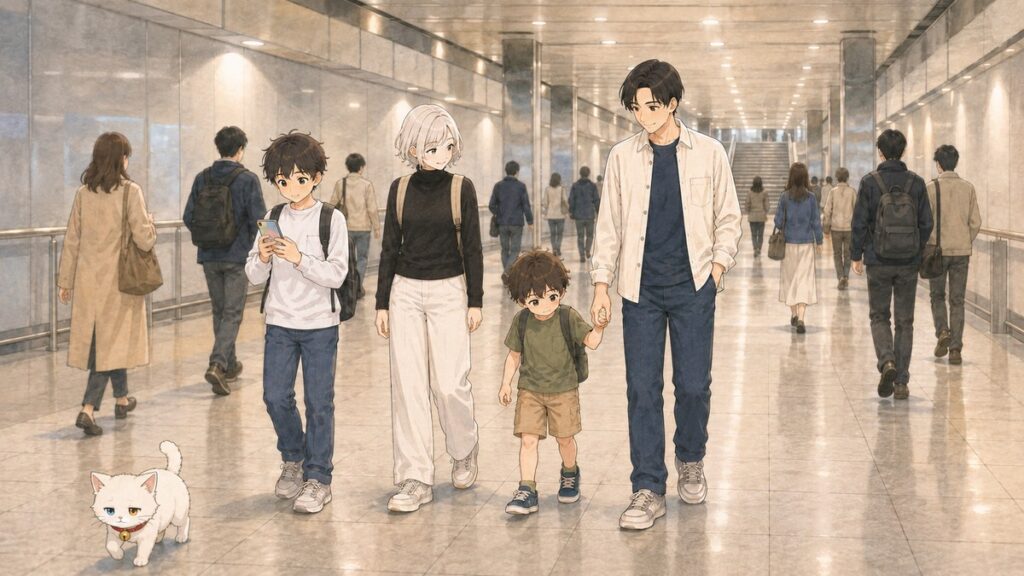
Japan turns an ordinary sightseeing plan into a very long walking day. A route that looks simple on a map includes a walk through the station, a transfer to another platform, stairs at a smaller exit, several blocks to the attraction — and then more walking once you’re actually there. Reaching 20,000 steps is surprisingly easy here. That’s not an official average, just a number that stops surprising you after a few days.
The surfaces keep changing, too. One hour you’re crossing a smooth underground arcade, the next you’re on temple gravel or a stone slope. Even a train day isn’t a rest day: the sitting is broken up by standing on platforms, finding exits, and carrying bags through passageways.
Good shoes still matter — they just can’t erase distance. Your favorite walking shoes may feel much less forgiving on day four of Tokyo, Kyoto, or Osaka. If you’re still deciding what to bring, our guide to what to wear in Japan in autumn covers shoes for long walking days.
 There’s one more thing nobody warns you about: how often your shoes come off. Temples, some restaurants, a ryokan, a friend’s home — you’ll be slipping them off and back on all day, and if you end up sitting on tatami, your legs get folded into positions they aren’t used to. Either way, already-tired feet don’t get much of a break.
The hard part usually arrives after you’re back at the hotel. The exciting part of the day is over, the adrenaline has settled, and now you notice every step to the bathroom, the vending machine, your suitcase. If you’re traveling with kids, you’re doing all of that while getting somebody else ready for bed.
This is where a small evening ritual earns its place. It doesn’t need to be expensive or complicated. Stop moving, wash the day off, drink something, and use a few comforting things that are easy to find here.
 One habit worth borrowing from us: browse a drugstore before you need anything. Japanese drugstores aren’t only for medicine — they carry toiletries, cosmetics, cooling sheets, eye masks, and drinks, so you can build a whole hotel comfort kit in one stop. Buy it in the afternoon, and it’s waiting in your room by the time you’re too tired to go looking.
Prevent It Before It Starts: Slip a Japanese Insole Into Your Shoes
Everything below helps after the damage is done — but here is one thing you can do before you even pack. Slip a cushioned insole into the sneakers you are bringing. A Tokyo or Kyoto day easily passes 20,000 steps, most of them on hard pavement and station stairs, and a shock-absorbing insole softens every single one of them.
If you want the Japanese option, look at Rela Kino — a Japanese brand whose insoles are designed under the supervision of physical therapists. Their gel insole has high arch support and more than 4,000 reviews on Amazon, at around $24.
Check Rela Kino Gel Insoles on Amazon
Already in Japan? Hands stores carry Insole Pro by Murai, a Japanese shoe-parts maker that has been at this since 1931 — worth a look if your feet are already complaining.
The ¥1,500 (≈) Hotel Recovery Routine
Prices are in yen, with rough dollar figures at about ¥154 to the dollar (September 2026). Exchange rates move, so treat the dollars as a ballpark.
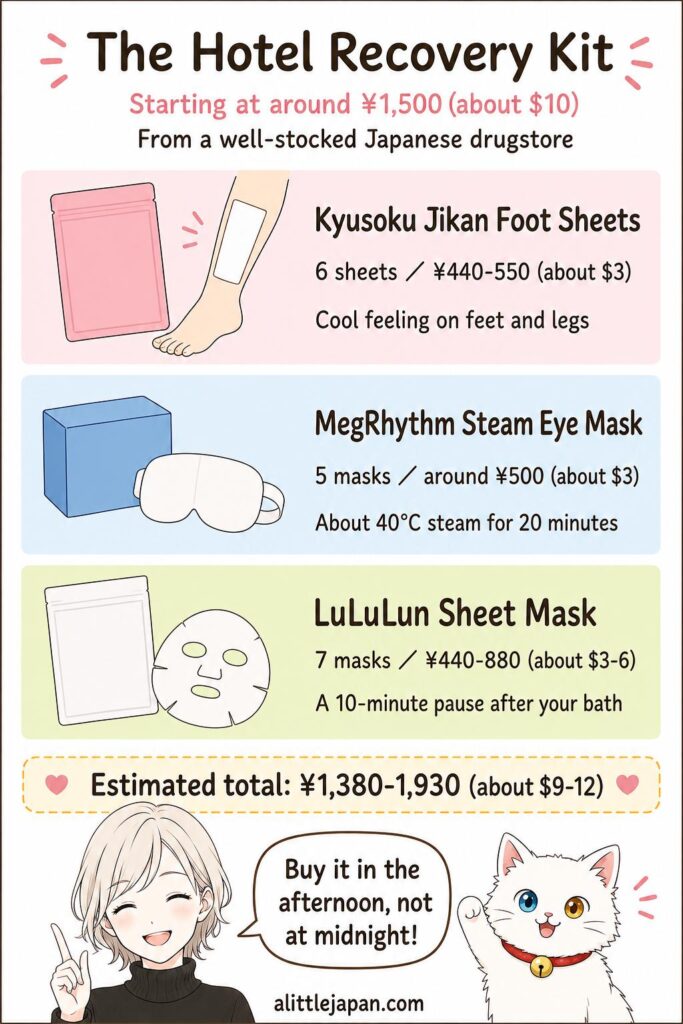
My kit has three parts: something cool for your feet, something warm for your eyes, and a sheet mask for skin that’s spent the day under sunscreen, makeup, and dry indoor air. One small pack of each comes to roughly ¥1,500, (≈$10) depending on the store and which mask you pick.
| Item | What it does for the evening | Starter pack | Approximate price |
|---|---|---|---|
| Kyusoku Jikan foot sheets | A cool, fresh feeling on tired feet and lower legs | 6 sheets | ¥440–¥550 (about $3) |
| MegRhythm steam eye mask | Warm steam, and a reason to close your eyes | 5 masks | Around ¥500 (about $3) |
| LuLuLun sheet mask | A short skincare pause after your bath | 7 masks | ¥440–¥880 (about $3–6) |
| Estimated total | ¥1,380–¥1,930 (about $13–12) |
Using the prices above, three starter packs come to roughly ¥1,380–¥1,930, or about $13–12. Pick an affordable LuLuLun pack and you can stay close to ¥1,500 (≈$10); the pricier lines push the total toward ¥2,000 (≈$13). Prices also move around by store, so treat ¥1,500 (≈$10) as a shopping target rather than a guaranteed total. Dollar figures throughout this guide are rough conversions at roughly ¥157 to the dollar in August 2026, so check the rate on the day.
 Those are starter sizes — enough to try the whole routine on your first big walking day. Kyusoku Jikan also comes in an 18-sheet box for ¥600–¥700 (about $4), which is the more realistic choice for a longer stay or two people sharing. There’s math for that in the FAQ.
You don’t need all three every night, either. Save the foot sheets for the days that actually earned them, use the eye mask when you want a quiet landing into sleep, and reach for the face mask when your skin feels like it.
There’s a plain psychological benefit to owning the kit before you need it, too. “I have a 30-minute routine waiting in the room” is a much easier thought at 9 p.m. than “I should rest better tonight, somehow.”
Not in Japan yet? All three are also on Amazon — Kyusoku Jikan foot sheets, MegRhythm steam eye masks and LuLuLun sheet masks — usually at import prices, so the drugstore in Japan is still the better deal if you are on your way.
Buy It the Moment You Land
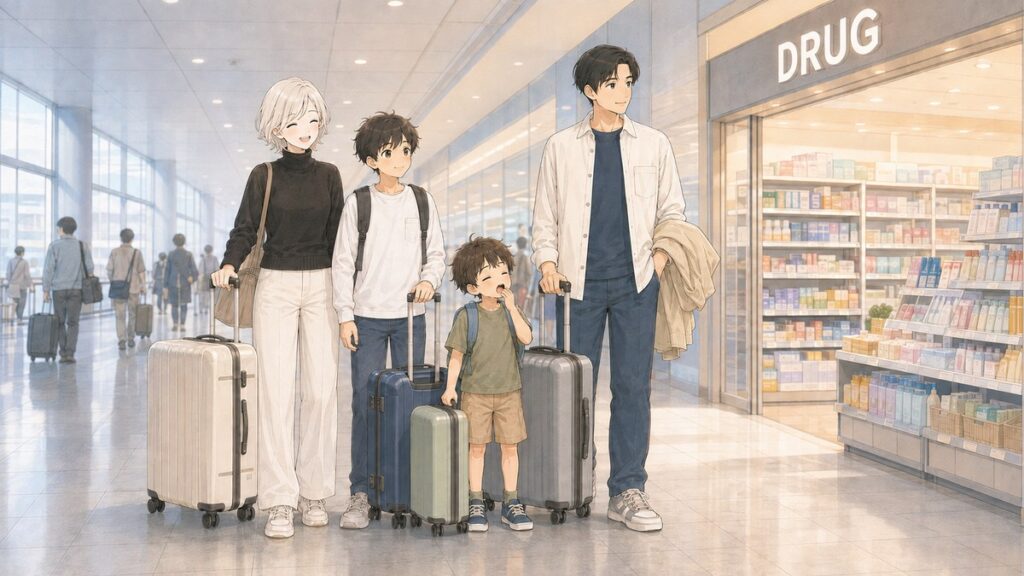
Here’s the part that can change your first night: you may not have to wait until you’ve found a drugstore near your hotel. Narita Terminal 2, Haneda Terminal 3, and Kansai Terminal 1 each have a drugstore in the public part of the building — no boarding pass needed — so you can try buying the kit after customs, before you head into the city. Stock varies by branch, so treat the airport as a convenient first try rather than a guarantee.
That matters because day one is often a walking day already — a long flight, a train into the city, then a hunt for your hotel with luggage. Buying the kit on the way out means it’s in your room before your feet start asking for it.
| Airport | Store | Where | Hours |
|---|---|---|---|
| Narita | Matsumoto Kiyoshi | Terminal 2, B1F — the train station level | 7:00–20:30 |
| Haneda | BOOKS & DRUGS NORTH | Terminal 3, 3F departure lobby | 6:30–24:00 |
| Kansai | Cocokara Fine | Terminal 1, 2F — one floor above arrivals | 7:00–22:00 |
If you land at Narita Terminal 2, the B1 branch is the handiest of the three: it sits on the same level as the trains, so it’s genuinely on your way out. At Haneda and Kansai the shops are a floor or two above where you come out, so check the floor guide rather than wandering — an airport terminal is the last place you want to add steps.
 One trap to know about: search for an airport drugstore and you’ll also find “departure area” branches. Those sit after passport control, so you can’t reach them when you arrive — only when you fly out. Opening hours change and stock varies by branch, so treat the airport as a convenient first try rather than a guarantee.
Kyusoku Jikan: Japan’s Famous Pink Foot Sheets
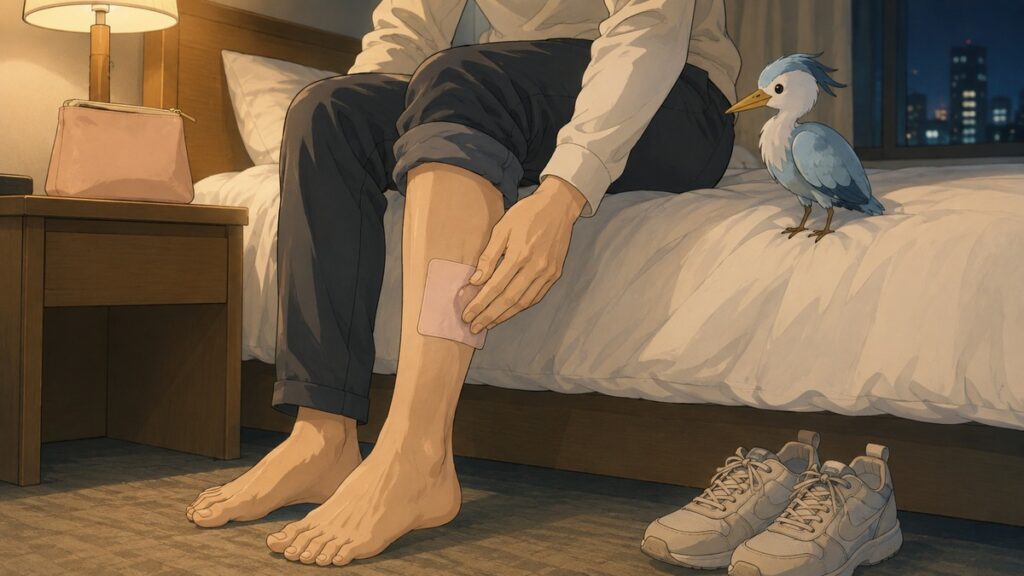
The full product name is 休足時間 足すっきりシート, made by Lion, and the brand is read Kyusoku Jikan. It comes as a six-sheet pack, or an 18-sheet box divided into three pouches of six.
These are cool gel sheets for your feet and lower legs. Lion suggests them after a bath or before bed, and after standing work or sports. You can put them on your calves, your ankles, or the soles of your feet.
The cooling has a plain physical explanation: water held in the sheet takes heat with it as it evaporates, and menthol adds the fresh sensation on top. Lion states outright that this isn’t a medicine. It’s a comfort item — the pleasant end of a heavy day, not a fix for whatever made the day heavy.
 That distinction matters more when you’re traveling. Ordinary end-of-day heaviness after a lot of walking is one thing. A new injury, swelling, severe pain, or a skin problem is another, and a cool gel sheet shouldn’t be used to quiet a symptom that needs proper attention. These won’t replace sleep, water, or medical care.
How I use them
I put mine on right before bed, on both calves and both soles — four sheets on a day that really earned them. Once the sheets are on, it’s lights out. There’s no point starting if you still have one more errand downstairs.
If the soles feel hot after hours in shoes, that’s the obvious place to begin. If you’ve spent the day climbing station stairs, your calves may want them more. Follow the package directions, and apply only to normal, unbroken skin.
Don’t decide in advance that they have to stay on for a set number of hours. Lion doesn’t publish a wear-time target for this product, so put them on around bath time or bedtime as directed, and take them off when they stop feeling good.
One very practical warning for travelers: don’t put your shoes back on over them. The gel can transfer to your socks and shoes.
What’s inside
The sheets contain menthol and five herbal ingredients: lavender, sage, rosemary, lemon, and orange. Formulas and labelling can change, so read the ingredient panel on the pack in your hand if your skin reacts to menthol or to scented body products.
The herbal scent and the menthol are part of the appeal for a lot of people — and a fair reason to skip these if you don’t like scented body products.
Safety notes worth two minutes
Never apply them around your eyes, on mucous membranes, or on skin with eczema, a wound, or any other abnormal condition. If redness, itching, or another reaction shows up during or after use, stop and consult a doctor.
Lion asks that young children use the sheets only under close adult supervision. Each sheet is for a single use.
MegRhythm: The 40°C Steam Eye Mask
This is the one item I most want you to recognize correctly in a Japanese store. The MegRhythm steam eye mask warms to about 40°C and stays comfortable for roughly 20 minutes. You unfold it, place the white side over your eyes, line it up with the curve of your nose, hook the loops over your ears, and close them.
Inside, iron powder reacts with oxygen in the air. That reaction produces heat, and the heat turns moisture into steam — no charging, no microwave, no hotel kettle. Opening the individual packet is what starts it.
The warmth doesn’t need a big claim to be worth about ¥100 — roughly 65 cents — a mask. After a day of reading platform signs, checking maps, and looking at your phone on trains, twenty minutes with your eyes shut feels like permission to stop processing information.
Why the box may look different from older English guides
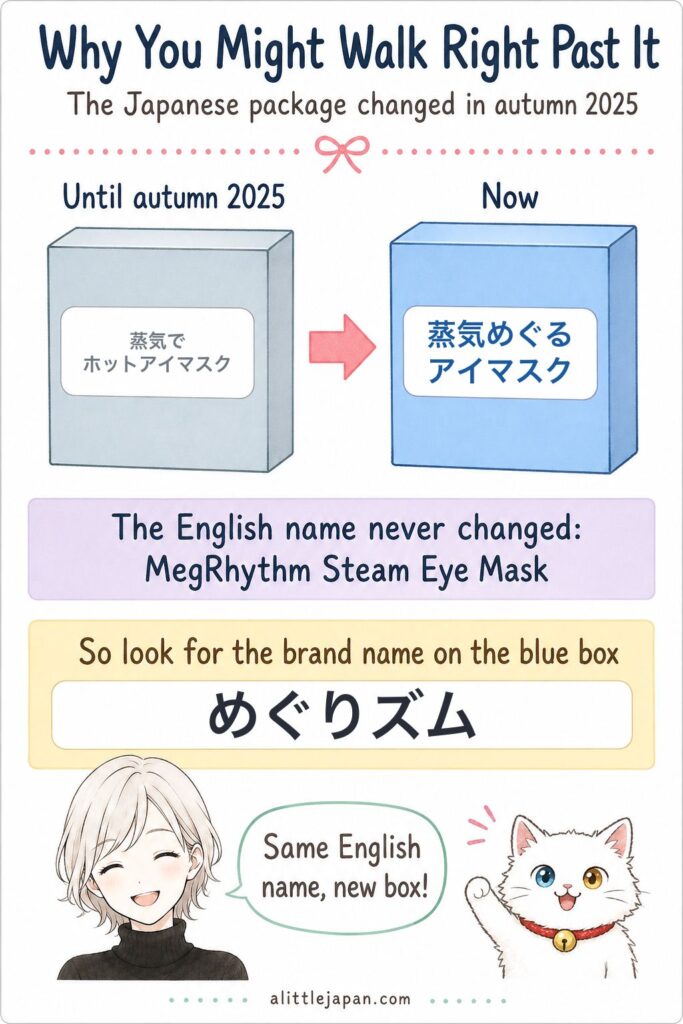
The English product name is still MegRhythm Steam Eye Mask. In Japan, though, Kao renamed the product on August 30, 2025 — from めぐりズム 蒸気でホットアイマスク to めぐりズム 蒸気めぐるアイマスク — and redesigned the package at the same time.
If you can’t read Japanese, don’t try to match every character from an old product photo. Look for めぐりズム / MegRhythm on the current blue package.
This was more than a new box. Kao changed the material as well: compared with the previous version, the nonwoven fabric is about 2.6 times thicker and holds heat about 1.5 times better. That’s also why older photos in English articles may not match the shelf in front of you.
Choosing a scent
Japan’s current lineup has seven versions: unscented, plus six scents — lavender, fully ripe yuzu, forest bathing, chamomile, osmanthus (kinmokusei), and hinoki, which is Japanese cypress. “Forest bathing” is a scent name, not an instruction to take the mask outdoors.
 And if an older English review told you to buy the rose one, that recommendation has expired — rose and “menthol-in” were discontinued in August 2025. Between the rename and the discontinued scents, the lineup has moved a long way from what many overseas articles still describe.
My own pick is fully ripe yuzu. Yuzu is a Japanese citrus, brighter and less sweet than orange, and I use the mask right before I go to sleep rather than earlier in the evening.
If fragrance bothers you, take the unscented one and still check the exact package before buying. This sits directly over your nose, so a scent that seems mild on a shelf can feel much stronger once the mask is on.
Why 20 minutes works in a hotel room
Twenty minutes is long enough to put the phone out of reach and short enough to survive an early start tomorrow. Nothing needs preparing, chilling, or washing afterward. Open the individual packet only when you’re ready to use it, because contact with air begins the warming.
If the warmth or the fit doesn’t feel right, take it off. Twenty minutes is an approximate comfortable duration, not a target you have to finish.
 I’d put this step near the end of the night. A face mask asks you to watch the clock and follow steps; the eye mask asks the opposite. Once it’s on, tomorrow’s route can wait.
Japanese Sheet Masks: The 10-Minute Skin Reset
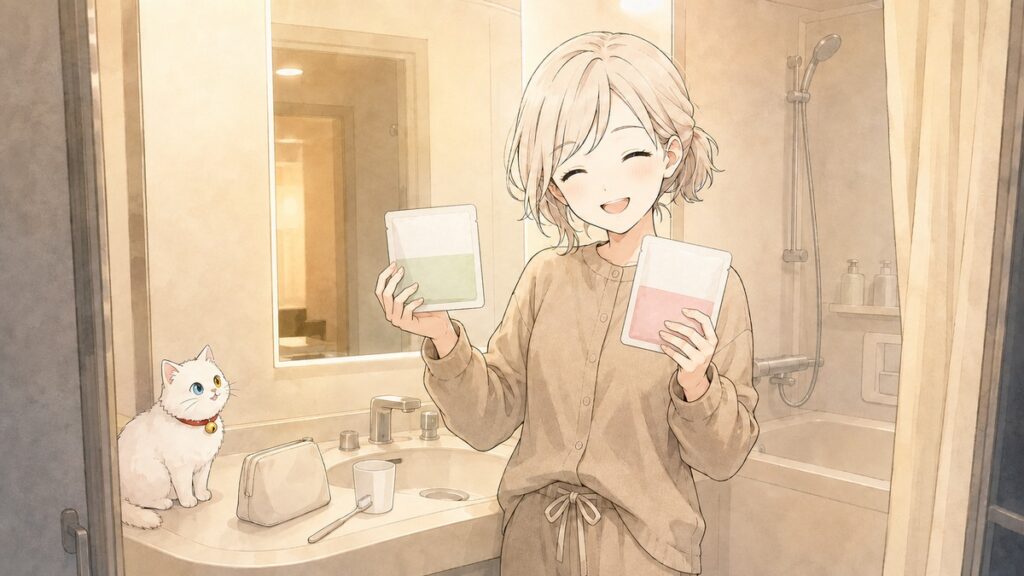
A sheet mask adds a different kind of comfort. It gives you a reason to sit down after washing your face, instead of doing skincare standing up in the middle of your shopping bags. LuLuLun is the easiest brand to start with, because it sells everyday multi-packs alongside regional versions that feel like part of the trip.
For a basic pick, start with LuLuLun Precious in GREEN, RED, or WHITE. One thing to know before you go hunting — the wording on Japanese packages and the wording in English listings don’t always match, so the same colour can be described differently depending on where you read about it. Match the colour and the LuLuLun Precious name rather than translating every word. LuLuLun also has HYDRA, OVER45, and Pure lines, so the full display looks more complicated than those three colours alone.
 The green Precious is the one I keep buying. You don’t need to decode the entire shelf: choose the range that matches the skincare you already like, and read the package directions before use.
A seven-mask pack usually costs ¥440–¥880 (about $3–6), while the big 28–32 mask boxes run ¥1,760–¥2,640 (about $17–17). For a hotel routine, the small pack is the practical starting point. It fits in a suitcase, and you’re not carrying a month’s supply around Japan to try something new.
One small habit worth copying: when you take the sheet off, there’s usually essence left in it and in the bottom of the pack. I press what’s left onto my neck, elbows, and the backs of my hands rather than throwing it away — the parts that also spent the day in dry train air and afternoon sun. It’s not a rule, just what the pack is designed to give you.
Tabisuru LuLuLun: a mask that belongs to the place you’re standing in
The most enjoyable option for travelers is 旅するルルルン, or Tabisuru LuLuLun — “Traveling LuLuLun.” The series is built on regional themes, so the place isn’t just where you bought it; it’s the idea behind the product.
As of August 2026, five new regional varieties have arrived: one each from Niigata, Nara, and Wakayama, and two from Ishikawa. The Ishikawa pair is built around Ruby Roman grapes and Kaga bocha, a local roasted stem tea, while the Wakayama one is inspired by green ume, the Japanese plum. Finding the one from the region you’re actually in turns a drugstore stop into a small treasure hunt.
They make good gifts, too, because they’re tied to a specific place without taking up suitcase room. For someone who enjoys skincare, a regional mask may get more use than another keychain. Just don’t assume every general drugstore stocks them — look where local souvenirs are sold, and buy the one you like when it’s in front of you.
Don’t forget the airport version
There’s also an airport-exclusive LuLuLun with a “Refresh Sky” scent, sold in airport souvenir shops. That makes it a useful last purchase if you never found a regional one, or if you remember one more person while you’re waiting to check in.
The convenience is that you don’t have to carry it across the country. The risk is that you’re relying on whatever your airport happens to have that day. If a particular regional package matters to you, buy it when you see it.
For the night routine, use a sheet mask right after your bath or shower, while you’re still awake enough to follow the instructions on the package — most ask for around ten minutes. Then finish with whatever skincare you normally do. The point isn’t to turn a tired hotel night into an elaborate beauty routine. It’s to make the routine you already have feel calm and deliberate. If daytime skincare is on your mind too, we have a full guide to choosing a Japanese sunscreen.
Where to Buy: Drugstore vs. Convenience Store
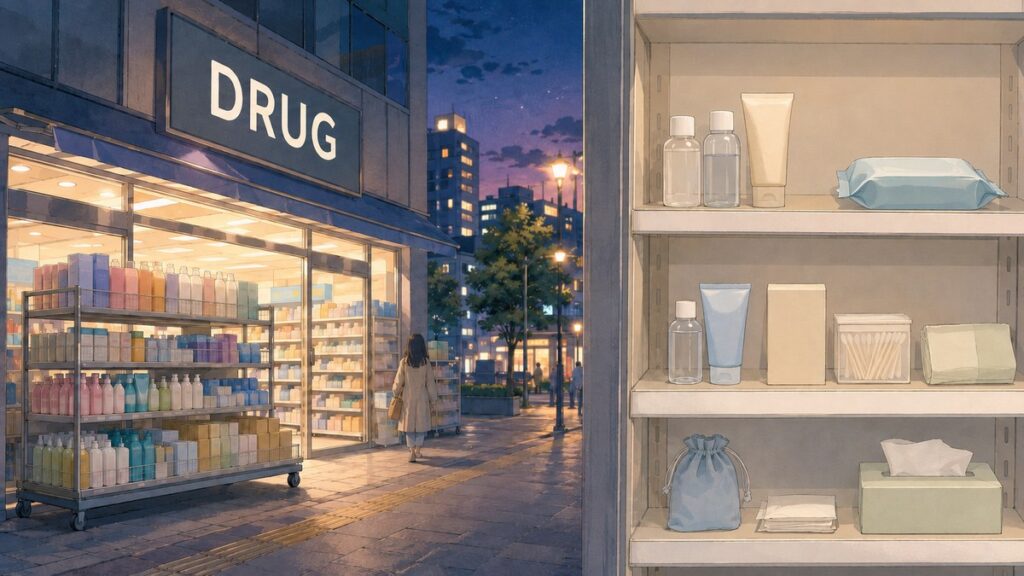
A drugstore is your best first stop for all three items. Kyusoku Jikan and MegRhythm are both well-known products, but convenience store stock varies a lot by branch. You might spot one of them at a big, busy store — you just shouldn’t plan your evening around it.
And while you are standing in one, the skincare aisle a few steps away is worth a slow lap. There is a full breakdown of what is worth buying — and what it actually costs — in Japanese Drugstore Skincare: What to Buy and What It Really Costs.
The chains to look for are Matsumoto Kiyoshi (マツモトキヨシ, usually shortened to “MatsuKiyo”), Sundrug, Cocokara Fine, Welcia, and Tsuruha. Don Quijote (ドン・キホーテ) isn’t a drugstore, but many larger branches carry similar products and may stay open late, which is often what matters at 10 p.m. If the signs all look the same to you, the storefront words to hunt for are ドラッグ, DRUG, or 薬.
Displays are dense and colorful, so showing the Japanese name on your phone is faster than scanning shelves. Save 休足時間 足すっきりシート for the foot sheets and めぐりズム 蒸気めぐるアイマスク for the eye mask — with めぐりズム as the part that matters if everything else on the package looks unfamiliar.
Opening hours aren’t uniform. A branch in a tourist area may run late into the evening while another closes earlier, so check the posted hours before making a special trip. The easiest version of this is buying the kit in the afternoon, when you happen to walk past a store and your feet still have opinions about walking further.
When the convenience store is still worth a look
A convenience store earns its place when it’s late, it’s raining, or the nearest drugstore is a ten-minute walk you don’t have in you. Check the travel-size toiletries section, but keep expectations small — a compact branch may have a couple of face masks and no foot-care sheets at all.
If it’s there, the convenience premium is probably worth it, because the store is downstairs and your hotel bed isn’t. If it isn’t, buy water and leave the rest for a drugstore tomorrow. A recovery routine that requires another long walk isn’t much of a recovery routine. Our convenience store etiquette guide covers what else to expect inside.
What about tax-free shopping?
Some drugstores offer tax-free shopping to eligible overseas visitors. The rules and procedures do change, so use our full tax-free shopping guide rather than a sign taped up beside the skincare shelf. Keep the two decisions separate, though: a ¥500 comfort item — about $3 — can be worth buying even when the tax benefit isn’t part of it.
Reading this from outside Japan? The same three products are listed on Amazon through third-party sellers — Kyusoku Jikan, MegRhythm (unscented) and LuLuLun — and Salonpas sells a US version of its patches there as well. Expect a markup compared with a Japanese drugstore.
Check the recovery kit on Amazon
The Full Night Routine, Step by Step
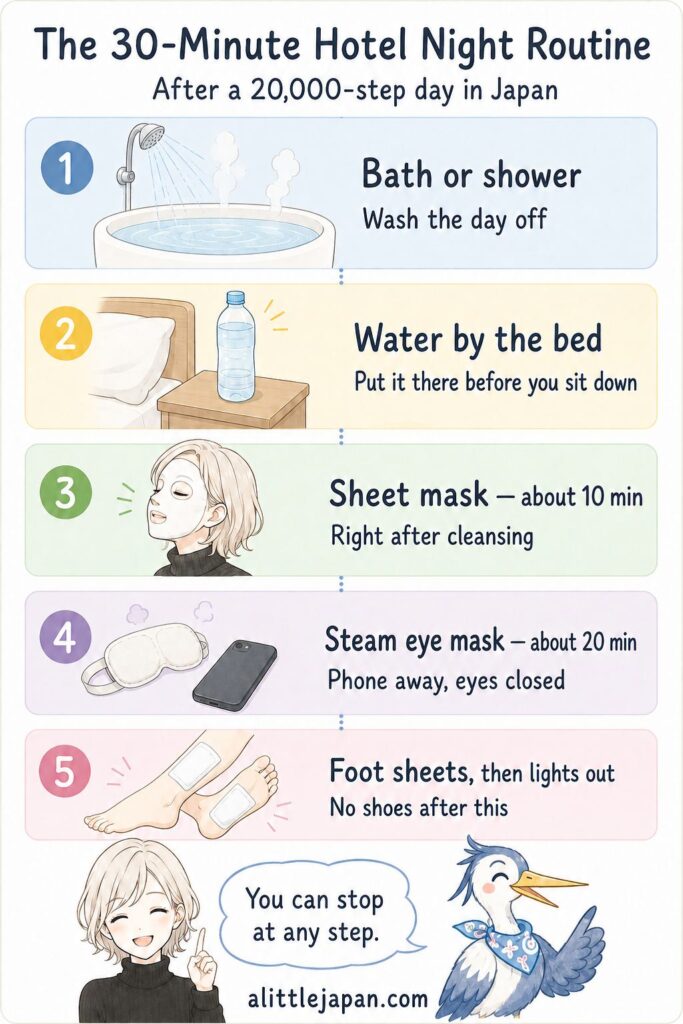
Every step moves you closer to the bed, which is the whole design. Set everything out before you start, so you’re not digging through a suitcase halfway through with a mask on your face.
- Take a bath or shower. Wash off the sunscreen, the sweat, and the general feeling of a full day outside. A shower-only bathroom is fine; none of this needs a bathtub.
- Put a drink beside the bed. Do it now, while you’re still standing. Once the eye mask is on, you won’t want to cross the room for anything.
- Sheet mask, around ten minutes. Apply it soon after cleansing and stay sitting down. This is a good moment for tomorrow’s small tasks — setting out clothes and charging your phone — the ones that don’t send you walking.
- MegRhythm eye mask, about twenty minutes. Phone away first. White side over your eyes, nose opening lined up, loops over your ears, then close your eyes while the mask warms the eye area with steam at about 40°C.
- Kyusoku Jikan, then bed. Calves, ankles, or soles, on normal unbroken skin only. No shoes over the gel sheets, and take them off if your skin gets itchy or red.
 About that first step — before you default to the shower, check whether your hotel has a 大浴場 (daiyokujo), a shared bath. Some business hotels have one, and it tends to sit in a corner of the booking page where nobody reads it. A proper soak is the free half of this routine. Check two things first: the opening hours, which are often shorter than you’d expect, and the tattoo policy, since some shared baths still don’t allow them.
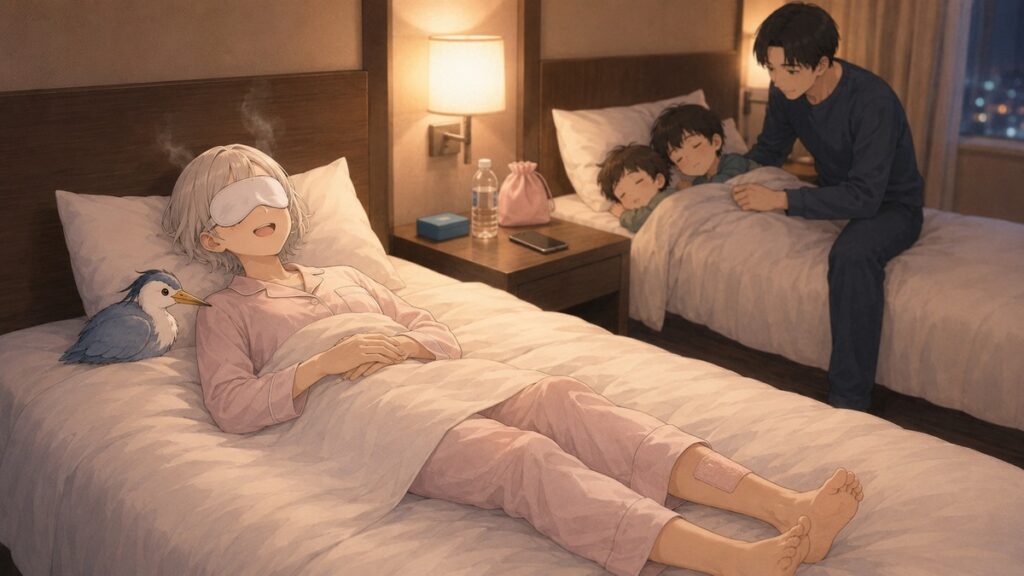
The order isn’t a medical protocol; it’s just logical. The face mask belongs with freshly cleansed skin. The eye mask belongs near sleep, because it removes the need to look at anything for twenty minutes. The foot sheets come last because you’re finished wearing shoes for the day.
If you’re traveling with children, simplify instead of building a spa night. Get everyone through the necessary bedtime steps first, then pick one quiet thing for yourself. As a mother, I can tell you that a routine only counts as a routine if it survives a messy family evening.
You can also stop at any step. A shower, a glass of water, and an earlier bedtime is a completely legitimate version of this.
Other Recovery Finds Worth Grabbing
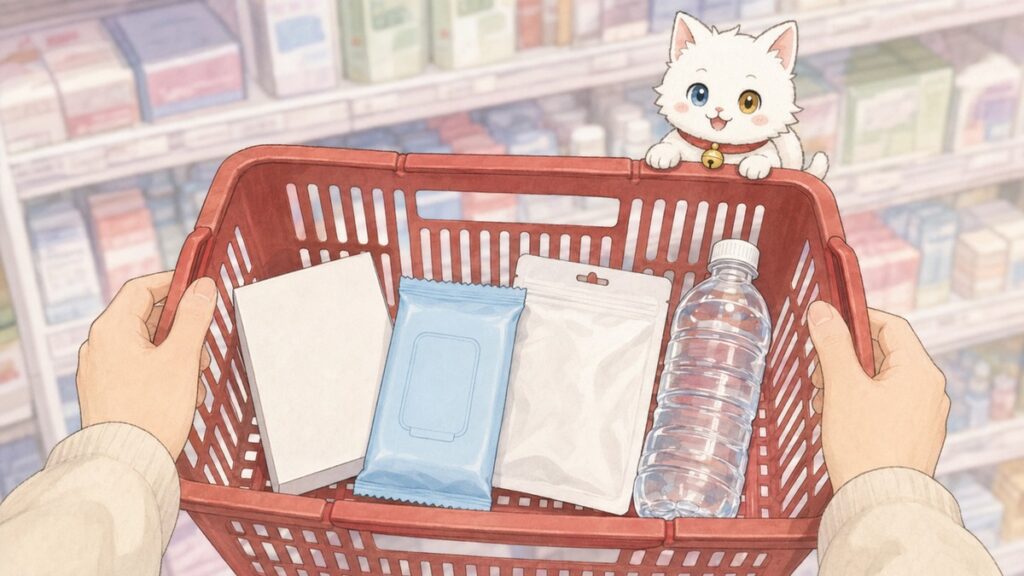
You’ll see plenty of other things in the drugstore promising relief for long days. Three are worth knowing about before you start filling the basket — and with each one, read the label of the exact product rather than assuming they all work the same way.
MediQtto (メディキュット): Japan’s best-known compression socks — every drugstore has a shelf of their purple-and-pink boxes. The overnight “sleep” type is the classic choice after a heavy walking day: you put them on at bedtime and they put gentle pressure on your calves while you rest. I wear these myself, and honestly, the next morning my legs feel so much lighter. Sizes are based on calf and ankle measurements, so check the chart on the box rather than guessing. They’re much cheaper at a Japanese drugstore, so it’s worth grabbing a pair while you’re there — but tired legs don’t only happen in Japan. If a trip isn’t on your calendar, or you tried them in Japan and want more at home, imported versions are on Amazon at around $33.
Check MediQtto Sleep Compression Socks on Amazon
Salonpas: Already familiar to a lot of English-speaking shoppers. Unlike the three comfort items above, some Salonpas products are over-the-counter medicines, so check the classification, directions, and warnings on the exact product you’re buying.
Cooling body wipes: In a Japanese summer, one of these makes the walk back to the hotel much less sticky. Choose one meant for the part of the body you plan to use it on — our guide to Japanese cooling body sheets compares the main ones.
Sore Feet in Japan: Frequently Asked Questions
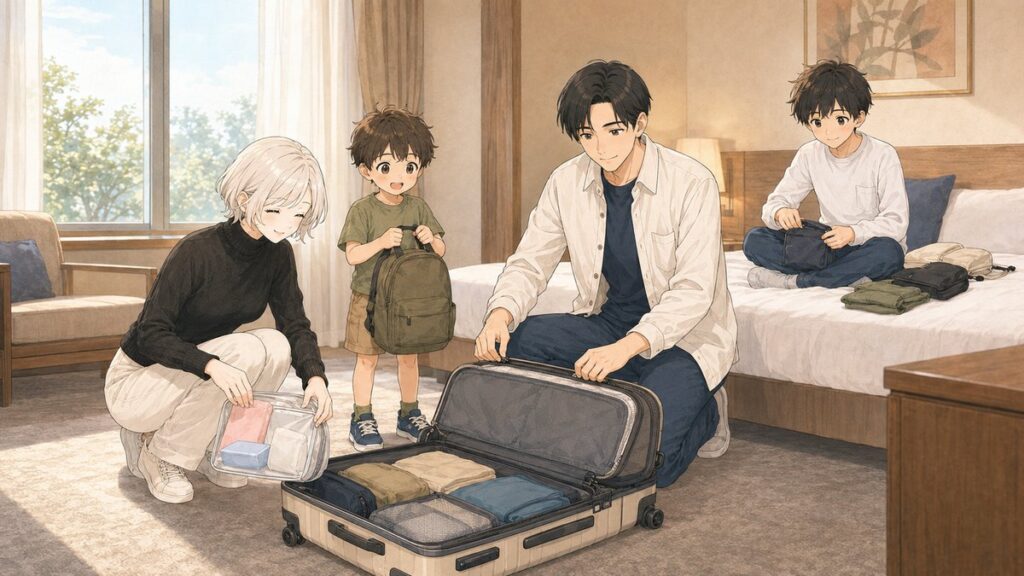
Can I bring these on a plane?
Lion states that Kyusoku Jikan isn’t classified as dangerous goods under Japan’s aviation law. The other two are different products, though: MegRhythm contains an iron-powder heating element, and sheet masks are saturated with skincare liquid. Don’t assume all three are treated the same way at every airport, and remember that your airline and the security staff make the final call.
Keep everything in its original packaging so staff can identify it quickly. If you’re carrying a large quantity, or you have any doubt about a specific product, ask your airline and your departure airport’s security authority before you fly.
Can I buy them outside Japan?
MegRhythm is the easiest of the three to find. Kao has an official MegRhythm store on Amazon in the United States, though pack sizes, scents, prices, and availability change — check the current listing before comparing overseas and Japanese prices.
Kyusoku Jikan has much weaker distribution abroad, so buying it during your trip is the realistic option. LuLuLun depends on your market, and the regional Tabisuru LuLuLun and the airport version are tied to specific places in Japan by design.
Are the foot sheets safe for sensitive skin?
Kyusoku Jikan isn’t guaranteed to suit sensitive skin. It contains menthol and fragrance, so check the current ingredient panel, and don’t use it on irritated, broken, or otherwise abnormal skin. Stop if redness or itching appears.
If you have a known skin condition or ingredient sensitivity, ask a healthcare professional — a travel article isn’t personal medical advice.
Can kids use them?
Lion’s official warning is that young children should use the sheets only under close adult supervision. That isn’t the same as saying every child needs one. Check the child’s skin and the current package instructions, and don’t put a sheet anywhere a child can touch the gel and then rub their eyes.
For the other products, read the exact package directions first. A bath, water, and sleep are perfectly good alternatives for a child who doesn’t need an extra product.
How many should I buy?
Count people, then nights, then areas. I use four sheets on a heavy day — both calves and both soles — so a six-sheet pack is a night and a half for one person, while the 18-sheet box is closer to four nights. If you only want the soles, the same box goes twice as far.
MegRhythm is single-use, so it’s one person, one night, one mask; packs come in fives and twelves. LuLuLun’s small pack holds seven, and the large boxes hold 28–32.
You probably won’t want the full routine every evening, either. Buy for your two or three biggest walking days, and pick up more mid-trip if the kit turns out to be the best ¥1,500 (≈$10) of the week. Drugstores aren’t hard to find here. If you’re still shaping the trip itself, our 10-day Japan budget plan shows where those long walking days tend to land.
Final Thoughts
Sore feet can take the shine off a Japan trip, but your evening doesn’t need to turn into another project. For ordinary end-of-day soreness, I’d start with a bath or shower, water beside the bed, and Kyusoku Jikan if the cooling feels good on your skin.
Add LuLuLun and MegRhythm when you want those simple steps to become a calmer thirty minutes. Just remember that the MegRhythm name and package changed in Japan in 2025, so look for the current brand name rather than an old product photo.
The easiest plan is to buy everything while you’re already walking past a drugstore — not after you’ve reached the hotel and taken your shoes off.
Now I’m curious about your side of the world — what do you reach for after a day on your feet? A long bath, a particular drink, something from your own local pharmacy? Tell me in the comments below. I read every single one!
I hope this guide has answered one of your questions and helped you feel a little closer to Japan. May your Japan journey be filled with wonderful discoveries and memories you’ll treasure for years to come.
See you in the next guide. 
Sources: Lion Corporation official product page (Kyusoku Jikan), Kao Corporation official MegRhythm site, and the official LuLuLun site. Prices and lineups were checked in August 2026 and may change.
What to Read Next
- Japanese Cooling Body Sheets: Biore vs. Gatsby
- Japan on a Budget: 10-Day Itinerary & Real Costs
- USJ Express Pass: Worth It? Which One to Buy?
- Best Japanese Sunscreens to Buy in Japan
- Save your feet on moving days: Luggage Forwarding in Japan: Is It Worth It?
- Already in the drugstore? Japanese Drugstore Skincare: What to Buy and What It Really Costs

Comments