You step into a small restaurant in Japan — and then you stop. Should you wait here? Or just take that empty table by the window? The staff look busy, the menu is in Japanese, and suddenly a simple lunch feels like a test.
If that moment sounds familiar, or sounds like exactly what you’re worried about, this guide is for you. I live in Japan and eat out often with my two children, so I’ve put together this guide to Japanese restaurant etiquette in the order you’ll actually experience it: entering, ordering, eating, and paying.
And here’s the most important thing, right up front: you don’t need to know every Japanese table-manner rule to enjoy a meal here. Nobody expects perfection from a visitor. A little awareness and a polite “sumimasen” are usually enough — and when in doubt, you can simply watch the flow of the room or follow the staff’s lead. That works for me too.

- Quick Answer: Japan Restaurant Etiquette and Table Manners at a Glance
- Wait to Be Seated
- Ordering May Work Differently at Every Restaurant
- Does Everyone Need to Order Something?
- The Oshibori Is Mainly for Your Hands
- The Two Chopstick Rules That Matter Most
- Slurping Noodles Is Fine—but Not Required
- You Don’t Have to Finish Every Grain of Rice
- Dining with Children in Japan
- Take the Bill to the Register
- FAQ: Japan Restaurant Etiquette and Table Manners
- 1. Do I need to tip at restaurants in Japan?
- 2. Is it rude to ask for a fork?
- 3. Can two people share one meal?
- 4. Can I take leftovers back to my hotel?
- 5. Is slurping noodles polite in Japan?
- 6. Do I need to say “Itadakimasu”?
- 7. Are Japanese restaurants suitable for children?
- 8. What should I do if I have a food allergy?
- Final Thoughts
Quick Answer: Japan Restaurant Etiquette and Table Manners at a Glance
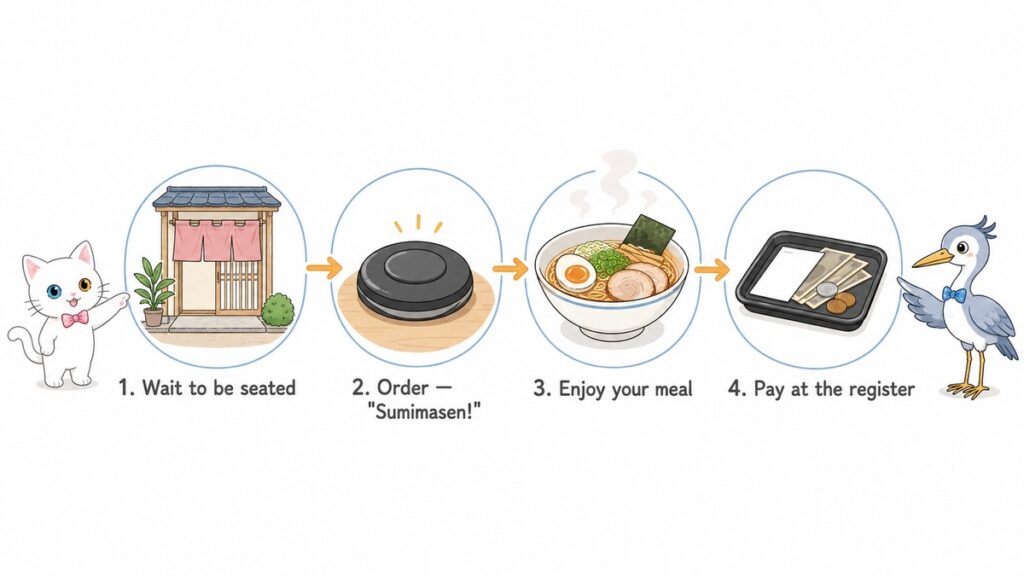
 In a hurry? Here’s the whole meal in one table. The details — and the reasons behind them — are below.
| Situation | What to Do |
|---|---|
| Entering | Wait near the entrance to be seated |
| Ordering | Use the tablet, ticket machine or call button provided |
| Calling staff | Say “Sumimasen” or press the call button |
| Eating | Follow basic chopstick manners, but don’t worry about being perfect |
| Paying | Take the bill to the register unless told otherwise |
| Tipping | No tip is normally needed |
Wait to Be Seated
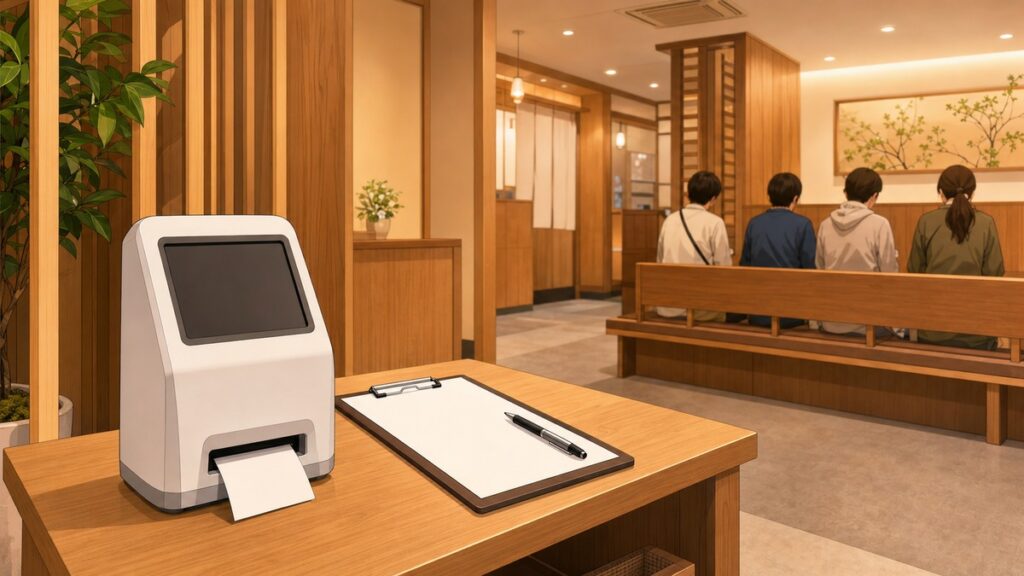
 At most restaurants in Japan, the safest move is wonderfully simple: step inside, then wait near the entrance. A staff member will greet you with “Irasshaimase!” (welcome!), ask how many people are in your group, and guide you to a table. Holding up two fingers for “two people” works perfectly — no Japanese needed. Taking an empty seat on your own can cause small mix-ups, since that table might be reserved or not cleared yet, so I’d let the staff lead the way.
Popular places usually organize the wait for you. You might see a machine that prints a numbered ticket, a tablet at the door, or a paper list where you write your name and group size. Many conveyor-belt sushi chains have reception machines with an English option, which makes them one of the easiest choices for visitors.
 That said, not every restaurant follows the same flow. At some ramen shops, you buy a meal ticket from a vending machine near the entrance before sitting down, then hand it to the staff. At food courts, it’s usually the opposite of a regular restaurant: order and pay first, then find your own seat. And at places with traditional tatami seating or some private rooms, you may be asked to take off your shoes — a raised floor or little shoe lockers at the entrance are your clue.
If all these patterns sound confusing, here’s the good news: the entrance itself usually tells you what to do. A machine, a list, a person — one of them will be there. When in doubt, pause for a moment and watch what the people ahead of you are doing. That’s honestly what I do at a restaurant I’ve never visited before.
Ordering May Work Differently at Every Restaurant
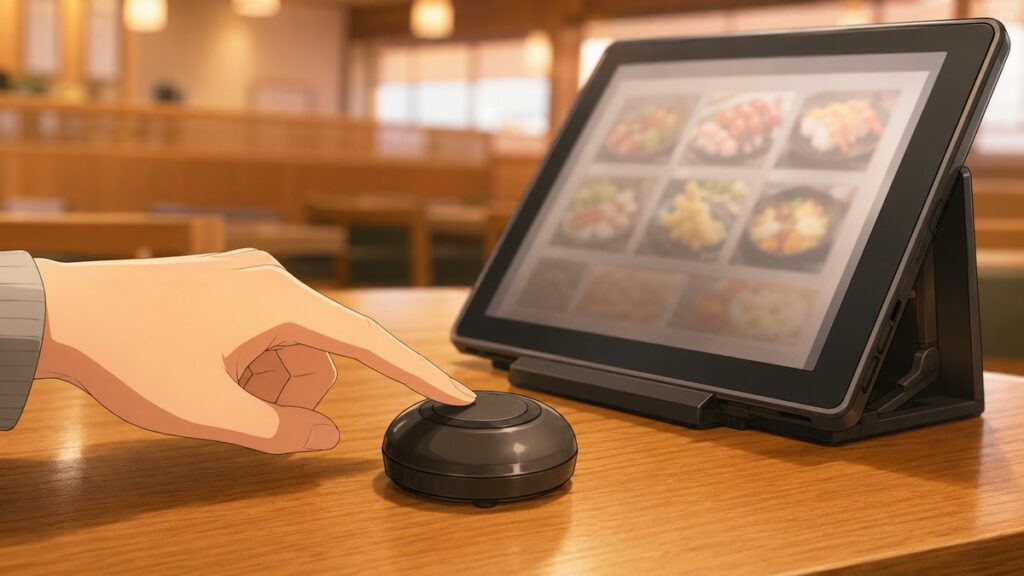
 Here’s something that surprises many first-time visitors: at a lot of restaurants in Japan, the staff won’t come to your table until you call them. It’s not neglect — it’s a way of giving you space until you’re ready. When you’d like to order, just raise your hand a little and say “Sumimasen” (I’ve written a full guide to this magic little word). Calling out like that is completely normal here. And if there’s a call button on the table, press it instead of raising your voice — that’s exactly what it’s for.
The ordering style itself changes from shop to shop. Some places take your order face to face. Others give you a touch-screen tablet, a QR code to scan with your phone, or — at some ramen shops — the ticket machine near the entrance we passed in the last section. Conveyor-belt sushi restaurants usually have their own ordering screen right at the table. Tablets and screens often include an English option, so you can take your time and order without saying a single word.
If you do want to try a little Japanese, these three phrases will carry you through almost any restaurant:
- Sumimasen. — Excuse me.
- Kore o onegai shimasu. — This one, please.
- Osusume wa nan desu ka? — What do you recommend?
Don’t worry about perfect pronunciation. Pointing at the menu while saying “kore” (this), or simply showing a translation app on your phone, works just fine — photo menus and those famous plastic food displays exist for exactly this reason. And on a day when even a restaurant feels like too much, a convenience store dinner is a genuinely good backup plan. I wrote a friendly guide to convenience store etiquette too.
Does Everyone Need to Order Something?
The short answer: there’s no nationwide “one dish per person” rule in Japan. But at small or busy places, ordering one item per adult is the considerate thing to do — and sometimes it’s the house policy. A tiny ramen shop with eight seats runs on those seats turning over, so when a shop is small or a line is forming outside, I’d plan on one order each.
At family restaurants and cafés, things are much more relaxed. Settling in with just a drink or a small dessert is usually fine. Some restaurants put up a sign asking for one order per person — if you see one, that sign is your answer. And when there’s no sign and you’re not sure, just ask the staff. It’s never rude to check.
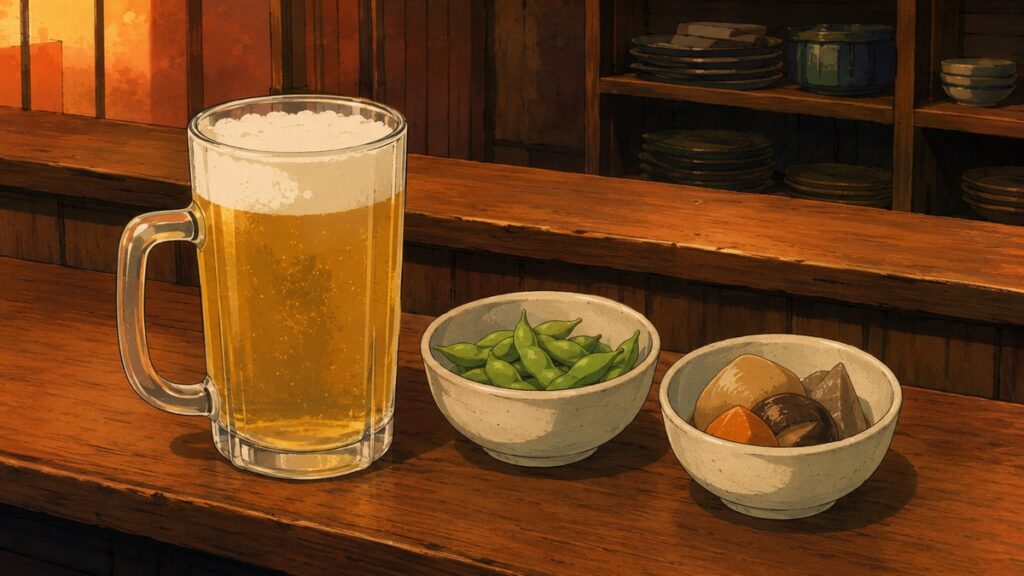
 Izakaya, Japan’s casual pubs, have one custom worth knowing in advance. Many expect each guest to order at least one drink, and a small dish you didn’t order may appear along with it. That’s called otoshi — a little appetizer that works like a table charge of a few hundred yen. It’s not a mistake, and it’s not a scam. It’s simply how many izakaya operate, so don’t be surprised when it shows up on the bill.
What about sharing? Sharing a dish isn’t forbidden — couples split desserts and families pass plates around all the time, and small children usually aren’t expected to order like adults. And here’s a handy word for sharing: torizara — a small plate for taking your portion from a shared dish. Just say “Torizara o onegai shimasu” (small plates, please), and the staff will bring one for each of you. At izakaya, they often appear without your asking. Sharing is so normal here that the little plate has its own name.
 The one situation I’d avoid is several people holding a table in a crowded restaurant with a single order between them. Think of it less as a rule and more as helping that little shop keep its lights on.
The Oshibori Is Mainly for Your Hands
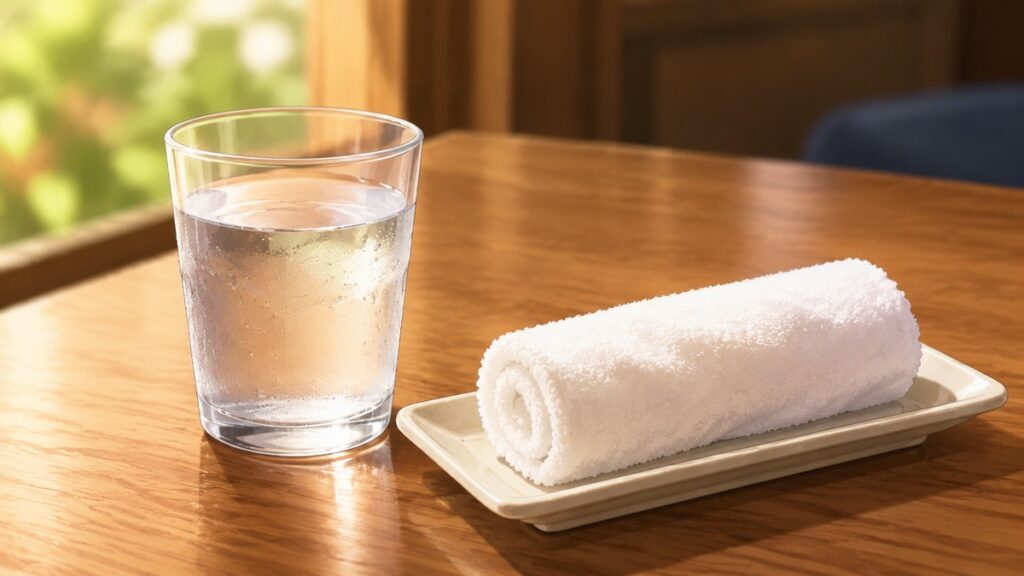
Sit down at almost any restaurant in Japan, and two things usually arrive before you’ve ordered a single item: a glass of water (or cold tea) and a small rolled towel called an oshibori. Both are free, and refills of water are free too. In summer the towel often comes out pleasantly chilled, and in winter, comfortingly warm.
The oshibori is mainly for wiping your hands before you eat. It isn’t really meant for the table, the dishes, or your phone screen — and while you might spot someone at a casual place giving their face a quick wipe, using it just for your hands keeps you safely polite. When you’re done, fold it loosely and set it back near its tray or wrapper. It’s a small gesture, but it looks tidy and makes the staff’s work a little easier.
One more gentle tip: if something spills or a plate gets messy, there’s no need to clean it up with your used oshibori. Just let the staff know — they’ll bring a cloth or a fresh towel, usually with a smile.
 And here’s something to look forward to: at some restaurants, the staff quietly notice when you’re finishing your meal and bring out a cup of hot tea — no need to ask, no extra charge. I love that moment. From the free water to that last warm cup, it’s all part of the same quiet hospitality.
The Two Chopstick Rules That Matter Most
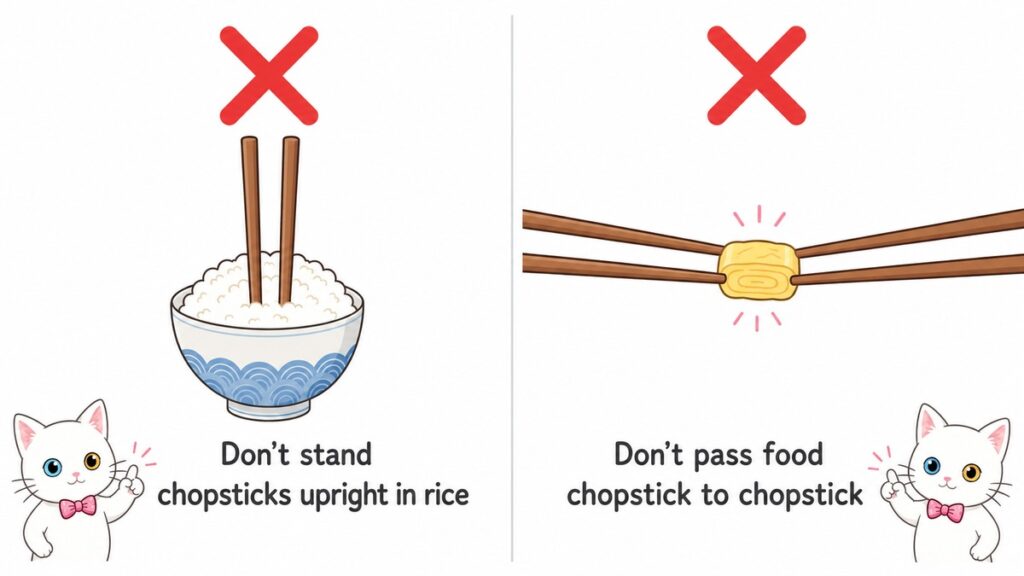
You may have seen scary lists of fifteen chopstick rules to memorize before your trip. Let me make it much simpler for you: only two of them really matter, and they’re easy to remember because they share the same reason — both are connected to Japanese funerals.
First, don’t stand your chopsticks upright in a bowl of rice. A bowl of rice with chopsticks standing in it is traditionally offered to the deceased at funerals and family altars, so seeing it at a dinner table gives people a small shock. If you need to put your chopsticks down, lay them flat instead.
Second, don’t pass food from your chopsticks directly to someone else’s chopsticks. This one also comes from a funeral ritual. If you’d like to share a bite, simply place it on the other person’s small plate — that torizara from earlier is perfect for this.
Beyond those two, a few small courtesies are nice to know, lightly: pointing at people or dishes with your chopsticks and stabbing food like a skewer are both better avoided. When you’re not using them, rest your chopsticks on the little holder called a hashioki, on the paper wrapper they came in, or on the edge of a plate. (Hashioki come in all kinds of adorable designs — they happen to make a lovely, tiny souvenir.)
 And please hear this clearly: nobody expects a visitor to handle chopsticks perfectly. Dropping a piece of food, holding them a bit awkwardly — no one minds. Asking for a fork isn’t rude either; just say “Fōku o onegai shimasu,” and it will appear. What matters is enjoying the meal, not passing a chopstick exam.
Slurping Noodles Is Fine—but Not Required
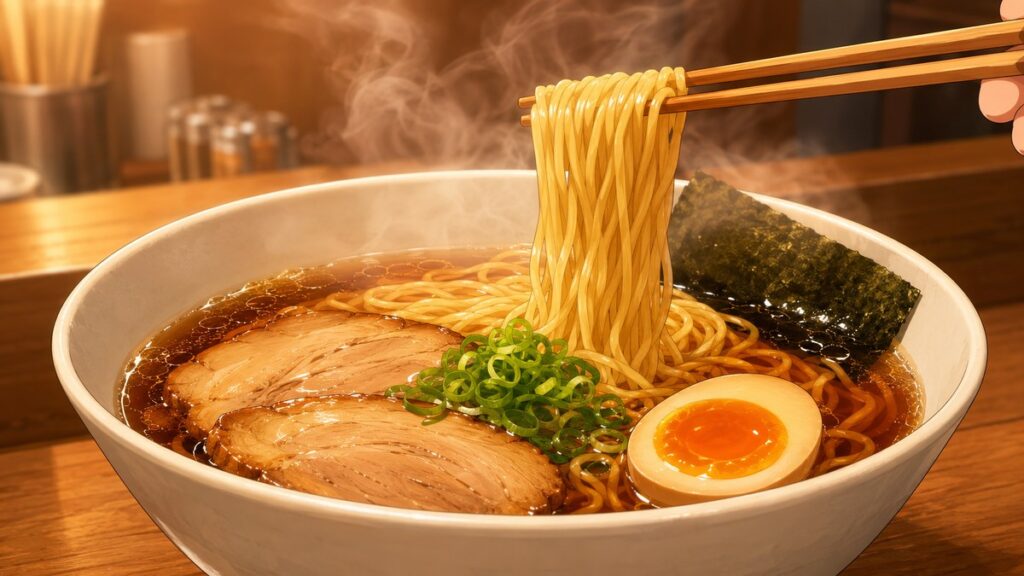
 Yes, the rumor is true: slurping your ramen, soba or udon is not rude in Japan. Many people here slurp happily — it cools the noodles on the way up and carries the aroma with them. But here’s the part many guidebooks skip: slurping is allowed, not required. If it feels unnatural to you, eat your noodles quietly. Nobody is checking.
Beyond the noodle question, most of the table manners you already know still apply. Talking loudly with your mouth full is as unlovely in Tokyo as it is anywhere else. When food arrives on a big plate for the table, take your share onto your small plate instead of eating straight from the middle — the torizara does its job again here. Whether sharing suits the meal depends on the restaurant and the dish: a set meal is made for one person, while big izakaya plates are made to be passed around.
Two small notes for the smartphone age: if you want to show someone a video, keep the sound off, and keep conversation at an easy volume — many restaurants in Japan run a little quieter than visitors expect. Photos of your beautiful food, though? Perfectly normal.
 And here’s a relaxing rule to finish with: when you’re done, you don’t need to stack your dishes or tidy the table. Leaving everything where it is counts as perfectly good manners — at some restaurants, stacking can even scratch the bowls, so the staff would rather handle it themselves. At an izakaya, just move your empty plates toward the edge of the table — the staff will notice and clear them for you.
As for me, even at places where no tidying is expected at all, I still nudge my plates together so the table looks reasonably neat when I stand up. It’s not a rule — just a small habit you’re welcome to borrow. Oh, and one true exception: at food courts, you usually carry your own tray to the return counter.
You Don’t Have to Finish Every Grain of Rice
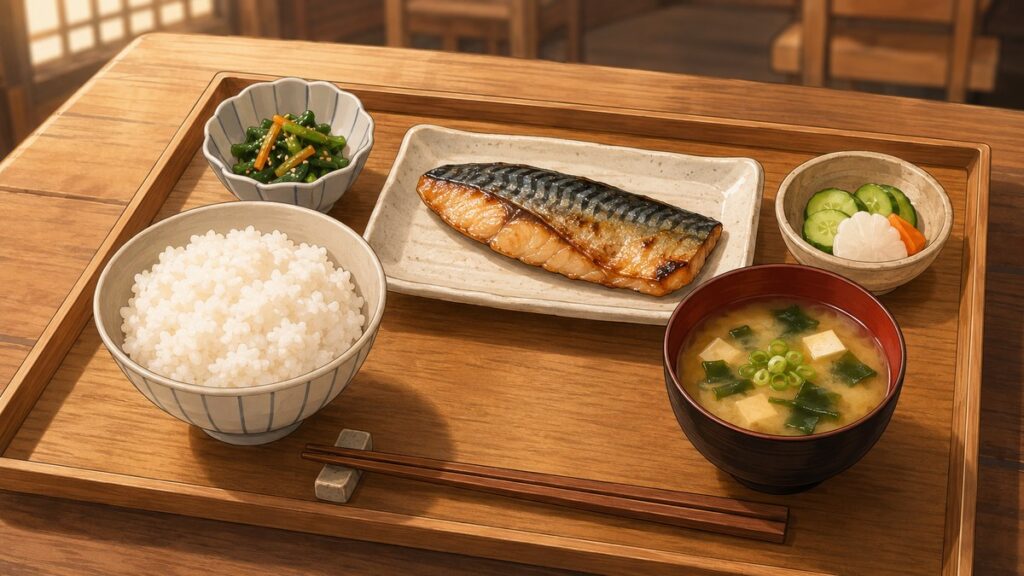
 Japan does have a deep respect for food. There’s even a word for it: mottainai — a soft pang of regret about wasting something that still has value. So yes, finishing what’s on your plate is quietly appreciated here. But let me say the other half out loud, because guidebooks often don’t: leaving food when you’re full, or when you’re not feeling well, is not a crime. Nobody will scold you, and forcing yourself to eat is never expected.
The happiest solution starts at ordering time: ask for an amount you can actually eat. Portions in Japan are moderate, and you can always order more later. I’m a light eater myself, so I almost always ask for a smaller portion of rice — “Gohan sukuname de onegai shimasu” (less rice, please). And honestly, I think telling the shop upfront is kinder than leaving food behind — it gives them the chance to serve you just the right amount.
What about taking leftovers back to your hotel? Here’s where Japan differs from many countries: doggy bags are not a given. Quite a few restaurants will politely decline for food-safety reasons, especially with raw fish, buffets, or at high-end places. The polite move is simple — never pack food into your own container, and just ask first: “Mochikaeri dekimasu ka?” (Can I take this home?). If it’s possible, the staff will bring you a proper container.
One last note, since we’re talking about food on the go: if you end up with a snack wrapper or a half-finished drink from a street stall, you’ll discover that public trash cans are surprisingly rare in Japan. The shop that sold you the snack will usually take the trash back — and I wrote a whole guide about what locals do when there’s no trash can in sight.
Dining with Children in Japan
If you’re traveling with kids, here’s some good news: eating out in Japan can be much easier than you might fear — as long as you pick the right kind of place. When I eat out with my children, my go-to choices are family restaurants (famiresu, as they’re affectionately called), food courts, and conveyor-belt sushi. They tend to have children’s chairs, small plates and kids’ cutlery, there’s a little more space for families, and a lively child blends right into the atmosphere.
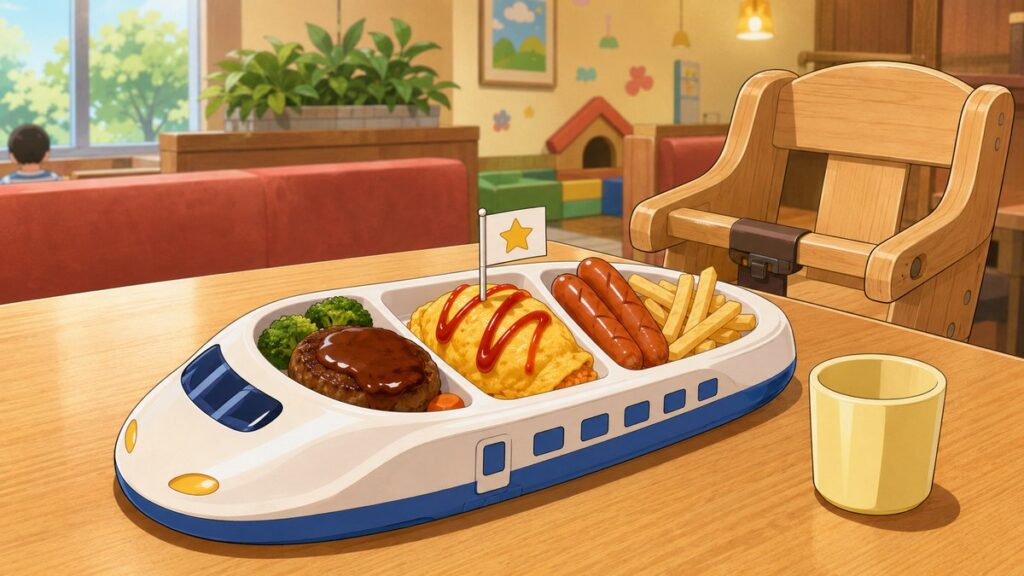
 And if there’s one thing I’d genuinely urge you to try, it’s the okosama lunch — the special meal that only children can order, offered at family restaurants and many other places. It’s everything kids love, all on one plate: a little hamburger steak, omurice, a wiener sausage or two — sometimes arranged on a plate shaped like a shinkansen bullet train, often with a small toy included. Adults aren’t allowed to order it, which might be the only truly unfair rule in this entire guide.
Not every restaurant is set up this way, though. Small independent places may have no room for a stroller, and at busy hours you might be asked to fold it. Quiet adult-oriented restaurants and some high-end places have age limits for children. None of this is anti-kid — it’s just each shop knowing what it can handle. A quick look at the restaurant’s website or listing before you go (especially before booking) saves the guesswork.
If you’re traveling with a baby, here’s what I did when mine were small: I brought store-bought baby food — the pouches and little jars sold at any drugstore in Japan — and fed them at the table. Bringing your own baby food is usually accepted, though it never hurts to check with the staff. And honestly, Japanese drugstore baby food is worth a look in itself: the variety might surprise you.
 And when a child starts crying or fussing? What I do is simple: I take mine outside once, let them settle down, and come back. Nobody expects you to disappear or apologize endlessly — a short reset outside is a common approach here, and it’s usually received as exactly what it is: a small kindness to the tables around you.
Take the Bill to the Register
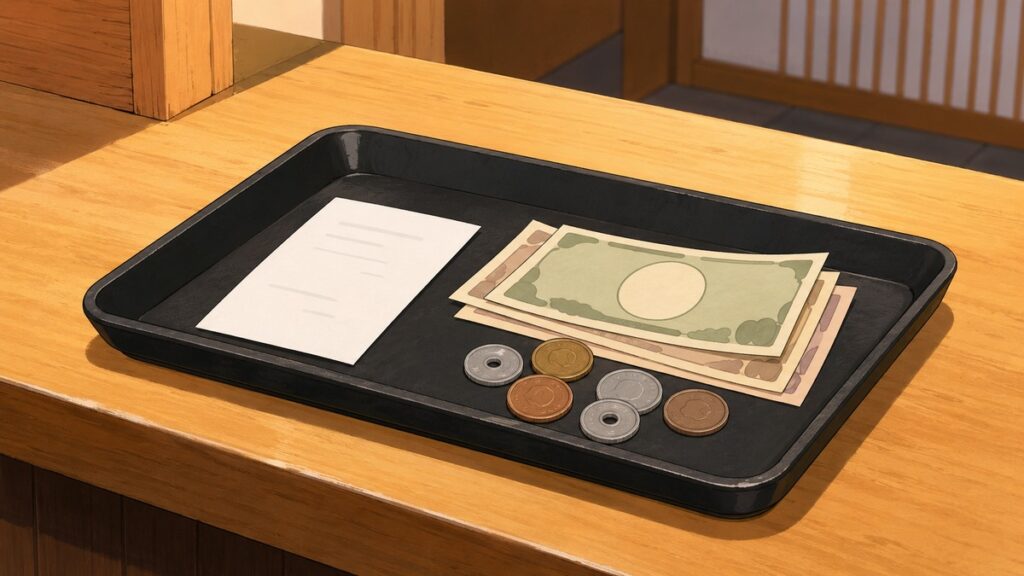
At many restaurants in Japan, the bill slip lands on your table soon after the food does, sometimes face down. It’s not a hint to hurry — it just means you can leave whenever you’re ready, without flagging anyone down. When you’re done, carry the slip to the register near the entrance. Some places do take payment at the table, and a growing number use self-checkout machines — if the staff gesture toward a screen, that’s your cue.
At the register, you’ll notice a small tray by the till. Place your money or card on the tray rather than handing it over directly — that’s the usual way here, and your change comes back just as neatly. Two practical notes from me: keep some cash on you, because small family-run places can still be cash-only even though chains widely take cards, transit IC cards and QR payments. And know that not every restaurant splits the bill — if a place looks busy, having one person pay and sorting it out later is the smoothest way.
Now, the question everyone asks: do you tip in Japan? No — no tip is normally needed. There’s no tip line on the receipt and no jar by the register. In fact, if you leave cash on the table, a staff member may hurry after you with it, worried you forgot your money.
And honestly? Even I sometimes wish I could hand a little extra to a server who’s been especially kind to us. But I know it would only fluster them, so I never do. That’s the funny dilemma of a no-tipping country.
 So how do you show appreciation? With words. As you leave, you can say “Gochisousama deshita” — “thank you for the meal.” That’s the standard, warm way, and no one expects a visitor to say it, so it always lands as a lovely surprise. Want to go one level up? Add “Oishikatta desu!” — “it was delicious.” Gochisousama is good manners; oishikatta desu is the phrase that truly makes the staff’s day.
There is one charming, old-fashioned exception — and it lives at the ryokan, Japan’s traditional inns. Not at hotels; this is a ryokan thing. Some guests hand a small thank-you called kokorozuke to the nakai-san, the attendant who looks after their room, usually in a small envelope at the start of the stay. It’s completely optional — many Japanese guests don’t do it either — but if you stay at a ryokan and feel moved to, that’s the one place in Japan where it belongs.
A couple of small footnotes: a 10% service charge at some high-end places, or the otoshi charge at an izakaya, is not a tip — it’s simply part of the bill. And on the rare occasion you spot a tip box at a tourist-area shop, just follow that shop’s own signs. Everywhere else, the number on the bill is exactly what you pay. No tip math, no guessing.
FAQ: Japan Restaurant Etiquette and Table Manners
1. Do I need to tip at restaurants in Japan?
No. Tipping isn’t part of everyday dining here — the price on the bill is exactly what you pay. If you want to thank the staff, a warm “gochisousama deshita” on your way out does the job better than any banknote.
2. Is it rude to ask for a fork?
Not at all. Many restaurants keep forks and spoons on hand, especially for children and visitors, and some will offer one before you even ask. Just say “Fōku o onegai shimasu.”
3. Can two people share one meal?
At cafés and family restaurants, usually yes. At small or busy shops, one order per adult may be the house policy — a sign or the staff’s guidance is your answer. Feel free to ask for a torizara (small plate) for sharing.
4. Can I take leftovers back to my hotel?
Not always. Many restaurants decline for food-safety reasons, especially with raw fish, buffets, or high-end meals. Ask first — “Mochikaeri dekimasu ka?” — and never pack food into your own container.
5. Is slurping noodles polite in Japan?
For noodles, slurping is completely normal — some people say it makes them taste better. But it’s optional, not a duty, and it’s just for noodles: soup, pasta and everything else follow the quiet rules you already know.
6. Do I need to say “Itadakimasu”?
No one expects it from a visitor. It’s a small phrase of gratitude said before eating — roughly “I gratefully receive this meal.” If you’d like to try, saying it quietly before your first bite is a lovely touch, but skipping it breaks no rule.
7. Are Japanese restaurants suitable for children?
Very much so, if you choose the right type: family restaurants, food courts and conveyor-belt sushi are the easiest, and many have children’s chairs and kids’ menus. Some quiet, adult-oriented or high-end places have age limits, so check before booking.
8. What should I do if I have a food allergy?
Prepare before you travel. Carry an allergy card written in Japanese that lists what you cannot eat, and show it when ordering — printable cards are easy to find online. Keep in mind that small kitchens often share fryers and cooking surfaces, so a dish without your allergen may still carry traces. For serious allergies, major chains that publish allergen charts are the safer choice, and if you can’t confirm clearly, it’s wisest to choose somewhere else.
Eating out with children raises its own questions, from high chairs to whether you can bring your own food. I answer those in my guide to Japan with kids.
Final Thoughts
From the outside, Japanese restaurant etiquette can look like a long list of rules. But it really boils down to a handful of habits: wait at the entrance to be seated, follow each restaurant’s own ordering style, remember just the two chopstick rules, order what you can eat, take the bill to the register unless the shop’s flow says otherwise — and skip the tip. That’s honestly most of it.
And if you forget something along the way? Nothing terrible happens. A smile, a small nod, a soft “sumimasen” — politeness travels even when words don’t. You don’t need to be perfect. You just need to be considerate, and you already know how to do that.
And when you’re ready for Japan’s other famously rule-bound experience — the onsen — my Japanese Onsen Guide for First-Timers walks you through it the same gentle way, from washing up to soaking.
One more thought before you go. If something at the table wins your heart — the little torizara plates, an adorable hashioki, the moment the hot tea arrives without your asking — remember that many of these things can come home with you. That’s what A Little Japan is all about: the trip ends, but the little discoveries don’t have to.
How is dining out different in your country? Do you call the server, or wait for them to come to you? I’d love to hear about it in the comments below!
I hope this guide has answered one of your questions and helped you feel a little closer to Japan. May your Japan journey be filled with wonderful discoveries and memories you’ll treasure for years to come.
 See you in the next guide.
Comments