Japan is remarkably clean — and yet, trash cans in Japan are surprisingly hard to find. It sounds like a contradiction, but there’s a reason behind it, and as a Japanese mom of two, I deal with it every single day without a second thought. In this guide, I’ll explain why public trash cans are so limited, and share exactly what locals do instead — so you can explore Japan without worrying about what to do with your trash.
Quick Answer: Where Can Tourists Throw Away Trash in Japan?
 Holding a wrapper right now? Here’s the short version:
| Place | What You Can Usually Throw Away |
|---|---|
| Your hotel or accommodation | Everyday travel trash; follow the property’s sorting rules |
| The shop or food stall where you bought it | Packaging from items you bought there, if a bin is provided |
| Convenience stores | Trash from that store’s items, when customer bins are available |
| Vending machine collection boxes | Empty PET bottles and cans (check the pictograms) |
| Train stations and airports | Only where designated bins are provided |
| Malls, department stores and food courts | Trash from food or products you enjoyed there |
Bin availability varies, so carrying a small bag is still the most reliable plan. Now, let me walk you through how this actually works.

Wait — Where Are All the Trash Cans?
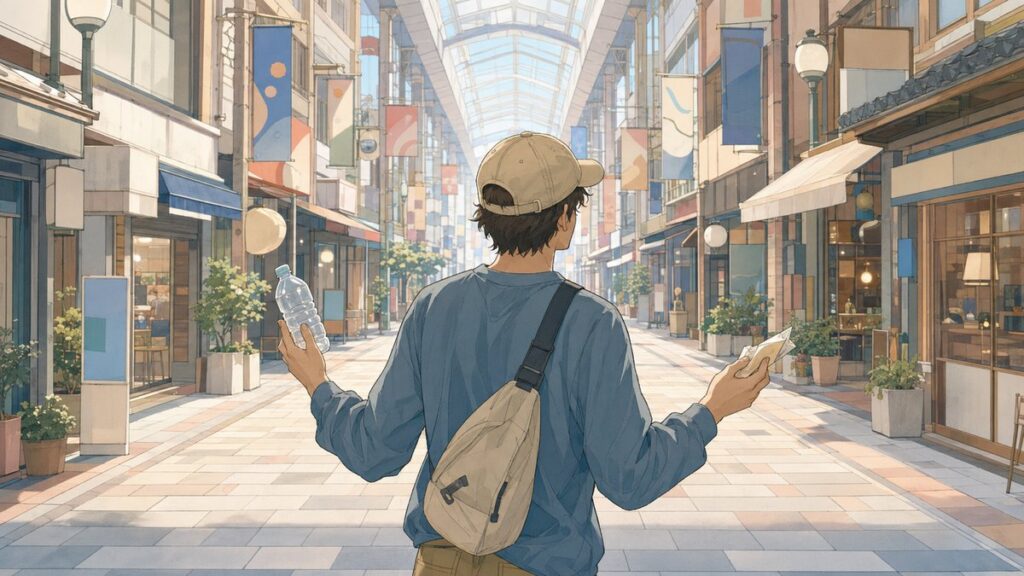
 You grab an onigiri and a bottle of tea from a convenience store, enjoy them as you explore, and then it hits you. There’s nowhere to throw anything away. You walk one block, then another — not a single trash can in sight.
So you do what every visitor ends up doing: you carry your trash. Ten minutes turn into thirty, and that plastic wrapper is still in your hand. Meanwhile, the streets around you are spotless, which somehow makes it feel even stranger.
How does a country with so few public trash cans stay this clean? The short answer: most people simply take their trash home. The full answer is a little more interesting — and once you know how locals actually handle it, that wrapper in your hand stops being a problem. Let me show you how it works.
Why Are There So Few Public Trash Cans in Japan?
Here’s the surprising part: Japan didn’t end up this way out of carelessness. There are a few reasons — and one of them is honestly quite sad.
 One commonly cited reason dates back to the 1995 Tokyo subway attack. After the attack, security concerns increased, and many trash cans were removed from train stations and other public spaces. Some were later brought back, but public bins have remained relatively limited ever since.
Security isn’t the only reason, though. Trash cans require regular collection and careful sorting, and some businesses removed theirs because people kept bringing in large amounts of household trash.
Over time, carrying your own trash until you find an appropriate place has simply become part of everyday life here. It’s something we grow up with — Japanese kids even clean their own classrooms at school — so holding on to a wrapper all day feels completely normal to most of us.
Sounds inconvenient? A little, yes. But it’s easier than it sounds — you just need the local playbook. Here it is.
5 Things Locals Actually Do
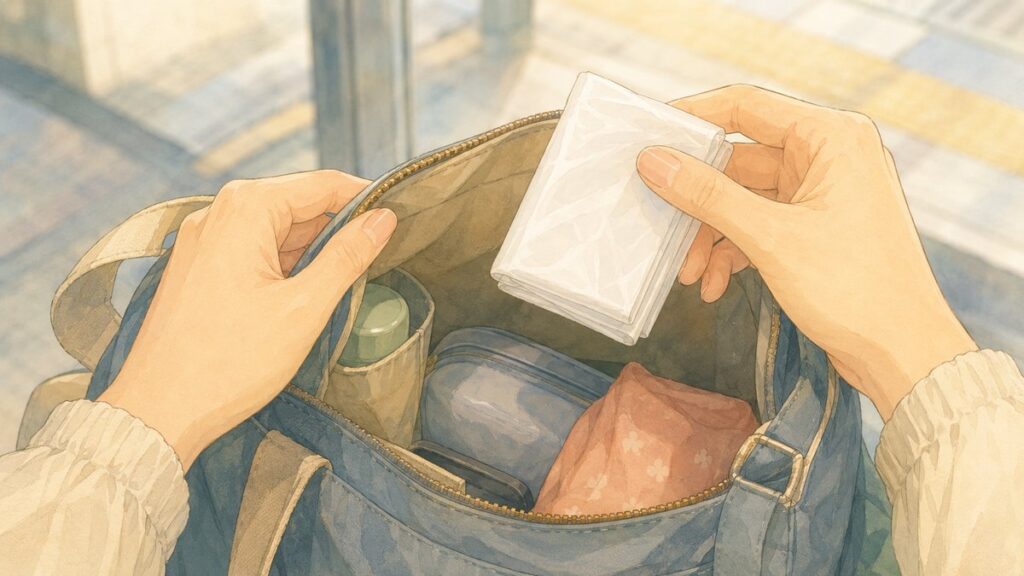
Locals get by with a few simple habits that are easy to adopt — nothing fancy, and you can borrow every single one of them starting today.
Tip 1 — Carry a Small Bag for Your Trash
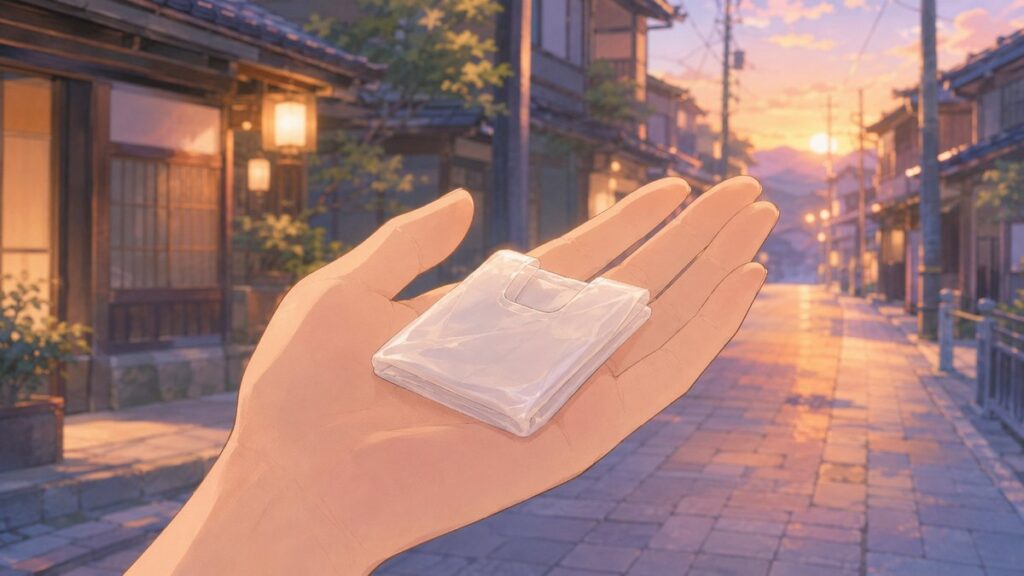
 This is the big one. Many people in Japan keep a small plastic bag tucked in a pocket or backpack, and it quietly becomes a portable trash can. Wrappers, tissues, an empty bottle — everything goes in the bag, and the bag goes home.
You don’t need anything special. Reuse any small bag you already have, or pick one up when you need it — folded flat, it takes up no space at all. From that moment on, “no trash cans” stops being your problem.
When I’m out with my kids, that little bag stops being optional. Children produce trash at an astonishing rate — and every single wrapper eventually lands in my hand, delivered with a proud little “Here, Mommy!” I’ve said “Mommy is not a trash can” more times than I can count. That’s exactly why a spare bag always lives in my daypack, like a member of the family.
Tip 2 — Use Convenience Store Bins Only When Available
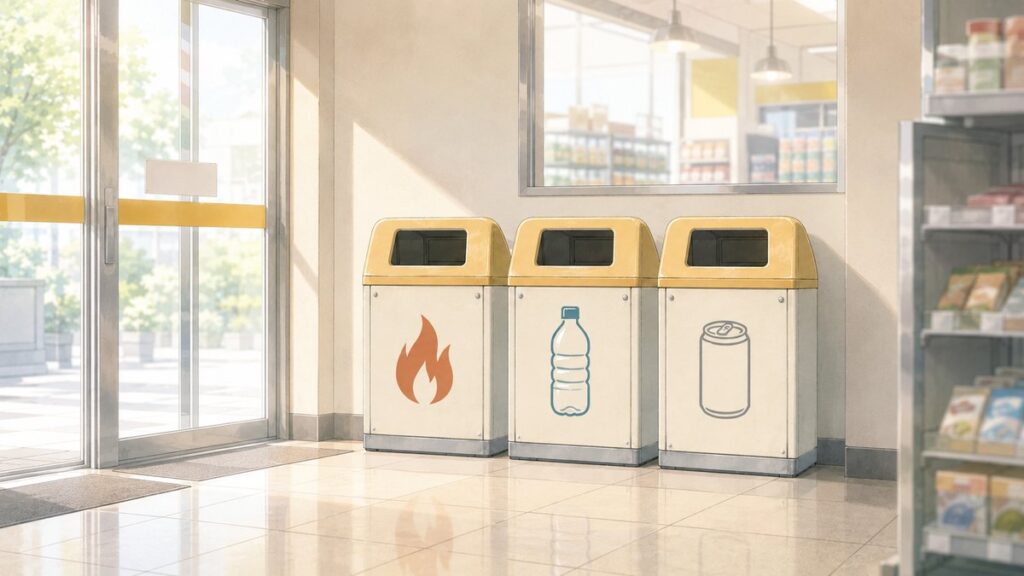
 Some convenience stores provide customer trash bins, often near the entrance or the eat-in corner. Not every store has them, though — so it’s best not to count on finding one at every konbini.
If a bin is available, use it mainly for packaging from items you bought at that store, and follow the pictures or signs above each opening. Walking in with a full day’s worth of trash from elsewhere is generally seen as poor manners — in fact, many stores moved their bins indoors, or removed them entirely, for exactly that reason. When in doubt, your hotel bin is the safer home for it.
(Convenience stores have a few more unwritten rules like this — I wrote a whole guide to Japanese convenience store etiquette.)
Tip 3 — Use Vending Machine Collection Boxes for Empty Drink Containers
Japan has vending machines on practically every corner, and beside many of them sits a small collection box. Finished your drink? That may be your spot.
 One thing to know: these boxes are not general trash cans — they’re for empty beverage containers only. Empty your drink first, then check the pictograms: depending on the label, the box may accept PET bottles, cans or glass bottles. Wrappers, food containers and paper cups don’t belong there. That’s what your Tip 1 bag is for.
Tip 4 — Stay Near the Place Where You Bought Your Food
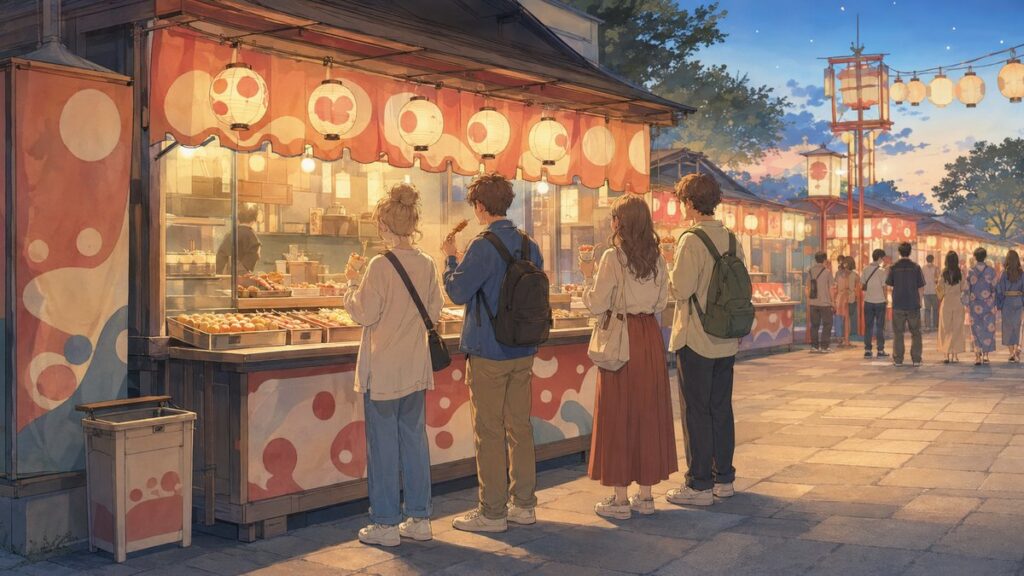
 At festivals, markets and street-food stalls, the easiest move is to finish your food near the place where you bought it. Some vendors set out a small bin, while others will take the empty container back from you.
If you’re not sure, just show the empty container to the staff and ask, “Gomi wa doko desu ka?” — “Where should I put the trash?” No perfect Japanese needed; the empty container and a questioning look do most of the work.
Eating while walking isn’t forbidden in Japan, but in crowded areas it can be inconvenient for the people around you. Stepping aside and finishing your snack before moving on is usually the easiest and most considerate choice — and honestly, the more relaxed way to enjoy it.
Planning a proper sit-down meal too? I wrote a friendly guide to Japanese restaurant etiquette.
Tip 5 — Take Your Trash Back to Your Accommodation
When nothing else works out — the bag from Tip 1 is full and there’s no bin in sight — take your trash back to your hotel or accommodation. For ordinary travel waste, this is usually the most reliable option. After all, locals do the same thing, just with their own homes.
A few small courtesies go a long way: separate bottles and cans if your accommodation asks, and empty any leftover drink before the container goes into the room bin. For large amounts of trash, broken items or anything unusual, the front desk or your host will happily point you in the right direction.
And a tip from my life with kids’ snacks: if something is wet or sticky — a half-finished drink, fruit skewers — seal it in a small bag before it goes into your daypack. Your souvenirs will thank you.
 So that’s the whole local playbook: a small bag, the right bins, and zero guesswork. Now let’s clear up the questions travelers ask most.
Quick FAQ — Trash Questions Travelers Actually Ask
Q1. Is littering illegal in Japan?
Rules and penalties vary by municipality, but many cities and wards prohibit littering through local ordinances — so please don’t leave trash on the street, in a park, or beside a full bin. For example, since June 1, 2026, anyone caught littering in Shibuya Ward can be charged a ¥2,000 (≈$13) administrative fine. Even where no fine applies, littering is genuinely frowned upon here.
Prices are in yen, with rough dollar figures at about ¥154 to the dollar (September 2026). Exchange rates move, so treat the dollars as a ballpark.
Q2. Do I need to sort my trash?
Yes — though the categories vary by location and facility. Common ones include general or burnable waste, PET bottles, cans and glass bottles. Follow the pictograms or labels on the bin, and if you’re not sure, feel free to ask a staff member — no one will mind.
Q3. Are there trash cans in train stations or parks?
Sometimes. Larger stations may have bins near the ticket gates or on platforms, while smaller stations may have none. Parks vary too, and bins are occasionally closed or removed for security reasons. It’s easier not to plan your day around finding one — your Tip 1 bag is the plan.
Q4. I’m traveling with a baby — what about diapers?
Diapers don’t go into regular street bins — but here’s the good news: many baby-care rooms in malls and department stores have dedicated diaper bins. Use them when provided, following the facility’s instructions. When there isn’t one around, do what many moms here — myself included — do: seal the diaper in an odor-blocking bag and take it back to your accommodation. These bags are widely available at drugstores, baby-goods stores and even some 100-yen shops, and they lock in the smell so completely it feels like magic. What a convenient world we live in. (Not sure how your accommodation handles diapers? Just ask the front desk or your host.)
One Small Bag Changes Everything
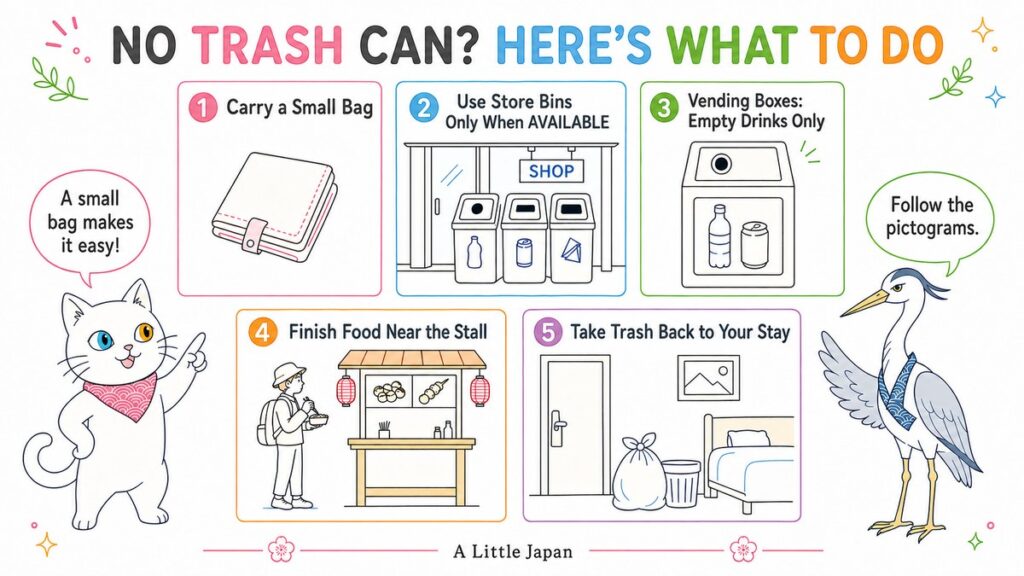
So few trash cans in Japan? True — but as you’ve seen, it stops being a problem the moment you know the local playbook. Keep a small bag with you. Follow the rules of the shop or stall you bought from. Save the vending machine boxes for empty drink containers. Sort where the labels ask you to — and when in doubt, take it back to your accommodation.
And here’s the quiet bonus. After a few days of carrying your own trash, the clean streets stop feeling like a mystery — because now, you’re one of the people keeping them that way.
Are there trash cans on every corner in your country, or do you carry your trash home like we do in Japan? Tell me in the comments below — I read every single one!
I hope this guide has answered one of your questions and helped you feel a little closer to Japan. May your Japan journey be filled with wonderful discoveries and memories you’ll treasure for years to come.
 See you in the next guide.

Comments