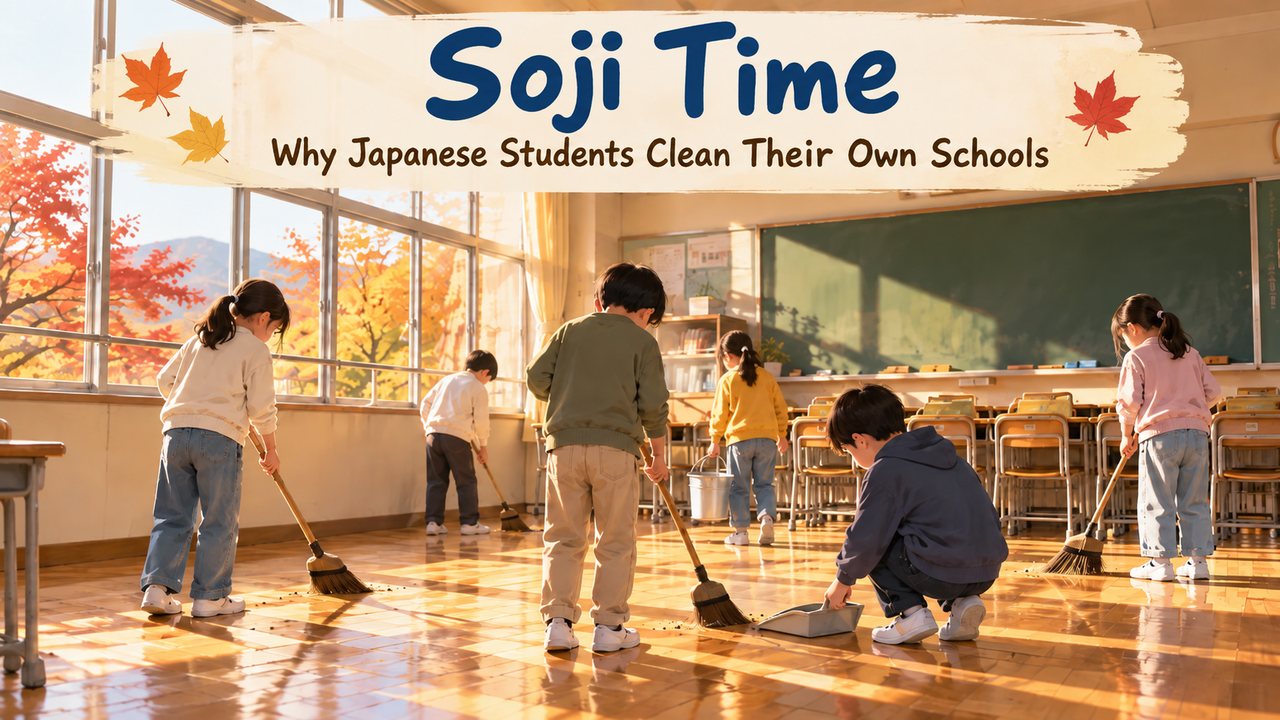
Little Things in Japanese Life — Episode 9. Today, you’ll get a glimpse of what happens in a Japanese classroom after lunch break.

We clean after lunch break
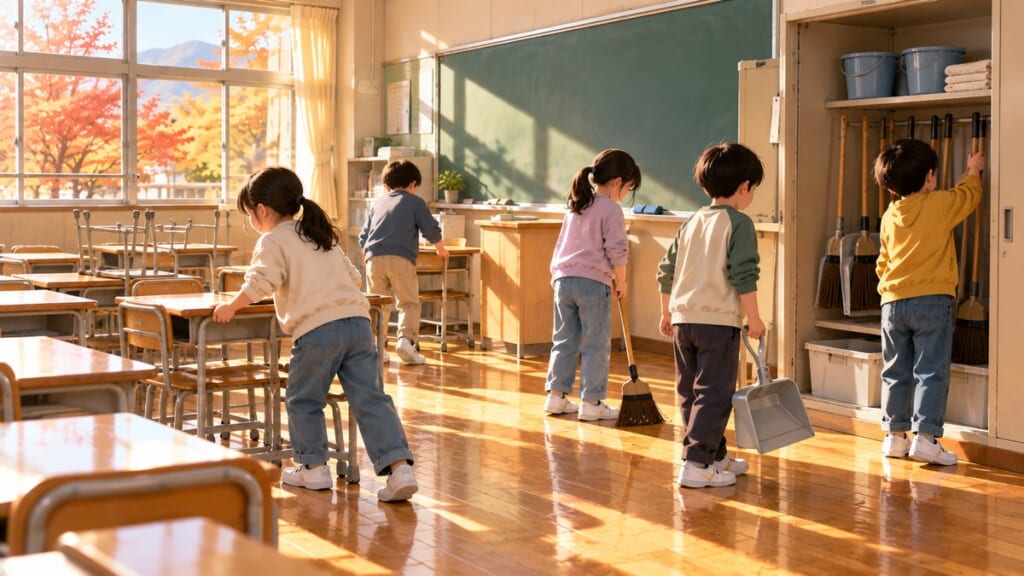
Imagine finishing lunch, enjoying a little free time, and then picking up a broom instead of a textbook. Yes, really! In many Japanese schools, students clean their own classrooms and other shared spaces every school day.
It’s called soji (souji), or cleaning time. And it’s not something schools simply do when the floors get dirty. It’s a regular part of school life, just like lunch and lessons.
 At my kid’s school, the daily order is simple: school lunch, lunch break, and then cleaning time. The children get some time to play or relax after eating, but once that break ends, there’s another job waiting for them.
If you’ve seen a video of Japanese children sweeping a classroom, the routine itself is real. It’s an ordinary part of school life in many schools, and one I grew up with too.
What kids actually do
Japanese school cleaning isn’t usually one child trying to tidy an entire classroom. Students work in small groups, with cleaning duties shared and rotated so everyone takes a turn.
A typical cleaning time looks something like this:
- Sweeping the floor with brooms and dustpans
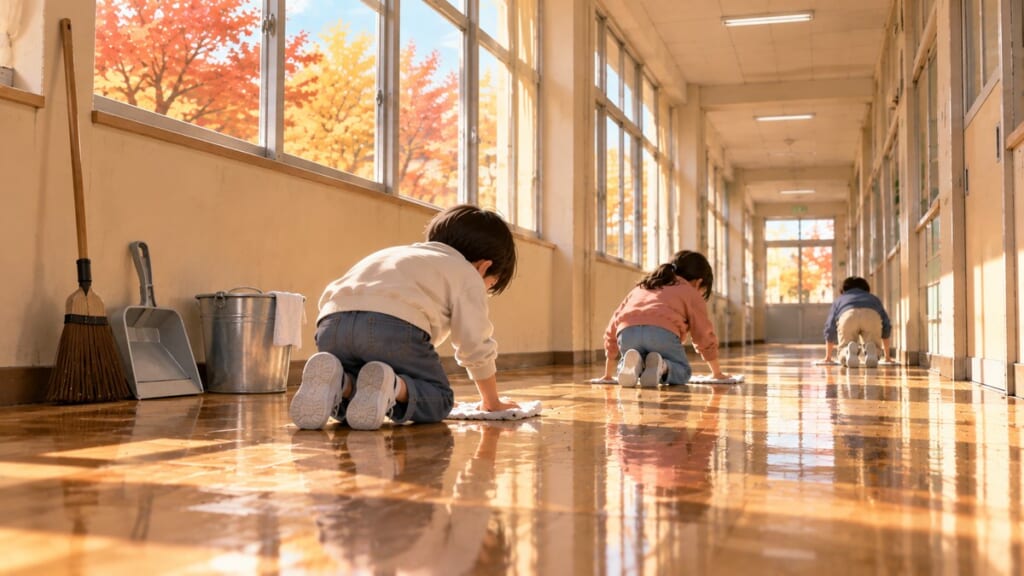
- Wiping floors and surfaces with a zokin, a cleaning rag often used damp
- Moving desks to the back of the room and back again
Classrooms and hallways are common places to clean. The exact assignments depend on the school, but the basic idea is that children help take care of the spaces they use together.
The children only have a short cleaning period, so it’s about doing their part every day rather than making everything spotless in one afternoon.
 I did this kind of cleaning when I was a child, too. It’s funny to think that something I once considered such an ordinary school routine is now part of my own child’s school life.
Why schools do it
Here’s the part that makes Japanese school cleaning more interesting than a daily chore: it’s part of the school curriculum, under what Japan calls special activities (tokkatsu).
Tokkatsu includes activities such as classroom discussions, rotating duties, and school events. These activities give children opportunities to learn things that don’t always fit neatly into a textbook.
 Japan’s national curriculum guidelines list cleaning among the classroom duties through which children learn:
- what it means to have a role and do it
- why working for others matters
- that their effort helps their class and school
There’s also a broader idea here that I think is worth noticing. Rather than always expecting someone else to take care of a mess, children are encouraged to think about what they can do themselves and how they can look after things everyone shares.
That’s one way I understand why cleaning has a place in Japanese school life. It isn’t supposed to be a punishment for making a mess. It’s an everyday opportunity to practice taking responsibility. The same idea starts even earlier, with the little bags children learn to pack and unpack in kindergarten. I wrote about that in my story about what’s inside a Japanese kindergartener’s bag.
Of course, this doesn’t mean children are responsible for maintaining the whole school. Depending on the school, maintenance may be handled by caretakers or other adult staff. Student cleaning has an educational role; it’s not a replacement for every job that needs doing.
You’ll see it in the streets too
When you travel around Japan, you may notice how much attention people give to shared spaces.
At school, children practice looking after spaces used by everyone. Outside school, there’s a familiar expectation that you take responsibility for your own belongings and rubbish rather than leaving them for the next person.
I can’t say that school cleaning is the reason a street looks tidy. There are many things involved in how public spaces are maintained. But to me, the two ideas feel connected: the place you’re using isn’t yours alone, so it’s worth thinking about the people who will use it after you.
One example you might notice during your trip is how people handle their rubbish. Japan can have fewer public trash cans than visitors expect, which raises a very practical question: where should you put that empty wrapper?
I’ve written more about that in my guide to why there are so few trash cans in Japan.
 A small tip for your own trip: keep a little bag handy for rubbish until you find somewhere appropriate to dispose of it.
If you’re visiting Japan with children, little routines like this can also become interesting things to notice together. You can find more family travel ideas in my Japan with kids guide.
It’s not always fun
Now, I don’t want you to imagine a classroom full of children happily polishing every corner with big smiles. They’re kids. Cleaning isn’t always something they look forward to.
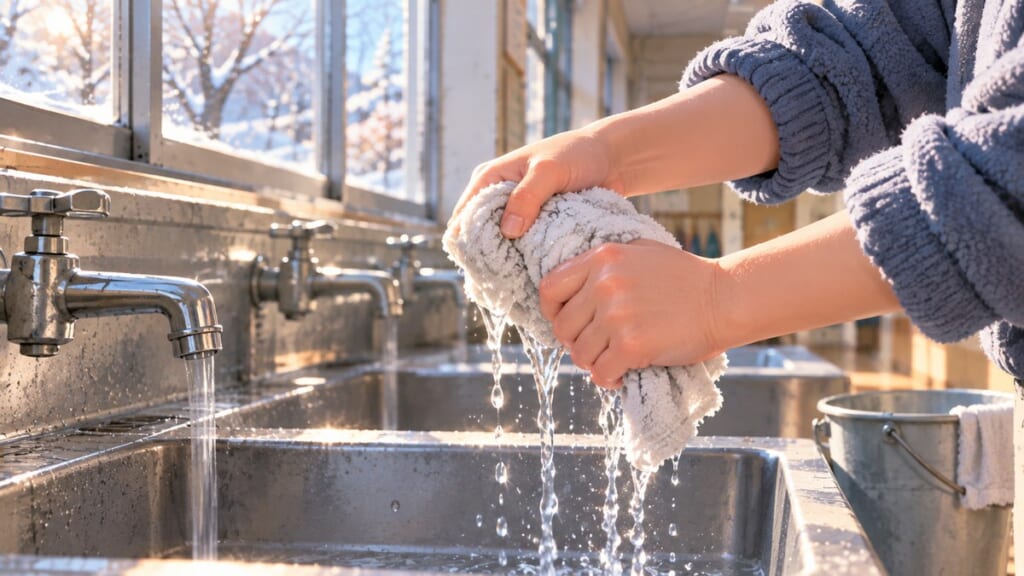
 My kid has a very practical complaint about winter cleaning: wringing out a wet zokin in cold water makes their hands feel like they’re freezing. And really, I can understand that one!
It’s easy to talk about school cleaning as a lesson in cooperation and responsibility. It’s another thing to be the child holding a cold, wet rag when you’d rather be doing something else.
Japan also has its own debates about school life, such as how busy teachers are and how children’s time is used. Cleaning has its goals, but that doesn’t mean every detail of the routine is beyond question.
Still, for many children in Japan, soji is simply part of the school day: lunch, break, cleaning, and then on with the afternoon.
When I think about my own school days and my child’s experience now, I don’t see a perfect little lesson in responsibility. I see a familiar routine that has continued from one generation to the next, complete with brooms, wet rags, and those cold winter hands.
So, the next time you see Japanese students cleaning their classroom, remember that you’re watching an ordinary part of their day, not just a lesson about being tidy. And somewhere in that classroom, someone might be wishing the water were a little warmer.
I’m curious: what kinds of classroom duties did you have when you were a child? I’d love to hear what you remember in the comments.
Thanks for reading! Next time, let’s peek into another little corner of life in Japan.
See you in the next episode.
Comments