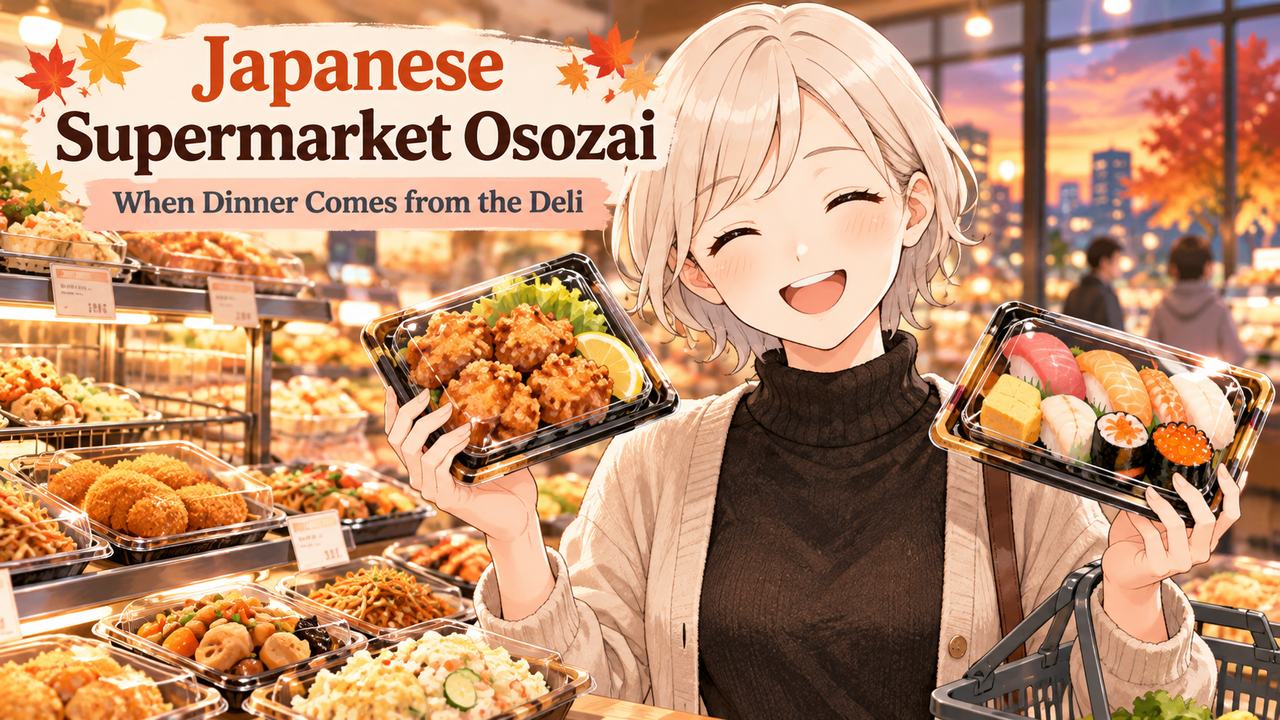

Some nights, dinner comes from the deli corner
You know those evenings when you’re hungry, tired, and the last thing you want to do is cook? Here’s a little secret from everyday life in Japan: sometimes, dinner comes straight from the supermarket deli corner. No cooking required.
 And yes, that happens at my house quite often, too.
In Japan, these ready-made dishes are called osozai (お惣菜). They’re not just emergency meals for people who forgot to cook. For many households, they’re a perfectly ordinary way to put dinner on the table.
Sometimes you cook the rice and buy the main dish. Sometimes you make the main dish and pick up a couple of sides. And sometimes the whole meal comes in little plastic containers from the supermarket.
Dinner is dinner, right?
But there’s something interesting about this everyday habit. Behind those neatly arranged croquettes and fried chicken, you’ll find a story about how Japanese families eat, how supermarkets handle unsold food, and how people’s ideas about home cooking are changing.
This is the fifth little discovery in my “Little Things in Japanese Life” series. Today, we’re heading to the supermarket.
What’s in the osozai section
Walk into a Japanese supermarket and look for the prepared-food section. Depending on the store, you might find trays of golden fried food, chilled salads, simmered vegetables, sushi, and complete boxed meals.
The wonderful thing about osozai is that you don’t have to buy an entire dinner. You can choose a single side dish, add it to whatever you’re making at home, and call the meal complete.
Here are a few things you might come across:
- Karaage (唐揚げ): Japanese-style fried chicken in bite-sized pieces, often seasoned with soy sauce, ginger, or garlic.
- Korokke (コロッケ): crispy, breaded croquettes, often filled with mashed potatoes and sometimes minced meat. Easy to recognize, even if you can’t read the label.
- Hijiki no nimono (ひじきの煮物): a simmered side dish of hijiki seaweed with ingredients such as carrots or soybeans. The kind of small homestyle dish that takes time to make from scratch.
- Potato salad (ポテトサラダ): usually made with Japanese mayonnaise, potatoes, and vegetables. It has a surprisingly interesting social history in Japan. More on that in a moment.
- Sushi (寿司) and bento (弁当): sushi packs are a ready-to-eat meal, while bento boxes combine rice with several dishes in one container.
 At my house, karaage, sushi, and bento are the family favorites.
If you already have rice at home, you might only need a main dish. If you don’t feel like preparing anything, a bento can take care of the whole meal.
Add a bowl of miso soup, and it starts to feel like a real Japanese dinner. Here’s how I make miso soup at home in five minutes.
Why Japan does it this way
A lot of it has to do with how people live.
As more households have two working adults, finding time to prepare every meal can be difficult. People living alone or in smaller households may also find that cooking several dishes from scratch leaves them with more ingredients than they need.
 The scale is striking. An industry report estimates that Japan’s prepared-food market was worth more than 11 trillion yen in 2025, although rising food prices also contributed to that figure.
So this isn’t just a tiny corner of Japanese food culture. Ready-made food has become a significant part of how people organize everyday meals.
The evening discount stickers
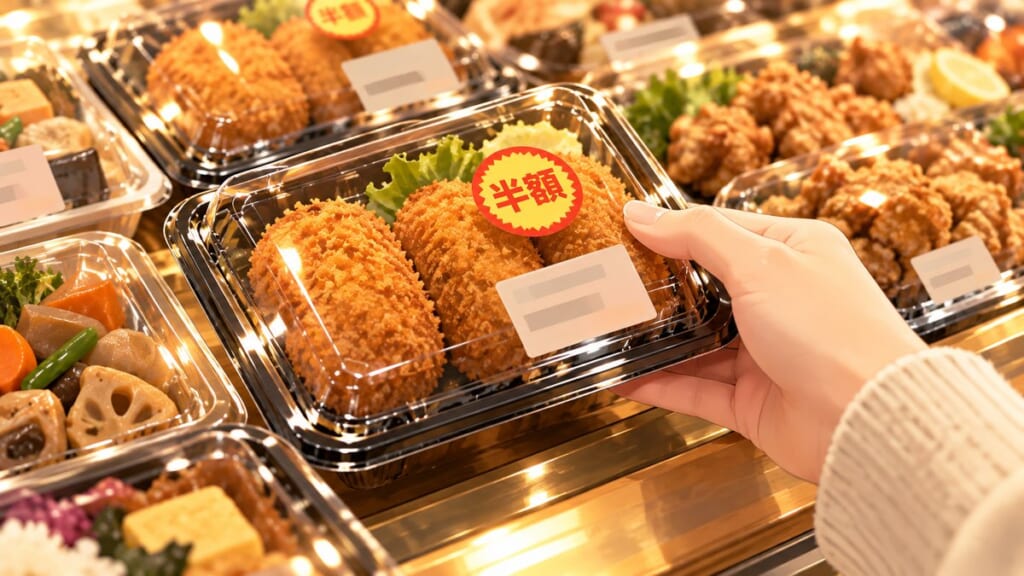
If you visit a Japanese supermarket in the evening, you might notice colorful stickers appearing on packs of bento, croquettes, sushi, and other fresh foods.
Those are discount stickers.
As closing time approaches, supermarkets often reduce the prices of prepared foods they want to sell that day. Here’s how to read them:
- 半額 (hangaku): half price.
- ○%引: a percentage off.
- ○円引: that amount in yen is taken off the original price. It isn’t the new total price.
 There’s no universal discount time. Each store decides when to start reducing prices.
The idea is simple: food that’s already been prepared needs to find a buyer. Selling it before it’s discarded can also help reduce food waste.
Japan has another related idea called temaedori (てまえどり). Since 2021, a national campaign has encouraged shoppers who plan to eat something soon to choose products near the front of the shelf, which may have earlier expiration dates.
It’s a small change in shopping habits, but it addresses a very real problem: perfectly usable food being thrown away.
 And one little etiquette note: there’s no need to hover over the employee applying the stickers or hurry anyone along. The staff have a job to do, and the stickers will appear when they’re ready.
It’s not lazy
Here’s where a simple supermarket dinner gets a little more complicated.
In July 2020, a social media post about an incident at a Japanese supermarket went viral. According to the account, an older man criticized a woman shopping with a young child, suggesting that a mother should at least make potato salad herself instead of buying it.
The reaction was enormous.
Many people pushed back against the idea that buying prepared food meant someone wasn’t doing enough for their family. Others pointed out that even a simple-looking dish like potato salad takes time: washing, peeling, boiling, chopping, mixing, and cleaning up afterward.
Later that summer, another debate broke out over frozen gyoza. A Japanese food manufacturer responded by drawing a line between two words:
- Tenuki (手抜き): cutting corners
- Temanuki (手間抜き): removing some of the work
That difference says a lot.
For years, home cooking has carried expectations about care, effort, and what a good parent should do. Those expectations haven’t disappeared. Some people in Japan still feel guilty about serving ready-made meals, even when their schedules leave them exhausted.
At the same time, conversations like these have helped make room for a different view: choosing prepared food doesn’t automatically mean you care less about the people eating it.
As a mother in Japan, that’s how I see it, too. My family often eats supermarket osozai, and I don’t think a meal needs to be made entirely from scratch to be a good family dinner.
 On a tiring day, if my family can enjoy dinner together, that’s enough for me.
A tip for travelers
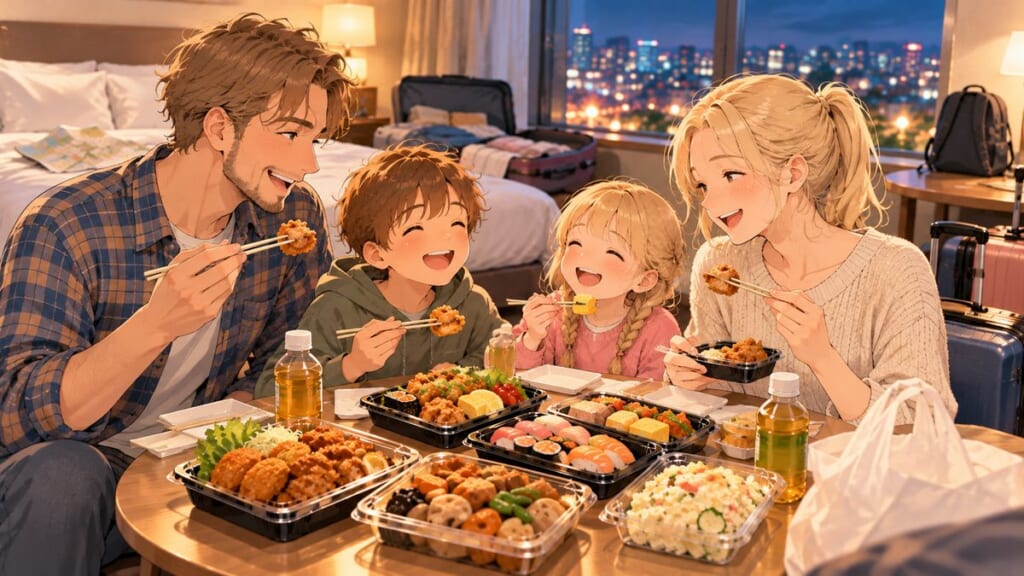
If you’re visiting Japan, a supermarket dinner can be a lovely way to see a small piece of everyday Japanese life.
After a day of sightseeing, try stopping by a supermarket and exploring the deli corner. You might pick up karaage, a small vegetable side dish, and a pack of sushi. Or, if you’re too tired to make decisions, simply choose a bento and enjoy a quiet evening.
 Most hotels in Japan don’t mind if you eat in your room. Before you dig in, just check three things:
- If you’re staying at a ryokan with meals included, whether outside food is allowed.
- The labels for storage instructions and dates, especially on sushi and other chilled items.
- Whether anything needs refrigeration. If it does, don’t leave it sitting in a warm room.
For families traveling with children, choosing familiar-looking dishes alongside something new can make supermarket shopping part of the adventure. If you’re planning your trip with little ones, you might also enjoy my guide to Japan with kids.
Curious how supermarkets differ from the convenience stores you’ll see on almost every trip? For a little more about everyday shopping manners, take a look at my guide to Japanese convenience store etiquette. And if you’re working out how food fits into your travel spending, my 10-day Japan itinerary on a budget can help you think through the bigger picture.
You might come home remembering a famous restaurant. But you might also remember the little supermarket dinner that gave you a glimpse of an ordinary evening in Japan.
And now I’m curious: if you could choose just one thing from a Japanese supermarket deli corner, what would you try first? Tell me in the comments! I’d love to hear what catches your eye.
Thanks for reading! Next time, let’s peek into another little corner of life in Japan.
See you in the next episode.


Comments