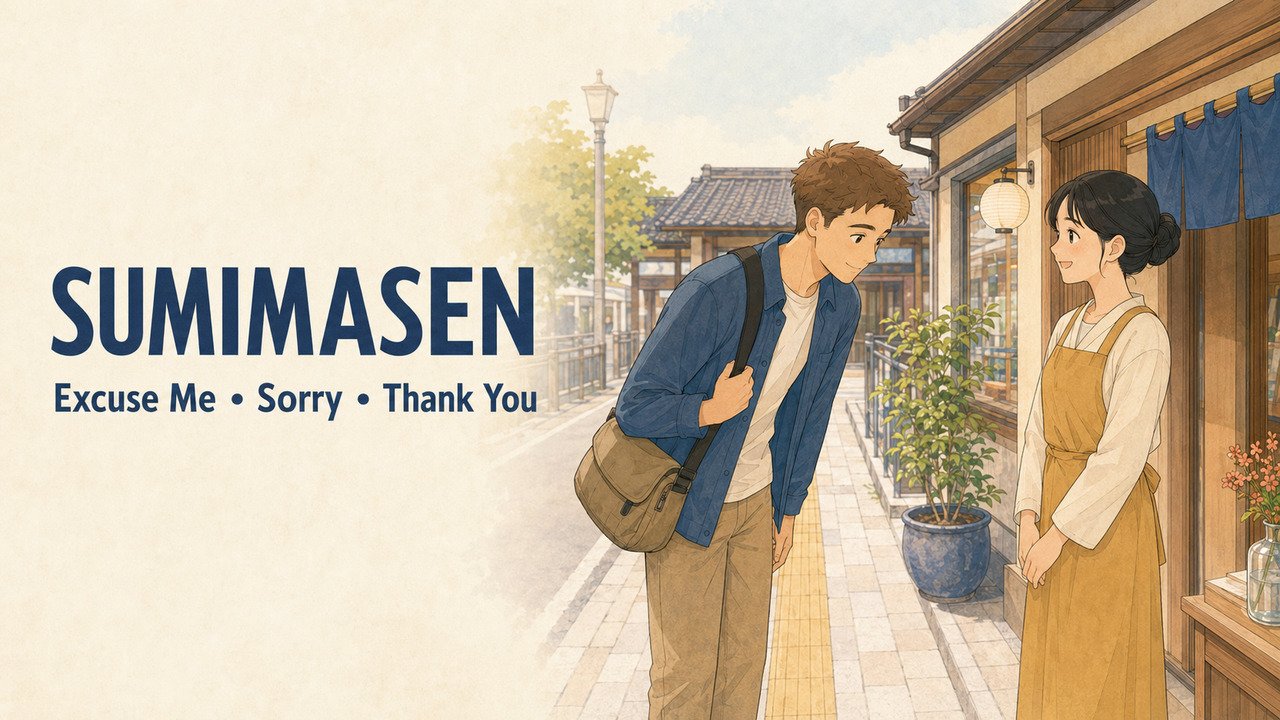

Your Japan trip is booked, your suitcase is half-packed — and somewhere in the back of your mind, a small worry keeps tapping: I don’t speak a word of Japanese.
Then let me hand you some good news, from someone born and raised here: you don’t need to memorize dozens of Japanese phrases before your trip. If you learn just one, make it sumimasen.
It works as “excuse me,” “sorry,” and sometimes even “thank you.” Paired with a small nod, a gesture, or a map on your phone, it can help you through an amazing number of everyday situations — from restaurants and crowded trains to asking someone for directions.
In this guide, I’ll show you exactly how to use it in real situations — and share how I, as a Japanese person, usually feel when a traveler says it.

- Sumimasen Cheat Sheet: One Word, a Small Bow, and You’re Fine
- Why One Word Works: The Three Faces of Sumimasen
- How to Use Sumimasen: Four Scenes from a Real Japan Trip
- Don’t Worry About Pronunciation — You’ll Often Hear “Suimasen,” Too
- What If Someone Says Sumimasen to You?
- Sumimasen FAQ: Quick Answers Before Your Trip
- You’re Ready: One Word and a Small Bow
Sumimasen Cheat Sheet: One Word, a Small Bow, and You’re Fine
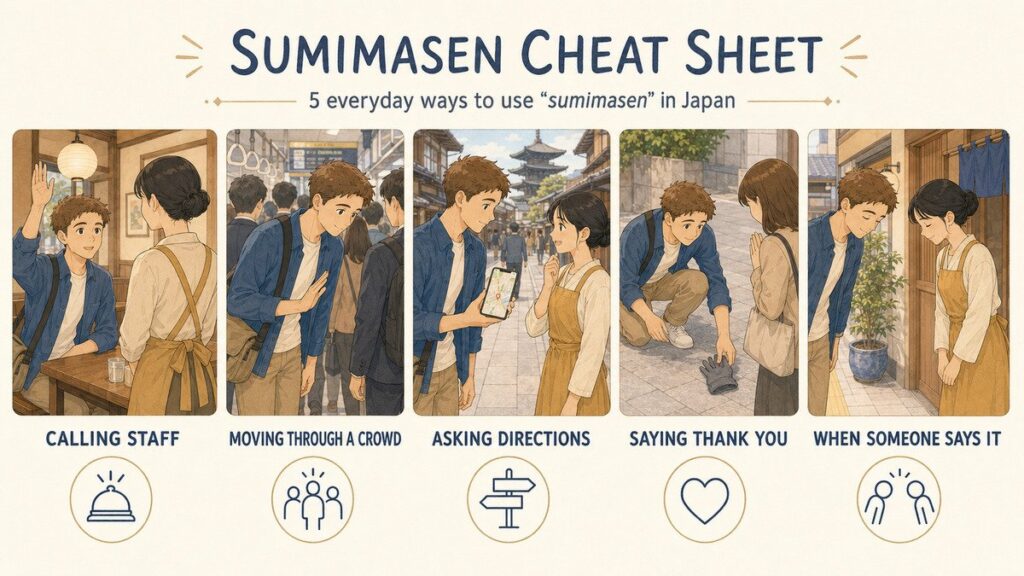
 If you only remember one Japanese word for your whole trip, make it sumimasen (soo-mee-mah-sen). It works as “excuse me,” “sorry,” and even a light “thank you” — and when you pair it with a small nod, it can help in many everyday situations a traveler may run into. Here’s the quick version; the rest of this guide walks you through each scene.
| Situation | What you do | What it means |
|---|---|---|
| Calling staff at a restaurant | “Sumimasen!” with a small raised hand | “Excuse me!” |
| Bumping into someone / squeezing through a crowd | Sumimasen + small nod | “Sorry” / “Pardon me” |
| Asking for directions | Sumimasen + point at your map or phone | “Excuse me, could you help me?” |
| Someone gives up a seat or picks up what you dropped | Sumimasen + nod | “Thank you (for going out of your way)” |
| Someone says sumimasen to you | Just nod back with a small smile | All good — no reply needed |
Why One Word Works: The Three Faces of Sumimasen
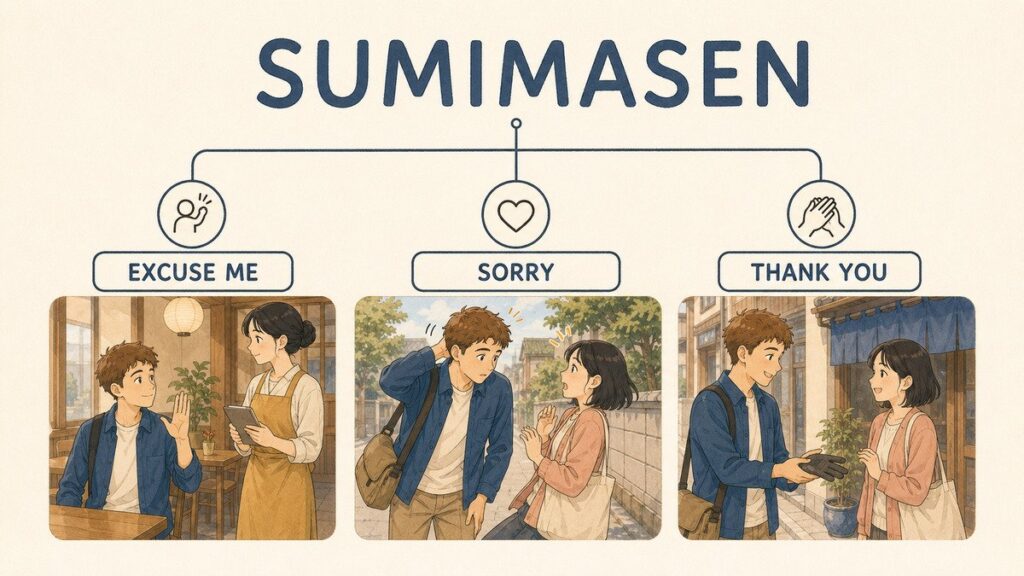
 Sumimasen is usually translated as “sorry,” but that’s only a third of the story. In real life, it does three jobs at once: “excuse me” when you need someone’s attention, “sorry” when you’ve caused a small inconvenience, and even “thank you” when someone goes out of their way for you.
How can one word stretch that far? Because underneath all three meanings, sumimasen is really saying the same thing: I know I’m taking a little of your time. In Japan, showing that you’ve noticed the other person’s effort matters more than choosing the perfect word — and sumimasen carries exactly that feeling.
Here’s a small confession: I probably say it a dozen times a day without even noticing. Calling a waiter, letting someone pass on a narrow sidewalk, squeezing off a crowded train — sumimasen, sumimasen, sumimasen. It’s less an apology and more the sound of everyday consideration.
 One personal exception, though. When someone holds a door for me or keeps the elevator open, most Japanese people say sumimasen here too — but I’ve made it a little habit to say arigatou (thank you) instead. A kindness like that deserves a thank-you, not an apology, don’t you think?
As a traveler, you don’t need to master that fine-tuning. Say sumimasen, add a small nod, and the situation sorts itself out — the arigatou upgrades can come on your second trip.
How to Use Sumimasen: Four Scenes from a Real Japan Trip
Calling Staff at a Restaurant

Here’s something that surprises many visitors: in most Japanese restaurants, staff won’t come to your table until you call them. It’s not neglect — it’s politeness. They’re waiting so they don’t interrupt your conversation.
So when you’re ready, raise your hand a little and say “Sumimasen!” toward the staff — a clear voice is fine, even in a quiet place. Nobody will think you’re rude; that’s exactly how we do it. (If there’s a call button on the table, that works too.) And if you’d like the full picture of eating out in Japan, from entering to paying, I’ve written a separate guide: Japanese Restaurant Etiquette.
Squeezing Through a Crowd (or Bumping Into Someone)
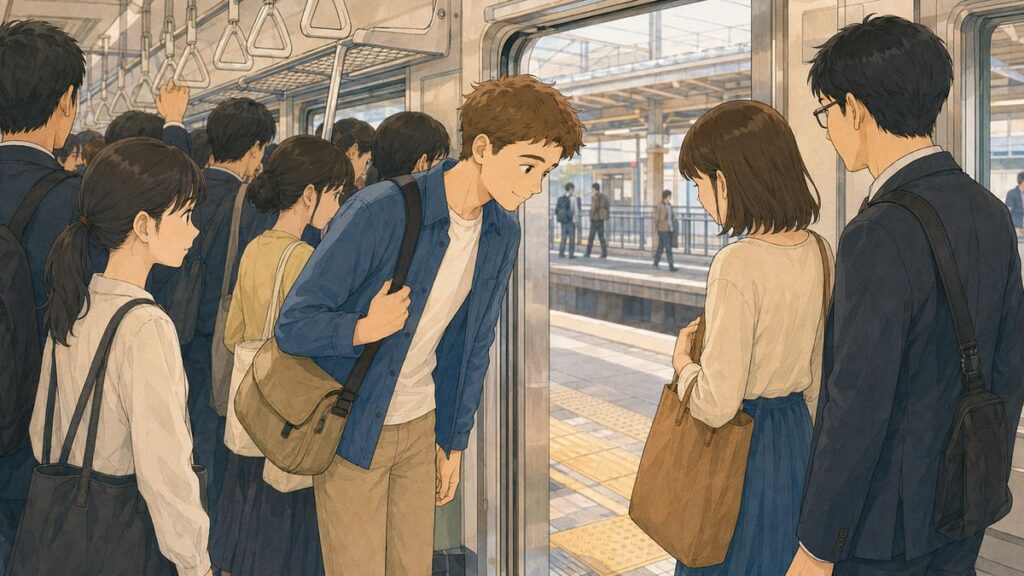
On a packed train or a crowded shopping street, sumimasen is your pass-through ticket. Getting off at your station when the train is full? A quiet “sumimasen” while you move toward the door, and people will make way for you — like magic, except it’s just manners.
And if you accidentally bump into someone, the same word with a small nod settles it on the spot. No need to stop and deliver a full apology; in fact, a long one would feel a little heavy here. Say it, nod, keep walking.
Asking for Directions

Starting a conversation with a stranger in a foreign language is scary — I know. But let me tell you what’s happening on the other side. When a foreign visitor walks toward us, our minds are usually racing: Oh no, I can’t speak English. What do I do? I won’t be able to explain anything properly…
Then you open with “sumimasen” — and everything flips. Wait, this person studied Japanese for their trip? That’s amazing. I want to help them with everything I’ve got. I’m not exaggerating: that flip happens even if sumimasen is the only Japanese word you know.
After that opener, you barely need words anyway. Show the place name on your phone, point, tilt your head a little — we’ll take it from there. Don’t be surprised if someone walks you partway to make sure you don’t get lost — though of course, not everyone will have the time, and that’s okay too.
Saying Thanks for Small Kindnesses
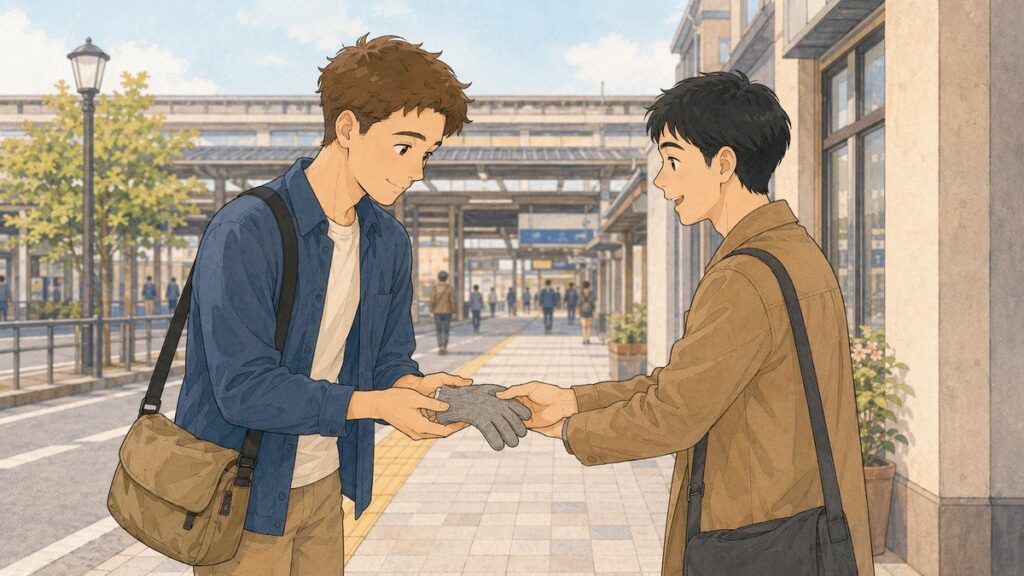
You drop your glove, someone picks it up. You’re offered a seat on the train. Here, Japanese people often say sumimasen instead of thank you — and this is the usage that puzzles visitors most. Why apologize for kindness?
 Remember the three faces: this sumimasen means “thank you for going out of your way.” It’s gratitude wrapped in consideration. As a traveler, a simple arigatou works perfectly well here too — so use whichever comes out first. The nod matters more than the word.
Don’t Worry About Pronunciation — You’ll Often Hear “Suimasen,” Too
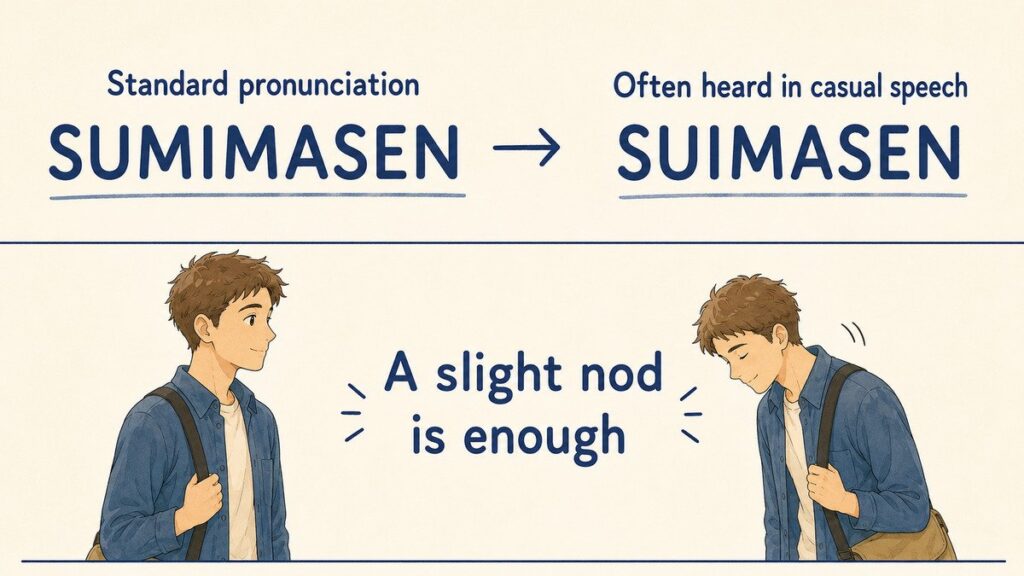
Here’s something that should take some of the pressure off: the standard pronunciation is sumimasen, but honestly, it’s a bit of a tongue-twister even for us. In casual everyday speech, you’ll often hear Japanese people shorten it slightly to suimasen — myself included.
Think about what that means for you. If native speakers round off the word every single day, nobody — truly nobody — is going to frown at a traveler’s imperfect version. Say it at whatever speed you can manage. Even a slightly mangled “sumimasen” is instantly understood, because the situation and your body language do half the talking.
And that’s the second half of the set: the small bow. Nothing dramatic — just a slight dip of the head, similar to a polite nod. A deep, formal bow would be unnecessary in everyday travel situations and might look a little theatrical at a convenience store.
 Word plus nod. That’s the complete set, and it’s honestly hard to get wrong. If the word escapes you entirely in the moment, even the nod alone carries goodwill — we read that gesture fluently.
What If Someone Says Sumimasen to You?

Sooner or later it will happen: someone brushes past you, meets your eye, and says “sumimasen.” What are you supposed to say back? Here’s the relaxing answer — nothing. A small nod, maybe a smile, and the exchange is complete. They weren’t asking for forgiveness; they were showing consideration, and your nod simply receives it.
You may also hear sumimasen from other customers and, depending on the situation, from shop or restaurant staff. It usually signals a small apology or a polite acknowledgment — not that anything serious has gone wrong.
 One last tip worth knowing: if you hear “Sumimasen!” called out behind you on the street, turn around. You may have dropped something, and someone could be trying to return it to you. It’s one of my favorite things about this country — and a warm “Arigatou gozaimasu!” is the perfect reply.
Sumimasen FAQ: Quick Answers Before Your Trip
1. Sumimasen vs. gomennasai — what’s the difference?
Many guides will tell you gomennasai is the “stronger” apology, but here’s how it actually feels to us: gomennasai is the personal, softer one — the word you’d use with family, friends, or someone close to you. Sumimasen, as an apology, is the more formal, grown-up one, and it carries a bit more weight with strangers. Since almost everyone you meet on your trip will be a stranger, sumimasen isn’t just the easier choice — it’s the right one. That said, the line between the two is soft: in real life people mix them freely, and you’ll even hear a flustered “gomennasai, suimasen!” both in one breath. So don’t overthink it. And if something genuinely serious happens, don’t rely on a single word — a fuller explanation, or a translation app, will serve you better.
2. Can I just say “Excuse me” or “Sorry” in English?
You can, and staff in major tourist areas will often understand basic English — though it’s better not to assume everyone will. But here’s the honest difference: English keeps the interaction functional, while sumimasen makes it warm. The moment a visitor uses it, you can almost see the other person soften — it reads as “I came to your country and learned your word.” One word buys a lot of goodwill.
3. When someone helps me, should I say sumimasen or arigatou?
Both work, and Japanese people mix them constantly. If you want a simple rule: arigatou (thank you) is always safe, always warm, and impossible to get wrong. Save sumimasen-as-thanks for when someone clearly went out of their way — or just say whichever comes out first. Nobody is grading you.
4. Should I learn any other Japanese words?
If you have room in your memory for two more, try arigatou gozaimasu (“thank you”) and onegaishimasu (“please”). Those three phrases will help you through many everyday interactions. But if your travel brain is already full, sumimasen is still the best place to start.
You’re Ready: One Word and a Small Bow
That’s the whole secret. Sumimasen to open a conversation, sumimasen to slip through a crowd, sumimasen — or a happy arigatou — when someone is kind to you. Add a small nod, don’t worry about perfect pronunciation, and you’re carrying the most useful thing a traveler can pack: a way to show consideration in the local language. It weighs nothing and works in an amazing number of everyday situations.
 And when you’re ready to go one step deeper into specific situations, I’ve written a guide for each one:
- Japanese Convenience Store Etiquette — the 5 unwritten rules of your soon-to-be favorite store
- Why Are There So Few Trash Cans in Japan? — what locals actually do with their trash
- Japanese Restaurant Etiquette — eating out with confidence, from entering to paying
- Japanese Onsen Guide for First-Timers — hot-spring etiquette from washing up to soaking, nothing to be nervous about
Each of them pairs beautifully with your new magic word.
Does your language have a “magic word” like sumimasen? I’d love to learn it — teach me in the comments below!
I hope this guide has answered one of your questions and helped you feel a little closer to Japan. May your Japan journey be filled with wonderful discoveries and memories you’ll treasure for years to come.
 See you in the next guide.


Comments