
You choose the time, not just the day
“Could you deliver my package between 7 and 9 tonight?”
In Japan, you can often choose a delivery time slot when you shop online. Not just the day your package arrives, but the part of the day, too.
I live in Japan, and I always choose a delivery time slot when I order something online. It’s such a normal part of my shopping routine that I sometimes forget how interesting the system itself is.
Think about it. You don’t have to spend an entire day wondering when the doorbell might ring. Instead, you can arrange for your package to arrive during a window when you’re more likely to be home.
 There’s a little catch, though: you’re choosing a time window, not an exact appointment. And behind that convenient little choice is a delivery driver with a very busy schedule.
This is the fourth story in Little Things in Japanese Life, a series about everyday details that make Japan worth a closer look.
How time slots work
Japan’s major delivery companies offer several time windows, including mornings, afternoons, and evenings. The exact choices depend on the carrier and the type of delivery, so there isn’t one universal schedule.
For example, Yamato Transport offers five delivery windows for eligible parcels, with no extra charge for choosing one:
- Morning (8 a.m.–noon)
- 2–4 p.m.
- 4–6 p.m.
- 6–8 p.m.
- 7–9 p.m.
 You can choose one of these windows, but you can’t ask the driver to arrive at exactly 7:15.
Depending on the online store, you may see the available dates and time slots when you place your order. If the option isn’t available at checkout, you may be able to change the delivery time later through the carrier’s website or delivery notification.
Of course, a selected window isn’t a promise that nothing unexpected will happen. Traffic, weather, and delivery conditions can still affect when a package arrives.
Why Japan does it this way
A delivery system isn’t very convenient if everyone has to stay home all day to use it. In households where adults work during the day, being able to choose an evening window can make receiving a package much easier.
Japan’s emphasis on punctuality may also help explain why delivery windows feel like such a natural part of daily life. But the practical reason matters just as much: a package is easier to receive when its arrival fits your schedule.
 There’s also a benefit for the carrier. If someone is home to accept the package on the first attempt, the driver doesn’t need to return to the same address.
At least, that’s the idea. Sometimes life has other plans.
Missed it? The redelivery slip
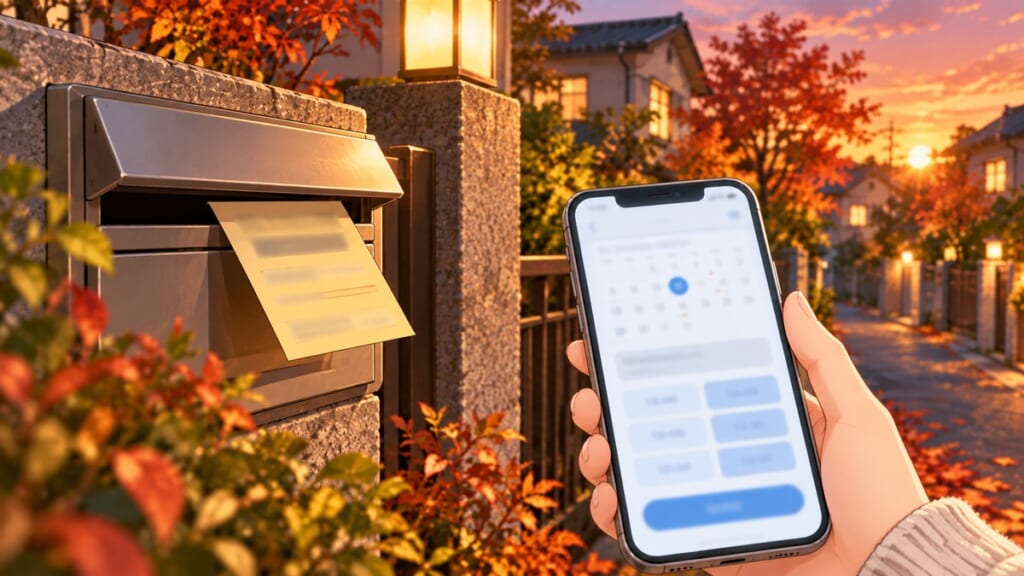
What if you choose a delivery window but aren’t home when the driver arrives? In Japan, you may find a small paper notice in your mailbox called a fuzaihyo (不在票), often described in English as a missed delivery slip or attempted delivery notice.
Yamato Transport, for example, uses a yellow notice. It tells you that delivery was attempted and provides information to help you arrange redelivery.
You can generally request redelivery online or by phone, and some carriers offer app or LINE services as well. With Yamato, you can use the shipment information to choose another available date and delivery window.
The paper isn’t just telling you what went wrong. It’s helping you figure out what to do next.
And if Japanese isn’t your first language, don’t worry about having to understand every character on the slip. Yamato has an English-language explanation of its attempted delivery notice, including where to find the information needed for redelivery.
 One thing to remember: carriers don’t keep undelivered packages indefinitely. Yamato’s standard storage period is generally one week, with exceptions depending on the shipment, so it’s better to arrange redelivery promptly.
The other side: drivers are stretched thin
Here’s something I think about when using Japan’s delivery services: every convenient time slot still depends on a person driving from address to address.
And those drivers have a lot to handle.
According to Japan’s Ministry of Land, Infrastructure, Transport and Tourism, the redelivery rate was about 7.6% in its April 2026 survey of major delivery companies. That’s a considerable number of trips back to addresses where nobody was available the first time.
The problem goes beyond missed packages. Japan has been facing a shortage of truck drivers, and in April 2024, new limits on drivers’ overtime took effect. The resulting challenges are often called the “2024 problem” in Japanese logistics.
Even delivery time slots have changed to ease the pressure. In June 2017, Yamato removed its noon–2 p.m. and 8–9 p.m. delivery windows as part of changes intended to improve working conditions.
That’s an interesting trade-off, isn’t it? A little less flexibility for customers can mean a more manageable working day for drivers.
Japan has also been encouraging alternatives to receiving every package at the door. Here are the main ones you’ll see:
- Okihai (置き配, unattended delivery): an eligible package is left at a spot you choose, such as your front door.
- Parcel lockers: at apartment buildings, stations, and other public locations.
- Convenience-store pickup: collect the package at a nearby store when it suits you.
Each one means a driver doesn’t have to come back to an empty home. I use okihai myself, along with delivery time slots, although leaving a package outside isn’t suitable for every item or location.
In the government’s April 2026 survey, about 31% of deliveries used alternative receiving methods such as unattended delivery or parcel lockers. Japan aims to raise the use of these methods to around 50% by fiscal 2030.
I like that the conversation is gradually becoming about more than how conveniently a package reaches my door. It’s also about how the people bringing it there can keep doing their jobs.
For travelers
You might be wondering whether you can use this system during a trip to Japan. The answer is sometimes yes, but there’s one important difference: your hotel isn’t necessarily the same as your home address.
 If you plan to have something delivered to your hotel, keep these three points in mind:
- Ask the hotel before you order. Some properties accept packages for guests, while others have restrictions or don’t offer the service.
- Write the address the way the hotel asks. Adding the name on your reservation and your check-in date can help the staff identify the package.
- Leave some breathing room. A time slot doesn’t guarantee your package will arrive before you check out, so avoid choosing a window right before you leave.
What about your suitcase? Japan also has luggage delivery services that can send bags between eligible hotels, airports, and service counters. Some locations offer same-day options, but availability depends on the route, counter, and acceptance time.
If you’re planning to explore without dragging your suitcase everywhere, take a look at my guide to luggage forwarding in Japan before your trip.
And if you’re curious about how Japan delivers chilled and frozen food, that’s another story in this series: Cool TA-Q-BIN: How Japan Mails Frozen Home Cooking. And for the regional food people here order from across the country, see my story about otoriyose.
The next time you see a package arriving during a carefully chosen evening window, you might think about both sides of the front door. There’s someone waiting for a delivery, and someone working to make it happen.
How do you usually receive packages where you live? Do you prefer a time slot, a parcel locker, or having something left at your door? I’d love to hear about it in the comments.
Thanks for reading! Next time, let’s peek into another little corner of life in Japan.
See you in the next episode.




Comments