You’ve probably read both versions of the advice: “Don’t bring a stroller to Japan” and “You absolutely need one.” Neither answer is useful when you’re picturing your tired toddler halfway through a long day in Tokyo or Kyoto.
The honest answer is that using a stroller in Japan is usually possible, but it isn’t equally convenient everywhere. Your child’s age matters. So do your itinerary, the season, and how often you’ll use trains, stairs, temples, or theme parks. A compact stroller can save a family day when little legs give up; on another day, it can feel like one more piece of luggage to carry.
I’m a Japanese mother of two, and I’ve been through the stroller stage twice. This guide will help you decide between a stroller, a baby carrier, both, or neither — then show you what to expect on trains, at stations, on the Shinkansen, and at places where wheels become a burden.

Disclosure: This article contains affiliate links. If you book through one, I may earn a small commission at no extra cost to you.
In a hurry? Here’s the one link you need:
- USJ Studio Pass on Klook — skip the ticket booth with a stroller in tow
Everything else in this guide is free advice — read on.
- Do You Need a Stroller in Japan? The Quick Answer
- Stroller, Carrier, or Both? Decide by Age and Itinerary
- Strollers on Trains: The Rules and the Reality
- Elevators at Stations: What “94%” Actually Means for You
- Taking a Stroller on the Shinkansen
- Buses, Taxis and Airports
- Where a Stroller Gets Difficult: Temples, Hills, and Stone-Paved Streets
- Bring, Rent, or Buy?
- What This Japanese Mom Actually Does
- FAQ
- YUU’s Final Thoughts
Do You Need a Stroller in Japan? The Quick Answer
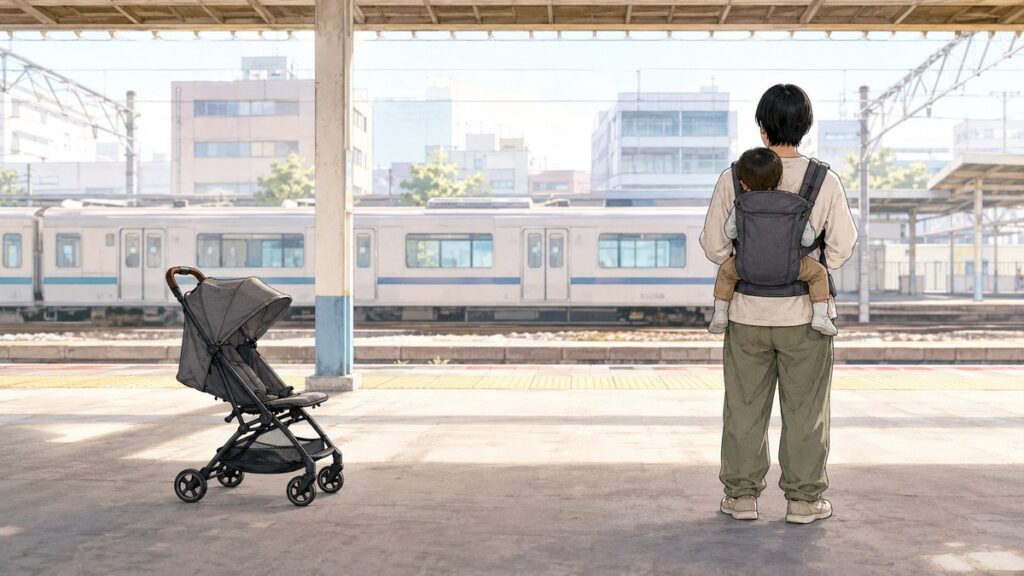
 Yes, Japan is a country where you can travel with a stroller. Trains and buses generally allow you to board without folding it, major stations are largely step-free, and a national stroller symbol marks places where strollers can be used more comfortably.
But “stroller-friendly” doesn’t mean “easy with a stroller everywhere.” The same stroller that saves your day in a theme park can slow you down at a hillside temple. An elevator may exist at a station, but it may be at the opposite end of the platform. A quiet train may be manageable with the stroller open, while a packed rush-hour carriage is a completely different situation.
 My quick recommendation is to bring a compact, easy-fold travel stroller if your child still naps, can’t walk for a full sightseeing day, or will spend long hours at a theme park. Pair it with a carrier if your child is small enough for one and your itinerary includes temples, steep streets, small stations, or rural areas.
 For an older child who walks well and doesn’t need naps, you may be happier without either. Renting only on the days you need a stroller can also work, especially at a theme park or in a major city.
Think of the stroller as one tool, not your only transport plan. Japan’s public transport system makes it possible to use one, but your route decides whether it feels helpful or heavy.
Stroller, Carrier, or Both? Decide by Age and Itinerary
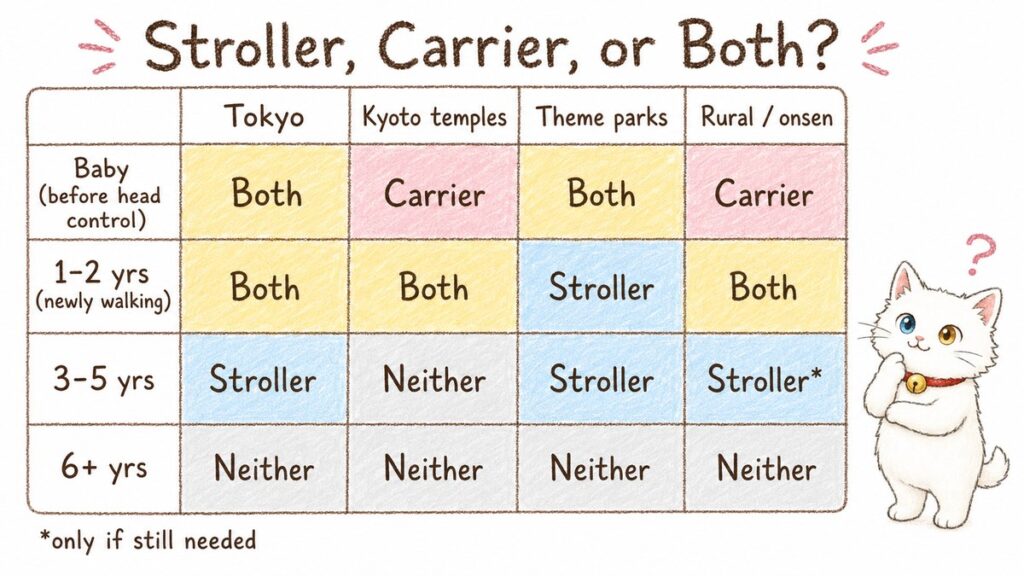
The best choice depends less on “Is Japan stroller-friendly?” and more on “What will my child need on this trip?” A Tokyo shopping day, a Kyoto temple day, and a full day at USJ place very different demands on both a child and a parent.
Use this table as a planning shortcut. “Both” doesn’t mean you must carry both every minute; it means having both available during the trip gives you the most flexibility. Before following any row, check that the exact stroller or carrier is approved for your child’s age, weight, and stage of development. For a baby who cannot yet hold their head steady, use only equipment specifically approved for that stage, and follow the manufacturer’s fit, recline, and positioning instructions.
| Child’s stage | Mostly Tokyo | Kyoto temples | Theme parks | Rural areas and onsen towns |
|---|---|---|---|---|
| Before your baby can hold their head steady | Both — stroller for longer city stretches, age-approved carrier when wheels are awkward | Age-approved carrier — easier around steps and slopes | Both — stroller for long hours, age-approved carrier for queues and transfers | Age-approved carrier — smaller stations and uneven routes can make wheels difficult |
| 1–2 years, newly walking | Both — walking, riding, and carrying may all happen in one outing | Both — stroller between sights, carrier for stairs and temple grounds | Stroller — little legs rarely last through a full park day | Both — useful when the route changes from smooth streets to steps |
| 3–5 years | Stroller — especially if your child naps or tires on long days | Neither — plan shorter temple routes and take regular breaks | Stroller — a full day can be too much even for a confident walker | Stroller — only if your child still needs it; check the terrain first |
| 6 years and older | Neither — usually easier if your child can manage the planned walking | Neither — take breaks and plan a realistic route | Neither — unless your family has a specific mobility need | Neither — check the terrain and transport for your family’s needs |
The hardest stage is often the newly walking stage
The baby-carrier months can feel simpler because the plan is clear: your child is being carried. The stage I found hardest was around the time my children had started walking but couldn’t walk all day. A child may refuse the stroller because walking is exciting, then suddenly have no energy left when you’re far from the station.
That is why “just let them walk” can fall apart during a Japan trip. Sightseeing days include station corridors, transfers, shopping streets, and the walk from the nearest stop to the attraction. Each section may look manageable on a map, but they add up.
A stroller carries your child — and sometimes all the family clutter
Traveling light sounds wonderful until you’re packing for a small child. Drinks, a change of clothes, wipes, snacks, and layers have a way of appearing even when you tried to cut the bag down.
A stroller basket can make that load easier while you’re on level ground. Avoid hanging heavy bags from the handle, because they can make the stroller tip backward. Then you reach a staircase and the advantage reverses: now the stroller itself has become another thing to lift, along with the child and everything in the basket. I have had moments when pulling a suitcase felt simpler than moving around with a child and a stroller.
Keep the stroller lightly loaded and use a bag you can put on your back. Before folding or lifting it, take your child out first, remove loose items, and follow the stroller manufacturer’s instructions.
Summer changes the answer
For a small child who can still be carried, a carrier is often the easiest option on stairs and in crowded places. Japan’s summer makes that choice harder. The parent and child are pressed together in heat and humidity, and both can become uncomfortably hot.
That doesn’t automatically make a stroller better all day, but it does make “carrier only” a tougher plan in summer. Build in indoor breaks and choose your daily route with the season in mind. The right answer in spring may not be the right answer for the same child in midsummer.
If you can’t decide, “both” is usually the most flexible answer for a baby or newly walking toddler — as long as the stroller is compact enough that carrying it doesn’t defeat the purpose.
Strollers on Trains: The Rules and the Reality
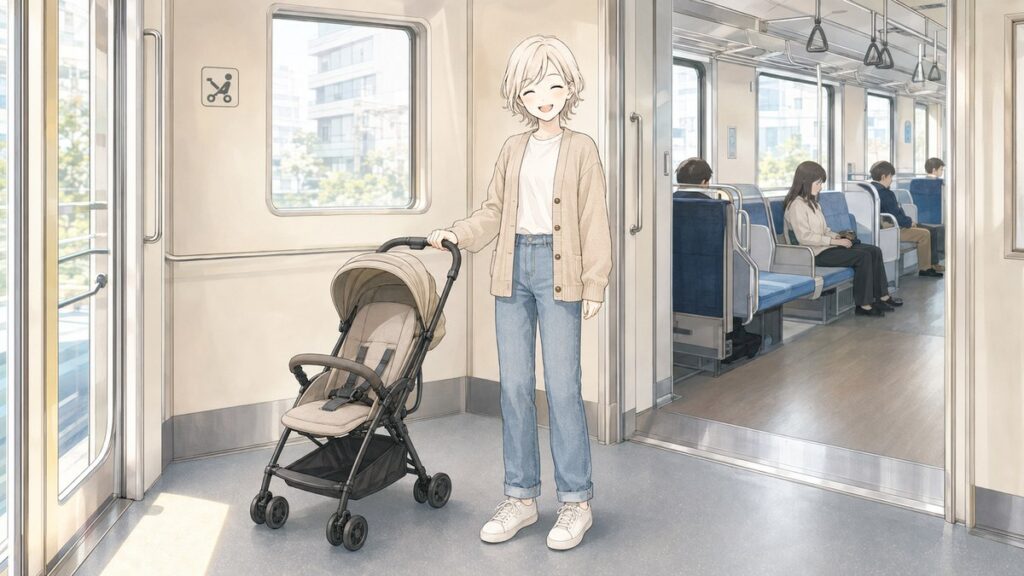
In principle, you can take a stroller onto trains and buses in Japan without folding it. Japan’s Ministry of Land, Infrastructure, Transport and Tourism introduced the stroller mark in March 2014. You may see it near elevators and in designated areas inside train cars, showing places intended to make stroller use safer and easier.
Some trains have marked multipurpose spaces, often near the end of a carriage. If one is available, position the stroller so it doesn’t block the doors or aisle, apply the brake, and keep hold of it. Wheelchair users have priority in shared accessible spaces, so be ready to move if needed.
The rule and the lived reality can both be true: you are allowed to board with an open stroller, and you may still feel very aware of how much room it takes. I know that uncomfortable feeling. Keeping the stroller open can make you worry about other passengers, but folding it may leave you holding a child, bags, and the stroller at once — then you still have the walk after leaving the station.
My Japanese-mom solution to rush hour
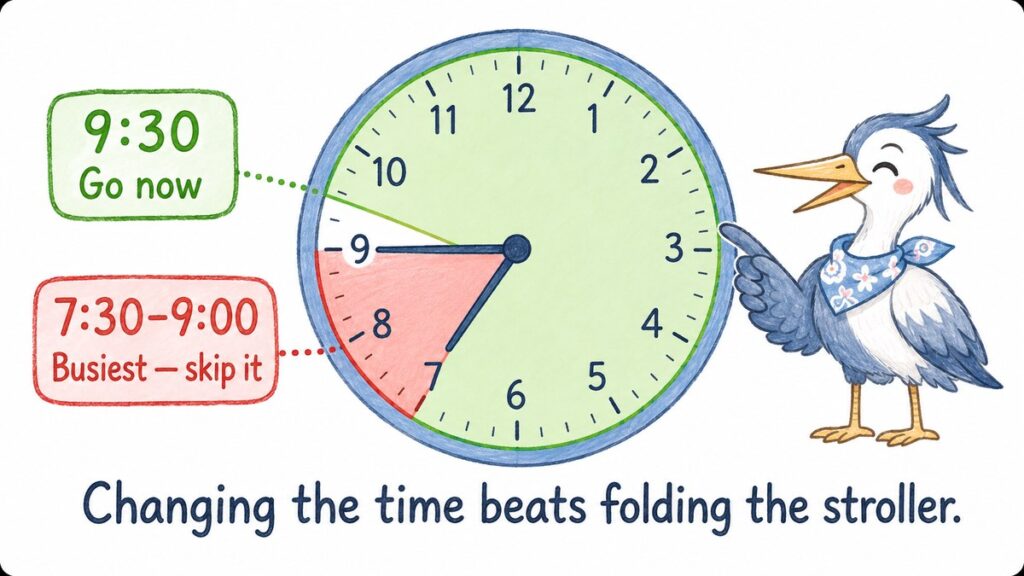
 I don’t solve the “fold it or leave it open?” question during rush hour. I avoid boarding then in the first place.
Tokyo commuter trains are generally busiest around 7:30–9:00 in the morning, although the exact peak varies by line and direction. Evening commuter periods can also be crowded. If your schedule is flexible, leaving later is usually kinder to your child, your own nerves, and the people around you. Many local parents fold strollers when trains are crowded, but changing the time of your journey is far easier than trying to manage a folded stroller inside a packed carriage.
If a train arrives too full, let it go and wait for another when you can. Standing near the carriage end before boarding also gives you a better chance of reaching the open space without pushing through the aisle.
Do children need a train ticket in Japan?
Tokyo Metro’s fare categories say that a child under 1 travels free. Children aged 1–6 who have not started school can travel free when accompanied by an adult, with up to two such children per adult; a third child requires a child fare. Children aged 6–11 pay half the adult fare, and passengers aged 12 and older pay the adult fare.
On JR, babies under 1 travel free. Up to two preschool-age children travel free with each fare-paying adult or child, and they may use unreserved seats. A child fare applies to the third or later preschooler, or when a child under 6 uses a reserved seat, a reserved Green Car seat or a berth, or travels alone. School enrollment can affect how the age categories are applied, so check the operator’s current rule if your child is around the school-age boundary.
Children aged 6–11 can also use a child IC card for half fare — see my Suica vs Pasmo guide for how to get one.
Elevators at Stations: What “94%” Actually Means for You
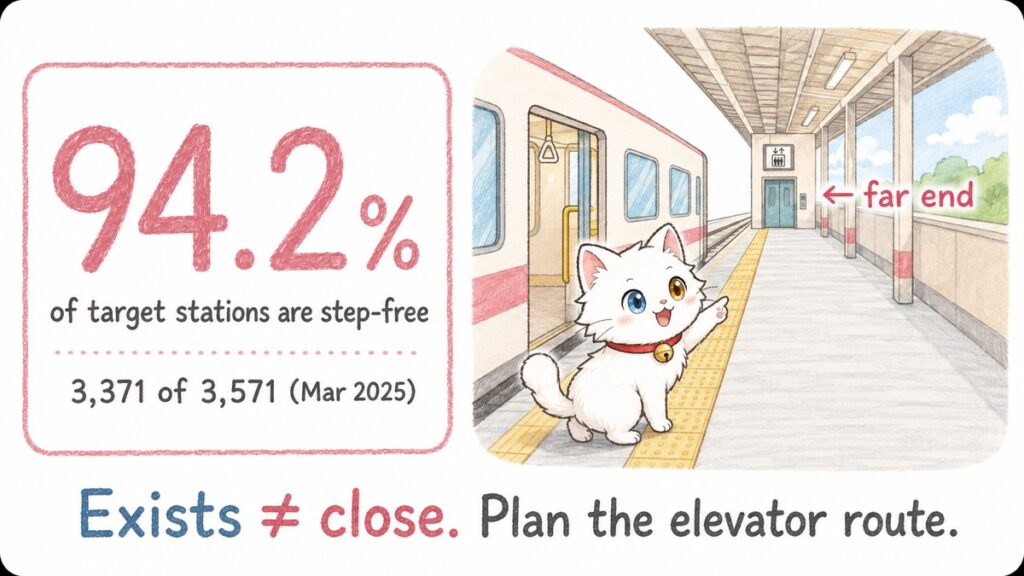
Japan’s major stations are much more accessible than the phrase “old train system” may suggest. By the end of March 2025, 3,371 of 3,571 stations covered by the government’s target had step-free access through elevators or other measures — 94.2%.
 That percentage does not cover every station in Japan. It applies to target stations, including those used by at least 3,000 passengers per day and other stations covered under the relevant criteria. The practical meaning is that major urban stations usually have a step-free route, while a small or older station may not.
There is another catch: an elevator existing is not the same as an elevator being close. It may be at the far end of the platform, behind the flow of passengers going the other way, or connected to a different ticket gate. A station may have only one suitable route, so you can also end up waiting behind other stroller users, travelers with luggage, and passengers who need step-free access.
Plan for the elevator route, not only the train route
In Google Maps, try the wheelchair-accessible route option when planning public transport. It can reduce the chance of being sent through a transfer built around stairs, though you should still allow extra time and follow station signs when you arrive.
Use the elevator whenever possible. Do not ride an escalator or use stairs with your child seated in the stroller. If you cannot avoid them, take your child out first and follow station staff and the stroller manufacturer’s instructions; never lift an occupied stroller. On platforms and trains, apply the brake and keep hold of the stroller.
If you can’t find the elevator, ask station staff. Even if you don’t share a language, “elevator?” while pointing to the stroller is usually enough to communicate the problem. Staff can direct you to the correct end of the platform or the accessible ticket gate.
This difference becomes more noticeable outside the biggest city centers. At a major station, the question is often “Where is the elevator?” At a smaller station on a day trip, the first question may be “Is there one?” That is one reason I would check the route carefully before taking a stroller to a more rural destination.
 Sending your large luggage ahead can make this much easier. Finding a distant elevator is frustrating with a stroller; doing it with a stroller and a large suitcase is worse.
My guide to luggage forwarding in Japan explains what it costs and which days it is worth it.
Taking a Stroller on the Shinkansen
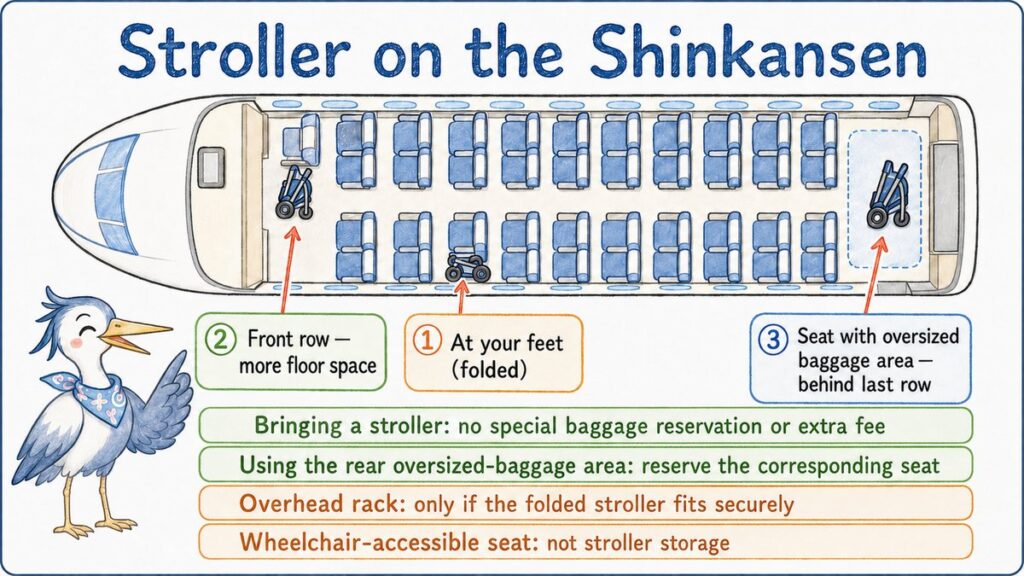
A stroller can be brought onto the Shinkansen without an extra fee, and the oversized-baggage rule does not apply to it even when the total of its three dimensions is over 160 cm. You don’t need an oversized-baggage reservation simply because you have a stroller.
Space is still the real issue. A stroller that is technically allowed on board must fit somewhere without blocking the aisle or bothering another passenger. Planning its position when you reserve your seats is much easier than improvising after boarding.
Three practical places for a stroller
The simplest option for a compact stroller is to fold it and keep it at your feet. This works best when the stroller folds small and you haven’t also filled your foot space with bags.
The front row of a carriage may offer more usable floor space in front of the seats, making it another option for a stroller that you don’t want to lift. Seat layouts differ, so confirm the seating plan when booking rather than assuming every front row will suit your stroller.
If you want to use the space behind the last row, reserve a “seat with an oversized baggage area.” This seat costs the normal reserved-seat fare; there is no separate charge for the space. Although the stroller itself is exempt from the oversized-baggage rule, the area behind these seats is for passengers who reserved the corresponding seat.
 Avoid putting a heavy or unstable stroller on the overhead rack. A wheelchair-accessible seat is not stroller storage, and it shouldn’t be booked for that purpose. If you need a private multipurpose room for feeding or another reason, ask a crew member; it may be available when it isn’t being used by someone with priority.
I haven’t taken a stroller onto the Shinkansen myself, so here I’d simply follow the official storage rules, choose seats deliberately, and keep the stroller compact enough to manage during boarding.
If you are still deciding how to pay for those Shinkansen rides, start with whether the JR Pass is worth it for your route.
And for a sense of how those train days fit into a whole trip, my 10-day Japan itinerary on ¥200,000 shows what a slower route with one main activity per day can look like.
Buses, Taxis and Airports
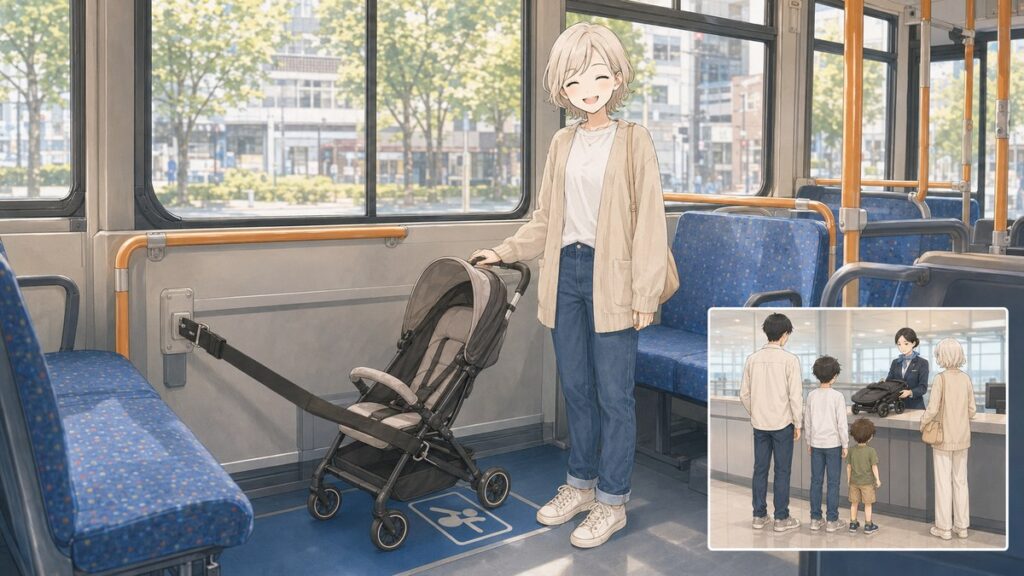
Local transport requires a little more flexibility than trains. Vehicle layouts differ, staff may need to manage wheelchairs and several strollers, and a stroller that fits easily in a large city bus may be awkward in a smaller vehicle.
On Toei buses in Tokyo, a stroller can remain open when it is secured with the onboard belt. Up to two strollers can be accommodated at the same time, and since June 7, 2021, this has included side-by-side double strollers without requiring them to be folded. Wheelchair users have priority, and you may still be asked to fold the stroller when the vehicle or circumstances make open use difficult.
Rules and vehicle space can vary on buses outside that system. In a rural area, be prepared to fold the stroller and keep your bags organized so you can board without a long reshuffle at the door.
For taxis, a compact stroller can often be folded and placed in the trunk, but the available space depends on the vehicle and any luggage already there. If you have a large stroller and several suitcases, don’t assume everything will fit just because the ride itself is short.
Free airport strollers can bridge the gap
Narita, Haneda, and Kansai airports provide free strollers for use inside the airport through their information counters. This can help when your own stroller has already been checked or before you collect it after landing.
At Narita, advance reservations aren’t available, and arriving passengers can borrow one after immigration. Availability may depend on what is at the counter when you ask.
For international flights, JAL strongly encourages you to check your stroller because cabin space is limited, and a stroller used by the passenger is checked free of charge. At some airports you can keep using it up to the boarding gate, but that isn’t offered everywhere, so ask at check-in. ANA also checks a passenger’s own folding stroller free of charge, and allows it as cabin baggage when it fits the size limits folded. Check your own airline’s instructions before flying, especially if you have connections or a stroller with detachable parts.
Landing at Narita? My Narita Express guide covers the train into Tokyo — including where a stroller goes.
Where a Stroller Gets Difficult: Temples, Hills, and Stone-Paved Streets
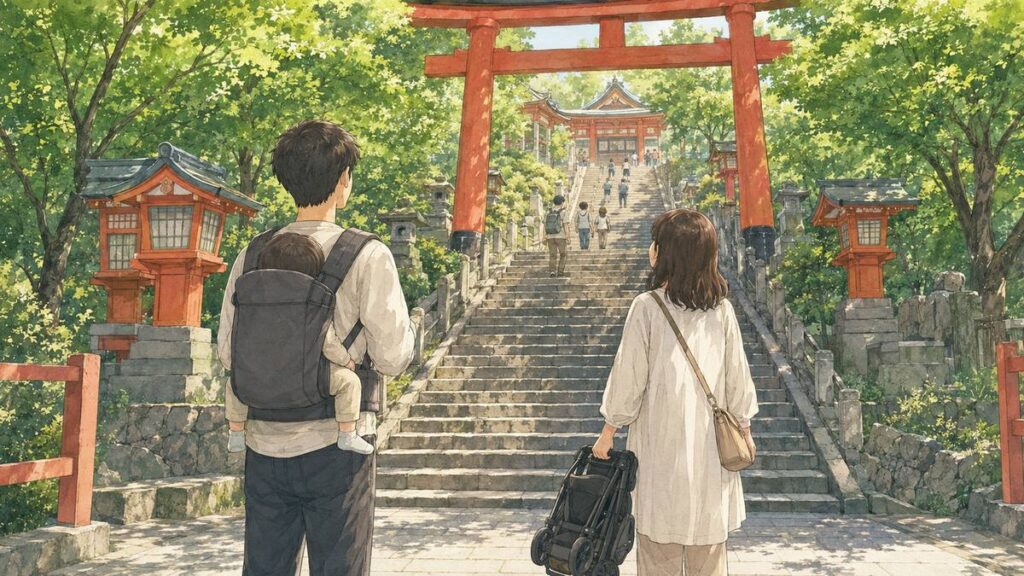
Some of Japan’s most memorable places are exactly where a stroller becomes least useful. Temple approaches, hillside paths, stone steps, steep lanes, and heavy crowds can turn a set of wheels into something you carry more than you push.
In winter, frozen or snowy pavements change the calculation again — I cover that in my Japan winter clothing guide.
That doesn’t always mean strollers are prohibited. It means that being allowed to bring one and being glad you brought it are different things.
Kyoto changes street by street
 At Fushimi Inari Taisha, the area around the main shrine at the foot of the mountain is generally manageable on level ground. Once you continue beyond the lower sections of the famous torii gates, the route becomes a mountain path with stone steps. A stroller may help before that point and become a burden after it.
At Kiyomizu-dera, the approach from the bus stop includes a steep uphill walk of about 10 minutes. There is a wheelchair and stroller route that avoids some stairs, but it is still a place where slope, crowds, and route choice matter. A carrier or a shorter plan may be easier than trying to complete every section with a stroller.
Koyasan and Kurama-dera also involve substantial slopes and stairs, so I wouldn’t choose them as easy stroller days. In busy parts of Gion or Asakusa, the challenge may be less about stairs and more about slow-moving crowds, narrow approaches, and uneven paving.
Give yourself permission to call it a carrier day
My honest view is that temples and shrines are not necessarily impossible with a stroller; they can simply be more inconvenient with one. On a day built around stairs, I would leave the stroller behind and use a carrier if the child is still small enough and the weather makes it reasonable.
For an older toddler or preschooler, the better answer may be a shorter route with more breaks. Trying to push, lift, fold, and reopen a stroller at every change of level can use more energy than it saves.
Check the ground, not only the destination name. “Kyoto sightseeing” could mean a smooth station building and shopping area, or it could mean a steep temple approach — those are two different stroller decisions.
Bring, Rent, or Buy?
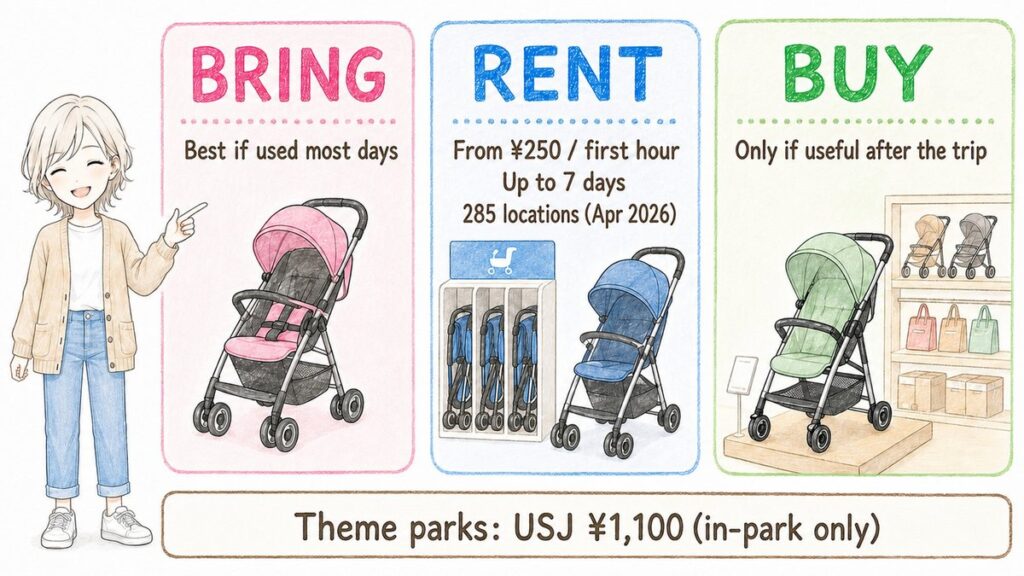
You don’t have to make one stroller decision for the entire trip. Bringing a compact model gives you certainty every day, renting avoids carrying it on days you don’t need it, and buying in Japan can make sense if you also want a lightweight stroller after the trip.
Bring your own for daily use
Bring your own stroller if your child relies on it for naps, long walks, or most outings. Familiarity matters: you already know how it folds, what fits in the basket, and how your child feels in it.
Compactness matters more in Japan than having the largest basket or widest seat. A smaller fold is easier at station elevators, inside shops, beside restaurant tables, and in a taxi trunk. I haven’t used a large overseas stroller myself, but I’d measure yours with Japanese ticket gates, elevators, and small indoor spaces in mind.
If you’re flying with JAL or ANA internationally, the checked-stroller policies described above can make bringing your own easier. Still, check the full conditions for your flight before you leave home.
Rent only when you need one
Stroller rental in Japan is more practical than older advice sometimes suggests. Babycal, run by the JR East group, listed 285 rental locations nationwide as of April 2026. You reserve online and collect the stroller from either a staffed counter or an unmanned unit, depending on the location. You can take it away from the pickup point — but you have to bring it back to the same place, so plan that day as a loop rather than a one-way trip.
Pricing starts at ¥250–¥500 for the first hour, then ¥150 for each additional 30 minutes, with a cap of ¥2,000 per 12 hours; rentals can run up to 7 days. Rates vary by location and by the stroller itself. Age limits depend on the model too: some locations stock an A-type stroller for babies from 1 month, others a B-type from 7 months, and both go up to 48 months. Check the model and its limits at your chosen location before you reserve.
Locations are not limited to Tokyo. Kyoto Station has rental points at Crosta Kyoto and the Hachijo Exit, which can be useful if you want a stroller for part of a city stay rather than every travel day. Reserve before relying on one, especially when your itinerary depends on collecting it at a specific place.
USJ rents reclining strollers for ¥1,100 including tax. They are for children aged 1–48 months, can be used only inside the park, and can’t be reserved in advance. Tokyo Disney Resort also offers paid stroller rentals inside its parks, though the fee isn’t included here because it can change.
Park rental solves the “my child can’t walk all day” problem without making you carry a stroller through the rest of Japan. The tradeoff is that you must return it before leaving, so it won’t help with the station journey afterward.
Buy a lightweight stroller in Japan
Lightweight, compact strollers are common among local families because they fit everyday life here. Buying one can be reasonable if you need a stroller for the rest of the trip and will continue using it at home.
Don’t buy only because you assume every Japanese stroller will fold into the smallest possible shape. Check the actual folded size, weight, reclining position, and instructions for the child who will use it. You also need a plan for taking it home.
For many visitors, the choice is simple: bring your own if it will be used most days, rent if you need it only for selected city or theme-park days, and buy only when the stroller will remain useful after the trip.
If a theme-park day is on your list, buying the USJ Studio Pass in advance on Klook removes the ticket-purchase step when you arrive — and you can rent a stroller once you’re inside.
What This Japanese Mom Actually Does
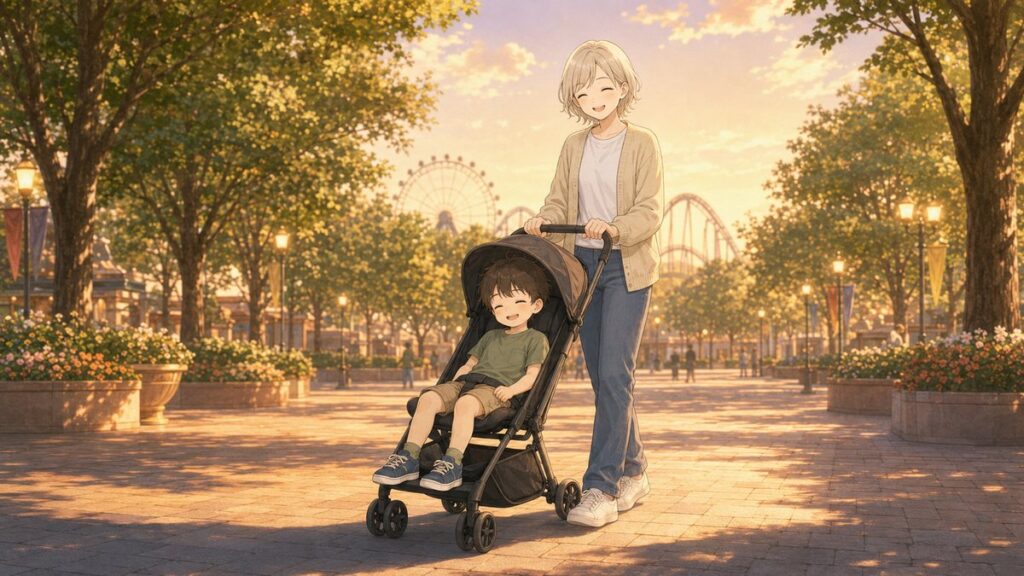
My younger son is 4, and I still use a stroller with him at USJ. A full theme-park day is too much walking for him, and the stroller gives us a place for him to rest before his energy disappears completely.
I don’t treat that as proof that a 4-year-old needs a stroller everywhere. In a shop, I use the store’s cart instead. At a temple or shrine with many stairs, taking a stroller can make the day harder, so I choose based on the destination.
I also don’t take a stroller onto a rush-hour train and then spend the journey worrying about whether I should fold it. I avoid that train. Changing the time is the most practical local-parent solution I know, because it removes the crowd problem before it starts.
When a child is still small enough to carry, a carrier gives you more freedom on stairs and uneven ground. But Japan’s summer is so hot that a carrier can leave both parent and child sweaty and uncomfortable. Season matters just as much as age.
The stroller has two opposite roles in family life. On smooth ground, it carries a tired child and some of your growing pile of belongings. At a staircase, it joins that pile — and you still have the child to move.
So I don’t have one rule for Japan. I ask three questions each morning: How far will my child need to walk? How many stairs or hills are on today’s route? Will the heat or crowds make carrying harder? That small check is more useful than declaring Japan either “stroller-friendly” or “not stroller-friendly.”
FAQ
Should I bring a stroller to Japan?
Bring one if your child still naps, can’t manage a full sightseeing day on foot, or will spend long days at theme parks. A compact, easy-fold model is the most practical choice for trains, elevators, shops, and taxis.
If your trip focuses on steep temple routes or rural areas, a carrier may be more useful. Renting on selected days can be a better compromise for a child who needs occasional rest but not a stroller every day.
Can you take a stroller on trains in Japan?
Yes. In principle, strollers can be taken onto trains without being folded, and the stroller symbol marks designated areas such as open spaces near the end of some carriages.
Keep the brake on, hold the stroller, avoid blocking doors and aisles, and give priority to wheelchair users in shared accessible spaces. Avoid rush hour when possible; changing your travel time is easier than managing a child, bags, and a folded stroller in a packed train.
Do Japanese train stations have elevators?
Most major stations have a step-free route. As of the end of March 2025, 94.2% of the 3,571 stations covered by the government’s target had step-free access through elevators or other measures.
That is not a figure for every station in Japan. Smaller stations may have no elevator, and at a large station the available elevator may be far from your carriage or lead to a different ticket gate.
Can I take a stroller on the Shinkansen?
Yes. Strollers are exempt from the oversized-baggage rule even when the total of their three dimensions exceeds 160 cm, so you don’t need a special baggage reservation merely to bring one on board.
Fold a compact stroller at your feet, consider a front-row seat, or reserve a seat with an oversized baggage area if you want to use the space behind the last row. Don’t use a wheelchair-accessible seat as stroller storage, and avoid placing a heavy or unstable stroller on the overhead rack.
Can I rent a stroller in Japan?
Yes. Babycal listed 285 rental locations across Japan as of April 2026. You reserve online and collect from a staffed counter or an unmanned unit, depending on the location. Rentals can last up to 7 days, but you must return the stroller to the same place you picked it up, and the model — along with its age limits — varies by location.
USJ and Tokyo Disney Resort also offer paid stroller rentals for use inside their parks. USJ’s rental is ¥1,100 including tax, is for children aged 1–48 months, and can’t be reserved in advance.
Is Kyoto stroller-friendly?
Parts of Kyoto are easy with a stroller, but temple routes can change the answer. Central stations and level city areas may be manageable, while steep approaches, stone steps, and crowds make some sightseeing days better suited to a carrier or a shorter walking plan.
Fushimi Inari is generally manageable near the main shrine at the foot of the mountain, but the route beyond the lower torii sections becomes a stepped mountain path. Kiyomizu-dera has a route that avoids some stairs, though the approach still includes a steep uphill walk of about 10 minutes.
Do kids need a train ticket in Japan?
On Tokyo Metro, children under 1 travel free. Up to two children aged 1–6 who have not started school can travel free with one adult; the third requires a child fare. Children aged 6–11 pay half fare, and passengers aged 12 and over pay the adult fare.
On JR, babies under 1 travel free. Up to two preschool-age children travel free with each fare-paying adult or child, and they may use unreserved seats. A child fare applies to the third or later preschooler, or when a child under 6 uses a reserved seat, a reserved Green Car seat or a berth, or travels alone. School enrollment can affect how the age categories are applied, so check the operator’s current rule if your child is around the school-age boundary.
Stroller or baby carrier for Japan?
A stroller is better for long, level days when your child may nap or stop walking. A carrier is better for stairs, slopes, crowded temple grounds, and smaller stations.
For a baby or newly walking toddler, bringing both gives you the most flexibility. In summer, remember that a carrier can become extremely hot for both of you; for an older child, a shorter itinerary or a stroller rented only on long days may work better.
A stroller is only one part of traveling with children here. For child train fares, kid-friendly restaurants, where to buy diapers and formula, and what to do if your child gets sick, see my complete guide to Japan with kids.
YUU’s Final Thoughts
If you remember three things from this guide, make them these. In principle, you can take a stroller onto trains without folding it, and you can bring one onto the Shinkansen; on buses, you may need to fold it depending on the operator, vehicle, and conditions. But “allowed” and “easy” are different words, and the gap between them is stairs, crowds and heat. Your child’s age and your itinerary decide the answer more than the country does. And you don’t have to commit to one plan for the whole trip: bring a compact stroller, borrow one at the airport or a theme park, and call it a carrier day when the route is built around steps.
For my 4-year-old, a full theme-park day is the one time I don’t skip the stroller.
Check USJ Studio Pass prices on Klook
 Now I’m curious about your side of the world — what is the stroller situation like where you live? Do trains and stations make it easy, or do you avoid public transport with a small child? Tell me in the comments below. I read every single one!
I hope this guide has answered one of your questions and helped you feel a little closer to Japan. May your Japan journey be filled with wonderful discoveries and memories you’ll treasure for years to come.
See you in the next guide. 
Comments