As an Amazon Associate, I earn from qualifying purchases.
Quick list: everything linked in this guide
-


Thermajane thermal underwear set Amazon US
-


Amazon Essentials packable down jacket Amazon US
-
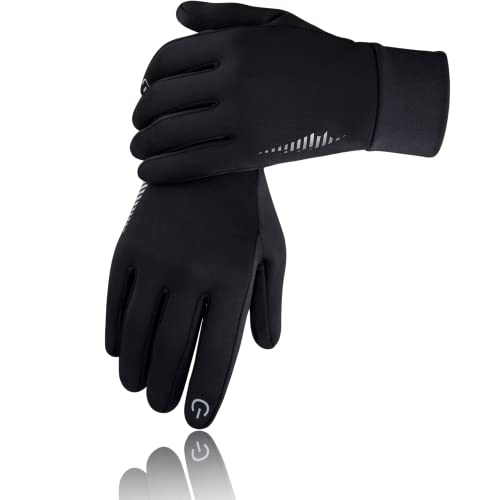
SIMARI touchscreen winter gloves Amazon US
-


Stick-on heat packs (kairo) Amazon US · Japan
-


Kyusoku Jikan foot cooling sheets Amazon US · Japan
-
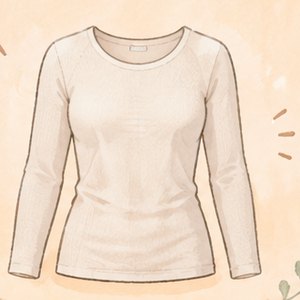
Gunze HOTMAGIC innerwear Amazon Japan
-
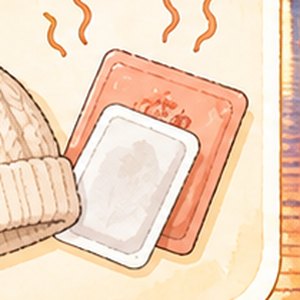
Kiribai Magma non-adhesive warmers Amazon Japan
-
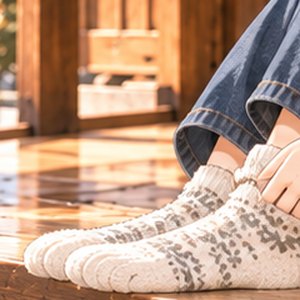
Okamoto “Marude Kotatsu” socks Amazon Japan
Amazon Japan links are for readers outside the US. Check delivery to your country before ordering.
You’ve checked the December temperatures in Japan. Tokyo looks chilly, Kyoto looks similar, and now you’re staring at your suitcase wondering: do you need a huge winter coat, or will a sweater do?
Here’s the short answer: for December in Tokyo, Kyoto, Osaka, and Fukuoka, you need a warm coat, layers you can remove, and comfortable walking shoes. You don’t need full snow gear for ordinary city sightseeing. The real challenge is going from cold streets into heated trains and shops — sometimes several times in an hour.
And one little detail changes your packing list: early December and late December aren’t quite the same trip. I’ll help you choose what to bring based on your dates, your cities, and whether you’ll be standing outside after dark.

- Quick Answer: What to Wear in Japan in December
- December Weather in Japan: How Cold It Actually Feels
- Early December vs. Late December: Two Different Trips
- December Layering Formula: Do You Need Heattech?
- Hot Trains, Cold Streets: Dressing for the Indoor Heat
- What to Wear in Tokyo, Kyoto, Osaka & Fukuoka
- Dressing for Illumination Nights and New Year’s Eve
- Shoes and Socks for December
- December in Japan with Kids
- Japan December Packing List
- FAQ
- Final Thoughts: What to Wear in Japan in December
Quick Answer: What to Wear in Japan in December
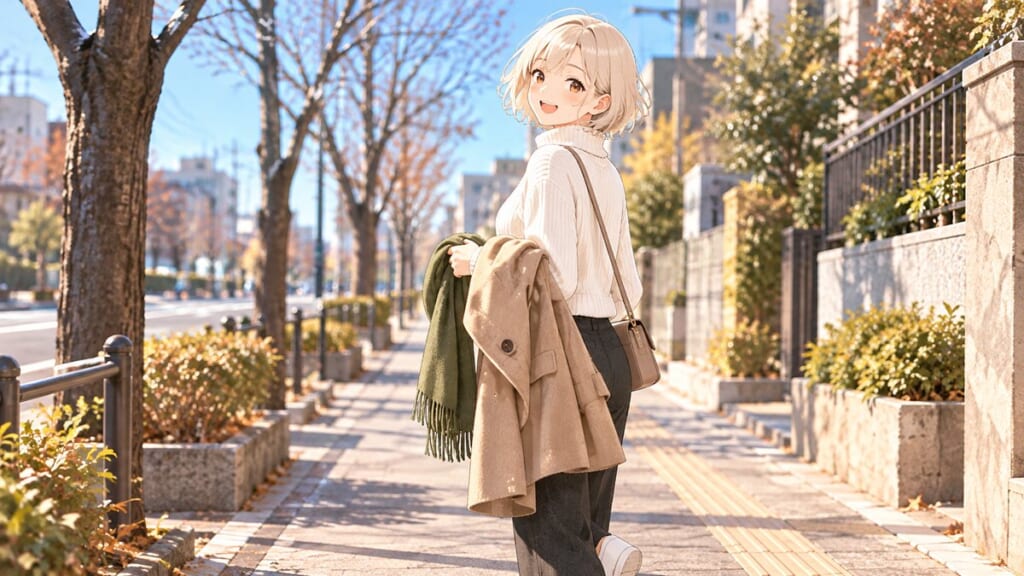
For most December city trips in Japan, build your outfits around these three rules:
- Everyday sightseeing: A warm coat over a sweater and a comfortable base layer. Add jeans or other full-length pants, walking shoes, and socks that keep your feet comfortable.
- Early vs. late December: Early December often works with your late-November wardrobe plus an extra warm layer. For late December, pack warmer accessories and allow for colder mornings and evenings.
- Illuminations and New Year’s Eve: Bring a knit hat, gloves, a scarf, warm socks, and disposable hand warmers if you’ll be standing outdoors for a while.
 One thing I’d prioritize is your feet. A typical sightseeing day involves plenty of walking, and warm, comfortable socks are useful long before you start thinking about snow boots.
My sock pick: Okamoto “Marude Kotatsu” socks from Japan. I’ll tell you more about them in the shoes and socks section below.
If your trip begins in late November, you can also use my guide What to Wear in Japan in November to plan those first few days.
December Weather in Japan: How Cold It Actually Feels
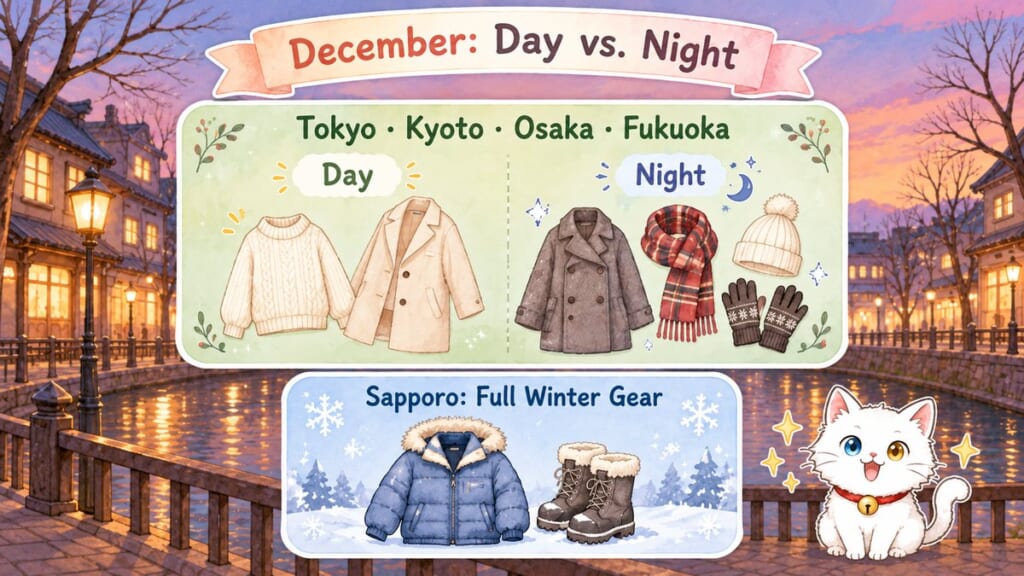
December temperatures in Japan can look surprisingly manageable on a weather app. The trouble is that a daytime high doesn’t tell you what you’ll feel while waiting for a train in the evening or walking back to your hotel after dinner.
Here are the December climate averages from the Japan Meteorological Agency, based on 1991–2020 data. The clothing suggestions are for ordinary city sightseeing, not mountain trips.
| City | Average High | Average Low | What to Wear During the Day | What You’ll Want at Night |
|---|---|---|---|---|
| Tokyo | 12.0°C (54°F) | 3.8°C (39°F) | Sweater, coat, long pants, walking shoes | Scarf, gloves, warmer socks |
| Kyoto | 11.6°C (53°F) | 3.5°C (38°F) | Warm layers, coat, comfortable shoes | Warm coat, hat, scarf, gloves |
| Osaka | 12.3°C (54°F) | 5.3°C (42°F) | Sweater and coat, with removable layers | Scarf and gloves for long outdoor stops |
| Fukuoka | 12.6°C (55°F) | 5.8°C (42°F) | Coat, knitwear, full-length pants | Wind-blocking outerwear and warm accessories |
| Sapporo | 2.0°C (36°F) | −4.0°C (25°F) | Insulated winter clothing and weather-appropriate footwear | Full winter protection for snow and freezing conditions |
Tokyo, Kyoto, Osaka, and Fukuoka are close enough in their monthly averages that you can usually build one basic winter wardrobe for a trip covering all four. The important adjustments come from your activities, the time of day, and how long you’ll spend outdoors.
 Daylight is another detail worth planning around. In Tokyo, sunset is at 4:28 p.m. on December 1, 2026, and 4:37 p.m. on December 31. In Kyoto, it’s 4:45 p.m. and 4:55 p.m. on those dates.
That means an afternoon sightseeing outfit may need a scarf and gloves before you’ve even reached dinner.
December also brings some rain, so a water-resistant outer layer or compact umbrella is worth considering. You don’t need to pack as if every day will be wet; simply check your destination’s forecast before leaving and again during your trip.
Early December vs. Late December: Two Different Trips
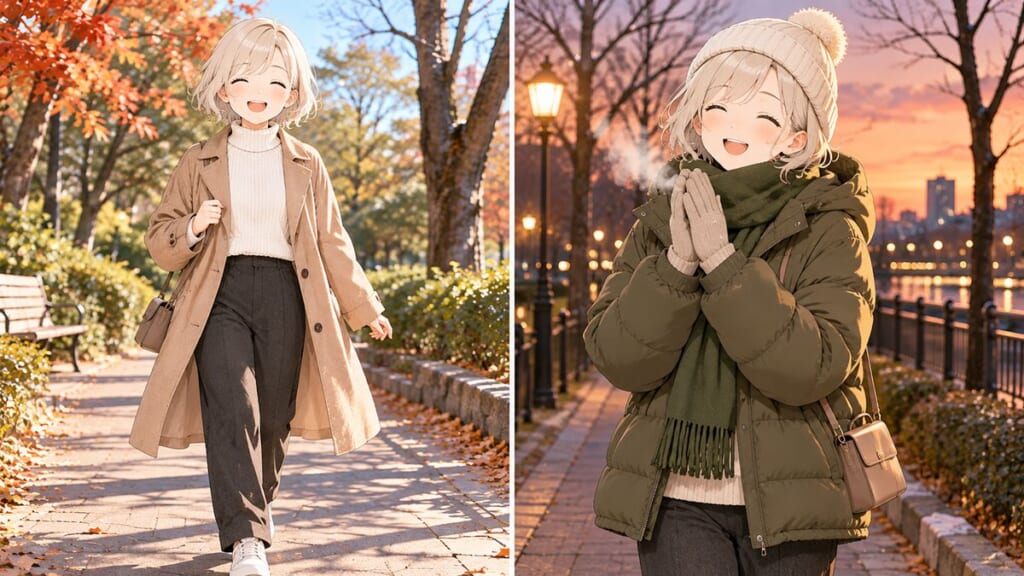
Early December can still feel like the final chapter of autumn, while late December is when you’ll want to treat the mornings and evenings as proper winter outings. That’s why I wouldn’t pack exactly the same accessories for both ends of the month.
I’ve seen autumn leaves still looking beautiful at the beginning of December. Some trees can hold onto their color into early December, so you may find a little autumn scenery mixed into your winter trip.
 But don’t let those autumn leaves fool you. A pleasant afternoon walking among them can turn into a cold evening once the sun goes down.
| When You’re Visiting | What to Pack |
|---|---|
| Early December (Dec 1–10) | Late-November outfits plus a warm coat, sweaters, long pants, walking shoes, a scarf, and light gloves. Add warmer accessories for evening plans. |
| Mid-December (Dec 11–20) | Warm base layers, sweaters, an insulated coat or down jacket, comfortable shoes, thicker socks, a scarf, and gloves. |
| Late December (Dec 21–31) | Warm base layers, an insulated coat, thicker socks, gloves, a scarf, a knit hat, and hand warmers for outdoor evening waits. |
If you’re coming at the start of the month, my guide What to Wear in Japan in November is useful for understanding that autumn-to-winter transition. By the final week of December, a good coat and winter accessories deserve more suitcase space.
The easiest way to decide is to look at your itinerary. A day of museums, shopping, and short walks needs less outdoor protection than an evening spent waiting for illuminations or celebrating New Year’s Eve.
December Layering Formula: Do You Need Heattech?
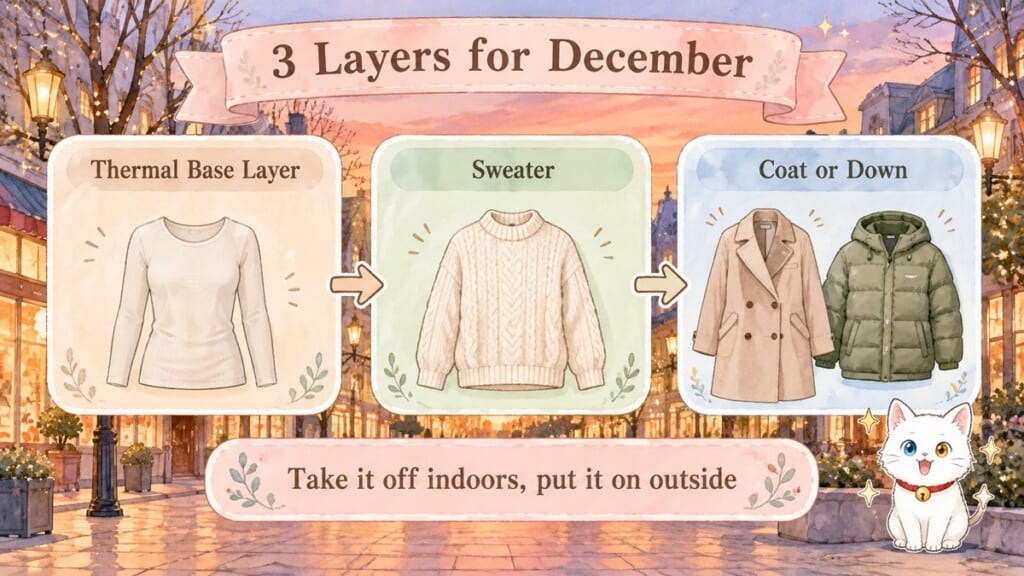
Three adjustable layers are a good starting point for December in Japan: something next to your skin, something warm in the middle, and a coat on top. They let you change your outfit without returning to your hotel whenever the temperature changes.
 In my everyday life in Japan, I wear a HEATTECH-style thermal inner layer, a knit sweater, and a coat in December. On colder days, I wear a down jacket instead, and I also use thicker thermal underwear such as HEATTECH Extra Warm.
Layer 1: A Comfortable Base Layer
Your base layer should sit comfortably under your regular clothes. A thin long-sleeved thermal top is an easy choice for cold mornings because it adds warmth without changing your entire outfit.
UNIQLO HEATTECH is familiar winter clothing in Japan. UNIQLO also sells HEATTECH Extra Warm and HEATTECH Ultra Warm; the company describes them as approximately 1.5 and 2.25 times as warm as regular HEATTECH, respectively, under its comparison conditions.
Regular thermal layers suit active sightseeing, while thicker versions are useful for colder days and long outdoor waits.
My pick for December: If you’re choosing one thermal top for your trip, I’d go with HEATTECH Extra Warm. UNIQLO’s US online store sells it for women, men, and kids, and UNIQLO stores in Japan carry it in winter, so you can also buy one after you arrive.
The Thermajane thermal underwear set gives you a base layer to wear under your everyday December outfits.
Thermajane Thermal Underwear Set (women’s)
A thin top-and-bottom set to wear under your usual December outfits.
Prices change often — please check the latest price on each store.
Outside the US? Gunze offers HOTMAGIC heat-generating innerwear for women, along with men’s styles and thermal leggings or tights on Amazon Japan. Check the size chart before ordering.
Gunze HOTMAGIC Heat-Generating Innerwear
Japanese thermal innerwear for women and men. Japanese sizes run small, so check the size chart. For readers outside the US.
Women’s
Men’s
Prices change often — please check the latest price on each store.
Layer 2: A Sweater You Can Wear Indoors
A knit sweater or cardigan should feel comfortable on its own when you remove your coat indoors. A button-front or zip-up middle layer lets you adjust further if you get too warm.
Layer 3: A Coat or Packable Down Jacket
Your outer layer needs to work for the coldest part of your planned day. A warm coat is suitable for ordinary December city sightseeing, while a down jacket is useful if you expect colder weather or long evenings outdoors.
The Amazon Essentials packable down jacket can be compressed for packing and pulled out when you need an extra warm outer layer on cold evenings.
Amazon Essentials Packable Down Jacket (women’s)
Packs down small in your suitcase and comes out for cold evenings.
Prices change often — please check the latest price on each store.
You can also buy winter clothing in Japan. UNIQLO stores carry seasonal options such as Ultra Light Down and PUFFTECH.
Buying after arrival can be convenient when you have time to shop, but arrive with enough clothing for your first day and evening. If shopping isn’t part of your plans, packing a coat before departure is simpler than making your first night depend on finding one.
Hot Trains, Cold Streets: Dressing for the Indoor Heat
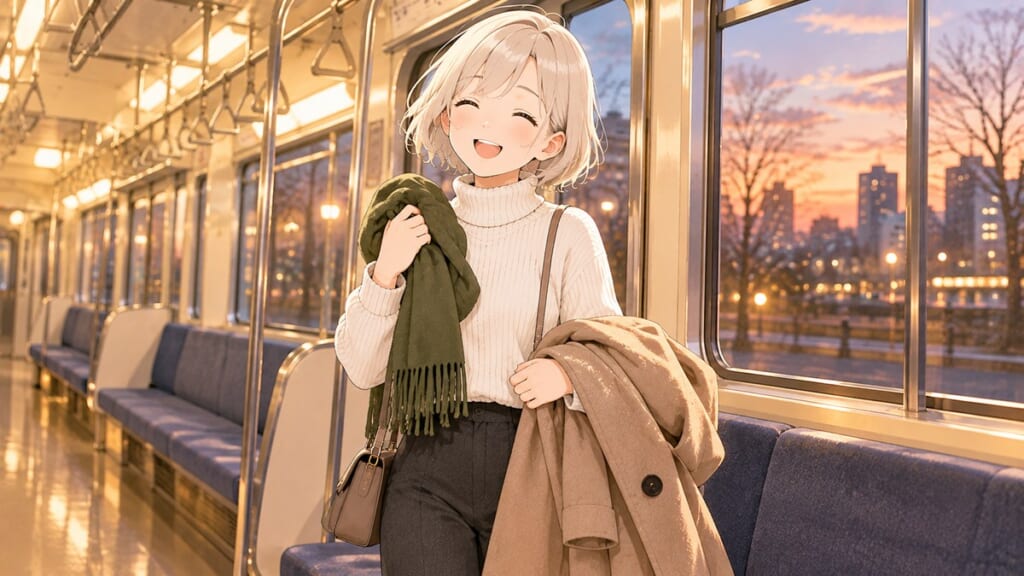
You step onto a train wearing your warmest coat, and ten minutes later, you’re wondering why you dressed for winter at all. Then the doors open, you walk outside, and suddenly you’re glad you brought that coat.
Heated trains, shops, and hotels are a big part of dressing comfortably in December. Travelers discussing winter trips online also mention the difficulty of balancing cold outdoor air with warm indoor spaces.
 When I get too warm on trains or inside shops, I take off my coat and carry it in my hands. Sometimes simply removing my scarf is enough to make the difference.
Three small adjustments make heated indoor spaces easier to handle:
- Open or take off your coat.
- Remove your scarf when you get too warm.
- Keep gloves and small accessories in your bag.
One more winter annoyance is dry indoor air from heating. If that bothers your skin, my winter dry skin kit covers a few practical items to consider for your trip.
What to Wear in Tokyo, Kyoto, Osaka & Fukuoka
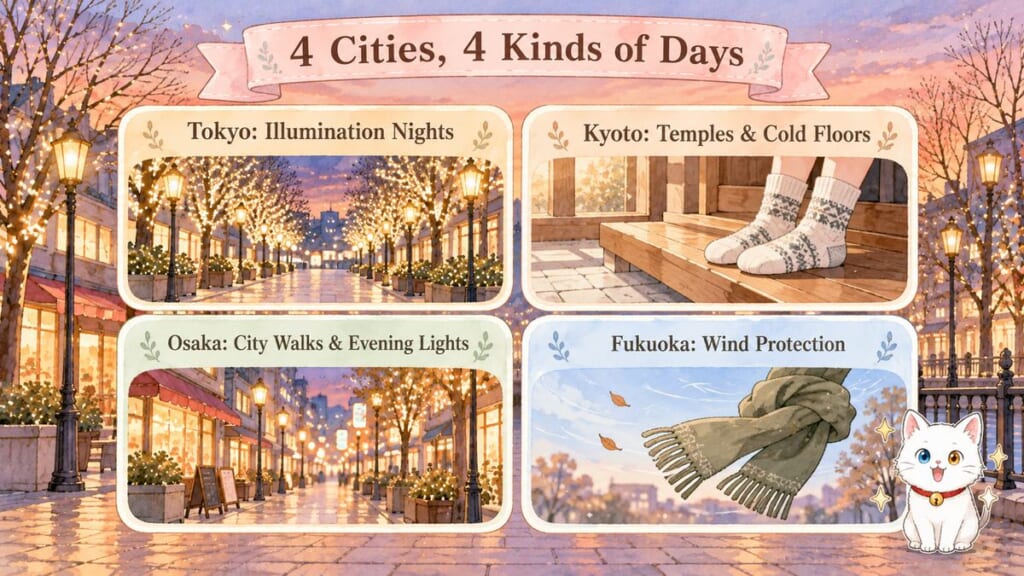
You can use the same basic wardrobe across Tokyo, Kyoto, Osaka, and Fukuoka. What changes is how you’ll spend your time: shopping indoors, walking around temple grounds, visiting a theme park, or standing outside at night.
Tokyo: Shopping Days and Illumination Nights
Tokyo’s heated stations, department stores, and cafés make removable layers especially useful. A thermal top, sweater, long pants, walking shoes, and coat work for daytime sightseeing.
 Tokyo’s winter illuminations can turn an ordinary evening into a much longer outdoor walk. Areas such as Marunouchi and Tokyo Midtown are known for seasonal light displays, but event dates vary, so check the schedule for your travel year.
For illumination nights, bring gloves, a hat, and warm socks. Standing still for photos can feel colder than walking.
Kyoto: Temples, Gardens, and Cold Floors
Kyoto’s average December low is 3.5°C (38°F), so a warm coat and sweater are useful for outdoor sightseeing. At temples and traditional buildings where you need to remove your shoes, warm socks and easy-to-remove footwear make visits more comfortable.
Socks that are warm enough to wear without shoes deserve a little attention here. Make sure they’re also comfortable inside your walking shoes, since thick socks can make a familiar pair unexpectedly tight.
Osaka: City Walking, USJ, and Evening Lights
In Osaka, a thermal top, sweater, coat, and comfortable walking shoes cover most city sightseeing. For USJ, add a hat, gloves, and scarf for outdoor queues and the hours after sunset.
Osaka also has seasonal illumination events, including Midosuji Illumination and Osaka Hikari-Renaissance. Their schedules can differ from year to year, so check the 2026 details before deciding which evenings you’ll spend outside.
Fukuoka: Comfortable Layers and Wind Protection
Fukuoka’s December average low is slightly higher than Tokyo’s or Kyoto’s, but a coat still belongs in your suitcase. For shopping streets, outdoor sights, and evening food areas, wear a sweater, long pants, comfortable shoes, and wind-blocking outerwear.
Going beyond these four cities? Sapporo, snowy mountain areas in Nagano, and higher-elevation destinations such as areas around Lake Kawaguchiko need more careful weather planning. Snow, ice, and freezing conditions may require insulated footwear and different outerwear, so use my guide What to Wear in Japan in Winter if your itinerary includes those places.
Dressing for Illumination Nights and New Year’s Eve
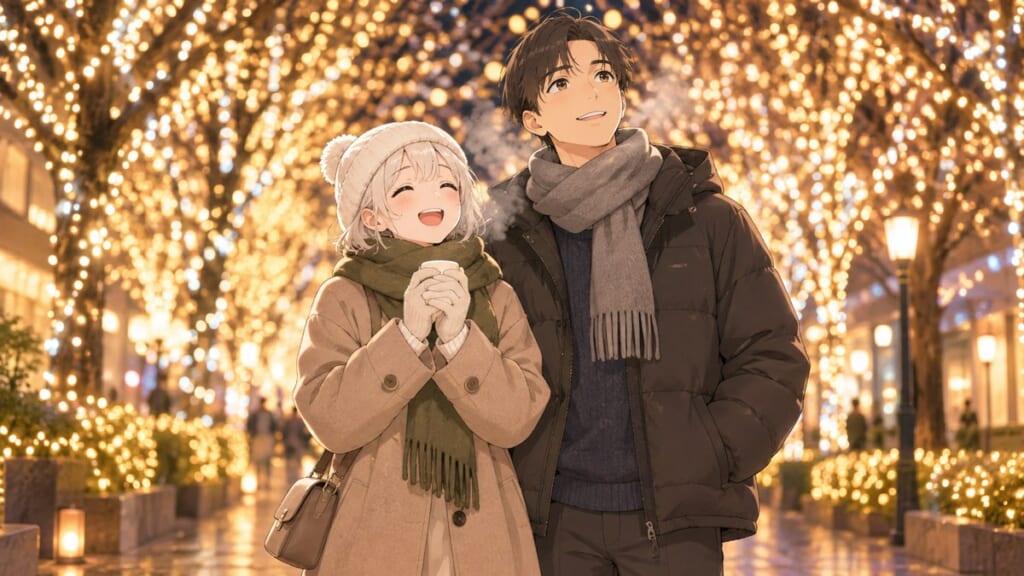
Standing still outside on a December night is a completely different experience from walking briskly through the city. If you’re planning winter illuminations, a countdown, or a New Year’s shrine visit, dress for the waiting rather than just the journey there.
 When I spend time outside for illuminations or New Year’s activities, the things I’m glad to have are a knit hat, hand warmers, gloves, a scarf, and warm socks with suitable shoes. A hat makes a surprisingly big difference for me.
Protect Your Hands, Neck, Head, and Feet
Start with the places that are easy to cover without changing your entire outfit. A scarf, gloves, and knit hat take up less room than an extra bulky sweater, and you can remove them once you’re indoors.
The SIMARI touchscreen winter gloves let you check maps and use your phone without removing your gloves.
SIMARI Touchscreen Winter Gloves
Use maps and your phone camera without taking your gloves off.
Prices change often — please check the latest price on each store.
Hand Warmers for Outdoor Waiting
Disposable hand warmers, commonly called kairo in Japan, are useful to carry for cold outdoor waits. Options include stick-on heat packs and Kiribai Magma non-adhesive warmers; follow the package directions and avoid applying them directly to bare skin.
Stick-On Heat Packs (kairo), 30 pack
Japanese disposable warmers that stick to the inside of your clothes. Outside the US, the Amazon Japan button links to a 90-pack of Hokkairo stick-on warmers.
Prices change often — please check the latest price on each store.
Kiribai Magma Non-Adhesive Warmers
Shake-and-hold warmers for your hands or pockets. This is Kiribai’s extra-hot Magma type, sold here as four 10-packs. For readers outside the US.
Prices change often — please check the latest price on each store.
For more about choosing and using these little winter helpers, see my guide to Japanese winter essentials.
New Year’s Eve and the First Shrine Visit
If you’re going out for New Year’s Eve or hatsumode, the traditional first shrine visit of the new year, prepare for outdoor waiting. A warm coat, hat, gloves, scarf, and comfortable shoes with warm socks form a sensible starting outfit.
Be especially careful about planning your journey back. Some JR lines have operated overnight around New Year’s Eve in previous years, while Tokyo Metro has not always offered overnight services. Check the actual 2026–27 holiday timetable before relying on trains after midnight.
For seasonal business hours, use my guide to what’s open over New Year. If you’re still deciding where to base yourself for the celebrations, my guide to where to stay in Tokyo for New Year’s covers the accommodation side of the trip.
Shoes and Socks for December
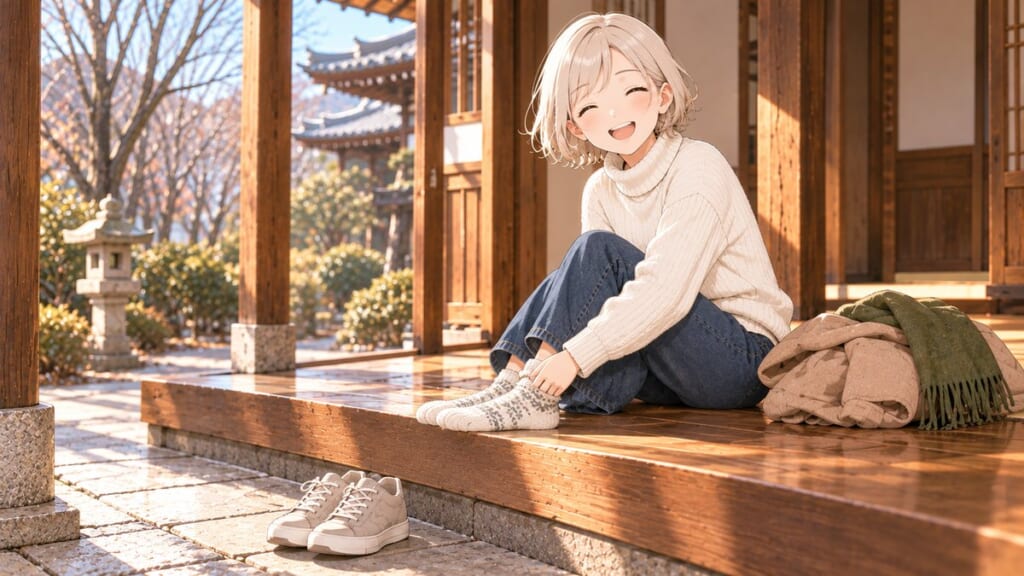
Comfortable walking shoes are more important than fashionable winter boots for an ordinary December city trip. You can spend an entire day moving between stations, shopping streets, gardens, and sightseeing spots without encountering snow at all.
For a 20,000-step sightseeing day, bring walking shoes you’ve already broken in.
Choose Shoes You Can Walk In and Remove Easily
Supportive sneakers or comfortable walking shoes are usually practical for Tokyo, Kyoto, Osaka, and Fukuoka. A pair with some water resistance can be useful on rainy days, especially if you have long outdoor plans.
You’ll sometimes remove your shoes at temples and traditional indoor spaces, so complicated laces or difficult fastenings can become annoying. Shoes that are easy to take off and put back on make those visits simpler.
Warm Socks That Work with Your Shoes
My sock pick for December is Okamoto “Marude Kotatsu” socks for women, with a men’s version also available. They’re thick and warm, so they’re also nice when you take your shoes off at temples. Check their thickness before wearing them with snug walking shoes.
Okamoto “Marude Kotatsu” Socks
My favorite warm socks for December. Thick and cozy, so check the fit with snug shoes. Women’s and men’s sizes. Not sold on Amazon US; Amazon Japan ships them to many countries.
Prices change often — please check the latest price on each store.
And after a long day on your feet, you may want a little time to rest at your hotel. Kyusoku Jikan foot cooling sheets are an optional cooling product for that evening routine, rather than something you need for warmth.
Kyusoku Jikan Foot Cooling Sheets
A cooling sheet for tired feet at the hotel — not for warmth.
Prices change often — please check the latest price on each store.
For more ideas about resting after sightseeing, see my guide to sore feet recovery in Japan.
December in Japan with Kids
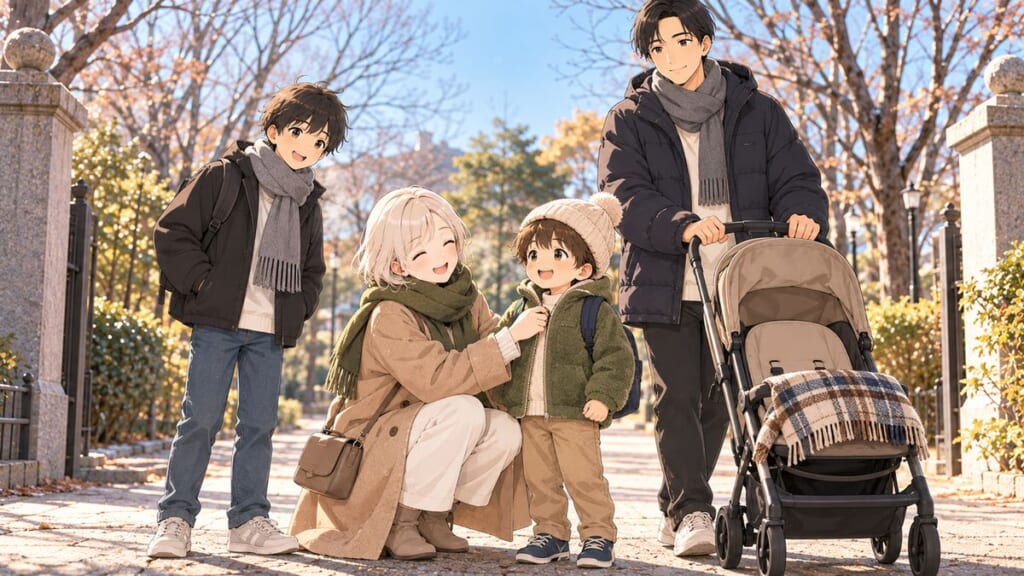
With children, the most useful December outfit isn’t necessarily the thickest one. It’s an outfit you can adjust quickly as they move between cold outdoor air and warm indoor spaces.
When I go out with my 12-year-old and 4-year-old in winter, I dress them in thinner layers so I can add or remove clothing. I’ve had times when a child got sweaty indoors and then felt cold after going back outside.
For December outings with kids, these extras are useful to keep handy:
- Spare clothes and a small towel — I always bring these in case my kids get sweaty indoors
- A mini blanket for a child riding in a stroller
- Gloves and a hat within easy reach
For my younger child, I also think about how much he’ll actually be walking. A child who’s being carried or sitting in a stroller isn’t moving around as much as an adult walking alongside them, so they can get very cold.
This matters particularly at places like USJ or Disney, where a child may spend a long time sitting in a stroller. A small blanket and suitable warm clothing are important for keeping a stroller-riding child comfortable in winter.
For active children, use layers you can remove when they get warm instead of leaving them in one thick outfit all day. That way, you can respond to the weather and the activity rather than trying to predict every temperature change in the morning.
Japan December Packing List
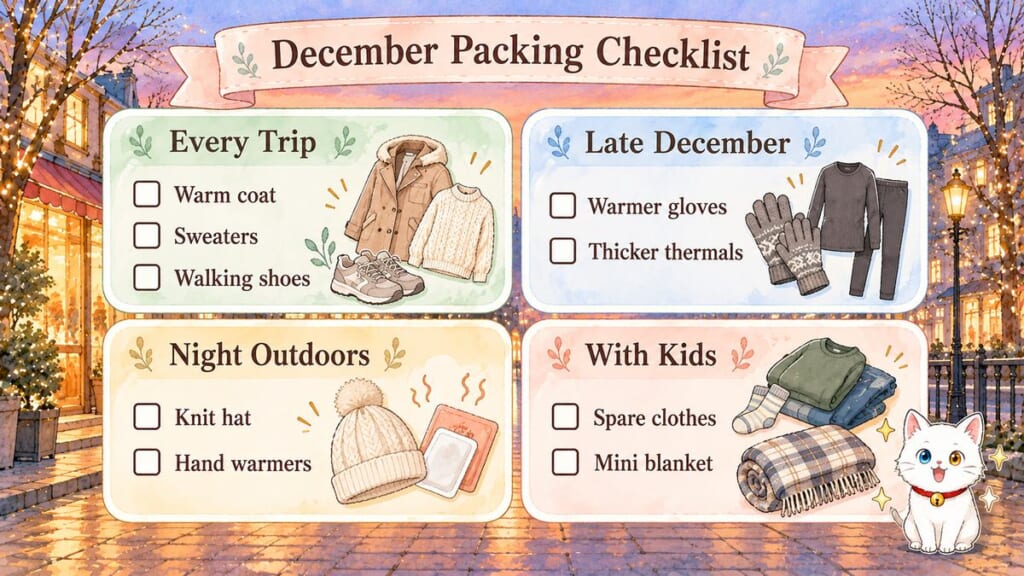
Ready to pack? Use the checklist below as a starting point for a December city trip to Tokyo, Kyoto, Osaka, or Fukuoka. It focuses on clothes you can combine rather than a completely separate outfit for every day.
The quantities are suggestions for a roughly one-week trip with the possibility of doing laundry. Adjust them to your trip length and how often you plan to wash clothes.
Your December Clothing Checklist
| Item | Early December | Late December |
|---|---|---|
| Warm coat | ☐ Bring | ☐ Bring; insulated style preferred |
| Thermal base-layer tops | ☐ 2–3 | ☐ 3–4; consider thicker options |
| Sweaters or warm middle layers | ☐ 2–3 | ☐ 2–3 |
| Long pants | ☐ 2–3 | ☐ 2–3 |
| Comfortable walking shoes | ☐ 1 main pair | ☐ 1 main pair |
| Warm socks | ☐ Several pairs | ☐ Several pairs, including thicker options |
| Scarf | ☐ Bring | ☐ Bring |
| Gloves | ☐ Light or warm pair | ☐ Warm pair |
| Knit hat | ☐ For outdoor evening plans | ☐ Especially useful at night |
| Hand warmers | ☐ Optional for long outdoor waits | ☐ Useful for illuminations and New Year’s |
| Compact umbrella or rain protection | ☐ Check forecast | ☐ Check forecast |
| Bag space for removed layers | ☐ Plan for it | ☐ Plan for it |
Pack for your coldest planned activity rather than each city separately. Add a hat, gloves, scarf, and warmer socks to your daytime outfit for evening events.
Extra Items for Evening Events and Families
For an evening spent outdoors, check that your gloves, scarf, hat, and warm socks are actually in your day bag before you leave. A warm coat alone may not feel sufficient when you’re standing still for an extended time.
For a family trip, add spare clothes and a small towel for children. If your younger child will spend long periods in a stroller, include a mini blanket and suitable extra layers.
Shop the December Packing Essentials
These are the optional products mentioned in this guide, gathered in one place so you can compare them before packing. Start with the clothes you already own and add only what your December plans call for.
| Item | Best For | Where to Buy |
|---|---|---|
|
SIMARI Touchscreen Winter Gloves |
Illumination nights and checking maps outside | |
|
Thermajane Thermal Underwear Set (women’s) |
A base layer under everyday outfits | |
|
Amazon Essentials Packable Down Jacket (women’s) |
An extra warm layer for cold evenings | |
|
Stick-On Heat Packs (kairo) |
Outdoor waits at illuminations and New Year’s | |
|
Kyusoku Jikan Foot Cooling Sheets |
Resting your feet at the hotel after a long day | |
|
Gunze HOTMAGIC Heat-Generating Innerwear |
Japanese thermal tops, leggings and tights (Amazon Japan) | |
|
Kiribai Magma Non-Adhesive Warmers |
Holding in your hands or pockets (Amazon Japan) | |
|
Okamoto “Marude Kotatsu” Socks |
Warm feet on cold days and at temples (Amazon Japan) |
Outside the US? The Amazon Japan buttons are for readers who can’t order from Amazon US. Check delivery to your country before ordering.
If you’re ordering from Amazon Japan for delivery overseas, order early. International shipments placed from mid-December onward may not arrive before the end of the year.
For the rest of your trip preparation, including the practical steps beyond clothing, see my Japan trip planning guide.
FAQ
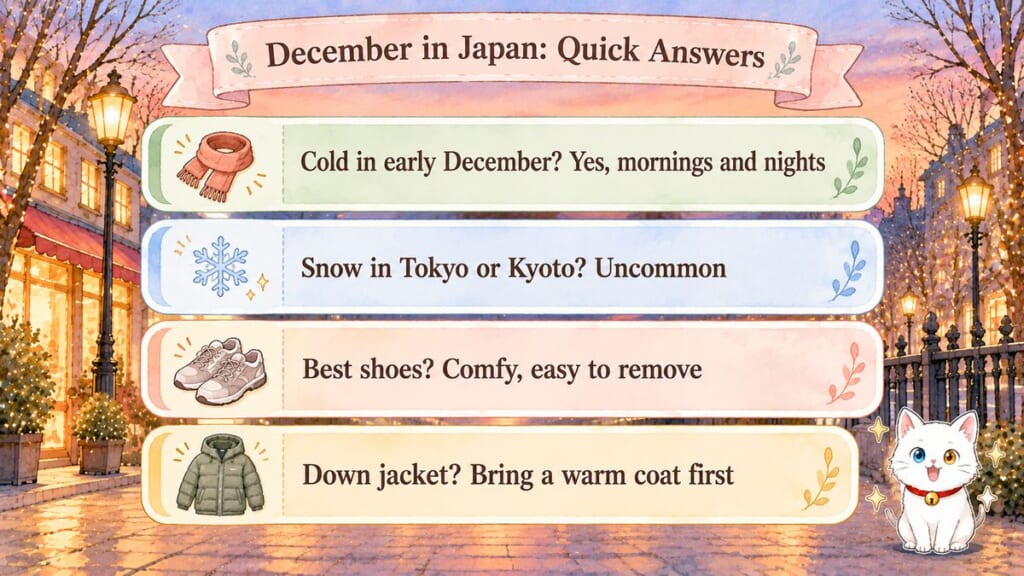
Is it cold in Japan in early December?
Yes, early December can feel cold, especially in the morning and evening, even when daytime sightseeing is comfortable. For Tokyo, Kyoto, Osaka, and Fukuoka, a warm coat, sweater, and adjustable layers are a good starting point.
Does it snow in Tokyo or Kyoto in December?
Snow accumulation in central Tokyo and Kyoto is uncommon in December, although Kyoto can occasionally have snowflakes. You generally don’t need snow boots for a typical city trip, but check the forecast if you’re heading into mountain areas.
What shoes should I wear in Japan in December?
Comfortable, already-broken-in walking shoes are the practical choice for most December city sightseeing. Choose a pair that works with warm socks, handles your expected walking distance, and is easy to remove when visiting places that require it.
Should I bring a down jacket or buy one in Japan?
Bring a warm coat that works for your first day, and consider a down jacket if you’ll spend long periods outdoors in colder weather. UNIQLO sells seasonal outerwear in Japan, including Ultra Light Down and PUFFTECH styles, so shopping after arrival is an option if you have time and can find the right fit.
Final Thoughts: What to Wear in Japan in December
A December suitcase for Japan doesn’t need to be filled with heavy winter clothing. A warm coat, comfortable shoes, and layers you can remove will take you through most ordinary city sightseeing, while a hat, gloves, scarf, and warm socks cover those colder evening plans.
If your trip continues into January or February, or you’re visiting snowy regions, What to Wear in Japan in Winter will help you plan for those different conditions.
Are you visiting Japan in early December or closer to New Year’s Eve? Tell me which cities you’re planning to explore — I’d love to hear what’s going into your suitcase.
I hope this guide has answered one of your questions and helped you feel a little closer to Japan.
May your Japan journey be filled with wonderful discoveries and memories you’ll treasure for years to come.
See you in the next guide.

Comments