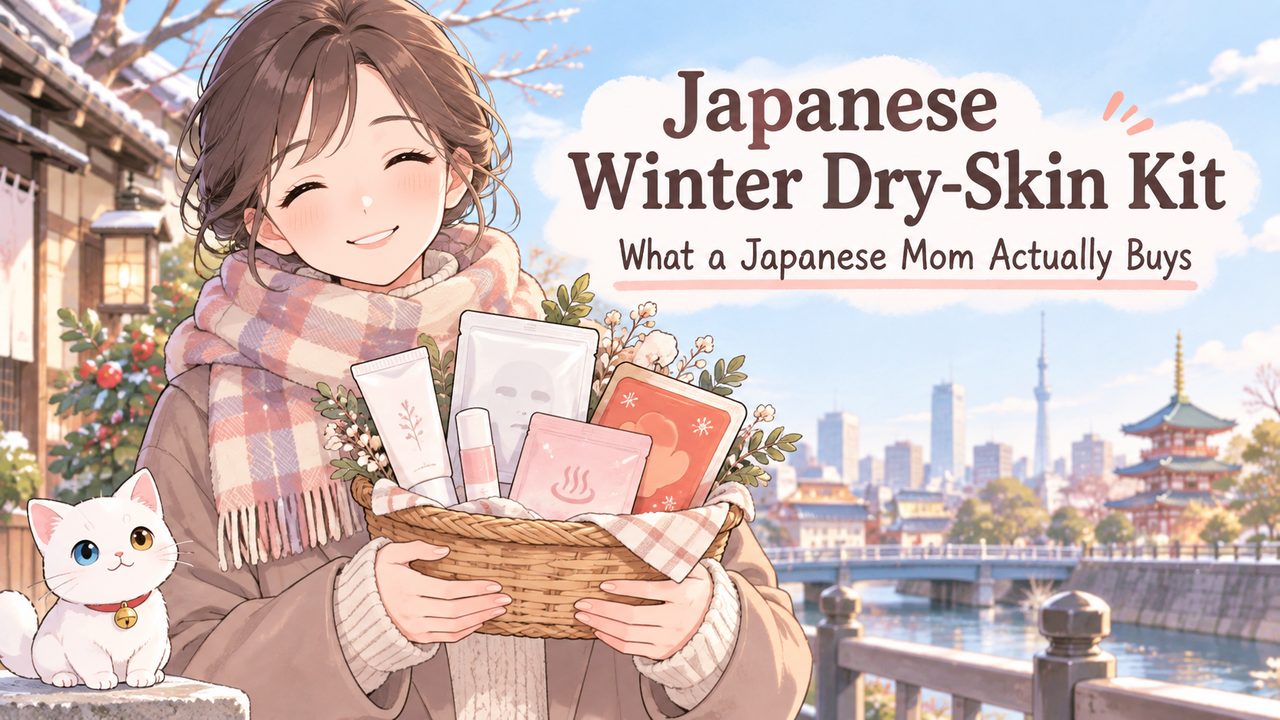
Japan’s winter dryness can sneak up on you after a few days of traveling. Think of your winter kit in five parts: hands, lips, nighttime moisture around your mouth, bath time, and warmth.
What I actually use every winter is simple: the blue tin of Nivea Creme, which I also use on my hands, a Nivea lip balm, Nodonuru wet masks for sleep, bath products, and heat packs. You do not need everything in this guide — choose one item for the part of you that gets dry first.
I’ll also show you which products can be ordered from outside Japan and which ones are better treated as a drugstore find once you arrive.

- Why Japan Dries You Out in Winter
- My Winter Kit at a Glance
- Hands 1: The Everyday Tubes
- Hands 2: When Your Hands Get Rough and Tough
- The Blue Tin: Nivea Creme in Japan
- Lips: Two Kinds, Day and Night
- The Japanese Wet Mask for Sleeping
- The Bath Is the Real Heater
- Heels and Feet
- Kairo: Japan’s Stick-On Heat Packs
- Where to Buy: At Home vs in Japan
- FAQ
- Final Thoughts
Why Japan Dries You Out in Winter

 You may notice it first on the backs of your hands — that tight, slightly prickly feeling after a day outside. Then your lips start peeling, and one morning you wake up in your hotel with your throat feeling dry.
Heating is one reason. Air conditioners commonly used for heating in Japanese hotels and homes warm the air, which can leave the room feeling dry. Many popular destinations on the Pacific side of Japan, including Tokyo, Kyoto, and Osaka, also tend to have clearer, less rainy winter weather.
By November, it is worth thinking about dryness at the same time you think about what to wear. If that is when you are traveling, see my November clothing guide too.
Japanese drugstores also start shifting their shelves for the season. Hand creams, lip balms, bath products, and heat packs begin taking up more space, so the easiest approach is not to buy everything — just pick one item for each problem you actually have.
My Winter Kit at a Glance
Disclosure: This article contains affiliate links. If you buy through one, I may earn a small commission at no extra cost to you.
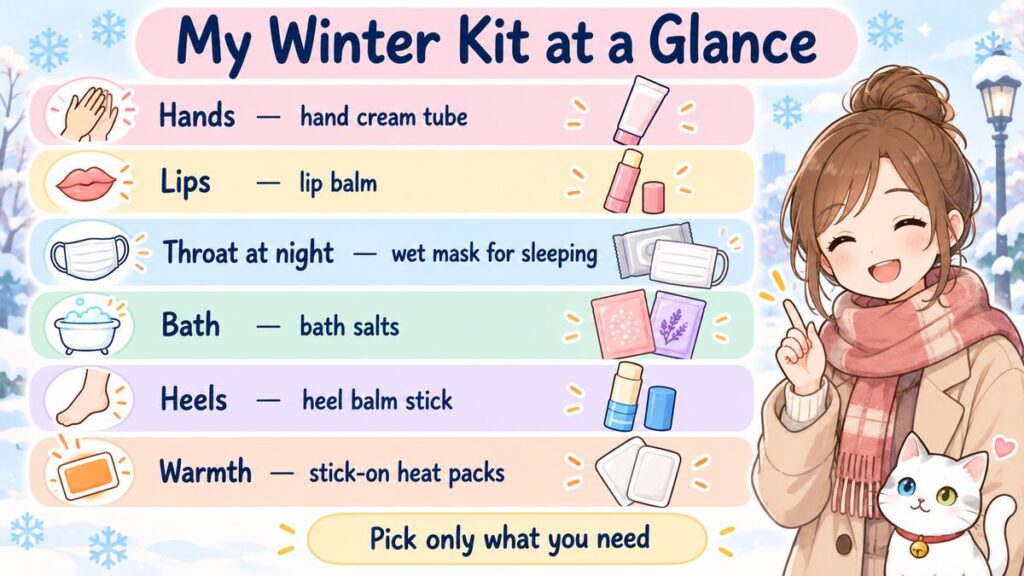
 If you want the short version, start here. These are approximate Japanese retail prices as of September 2026. Dollar amounts are shown only as a guide, converted at about ¥148 = $1 (September 2026).
| Part of you | What to buy | Japan price | Where to buy |
|---|---|---|---|
| Hands — everyday | Atrix Beauty Charge 80g | ¥540–580 (about $4) | Ships worldwide |
| Hands — rough and tough | Keratinamin Kowa 20% Urea Cream 60g | ¥930–1,020 (about $6–7) | Ships worldwide |
| Face & everything | Nivea Creme, large blue tin 169g | ¥630–660 (about $4) | Buy in Japan |
| Lips | Nivea Deep Moisture Lip 2.2g | ¥450–580 (about $3–4) | Ships worldwide |
| Throat at night | Nodonuru wet mask for sleep, 3-set pack | ¥370–440 (about $3) | Ships worldwide |
| Bath | HERS Bath Labo, bottle 500–540g | ¥263–265 (about $2) | Ships worldwide |
| Heels | Nameraka Kakato heel stick 30g | ¥640–750 (about $4–5) | Ships worldwide |
| Warmth | Kiribai stick-on heat pads, 10-pack | ¥420–490 (about $3) | Buy in Japan |
Prices vary by store. These are approximate prices as of September 2026.
You do not need to buy all of these. Choose only what matches the parts of you that get dry.
If you also want to browse Japanese skincare while you are at the drugstore, see my Japanese drugstore skincare guide.
Hands 1: The Everyday Tubes
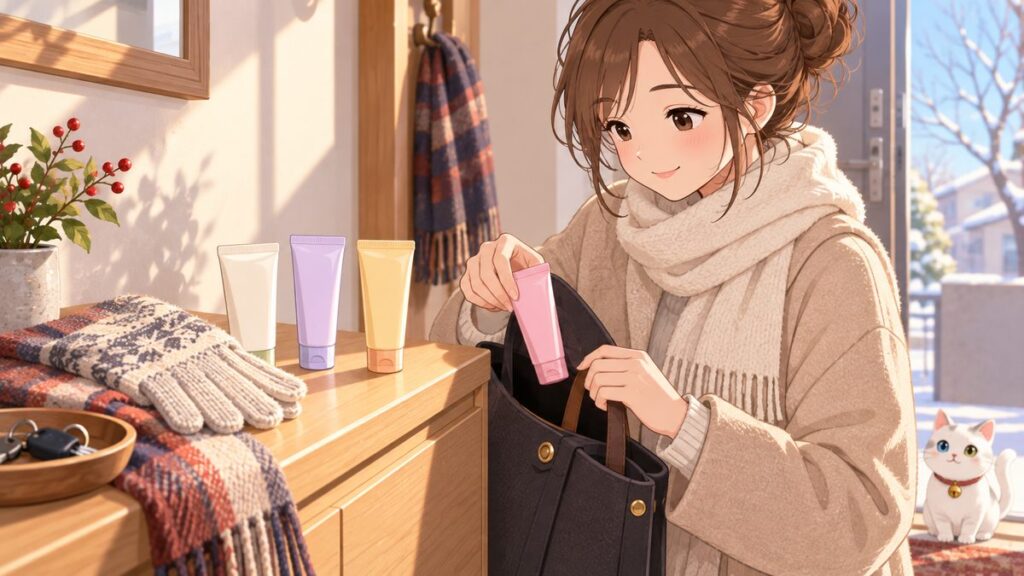
If you want something to carry every day, a tube is the easiest place to start. Atrix Beauty Charge is an 80g tube that costs around ¥540–580 (about $4), making it easy to keep in a bag and apply before you head out or whenever your hands start feeling dry.
 There is one detail to watch for when buying Atrix outside Japan. Atrix is a Kao product in Japan, while products under the same Atrix name are also sold overseas as a separate German-made range. If you specifically want the Japanese version, look for Kao and “Beauty Charge” on the product.
That does not make one version better than the other — they are simply different products sold under the same brand name.
Yuskin is another option you will often see in Japan. The 30g hand cream tube is around ¥510–600 (about $3–4), and a tube format is convenient for reapplying after washing your hands or doing dishes.
Curél hand cream comes in a 50g tube at around ¥1,100 (about $7). If you want this particular Japanese product, look for it while you are in Japan. For any hand cream, fragrance and texture are personal, so check the package and choose the one you will actually be comfortable using several times a day.
Hands 2: When Your Hands Get Rough and Tough
When winter dryness and repeated handwashing leave your hands feeling rough and tough — but the skin has not cracked — one Japanese drugstore option is Keratinamin Kowa 20% Urea Cream. The 30g size is around ¥460–500 (about $3), while the 60g size is around ¥930–1,020 (about $6–7).
 There are two important limits. This cream is for ages 15 and up, so do not use it on children. It is also not for hands that are already cracked or bleeding.
The manufacturer has separate products designed for cracked skin. If your hands are already split or bleeding, ask at the medicine counter in a Japanese drugstore instead of choosing the urea cream on your own.
Yuskin is another familiar choice in Japan for rough, dry hands. The larger 120g tube costs around ¥1,078 (about $7). The current Japanese package simply says “Yuskin” — it does not have the “A” that you may see in the name overseas.
Yuskin can feel a little sticky, and it has a noticeable scent. For a richer cream like this, nighttime is an easy time to use it, and wearing gloves afterward can make the routine more comfortable while you sleep.
In the United States, the same company also sells an overseas line called Yu-Be. I would not assume the formula is exactly the same as Japanese Yuskin, so think of it as the same company’s overseas line rather than an identical replacement.
The Blue Tin: Nivea Creme in Japan
 My hand cream in winter is actually this blue tin. I use Japanese Nivea Creme on my hands, and I also like that the same tin can be used on other dry areas such as the face or feet.
The large blue tin is 169g and usually around ¥630–660 (about $4). The medium tin is 56g and around ¥270 (about $2). You will often see the familiar blue tins in Japanese drugstores during winter.
You may already know Nivea from your own country, but the container and the feel of the product can vary depending on where it is sold. I am not saying the Japanese version is better. For me, this is simply one of those everyday Japanese drugstore items that is fun to pick up while you are here.
Lips: Two Kinds, Day and Night
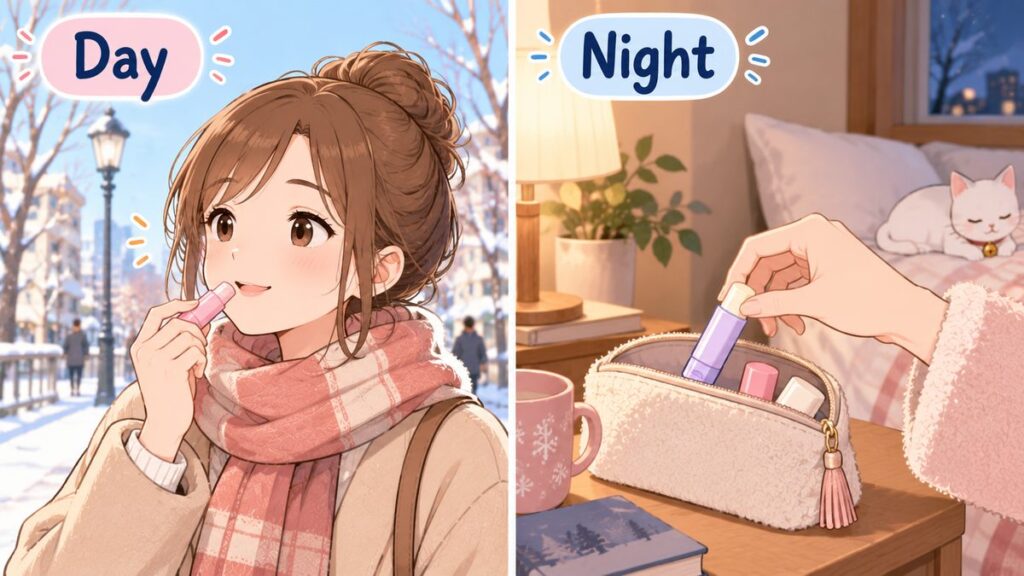
I use a Nivea lip balm in winter. If you want a specific Japanese option that can also be ordered from outside Japan, Nivea Deep Moisture Lip is 2.2g and around ¥450–580 (about $3–4).
For daytime, especially when you will be walking outside, Melty Cream Lip in the fragrance-free SPF25 version is another useful option. It is 2.4g and around ¥460–540 (about $3–4). Winter days still include plenty of time outdoors, so an SPF lip product can make sense when you want sun protection as part of your daytime routine.
For nighttime, DHC Medicated Lip Cream is another common Japanese drugstore choice. The 1.5g tube is around ¥760–770 (about $5), and its slim shape makes it easy to keep beside your bed or in a travel pouch.
These are moisturizers, not a promise to fix damaged lips. Pick the texture and timing that suit your routine: your regular lip balm, an SPF option for daytime, or a simple balm before bed.
The Japanese Wet Mask for Sleeping
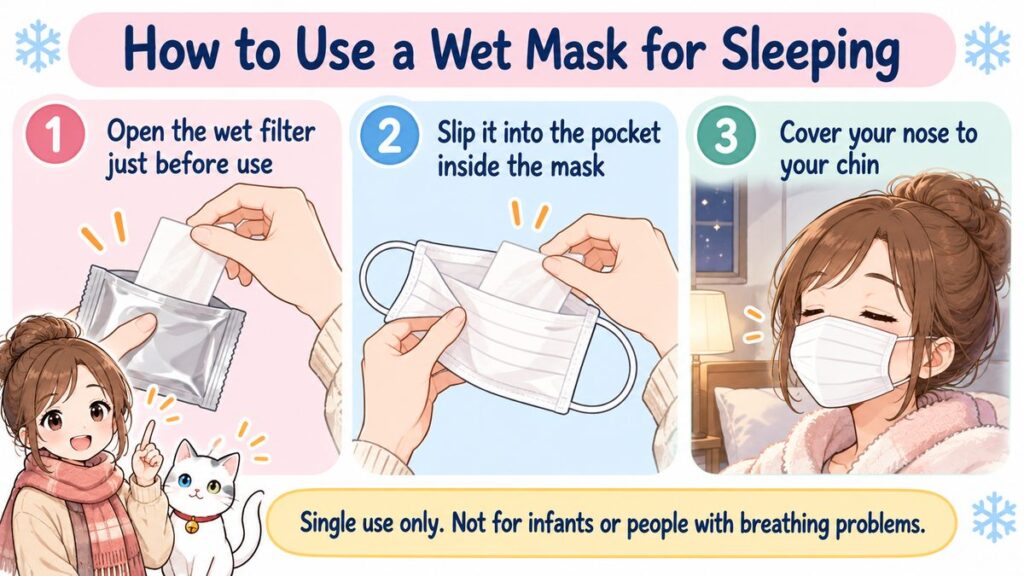
 One winter product I actually use every year — and one I especially want travelers to know about — is Nodonuru wet mask for sleep. It is a disposable sleeping mask with a pocket inside for a moisture-filled “wet filter,” which keeps the air around your mouth damp while you sleep.
That makes it practical for a heated hotel room when you do not want to travel with a humidifier. Using one from your first night in Japan is an easy way to build moisture into your bedtime routine.
- Take the wet filter out of its aluminum pouch immediately before use and place it in the pocket inside the mask. The filter is already wet, so you do not need to add water.
- Fit the nose wire to your nose and wear the mask so it covers from your nose down to your chin.
- Use both the mask and the wet filter once, then discard them. Do not reuse them.
There is also an important safety warning: do not use this product on infants or on people with respiratory abnormalities. Because many A Little Japan readers travel with children, I would not treat this as a child’s winter-dryness product.
The sleeping version comes in pleated and three-dimensional styles. The pleated 3-set pack covered here contains three masks and three wet filters and costs around ¥370–440 (about $3).
This is not medicine. Its job here is simply to keep the air around your mouth damp and make the nighttime environment feel less dry.
The Bath Is the Real Heater

 In many Japanese homes, a winter bath is not just about getting clean. It is also the time to warm your body thoroughly and reset after spending the day in dry winter air before you head to bed.
If you want something you can order from outside Japan, HERS Bath Labo is one option. The bottles are 500g or 540g depending on the fragrance, and the approximate Japanese retail price is ¥263–265 (about $2).
If you are shopping in Japan, Kikiyu is easy to try without committing to a full bottle. The 360g bottle costs around ¥660–720 (about $4–5), while a 30g single sachet is ¥99 (about $0.70).
Bub Medicure is another product to buy in Japan. A 6-tablet pack is around ¥590–860 (about $4–6), with the price varying by fragrance. When bath products carry claims about things such as stiff shoulders or feeling cold, I treat those as the product’s own labeled uses rather than promising that the bath additive itself will fix those problems.
If you are planning to warm up in an actual Japanese hot spring instead, read my Japanese onsen guide before you go.
Heels and Feet
Dry winter heels can be easy to ignore until your socks start catching on them. Travelers also tend to spend long days walking, so once your heels get very dry, you may notice them more than you would at home.
For this category, I would keep it simple and choose one product: Nameraka Kakato heel stick by Kobayashi Pharmaceutical. The 30g stick costs around ¥640–750 (about $4–5).
The stick format lets you apply it without getting cream all over your hands. A simple routine is to apply it to your heels at night and then put on socks.
If the bigger problem is tired feet from walking all day rather than dry heels, treat that as a separate issue. I have a full guide to recovering from sore feet in Japan.
Kairo: Japan’s Stick-On Heat Packs
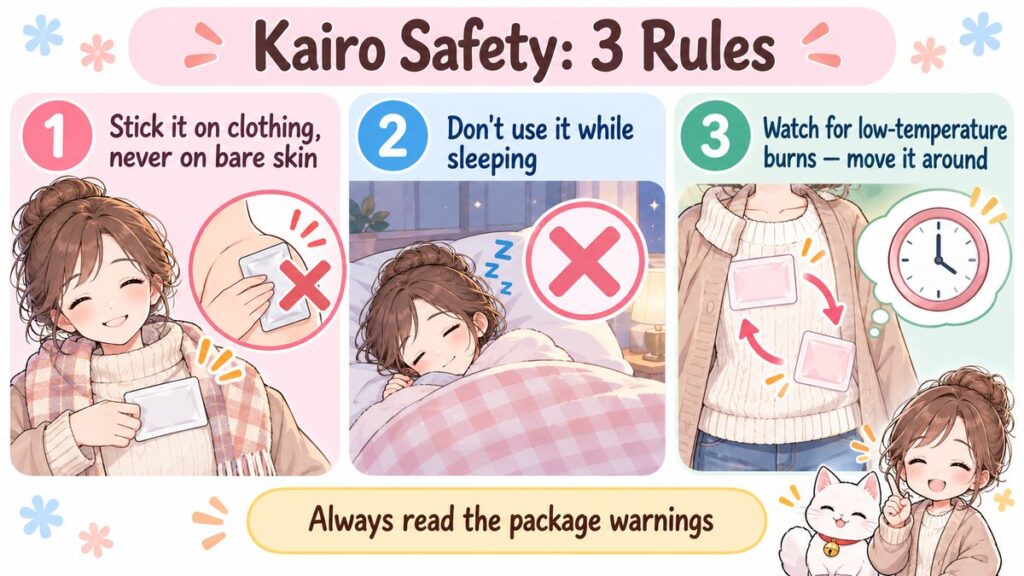
Japanese drugstores sell several kinds of kairo for winter. Kiribai stick-on heat pads attach to the outside of your clothing, while non-stick types can be held in your hand or kept in a pocket — the pocket-style Kiribai hand warmers also ship worldwide. There are also versions designed for shoes.
For something reusable, Azuki no Chikara for the neck and shoulders is warmed in a microwave instead. One costs around ¥1,780–1,980 (about $12–13).
Kiribai stick-on heat pads are around ¥420–490 (about $3) for a 10-pack and ¥999–1,298 (about $7–9) for a 30-pack.
Heat packs need careful use. Do not stick them directly to your skin — place them over clothing. Do not use them while sleeping. Children and older adults need particular care with low-temperature burns, so do not keep a heat pack against the same spot for a long time. Read the warnings on the package too, because the wording varies by manufacturer.
I cover kairo in more detail as part of winter clothing, so continue with my Japan winter clothing guide if you are packing for cold weather.
If you plan to take heat packs on a flight, check your airline’s rules.
Where to Buy: At Home vs in Japan
If you want to prepare before your trip, several of these Japanese products can be ordered from outside Japan. Others make more sense as things to look for once you are standing in a Japanese drugstore.
| Ships worldwide | Buy in Japan |
|---|---|
| Atrix Beauty Charge, Japanese version | Nivea Creme, blue tin |
| Yuskin | Curél hand cream |
| Keratinamin Kowa 20% Urea Cream | Kikiyu |
| Melty Cream Lip, fragrance-free SPF25 | Bub Medicure |
| DHC Medicated Lip Cream | Kiribai stick-on heat pads |
| Nivea Deep Moisture Lip | |
| Nodonuru wet mask for sleep | |
| HERS Bath Labo | |
| Nameraka Kakato heel stick | |
| Kiribai pocket-style kairo (non-stick) | |
| Azuki no Chikara, neck & shoulder |
If you are ordering from home, there are stores that sell the Japanese versions themselves. Check shipping fees and estimated delivery time with the store before ordering.
 In Japan, look for drugstores such as Matsumoto Kiyoshi, Sundrug, and Cocokara Fine. In the colder months, you will often see seasonal dryness products grouped near the front of the store or in a dedicated winter section.
If you are buying several items at once, you may also want to check whether your purchase qualifies for tax-free shopping. The rules depend on the purchase, so use my Japan tax-free shopping guide rather than assuming a product will qualify.
And if you are already back home but still want Japanese products or gifts, my Japanese gift guide has more ideas that do not require another trip to Japan.
FAQ
Is the Japanese version different from the one sold in my country?
Sometimes. Atrix is one example: the Japanese Kao Beauty Charge range and German-made Atrix products sold overseas are separate product lines under the same brand name. If you specifically want the Japanese one, look for Kao and “Beauty Charge.”
Japanese Yuskin packaging now simply says “Yuskin.” In the United States, the same company also sells its overseas line as Yu-Be, but I would not assume the contents are exactly identical to Japanese Yuskin.
Can I buy these at a convenience store?
You will often find things like lip balm and kairo at convenience stores, although the selection varies from store to store.
If you want a wider choice of bath products or a 20% urea cream, a drugstore is the better place to look.
Can I use urea cream on my kids?
The Keratinamin Kowa 20% Urea Cream in this guide is for ages 15 and up. For a child’s hands, choose something at the drugstore that is specifically labeled for children.
Do I need a humidifier in my hotel room?
Many Japanese hotels have a humidifier in the room or offer one to borrow, so check your hotel’s amenities first. If there is not one, a wet mask for sleeping and a warm bath can be simple additions to your nighttime routine without carrying a humidifier with you.
When do Japanese drugstores start selling winter items?
From around October into November, more drugstores begin setting up seasonal sections for hand creams, lip products, kairo, and other winter items. The timing varies by store and area.
If you plan to buy several products while you are in Japan, check the current tax-free shopping rules here: Japan tax-free shopping guide.
Final Thoughts

You do not need a giant Japanese winter-care haul. If your hands get dry, add one hand cream. If it is your lips, bring one lip balm. If heated hotel rooms make nighttime feel dry, a wet mask may be the one item worth adding.
What I really use each winter is just as straightforward: the blue tin of Nivea Creme, including on my hands, a Nivea lip balm, Nodonuru wet masks, bath products, and kairo. Start with the place that gets dry first, then add something only if you need it.
Check the Nodonuru wet mask for sleep (ships worldwide)
What do you use for dry skin in winter where you live? Tell me in the comments below — I read every single one!
I hope this guide has answered one of your questions and helped you feel a little closer to Japan. May your Japan journey be filled with wonderful discoveries and memories you’ll treasure for years to come.
See you in the next guide.

What to Read Next
Japanese Drugstore Skincare: What to Buy and Real Prices


Comments