Your feet are tired, your hotel has a bathtub, and you’ve just found a whole shelf of colorful Japanese bath salts. Tablets that fizz, powders named after hot springs, little packets that promise a fragrant bath — where do you even start?
In my home in Japan, we take a bath every evening, and Kao’s Bub tablets are what I usually reach for, especially on a tiring day. You don’t need a dozen varieties. Just pick one that suits your evening.
As an Amazon Associate, I earn from qualifying purchases.
My quick picks:


For a tired evening: Bub Full Herb, 12 tablets (Amazon US)


For a hot-spring atmosphere: Yunohana Gift Box, 250g (Amazon US)


For a citrus-scented bath: Yuzu Bath Salt, 600g (Amazon US)
 For a milky bath: Bub Milky, 20 tablets (Amazon Japan)For a box of different Bub tablets: Bub 60-tablet assortment (Amazon Japan)
 For dry winter skin: HERS Bath Labo (Amazon Japan)
One quick warning before you fill the tub: not every hotel allows bath additives, and a Japanese bath tablet may require more water than your bathtub holds. I’ll help you check both before you open the package.

- Do Japanese People Really Use Bath Salts?
- Quick Picks: Which Bath Salt for Which Purpose?
- Before You Buy: 3 Quick Checks
- For Tired Legs: Carbonated Bath Tablets (Bub)
- Onsen Feeling at Home: Hot Spring Powders
- For Scent and a Slow Evening: Yuzu Baths
- For Dry Winter Skin: Moisturizing Bath Additives
- Where to Buy in Japan: Drugstores & More
- Ordering From Home: What Ships, What to Watch
- FAQ
- Final Thoughts
Do Japanese People Really Use Bath Salts?
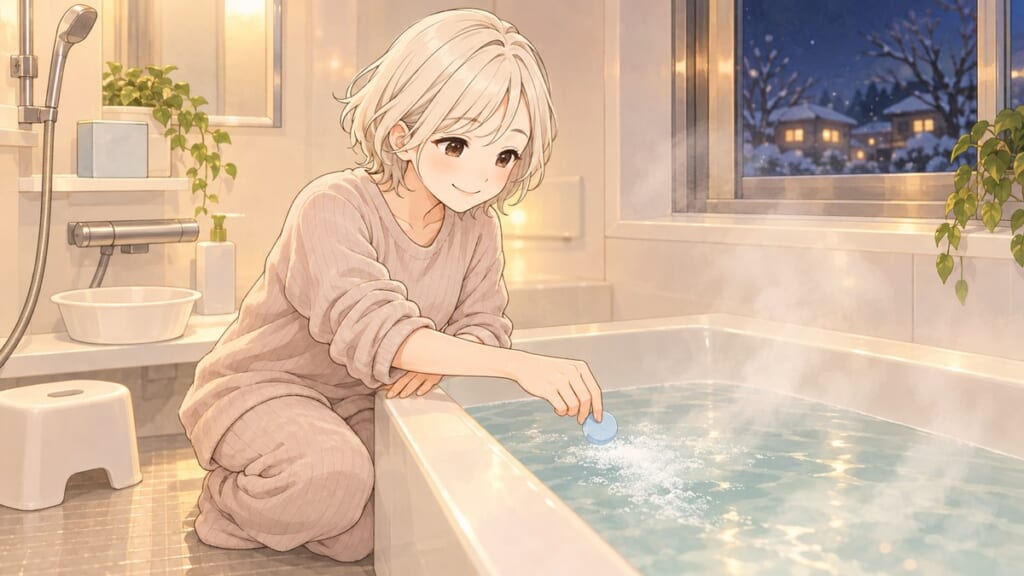
Yes. Bath additives are a familiar part of bathing at home in Japan. They’re called nyuyokuzai (入浴剤), and you’ll see them in drugstores, supermarkets, and other everyday shops.
In my family, we take baths every evening. I usually use Kao’s Bub, including on days when I’m tired, but we also enjoy bubble baths. My four-year-old son bathes with me and loves watching the water change color or fill with bubbles.
 Japanese “bath salts” aren’t always made from salt. Some are carbonated tablets, some are powders, and others contain moisturizing ingredients. You’ll also see famous hot-spring names on the packaging — those are bath additives inspired by the atmosphere of that area, not a replacement for bathing in a real spring.
If you’re curious about real Japanese hot springs, I’ve written separate guides for that.
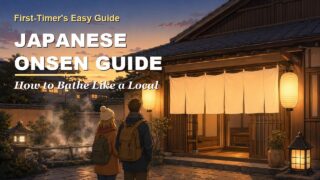
Japanese Onsen Guide for First-Timers
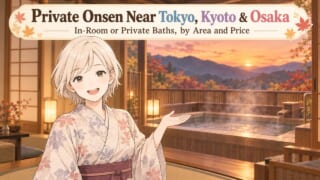
Private Onsen Near Tokyo, Kyoto & Osaka
And if you only take showers, this probably isn’t the shopping guide for you. These products are made for soaking in a bathtub.
Quick Picks: Which Bath Salt for Which Purpose?
Start with what you want from your bath tonight, then check the product’s form and directions.
| Your purpose | Product | Form | Use with children? | Where to buy |
|---|---|---|---|---|
| A bath after a tiring day |
|
Fizzing tablets | Check the box | Amazon US |
| A milky bath |
|
Cloudy fizzing tablets | See Kao’s baby-bath guidance | Japan stores / Amazon Japan |
| Different Bub varieties in one box |
|
Fizzing tablets | Check each variety’s label | Japan stores / Amazon Japan |
| A hot-spring atmosphere |
|
Natural mineral powder | Check the box | Amazon US |
| A cloudy, hot-spring-style bath |
  |
Cloudy bath powders (15 scents) | Check the box | Amazon US |
| Hot-spring destination names |
 |
Bath powders | Check the box | Japan stores / Amazon Japan |
| A yuzu-scented evening |
|
Bath powder | Check the box | Amazon US |
| Dry winter skin |
|
Bath powder (bottle) | Check the box | Japan stores / Amazon Japan |
 My simplest suggestion: choose Bub if you want the classic fizzing tablet, a hot-spring powder if atmosphere matters most, or yuzu if you’re mainly after a pleasant scent.
Before You Buy: 3 Quick Checks
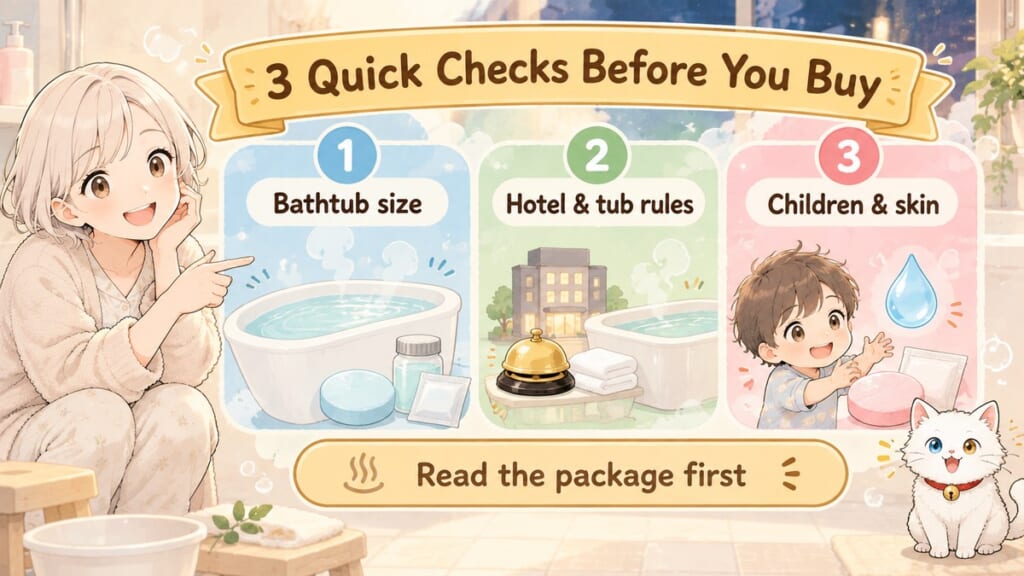
There are three things I’d check before putting a bath additive in my basket — especially when traveling with children.
1. Is your bathtub the right size?
For standard Kao Bub tablets, the guidance is one tablet for about 150–200 liters of bathwater (about 40–53 US gallons). So check your hotel’s bathtub size before using one.
 I wouldn’t break a tablet into pieces to reduce the dose. Choose a product whose directions suit your bathtub instead, and follow the amount on the package. Powders have their own directions too — a large container isn’t meant to go into one bath.
Official source: Kao — Bub FAQ (in Japanese)
2. Does the hotel or bathtub allow it?
Having a bathtub in your hotel room doesn’t automatically mean bath salts are allowed. Before using anything that colors the water, foams, or leaves residue, check the property’s rules or ask the front desk: “Are bath additives allowed in the guest-room bathtub?”
Curious why many Japanese families share the same bathwater? I explain the wash-first routine in my guide to why Japanese families fill the bathtub every night.
The tub itself matters too. Kao says Bub shouldn’t be used in natural marble tubs (artificial marble is fine). If a bathtub’s manual says no cloudy or foaming bath additives, don’t use them. Kao also advises against adding Bub while the water is being reheated or right afterward, because the gas can enter the circulation system and cause a malfunction. After cloudy types, rinse the tub and the circulation filter.
If the answer is unclear, enjoy a plain bath and take your unopened box home.
3. What about children and sensitive skin?
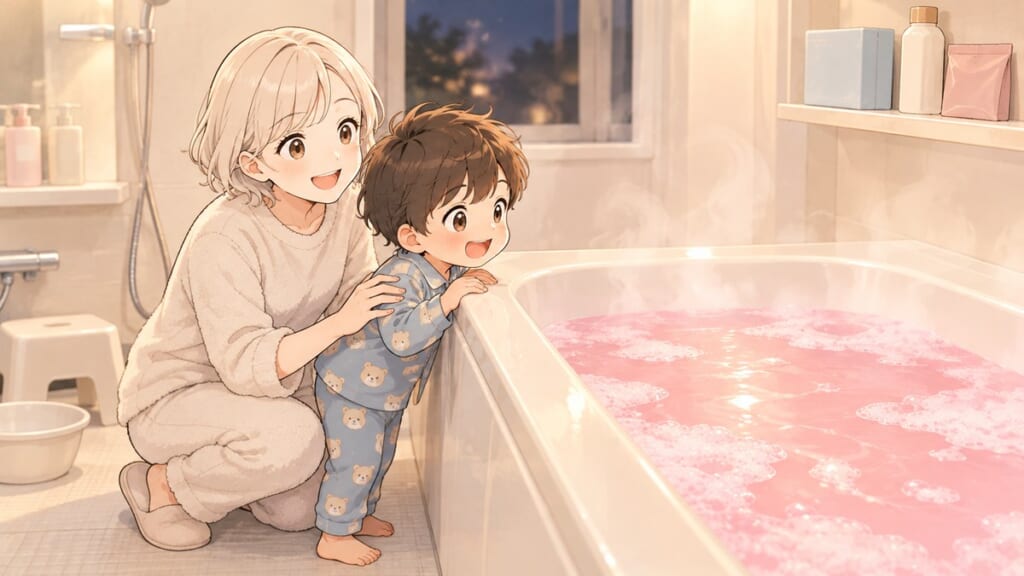
My four-year-old enjoys colorful bathwater and bubbles with me, but that’s our family’s experience, not a safety promise for every child or every product.
Kao’s guidance is that babies can share a Bub bath once they’re ready to bathe with an adult (it suggests checking at the one-month checkup), with lukewarm water, shorter baths, and care around slippery floors. For young children, Kao recommends choosing products specifically labeled as suitable for bathing with babies, rather than assuming strongly fizzing or fragrant varieties are suitable.
 Keep tablets and powders out of children’s reach so no one puts them in their mouth. And don’t hold a fizzing tablet close to your face, as the gas may make you cough.
If you have sensitive skin, check the ingredients and warnings on the exact product rather than relying on words like “gentle” or “herbal.”
For Tired Legs: Carbonated Bath Tablets (Bub)
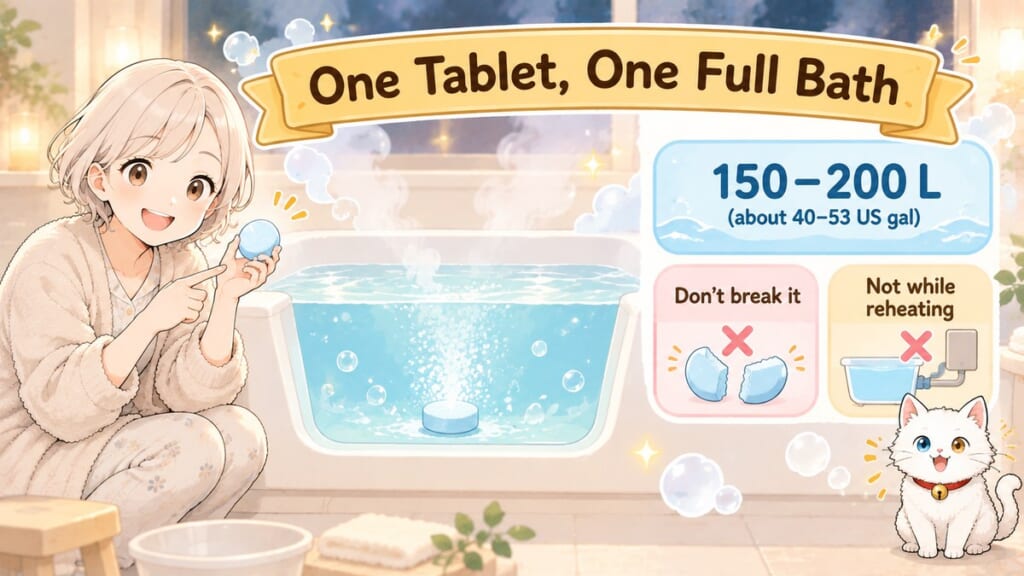
 After a long day of sightseeing, a warm bath is one of the best parts of the evening. At home, Bub is what I choose when I’m tired.
Bub is Kao’s fizzy bath tablet. You drop a tablet into the bathwater, let it dissolve, and then get in.
Bub Full Herb: An easy start from home
Bub Full Herb, 12 tablets is the Bub I’d order if you don’t want to shop in Japan. It’s a 12-tablet box with herbal scents, a simple way to try the classic fizzing tablet. The box is in Japanese, so follow the dosage on the package.
Kao Bub Full Herb, 12 tablets
The classic fizzing tablet in herbal scents. Sold by a third-party seller and shipped by Amazon; the box is in Japanese.
Prices change often — please check the latest price on each store.
Bub Milky: For a cloudy bath
Bub Milky, 20 tablets is the one to pick if you like milky bathwater.
It’s a medicated bath additive (a “quasi-drug” in Japan). Kao’s label says the carbonation boosts the warming effect of the bath and promotes blood circulation, helping with fatigue recovery. That’s the label’s claim, not a promise for every bath. Use one tablet in 150–200 liters of water and wait until it has fully dissolved before getting in.
Kao Bub Milky, 20 tablets
Milky, cloudy bathwater. Sold and shipped by Amazon.co.jp, which showed US delivery in our October 2026 check.
Prices change often — please check the latest price on each store.
Bub 60-tablet assortment: For variety
Bub 60-tablet assortment suits you if you want a big box for home rather than one night’s bath. Check the varieties in the listing, especially if you bathe with children.
Kao Bub 60-tablet assortment
A big box of five Bub scents for home. Sold and shipped by Amazon.co.jp.
Prices change often — please check the latest price on each store.
A bath additive is just one part of an evening after sightseeing. For a full routine for tired feet and legs, see my separate guide.

Sore Feet in Japan? The $10 Hotel Recovery Routine
Onsen Feeling at Home: Hot Spring Powders
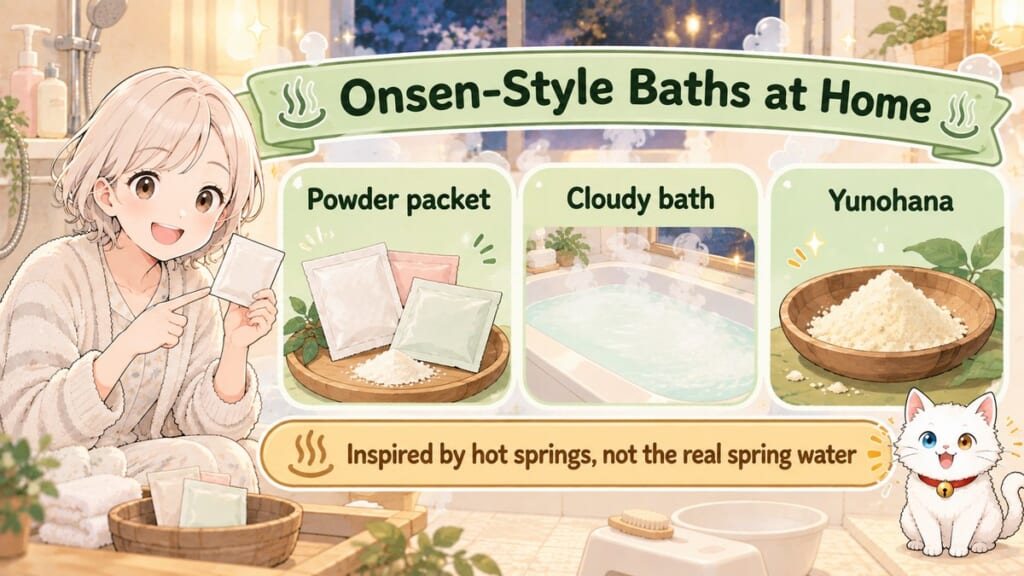
Want a little Japanese hot-spring atmosphere in your bathroom? Look for bath powders named after famous onsen areas, or yunohana. Just remember that a powder with an onsen name isn’t the same as bathing in that spring.
Tabi no Yado and Nihon no Meito: Onsen-name packets
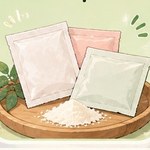
Tabi no Yado and Nihon no Meito are names to look for on the hot-spring shelf of Japanese drugstores. Each packet carries the name of a hot-spring area, so you can pick a different “destination” each evening.
Nihon no Meito is a medicated bath additive, and its box notes that it isn’t exactly the same as a real hot spring — a good reminder for every hot-spring-themed product.
Bathclin Tabi no Yado assortment, 24 packets
Clear bath powders in 4 hot-spring types (12 packets × 2). Sold and shipped by Amazon.co.jp.
Prices change often — please check the latest price on each store.
Bathclin Nihon no Meito, 14 cloudy packets
Cloudy, milky bath powders inspired by 14 hot-spring areas. Sold and shipped by Amazon.co.jp.
Prices change often — please check the latest price on each store.
Yunohana Gift Box: A natural mineral powder
Yunohana Gift Box, 250g is listed on Amazon US as a natural mineral bath powder from Okuhida Onsen, a hot-spring area in the mountains of Gifu.
Yunohana means “hot-spring flowers,” the mineral deposits that form around hot springs. Its composition differs from regular bath additives, so check the listing’s directions and warnings for bathtubs and reheating systems before you use it.
Yunohana Gift Box, 250g
Natural mineral bath powder from Okuhida Onsen. Sold by a third-party seller and shipped by Amazon.
Prices change often — please check the latest price on each store.
Roten Yumeguri: A cloudy-bath assortment
Roten Yumeguri assortment is a set of cloudy bath powders in 15 scents, themed on Japanese outdoor hot springs. It’s a fun pick if you like milky, onsen-style water and want to try a different one each night.
Earth Roten Yumeguri assortment
Cloudy, onsen-style bath powders in 15 scents. Sold by a third-party seller and shipped by Amazon.
Prices change often — please check the latest price on each store.
With cloudy or mineral powders, look again at your bathtub’s rules, especially with a reheating system, and rinse the tub and filter afterward if the directions say so.
If what you really want is a real onsen, a bath powder is a starting point for your curiosity — not a substitute for the trip.
For Scent and a Slow Evening: Yuzu Baths
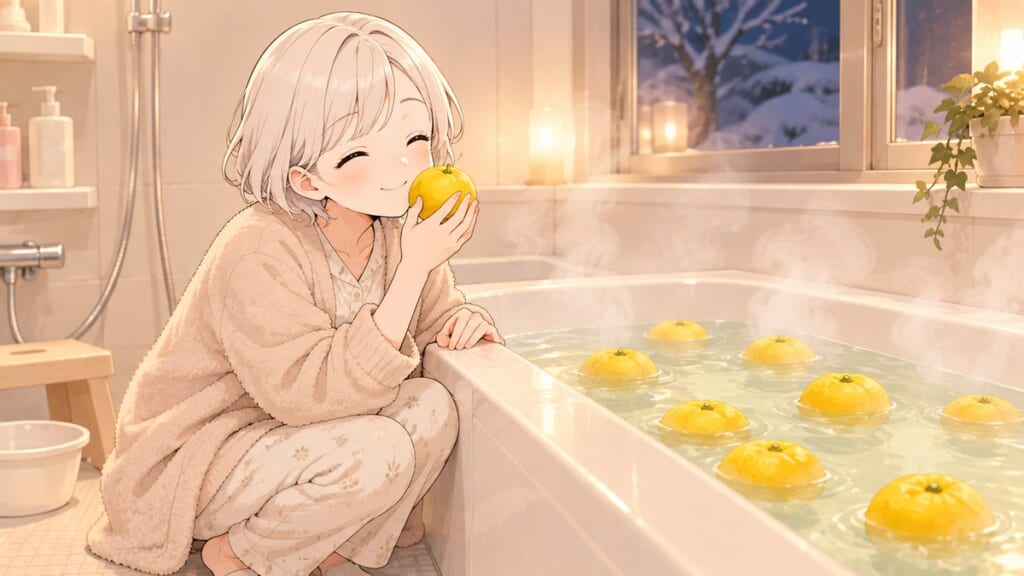
If you love citrus scents, yuzu is a lovely place to begin. Sometimes a fragrance you like is enough to make an ordinary evening feel special.
Yuzu Bath Salt: A citrus option for home
Yuzu Bath Salt, 600g is the one I’d consider when scent is the main reason you’re buying. The 600g is the whole bag, not one bath’s worth — check the amount per bath on the package, and the ingredients if you’re sensitive to fragrance.
Yuzu Bath Salt, 600g
A citrus-scented bath powder. The bag holds many baths — check the amount per bath on the package.
Prices change often — please check the latest price on each store.
Yuzuyu: A Japanese winter tradition
There’s another way to enjoy yuzu in the bath, and it doesn’t involve bath salts at all. In Japan, yuzuyu means a bath with real yuzu fruit, especially on Toji, the winter solstice — December 22 in 2026, according to the National Astronomical Observatory of Japan.
In my home, I float real yuzu in the bathtub on the winter solstice. You may hear that it keeps colds away, but that’s a traditional belief, not a medical promise.
Once you’re out of the bath, a few cozy layers make a chilly winter evening even nicer.

5 Japanese Winter Essentials: Kotatsu Socks, Yutanpo & Kairo
For Dry Winter Skin: Moisturizing Bath Additives
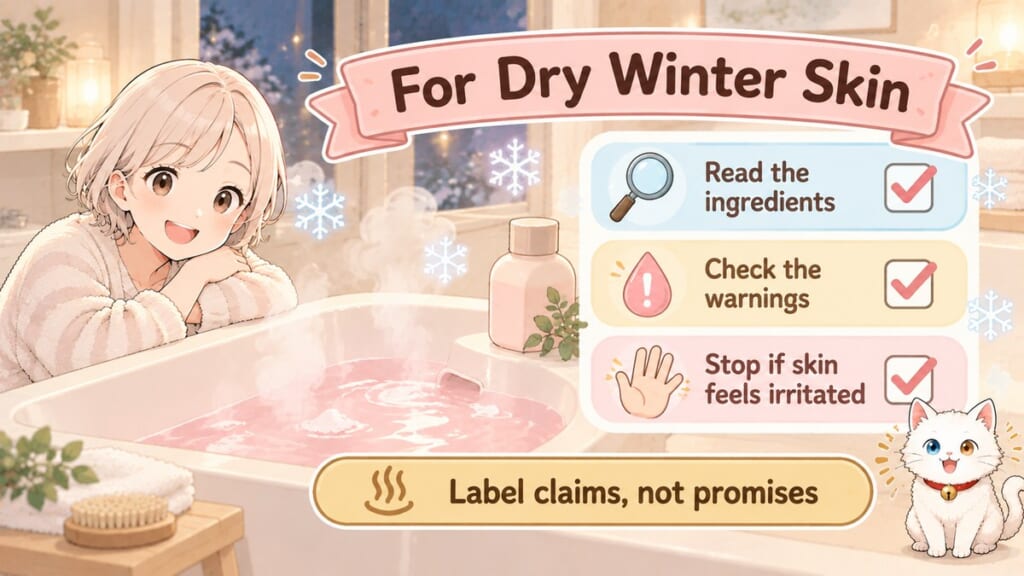
If you’re shopping with winter dryness in mind, read the product’s actual claims and ingredients, not just packaging words like “moist” or “smooth.”
HERS Bath Labo: A moisturizing powder
HERS Bath Labo from Hakugen Earth is a medicated bath powder in a 540g bottle (Night Lavender scent), with hyaluronic acid as a moisturizing ingredient. Its labeled effects include fatigue recovery, sensitivity to cold, stiff shoulders, and rough skin — the label’s claims, not a promise for every user.
HERS Bath Labo, 540g bottle
Medicated bath powder with hyaluronic acid (Night Lavender). Sold and shipped by Amazon.co.jp.
Prices change often — please check the latest price on each store.
In Japanese stores, you’ll also see Kikiyu, another medicated bath-salt range. Compare the labeled effects of the exact variety you pick up.
Kikiyu assortment, 36 packets
Carbonated medicated bath salts in six varieties, individually packed. Sold and shipped by Amazon.co.jp.
Prices change often — please check the latest price on each store.
If your skin is easily irritated, check the warnings before bathing and stop if irritation occurs. For winter dryness beyond the bath — hands, lips and more — I’ve put together a separate guide.

Japanese Winter Dry-Skin Kit
Where to Buy in Japan: Drugstores & More
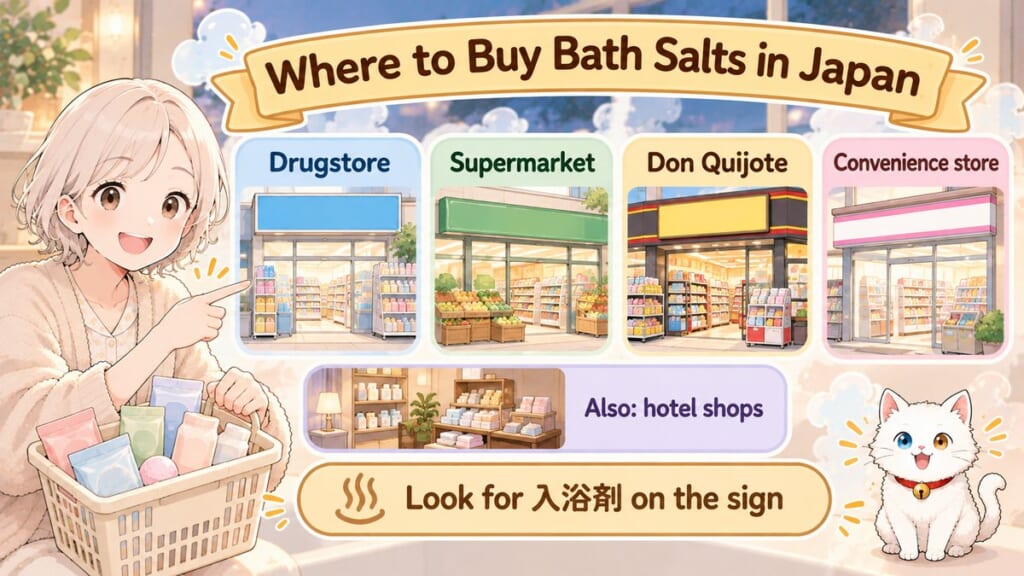
I usually buy bath additives at drugstores and supermarkets. Convenience stores are handy too, and some hotels sell them in their shops.
| Where to shop | Selection | Single-use packets | Open late? |
|---|---|---|---|
| Drugstore | A wide selection of everyday bath additives | Often | Depends on branch |
| Supermarket | Everyday household brands | Sometimes | Depends on branch |
| Don Quijote | Often carries bath products; varies by branch | Check in store | Some branches open late |
| Convenience store | Small, changing selection | Check in store | Many open 24 hours |
| Hotel shop | Whatever that hotel stocks | Check in store | Depends on hotel |
Drugstores and supermarkets: My first choice
 These are where I buy bath additives for home. For a traveler, a drugstore is a convenient place to compare packages. Look for the word nyuyokuzai (入浴剤) on signs, and tansan (炭酸) on carbonated products.
For tax-free shopping and other personal-care finds at Japanese drugstores, see my separate guide.
Japanese Drugstore Skincare: What to Buy
Don Quijote and convenience stores: For tonight
Don Quijote often has bath products, but the selection depends on the branch, so don’t count on one specific item. If you forgot to buy one before heading back to your hotel, a convenience store may have a few — just don’t expect a large selection.
Buying one at the hotel shop doesn’t automatically mean every guest-room bathtub allows it, so ask first.
For fitting shopping into the rest of your trip, see my Japan travel-planning guide.
How to Plan Your First Trip to Japan: 7 Steps
Ordering From Home: What Ships, What to Watch
You don’t need a plane ticket to enjoy Japanese bath additives. Some products in this guide are on Amazon US, and others can be ordered from Amazon Japan when it ships to your country.
Amazon US: The easiest option
Bub Full Herb, the Yunohana Gift Box, Yuzu Bath Salt, and Roten Yumeguri are on Amazon US. In the October 2026 listing check, all four were offered by third-party sellers, fulfilled by Amazon, and shown with Japanese-language packaging.
“Shipped by Amazon” describes delivery; it doesn’t tell you whether the seller is the manufacturer or an official distributor. Check the seller, the exact variation, and the ingredients before ordering. Since the box is in Japanese, a translation app helps with the directions and warnings.
Amazon Japan: Check delivery for each item
Bub Milky, the Bub 60-tablet assortment, HERS Bath Labo, Tabi no Yado, Nihon no Meito, and Kikiyu were sold by Amazon.co.jp and showed US shipping in the October 22, 2026 listing check. Delivery options can change, so set your address and check the product page before buying.
Buying as a gift?
For a gift, think about the recipient’s bathtub and whether they enjoy scented baths. I’ve kept the detailed gift advice in another article.
Japanese Gifts You Can Buy Without Going to Japan
FAQ
What is the best bath salt in Japan?
For a first try, I’d start with Kao’s Bub, the one I use at home. If you want hot-spring atmosphere or scent, pick an onsen powder or a yuzu bath salt instead.
Do Japanese use bath salts?
Yes. Bath additives are everyday household products in Japan, and my family uses Bub and bubble baths at home. Not everyone uses bath additives, though — you can enjoy a plain bath, too.
Can I use Japanese bath salts in a hotel bathtub?
Only if the hotel allows it and the product suits the tub. Ask first, especially for cloudy, foaming, or mineral products.
Are Japanese bath salts good for you?
Some are medicated bath additives with labeled effects, such as helping fatigue recovery or promoting circulation through a warm bath. Read the claims and warnings on the exact product rather than assuming all bath salts do the same thing.
Can I bring bath salts home on the plane?
Packing them in your checked suitcase is the simplest choice. For flights into the US, TSA screens powders over 12 oz (350 mL) separately in carry-on bags, may open the container, and recommends checked bags for larger amounts. Liquid bath products in carry-ons follow the 3.4 oz (100 mL) rule.
Official source: TSA — What Can I Bring?
Final Thoughts
Your first Japanese bath additive doesn’t need to be complicated. Choose Bub for the classic fizzing tablet, a hot-spring powder for atmosphere, yuzu for scent, or a moisturizing powder for dry winter skin.
At my home, Bub is still the one I reach for most often. I hope you find one that makes your own evening a little warmer, whether you’re visiting Japan or bringing a little Japan into your home.
Have you tried a Japanese bath additive, or is there one you’re curious about? Do people in your country take baths with bath salts? Tell me in the comments — I’d love to hear which scent or style caught your eye.
I hope this guide has answered one of your questions and helped you feel a little closer to Japan.
May your Japan journey be filled with wonderful discoveries and memories you’ll treasure for years to come.
See you in the next guide.



Comments