Everyone tells you the same thing before your trip to Japan: just send your suitcase ahead. It’s cheap, it’s reliable, and you’ll wander Kyoto with your hands free while your bag meets you at the hotel.
Then you start looking into it, and the numbers refuse to agree. One traveler paid around ¥3,000. Someone else was quoted more than ¥5,000 for what sounds like the same suitcase. A forum thread says next day; another says it arrived the same evening. And nobody seems to know what happens if you’re staying at an Airbnb.
Here’s why those numbers clash. People aren’t just comparing two different services — they’re comparing different routes, different distances, and different drop-off counters. Once you know which of those you’re actually being quoted, the confusion clears up fast.
So let me lay it out properly, with Yamato’s current official prices rather than the pre-2025 numbers still floating around. I’ll cover what it actually costs, how long you’ll be apart from your bag, how to send it from one hotel to the next, and what to do about Airbnbs and airports. Just as importantly, I’ll tell you which days of your trip genuinely don’t need it — because the smartest way to use this service is selectively, and the money you don’t spend is yours.
By the end, you won’t be asking whether luggage forwarding is worth it in general. You’ll know which days of your itinerary it’s worth it for.
Prices and conditions in this guide were checked in August 2026 against Yamato Transport’s official pages.

Disclosure: This article contains affiliate links. If you book through one, I may earn a small commission at no extra cost to you.
In a hurry? Everything in this guide, in one list:
- Luggage delivery: Tokyo, Narita & Haneda — hotel-to-hotel or airport-to-hotel
- Luggage delivery: Osaka, Kyoto & Kansai Airport — the Kansai side
Two regions, same service — pick the one your route starts in.
- Is Luggage Forwarding in Japan Worth It? The Quick Answer
- Why Prices Vary So Much
- How Much Does Luggage Forwarding Cost in Japan? 2026 Yamato Price Examples
- How Long Does It Take? Plan for at Least One Night Without Your Main Bag
- When It’s Worth It — and When It’s Honestly Not
- Hotel to Hotel: How to Actually Do It (7 Steps)
- Airport to Hotel & Hotel to Airport (The Rules Change at the Airport)
- Can You Send Luggage to an Airbnb? (Usually Not Directly — Here’s the Workaround)
- What to Keep in Your Overnight Bag (The Part People Get Wrong)
- Traveling with Kids? Here’s What Changes
- If You’d Rather Not Ship: Lockers, Storage & Carrying Smart
- Luggage Forwarding in Japan: FAQ
- How much does it cost to forward a suitcase?
- How far in advance do I need to hand over my bag?
- Can hotels send luggage to another hotel?
- Can I send luggage to an Airbnb?
- Can my bag arrive the same day?
- Do I need to book luggage forwarding in advance?
- Can I track my suitcase?
- What should stay in my overnight bag?
- Do I need to speak Japanese to use it?
- Is it reliable? What happens if my bag is delayed or damaged?
- YUU’s Final Thoughts
Is Luggage Forwarding in Japan Worth It? The Quick Answer
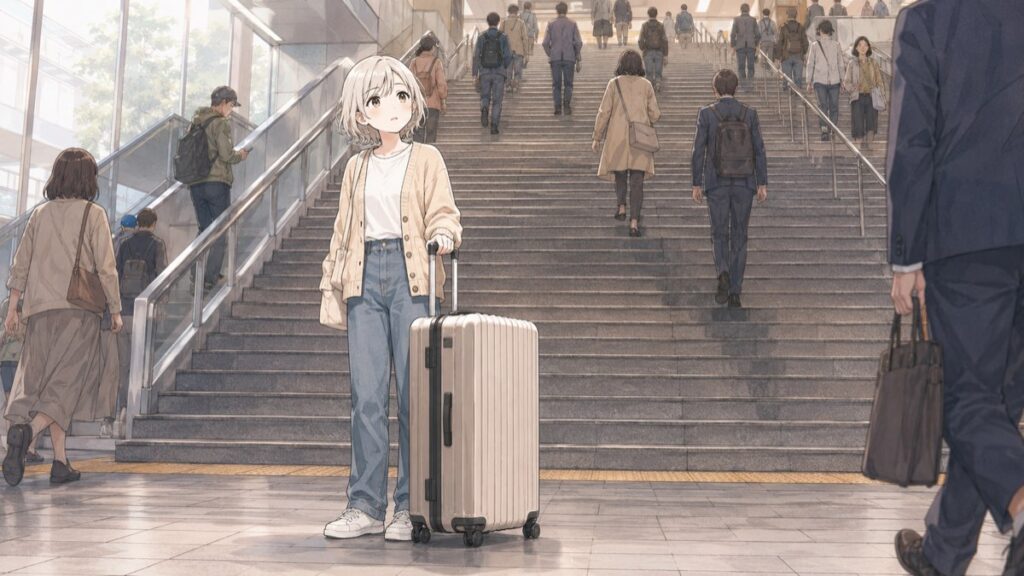
You’re standing at the bottom of a station staircase with a suitcase that weighs more than a four-year-old, and the elevator is somewhere on the far side of the concourse. That’s usually the moment people start searching for luggage forwarding.
 The short answer: it’s worth paying for on your hard travel days, and it’s money you don’t need to spend on the easy ones. Shipping every bag on every leg of the trip isn’t the goal. I send our family’s bags ahead when we travel to my parents’ place, and it makes the whole day easier. For a short move across town, carrying the bag can be the better value.
Most of the confusion you’ll find online is about price, and the honest explanation isn’t “fast costs double.” Yamato’s standard next-day rate for a 160-size case (a large suitcase) from the Tokyo area to the Kansai area is ¥3,160. Same-day delivery from Haneda Airport to a central Tokyo hotel starts at ¥5,170. But Yamato’s covered same-day route from selected Kyoto sales offices to eligible hotels in Kyoto city is ¥2,860 for that same size — less than the next-day trip from Tokyo. Distance, size and which counter you use matter at least as much as speed.
Once you know which service and route your quote covers, the decision gets a lot simpler. So which days of your trip are worth around ¥3,000?
 Ship your bags when you’re changing cities, moving hotels on a day you want to sightsee, traveling with small children or a stroller, or handling more than one large case per adult.
 Carry them yourself when you’re staying several nights in one place, traveling with a cabin-size bag, taking a direct bus or taxi from the airport to your door, or when you’ll need that bag again first thing tomorrow morning.
Why Prices Vary So Much
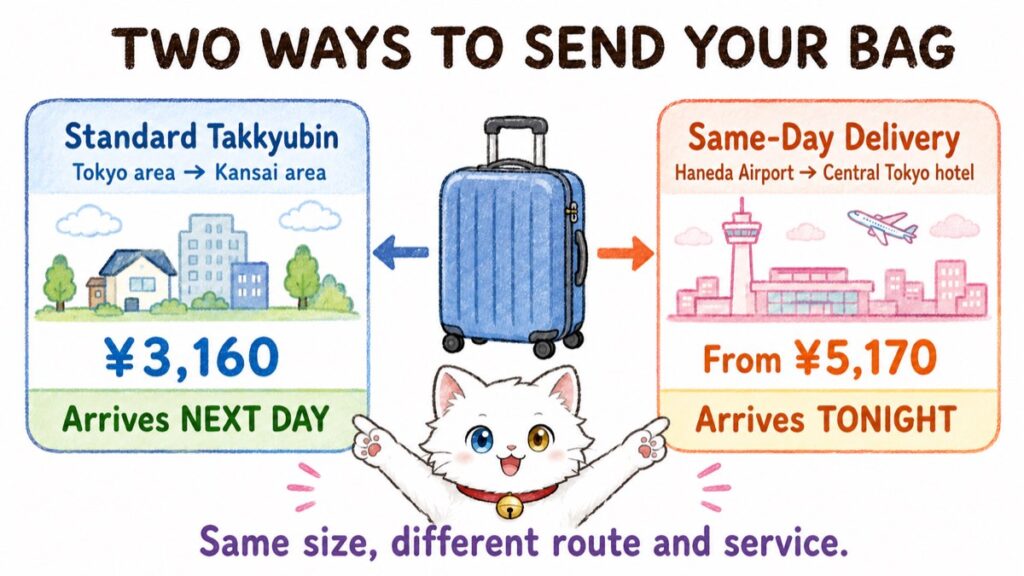
The price gap has two causes: travelers are often comparing different services, but they are also comparing different routes and service counters. Standard TA-Q-BIN is usually the lower-cost next-day option. Same-day delivery is limited to selected airport and station counters, and its price varies by counter, destination, bag size and weight. The prices below are real budgeting examples, not a like-for-like surcharge for speed.
1. Standard TA-Q-BIN. Your bag travels overnight through Yamato’s regular network, and you can hand it in at a hotel front desk, a convenience store or a Yamato office. From the Tokyo area to the Kansai area, a 160-size case costs ¥3,160. This is the standard service most travelers mean when they talk about affordable luggage forwarding.
2. Same-day delivery. This runs only between specific airport or station counters and specific delivery areas, each with its own cutoff time. On Yamato’s dedicated Haneda page, a 160-size case from the airport to a central Tokyo hotel currently starts at ¥5,170, while delivery to Yokohama, Kawasaki or Urayasu is ¥5,780. In Kyoto, same-day delivery of the same size from selected Yamato sales offices to covered hotels is ¥2,860.
 Look at those last two numbers again. Same-day on that covered Kyoto route (¥2,860) costs less than standard next-day from Tokyo to Kansai (¥3,160). Speed alone isn’t what makes a quote expensive — distance, size and the counter you use all move the number. Same size and same company, but a different service, route and delivery deadline. That is why the exact quote matters.
 Airport fees depend on the direction. Sending luggage to an airport adds a ¥660 airport handling fee to the regular fare. Separately, when you send luggage from a Yamato counter at Narita, Haneda or Kansai Airport, a ¥660 counter-use fee applies. Do not automatically add both fees and assume that every hotel-to-airport shipment costs ¥1,320 extra. Check the official calculator and the page for your airport and service counter.
So when two people quote you wildly different prices, ask two questions: which service was it, and between which two points? Those details explain almost every “contradiction” you’ll read online.
How Much Does Luggage Forwarding Cost in Japan? 2026 Yamato Price Examples
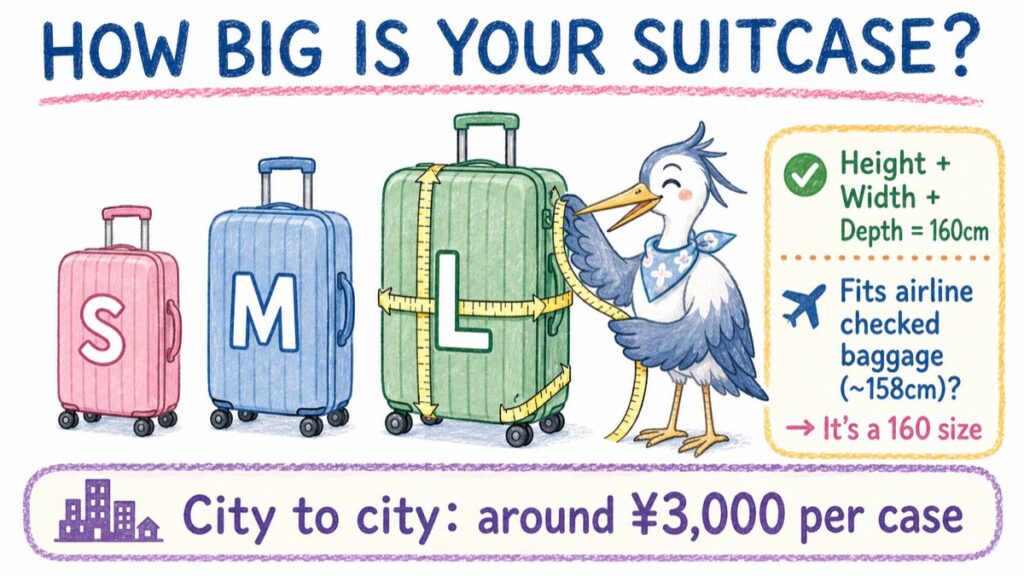
 For trip-budget purposes, here’s the number to hold onto: a large suitcase moving one hop between cities costs around ¥3,000. Not per day, not per person — per suitcase, per journey.
These are Yamato’s official examples after the October 2025 fare revision (many older articles still quote the cheaper pre-revision prices):
| Route | Service | 160 size |
|---|---|---|
| Tokyo area → Kansai area | Standard, next day | ¥3,160 |
| Kyoto → Osaka | Standard, next day | ¥3,020 |
| Haneda Airport → central Tokyo hotel | Same-day | From ¥5,170 |
| Haneda Airport → Yokohama, Kawasaki or Urayasu | Same-day | ¥5,780 |
| Selected Kyoto sales office → covered Kyoto city hotel | Same-day | ¥2,860 |
These are route-specific examples, not flat nationwide prices. Same-day fees can vary by airport, station, service counter, destination area, bag size and weight. Always check the exact counter and route before budgeting. Cash rates, tax included; where cashless payment is accepted it shaves off a few yen (¥3,157 instead of ¥3,160 for Tokyo–Kansai 160 size). Rates checked August 2026.
For your own route, Yamato’s official fare and delivery-date checker gives the current number in seconds. One quick note on names: what travelers call “takkyubin” is Yamato’s service (the company with the black cat logo). Sagawa Express and Japan Post also ship suitcases within Japan, Yamato is widely available through hotel desks and convenience stores, and its current rates and service conditions can be checked on official English pages — which is why the examples in this guide use Yamato.
What’s a “160 size”? Japanese shipping sizes are the height, width, and depth of your bag added together, in centimeters. A carry-on lands around 115–140; a large check-in suitcase is typically a 160. Here’s a reassuring shortcut: if your suitcase was allowed as checked baggage on your flight — most airlines cap around 158cm total — it fits in the 160 tier.
Yamato uses whichever category is higher: the bag’s total dimensions or its weight. A 160-size item is limited to 25kg; heavier luggage moves into the 180-size tier, up to the overall 30kg maximum.
And here’s the part I want you to relax about: you don’t measure it yourself. I don’t either. I’ve shipped bags from counters plenty of times, and the staff measures it on the spot — the final size category is whatever the staff confirms after measuring it and checking the applicable weight tier, and that’s the price you pay. There’s no penalty for guessing wrong, because you were never asked to guess.
Two limits worth knowing before you pack. Yamato won’t accept anything over 200cm total or 30kg, packed or not — so one overstuffed giant case is riskier than two mediums. And convenience stores are convenient for a suitcase up to 160 size; for a 180- or 200-size case, use a Yamato sales office or request pickup instead.
How Long Does It Take? Plan for at Least One Night Without Your Main Bag
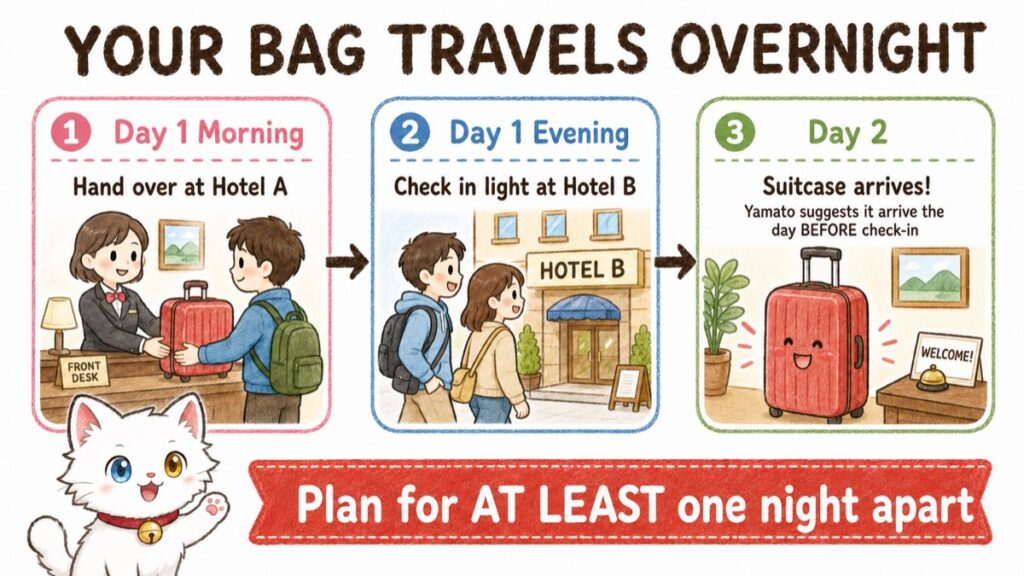
Standard TA-Q-BIN usually takes one or two days, depending on the route. Hotel delivery needs one extra planning step: Yamato recommends arranging for the suitcase to arrive at least one day before your stay begins. On a next-day route, that usually means handing it over about two days before check-in.
If the receiving hotel explicitly agrees to accept a suitcase after you have already checked in, you may be able to send it on your travel morning and receive it the following day. Confirm that plan with both hotels before relying on it. Treat one night apart as the minimum, not a guarantee.
 Once you plan around “arrive before I do,” the smartest trick in this whole article appears: the skip-a-stop. Say your route is Tokyo → one night in Hakone → four nights in Kyoto. Instead of dragging the big case up a mountain for one night, send it from Tokyo ahead to your Kyoto hotel and take only an overnight bag to Hakone. The suitcase skips the hardest leg of your trip entirely, and it lands before you do — exactly the way Yamato suggests arranging it.
That gap between handover and reunion is why the overnight bag section later in this article isn’t optional reading. Anything you’ll want in between — medication, chargers, tomorrow’s clothes — has to stay with you.
One caveat before you build your schedule around any of this: these are delivery targets, not guarantees — weather and peak congestion can add time. If something in that bag is essential and time-sensitive (a suit for a wedding, a full run of medication), keep it with you. And if you’re wondering about same-day options, they exist only at specific airport and station counters — I explain those exceptions in the airport section below.
When It’s Worth It — and When It’s Honestly Not
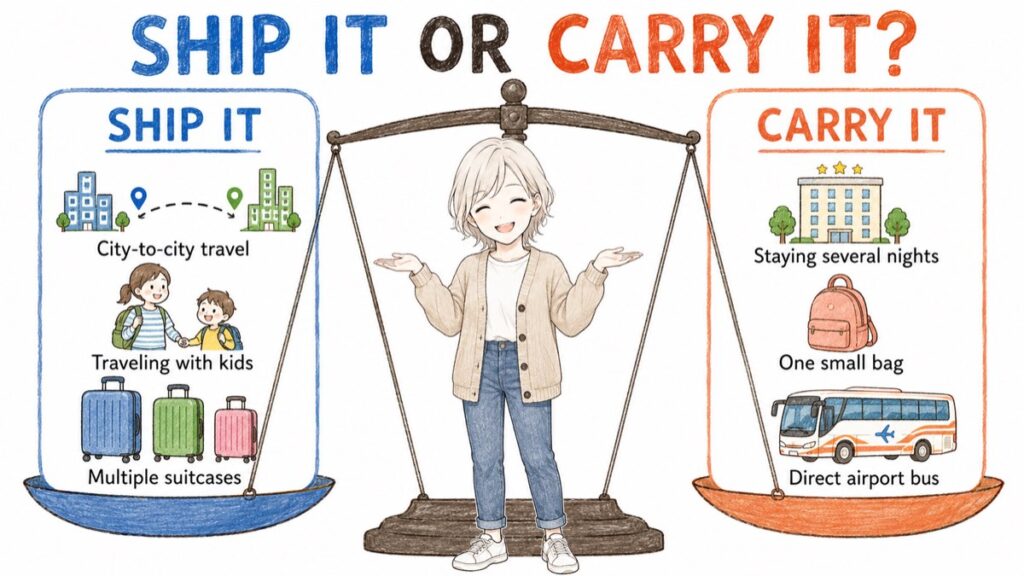
Here’s the honest version you won’t find in most guides: luggage forwarding is famous for a reason, but it is not a must-do for every traveler on every day. It’s a tool for your hardest travel days. The skill is knowing which days those are.
What you’re really buying for around ¥3,000 isn’t shipping — it’s your hands, your shoulders, and your evening. A travel day with a suitcase is logistics; a travel day without one is just another day of your trip. When I send our family’s bags ahead to my parents’ place, that’s the difference I notice every time: the journey itself stops being work. (Your feet will thank you too — more on surviving Japan’s walking days separately.)
So run your itinerary through this table, one travel day at a time:
| Your situation that day | Ship or carry? |
|---|---|
| Changing cities with a large suitcase | Ship it |
| Moving hotels on a day you also want to sightsee | Ship it |
| More than one big case per adult | Ship it |
| Small children or a stroller in tow | Ship it (details in the family section below) |
| Your route involves subways, transfers, or stations with stairs | Ship it |
| Staying several nights in one place | Carry it — the bag only moves once |
| Cabin-size bag only | Carry it |
| Direct airport bus or taxi to your hotel door | Carry it |
| A short hop, like Kyoto to Osaka | Carry it — unless stairs + kids say otherwise |
| You’ll need the bag first thing tomorrow morning | Carry it — remember you’ll be apart for at least a night |
| Staying at an Airbnb with no staff | Different problem — see the Airbnb section below |
Then do the math, which takes thirty seconds. Count your “ship it” days, multiply by the number of large cases, multiply by roughly ¥3,000. A couple with two suitcases changing cities twice pays about ¥12,640 for the whole trip — less than one nice dinner in Tokyo, spread across your two hardest days. If you’re following an itinerary like the A Little Japan 10-day ¥200,000 plan, that’s the scale of decision we’re talking about: real money, but small against the total.
And if the table told you to carry everything? Then carry it with my blessing. You just saved ¥12,000 — skipping it on an easy itinerary is the correct call, not a rookie mistake.
Hotel to Hotel: How to Actually Do It (7 Steps)
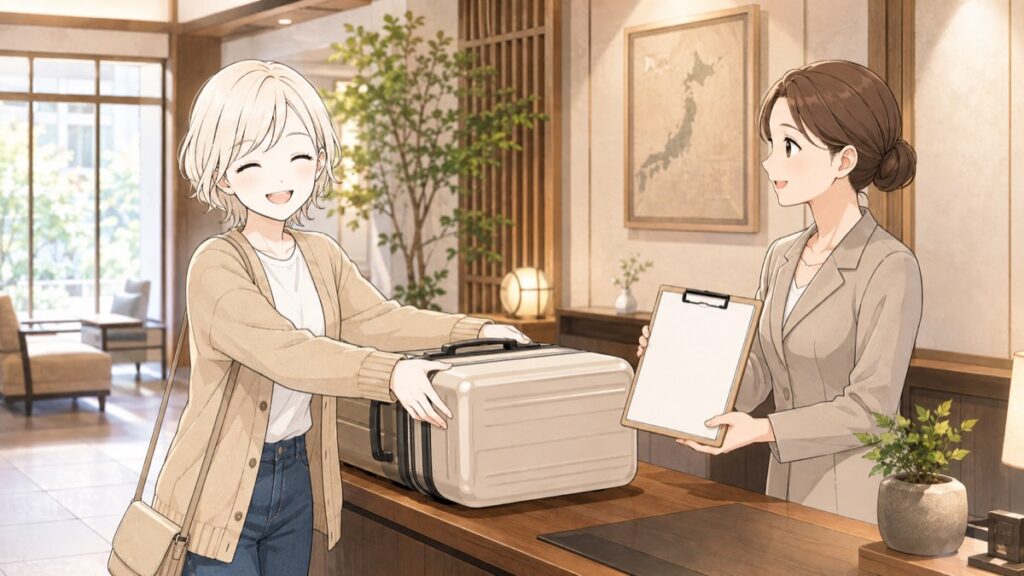
If you decided “ship it” for at least one day, here’s the entire process. The good news: the hardest part is a two-line email, and everything else happens at a front desk.
1. Confirm both ends — before you rely on the plan. Yamato’s own advice is to check two things in advance: that your hotel handles takkyubin shipping, and that the receiving hotel accepts luggage for incoming guests. Most hotels in tourist areas do both, but “most” isn’t “all” — a two-line message to each hotel (“Can I send luggage ahead via takkyubin? Can you ship my luggage onward?”) settles it.
2. Work backwards from your check-in date. Ask the front desk for a shipping slip and check the delivery date for your route, aiming for the bag to arrive before your stay starts. You don’t need to find a Yamato counter — the desk has the slips and will help you fill one in, so you don’t need Japanese for this step.
3. Write the destination clearly. The receiving hotel’s name and address, the hotel’s phone number, your name exactly as it appears on your booking, and your check-in date. That last line — “Guest: [name], arriving 2026/09/05” — is what lets the hotel match the mystery suitcase to you.
4. Pull your overnight things out first. Once the case is sealed and handed over, it’s gone for at least one night, and sometimes two. (The full checklist is two sections down.)
5. Pay and keep your copy of the slip. It carries the tracking number — you’ll almost certainly never need it, but if anything goes sideways, that number is the answer to every question.
6. Head off and enjoy your day. This step is the entire point of the exercise.
7. Track it, and mention it at check-in. Say “I have a suitcase arriving by takkyubin” when you arrive. If the bag has already landed the desk will hand it over; if it’s still in transit, tracking tells you where it is.
If a hotel says no — small guesthouses sometimes don’t handle shipping — you have two fallbacks. A Yamato office (eigyousho) is the sure bet: they take any size the service allows. I have also used convenience-store drop-off for ordinary parcels, but large suitcases are better taken to a Yamato office: convenience stores take suitcases only up to 160 size.
Airport to Hotel & Hotel to Airport (The Rules Change at the Airport)
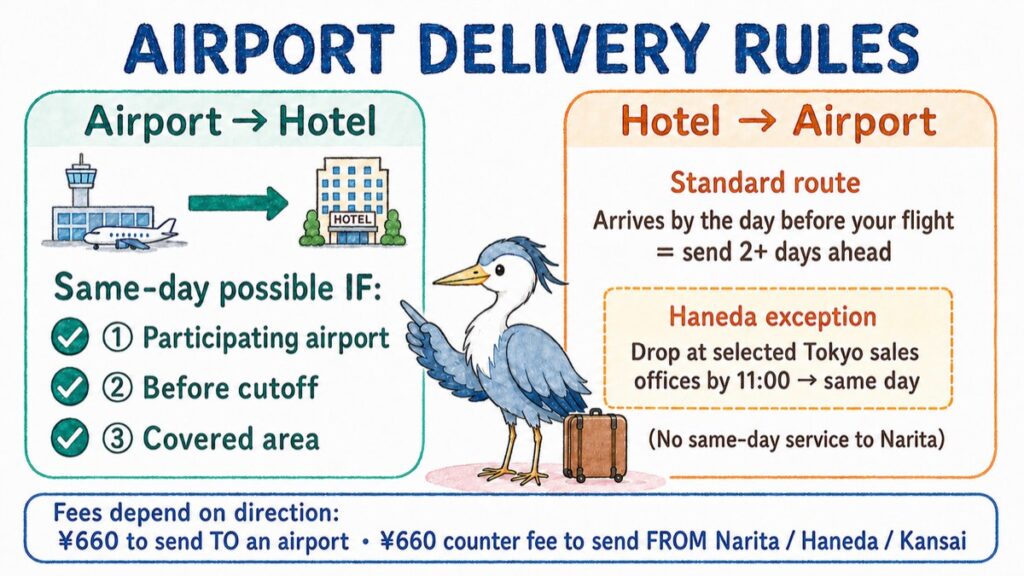
Airports are where the simple rules stop being simple, and the two directions work completely differently.
Arriving: airport → hotel. Drop your case at the takkyubin counter after landing, and it can reach your hotel that evening — but only when three conditions all line up: you’re at a participating airport, you make the counter’s cutoff time, and your hotel is inside the covered delivery area. Miss any one of the three and same-day delivery will not apply. Ask the counter whether standard delivery is available and confirm the expected delivery date for your route. Same-day from Haneda starts at ¥5,170 for a 160-size case to a central Tokyo hotel. Whether that beats simply taking the bag with you depends on your train — I’ve broken down the options for the Narita Express, the rapi:t to Namba, and the Haruka to Kyoto separately, and all three handle suitcases better than travelers fear.
Departing: hotel → airport. The standard hotel-front-desk route is not designed as a same-day service. Yamato normally asks you to send luggage early enough for it to reach the airport by the day before departure, which means at least two days in advance and longer from some regions.
There is one useful exception: Yamato currently offers same-day delivery to Haneda Airport from selected sales offices in Tokyo when luggage is dropped off by 11:00 a.m. This is not a hotel pickup service, and Yamato does not offer the same arrangement to Narita. Check the dedicated Haneda page before building your departure day around it.
Prefer to book in English before you land? A few private companies run airport-to-hotel luggage transfer that you can reserve online in advance, in English, with a confirmation in your inbox. They’re typically pricier than walking up to the Yamato counter, but if you want the whole thing settled before your flight boards — or you’re heading somewhere Yamato’s counters can’t serve — they fill that gap. One English-bookable option available through Klook is LuggAgent, with routes around Tokyo, Narita and Haneda and around Osaka, Kyoto and Kansai Airport.
Can You Send Luggage to an Airbnb? (Usually Not Directly — Here’s the Workaround)
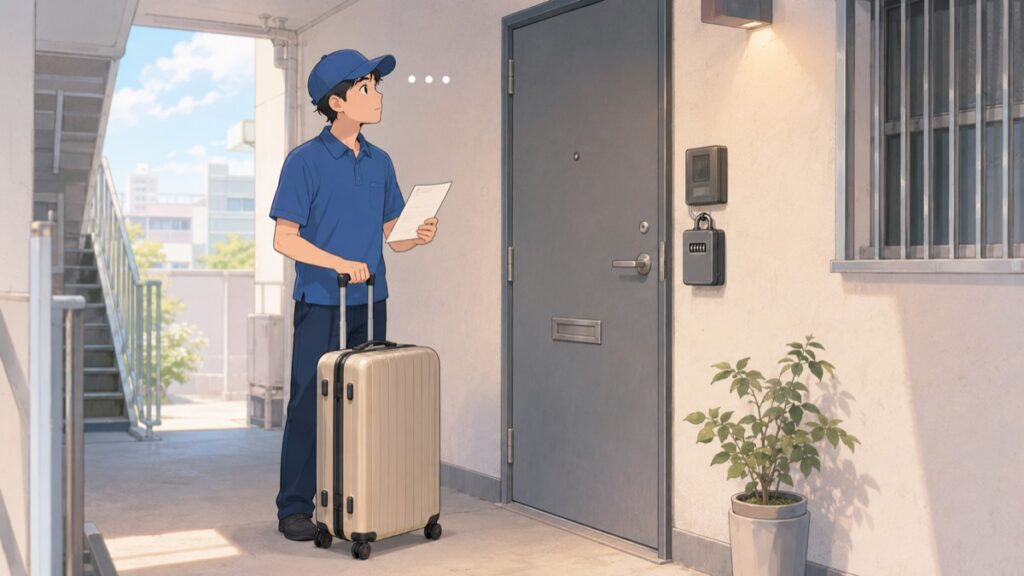
Short answer: not to an empty apartment, no. For luggage forwarding to a vacation rental, Yamato requires reception staff who can accept it on your behalf. Yamato’s own FAQ draws the line clearly: delivery to a vacation rental works only when reception staff are available to receive it on your behalf, and Yamato’s Haneda service page states plainly that it does not deliver to private rentals. A staffed apartment-hotel lobby that’s agreed to receive it — fine. A lockbox-and-nobody-home rental — the driver has no one to give it to, and “leave it at the door” isn’t how this system works.
If that’s your situation, the official workaround is office hold (eigyousho-dome): instead of your rental’s address, the bag is sent to a Yamato office near it, and you collect it yourself. For sales-office pickup, you will need the office name, address and branch code on the waybill, plus your tracking number and photo ID when collecting the bag. Yamato also asks for contact details. If your travel eSIM is data-only and does not include a voice number, ask the counter what contact information they will accept rather than assuming office pickup is unavailable. (I compare which connectivity options do what in the A Little Japan eSIM guide.) Check the office’s business hours, note that delivery to some regions runs one to three days, and confirm through tracking that the suitcase has arrived before visiting.
Selected LuggAgent packages support Airbnb delivery and may place luggage inside the room when you provide the required door code and check-in instructions. Routes, deadlines and handover rules vary by package, so check the current conditions before booking.
My honest take: if your whole trip is unmanned Airbnbs, plain takkyubin simply isn’t the tool it is for hotel travelers — this is the one itinerary where I’d say plan to carry, book a staffed hotel for the nights you change cities and let the front desks do the work, or budget for a private service. Takkyubin was built around a person at each end. Airbnb removed one of the people.
What to Keep in Your Overnight Bag (The Part People Get Wrong)
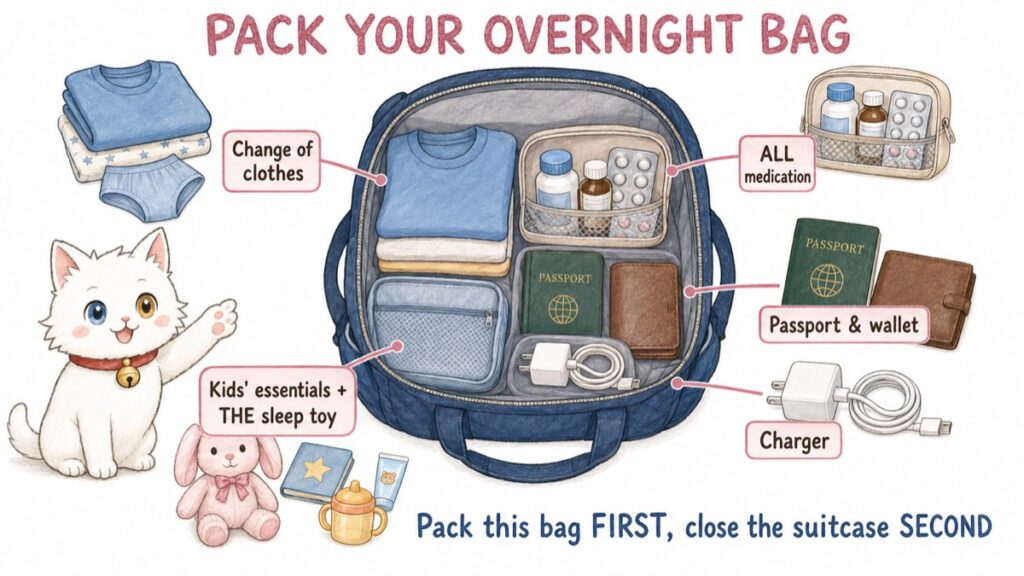
Almost every luggage-forwarding regret starts the same way: the suitcase was sealed and handed over, and then someone remembered what was inside it. So pack your overnight bag first, close the suitcase second. Here’s what stays with you — and pack for at least one night, sometimes two:
- A full change of clothes — including underwear, not just a fresh shirt. You’re dressing tomorrow morning before the bag arrives.
- All of your medication — not one night’s dose. Delivery targets can slip in bad weather or peak season, and medicine is the one thing you can’t shrug off. Same logic for anything truly irreplaceable.
- Passport, cash, cards — these live on your body when you travel, full stop. Never in a shipped bag.
- Phone charger — tonight’s hotel has outlets; your charger is in a truck somewhere.
- Laptop, camera, anything fragile or precious — ship clothes, carry treasures.
- Tickets and reservations you’ll need tonight or tomorrow morning, if you keep paper copies.
- Kids’ essentials — diapers, formula, snacks, and above all the sleep toy. As a mom I’ll say it plainly: you can replace a forgotten toothbrush at any konbini; you cannot replace the one rabbit that makes a strange hotel bed feel safe at 9 p.m.
One reassurance so you don’t overpack: Japanese hotels typically provide toothbrushes, razors, and pajamas or a yukata robe, and a convenience store is rarely more than a few minutes away. Between those two safety nets, a small backpack per adult genuinely covers a night. Pack it like you’re staying at a friend’s house, not like you’re evacuating.
Traveling with Kids? Here’s What Changes

Everything above still applies — but with children, the math isn’t really about money anymore. It’s about hands.
Count yours. Two adults have four hands. Now subtract one for a small child who needs holding, one for a stroller, and suddenly two large suitcases have zero hands left to pull them — on stairs, through ticket gates, across a crowded platform with a train to catch. This is why the decision table earlier says “ship it” the moment small kids are involved: for solo travelers the service buys comfort, but for parents it buys back the hands the trip already claimed.
And if you haven’t settled the stroller question yet, my guide to using a stroller in Japan works through that choice by your child’s age and the kind of route you’re planning.
 The way to make it work as a family is to consolidate, then ship. Put everyone’s clothes into the big cases and send those ahead — two cases at ¥3,160 each covers a family of four for the hop — and travel with one shared overnight bag plus a small backpack per kid. Ours carry their own snacks and entertainment, which lightens the parent bag.
A travel day without luggage changes shape for parents in ways the brochure doesn’t mention. You can use the baby carrier and hold the older one’s hand. You can take the stairs when the elevator queue is long instead of waiting because the suitcase decided for you. And if someone melts down mid-transfer, you deal with the child, not the child and the cargo. (For the train legs themselves, the A Little Japan JR Pass guide covers seat-choosing tips that pair well with traveling light.)
One family-specific warning, though: that overnight bag is now doing heavy duty. Diapers, formula, the sleep toy, medicine, and a full change per kid — pack it as carefully as the suitcase you’re sending. The checklist above was written with you especially in mind.
If You’d Rather Not Ship: Lockers, Storage & Carrying Smart
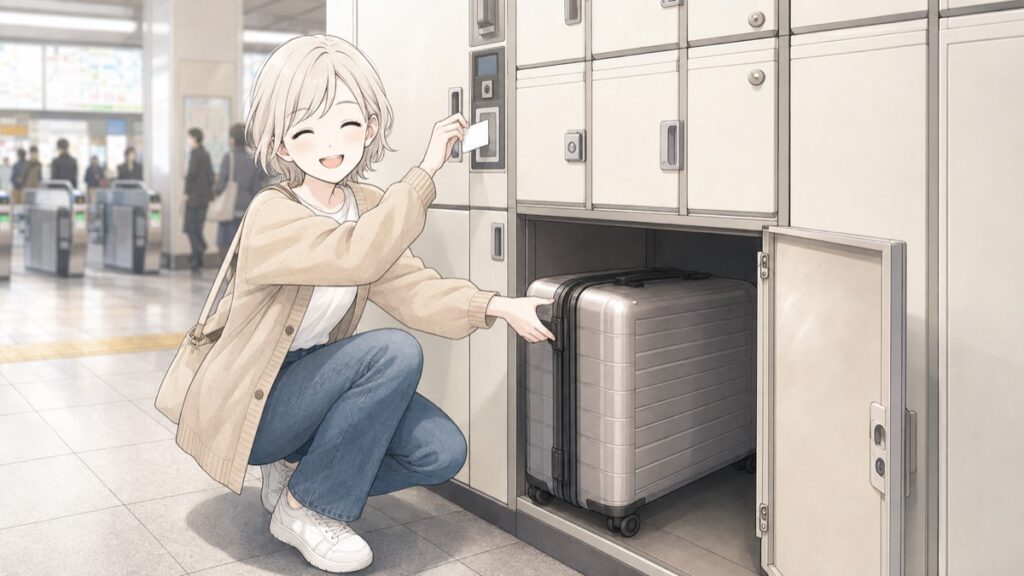
If the decision table sent you to “carry it” — good, you’re saving money. Here’s how to carry well, because Japan is genuinely well set up for it.
Your hotel’s front desk is the option everyone forgets. Hotels will typically hold your bags before check-in and after check-out for that same day — arrive at 10 a.m., drop the cases, sightsee, come back. It’s often free for guests, but confirm with the hotel. Between two hotels in the same city, this covers most “what do I do with my bags until 3 p.m.” problems.
Coin lockers are best for short-term storage. Maximum storage periods and operating rules vary by station and locker, so check the instructions on the machine. Large lockers are limited and may fill early at busy tourist stations. Most modern ones take IC cards, so you don’t need coins despite the name — but a locker doesn’t solve a city-to-city move; it just pauses a bag where you already are.
Staffed storage counters can be more predictable than lockers. Size limits, capacity, hours and reservation rules vary, so check the individual counter before relying on it. Some services let you book storage online in English ahead of time, which is worth it in peak season.
Door-to-door transport makes carrying painless. An airport limousine bus or a taxi turns your suitcase into a non-issue — it rides in the hold while you ride in a seat. If your route is airport → bus → hotel lobby, you never needed forwarding in the first place; that’s exactly the “carry it” row from the table.
And the Shinkansen? Your suitcase can ride with you — mind one number. Here’s a tidy coincidence: 160cm — the same three-side total that defines the shipping tier — is also the Shinkansen’s threshold. Bags up to 160cm total ride with no special arrangement, at your feet, overhead, or in the luggage area by the deck. Over 160cm and up to 250cm, on the Tokaido, Sanyo, Kyushu and Nishi Kyushu Shinkansen you must reserve a seat with an oversized baggage area: there is no additional baggage charge, but you must reserve an eligible seat, and turning up without one costs a ¥1,000 handling fee on board. So measure once, and the same answer tells you both your shipping tier and your train rules.
Luggage Forwarding in Japan: FAQ
How much does it cost to forward a suitcase?
Roughly ¥3,000 per large (160-size) case per city-to-city hop on the standard next-day service — ¥3,160 from the Tokyo area to the Kansai area. Same-day delivery is priced by counter and destination: from ¥5,170 for Haneda to a central Tokyo hotel, but ¥2,860 on Yamato’s covered Kyoto same-day route. Check your exact route and counter.
How far in advance do I need to hand over my bag?
Check the exact delivery date for your route first. For hotel delivery, Yamato recommends having the suitcase arrive at least one day before check-in, which usually means handing it over about two days before arrival on a next-day route. If the hotel agrees to receive it after you have checked in, a one-night separation may be possible, but confirm that arrangement in advance.
Can hotels send luggage to another hotel?
Yes — this is the most common way travelers use the service, and the front desk handles the paperwork. Confirm two things first: that your current hotel offers takkyubin shipping, and that the receiving hotel will accept a bag for an incoming guest. Most tourist-area hotels do both.
Can I send luggage to an Airbnb?
Usually not directly — someone has to receive it, so unstaffed rentals don’t work. The workaround is having it held at a Yamato office for pickup, which needs the office details on the waybill plus ID and your tracking number when you collect. Details in the Airbnb section above.
Can my bag arrive the same day?
Only at specific airport and station counters, when three things line up: a participating counter, its cutoff time, and a destination inside the covered area. Haneda also has a same-day route to the airport from selected Tokyo sales offices with an 11:00 a.m. cutoff. Narita has no same-day service.
Do I need to book luggage forwarding in advance?
Yamato does not take advance reservations for this walk-up luggage service; you complete the waybill when you hand over the bag. Hotel arrangements are separate, so confirm in advance that the sending hotel handles takkyubin and that the receiving hotel will accept your suitcase. Private English-bookable services usually require advance booking.
Can I track my suitcase?
Yes — your copy of the shipping slip carries a tracking number you can look up online. Keep the slip until the bag is back in your hands.
What should stay in my overnight bag?
A full change of clothes, all of your medication, passport, cash and cards, your charger, and anything fragile or irreplaceable. Pack for at least one night, sometimes two. The full checklist is in the overnight bag section above.
Do I need to speak Japanese to use it?
Not really, especially the hotel-desk route: the front desk provides the slip and helps you fill it in, and that’s the whole interaction. Counter staff at offices and convenience stores may speak limited English, but the process is a form and a payment.
Is it reliable? What happens if my bag is delayed or damaged?
Yamato provides a tracking number, so keep your copy of the waybill until the suitcase is back in your hands. The maximum liability for a standard TA-Q-BIN parcel is ¥300,000, but compensation rules and exclusions apply — for damaged parts such as casters or handles, repair costs rather than a replacement suitcase. Delivery dates are targets rather than guarantees, so keep your passport, medication, valuables and anything needed for a fixed event with you.
Traveling as a family adds bags you never planned for. If you are coming with children, my guide to Japan with kids covers fares, meals, diapers and the rest of the everyday logistics.
YUU’s Final Thoughts
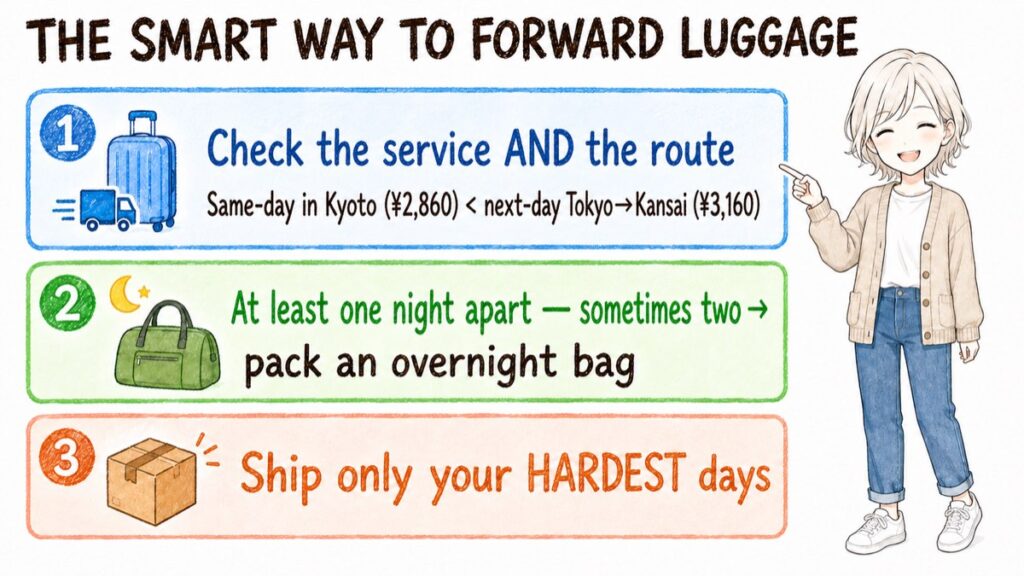
If you remember three things from this guide, make them these. The wildly different prices you’ve read about come from different services and different routes and counters — so always check what your quote actually covers. You and your bag will be apart for at least one night, so the overnight bag is part of the plan, not an afterthought. And you don’t have to choose between “ship everything” and “carry everything” — the smartest version of this is shipping on your one or two hardest days and carrying the rest.
That last point is the one I’d underline. Luggage forwarding isn’t an entrance fee to Japan; it’s an upgrade you apply exactly where your itinerary hurts. Some trips need it twice, some not at all, and both of those travelers planned well.
Start with Yamato’s official rate and delivery-date checker. If the timing, destination or accommodation type does not work for your itinerary, compare an English-bookable private service next. Check Yamato’s official rates and delivery dates here.
Check LuggAgent luggage delivery on Klook
 Now I’m curious about your side of the world — does anything like this exist where you live? Could you hand your suitcase to a hotel front desk and find it in another city the next day? Tell me in the comments below. I read every single one!
I hope this guide has answered one of your questions and helped you feel a little closer to Japan. May your Japan journey be filled with wonderful discoveries and memories you’ll treasure for years to come.
See you in the next guide.