You shouldn’t have to choose between seeing Kyoto and keeping your family comfortable. If you want to enjoy Japan at a gentler pace without wearing yourself out on transfers and queues, start with the part of the day you find hardest. A crowded approach to a temple is a reason to change your timing, not automatically remove the temple from your trip.
Quick Answer
You can’t buy an empty Kyoto. You can buy the hours when it is empty.
In practice, that means a better chance of quieter hours, never a promise of empty streets.
Spend first on where you sleep, how long you stay, and dates outside local peaks.
Pay for seats and shorter queues only after those choices work for your group.
If you’re still arranging your route, start with my Japan trip-planning guide, then use the comparison below to decide where extra spending would help. You don’t need to upgrade the whole holiday.

- Why Japan Feels Crowded Now (and Where It Actually Is)
- The Free Tricks That Actually Work (Be Honest First)
- Comparison Table: What Each Upgrade Costs and What It Buys
- Upgrade 1 — Where You Sleep (the biggest one)
- Upgrade 2 — How Long You Stay
- Upgrade 3 — Your Seat (Shinkansen Green Car, and when it’s a waste)
- Upgrade 4 — Skipping the Line
- Upgrade 5 — Not Carrying Your Bags
- What Japan Already Charges You Extra For (2026 changes)
- What’s NOT Worth Paying For
- You Only Need to Upgrade One Part of the Trip
- If Someone in Your Group Can’t Handle Crowds
- FAQ
Why Japan Feels Crowded Now (and Where It Actually Is)
Japan’s visitor numbers have grown substantially over the past decade, but they don’t tell you how crowded your particular morning will be. The Japan National Tourism Organization’s arrival statistics show the growth; a national total isn’t a crowd forecast for every neighborhood. JNTO visitor statistics
The practical problem is concentration: familiar landmarks draw visitors toward the same approaches, entrances, and transport routes. Kyoto City, for example, identifies bus crowding on particular sections and at particular times, rather than describing every service as equally crowded. Kyoto City’s explanation
For your itinerary, treat each famous stop as a place with a busy window, not as proof that Japan is full. You can keep the sight you care about and change the circumstances around it.
The Free Tricks That Actually Work (Be Honest First)
 Try changing the hour, street, or day before paying for an upgrade. Those changes cost nothing in themselves, and they address the crowd more directly than a more expensive seat on the journey there.
Kiyomizu-dera opens at 6:00 a.m., so you can visit before a conventional morning of breakfast and sightseeing. Its amulet and temple-stamp counters start around 8:00 a.m.; an early visit won’t include every service. Kiyomizu-dera opening hours
At Senso-ji, the morning service is at 6:00 a.m. (6:30 a.m. from October through March). It’s a religious service, so visit quietly and follow the temple’s instructions. Senso-ji service schedule
Early starts are no longer a secret, though. The tip is shared so widely online that at the most famous spots, you may find you’re not the only early riser. Treat dawn as a useful habit rather than a guarantee, and use the upgrades below where your group needs more certainty.
Away from the main approach, try a parallel public street if it still takes you where you need to go. Respect private lanes and access restrictions, and don’t turn a quiet residential entrance into a photo stop. A detour should make the walk easier for everyone.
When your dates are flexible, compare ordinary weekdays with weekends, holidays, and local event dates. Avoid scheduling your most crowd-sensitive outing at the destination’s seasonal peak. If your family can’t manage dawn, changing the date may be the more useful free adjustment.
The New Year holiday is one of those local peaks: shrines and long-distance trains fill up from December 28 to January 3. My guide to Japan over New Year shows which days are the problem and which are quiet.
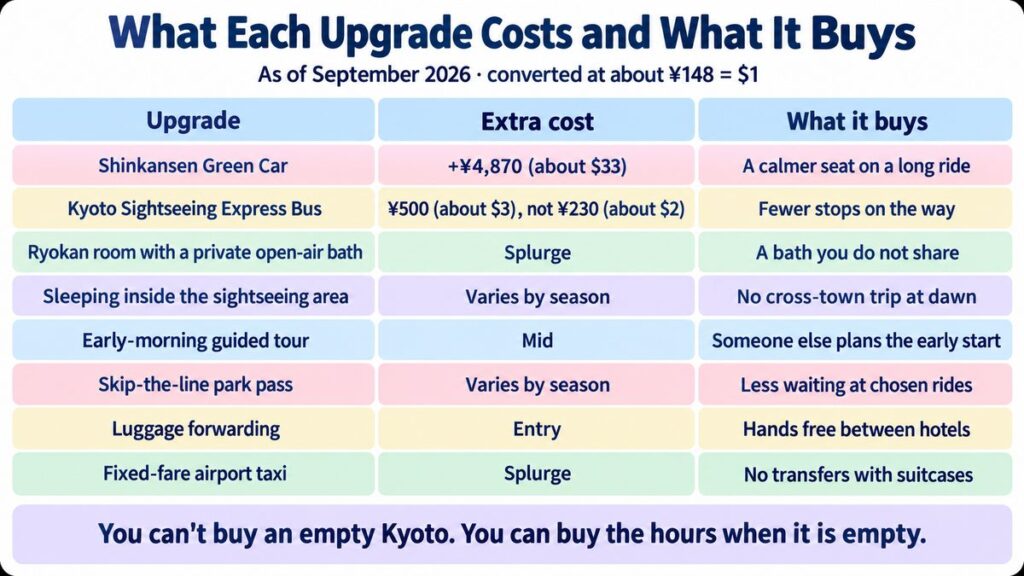
Comparison Table: What Each Upgrade Costs and What It Buys
First, choose the difficulty that sounds most like yours. You only need to spend more on the part that would make your day easier.
| If this is your difficulty | What actually helps | What it does not fix |
|---|---|---|
| Crowded trains are hard to manage with luggage or children | Arrangements that include a transfer to your accommodation, or a private car with a driver for just that day | Road traffic and crowds at your destination |
| You don’t want to be rushed through a large-group tour | A private or small-group guide who confirms your preferred pace before you book | Crowds in public places; a small group still walks the same streets |
| You want to enjoy an onsen without worrying about sharing the bath | A room with its own open-air bath, or an inn with a reservable private bath | Crowds outside the property |
| You want a calmer visit to a popular place | An experience with different admission conditions, such as limited visitor numbers or access outside regular visiting hours. Buy it for this purpose only if the product page explicitly states those conditions | Crowds during regular visiting hours |
| You don’t want to pack too much into a day with children | A stay where you can have meals and enjoy activities at the property | Crowds on the days you travel there and back |
 Use this table to choose a problem to solve, not a shopping list. The cost labels are broad planning categories, not quotes: entry means a smaller extra, mid a more considered purchase, and splurge a major one.
Yen figures reflect the official sources checked in September 2026; the train figures use smartEX’s April 1, 2025 fare tables. Dollar amounts are converted at ¥148 (about $1), using a fixed comparison rate for September 2026 rather than a live exchange quote.
Disclosure: This article contains affiliate links. If you buy through one, I may earn a small commission at no extra cost to you.
| Upgrade | Extra cost (¥ / approx. $) | What it removes | Worth it for |
|---|---|---|---|
| Shinkansen Green Car | Tokyo–Kyoto: +¥4,870 (about $33), per adult, one way | Some seat-space pressure; station crowds remain | Families, travelers with bags, or peak-period trips where the seating arrangement helps |
| Kyoto’s Sightseeing Express Bus | entry; full adult fare ¥500 (about $3), versus ordinary flat fare ¥230 (about $2) | Intermediate stops; traffic remains | A matching sightseeing route on an operating day |
| A room with a private open-air bath at a ryokan | splurge | Sharing that bath with other guests; crowds outside remain | A couple or family who will spend time enjoying the room |
| Staying inside the sightseeing area, not near the station | varies by season | The cross-town journey before an early visit or after an evening walk | Travelers prioritizing that area over frequent departures |
| An early-morning guided tour | mid | Planning the early route yourself; normal entry rules apply | Travelers who want an organized start |
| USJ Express Pass | varies by season | Part of the regular wait at included attractions | A USJ day built around those attractions |
| Luggage forwarding | entry | Carrying the shipped suitcase during transfers | Families or anyone juggling several bags |
| A fixed-fare airport taxi | splurge | Train changes and carrying bags between them; traffic remains | Groups who need a simpler airport-to-hotel journey |
The bus figure is its full fare, not a surcharge added to the ordinary fare. Its published service has limited operating days, so check the timetable before building your day around it. The higher fare doesn’t guarantee a seat or an uncrowded vehicle. Kyoto Sightseeing Express Bus
For rail tickets, compare the railway’s own booking option with Shinkansen and airport-express e-ticket listings, checking the actual seat and collection conditions. Buying online doesn’t by itself upgrade your seat.
Fixed fares are available for designated airport-taxi routes; confirm that your hotel address is covered and what the quote includes. For a Narita arrival, compare that convenience with my Narita Express guide before choosing.
Upgrade 1 — Where You Sleep (the biggest one)
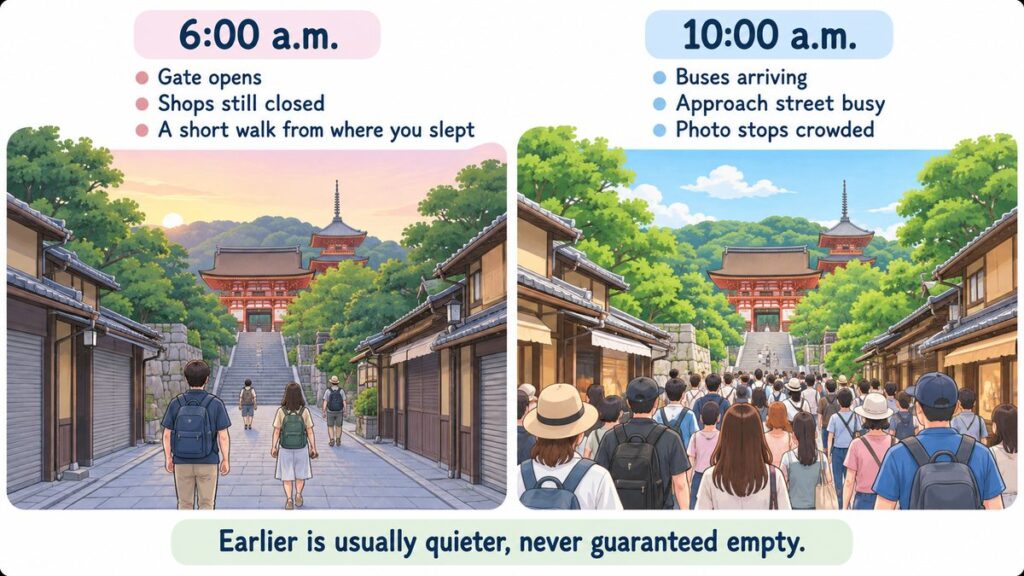
 Pay for a useful address before paying for a grander lobby. If Kiyomizu-dera is your priority, being within a manageable walk makes its 6:00 a.m. opening easier to use without arranging an early cross-town journey. With more visitors now aiming for opening time, that short walk helps you reach the gate among the first, without relying on the day’s first trains or buses.
Staying nearby isn’t the only way to arrive at opening time; you could travel from farther away. The advantage is less preparation and a nearby place to return to afterward. Compare accommodation within walking reach of the temple, checking the actual route rather than the district name.
Don’t let “walking distance” hide a route your group would struggle with. Check slopes, steps, and the journey back, especially with a stroller or an older parent. As a mother, I’d put an easy return to the room ahead of a beautiful address that nobody wants to walk back to.
On Miyajima, an island stay lets you remain after day visitors leave and go out before the next day’s arrivals. Residents and other people are still there; the island doesn’t become exclusive to overnight guests. The useful purchase is freedom from needing to return to a mainland hotel that evening.
A private bath is a separate upgrade. An in-room open-air bath gives you privacy in your own room, while a reservable shared-facility bath may have time slots and separate charges; confirm what the plan includes. If bathing arrangements affect your choice, read my onsen guide before booking.
For an autumn example of this upgrade, see three Kyoto-area ryokan where you watch the foliage from your room.
Upgrade 2 — How Long You Stay
 Stay two nights in the place where timing matters most. That gives you a full day between arrival and departure, when neither checkout nor the next train has to dictate your sightseeing.
Use that middle day differently: your priority sight early, a break when the main routes feel busy, and an evening outing if the place you want to visit is still open. You’re buying room to move the plan around. The evening doesn’t have to become another checklist.
If your holiday length is fixed, shift a night from another stop instead of adding another city. You still get the same number of nights away, but fewer checkouts, fewer suitcase transfers, and fewer mornings spent finding the next platform. Compare consecutive nights in the same property so a room change doesn’t quietly reappear in your plan.
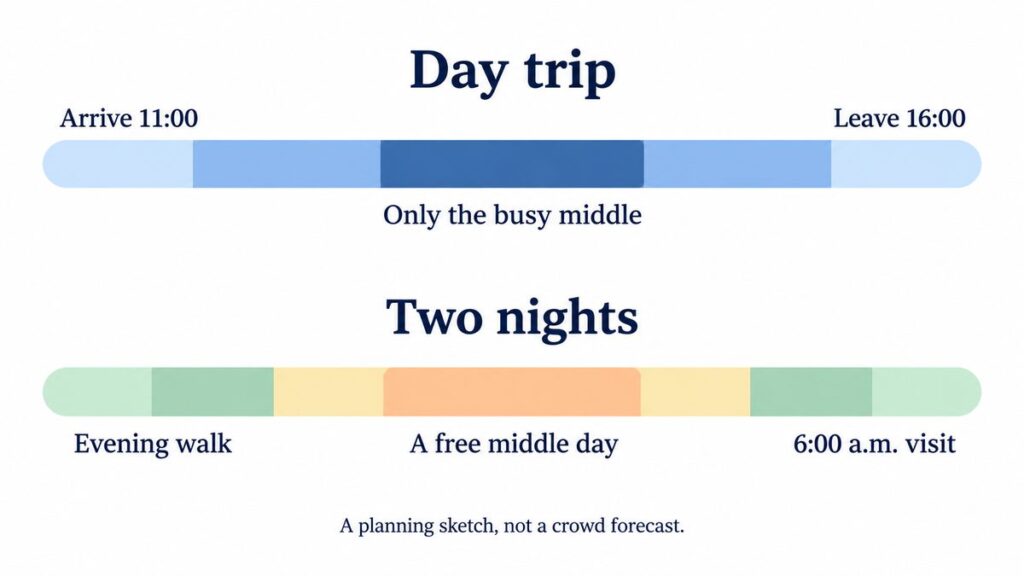
Keep part of that time unbooked. If you pay for another night and fill every hour with timed activities, you lose much of the flexibility you were paying for.
Upgrade 3 — Your Seat (Shinkansen Green Car, and when it’s a waste)
 Consider Green Car for a family journey, a trip with several bags, or a busy travel period when its seating arrangement would make you more comfortable. Don’t buy it simply to secure a seat: an ordinary reserved-seat ticket already does that.
For Tokyo–Kyoto on Nozomi, smartEX lists an ordinary reserved seat at ¥13,970 (about $94) and Green Car at ¥18,840 (about $127). The difference is ¥4,870 (about $33) per adult, one way, for the regular season; these are the April 1, 2025 official tables checked for this September 2026 article. Ordinary reserved-seat fares, Green Car fares
Compare that extra across everyone who needs a ticket with the cost of a more useful hotel location. Green Car doesn’t remove the platform crowd, guarantee silence, or make your bags disappear. If luggage is the problem, check the luggage arrangements for your booking rather than assuming a premium seat solves them.
For a short ride, the upgrade can be a waste of your comfort budget. The same applies when an ordinary reserved seat on a quieter departure already meets your needs. Check the separate pass decision in my JR Pass guide before paying for a class upgrade.
In Kansai, some of the nicest seat upgrades are not on the Shinkansen at all, and a few cost only a few hundred yen extra. See 8 Kansai trains worth paying extra for, and how to book each one.
Upgrade 4 — Skipping the Line
 Buy a shorter queue only when the booking explicitly includes one. For USJ, use my Express Pass guide to decide whether the included attractions fit your day; a pass doesn’t make the whole park uncrowded.
An early-morning guided tour usually solves a different problem: you don’t have to plan the route and coordinate the start yourself. Check the meeting place and the time you actually reach the headline sight, not just the word “early.” A distant meeting point can cancel out the convenience you’re buying.
A private or small-group tour may make the day easier to organize, but a small group still walks through public crowds. If you need breaks or a slower pace, get those arrangements confirmed before booking; “small-group” alone doesn’t promise flexibility.
If you can reach the same public place at the same hour independently, the guide isn’t necessary for crowd avoidance alone. Pay when the organization or agreed pacing is something your group needs.
If the journey itself is the hard part, consider arrangements that include a transfer to your accommodation or a private car with a driver for just one day. What you’re buying is fewer transfers and fewer rounds of lifting bags on and off transport. Road congestion can still make journey times unpredictable, and the crowds at your destination remain.
Some experiences offer different admission conditions, such as limited visitor numbers or access outside regular visiting hours. The product page determines what you’re buying: check the exact access time, visitor limit, and any stated queue arrangements. If you need a quiet visit or entry without queuing, don’t buy an experience for that purpose unless the page explicitly promises it; a “special” experience alone isn’t enough.
Upgrade 5 — Not Carrying Your Bags
 Forwarding a suitcase leaves you with fewer things to maneuver through a busy station, which can matter more than a premium seat. For airport-bound deliveries, Yamato adds an airport handling fee of ¥660 (about $4), including tax, as of September 2026; its airport-service calculator already includes that fee in the displayed total, so don’t add it twice. Check delivery timing and what to keep with you in my luggage-forwarding guide. Only need to drop your bags for a few hours? Here’s what to do when station coin lockers are full. Yamato Airport TA-Q-BIN
What Japan Already Charges You Extra For (2026 changes)
 Some extra costs are compulsory, and paying them doesn’t buy priority access. Public charges support different things, including tourism management, transport, and preservation; they aren’t all congestion charges.
Kyoto City’s revised accommodation tax took effect on March 1, 2026. The table shows the old and new nightly tax amounts as of September 2026; the room-charge brackets are per person, per night.
| Room-only charge per person, per night | Tax through February 28, 2026 | Tax from March 1, 2026 |
|---|---|---|
| Under ¥6,000 (about $41) | ¥200 (about $1) | ¥200 (about $1), unchanged |
| ¥6,000 (about $41) to under ¥20,000 (about $135) | ¥200 (about $1) | ¥400 (about $3) |
| ¥20,000 (about $135) to under ¥50,000 (about $338) | ¥500 (about $3) | ¥1,000 (about $7) |
| ¥50,000 (about $338) to under ¥100,000 (about $676) | ¥1,000 (about $7) | ¥4,000 (about $27) |
| ¥100,000 (about $676) or more | ¥1,000 (about $7), within the former bracket starting at ¥50,000 (about $338) | ¥10,000 (about $68), new bracket |
Those brackets use the room-only charge per person, per night, excluding meals and consumption tax. A ryokan package with dinner and breakfast shouldn’t be assigned a bracket from its headline total alone; ask the property for the accommodation portion and tax payable. Kyoto accommodation-tax revision
Himeji Castle’s standard adult admission changed from ¥1,000 (about $7) to ¥2,500 (about $17) on March 1, 2026, while admission became free for visitors under 18. That exemption also covers someone who has just turned 18, up to the March 31 that follows their birthday, so a student in their final school year may still enter free. Himeji residents aged 18 and over pay ¥1,000 (about $7); this is a residence-based distinction, and the under-18 exemption applies whether or not you live in the city. The city’s stated purpose centers on preserving and maintaining the castle, not selling a quieter visit. Himeji Castle admission
Kyoto’s Sightseeing Express Bus is an existing higher-fare service, rather than a new 2026 surcharge. As of September 2026, adults pay ¥500 (about $3) and children ¥250 (about $2); a valid Subway & Bus 1-Day Pass covers it without an extra payment. Fewer stops don’t guarantee an uncrowded vehicle. Official bus guide
Separately, Kyoto plans to introduce resident-priority bus pricing during fiscal 2027, subject to national approval. The proposal puts the ordinary flat-zone fare around ¥350 (about $2)–¥400 (about $3), with a discounted resident fare of ¥200 (about $1); these aren’t current fares. Follow my 2026 changes guide when checking what applies to your trip. Kyoto’s proposed system
What’s NOT Worth Paying For
 Don’t pay for a premium that leaves your hardest part of the day unchanged. An expensive room, a nicer seat, and a guided outing can all be lovely purchases; each still needs to solve the problem you actually have.
A central-city ryokan chosen mainly for a quiet retreat. If your aim is a restful inn stay with bathing and meals, I would compare ryokan in an onsen town before committing to central Kyoto. Treat the location premium cautiously: a city address isn’t automatically good value for the experience you want. Browse onsen-town ryokan with the bath and meal arrangements included in your comparison.
A city ryokan can still make sense when its walkable location is precisely what you need. Likewise, a room called a ryokan doesn’t automatically include natural hot-spring water, a private bath, or dinner. Compare the actual plan instead of paying for the label.
Green Car on a short journey. Once an ordinary reserved seat meets your needs, paying more for a brief ride adds little to your crowd-avoidance plan. Keep that money available for a longer journey or a hotel that removes an awkward transfer.
A room-only saving with no workable dinner plan. Before removing meals from a ryokan booking, check what will actually be open nearby when you arrive. An inn in a town with limited evening dining can leave you searching for food just when you intended to settle in.
The fix isn’t to buy every meal package automatically. Choose dinner-inclusive accommodation when it suits your needs, confirm the serving time and dietary arrangements, or secure a specific outside option. With children, I wouldn’t leave that decision until everyone is hungry.
A remote hotel that consumes the day you wanted to enjoy. A quiet room can be poor value if every outing requires a long journey back toward the sights. Add the outward and return journeys to your plan before deciding that a low room rate is a saving.
A distant stay is different when that destination is itself the holiday. The mismatch is booking a secluded base while still expecting to spend every day sightseeing across Kyoto; choose the kind of trip first, then its address.
Too much itinerary, however comfortably booked. Don’t treat a 20,000-step day as a small detail, particularly when the walking also includes standing in queues and moving between stations. That isn’t a prediction of your daily total; it’s a reason to check how much movement you’ve scheduled.
Remove a stop before buying something to compensate for an overloaded day. My guide to tired feet in Japan can help you think through the practical side, but no upgrade gives you back the rest time you never allowed.
You Only Need to Upgrade One Part of the Trip
 You don’t need to upgrade your whole trip. Put the extra budget toward the part you’re most concerned about, and keep the rest of your plans simple.
You could book a private car with a driver for just one day of exploring Kyoto, knowing that traffic still affects the journey. Or make only your final night a stay with an open-air bath attached to your room, checking that the room you book includes it. Another option is an early-morning tour on your busiest sightseeing day, provided its actual arrival time helps you visit before the rush; “early” alone doesn’t promise fewer people.
Choose the one change that addresses your hardest moment. Upgrading just one part can make a difference to how tired you feel during the trip.
If Someone in Your Group Can’t Handle Crowds
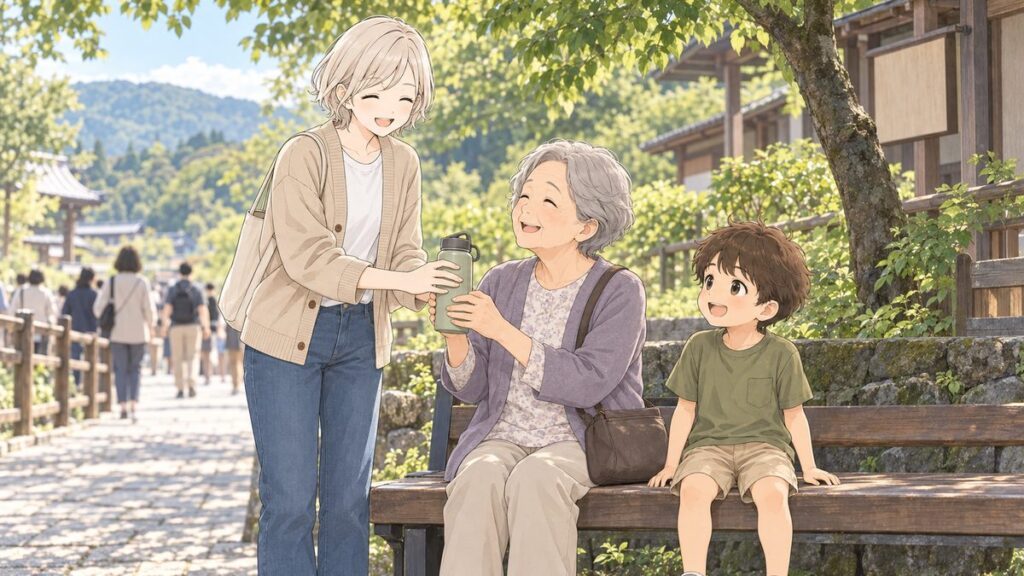
 Build the day around the person with the least tolerance for crowding, standing, or repeated transfers. Ask which part is difficult, because a packed carriage, a long queue, and a steep walk call for different changes.
If standing is the problem, prioritize a reserved seat and an outing with planned places to sit. If a dense crowd is the problem, protect the quieter visiting window and agree that you can leave without finishing. A booking you’ve already paid for shouldn’t become a reason someone has to endure an unsuitable outing.
For a small child, keep food and a return to the room within the plan. Choose a nearby base only after checking the walking route and access, then keep the afternoon flexible. My Japan-with-kids guide and stroller guide cover those decisions in more detail.
For a day with fewer outings, choose a stay where you can have dinner, breakfast, and activities at the property. With children or older companions, I’d make this my first choice when repeated trips out are the main strain: you can enjoy part of the holiday without leaving the accommodation each time. Check which meals and activities are included and which need separate reservations before booking.
An early start also needs an earlier night. If that doesn’t suit your parent, partner, or child, change the visiting day or choose a less demanding stop; dawn sightseeing isn’t an obligation.
FAQ
When is the best time to visit Japan to avoid crowds?
Choose dates outside the local attraction’s main season, public holidays, and major events, then favor ordinary weekdays where possible. There isn’t one quiet month for every destination: the season that draws people to one place may matter much less somewhere else. Check your priority sight’s calendar before fixing the hotel dates.
Is a ryokan worth it?
Yes, if the room, bathing arrangements, meals, and time spent there are part of the trip you want. It’s harder to justify when you arrive late, skip the included experience, and leave immediately after breakfast. I’ll cover how to choose a ryokan in a separate article.
How do I avoid crowded trains in Japan?
For local travel, try a departure outside commuter peaks and avoid combining a busy transfer with large suitcases. For an intercity journey, book an ordinary reserved seat before considering Green Car, and choose a departure that doesn’t force you to rush. A better seat changes the ride, not the station around it.
Do I need to spend more to enjoy Japan?
No: earlier visits, fewer hotel changes, and a lighter daily plan may be enough. Add money only where it removes a difficulty your group would otherwise face, then fit that choice into the whole trip using my 10-day itinerary and budget guide.
Compare Kyoto stays near the sights on Agoda
Now I’m curious about your side of the world — where do you draw the line between saving money and being comfortable on a trip? Tell me in the comments below. I read every single one!
I hope this guide has answered one of your questions and helped you feel a little closer to Japan. May your Japan journey be filled with wonderful discoveries and memories you’ll treasure for years to come.
See you in the next guide.

Comments