Planning a trip to Japan usually looks like this: forty browser tabs, three currencies, and still no answer to the only question that matters — how much is this actually going to cost me?
Here’s the answer: ¥200,000 per person, about $1,300 for a 10-day trip. Not a rough guess — a complete plan. Tokyo, a hot spring ryokan in Hakone, Kyoto, Osaka, and Universal Studios, with hotels, major train journeys, and attraction tickets priced out as of summer 2026. I live in Japan, so the numbers are current — including the price changes introduced this year that many guides haven’t caught up with yet.
This is a plan built on one promise: one main thing per day, real costs attached to real days, and enough empty space to actually enjoy yourself. Close the other tabs. Let’s plan your trip.

Disclosure: This article contains affiliate links. If you book through one, I may earn a small commission at no extra cost to you.
In a hurry? Everything in this guide, in one list:
- teamLab Planets tickets — book before you fly, it sells out
- Hakone Freepass — the day-trip transport bundle
- USJ 1-Day Studio Pass — park entry
- USJ Express Pass 4 — the line-skipping upgrade
These are the four bookings from this itinerary — the ones that sell out first.
- How Much Does 10 Days in Japan Cost? The Full Budget Breakdown
- The 10-Day Route: Tokyo → Hakone → Kyoto → Osaka
- Days 1–3: Tokyo — Land, Breathe, Then Explore
- Days 4–5: Hakone — The Vacation Inside Your Vacation
- Days 6–7: Kyoto — Old Japan, One Temple at a Time
- Days 8–10: Osaka — Big Fun, Big Food, Easy Exit
- What I Left Out (On Purpose)
- Book These Before You Fly: The Reservation Calendar
- 2026 Price Changes You Should Know
- What to Eat: My “Can’t-Go-Wrong” List for Each City
- FAQ: The Questions Everyone Asks
- Ten Days, ¥200,000, (≈,300) Zero Regrets
How Much Does 10 Days in Japan Cost? The Full Budget Breakdown
If you’ve been researching a trip to Japan, you’ve probably noticed something frustrating: itinerary articles tell you where to go but not what it costs, and budget articles give you numbers with no plan attached. That doesn’t really help, does it?
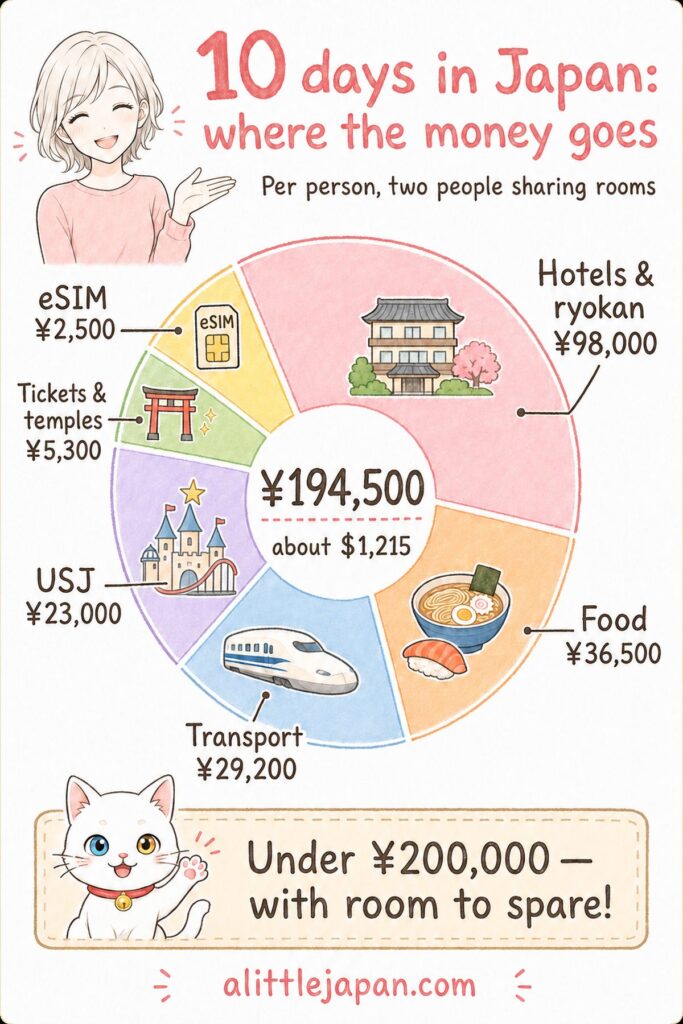
So here’s the answer first: ¥200,000 per person — roughly $1,300 — covers a 10-day trip to Japan. That’s based on two people traveling together and sharing rooms, and it includes everything from the moment you land: nine nights of accommodation, transportation, a two-night stay at a hot spring ryokan with dinner and breakfast, Universal Studios Japan with an Express Pass, and a daily food budget. In fact, the full plan below adds up to ¥194,500 (≈$1,265) — leaving you a cushion of about ¥5,500 (≈$36) for that unplanned ice cream. Not a “survival budget” — a trip you’ll actually enjoy.
Prices are in yen, with rough dollar figures at about ¥154 to the dollar (September 2026). Exchange rates move, so treat the dollars as a ballpark.
| Category | Per person | USD (approx.) |
|---|---|---|
| Hotels & ryokan (9 nights) | ¥98,000 | $640 |
| Trains & transport (airport to airport) | ¥29,200 | $190 |
| USJ (1-day pass + Express Pass 4) | ¥23,000 | $150 |
| teamLab, temples & attractions | ¥5,300 | $35 |
| Food (10 days) | ¥36,500 | $240 |
| eSIM (data for your phone) | ¥2,500 | $16 |
| Total | ≈ ¥194,500 | ≈ $1,265 |
Every number in this table connects to a specific day in the plan below — you’ll see the same figures again, day by day, so you always know where your money is going.
 Hotels and the ryokan are the biggest line in this budget — roughly half of it — so this is the one place where comparing rates really pays off. Current prices for the four stops on this route: Tokyo, Hakone, Kyoto, and Osaka on Agoda.
What This Budget Includes (and What It Doesn’t)
Let me be upfront about the fine print, so there are no surprises at the airport.
This budget does not include your international flights or souvenirs. Flights vary too wildly by country to give you one honest number, and souvenir spending is deeply personal — some people are happy with ¥5,000 (≈$33) of konbini snacks, others fill a suitcase. Budget those separately.
 Two more honest notes. If you’re traveling solo, add about ¥30,000–40,000, (≈$195–260) because you won’t be splitting room costs. And this plan assumes travel outside the peak seasons — cherry blossom and autumn foliage season push hotel prices up enough that this exact budget won’t hold. I’d rather tell you that now than have you find out mid-booking.
The 10-Day Route: Tokyo → Hakone → Kyoto → Osaka
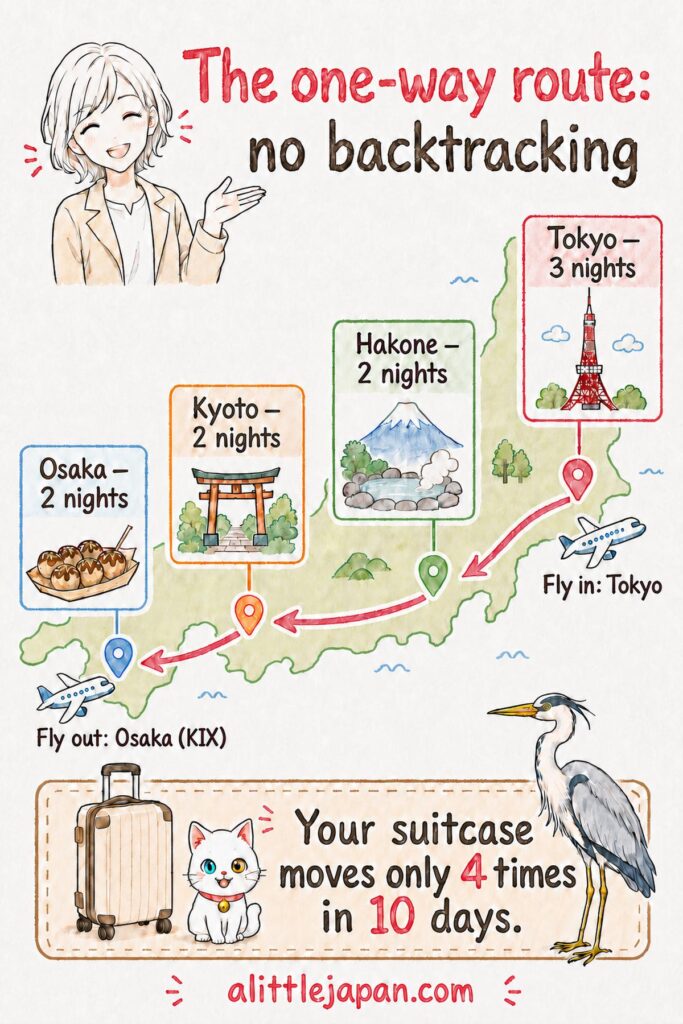
 The route is simple on purpose: fly into Tokyo, travel in one straight line, and fly home from Osaka. Tokyo for 3 nights, Hakone for 2, Kyoto for 2, Osaka for 2. You never backtrack, you never repack for a one-night stay, and your suitcase moves only four times in ten days.
One booking tip that makes this work: book an “open-jaw” ticket — into Tokyo (Narita or Haneda), out of Osaka (Kansai Airport). Many airlines price this similarly to a standard round trip, and it saves you a ¥14,000 (≈$91) train ride back to Tokyo plus half a day of your vacation.
Why Hakone in the middle? Because around day 4 or 5 of any Japan trip, your feet start filing complaints. Hakone is where this plan slows down: a traditional ryokan, dinner served in your room or at the inn, and a hot spring bath instead of a to-do list. Think of it as a vacation inside your vacation — and yes, those two nights are the single biggest line in the hotel budget. They’re worth it.
And here’s the promise this whole plan is built on: one main thing per day. Every day has one anchor — a shrine, a park, a neighborhood — and the rest is unscheduled. That’s not laziness; that’s how you leave room for the alley you want to wander down, the second bowl of ramen, the unplanned hour in a stationery shop. The days below tell you the one thing worth locking in. Everything else is yours.
Days 1–3: Tokyo — Land, Breathe, Then Explore
Day 1: Arrival Day (Plan Nothing. Seriously.)
Whatever time you land, Day 1 has exactly one job: get to your hotel. Take the Skyliner from Narita (¥2,580, (≈$17) 41 minutes to Ueno) or the monorail from Haneda, check in, and let your body arrive too. Torn between the Skyliner, N’EX, bus, or a private transfer? My Narita to Tokyo comparison does the math for you. Your first dinner isn’t at a restaurant — it’s from a Japanese convenience store. A konbini haul of onigiri, fried chicken, a salad, and a drink you can’t identify costs about ¥1,500 (≈$10) and is a genuinely beloved Japan experience, not a compromise. Jet lag wins tonight. Let it. If your shoulders need more than a konbini dinner to let go, a dry head spa is one treat you can actually book for arrival day — my guide to booking a head spa in Tokyo in English shows which salons confirm quickly.
Day 1 spending: ¥2,580 (≈$17) transport + ¥1,500 (≈$10) dinner
Day 2: Asakusa by Day, teamLab by Night
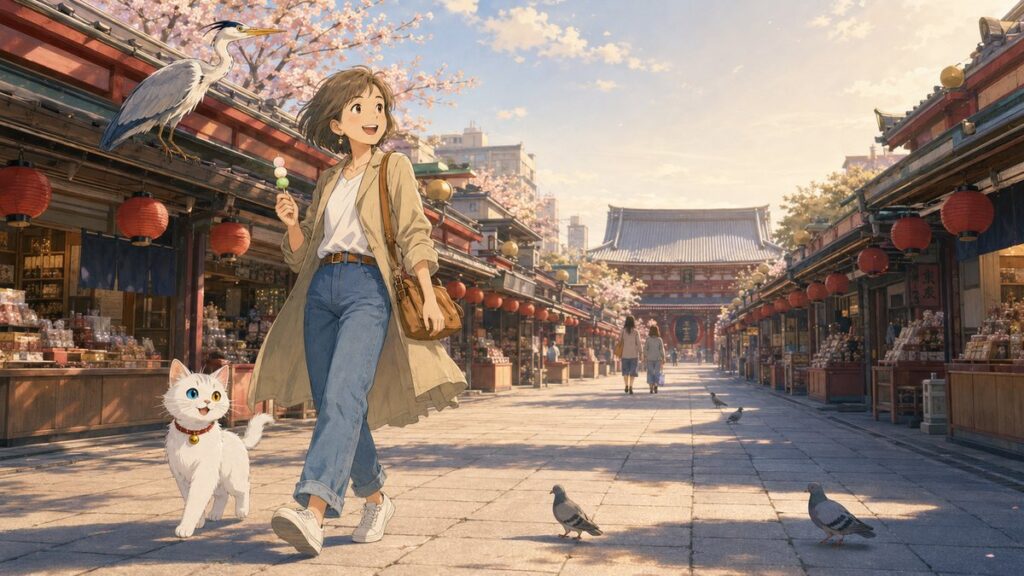
Start at Senso-ji, Tokyo’s oldest temple — go before 9 a.m. and you’ll share it with monks and pigeons instead of crowds. Wander down Nakamise Street, draw an omikuji fortune, and eat your way through the food stalls. Entry is free; lunch from the stalls runs ¥1,500 (≈$10) or so. Then stop. Go back to the hotel, rest your feet.
Your one pre-booked ticket in Tokyo is tonight: teamLab Planets in Toyosu (¥3,600–4,200 (≈$23–27) depending on the date — book before you fly, because popular dates can sell out weeks ahead). You’ll walk barefoot through water and light, and your camera roll will never be the same.
Day 2 spending: ¥3,800 (≈$25) teamLab + meals
Day 3: Meiji Shrine to Shibuya — One Long, Perfect Walk
Today is one continuous line, no trains needed once you arrive. Morning at Meiji Shrine, where a forest of 100,000 trees somehow exists inside Tokyo (free). Drift down through Harajuku — Takeshita Street if you want the chaos, Omotesando if you want the calm. End at Shibuya Crossing at dusk, when the neon comes on and a thousand people cross in every direction at once. It’s free, and it’s the Tokyo you came for.
Day 3 spending: just meals — today costs nothing to see
Your Tokyo Total
| Hotels (3 nights) | ¥33,000 (≈$215) |
| Transport (airport + city) | ¥4,580 (≈$30) |
| teamLab Planets | ¥3,800 (≈$25) |
| Food (3 days) | ¥12,000 (≈$78) |
| Tokyo stint | ≈ ¥53,400 (≈$350) |
Days 4–5: Hakone — The Vacation Inside Your Vacation

Day 4: The Slow Train to Slow Down
 Check out after breakfast and head to Shinjuku Station for the Romancecar — a comfortable reserved-seat express that runs straight to Hakone-Yumoto in about 85 minutes, no transfers. Buy the 3-day Hakone Freepass (¥7,500 (≈$49)) plus the Romancecar seat fee (about ¥1,200 (≈$8)). The Freepass covers nearly every boat, cable car, and ropeway you’ll ride tomorrow, plus your exit train on Day 6. Full disclosure: buying every ticket separately costs about the same — the pass simply saves you six separate ticket lines and adds small discounts along the way. You can get the Freepass on Klook before you fly — one less ticket machine to figure out on travel day.
Have lunch along Hakone-Yumoto’s charming main street, then check into your ryokan around 3 p.m. — and that’s it. That’s the day. Change into your yukata, sink into the hot spring bath, and let dinner come to you: a kaiseki course of small, beautiful dishes that’s included in your room rate. Tonight, doing nothing is the itinerary.
Day 5: Volcano Eggs and a Pirate Ship (Then Back to the Bath)

Today’s loop is easy and entirely covered by your Freepass: ropeway up to Owakudani, a steaming volcanic valley where they boil eggs black in the sulfur springs (eat one — legend says it adds seven years to your life), then glide down to Lake Ashi and cross it on a gloriously unnecessary pirate ship. On a clear day, Mt. Fuji photobombs the whole ride. You’ll be back at the ryokan by mid-afternoon for another long soak. That’s the whole point.
A Quick Onsen Guide (from a Japanese mom)
 Nervous about the naked-bath thing? Everyone is, the first time. Here’s how it works: you wash and rinse thoroughly at the shower stations before entering the bath — the bath is for soaking, not scrubbing. Your small towel never goes in the water (fold it on your head like the locals do).
If you have tattoos, check with your ryokan ahead of time — many now offer private family baths you can book, which is also the comfortable option for shy first-timers. Nobody is looking at you, I promise. They’re all busy relaxing. (If this is your first onsen, my full onsen guide for first-timers walks through the whole routine, step by step.)
Your Hakone Total
| Ryokan (2 nights, dinner & breakfast included) | ¥30,000 (≈$195) |
| Hakone Freepass (3-day) + Romancecar | ¥8,700 (≈$57) |
| Black eggs & small extras | ¥1,000 (≈$6.50) |
| Food (2 lunches — dinners and breakfasts are covered) | ¥3,000 (≈$20) |
| Hakone stint | ≈ ¥42,700 (≈$280) |
If you book only one thing early on this trip, make it the ryokan. Rooms with a private open-air bath tend to go first, especially on weekends. See what is available in Hakone on Agoda.
Days 6–7: Kyoto — Old Japan, One Temple at a Time

Day 6: The One-Transfer Trip to Kyoto (Easier Than It Sounds)
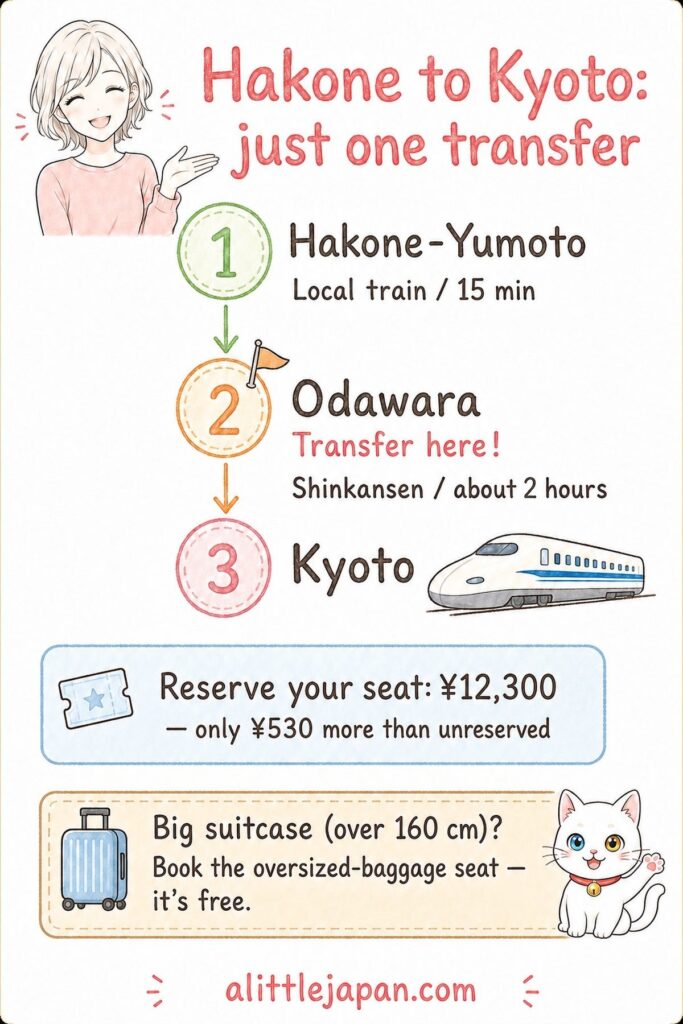
 Leaving Hakone is refreshingly simple: a local train from Hakone-Yumoto to Odawara (15 minutes, covered by your Freepass), then take a direct Hikari Shinkansen to Kyoto — about 2 hours, depending on the train. Book a reserved seat (¥12,300, (≈$80) just ¥530 more than unreserved): you’re guaranteed to sit together, and if your suitcase is on the larger side (over 160 cm total), JR actually requires a reserved seat with an oversized-baggage space — it’s free, but you must book it.
Drop your bags at the hotel, rest a little, then head out in the late afternoon for Fushimi Inari — the shrine with thousands of vermilion torii gates winding up a mountainside. Here’s the insider timing: the tour buses leave by 4 p.m., the gates are lit after sunset, and the shrine never closes. An evening walk through the glowing tunnels, with the crowds gone, is one of the best free experiences in all of Japan.
Day 6 spending: ¥12,300 (≈$80) transport — Fushimi Inari is free
Day 7: Kiyomizu-dera to Gion, the Classic Kyoto Evening
One anchor today: the eastern hills. Start with a sukiyaki lunch — the treat meal of this trip at around ¥4,000 (≈$26) (details, plus a special-occasion upgrade, in the food section). Then Kiyomizu-dera (¥500), the temple on massive wooden stilts overlooking the city, and a slow drift downhill through the preserved lanes of Sannenzaka and Ninenzaka — this is the Kyoto of photographs, all wooden facades and paper lanterns. Time it so you reach Gion at dusk, when the lanterns come on and, if you’re lucky and respectful, you might glimpse a geiko hurrying to an appointment. Keep dinner casual tonight — lunch was the event.
 Want to meet the deer instead? Swap today for a half-day trip to Nara: the Great Buddha at Todai-ji (¥800) and hundreds of bowing deer, 45 minutes from Kyoto. Half a day is genuinely enough — go in the morning, and you’re back in Gion by evening. A similar pace, with a little more spent on local transport — your choice.
Day 7 spending: ¥500 temple + local transport ¥600 + the sukiyaki lunch
Your Kyoto Total
| Hotels (2 nights) | ¥20,000 (≈$130) |
| Shinkansen from Odawara | ¥12,300 (≈$80) |
| Kiyomizu-dera & local transport | ¥1,100 (≈$7) |
| Food (2 days) | ¥10,500 (≈$68) |
| Kyoto stint | ≈ ¥43,900 (≈$285) |
Worried about Kyoto crowds? I compared which upgrades actually buy you quieter hours, and which don’t, in my guide to avoiding crowds in Japan.
Days 8–10: Osaka — Big Fun, Big Food, Easy Exit
Day 8: The 30-Minute Move, Then Osaka at Night
Kyoto to Osaka is barely a trip: ¥580 and about 30 minutes on the JR rapid train. No reservations, no planning — just go after breakfast. You’ll have dropped your bags at the hotel before lunch, with a whole afternoon to rest before Osaka’s main event: the night.
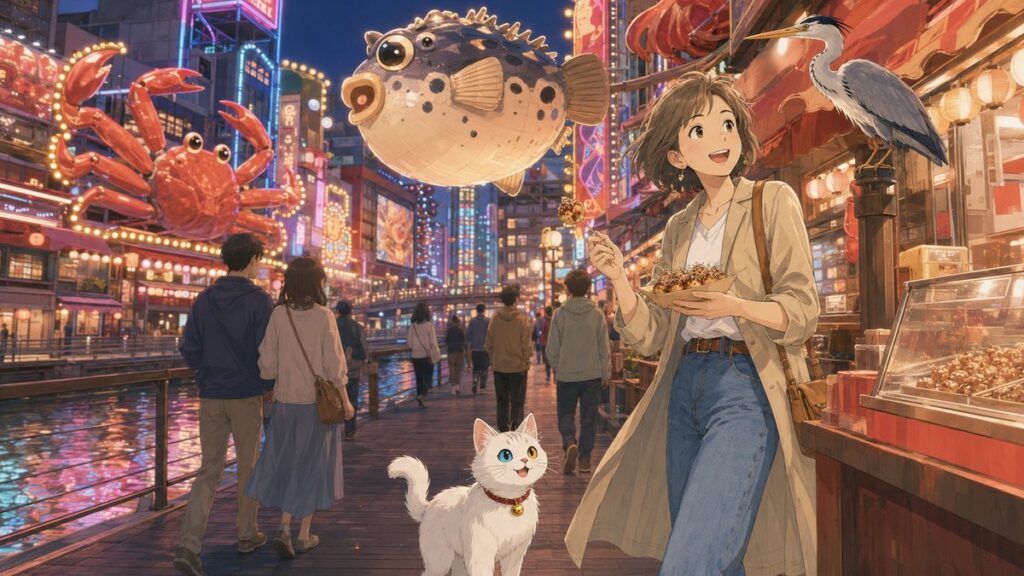
Dotonbori after dark is everything the photos promise — a canyon of neon, giant mechanical crabs, the famous Glico running man, and food in every direction. This is takoyaki and okonomiyaki territory (details in the food section). Wander, eat, repeat. Dinner here runs about ¥2,000 (≈$13) and you’ll want to try everything.
Day 8 spending: ¥580 transport + street food dinner
Day 9: Universal Studios Japan — The Splurge Day, Done Right
This is the most expensive day of the trip, and it’s worth planning properly. Two tickets to buy, both before you fly:
First, the 1-Day Studio Pass costs from ¥8,400 (≈$55), depending on the date and how early you book; both the official site and Klook show the exact price for each day. Second, the Express Pass 4 starts at about ¥11,800 (≈$77) for autumn 2026 dates, though the versions that guarantee the most popular rides cost more. It isn’t just a luxury — it can mean the difference between riding four major attractions with short waits and spending your day in 90-minute lines. Choose an Express Pass that includes Area Timed Entry to Super Nintendo World — not every Express Pass does.
One honest warning: from September 2026, USJ switches to a system where ticket prices rise as demand rises — so booking early stops being a preference and becomes a money-saving move. I broke down which Express Pass is actually worth it in my USJ Express Pass guide.
Day 9 spending: ≈ ¥23,000 (≈$150) tickets + park food ≈ ¥3,000 (≈$20)
Day 10: The Retro-Futuristic Train to the Airport
Your last ride is a fun one: the Rapi:t, the deep-blue, porthole-windowed express from Namba to Kansai Airport — 39 minutes, ¥1,410 (≈$9) with the digital ticket. It looks like a retro spaceship and feels like a proper send-off; I wrote a full guide to the Rapi:t if you want the seat and ticket details. (Starting or ending in Kyoto instead? The Haruka express is the equivalent from that side, and its ticket is on Klook too.) If your flight is in the evening, Namba’s shopping streets are right there for last-minute souvenirs.
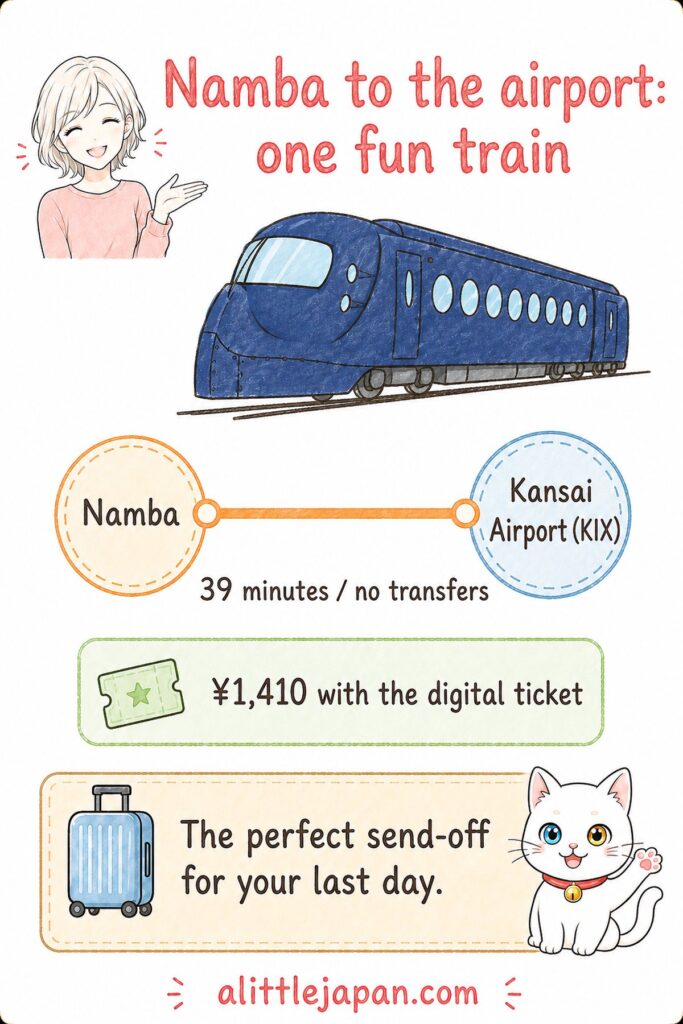
Day 10 spending: ¥1,410 (≈$9) transport
Your Osaka Total
| Hotels (2 nights) | ¥15,000 (≈$98) |
| USJ (pass + Express Pass 4) | ¥23,000 (≈$150) |
| Transport (incl. airport) | ¥3,000 (≈$20) |
| Food (street food heaven, 3 days) | ¥11,000 (≈$72) |
| Osaka stint | ≈ ¥52,000 (≈$340) |
What I Left Out (On Purpose)
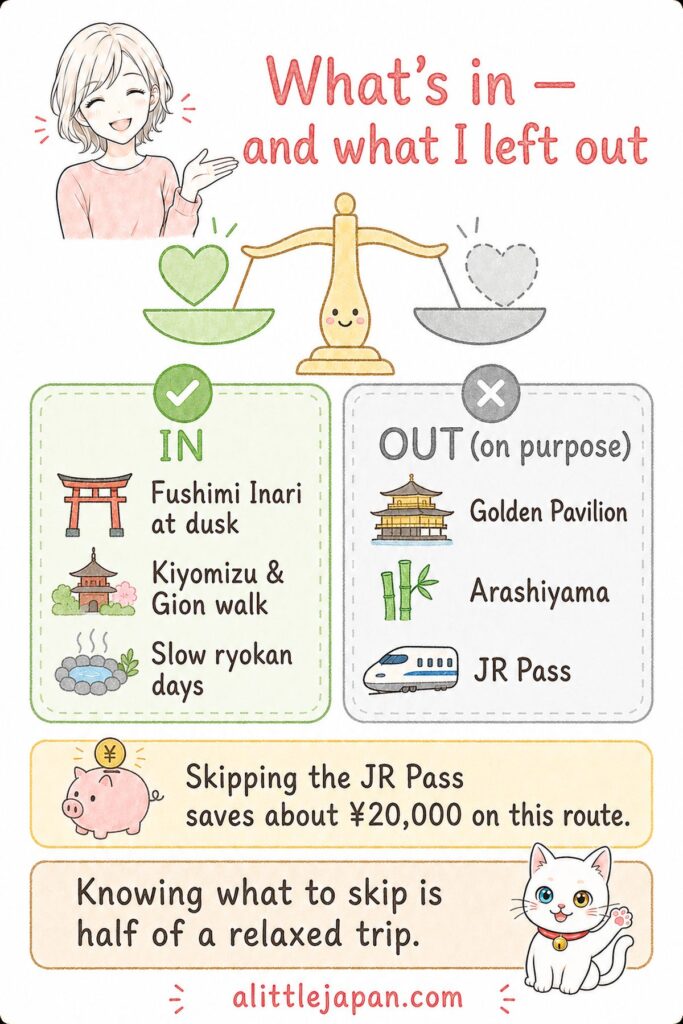
Every other 10-day itinerary tries to squeeze everything in. I’d rather tell you honestly what I cut, and why — because knowing what not to do is half of a relaxed trip.
Kinkaku-ji (the Golden Pavilion)
Yes, it’s beautiful. It’s also a 40-minute bus ride to the opposite side of Kyoto, for a visit that is essentially: see the famous view, take the famous photo, file out along the one-way path. You can’t enter the building. With only two Kyoto evenings, Fushimi Inari and the Kiyomizu-to-Gion walk are experiences you move through — the Golden Pavilion is one you look at. If you have a third Kyoto day someday, it’s a lovely morning. This trip doesn’t.
Arashiyama (the Bamboo Grove)
The bamboo forest photographs like a dream, but here’s the honest math: the grove itself is a 15-minute walk, at the center of a half-day round trip to Kyoto’s far western edge, shared with some of the densest crowds in the city. As a ratio of magic to effort, an evening at Fushimi Inari simply wins. Save Arashiyama for trip number two — ideally on a weekday, at 8 a.m.
The Japan Rail Pass
This one saves you real money by not buying it. The 7-day pass costs ¥50,000 (≈$325) (and rises to ¥53,000 (≈$345) from October 2026). This entire itinerary’s long-distance travel — airport trains, Hakone, the Shinkansen to Kyoto, Kyoto to Osaka, the airport express home — adds up to about ¥29,000 (≈$190). The pass only pays off when you’re crossing the country and back; a one-way route like ours makes it a ¥20,000 (≈$130) donation to JR. I did the full math in my JR Pass guide if you want to check other routes.
Book These Before You Fly: The Reservation Calendar
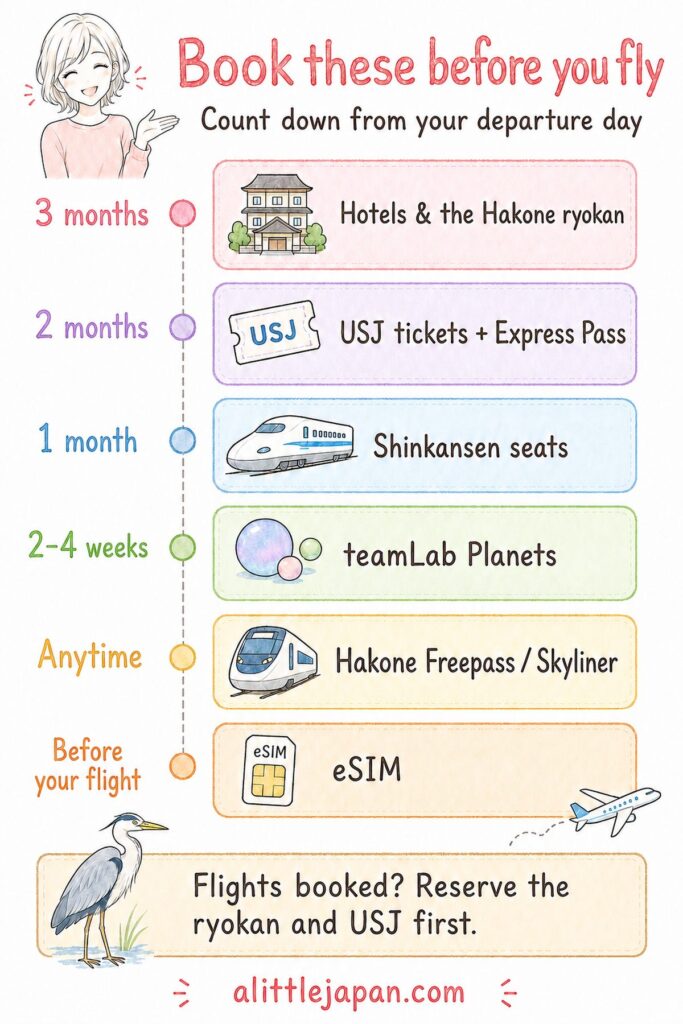
Japan has quietly become a book-ahead country — popular experiences now sell out, and some become more expensive as availability drops. The good news: only a handful of things actually need booking, and none of them are complicated. Here’s the whole list, sorted by deadline.
One more free thing for the same to-do list: register on Visit Japan Web before you leave. It takes about fifteen minutes and replaces the immigration and customs forms you’d otherwise fill in at the airport — my step-by-step guide covers it, including how to add children to one account.
| When | What | Where |
|---|---|---|
| ~3 months before | Hotels & the Hakone ryokan | Booking sites — good-value ryokan rooms with dinner go first |
| ~2 months before | USJ Studio Pass + Express Pass 4 | Klook or the official site — Express Passes sell out, and from Sept 2026 prices rise as dates fill |
| ~1 month before | Shinkansen reserved seats | SmartEX app or any JR station — seats open exactly one month ahead |
| 2–4 weeks before | teamLab Planets | Klook or the official site — morning and weekend slots go first |
| Anytime | Hakone Freepass, Skyliner | Klook — no sellout risk, just one less queue on the day |
| Before your flight | eSIM | See my eSIM guide — install at home, activate when you land |
Two things you don’t need to book: Fushimi Inari (always open, no ticket) and the Nara deer, who accept walk-ins.
 The one-sentence version: the moment your flight dates are fixed, book the ryokan and USJ — everything else can wait.
2026 Price Changes You Should Know
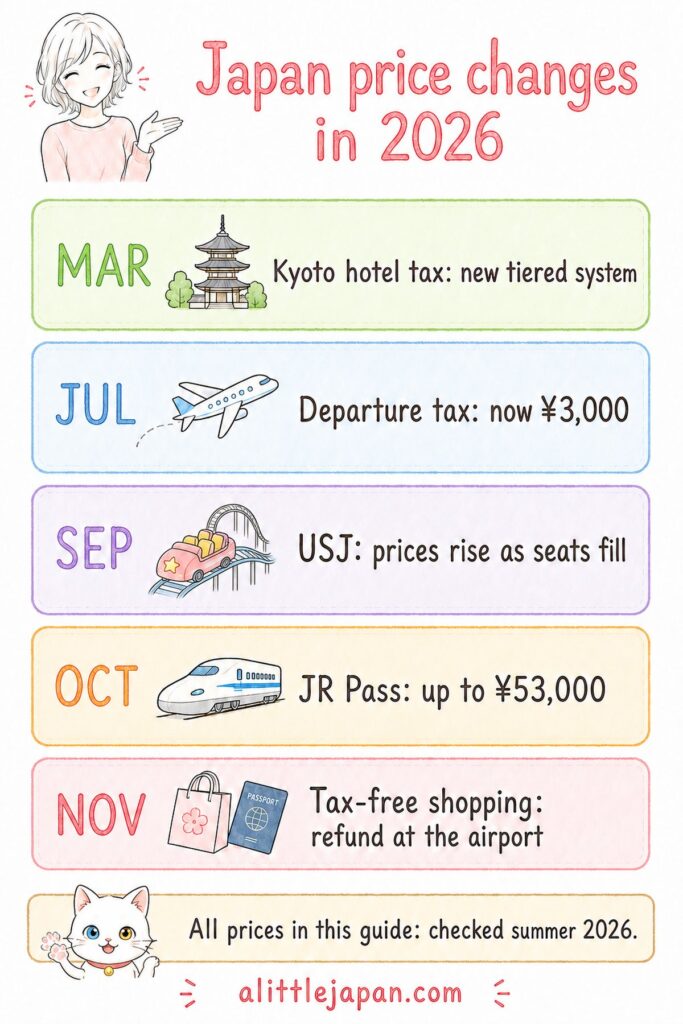
Prices in Japan have changed more in the past two years than in the previous twenty — which is exactly why a budget article needs a date on it. Everything above reflects summer 2026. Here’s what changed recently, and what changes next:
The departure tax tripled (July 2026). Japan’s exit tax rose from ¥1,000 (≈$6.50) to ¥3,000 (≈$20). You won’t pay it separately — it’s baked into your airline ticket — but it’s one reason your flight quote crept up.
Hotel taxes went up in Kyoto and Osaka. Kyoto now charges by room-rate tier (March 2026); at this plan’s hotel level it’s ¥400 per person per night. Osaka lowered its tax-free threshold, so almost every hotel now adds a small nightly tax. Both are already reflected in the budget above — just don’t be surprised by the extra line on your hotel bill.
Tax-free shopping changes completely on November 1, 2026. Instead of paying tax-free prices in the store, you’ll pay full price and claim the refund at the airport when you leave. If you’re traveling after that date and planning to shop, read my full tax-free guide before you go — it changes how you should pace your purchases.
And the two changes already covered above, in one line each: USJ moves to demand-based pricing in September 2026 (book early), and the JR Pass rises to ¥53,000 (≈$345) in October 2026 (still don’t buy it for this route).
What to Eat: My “Can’t-Go-Wrong” List for Each City
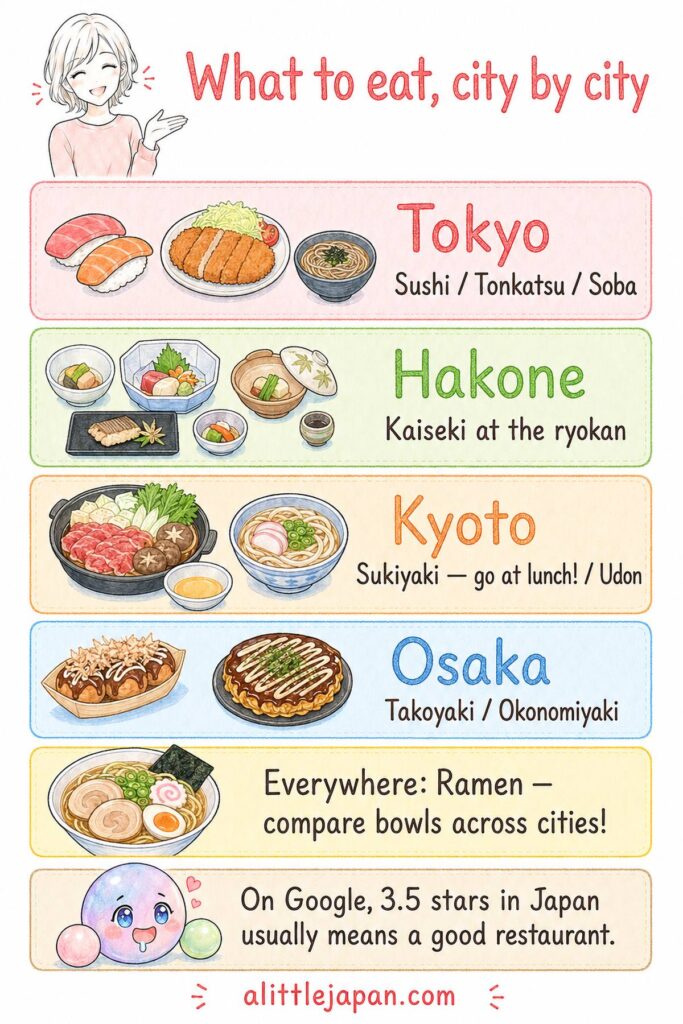
 ¥4,000 (≈$26) a day sounds tight for the food capital of the world, but here’s the math that makes it work: a konbini breakfast (¥500), a solid lunch (¥1,000 (≈$6.50)), and a real dinner (¥2,500 (≈$16)). Japan’s everyday food is so good and so affordable that the budget version of this trip still eats better than most people’s splurge trips elsewhere. The plan: each city gets its specialties, and you’ll have tried everything on my “can’t-miss” list — sushi, ramen, sukiyaki, tonkatsu, street food — exactly once by Day 10.
| City | Eat this | If you’re unsure, go here |
|---|---|---|
| Tokyo | Sushi, tonkatsu, soba | Sushiro (touch-screen ordering in English), Maisen for tonkatsu, any standing soba shop for the ¥500 experience |
| Hakone | Kaiseki at the ryokan | Already booked — it comes to you |
| Kyoto | Sukiyaki (Kansai-style), udon, teishoku set meals | Sukiyaki at lunch — casual sukiyaki lunch sets run around ¥3,000–4,000 (≈$20–26). Celebrating something? Book Mishima-tei, a sukiyaki restaurant that has been in business since 1873: the lunch course (from about ¥8,600 (≈$56)) is roughly half its dinner price. Reserve at least 3 days ahead — closed Wednesdays, English menu available. Marugame Seimen for udon |
| Osaka | Takoyaki, okonomiyaki, izakaya night | The food stalls and casual shops around Dotonbori — this is the city where street food is the whole meal |
| Everywhere | Ramen | Ichiran — not the ramen-nerd pick, but the friendliest first bowl in Japan: English menus, a ticket vending machine, and your own private booth. Compare bowls across cities |
One cultural decoder that will change how you choose restaurants: in Japan, a 3.5-star rating on Google usually means a good restaurant. Japanese reviewers grade hard — a 3.2 can be genuinely great, and anything above 3.8 usually has a line. Don’t skip a place because it “only” has 3.4 stars; that’s often exactly where the locals are.
 And one mom-tip for your wallet: the vending-machine ticket system at many casual restaurants (buy a ticket, hand it over, sit down) isn’t just efficient — it means no tipping, no bill anxiety, and no surprises. The price on the machine is the price. It never stops feeling like a small miracle.
FAQ: The Questions Everyone Asks
How much extra if I’m traveling solo?
Add about ¥30,000–40,000 ($195–250). Rooms are the reason — nearly everything else in this plan costs the same alone. The ryokan is the biggest jump, since rates are per person and solo-traveler plans are rarer. Everything else — trains, tickets, food — is identical.
Does this budget work during cherry blossom or autumn foliage season?
Honestly, no. Hotel prices in late March–early April and November rise 50–100%, and the ryokan will be the hardest hit. The same trip in peak season is realistically a ¥250,000–280,000 (≈$1,630–1,825) plan. If those seasons are your dream, budget for it — or aim for May or October, which are beautiful and much kinder to your wallet. If you’re set on koyo season anyway, my guide to what to wear in Japan in October covers the packing side of an October or November trip.
Is this plan doable with kids?
The route, yes — the pace is gentle by design, and Japan is a wonderfully easy country for family travel. The budget, not quite as written: children under 6 ride trains free and kids’ USJ tickets are cheaper, but you’ll need a bigger room or two rooms, which changes the hotel math. A family version of this plan is on my list to write.
What about the flight — how much should I expect?
Too country-dependent for one honest number, but as rough 2026 ranges: $700–1,400 round trip from North America, €650–1,100 from Europe, and less from Australia and Southeast Asia. Book 3–6 months out and remember the open-jaw trick from earlier — into Tokyo, out of Osaka.
Do I need to tip in Japan?
No — and please don’t. Tipping isn’t part of the culture here, and leaving money on the table will usually get you chased down the street by a staff member returning it. Service charges are already built into the price, and good service is simply the standard, not something you pay extra for. The one exception you might meet is a small “service charge” line on the bill at high-end restaurants and ryokan, which is added automatically — nothing for you to calculate. Save the mental math for the fun part of your budget.
Do I need cash, or does Japan take cards now?
Cards and phone payments work almost everywhere on this route now — hotels, trains, USJ, chain restaurants. (For trains and convenience stores, an IC card makes it even easier — here’s how to choose between Suica and Pasmo.) Carry ¥10,000–20,000 (≈$65–130) in cash for street food stalls and small family-run places — and keep the coins from your change. You’ll want them at shrines: tossing a coin into the offering box before you pray is the custom, and the ¥5 coin is considered the luckiest. Its name, “go-en,” sounds exactly like the Japanese word for “good fortune and connection.” Withdraw cash at any 7-Eleven ATM (they accept foreign cards and have English-language menus). For the currency-choice screen, fees and what to do if your card is declined, see my guide to using a foreign card at Japan ATMs. Not sure how much yen to carry? See how much cash to bring to Japan for amounts by trip length.
Ten Days, ¥200,000, (≈,300) Zero Regrets
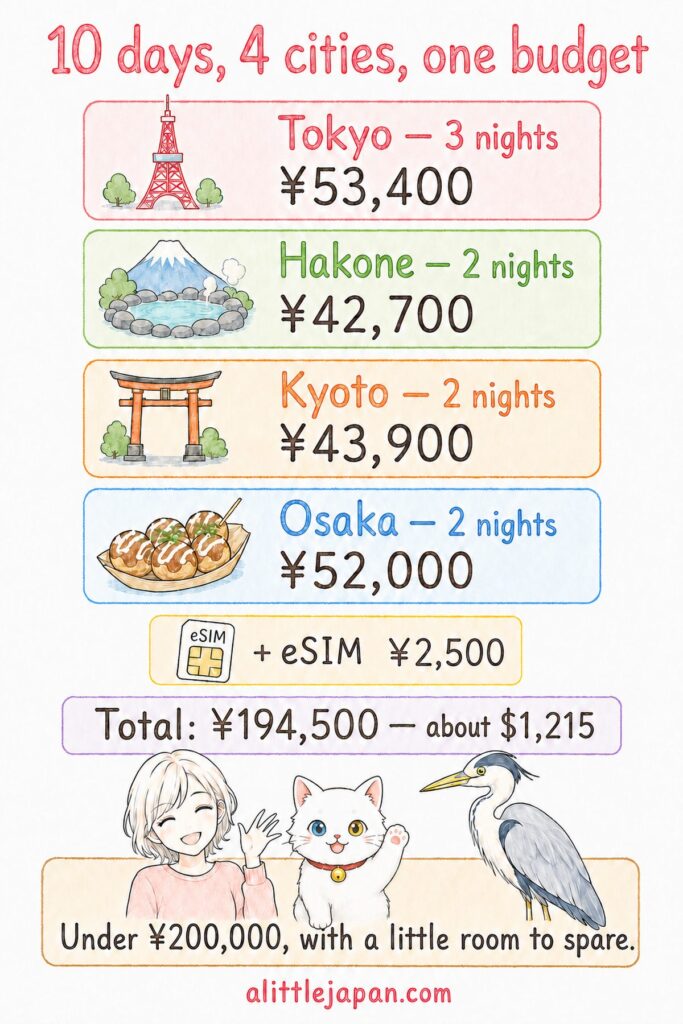
So that’s the whole plan: ten days, four cities, one straight line from Tokyo to Osaka — and every yen accounted for. Three things to remember above all: book the ryokan and USJ the moment your flights are set, skip the JR Pass for this route, and protect the empty spaces in the schedule. The unplanned hours are where Japan actually happens.
The one-glance recap:
- Tokyo (3 nights) ≈ ¥53,400 (≈$350) — temples, neon, and teamLab
- Hakone (2 nights) ≈ ¥42,700 (≈$280) — the ryokan is the destination
- Kyoto (2 nights) ≈ ¥43,900 (≈$285) — glowing torii gates at dusk
- Osaka (2 nights) ≈ ¥52,000 (≈$340) — USJ and street food heaven
- eSIM ¥2,500
- Total ≈ ¥194,500 (about $1,265) per person — under ¥200,000, (≈$1,300) with a little room to spare
Ten days of walking adds up. If your feet are already complaining by day three, here’s the ¥1,500 (≈$10) hotel routine I use to reset in the evening.
Thinking about bringing a piece of Japan home with you? Here’s my honest take on whether a Zojirushi rice cooker is worth the money.
Now I’m curious about your side of the planning: how much would a 10-day trip cost in your country? And if you’ve been to Japan — what would you cut, and what would you never skip? Tell me in the comments. I read every one.
See you in the next guide.

Check Tokyo Hotel Prices on Agoda
What to Read Next
- Is the JR Pass Worth It in 2026?
- Best eSIM for Japan: Tested & Compared
- What to Wear in Japan in October & Autumn
- Japan Tax-Free Shopping Guide
- Budgeting for the days you change cities? Luggage Forwarding in Japan: Is It Worth It?


Comments