¥50,000. That’s what a 7-day Japan Rail Pass costs now — roughly a night or two at a nice hotel. Whether it’s worth it isn’t a matter of opinion; it’s simple math that depends on your route. Some travelers genuinely save money with the pass. Most first-timers, honestly, don’t.
Here’s my one unusual qualification: as a Japanese mom living in Japan, I’m not eligible to buy this pass myself. But I’ve been riding these same trains all my life, paying for every ticket one by one — so I have a pretty good idea what your rides should cost, and I’ll help you decide in about two minutes.

Disclosure: This article contains affiliate links. If you book through one, I may earn a small commission at no extra cost to you.
In a hurry? Everything in this guide, in one list:
- 7-Day whole-Japan JR Pass — the nationwide pass this article does the math on
- Kansai Area Pass — Osaka–Kyoto–Nara–Kobe short hops
- Kansai Wide Area Pass — adds Himeji and Kinosaki
- All Kyushu Area Pass — the southern island loop
- Hokkaido Rail Pass — the northern island loop
Do the math first — for many itineraries individual tickets win. The passes above are for when they don’t.
- The Quick Answer: Find Your Trip in This Table
- What Is the JR Pass, and Why Isn’t It an Automatic Yes Anymore?
- The Math: Why Most Travelers Lose Money on the JR Pass
- When the JR Pass Does Pay Off
- The Smarter Alternative: Regional Passes
- The Nozomi Problem: The Pass Doesn’t Cover the Fastest Trains
- Which Seat Should You Book? A Japanese Mom’s Seat-Picking Tips
- Where to Buy the JR Pass (This Changes in October 2026)
- JR Pass FAQ: Quick Answers Before You Decide
- The Bottom Line: Buy the Pass for the Right Trip, Not Just in Case
The Quick Answer: Find Your Trip in This Table
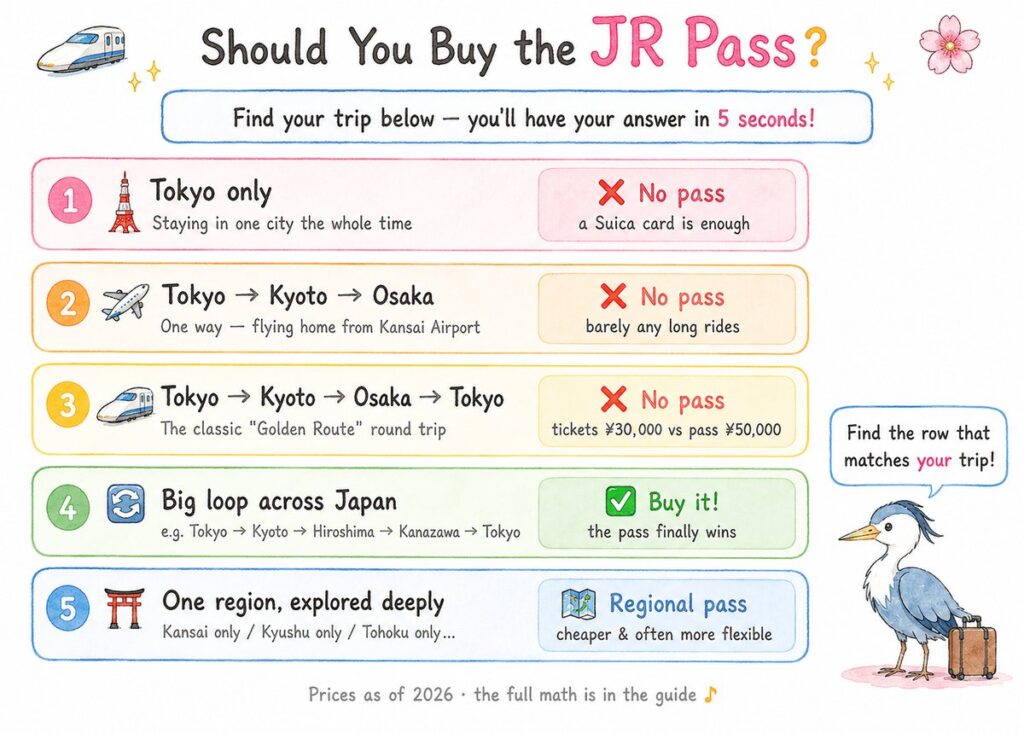
 Find the row that looks like your itinerary — the verdict is right next to it.
| Your trip looks like… | Should you buy the nationwide JR Pass? |
|---|---|
| Tokyo only | ❌ No — a Suica card is all you need |
| Tokyo + Kyoto + Osaka, flying home from Kansai | ❌ No — you barely use long-distance trains |
| Tokyo + Kyoto + Osaka + back to Tokyo (the Golden Route) | ❌ No — round-trip tickets are about ¥20,000 (roughly $130) cheaper than a 7-day pass |
| A big loop: Tokyo, Kyoto, Hiroshima, Kanazawa… | ✅ Yes — the pass pays off |
| One region, explored deeply (Kansai, Kyushu, Tohoku…) | 🔁 Get a regional pass instead |
If you found your row, you already have your answer. The rest of this guide shows you the numbers behind it — plus the seat-booking tricks I wish every first-time rider knew.
 Check the current JR Pass price on Klook.
What Is the JR Pass, and Why Isn’t It an Automatic Yes Anymore?
The Japan Rail Pass is a ticket that lets you ride almost every JR train in the country — including most Shinkansen, with a few important exceptions we’ll get to — as much as you want, for 7, 14, or 21 days. (Subways and private railways are separate companies, so those aren’t included.) For years, it was the first thing every guidebook told you to buy before flying to Japan. Not anymore.
 In October 2023, the price jumped by about 70%. A 7-day pass went from ¥29,650 (about $195) to ¥50,000 (about $325) — the trains themselves didn’t change, but the ticket now costs far more. That’s why “should I get a JR Pass?” has quietly become one of the most common questions travelers ask before their trip.
Here are the current prices (as of 2026):
Prices are in yen, with rough dollar figures at about ¥154 to the dollar (September 2026). Exchange rates move, so treat the dollars as a ballpark.
| Pass | Ordinary Car | Green Car (First Class) |
|---|---|---|
| 7 days | ¥50,000 (≈$325) | ¥70,000 (≈$455) |
| 14 days | ¥80,000 (≈$520) | ¥110,000 (≈$715) |
| 21 days | ¥100,000 (≈$650) | ¥140,000 (≈$910) |
Children aged 6–11 pay half price.
 So is it a bad deal now? Not always — but it stopped being something you buy “just in case.” Whether it pays off depends entirely on how far you plan to travel. Let’s do the math together.
The Math: Why Most Travelers Lose Money on the JR Pass
Here’s the honest answer up front: if your trip is the classic first-timer route — Tokyo, Kyoto, Osaka — the JR Pass will cost you more than just buying tickets. Let me show you the actual numbers.
A one-way Shinkansen ticket from Tokyo to Kyoto costs about ¥14,400 with a reserved seat. Between Kyoto and Osaka, the JR Special Rapid train costs around ¥600. So the whole “Golden Route” looks like this:
| Trip | Regular Ticket |
|---|---|
| Tokyo → Kyoto (Shinkansen) | about ¥14,400 |
| Kyoto → Osaka (JR Special Rapid) | about ¥600 |
| Osaka → Tokyo (Shinkansen) | about ¥15,000 |
| Total | about ¥30,000 (≈$195) |
 The 7-day pass costs ¥50,000 (≈$325). That’s a difference of more than ¥20,000 (about $130) — per person. For four adults, the overpayment tops ¥80,000 (about $520) — practically another trip’s budget. (Kids aged 6–11 pay half for both passes and tickets, so family numbers differ — the direction doesn’t.)
As a rough rule of thumb: the pass starts paying off when your 7 days include three or more long-distance rides of the Tokyo–Kyoto class. A simple there-and-back doesn’t come close. It’s a starting point, not a promise — always run the numbers for your exact route.
Don’t feel bad if you assumed the pass was the smart default — it used to be, before the 2023 price hike. The good news is that once you know your route, the decision almost makes itself. Let’s look at when the pass does win.
When the JR Pass Does Pay Off
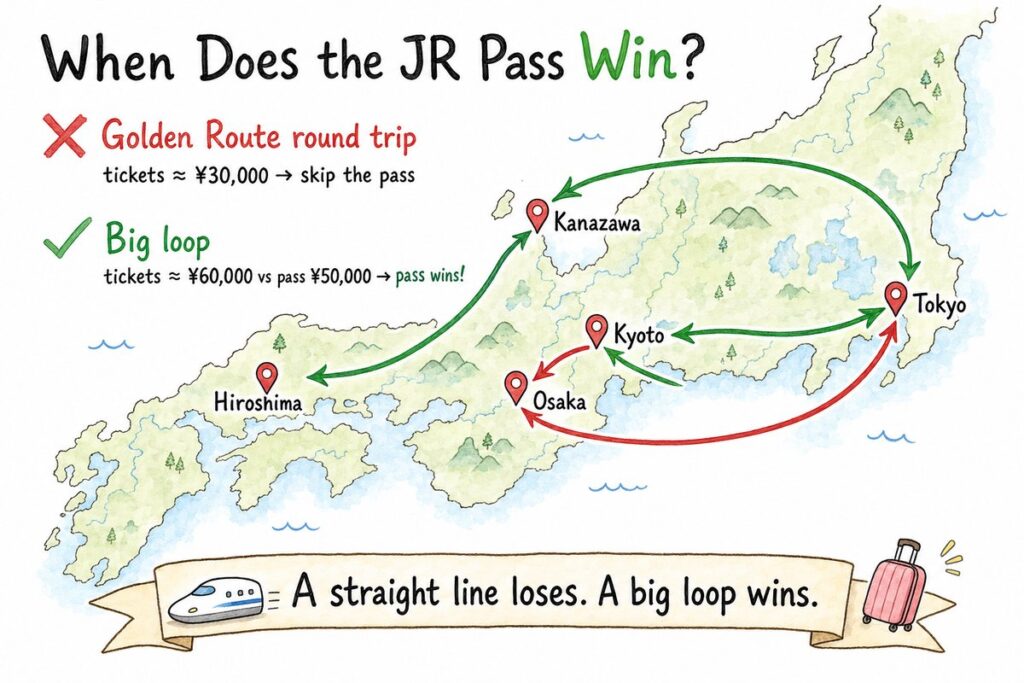
The pass starts winning the moment your trip stops being a straight line and becomes a loop. The magic ingredient is distance — but strictly speaking, what decides it is simple: whether the total cost of your covered rides beats the pass price. Big cross-country loops are just the easiest way to get there.
 Here’s a 7-day itinerary where the pass clearly wins:
| Trip | Regular Ticket |
|---|---|
| Tokyo → Kyoto | about ¥14,400 |
| Kyoto → Hiroshima | about ¥12,000 |
| Hiroshima → Kanazawa | about ¥18,800 |
| Kanazawa → Tokyo | about ¥14,800 |
| Total | about ¥60,000 (≈$390) |
That’s ¥10,000 (about $65) more than the ¥50,000 (about $325) pass — so the pass saves you money, and that’s before counting the small rides in between. The JR Pass also covers things people don’t expect: the Narita Express from the airport, the Haruka airport express from Kansai Airport to Kyoto, local JR lines inside cities, even the ferry to Miyajima, the famous shrine island near Hiroshima (just bring ¥100 for the small visitor tax — that part isn’t included). If you want the full airport math — N’EX vs Skyliner, bus, and private transfers — I compare them all in my Narita to Tokyo guide.
There’s one more benefit that never shows up in calculators: freedom. With the pass, seat reservations are free and unlimited, so a rainy-day change of plans — “let’s do a day trip to Himeji instead” — adds no extra JR fare, as long as your trains are covered and seats are open. When every ride is separately paid, you hesitate. With a pass, you just go.
If your route looks like a big loop across several regions, the pass is probably your friend. If you’re staying in one area — say, only Kansai or only Kyushu — there’s a smarter option, and that’s next.
A trip that makes the pass pay off is also a trip with three or four hotel bookings, and moving cities on a Saturday is when the good rooms have already gone. Worth lining up early: Tokyo, Kyoto, Osaka on Agoda.
 Staying in Kansai? Many of the region’s most comfortable rides, like Aoniyoshi, Hinotori and the Keihan Premium Car, are not JR trains, so no JR pass covers them. Here are 8 Kansai trains worth paying extra for, with how to book each one.
The Smarter Alternative: Regional Passes
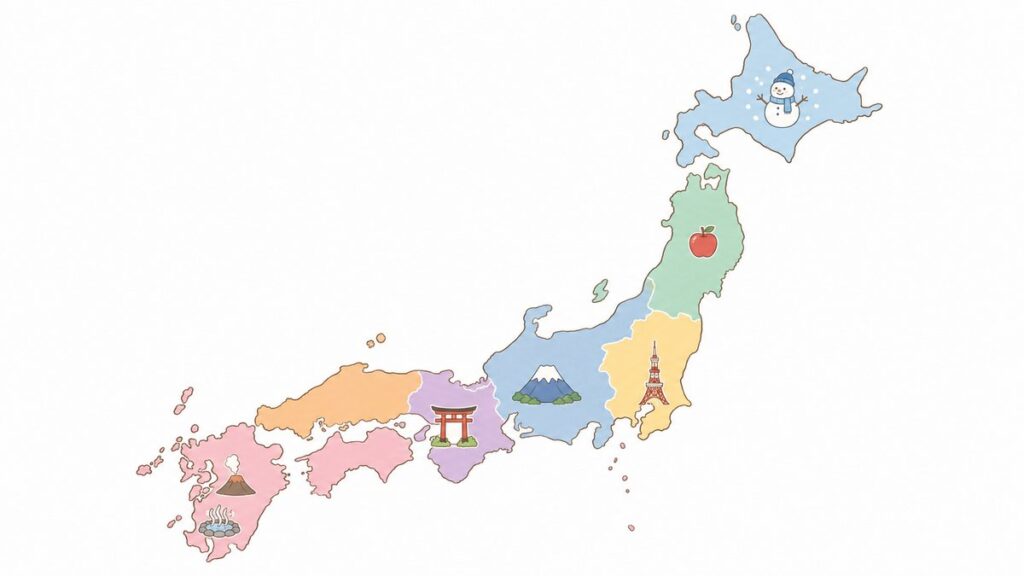
If your trip stays mostly in one region, a regional pass gives you the same “unlimited rides” freedom at a fraction of the price. This is where most travelers should actually be looking.
Each JR company sells its own passes, and the popular ones look like this:
| Pass | Best for | Price |
|---|---|---|
| JR East Pass | Tokyo + Tohoku / Nagano / Niigata | 5 days ¥35,000 / 10 days ¥50,000 |
| Kansai Area Pass | Osaka, Kyoto, Nara, Kobe | from ¥2,800 (1 day) |
| Kansai Wide Area Pass | Kansai + Himeji, Okayama, Kinosaki | 5 days ¥12,000 |
| All Kyushu Area Pass | The whole Kyushu loop | 3–7 days ¥22,000–26,000 |
| Hokkaido Rail Pass | Sapporo, Hakodate, Furano | 5–10 days ¥22,000–37,000 |
Two things worth knowing. First, the JR East Pass was renewed in March 2026 — the old Tohoku and Nagano-Niigata versions were merged into one pass, so older articles you may have read are out of date. Second, some regional passes are actually more generous than the national one: on JR West’s passes that include the Sanyo Shinkansen (like the Kansai Wide pass), you can ride every train on that line — Nozomi and Mizuho included — with no extra fee. That’s something the nationwide JR Pass doesn’t allow.
One small note: the Hokkaido Rail Pass costs ¥1,000 more if you buy it after arriving in Japan, so order ahead. And pass names, prices, and coverage areas change more often than you’d think — always confirm on each JR company’s official page before you buy.
Buying a Regional Pass: Official JR Sites or Klook?
Every pass in the table above links to its official JR page, and most are also available through Klook. For some international travelers, Klook may feel simpler because booking and payment are handled in one English-language platform. Prices are often similar, but Klook sometimes runs promotions, so it is worth comparing the final price on both sites.
| Official JR sites | Klook | |
|---|---|---|
| Price | Official listed price | Often similar; promotions and exchange rates may affect the final total |
| Booking | Separate JR booking sites; English interfaces and payment rules vary | One English-language platform with international payment options |
| Pass collection | Varies by pass; many still require pickup in Japan | Usually requires collecting or exchanging the pass in Japan |
| Advance seat reservations | Available for many passes; rules and fees vary | Often after pass collection, although some passes allow advance booking through JR systems |
The biggest practical difference is when you can reserve seats. Buying through an official JR reservation site often lets you book seats before arriving in Japan. With Klook, many passes require you to collect the pass first, although there are exceptions. If you plan to ride a popular limited express, check the rules for that specific pass before buying. Once collected, the pass coverage is the same regardless of where you bought it.
Prefer Klook? Check current prices for the Kansai Area Pass, Kansai Wide Area Pass, All Kyushu Area Pass, and Hokkaido Rail Pass. For the JR East Pass, use the official link in the table above.
 My honest suggestion: decide your itinerary first, then look for a pass that fits it — not the other way around. Planning a trip around a pass you already bought is how people end up rushing through Japan instead of enjoying it.
The Nozomi Problem: The Pass Doesn’t Cover the Fastest Trains
Here’s the detail that surprises almost everyone: on the Tokyo–Osaka–Fukuoka line, the base JR Pass doesn’t let you ride the two fastest train types — the Nozomi and the Mizuho — unless you buy a separate add-on ticket. With the base pass alone, you ride the Hikari, Kodama or Sakura instead.
Does it matter? It depends on how you travel. Tokyo to Kyoto takes about 2 hours 15 minutes on the Nozomi and about 2 hours 40 minutes on the Hikari. Not a huge gap on paper — but Nozomi trains run far more often than Hikari trains, so the real difference at the platform can feel bigger.
I’ll be honest with you: I’m the type who always wants the fastest option. When I ride the Shinkansen between Osaka and Fukuoka, the arrival time changes quite a bit depending on which train type I pick — and I pick the quick one. If you’re the same type, you have two choices.
One: buy the pass anyway, plus a special “Nozomi Mizuho ticket” for the legs where speed matters:
| Section | Extra fee (ordinary reserved seat, one way) |
|---|---|
| Tokyo ⇔ Kyoto / Shin-Osaka | ¥4,960 |
| Tokyo ⇔ Nagoya | ¥4,180 |
| Tokyo ⇔ Hiroshima | ¥6,500 |
| Shin-Osaka ⇔ Hakata (Fukuoka) | ¥4,960 |
Seats for pass holders on these trains are limited, and prices can change — double-check on the official site before you buy.
Two: skip the pass and just buy regular tickets for the fastest trains — which, as we calculated above, is often cheaper anyway.
 And if you’re not in a hurry? The Hikari and Sakura are still comfortable Shinkansen services, just with a few more stops. Sit back with a bento and enjoy the extra 25 minutes of countryside.
Which Seat Should You Book? A Japanese Mom’s Seat-Picking Tips
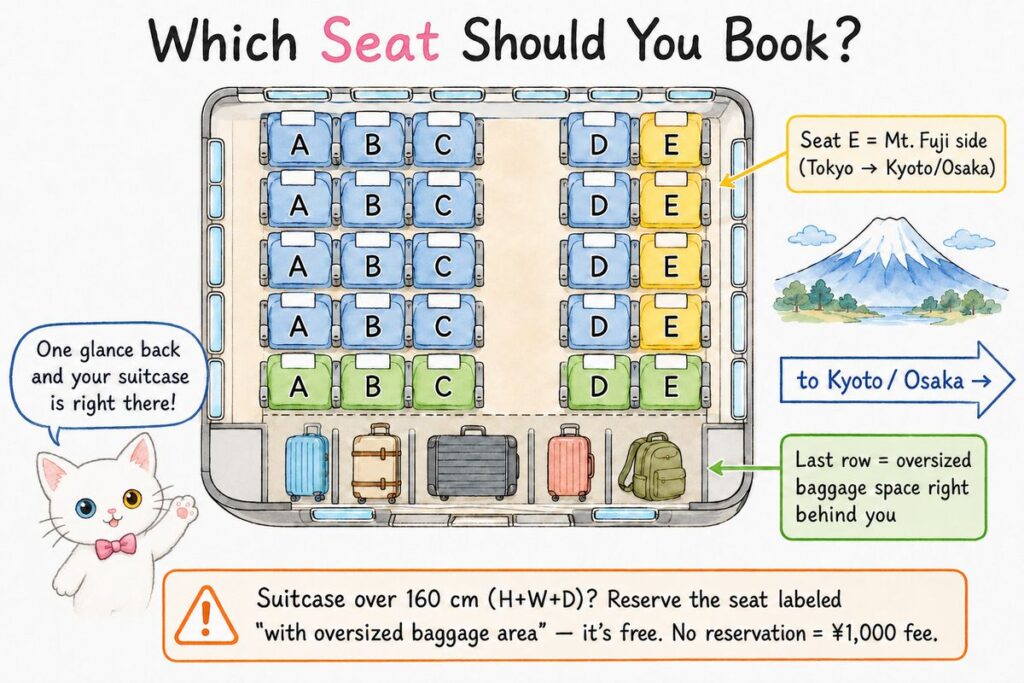
Whichever ticket you end up choosing, here’s the part nobody tells you: which seat you book changes your ride more than you’d think. Even as a Japanese person, I still get a little nervous boarding the Shinkansen — so let me share what I’ve learned.
For the view: seat E, the Mt. Fuji side
 In the ordinary cars on the Tokyo–Kyoto/Osaka line, window seat E faces Mt. Fuji (Green Car seat letters run differently, so check the seat map when booking). The best view comes roughly 40 minutes out of Tokyo, near Shin-Fuji station. On a clear day the whole car quietly lifts their phones at the same moment — it’s a little ritual I love.
For big suitcases: know the 160 cm rule
On the Tokaido, Sanyo and Kyushu Shinkansen — the main tourist routes — if your suitcase’s height + width + depth adds up to more than 160 cm, you must reserve a seat with an oversized-baggage space in advance. The reservation is free — but if you board without it, you’ll be charged a ¥1,000 fee on the spot. (Over 250 cm can’t come aboard at all — ship it ahead with a luggage service.) Many large check-in suitcases sit right around that line, so measure before you fly.
For peace of mind: the last row is your friend
Here’s my honest confession. When I took the Shinkansen from Osaka to Fukuoka with a big suitcase, my luggage had to sit in its designated spot instead of next to me — and I spent the ride glancing back, wondering if it was really safe there. Japan is a country where lost wallets famously come back, and yet: a mom with a suitcase full of her family’s things still worries. That’s normal.
The fix is simple: when you reserve, choose a seat labeled “with oversized baggage area” — the last row of the car. The space behind it belongs to those seat holders, so your suitcase rides right behind your back — one glance over your shoulder and you can see it. That’s the seat I’m booking next time, and if it’s your first Shinkansen ride with a big suitcase, I’d start there.
Which car stops near the escalator?
It varies by station, so here’s a cheat sheet for the stations you’re most likely to use (16-car trains on the Tokaido/Sanyo line, as of 2026):
| Station | Escalator / stairs near | Elevator near |
|---|---|---|
| Tokyo | Cars 6 & 12 | Cars 6–7 |
| Kyoto | Cars 8–9 | Car 8 or 11 (depends on platform) |
| Shin-Osaka | Cars 7–8 | Car 11 |
| Hakata (Fukuoka) | Cars 8 & 11–12 | Cars 8–12 |
Exact positions shift a little depending on which platform your train uses, so treat this as a “head that way” guide rather than GPS.
For any other station, the Japan Travel by NAVITIME app (English) shows station maps, and each JR station has an official map online — search “station name + station map.” (Apps are great for finding elevators; exact stopping positions are easiest to confirm on the platform signs.)
Wondering whether the Green Car is worth the extra ¥4,870 (about $33) from Tokyo to Kyoto? I break down when it helps and when it’s a waste in my guide to avoiding crowds in Japan.
Where to Buy the JR Pass (This Changes in October 2026)
Right now, the base price is the same everywhere — though exchange rates and card fees can nudge your final amount. But from October 1, 2026, that changes — so where you buy suddenly matters.
You have two main routes. The first is the official site (japanrailpass.net): you buy online, reserve seats online in advance, and pick up the pass in Japan with your passport. The second is a travel agency site like Klook or KKday: you receive an exchange order and swap it for the real pass at a JR counter after you arrive.
Here’s the October change: agency prices go up by about 6% — a 7-day pass becomes ¥53,000 through agencies, while the official site stays at ¥50,000 (for now, at least — JR calls it “for a limited time”). So my honest advice is simple:
- Buying before October 2026? Buy wherever is most convenient for you — the base price is identical.
- Buying in October or later? The official site becomes the cheapest place. Four adult travelers would save ¥12,000 just by choosing the right website.
Agency sites still have their conveniences — you can pay in your own currency and buy your other Japan tickets in the same place. Just go in knowing the numbers, and you won’t overpay.
By the way, the JR Pass isn’t the only thing changing in 2026 — new taxes and rules are arriving across Japan travel too. I’ve rounded them all up in What’s Changing for Japan Travel in 2026.
If an agency site fits your plans, you can check the current JR Whole Japan Rail Pass price on Klook — it shows prices in your own currency.
One important eligibility note: the JR Pass is for travelers who enter Japan as “Temporary Visitors” (Japanese nationals who’ve lived abroad for ten years or more can qualify too) — which is exactly why I, living happily in Japan, can’t use one. All these years watching travelers glide by with unlimited rides, and I still buy my tickets one by one!
JR Pass FAQ: Quick Answers Before You Decide
Isn’t flying faster — or cheaper — than the Shinkansen?
Door to door, they’re surprisingly close. Tokyo to Osaka often lands around 3 hours either way once you add airport access and security — the exact result depends on where you start and which airport you use. The Shinkansen wins on simplicity: no baggage check-in, departures every few minutes, and you arrive in the city center. Budget airlines can be cheaper than a single Shinkansen ticket, though — so if you’re not buying a rail pass and money matters more than comfort, a flight is worth checking.
I’m staying only in Tokyo. Should I get the pass?
No — and I’d say it kindly but firmly. Most of Tokyo’s subway network isn’t JR, so the pass wouldn’t even cover many of your daily rides. A prepaid Suica card is really all you need for getting around — just note that reserved airport trains like the Narita Express take a regular ticket.
Not sure which Suica to get — the app or a physical card? I’ve sorted out all four options in my Suica vs Pasmo guide for tourists.
Do I need to reserve seats? Does it cost extra?
With the pass, seat reservations are free and unlimited. If you buy on the official site, you can even reserve online before your trip; otherwise, use the reserved-seat ticket machines or any JR ticket office once your pass is in hand. Many Shinkansen also have non-reserved cars if you prefer to just hop on — but some trains (and peak-season Nozomi) are fully reserved, so check before boarding. The one exception: if your suitcase is over 160 cm total, the oversized-baggage seat reservation is required, not optional.
What about my kids?
Children aged 6–11 get their own pass at half price. Children under 6 ride free on your lap — up to two small children per adult — and you only pay (a child pass) if you want them to have their own reserved seat.
What if I lose my pass?
This is the scary one, so let me say it like a mom: a lost JR Pass is gone. No reissue, no refund — losing a ¥50,000 pass means losing ¥50,000. Treat it like cash. Guard it the way you guard your passport, and make it a habit to check for both every time you leave a train.
Does the pass work at the automatic ticket gates?
Yes — today’s passes work in many automatic gates just like a regular ticket, so you won’t be waving paper at a staff window every time. Two small notes: skip the IC-card-only gates, and remember to collect your pass as it pops back out. Keep your passport with you, too — staff may ask to see it.
The Bottom Line: Buy the Pass for the Right Trip, Not Just in Case
If you remember only three things from this guide, make it these:
One big loop across regions → the nationwide JR Pass earns its keep. Tokyo, Kyoto, Hiroshima, Kanazawa in one week — that’s pass territory. (Confirm with your own numbers — that’s the whole trick.)
The classic Tokyo–Kyoto–Osaka route → skip it. Regular tickets cost around ¥30,000 (≈$195); the pass costs ¥50,000 (≈$325). Put the difference toward a nice dinner — or four.
Staying in one region → look at regional passes first. They’re cheaper, and some are even more flexible than the national pass.
And whichever ticket you choose, book your seat like someone who’s done it before: seat E for Mt. Fuji, the labeled last-row seat for your big suitcase, and that reservation made in advance if your luggage is over 160 cm. That’s the difference between a nervous first ride and a relaxed one — I speak from experience.
Check JR Pass prices on Klook →
One small practical note before you book anything: fare checks, seat reservations, and route apps all assume your phone is online in Japan — if you haven’t sorted your data yet, start with my Japan eSIM guide.
Continue planning your Japan trip:
- Doing a day at Universal Studios Japan? Here’s my USJ Express Pass guide — worth it, and which one to buy.
- Landing at Kansai Airport? Here’s my guide to the Rapi:t airport train — the deep-blue train with the robot face.
- New to Japanese hot springs? Read my Japanese Onsen Guide for First-Timers.
- Wondering how dinner works from entering to paying? See my Japanese Restaurant Etiquette guide.
- Make your first convenience store run easy with these Japanese Convenience Store Etiquette tips.
 Now I’m curious about your side: how do long-distance trains work in your country — and what does your Japan route look like? Tell me in the comments. If you list your cities, other readers (and I) can cheer on your itinerary.
I hope this guide has answered one of your questions and helped you feel a little closer to Japan. May your Japan journey be filled with wonderful discoveries and memories you’ll treasure for years to come.
Planning the actual route? I costed out a complete 10-day Tokyo-to-Osaka itinerary for ¥200,000 (about $1,300) — it’s the trip where skipping the pass saves you about ¥20,000.
 See you in the next guide.


Comments