You’re standing in a Japanese drugstore, somewhere between the shampoo and the sunscreen, looking at a wall of white bottles covered in Japanese text. You’ve heard that Japanese skincare is worth buying while you’re here. What you haven’t found is a straight answer about which bottles to pick up — and what they actually cost.
So let me help. I’m a Japanese mom living in Japan, and the seven products in this guide are the ones I use at home, not a list gathered from other websites. In August 2026 I checked the current prices on Japanese drugstore and brand websites, so you’ll see real yen figures instead of “it’s cheap here.” By the end you’ll know which three to five products suit your skin, roughly what your basket will cost, how tax-free works before and after the rules change on November 1, 2026, and where to buy the same products once you’re back home.
Prices checked on Japanese drugstore and official brand websites in August 2026.

Disclosure: This article contains affiliate links. As an Amazon Associate I earn from qualifying purchases. If you buy through one, I may earn a commission at no extra cost to you.
In a hurry? Everything in this guide, in one list:
- Hada Labo Gokujyun Lotion — the ¥700 hydration legend
- Hada Labo Gokujyun Premium — the richer upgrade
- Hada Labo Milky Lotion — the moisturizing step two
- Curél Hydrating Water Essence — for sensitive skin
- LuLuLun Precious sheet masks (32 pack) — the daily-use mask
Already in Japan? All of these are cheaper at any drugstore — the links above are for shopping from home.
- Is Skincare Really Cheaper in Japan? Here’s the Math
- Three Easy Starting Points: Hada Labo, Melano CC, and Sunscreen
- If Your Skin Is Sensitive or Dry: Curél and Minon
- The Budget Pick: MUJI’s Sensitive Skin Toning Water
- Sheet Masks: Why Locals Buy LuLuLun Too
- Matsumoto Kiyoshi, Don Quijote, or Loft: Where Should You Actually Shop?
- Tax-Free at Drugstores (and What Changes on November 1, 2026)
- Can’t Get to Japan? Where to Buy Japanese Skincare Outside Japan
- Frequently Asked Questions About Japanese Drugstore Skincare
- Final Thoughts
Is Skincare Really Cheaper in Japan? Here’s the Math
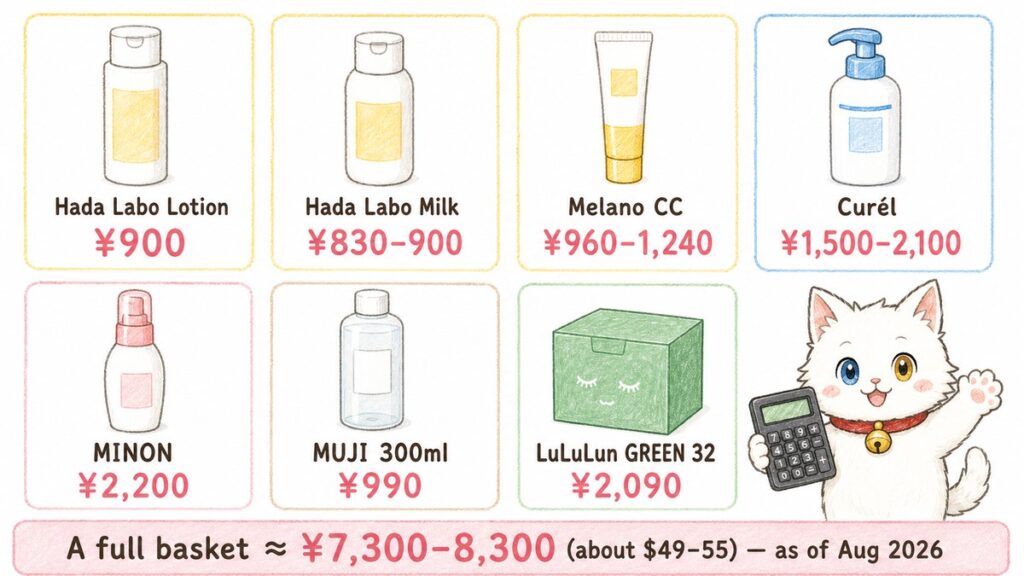
The short answer is yes — at least for the products in this guide. You can put together a generous Japanese drugstore skincare basket for about ¥7,300–8,300, or roughly $49–55 at an exchange rate of ¥150 to $1. That’s the local price; I’ll come back to how buying the same products from abroad compares near the end of this guide.
The seven products below are a menu, not a checklist. For the calculation, I included either Curél or Minon, not both. If you choose Hada Labo lotion and milk, Melano CC, either Curél or Minon, MUJI, and the green LuLuLun Precious mask, the total comes to about ¥7,300–8,300. Most travelers will only need three to five products, so your actual total may be lower.
| Product | Size | Price in Japan | Roughly |
|---|---|---|---|
| Hada Labo Gokujyun Hyaluronic Acid Lotion | 170ml | Around ¥900 | $6 |
| Hada Labo Gokujyun Hyaluronic Acid Milk | 140ml | ¥830–900 | $5.50–6 |
| Melano CC Vitamin C Essence | 20ml | ¥960–1,240 | $6.50–8.50 |
| Curél Intensive Moisture Care Lotion III (Enrich) | 150ml | ¥1,500–2,100 | $10–14 |
| MINON AminoMoist Moist Charge Lotion I | 150ml | ¥2,200 | $14.50 |
| MUJI Sensitive Skin Toning Water – High Moisture | 300ml | ¥990 | $6.50 |
| LuLuLun Precious GREEN | 32 sheets / 7 sheets | ¥2,090 / ¥605 | $14 / $4 |
Prices include tax and reflect Japanese store prices checked in August 2026. Prices can vary by store. Dollar figures are rounded estimates at ¥150 to $1 — check the current rate for your own currency. The basket total does not include sunscreen.
 The price difference between stores can matter more than you might expect. Curél showed the widest gap in the prices I checked: the same 150ml bottle ranged from ¥1,478 to ¥2,090. You don’t need to visit five stores to save every last yen, but checking one other shop may be worthwhile when a product costs noticeably more than the range above.
The most useful way to shop is to decide what your skin actually needs before you enter the store. That keeps a wall of unfamiliar bottles from turning into seven products you never planned to buy.
Three Easy Starting Points: Hada Labo, Melano CC, and Sunscreen
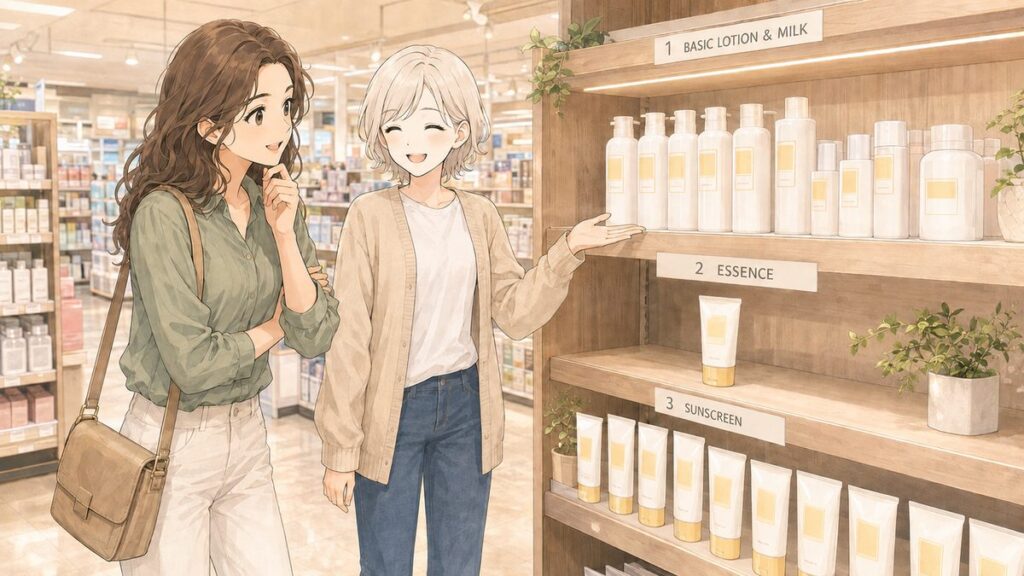
If you don’t want to compare twenty different products, start with three categories: hydration from Hada Labo, a targeted essence from Melano CC, and a Japanese sunscreen. You don’t need every popular bottle on the shelf. You need products that have a clear place in your own routine.
Hada Labo Gokujyun Lotion and Milk
Hada Labo Gokujyun Hyaluronic Acid Lotion costs around ¥900 for 170ml, while the matching 140ml milk is about ¥830–900, as of August 2026. Buying both gives you two separate steps, but you can also start with only the one that fills a gap in your current routine.
 I use the Gokujyun lotion myself, and the hydration is excellent. I use the milk after the lotion, almost like putting a lid over the hydration.
If you plan to buy Hada Labo outside Japan, check the exact product name and bottle size. Amazon in the United States does list a Japanese 170ml Gokujyun bottle, and it sits on the same shelf as Hada Labo Tokyo — a separate range built for the U.S. market. Read the name on the listing rather than going by the shape of the bottle.
One detail worth knowing: Rohto’s Japanese site describes the current Gokujyun lotion as containing four types of hyaluronic acid, while that Amazon listing still describes three. Product descriptions often lag behind reformulations, so check the ingredient list on the bottle you receive if this matters to you.
The 140ml milk is harder to pin down: when I checked in August 2026, the standard bottle wasn’t listed on its own, so you may only find the Premium version or a refill pack. Current Hada Labo milk listings are here if you want to compare what’s in stock.
Melano CC Vitamin C Essence
The standard Melano CC Vitamin C Essence is a 20ml product that usually costs ¥960–1,240 in Japan, with ¥1,210 being a common price. Look closely at the name: Melano CC Premium is a different product and costs about ¥1,628.
 That distinction matters once you leave Japan. When I checked Amazon in the United States in August 2026, the essence I could actually find there was the Premium version — the standard 20ml essence wasn’t listed on its own. If the standard one is what you want, buy it while you’re here.
I use Melano CC at night, before I go to bed.
Don’t Forget Sunscreen
Sunscreen deserves its own choice rather than being added as an afterthought. Biore UV Aqua Rich Watery Essence 70g, for example, was about ¥970–1,080 in the prices checked for this guide.
I won’t turn this section into another long sunscreen comparison. You can use my full Japanese sunscreen guide to choose by skin type and travel plans, or compare Anessa and Biore directly if those are the two bottles you’re considering.
If Your Skin Is Sensitive or Dry: Curél and Minon
If sensitive or dry skin is your main concern, look at Curél and Minon before filling your basket with every viral product. Both bottles in this guide are 150ml lotions, but their pricing patterns differ.
Curél Intensive Moisture Care Lotion III (Enrich) ranged from about ¥1,500 to ¥2,100 in the stores checked in August 2026. It had the widest price difference of all seven products: the same bottle was ¥1,478 at one store and ¥2,090 at another. That’s a difference of more than ¥600 without changing the product.
MINON AminoMoist Moist Charge Lotion I was ¥2,200 at each store I checked for this guide. That makes the decision simpler: you can think about whether the product suits your routine instead of walking around town looking for a better deal.
 I use both Curél and Minon when I’m concerned about skin irritation. Neither is an everyday product for me.
You don’t need both simply because both are presented as sensitive- or dry-skin options. The deciding factor should be your own skin, not which package appears most often online.
These two also behave very differently once you go home. Amazon in the United States lists Curél Hydrating Water Essence under its U.S. product name, but I did not find the Japanese Lotion III (Enrich) listed there. Minon was the hardest of all seven: in August 2026 I couldn’t find the Amino Moist lotion on Amazon in the United States. Other international shops may carry it, but if you want this exact bottle, buying it while you’re in Japan is the safest route.
The Budget Pick: MUJI’s Sensitive Skin Toning Water
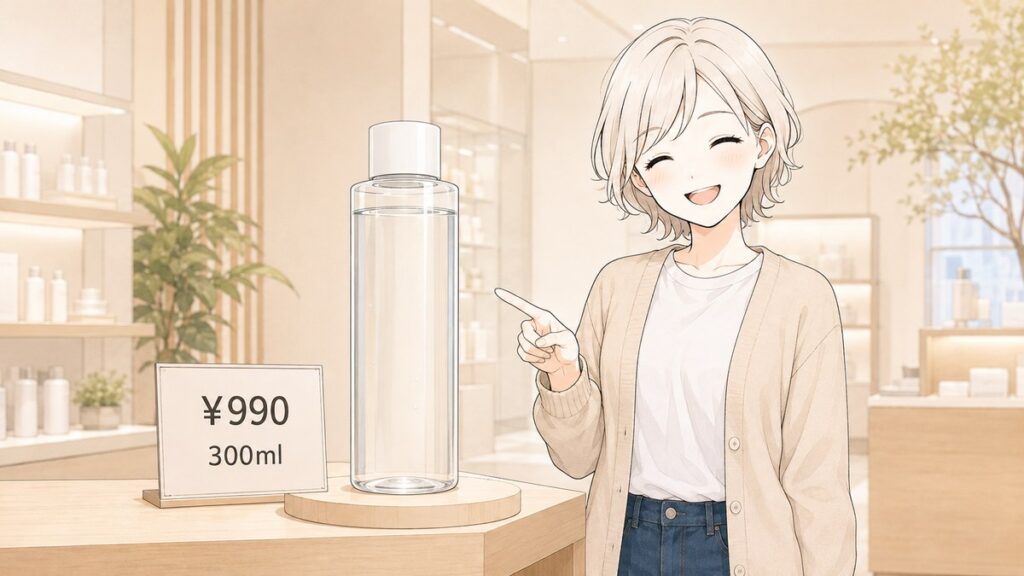
MUJI Sensitive Skin Toning Water – High Moisture is the clearest budget option in this guide: 300ml for ¥990 in Japan, as of August 2026. That is a larger bottle than the other lotions here while remaining under ¥1,000.
Check the size before following an older shopping guide. MUJI discontinued the previous 200ml and 400ml versions in 2023. The current bottle covered in this article is 300ml.
MUJI also has stores outside Japan, so availability alone is not the reason to buy it during your trip. But if this exact Japanese 300ml bottle is what you want, ¥990 is a straightforward local price.
 You may not even need to find a MUJI store. Lawson convenience stores carry a MUJI section too — around 170 items, in roughly 13,000 branches across all 47 prefectures — and many are open 24 hours. What each branch stocks varies, so treat it as a handy backup rather than a sure thing.
I use this MUJI toning water every day now.
If you shop online later, compare the product size and market version instead of clicking the first listing with a similar beige label.
Sheet Masks: Why Locals Buy LuLuLun Too
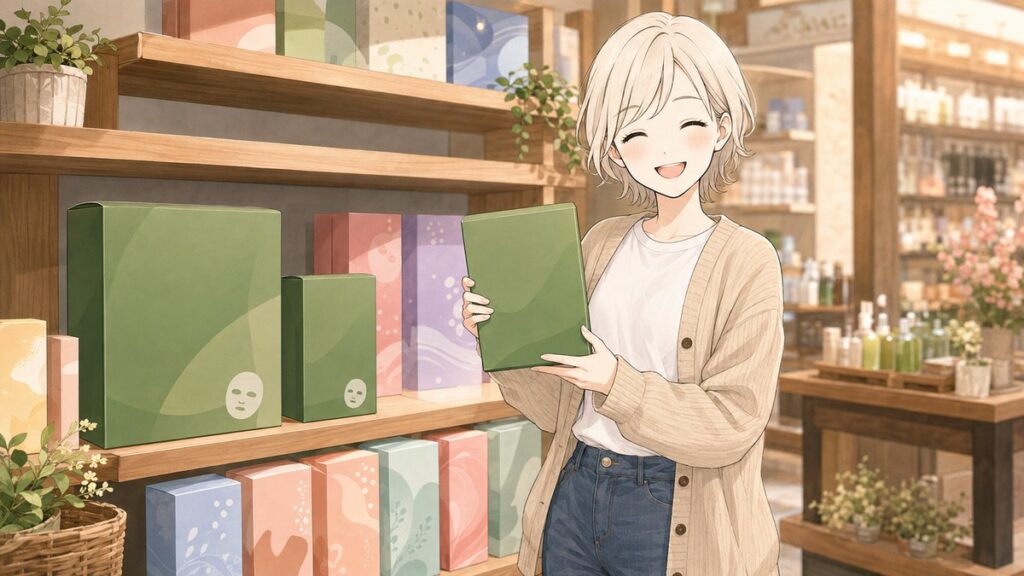
LuLuLun is easy to notice as a souvenir, but it also has regular packs designed for repeated use. The green LuLuLun Precious mask costs ¥2,090 for 32 sheets or ¥605 for seven sheets from the official store, as of August 2026.
The green Precious mask was renewed in November 2025. Older guides and older stock may show the previous 32-sheet version at ¥1,980, so check the sheet count and current price rather than relying on an old product page.
Pay attention to the exact name and sheet count. LuLuLun ONE contains five sheets and costs ¥1,760, but it is a different product — not a smaller version of the green Precious mask.
I use the green LuLuLun Precious mask every morning after washing my face.
If you want something connected to the place you visited, look for regional LuLuLun versions. These are regional products made with ingredients associated with their destinations. They turn a sheet mask into a small reminder of your trip, but availability depends on the region and shop.
That makes LuLuLun useful in two different ways: the green Precious mask can be part of your regular routine, while a regional pack works better as a travel souvenir. Decide which role you want it to fill before you buy.
If you want to try it before your trip — or restock after — the 32-sheet green Precious pack is sold on Amazon. Check that the listing says GREEN: the white Precious pack looks almost identical in a thumbnail.
Matsumoto Kiyoshi, Don Quijote, or Loft: Where Should You Actually Shop?
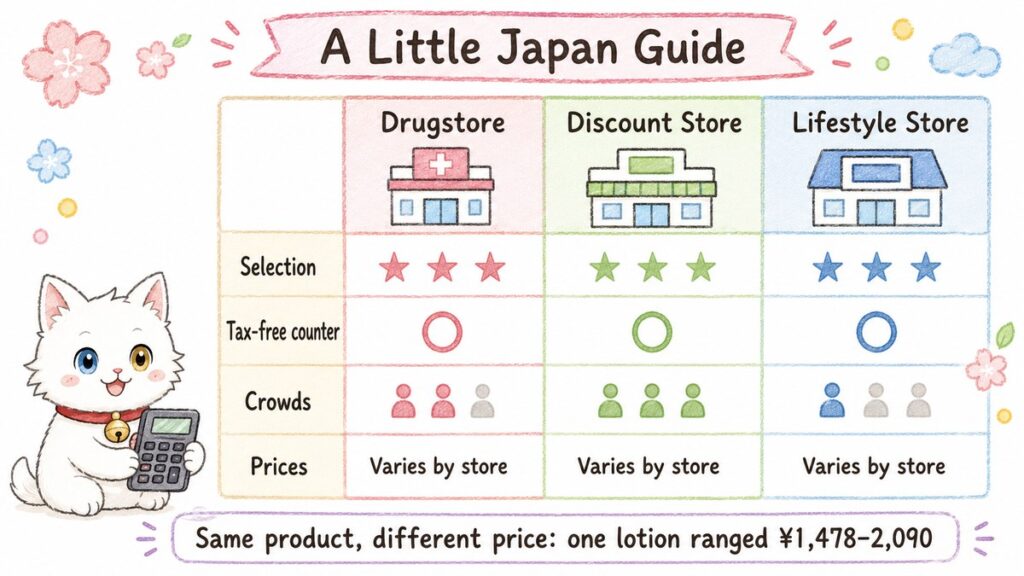
There is no honest answer to “Which store is always cheapest?” Prices can change by branch, campaign, and membership offer. The same Curél lotion varying by more than ¥600 is a good reminder that the store name alone does not guarantee a price.
| Store | How Pricing Works | What to Know |
|---|---|---|
| Matsumoto Kiyoshi | Its online prices may differ from in-store prices. | Use the shelf price at the branch you visit rather than assuming the website price will match. |
| Don Quijote | Prices may differ by store, and branch prices cannot be confirmed through its website. Some products have majica member prices. | Don’t assume Don Quijote is automatically the cheapest. Check the displayed price and whether it requires membership. |
| Loft | Online and in-store prices are generally the same, except during store-specific or online campaigns. | Regular drugstore staples such as Gokujyun and Melano CC may have thinner availability than at a drugstore. |
A practical approach is simple: start with the store already on your route. If the product is within the price range in this guide, buying it there may be worth more than spending an hour trying to save ¥100. If it is several hundred yen higher — especially Curél — check one more nearby shop.
Tax-free shopping is a separate question. A good shelf price does not automatically mean the purchase qualifies, so check the rules before combining everything into one transaction.
Tax-Free at Drugstores (and What Changes on November 1, 2026)
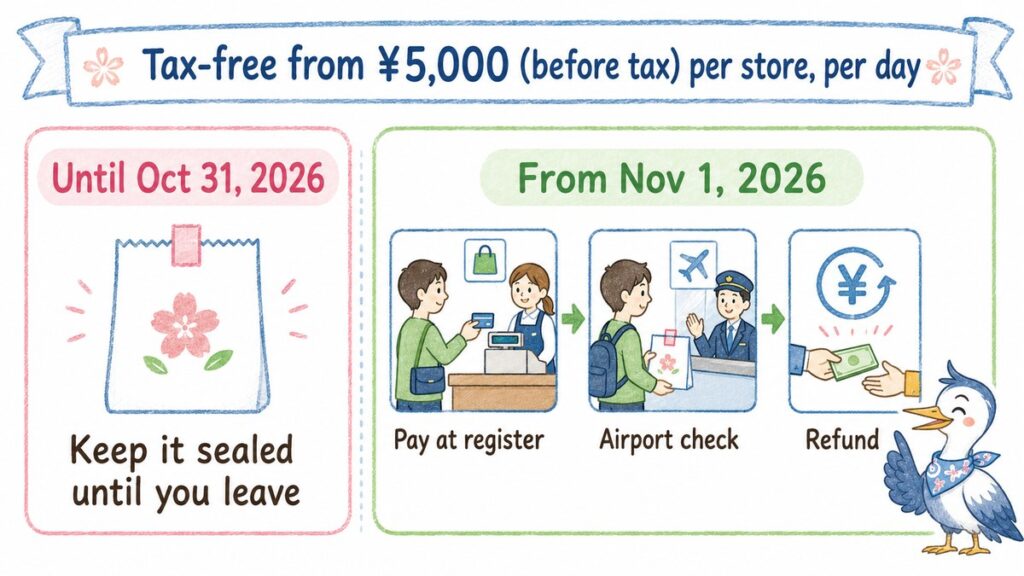
Tax-free skincare purchases generally require a total of at least ¥5,000 before tax at the same store on the same day — roughly ¥5,500 including Japan’s 10% consumption tax. The rules for what happens after you pay depend on the purchase date.
Purchases Made Through October 31, 2026
Skincare is treated as a consumable. Under the system in effect through October 31, 2026, tax-free consumables are placed in special packaging and cannot be opened or used in Japan.
This matters if you planned to buy a lotion on your first day and use it during the trip. If it was processed as tax-free, keep it sealed until you leave Japan.
Purchases Made on or After November 1, 2026
From November 1, 2026, Japan moves to a refund system. You pay the tax-inclusive price at the store, and the amount equivalent to consumption tax is refunded once customs confirms at departure that the goods are leaving Japan.
The distinction between general goods and consumables, along with special packaging for consumables, will be abolished. That does not mean you can use tax-free skincare freely during your trip. Cosmetics used in Japan are not eligible for the refund because the goods must be exported.
The rules are changing enough that this short section should not be your only reference. Read the full tax-free guide before deciding whether to use your new skincare in Japan or save it for home.
Can’t Get to Japan? Where to Buy Japanese Skincare Outside Japan
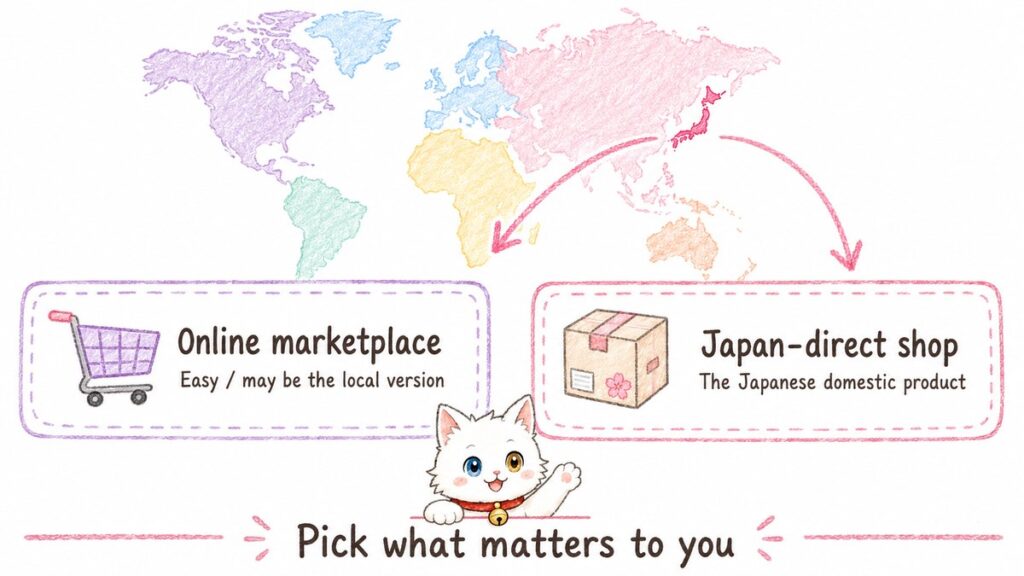
If you can’t visit Japan — or you finish a product after returning home — Amazon and Kokoro Japan solve different problems. One is usually easier; the other makes it simpler to identify the Japanese domestic product.
Amazon: Convenient, but Check the Market Version
Amazon has a wide selection, but the familiar brand name does not always mean you’re looking at the same product sold in a Japanese drugstore.
On Amazon in the United States, the products in this guide appear in a few different forms. A Japanese Gokujyun bottle is listed alongside Hada Labo Tokyo, a separate range built for the U.S. market — though, as I mentioned above, the Japanese listing still describes the older three-hyaluronic-acid formula. Curél appears under its U.S. product name, Curél Hydrating Water Essence, rather than the Japanese Lotion III (Enrich), so the bottle you saw in the drugstore is not the one shown in the search results.
When I checked in August 2026, the Melano CC listing I found was the Premium essence rather than the standard one, while the green LuLuLun Precious pack appeared as a Japanese import. Prices, sellers, and stock can change, so compare the current listing details and checkout total before ordering. I could not find the MINON AminoMoist lotion on Amazon in the United States at all.
Amazon is the convenient choice when easy ordering matters most. Just read the complete product name, bottle size, seller, and market version before buying.
Affiliate link
Browse Japanese Skincare on Amazon
Kokoro Japan: Japanese Domestic Products Shipped from Japan
Kokoro Japan ships Japanese products directly from Japan. It can be useful when you want a Japanese domestic product rather than a market-specific version. Destination coverage, prices, and stock can change, so confirm shipping to your country before filling your cart.
When I checked in August 2026, the products I compared were priced above the Japanese drugstore prices in this guide, and one price changed between two checks in the same week. I wouldn’t call Kokoro the cheapest option. Its advantage is access to Japanese domestic products.
At the time of writing, free Premium Shipping starts at $45 USD, or $35 USD for orders going to Asia, depending on the destination. Check the shipping page and your checkout total before you order.
The better option depends on what you care about. Choose Amazon for convenience, but verify the version. Choose Kokoro when matching the Japanese domestic product matters more than getting the lowest possible price.
Frequently Asked Questions About Japanese Drugstore Skincare
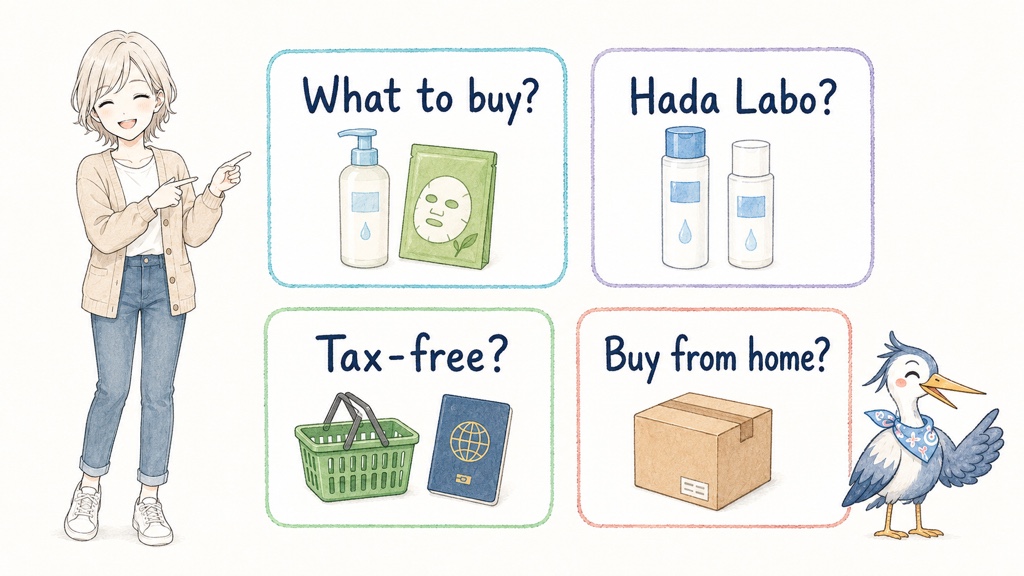
What should I buy at a Japanese drugstore?
If you want to keep it simple, start with Hada Labo for hydration, Melano CC as a targeted essence, and a Japanese sunscreen. If sensitive or dry skin is your priority, consider Curél or Minon instead of buying every popular product.
For sheet masks, the green LuLuLun Precious mask is the one I use every morning after washing my face. Most travelers only need three to five carefully chosen items.
Is Hada Labo the same as Hada Labo Tokyo?
Both are Hada Labo lines, but the names are not interchangeable. Hada Labo Tokyo is the range sold for markets such as the United States, while the Gokujyun 170ml bottle in this guide is the Japanese domestic product. Formulas, containers, names, and sizes can differ — and even a Japanese-looking listing may describe an older formula — so read the full product page before ordering.
Can I use tax-free skincare before I leave Japan?
For purchases made through October 31, 2026, tax-free skincare is placed in special packaging and cannot be opened or used in Japan.
For purchases made on or after November 1, 2026, the special packaging requirement is abolished, but skincare used in Japan is not eligible for the refund. The product still needs to be taken out of Japan. See the full tax-free guide for the details.
Where can I buy Japanese skincare in the US, UK, or Australia?
Amazon is convenient, but check whether the listing is a local-market version or a Japanese import. Kokoro Japan ships Japanese domestic products from Japan to many countries, including destinations outside the United States. Availability, prices, and shipping charges can change, so confirm them before ordering.
Wondering whether the expensive counters upstairs are worth it once your drugstore basics are sorted? I compare Shiseido Ultimune, SK-II and Shu Uemura in my guide to Japanese luxury skincare: what’s worth it (and what’s not).
Final Thoughts
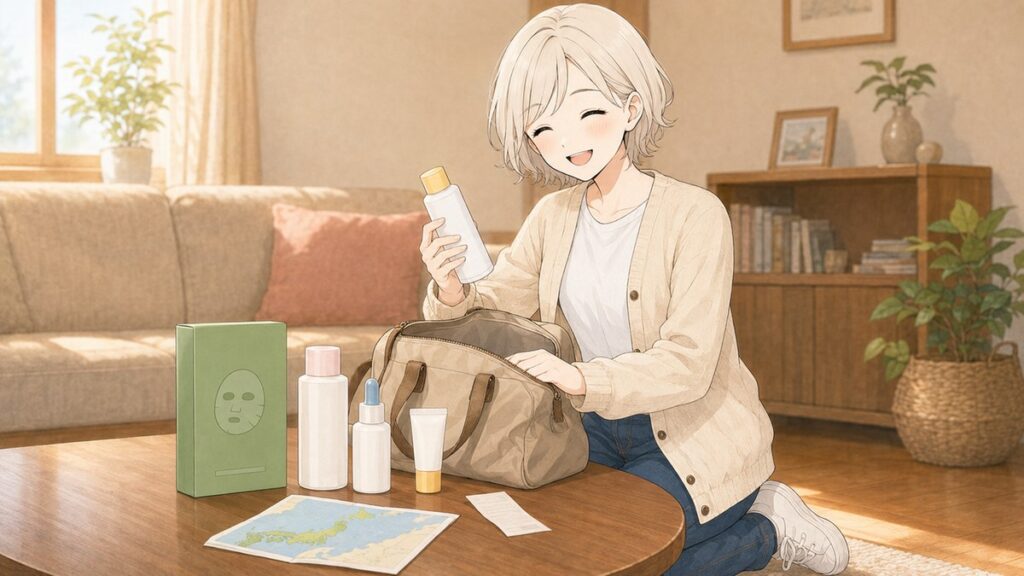
A Japanese drugstore skincare shelf becomes much easier to handle when you stop treating it like a list of products you’re supposed to collect. Start with what your skin and current routine actually need.
For many travelers, that may mean Hada Labo, Melano CC, and sunscreen. Sensitive or dry skin may point you toward Curél or Minon, while MUJI gives you a lower-cost large bottle. The green LuLuLun Precious mask can work as part of a daily routine — I use it every morning after washing my face — while regional LuLuLun versions are better suited to travel souvenirs.
Choose three to five products, check the exact name and size, and compare one more store only when the price looks unusually high. That is enough to leave the store with products you understand instead of a suitcase full of guesses.
If you’re preparing for Japan’s hot season, my cooling body sheet guide can help with another common drugstore purchase. If long sightseeing days leave your feet tired, the sore-feet recovery guide explains what to look for. And if you want to bring a little more of everyday Japan home, you can also read my guide to choosing a Zojirushi rice cooker.
 Where can you buy Japanese skincare in your country? And which one product in this guide are you most curious to try? Let me know in the comments. I read every single one!
I hope this guide has answered one of your questions and helped you feel a little closer to Japan. May your Japan journey be filled with wonderful discoveries and memories you’ll treasure for years to come.
See you in the next guide.