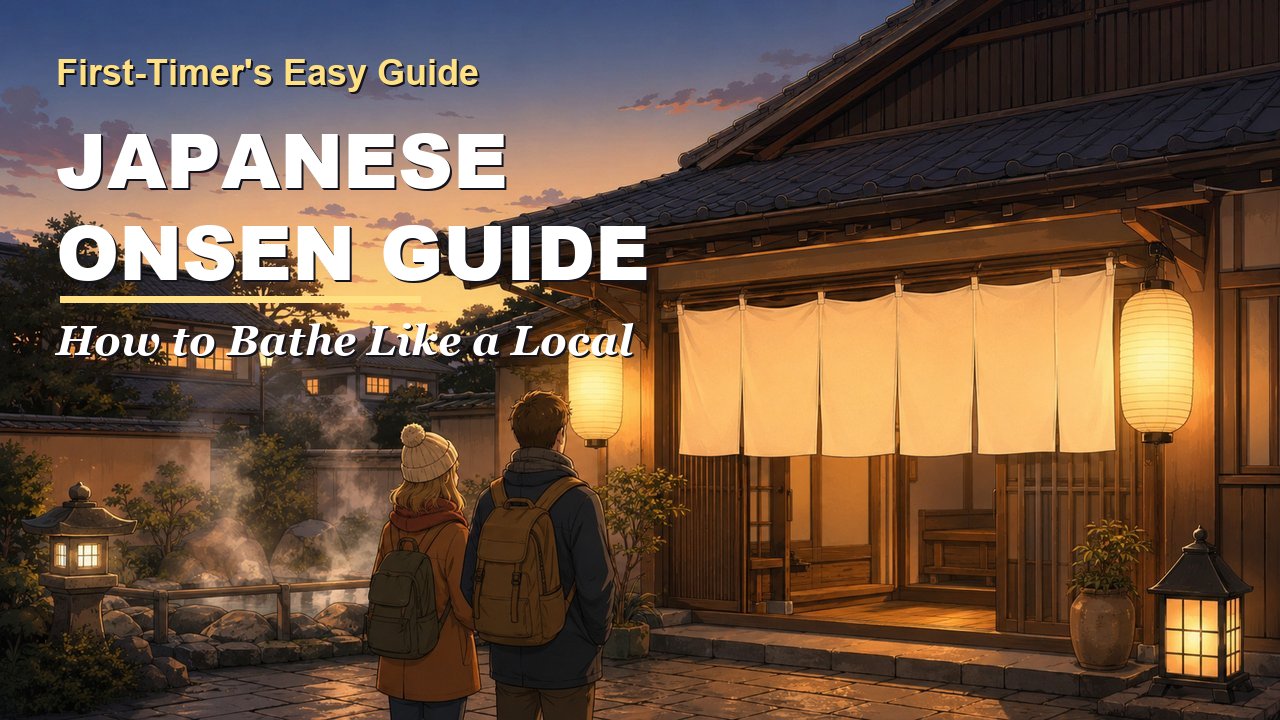
Somewhere on your Japan wish list, there’s a steaming bath. Maybe it’s the outdoor onsen framed by snow, maybe just a proper soak after a 20,000-step Kyoto day. And right next to that daydream sits a knot of questions: Do I really go in naked? What are the rules? What if I get it wrong?
Going in winter? What to wear on the way there matters as much as what you do at the bath — see my winter clothing guide.
I can untangle all of it. I’m a Japanese mom whose family spends ordinary weekends at our local super sento, and in this guide I’ll walk you through your first bath from the shoe locker to the coffee milk — including the parts other guides forget to mention.

- Nervous About Your First Onsen? You’re Not Alone
- Onsen, Sento, Super Sento — What’s the Difference?
- How to Bathe, Step by Step
- The Etiquette Rules That Actually Matter
- What to Bring (and What the Bathhouse Provides)
- Visiting an Onsen with Kids
- What About Tattoos?
- After Your Bath: The Best Part
- Frequently Asked Questions About Japanese Onsen
- Ready for Your First Soak?
Nervous About Your First Onsen? You’re Not Alone
 Let’s talk about the thing nobody says out loud: yes, you’ll be naked. In a room full of strangers. For most first-time visitors, that one fact feels scarier than any language barrier in Japan.
 And yes, you’ve probably heard there are rules — lots of them, all unwritten. So here’s the honest truth from someone who grew up with these baths: only a handful actually matter. Rinse yourself before you get in, keep your towel out of the water, keep your voice low. Do those three things, and you’re already doing better than fine.
 Everything else? Nobody expects you to be perfect — not even close. I’m Japanese, I’ve been soaking my whole life, and I still worry about losing my locker key. Locals fumble too. And the people around you are far too busy melting into the water to grade your technique; if anything, they’re quietly glad you came to try their favorite place.
And the reward is worth every second of hesitation — sinking into hot water until your shoulders finally drop, then walking out lighter than you’ve felt all trip. In this guide, I’ll walk you through everything: which type of bath to choose, what to do with your shoes, what to bring, and what to drink afterward (this part is sacred). By the end, you’ll walk in like you’ve done it a hundred times.
Onsen, Sento, Super Sento — What’s the Difference?
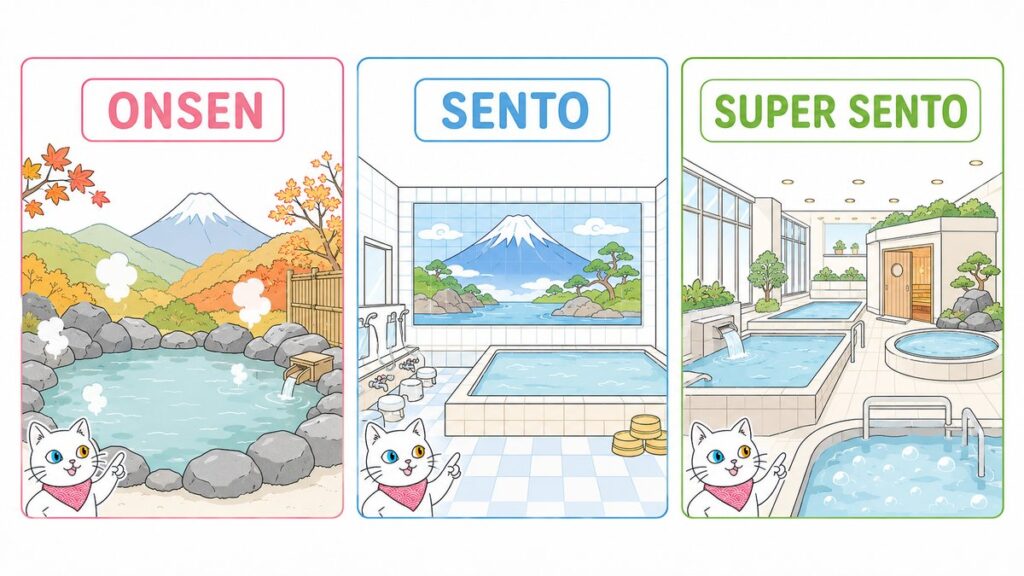
Here’s some good news: from the inside, they all work exactly the same way — undress, wash, soak. The differences are in the water, the size, and the price, and knowing them helps you pick the right first experience.
 An onsen is a true hot spring, fed by natural hot-spring water from underground. Japanese law even defines what qualifies — the water has to reach a certain temperature at the source or contain specified natural substances — and it’s the version you’ve seen on postcards: steam rising off an outdoor bath in a mountain town. Many onsen belong to ryokan inns, but plenty welcome day visitors too.
A sento is the neighborhood bathhouse, born in the days when many homes had no bath of their own. The water is usually heated tap or well water — though some sento are fed by natural hot springs — the price is a few hundred yen, and the atmosphere is wonderfully local — in Tokyo, you’ll often find a painting of Mt. Fuji watching over the tubs. Just know they’re bare-bones: at many of them, you bring your own towel and soap.
A super sento is the modern deluxe version: half a dozen different baths, saunas, a restaurant, massage chairs, and relax lounges, usually for somewhere around 1,000 to 2,500 yen. Some even pump genuine onsen water into the city. Towels and amenities can be rented or bought right there, so you can walk in with nothing but your wallet.
 If it’s your first time, I’d point you to a super sento. Everything is beginner-friendly — signs, variety, things to do between baths — and you can happily lose three hours there. It’s not a tourist compromise, either: an ordinary weekend for my own family is our local super sento. The classic onsen-town trip is still the dream, but it doesn’t have to be the entry exam.
Not Ready to Get Naked? Start with a Footbath
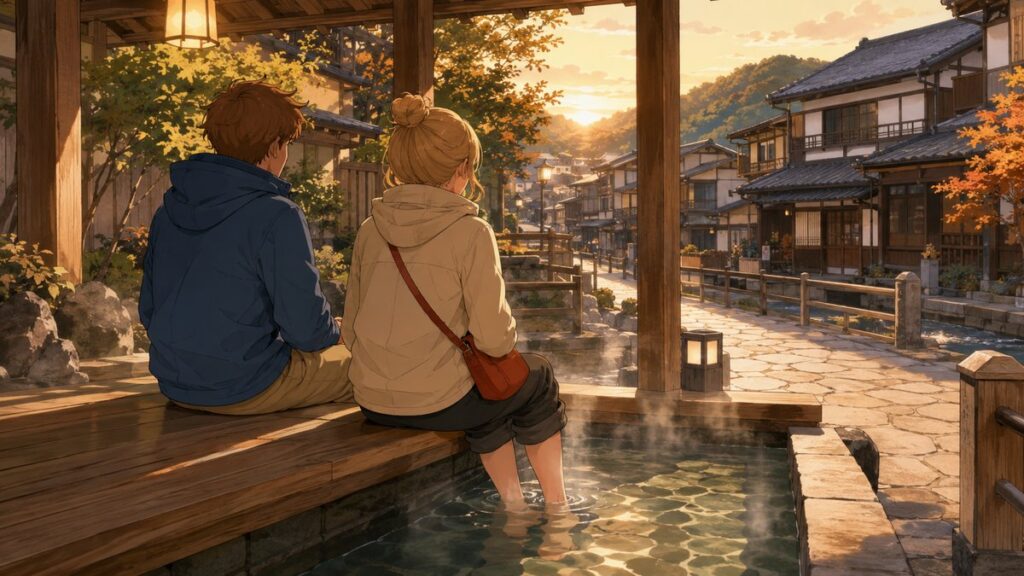
 If the no-clothes part still feels like too much, there’s a gentle side door: the ashiyu, or public footbath. You stay fully dressed, take off your shoes and socks, roll up your pants, and soak your feet — often for free, in onsen towns and near some stations. Ten minutes in, you’ll understand what the fuss is about.
Think of it as the free sample of onsen culture. Once your feet have convinced you, come back to this guide — the rest of you deserves it too.
How to Bathe, Step by Step
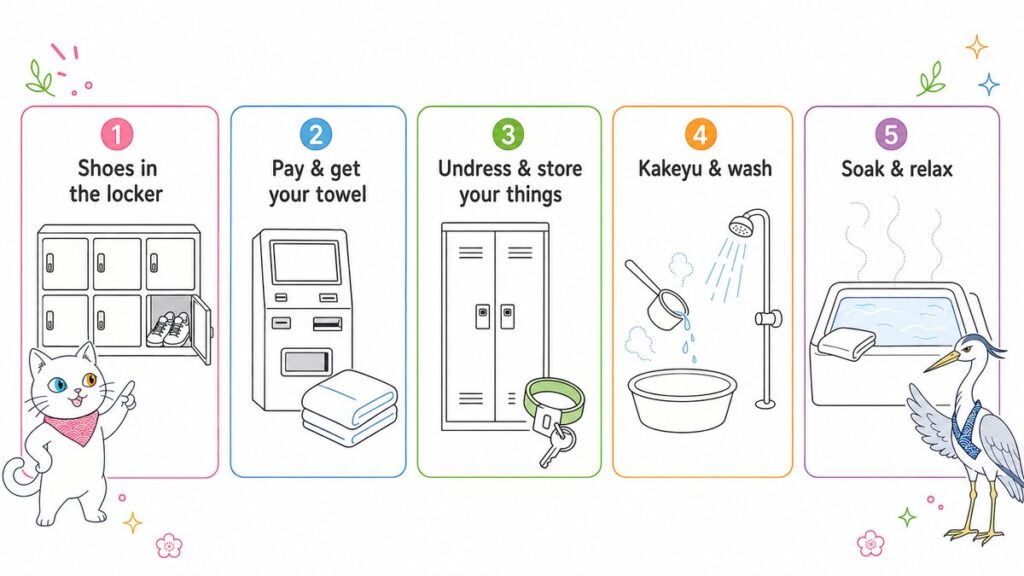
The whole visit follows one simple flow: shoes off, pay, undress, wash, soak. Here it is in the exact order you’ll walk through it.
1. Shoes go in first. Just inside the entrance you’ll find small shoe lockers. Put yours in and take the key or wooden tag with you.
2. Pay at the front desk or the ticket machine. Many places use a vending machine near the entrance: press the button for adult admission, add a towel set if you need one, and hand the ticket to the staff. Don’t worry about getting it wrong — the staff here meet lost-looking first-timers every single day.
3. Find your curtain. You’ll see two doorways hung with fabric curtains. Red or pink usually means women (女), blue or navy means men (男) — but check the kanji too, because some facilities switch sides between days.
4. Undress completely at your locker. Clothes, phone, big towel — everything goes in. And here’s my favorite worry-saver: at some places, reception collects your shoe key when you pay and hands you a wristband in exchange; if not, just drop the shoe key inside your locker. The locker key is usually on a coiled band you wear on your wrist right into the bath — so either way, one key on your wrist is all you have to think about.
5. Take the small towel with you — plus your own soap and shampoo if the facility doesn’t provide them. The big towel stays in the locker, dry and waiting for the after-bath you.
6. Splash first — the kakeyu. Right at the entrance to the bathing area, you’ll usually see a small station with warm water and a ladle or basin. Pour a few scoops over yourself before anything else. This is kakeyu: it rinses off the day’s sweat, starts warming your body up, and — as a bonus — it’s the easiest way to look like you’ve done this all before. Then find a low stool at a shower station and give yourself a real wash, head to toe. When you’re done, rinse off the stool and basin — a small courtesy for the next person.
7. Ease into the water. Japanese bathwater runs hot — often around 40 to 42°C, warmer than most bathtubs back home. Slide in slowly, breathe out, and let your shoulders sink. Get out before you feel light-headed; ten minutes is plenty for your first round, and you can always go back in.
 Travel Tip: Drink some water before and after bathing, and avoid getting in right after alcohol or a big meal. If you ever feel dizzy, overheated, or unwell, get out slowly and rest.
8. Wipe down before the locker room. Before you step back into the changing area, squeeze out your small towel and give yourself a quick pat-down. Dripping across the changing-room floor is one of the few things that genuinely bothers people — and now you know, so it won’t be you.
 That’s the entire ceremony. None of it needs Japanese, and none of it needs to be perfect — just roughly in this order.
The Etiquette Rules That Actually Matter
If you want one key that unlocks every onsen rule at once, it’s this: the water is shared, and it has to stay clean for everyone. Once you see it that way, you could almost write the rules yourself.
Keep your towel out of the water. Fold your small towel and rest it on your head — the classic onsen look — or set it on the edge of the tub. This one takes a little practice: my own child once came this close to dunking theirs, rescued a second before it touched the water. Even Japanese kids learn this rule one near-miss at a time.
Tie up long hair. Same principle — hair shouldn’t touch the shared water. A simple bun or a hair tie is all it takes, and you’ll fit right in.
Phones stay in the locker. No photos, no exceptions, anywhere past the changing-room door. Everyone in there is trusting each other with a lot, and that trust is exactly what makes the place feel so peaceful. Your bath photos can wait for the footbath outside.
Keep your voice at murmur level. Chatting with your travel buddy is completely fine — this is a social place, not a library. Just keep it at the volume of the water itself, and save the big laugh for the lounge afterward.
The tub is for soaking only. No washing, no scrubbing, and — if you’re bringing kids — no swimming, no matter how much the big bath looks like a pool. (More on the kids question in a moment.)
And that’s genuinely the whole list. Notice what’s not on it: being graceful, speaking Japanese, knowing what you’re doing. Keep the water clean and the room quiet, and you’ll be more polite than you think.
What to Bring (and What the Bathhouse Provides)
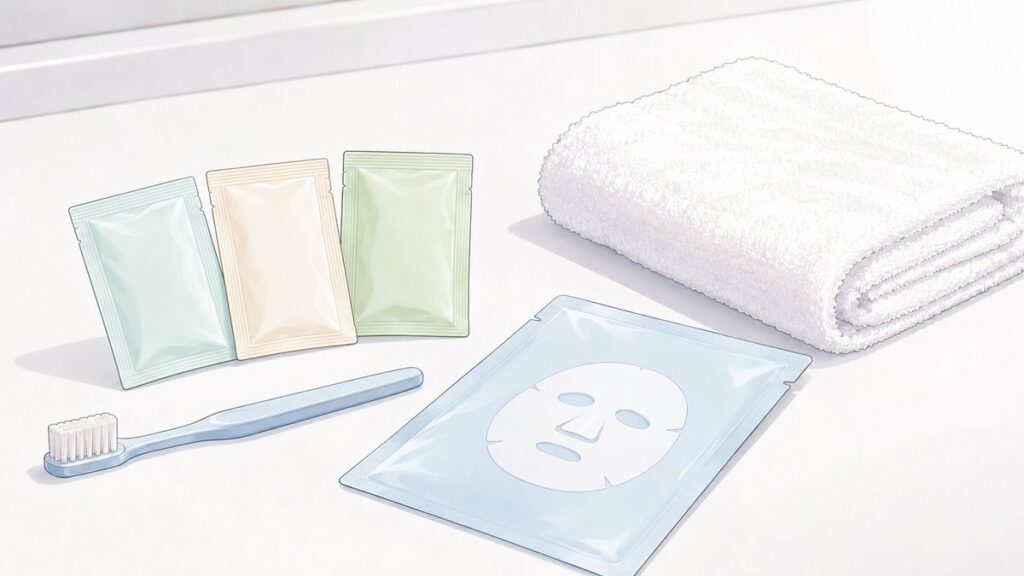
 The packing list depends entirely on where you’re going. At a super sento, you can honestly show up with nothing but your wallet — towels are rented or bought at the front desk, and the wash stations are fully stocked. At a small neighborhood sento, it’s the opposite: bringing your own towel and soap is the norm, though the front desk usually sells the basics if you forget.
So what’s actually provided? At super sento, the shower stations have shampoo, conditioner, and body soap waiting for you, and many places even set out toner and moisturizing lotion in the powder area — a small luxury that always surprises visitors. One honest note, though: these are the workhorse versions. They’ll get you clean and presentable, but if your hair has opinions, don’t expect miracles from the house shampoo.
 Which brings me to my favorite trick: on your way there, stop at any Japanese convenience store and pick up an otomari set — an “overnight kit” of travel-size toiletries for a few hundred yen. There are all kinds, and this is the fun part: they’re miniature versions of real Japanese brands, so the kit doubles as a tasting menu of Japanese skincare. Some even include a sheet face mask — save it for the powder corner in the changing room afterward, when your freshly-bathed skin will drink it up. If you fall in love with something, you’ve just found a souvenir that fits in any suitcase.
Beyond that, only a few small things are worth tucking in your bag: a hair tie if your hair is long, a plastic bag for the damp towel, and a 100-yen coin in case the lockers take one (you get it back). You don’t even need to carry water — many larger bathhouses have a drinking-water station near the baths or the changing room, and others sell cold drinks from vending machines. Either way, you’ll sweat more than you expect, so hydrate before and after your soak.
Visiting an Onsen with Kids
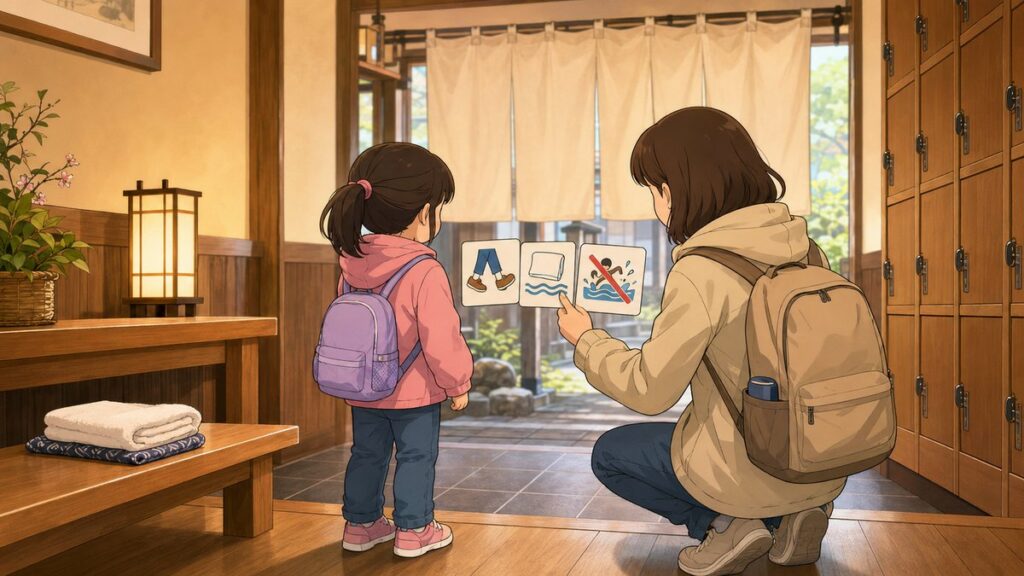
Here’s something the guidebooks rarely mention: Japanese bath culture is family culture. Weekend afternoons at our local super sento are full of toddlers in tiny bath stools and grandparents teaching grandkids to pour kakeyu. Bringing your children isn’t just allowed — it’s the most natural thing in the world here, and honestly, kids often fall in love with the place faster than adults do.
The logistics first. Small children can enter the bath with a parent of either gender, up to an age limit that varies by region — often somewhere around six — and some facilities set their own, lower limit, so check the bathhouse’s rules before visiting. If your child is older than that, they’ll go to their own side, so this works best when there’s an adult for each. Babies still in diapers are a facility-by-facility question, so check before you go — and if the shared bath won’t work, some places offer private family baths you can book by the hour, which solve the whole puzzle at once.
A few things I’ve learned as a mom on many bath days: brief your kids before you go in, not during. Three rules cover it — walk, don’t run (wet floors are slippery), the towel never goes in the water, and the big bath is not a pool. Then head for the lukewarm tub if there is one; Japanese bathwater is hot for little bodies, so keep soaks short and take breaks at the cold water fountain. Nobody will glare at a child who gets it wrong — everyone in that room once taught their own kids the same lessons.
 And keep one card up your sleeve: promise them something for afterward. In our house, the after-bath ice cream is a sacred institution, and my kids look forward to it all week. It buys you an amazing amount of cooperation — and it happens to be the perfect bridge to the best chapter of this guide.
What About Tattoos?
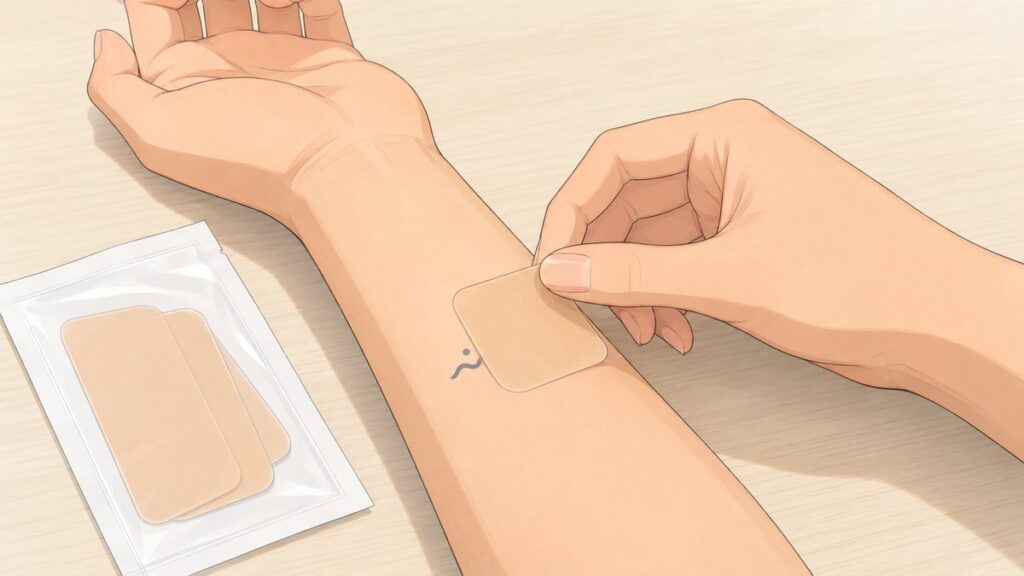
I’ll give it to you straight: this is the one area where Japan’s baths are still complicated. Many onsen and sento ask guests with tattoos to refrain from the shared baths. It’s a leftover from old associations that have nothing to do with you or your travel tattoos — but the rule is set by each facility, and it’s theirs to make.
 The good news is you have real options. Check the facility’s website before you go — many now state their tattoo policy clearly, sometimes in English. If your tattoo is small, waterproof cover stickers are sold online and in some shops — some facilities accept a fully covered tattoo, but others don’t, so check the policy before relying on a cover. A growing number of baths are openly tattoo-friendly, especially around tourist areas. And the private family bath — the same one that saves parents of babies — is often another way in, though even there, confirm the facility’s tattoo policy before booking.
If you have ink, don’t write off Japanese baths. It just takes one extra step of planning — and this topic deserves a proper deep-dive of its own, which is on my list for a future guide.
After Your Bath: The Best Part
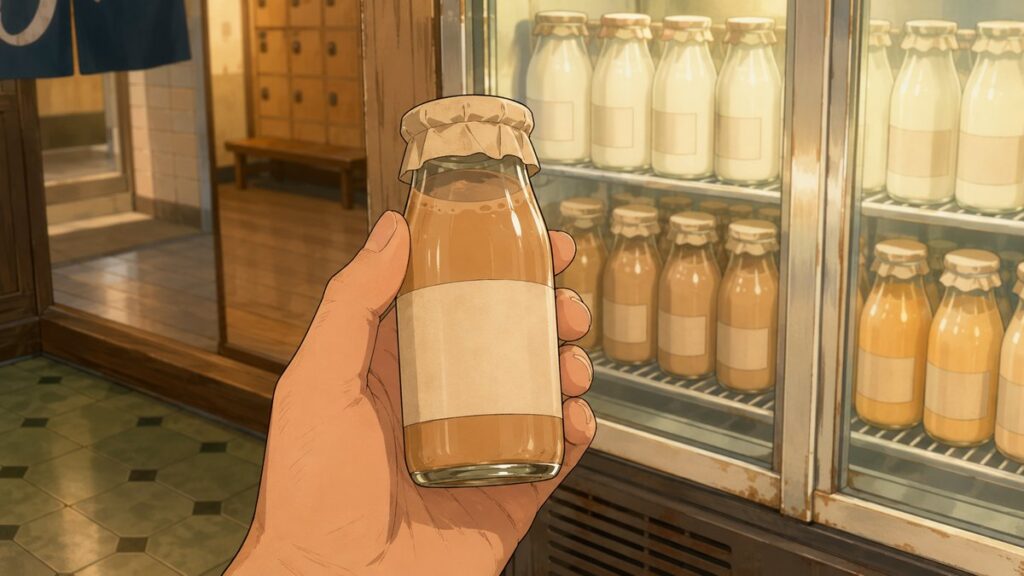
 Remember when I called this part sacred? Here’s why. You step out of the changing room with your skin glowing and your body feeling about half its usual weight — and Japan, being Japan, has a whole ritual waiting for exactly this moment.
 Find the drink fridge or vending machine near the changing room. The classic prize is a small glass bottle of coffee milk (kōhī gyūnyū) — or its sunset-orange sibling, fruit milk. Fair warning: the glass bottles are slowly becoming rare, so many places only carry cartons or plastic these days. That just raises the stakes — spotting one is your lucky day. And when you do: plant your free hand on your hip, tip the bottle back, and drink it in one long go — the classic after-bath pose you’ll recognize from Japanese TV, manga, and generations of bathhouse nostalgia. Nobody can fully explain why we drink it that way. We just know the milk tastes better.
The kids have their own version of this ritual: ice cream. In our family, it’s non-negotiable — the after-bath ice cream is half the reason my children agree to behave so beautifully inside. And if you’re at a super sento, don’t rush off. Put on that face mask from your convenience-store kit at the powder corner before you get dressed — then it’s time for the massage chair, the relax lounge, and a cold glass of water on your way out.
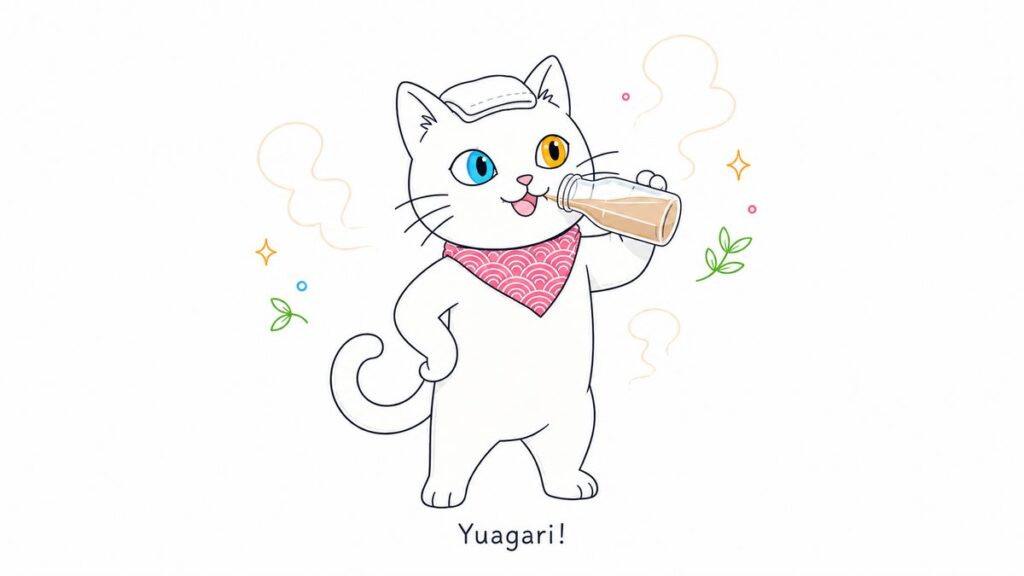
 There’s a word for this state — yuagari, “just out of the bath” — and it might be the most pleasant condition known to Japanese life. Best of all, it travels. Japanese drugstores and supermarkets sell onsen no moto — bath powders inspired by Japan’s famous hot-spring areas — and fizzy bath tablets like Bub. Fair warning from someone who’s carried them: a full box is heavier than it looks, so slip a few single packets into your suitcase as a trial. If they win you over, the same brands are often easy to order online back home. Long after your trip, on some cold evening, a hot bath, a packet of hot-spring powder, and a cold sweet drink will bring a little of Japan right back to you.
Disclosure: This article contains affiliate links. If you book through one, I may earn a small commission at no extra cost to you.
If reading this has you curious about staying the night, Hakone is the gentlest place to start — about 90 minutes from Tokyo, and many ryokan there have private baths you can reserve, so you can ease into it on your first visit. See onsen ryokan in Hakone on Agoda.
Ryokan With Private Baths Worth a Look
If a private bath is what makes the first night feel doable, these four are the ones I’d point a nervous friend to — three in Hakone, one in Kyoto. Tap a photo to check dates on Agoda. 🌿

🏯 Hakone Kowakidani Onsen Mizunoto
Three private baths, free and no reservation needed. Shuttle from Kowakidani Station.

🏯 Hakone Kowakien Ten-yu
Every room has its own open-air bath, plus an infinity bath on the 6th floor. Very used to overseas guests.

🏯 Hakone Ashinoko Hanaori
A gentle first ryokan: beds instead of futon, buffet meals, lake views. Two private baths (reservation required).

🏯 Kyoto Arashiyama Onsen Kadensho
One minute from Arashiyama Station, with five private baths that are free to use.
Frequently Asked Questions About Japanese Onsen
Do you wear a swimsuit in a Japanese onsen?
No — in regular gender-separated baths, everyone bathes naked, and swimwear isn’t allowed in the water. Exceptions exist, like onsen theme parks and mixed-gender areas that require swimsuits, so follow each facility’s rules.
Can I visit an onsen if I have a tattoo?
It depends on the facility, so check the official website before you go. Some accept small tattoos covered with a waterproof sticker — but don’t cover one secretly, and if you book a private bath, confirm the tattoo policy there too.
Do I need to bring my own towel?
At super sento and ryokan, towels can usually be rented or bought on site. At small neighborhood sento, bringing your own is the norm. When in doubt, the facility’s website will tell you.
Can children enter an onsen?
Yes, at most places. The age limit for bathing with an opposite-gender parent and the rules for babies in diapers vary by facility, so check before your visit.
What should I do if I feel dizzy in the bath?
Get out slowly, rest somewhere safe, and drink some water. If you don’t feel better soon, let the staff know — they’re used to helping.
Ready for Your First Soak?
So that’s everything I’d tell a friend before their first Japanese bath: pick a super sento, keep your towel dry, do your kakeyu, and save room for the coffee milk. The rules are fewer than you feared, the water is warmer than you imagine, and everyone in there started out as a nervous first-timer once — even the locals with the perfect hand-on-hip form.
 Now I’m curious about your side of the world — what’s bath culture like in your country? Do you have public baths, hot springs, saunas, or is bathing strictly a private affair? Tell me in the comments below. I read every single one!
I hope this guide has answered one of your questions and helped you feel a little closer to Japan. May your Japan journey be filled with wonderful discoveries and memories you’ll treasure for years to come.
Want to build an onsen night into a real trip? My 10-day Japan itinerary puts two nights at a Hakone ryokan right in the middle — on a ¥200,000 (≈$1,300) budget.
Prices are in yen, with rough dollar figures at about ¥154 to the dollar (September 2026). Exchange rates move, so treat the dollars as a ballpark.
 See you in the next guide.
Find an Onsen Ryokan in Hakone on Agoda
Comments