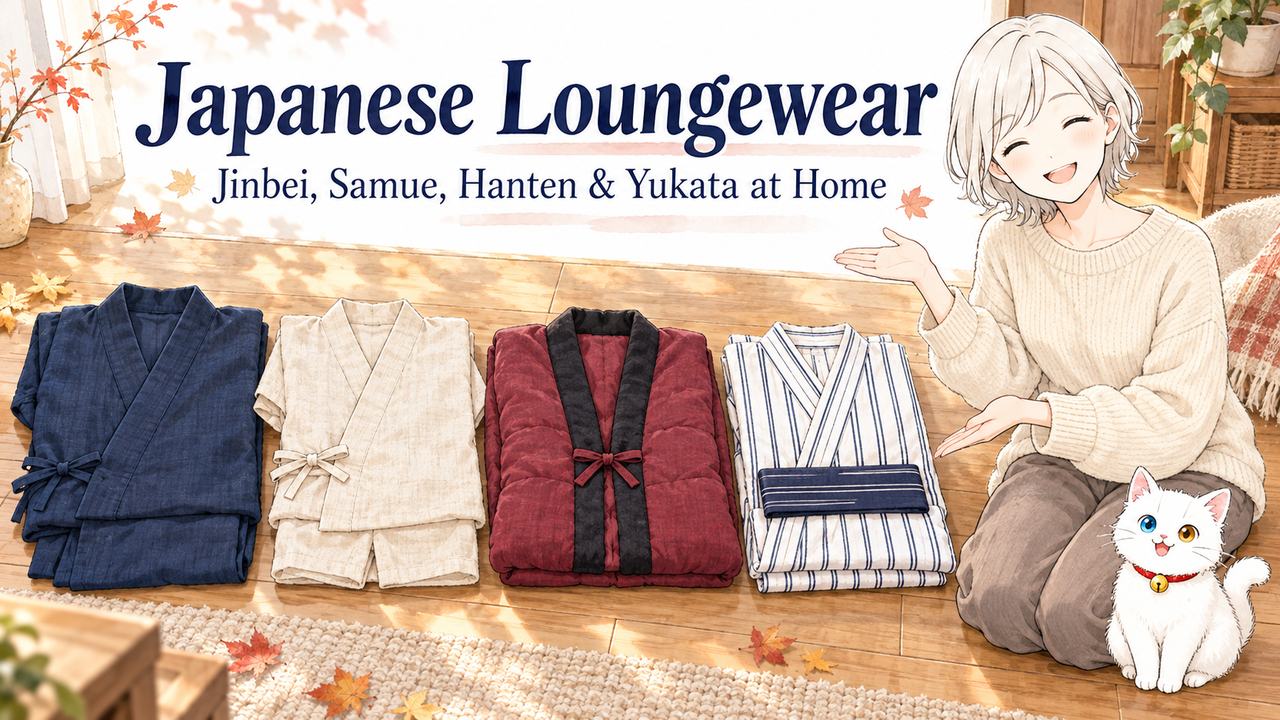
Yes, you can wear it at home. Start with a samue or jinbei; add a hanten in winter. If you already own a yukata, you can make it part of your evenings, too: fasten it with a comfortable sash and settle in for a quiet evening.
Disclosure: This article contains affiliate links. If you buy through one, I may earn a small commission at no extra cost to you. As an Amazon Associate I earn from qualifying purchases.
- Best year-round: WATANOSATO Kurume Samue | Amazon.com
- Best for summer: Edoten Shijira-ori Jinbei | Amazon.com
- Best for winter: Edoten Kurume Hanten | Amazon.com
- Best for women / unisex: Tokyoin Cotton Yukata Robe | Amazon.com
- What many Japanese women lounge in: gelato pique | Amazon Japan

- Yes, You Can Wear It at Home (a Yukata Began as a Bathing Robe)
- Yukata, Jinbei, Samue, Hanten, Nemaki: What’s the Difference?
- Honestly? Most Japanese Families Wear Regular Clothes at Home
- “Made in Japan” on Amazon: Why “Imported” Tells You Nothing
- Our Picks: Japanese Loungewear on Amazon.com
- WATANOSATO Kurume Samue: the year-round starting point
- Aiai JAPAN Tsumugi Samue: textured cotton for relaxed evenings
- Edoten Shijira-ori Jinbei: summer loungewear
- Tokyoin Cotton Yukata Robe: a women / unisex option
- Edoten Kurume Hanten: the winter layer
- Edoten Quilted Sashiko Samue: a winter set
- What many Japanese women actually lounge in
- Sizing: Japanese Size Charts Often Go by Height, Not Width
- Too Hard to Tie? The No-Knot Options
- Wearing It Outside Japan: What Most People Wonder
- 5 Ways to Actually Wear It After Your Trip (So It Doesn’t Stay in the Closet)
- If You’re in Japan: Where to Buy
- FAQ
- Final Thoughts
Yes, You Can Wear It at Home (a Yukata Began as a Bathing Robe)
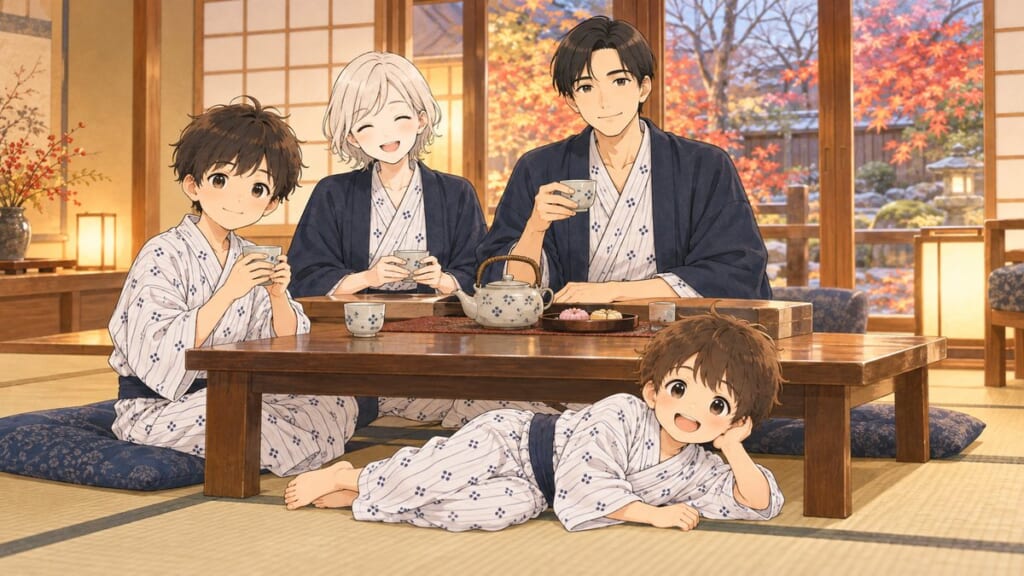
One r/kimono poster wanted to keep wearing a yukata because the cotton felt too lovely to give up. Another felt their collection was too pretty to leave in a closet, while a third decided to wear theirs at home to relax. If yours is still folded away after your trip, you have plenty of company.
A yukata has a connection to bathing through its predecessor, the yukatabira. It began as a robe worn inside steam baths, and later became what people wore after the bath. That history helps explain why a yukata belongs in this conversation about relaxing at home.
For casual wear around your own home, you don’t need a festival outfit. You can use a suitable soft sash instead of a decorative obi, although a wrap-style yukata still needs something to keep it closed.
Yukata, Jinbei, Samue, Hanten, Nemaki: What’s the Difference?
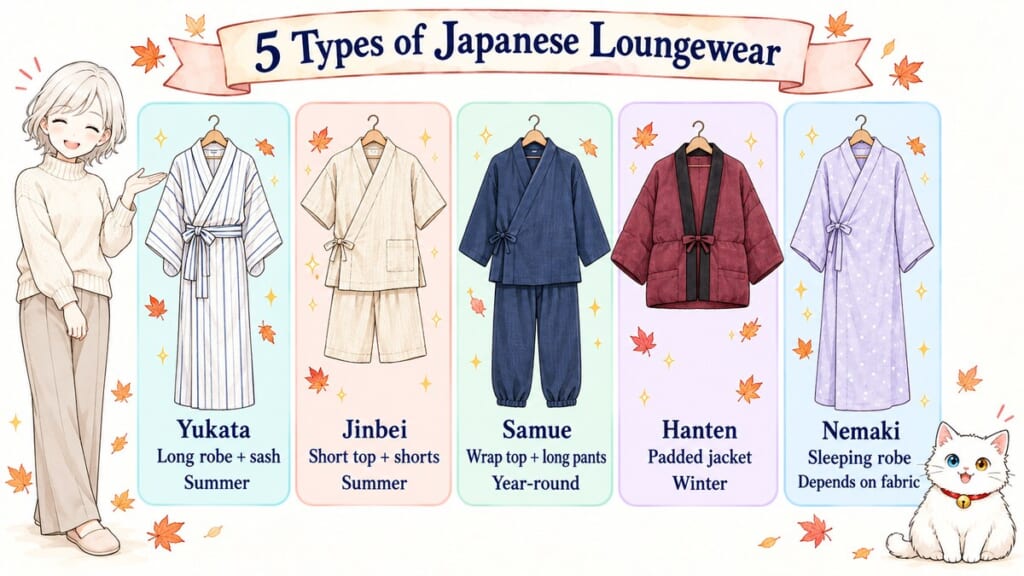
Choose by how you want to spend time at home. A short summer set, long trousers, and a padded layer solve different needs, even when a search page calls all of them “Japanese pajamas.”
| Type | What it looks like | Season | Easy to wear? | Typical price in Japan (¥) |
|---|---|---|---|---|
| Yukata | Long, overlapping robe with a sash | Summer; indoors with suitable layers | Needs fastening and enough overlap | Polyester sets: ¥3,000–7,000 (about $20–47); cotton yukata: varies by brand and construction |
| Jinbei | Short-sleeved wrap top and shorts | Summer | Simple ties; no obi | ¥3,000–10,000 (about $20–67) |
| Samue | Wrap top and long trousers | Year-round, depending on fabric | Simple ties; no obi | From around ¥6,000 (about $40) |
| Padded hanten | Short, padded jacket over other clothes | Winter | Slip on; usually simple front ties | Mass-market: ¥3,500–8,000 (about $23–53); Kurume padded styles: around ¥8,000–23,000 (about $53–153) |
| Nemaki | Sleeping robe; often a simple wrap style | Depends on fabric and bedding | Simple fastening; front can loosen | Varies by fabric |
These are 2026 Japanese retail guidelines, not Amazon prices; shops and seasons vary. Dollar estimates use a fixed conversion of 150 yen per US dollar as of October 2026.
 “Jimbei” is another spelling of jinbei, not a different garment. Nemaki means sleepwear; the table focuses on simple sleeping robes.
Is a kimono a bathrobe? No: kimono is a broader clothing category, and a bathrobe-like shape doesn’t make every robe a traditional kimono. When comparing “robe vs kimono” listings, check the garment’s construction and intended use rather than relying on the title.
Honestly? Most Japanese Families Wear Regular Clothes at Home
My family wears everyday clothes at home, including T-shirts and sweats. Jinbei, samue, hanten, and yukata aren’t our usual home wardrobe, and I don’t want to give you that impression. Today, yukata and jinbei are often associated with summer festivals or particular occasions, rather than everyone’s daily routine.
Why Japan does it this way: The yukata in a ryokan room makes sense when you remember its bathing origins. Changing after a bath and relaxing around the inn keeps that connection alive. It’s part of the stay, even for guests who return to ordinary pajamas at home.
If you choose traditional loungewear for your evenings, you may end up wearing it more often than my family does. You don’t have to copy our wardrobe to find something you enjoy in yours.
“Made in Japan” on Amazon: Why “Imported” Tells You Nothing
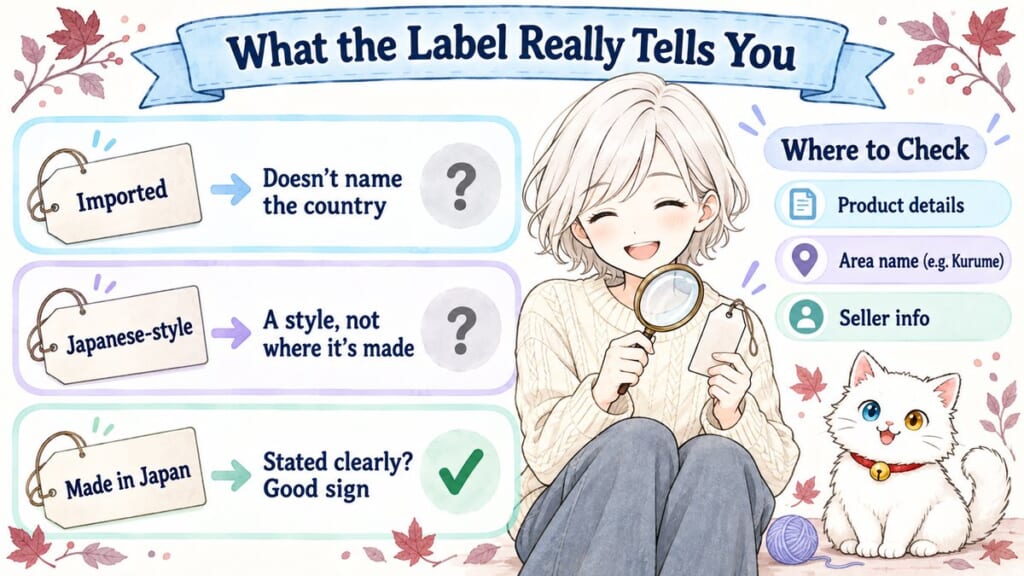
 “Imported” doesn’t identify a manufacturing country. On Amazon.com, that field can appear on clothing made in Japan or elsewhere, so it doesn’t answer the question you actually need answered.
“Japanese-style” describes a style, not an origin guarantee; it also doesn’t prove that an item was made outside Japan. Likewise, “2-Piece Set” can mean a yukata plus its obi, rather than a separate top and skirt. The included-items list tells you which pieces come together.
To find a listing that states a Japanese origin, look for an explicit manufacturing statement, a named production area such as Kurume, and the seller’s business details. A Japan-based seller provides useful context, but its address alone doesn’t establish where the clothing was made.
For that reason, I describe a listing as “the seller lists it as made in Japan,” rather than treating the page as independent verification. You can use the same distinction between a Japanese name and a stated manufacturing origin in Is Your “Japanese” Knife Actually Japanese?.
Our Picks: Japanese Loungewear on Amazon.com
 Start with the garment you expect to reach for regularly. The product details below follow seller descriptions.
WATANOSATO Kurume Samue: the year-round starting point


WATANOSATO Kurume Samue
Cotton Kurume cloth, listed as made in Japan. A top-and-trouser set for lounging all year.
Prices change often — please check the latest price on each store.
For you if you want a straightforward top-and-trouser set for everyday lounging.
WATANOSATO Kurume Samue is a cotton set with a tie-fastened top. The seller lists it as made in Japan using Kurume cloth woven in the Kurume area of Fukuoka.
With your top and trousers already paired, you can make tea, answer the door for a delivery, and settle back onto the sofa in the same outfit. For year-round use, add a layer when your room feels cold.
Aiai JAPAN Tsumugi Samue: textured cotton for relaxed evenings


Aiai JAPAN Men’s Tsumugi SAMUE
Textured 100% cotton, listed as made in Japan. A matching set for relaxed evenings.
Prices change often — please check the latest price on each store.
For you if you want the texture of tsumugi in a cotton lounging set.
The seller lists Aiai JAPAN Men’s Tsumugi SAMUE as made in Japan and recommends it for indoor use year-round and outdoor use in spring and autumn. Tsumugi is often silk in Japan, but this set is listed as 100% cotton. Pull on the matching top and trousers for an evening of reading with a cup of tea beside you.
Edoten Shijira-ori Jinbei: summer loungewear


Edoten Men’s Jimbei SIJIRAORI
Puckered 100% cotton for summer nights. Short sleeves and shorts with simple ties.
Prices change often — please check the latest price on each store.
For you if you want shorts and a simple wrap top for summer evenings.
Edoten Men’s Jimbei SIJIRAORI is listed as 100% cotton. Shijira-ori has a puckered surface, leaving less fabric resting flat against the skin; that texture makes it a common summer choice.
Wear the short-sleeved set on a summer night when you want to stretch out on the sofa with your arms and lower legs uncovered. If you prefer covered legs, choose samue with long trousers instead.
Tokyoin Cotton Yukata Robe: a women / unisex option


Tokyoin Cotton Yukata Robe
An easy cotton robe, listed as made in Japan. A robe-and-obi set is also sold.
Prices change often — please check the latest price on each store.
For you if you prefer a robe, including women looking for an alternative to the men’s sets above.
Tokyoin Cotton Yukata Robe is presented as easy-wearing cotton loungewear, and the seller lists it as made in Japan. Choose the robe-and-obi set if you’d like the sash included.
After your bath, wrap it around you and tie the sash. It’s a simple way to enjoy a little of that ryokan feeling at home.
A newer alternative for a quiet evening in a gauze robe is Aiai JAPAN Womens Gauze Yukata Robe, which the seller lists as made in Japan.
Edoten Kurume Hanten: the winter layer
![Edoten] Made in Japan handmade insulated short coat Kurume Hanten Original pattern 9807-3 One size](https://m.media-amazon.com/images/I/41kheqF1dGL._SL160_.jpg)

Edoten Kurume Hanten
A handmade padded Kurume jacket, listed as made in Japan. Wear it over your pajamas. One size.
Prices change often — please check the latest price on each store.
For you if you already like your pajamas and want a padded jacket over them.
Edoten Kurume Hanten is described by the seller as a handmade, padded Kurume jacket. The seller lists it as made in Japan, and the short shape makes it an extra layer rather than a complete change of clothes.
Slip it on over the pajamas you already own when the living room gets cold in the evening. The seller offers it in one size.
Edoten Quilted Sashiko Samue: a winter set


Edoten Men’s Quilted Sashiko Samue
A padded winter samue: top and trousers in one set.
Prices change often — please check the latest price on each store.
For you if you want a padded top-and-trouser set rather than an extra jacket.
Edoten Men’s Quilted Sashiko Samue is listed as a padded winter version of samue. It offers a different starting point from buying an unpadded set and layering a hanten over it.
Choose it for a winter weekend of breakfast, reading, and a film at home in one matching set. In a well-heated room, an unpadded set with a removable hanten may be easier to adjust.
For winter hanten searches, use “insulated,” “quilted,” or “Kurume Hanten” to find padded styles. “Festival Hanten / Happi Coat” refers to the festival jacket rather than the winter layer discussed here.
What many Japanese women actually lounge in
For you if you want a Japanese loungewear brand in familiar tops and bottoms.
gelato pique is a popular Japanese roomwear brand, not traditional Japanese clothing. I’ve given its loungewear as a gift. Choose a matching set for a slow breakfast or an evening curled up with a book.
In the US, shop through the official US store or visit its New York shop at 125 Orchard St. For the Japanese selection, the options here are a unisex long-sleeved top-and-trouser set and a women’s Baby Moco jacquard set.
Unisex long-sleeved top-and-trouser set:
Women’s Baby Moco jacquard set:
Both are sold and shipped by Amazon Japan, which ships to the US. Shipping fees and import taxes may apply, so check the total at checkout.
For more present ideas, see Japanese Gifts You Can Buy Without Going to Japan. Kids’ sets are hard to find on Amazon.com, so I’ve left them out of this list.
Sizing: Japanese Size Charts Often Go by Height, Not Width
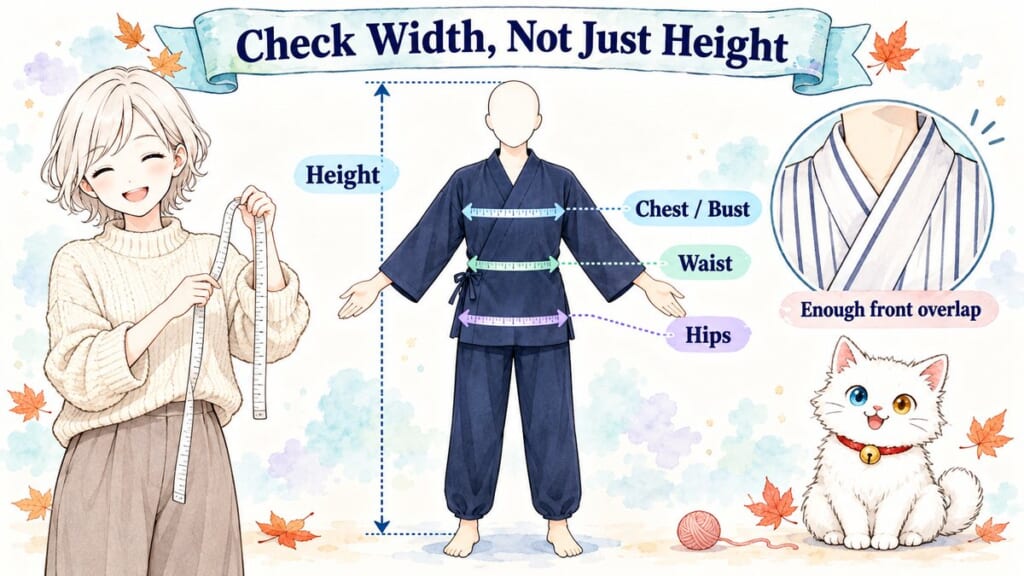
 Choose your size by body width as well as height. Yukata, jinbei, and samue charts often lead with a recommended height range, so moving from M to L may add length without giving you the room you need around your body. That doesn’t mean every larger Japanese size is only for taller people.
Measure your chest or bust, waist, and hips, then match them to the chart’s recommended body measurements. Finished garment measurements describe the clothing itself and include its extra room. If the chart gives only height, ask the seller for the missing body or garment measurements.
For a fuller bust or hips, search “wide size” or “ワイドサイズ”; some 3L and 4L ranges also offer more width. A comfortable yukata leaves enough front overlap for sitting and moving. With a set, use your waist and hips to choose the trousers, alongside your chest or bust for the top.
Use those measurements when choosing the WATANOSATO Kurume Samue introduced above. As a mother, I care more about whether you can sit comfortably than whether the size label looks familiar.
 At ryokan and hotels, I’ve been able to choose yukata in small, medium, and large sizes. If yours doesn’t fit, ask the front desk whether another size is available: “Do you have a larger size?” — 大きいサイズはありますか? Ōkii saizu wa arimasu ka?
For the bathing part of your stay, read Japanese Onsen Guide for First-Timers. If you’re choosing an autumn stay, my guide to three ryokan where you watch autumn leaves from your room connects that quiet time in a yukata with somewhere to enjoy it.
Too Hard to Tie? The No-Knot Options
For the simplest way to get dressed, choose the small ties on jinbei or samue instead of a decorative obi knot. With the Tokyoin robe-and-obi set above, use the included sash to secure the robe at your waist.
For a separate top and bottom, search for “separate yukata” or “二部式.” A pre-tied obi gives you the decorative knot already formed, with its own fastening system. If tying is physically difficult, ask the seller how it closes, since even a pre-tied obi may use ties.
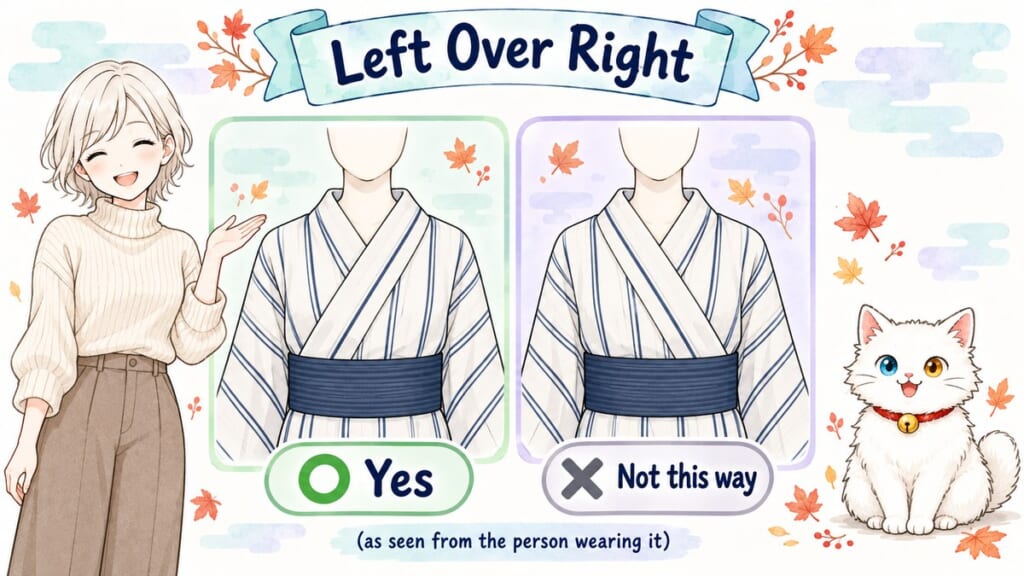
For a yukata or wrap-style top, wear the left side over right side, from your own viewpoint as the wearer. Bring your right panel across first, then place the left panel over it. Your right hand should slide into the overlap at your chest beneath the outer left panel.
 The reverse arrangement is traditionally used when dressing the deceased. You only need to remember the overlap; there’s no need to turn getting comfortable at home into a full dressing lesson.
Wearing It Outside Japan: What Most People Wonder
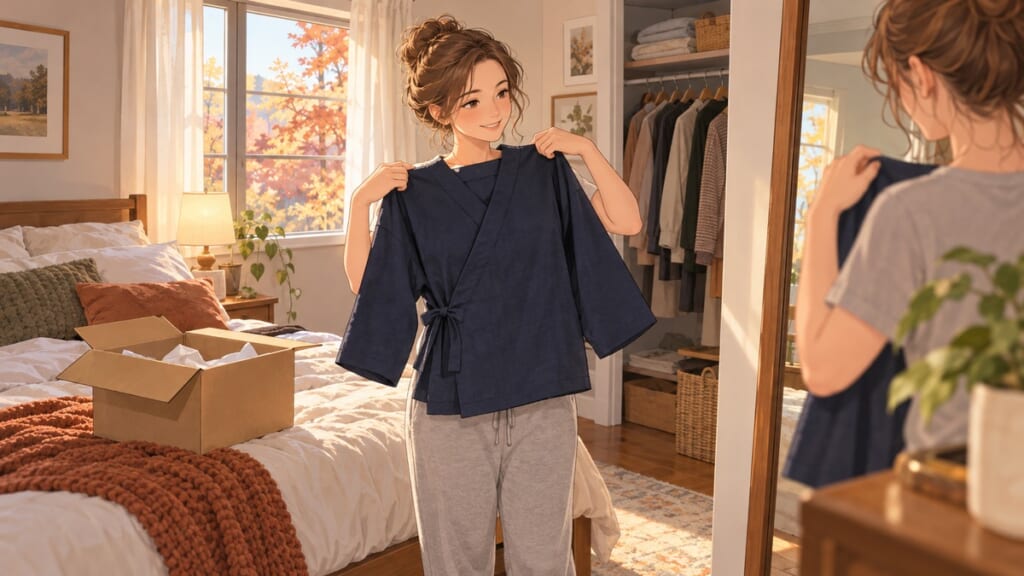
Wanting to enjoy something without disrespecting the people it comes from is a reasonable concern. You can take that concern seriously while still making room for an ordinary evening in a garment you like.
In a letter dated June 28, 2019, Kyoto’s then-mayor, Daisaku Kadokawa, asked Kim Kardashian West to reconsider using “Kimono” as a trademark. He described international visitors wearing kimono in Kyoto as evidence of worldwide affection for the clothing, while arguing that its names shouldn’t be monopolized.
A 2026 online survey of 400 people in Japan, conducted in March by GRAS Group’s Eikaiwa Cafe editorial team, found that 68.5% felt uncomfortable with monopolizing traditional names, compared with 3.8% for enjoying pop culture regardless of race. Those were different scenarios, not a direct test of wearing yukata at home. The researchers also stated that they weren’t defining every scenario as cultural appropriation.
To me, wearing clothing you appreciate and claiming its name for an unrelated business are different actions. Jinbei and samue are casual garments, and choosing one for relaxing at home isn’t something you need to feel anxious about. Avoid turning it into a geisha impersonation or a “sexy geisha” costume.
Some Japanese Americans feel differently about this, and that comes from a history — forced assimilation and wartime incarceration — that I did not live through. Their perspectives deserve room in the conversation, too.
 This is my perspective, not permission on behalf of everyone. As a Japanese person living in Japan, I can speak only from my own experience.
5 Ways to Actually Wear It After Your Trip (So It Doesn’t Stay in the Closet)
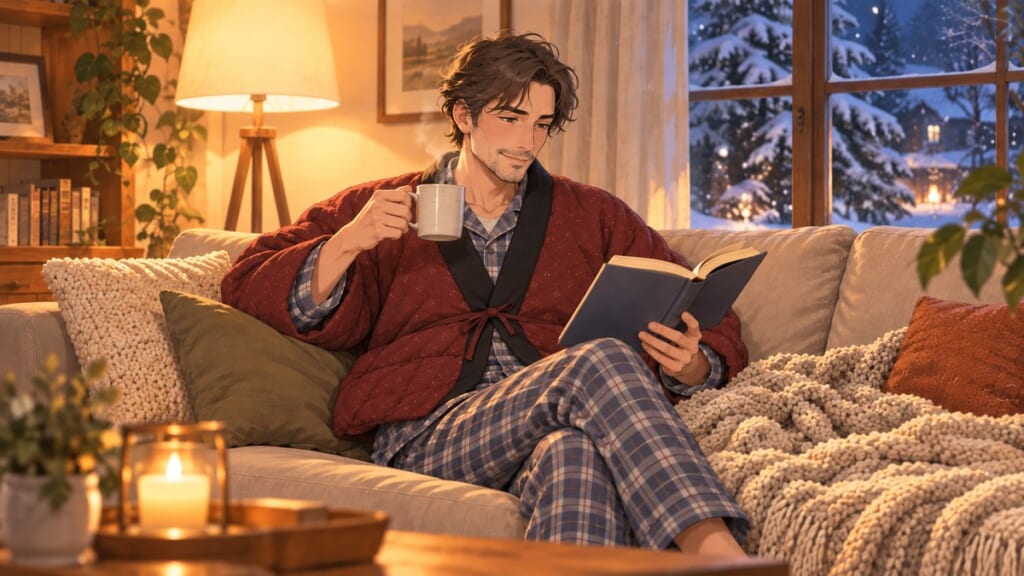
- Put it on after your bath. Dry off first, then change into your yukata or set for the rest of the evening.
- Add a hanten in winter. Wear it over clothes you already find comfortable; for travel clothing rather than indoor lounging, see What to Wear in Japan in December & Winter.
- Give it a weekend morning. A slow breakfast at home is a simple opportunity to wear something that feels too special for a weekday.
- Wear the memory instead of storing it. Let the garment you bought on your trip become part of an ordinary evening, without waiting for a themed occasion.
- Make care part of the routine. Follow the garment’s care label for washing, drying, and storage so it stays part of your regular wardrobe.
If You’re in Japan: Where to Buy
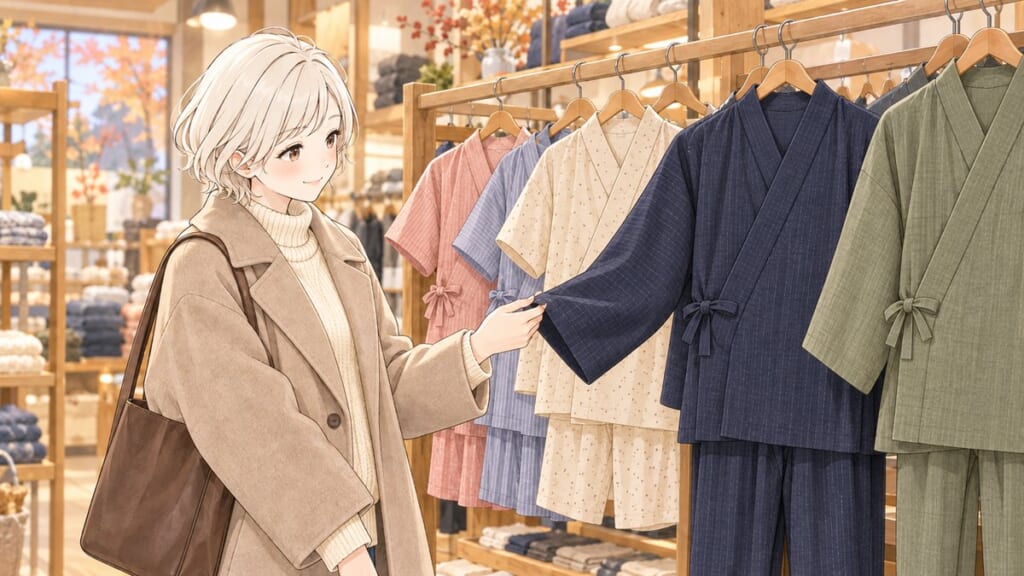
Ask at your ryokan if you’d like a yukata to take home. Some inns sell them or offer a stay plan that includes one, but the robe provided in your room is the inn’s property unless staff explicitly tell you otherwise.
Look for MUJI’s shijira-ori jinbei during its summer season. Shopping in person also lets you feel the fabric and choose your size at the shop; if you aren’t traveling, the online choices above offer another route.
For the shopping part of your trip, see Japan Tax-Free Shopping Guide 2026, and use my Japan Trip Planning Guide for the wider plan. If a Pinterest or other social-media ad offers unusually cheap “kimono robes,” check the company’s name, address, contact details, and return terms before ordering.
FAQ
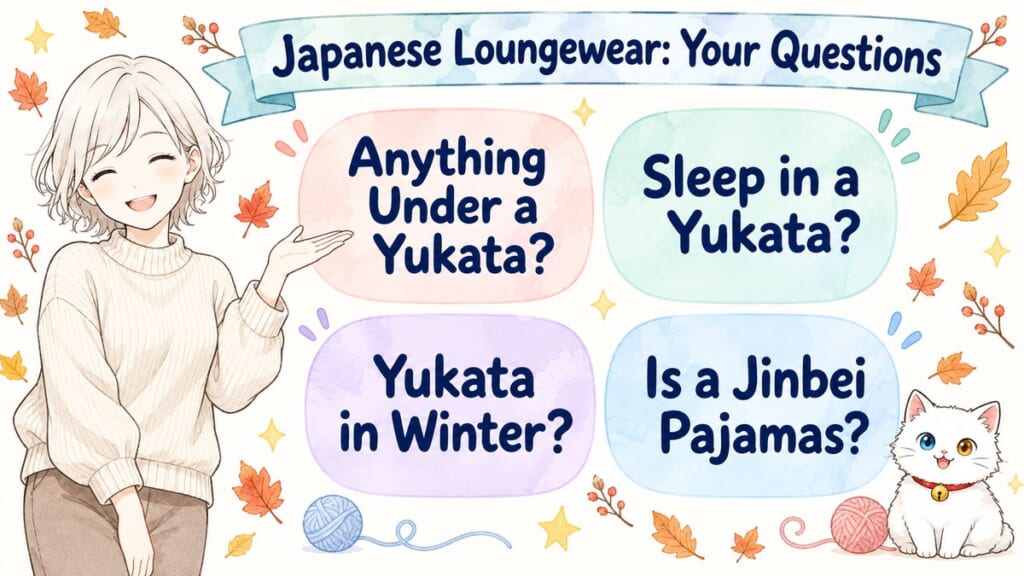
Do you wear anything under a yukata?
Yes, you can wear underwear and a light inner layer beneath a yukata at home. Choose what gives you comfortable coverage, especially if the fabric is light or the neckline moves when you sit.
Can I sleep in a yukata?
Yes, but the front can come open: that happened to me while sleeping in a ryokan yukata. For sleeping, a jinbei or samue set can make keeping your lower body covered easier because it has separate bottoms.
Can I wear a yukata in winter?
Yes, indoors, if your room temperature and layers make it comfortable. For winter lounging, wear a padded hanten over your yukata and add comfortable layers underneath.
Is a jinbei pajamas?
You can wear jinbei as pajamas, although it’s also casual summer loungewear. Choose a set whose fabric, fit, and ties feel comfortable for sleeping.
Final Thoughts
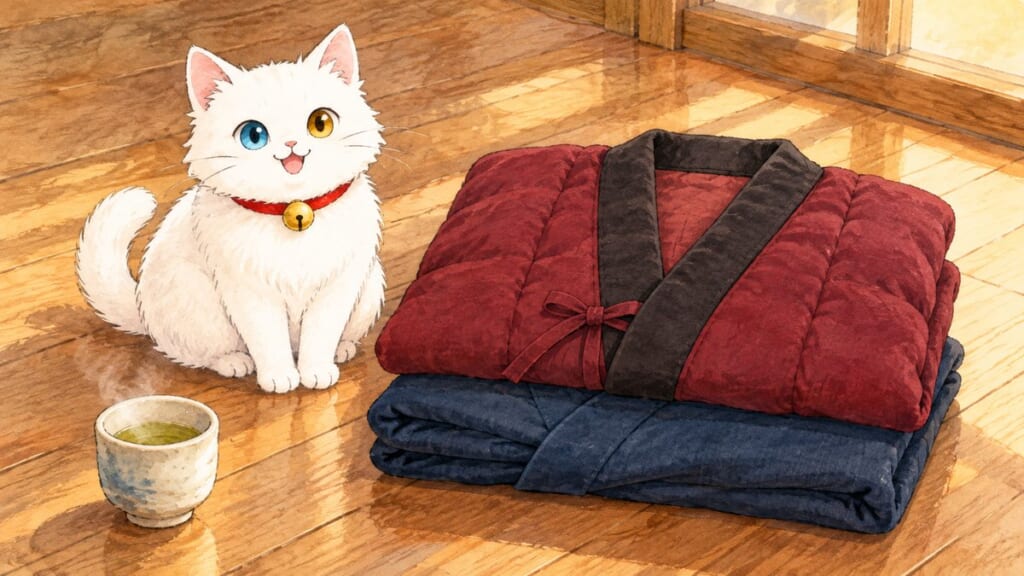
For a first set you can adapt through the year, start with WATANOSATO Kurume Samue. For winter, when you already have pajamas you like, choose Edoten Kurume Hanten as your extra layer.
Now I’m curious about your side of the world — what do you wear to relax at home? Tell me in the comments below. I read every single one!
I hope this guide has answered one of your questions and helped you feel a little closer to Japan.
May your Japan journey be filled with wonderful discoveries and memories you’ll treasure for years to come.
See you in the next guide.
Comments