Your flight lands at Haneda Airport late at night. You’re tired, your suitcase is heavy, and there’s one question you need answered before you even leave home: Will I still be able to reach my hotel?
 Haneda’s last trains leave shortly after midnight, but your landing time isn’t the time you’ll reach the arrivals lobby. Immigration, baggage collection, and airport crowds can change your plans.
The good news is that you have other choices. A late-night bus, a flat-rate taxi, a pre-booked transfer, or a hotel connected to the airport can all work — but the right answer depends on when you walk out of arrivals and how many people are traveling with you.
I’ve put together this guide using official airport information, hotel details, and traveler feedback, so you can make that decision before your flight.
Disclosure: This article contains affiliate links. If you book through one, I may earn a small commission at no extra cost to you.

- 1. Quick Answer: Your Plan by Exit Time
- 2. Before You Land: 3 Things to Set Up
- 3. Can You Still Catch the Last Train?
- 4. After the Last Train: Taxi, Bus or Transfer
- 5. Sleep at Haneda: Airport-Connected Hotels
- 6. Stay Just Outside Haneda Airport
- 7. Arriving Late With Kids or Lots of Luggage
- 8. Waiting for the First Train at Haneda
- FAQ
- 9. Which One Should You Pick? A Simple Rule
1. Quick Answer: Your Plan by Exit Time
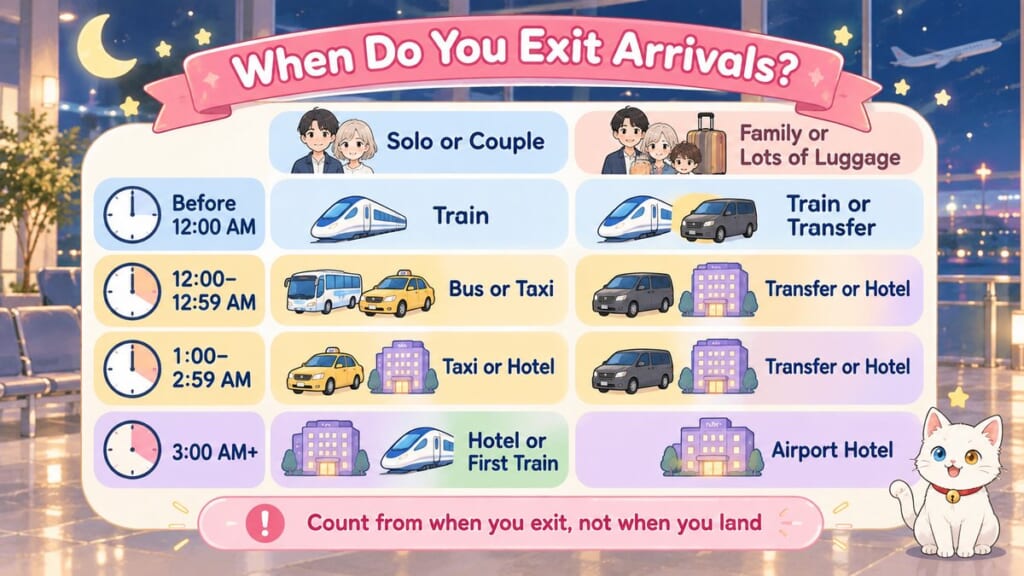
If you’re outside the arrivals lobby before midnight, check the trains first. If it’s already after midnight, plan around a bus, taxi, pre-booked transfer, or airport hotel. Families with young children or several suitcases should be especially careful about relying on the last train.
| Time you exit arrivals | Solo traveler or couple | Family, lots of luggage, or baby |
|---|---|---|
| Before midnight (through 11:59 PM) | Train, if your entire route still operates; otherwise taxi or airport hotel | Train only with a straightforward route and enough time; otherwise pre-booked transfer or airport hotel |
| 12:00–12:59 AM | Late-night bus if your destination matches its route; otherwise flat-rate taxi or airport hotel | Pre-booked transfer or airport hotel; late-night bus only if the stop is convenient |
| 1:00–2:59 AM | Late-night bus if one is still scheduled; otherwise taxi, transfer, or airport hotel | Pre-booked transfer or airport hotel |
| 3:00 AM onward | Airport hotel if booked in advance, or wait for the first train if you can comfortably stay in an accessible area | Airport hotel; avoid making an overnight wait your default family plan |
The table is based on the time you finish immigration and collect your bags, not when the plane touches down. There is no reliable single number of minutes to allow between landing and reaching the lobby; the process varies considerably with passenger volume and airport conditions.
 If your flight is scheduled to land close to midnight, I would book a backup that doesn’t depend on catching a particular train.
Three Things to Book Before Your Late-Night Arrival
| Book ahead | What to check | Booking |
|---|---|---|
| Airport transfer | Hotel address, flight tracking, passengers, luggage, child seats |
From US$54 as of October 2026 |
| Japan eSIM | Activation instructions and mobile data on arrival |
Compare: my guide to the best eSIM for Japan |
| Airport hotel | Correct check-in date, room occupancy, late arrival |
2. Before You Land: 3 Things to Set Up
Book the night that begins before your after-midnight arrival
 Suppose your flight lands at 1:00 AM on November 18, and you want to go directly to your hotel and sleep. You generally need a reservation beginning November 17, with November 18 as the checkout date, rather than a reservation beginning November 18.
A November 18 reservation normally allows check-in that afternoon, not at 1:00 AM.
For example:
| Your plan | Reservation date to arrange |
|---|---|
| Arrive at 11:30 PM on November 17 and sleep that night | Check in November 17 |
| Arrive at 1:00 AM on November 18 and sleep immediately | Check in November 17, subject to the hotel’s late-arrival acceptance |
| Arrive at 1:00 AM on November 18 and wait until normal afternoon check-in | Check in November 18 |
Check the hotel’s late-arrival policy before paying.
Tell the hotel your actual arrival time
Even with the correct reservation date, tell the hotel when you expect to reach its front desk. Mention that your flight arrives after midnight if that’s the case.
For example, you can write:
“I have a reservation for the night of November 17. My flight lands at Haneda Airport at 1:00 AM on November 18, and I expect to arrive at the hotel after that. Could you please confirm that late check-in is possible and that my room will be held?”
 A hotel may treat an unexplained absence as a no-show, so don’t rely on the booking confirmation alone. Villa Fontaine Grand Haneda Airport, for example, states that an unannounced no-show carries a full cancellation charge.
Set up mobile data before departure
 Your phone is your link to your hotel, maps, and transport booking once you’re outside arrivals. An eSIM arranged before your trip can save you from trying to set everything up while standing in an unfamiliar terminal.
Follow your provider’s instructions for installation and activation, and check that your phone supports the eSIM. If you haven’t chosen one yet, see my guide to the best eSIM for Japan or the Klook eSIM for Japan.
Suica won’t solve a missed last train. For paying fares once you’re on your way, see my guide to Suica vs Pasmo for tourists.
Before departure, also keep your hotel address, booking confirmation, and driver’s contact information somewhere accessible without mobile data.
3. Can You Still Catch the Last Train?
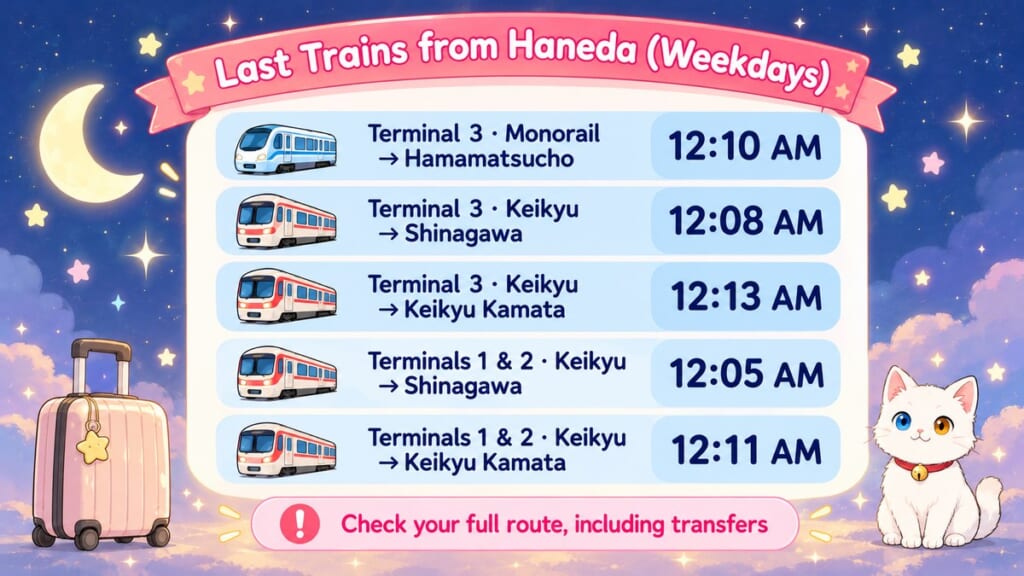
Haneda’s final trains toward central Tokyo generally leave just after midnight, around 12:05–12:13 AM. If you’re still collecting your bags around that time, don’t make the train your only plan.
The two main rail operators are Tokyo Monorail and Keikyu Railway. Both connect Haneda with the wider Tokyo rail network, but their routes and last departures are different.
Last departures from Haneda
These are the weekday departure times listed in the official timetables as of October 2026, in Japan local time.
| Station and operator | Final service | Departure |
|---|---|---|
| Terminal 3 — Tokyo Monorail | Hamamatsucho | 12:10 AM |
| Terminal 3 — Keikyu | Shinagawa, Limited Express | 12:08 AM |
| Terminal 3 — Keikyu | Keikyu Kamata, Local | 12:13 AM |
| Terminals 1 & 2 — Keikyu | Shinagawa | 12:05 AM |
| Terminals 1 & 2 — Keikyu | Keikyu Kamata | 12:11 AM |
On weekends and holidays, Terminal 3’s last Keikyu train to Shinagawa leaves at 12:08 AM, while the last train to Keikyu Kamata leaves at midnight, according to the timetable available in October 2026.
Keikyu has announced a timetable change starting November 21, 2026 (weekends and holidays) and November 24, 2026 (weekdays). Its announcement doesn’t list changes to the late-night departures above, but check the new timetable for your travel date and allow enough time to reach the platform.
The connecting train matters just as much
 Imagine you’re staying in Asakusa, Shinjuku, or another neighborhood requiring a transfer. Catching the last Keikyu or monorail departure doesn’t guarantee you’ll be able to finish your rail journey.
Check your entire route, including the final connection and the walk from the destination station to your hotel. Multiple transfers, stairs, and bulky luggage make a tight connection a particularly poor bet.
Why Japan does it this way
 In Japan, most regular urban train services finish around midnight rather than operating through the night. People living here plan evenings around the last train, and missing it often means finding another way home or waiting until morning.
If you can choose your flight, allow enough time for immigration and train connections.
For travelers using Narita Airport instead, rail services and transfer planning are different. See my guide to getting from Narita Airport to Tokyo.
4. After the Last Train: Taxi, Bus or Transfer
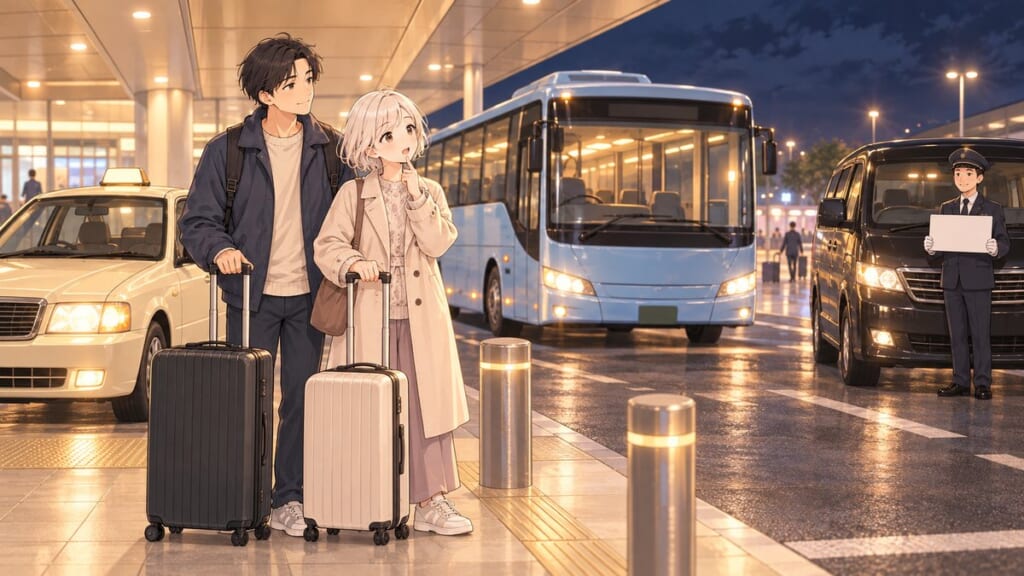
If you’ve missed the last train, a taxi or pre-booked transfer is the most flexible way to reach your hotel. A late-night bus can cost less, but it only helps if its route matches your destination and you’re outside arrivals in time.
Compare your late-night transport choices
| Transport | Approximate total cost | Waiting time | Luggage and children | Conditions |
|---|---|---|---|---|
| Flat-rate taxi | Shinjuku: ¥10,700 (about $69) overnight, plus tolls; about $35 each for two | Depends on taxi queue | Vehicle size and available luggage space vary | Fixed-fare zones only; no advance booking needed at airport taxi ranks |
| Late-night bus | Shinjuku/Ikebukuro: ¥2,800 (about $18) per adult, or about $36 for two; onward taxi extra | Depends on scheduled departure | Luggage must meet operator rules; additional transfer may be needed | Limited routes and departures |
| Pre-booked transfer | From US$54, about $27 each for two at the starting price | Prearranged pickup; confirm waiting allowance | Larger vehicles and child-seat options | Book ahead; price depends on route and vehicle |
| Airport hotel | Room rate varies by property and date | No city transfer if you stay in your arrival terminal | Room occupancy and terminal access must be checked | Correct booking night and late check-in acceptance required |
Taxi and bus yen-to-dollar amounts use a fixed illustrative exchange rate of ¥155 = US$1, as of October 2026. Transfer starting price is as of October 2026. Actual costs and availability may change.
Flat-rate taxis: check whether your hotel area qualifies
Haneda Flat-Rate Taxi Fares (Official)
Haneda’s flat-rate taxis cover designated areas only.
For rides between 10:00 PM and 5:00 AM, the official fare includes the late-night premium. Expressway tolls are charged separately.
Some examples from the October 2026 fare information are:
| Destination area | Daytime flat fare | Late-night flat fare |
|---|---|---|
| Chiyoda | ¥7,600 (about $49) | ¥9,000 (about $58) |
| Shibuya | ¥8,500 (about $55) | ¥10,000 (about $65) |
| Shinjuku | ¥9,000 (about $58) | ¥10,700 (about $69) |
Minato, Shinagawa, Chuo, and Ota are among the wards excluded from this particular fixed-fare system. A journey to an excluded area isn’t automatically covered just because it begins at Haneda.
At the airport’s designated taxi ranks, eligible flat-rate journeys don’t require an advance reservation. You should still confirm your destination and fare category with the driver.
A metered taxi may be appropriate for areas outside the fixed-fare zones.
The late-night bus: useful, but only for certain destinations
Haneda Late-Night Bus Times (Official)
Airport Limousine Bus (Official)
As of October 2026, Haneda’s late-night buses serve these destinations:
| Destination | Departure terminal and times | Fare / Arrival |
|---|---|---|
| Shinjuku / Ikebukuro | T3: 12:20, 1:00, 1:40, 2:20 AM. T2: 12:05 AM; T1: 12:10 AM | ¥2,800 (about $18) per adult. Busta Shinjuku: 12:53–3:03 AM; Ikebukuro East Exit: 1:13–3:25 AM |
| Yokohama (YCAT) / Sakuragicho | T3: 1:20 AM | Check fare with operator |
There are no late-night direct buses to Tokyo Station, Ginza, Asakusa, Shibuya, or Shinagawa. If your hotel isn’t an easy walk from the bus stop, budget for a short taxi ride afterward. Recheck the schedule for your travel date.
A pre-booked transfer: someone waiting for your flight
Check Haneda Airport Transfers on Klook
 In a Japanese family, when someone arrives at an airport after the last train, asking a family member to collect them by car is a familiar solution. As a visitor, you probably don’t have someone waiting at Haneda with a car.
A pre-booked airport transfer can fill that role.
Klook lists Haneda airport transfers operating around the clock, with flight tracking and optional child seats. Its service information says the driver will wait without additional charges if your flight is delayed.
Among travelers discussing late arrivals, some travelers say booking a ride was worthwhile when taxi queues became long, sometimes reporting waits exceeding half an hour. Others worry that a flight delay or slow immigration process could cause them to miss their driver.
Both concerns are worth considering. A delayed flight and a long wait after landing are not necessarily covered by the same policy.
Haneda Terminal 3 also has a designated pickup area for booked taxis and app-dispatched vehicles at the eighth floor of Parking P5. Follow the instructions for your particular service rather than assuming every transfer uses that location.
What about moving between Haneda’s terminals?
As of October 2026, the last departure from Terminal 3 is 1:15 AM. The last Terminal 1 departures are 1:23 AM toward Terminal 2 and 1:32 AM toward Terminal 3, while the final Terminal 2 departure is 1:28 AM.
If you’re arriving at Terminal 3 and planning to sleep at a Terminal 1 or Terminal 2 hotel, check the connection before booking. Once the shuttle has stopped, you’ll need another arrangement.
5. Sleep at Haneda: Airport-Connected Hotels
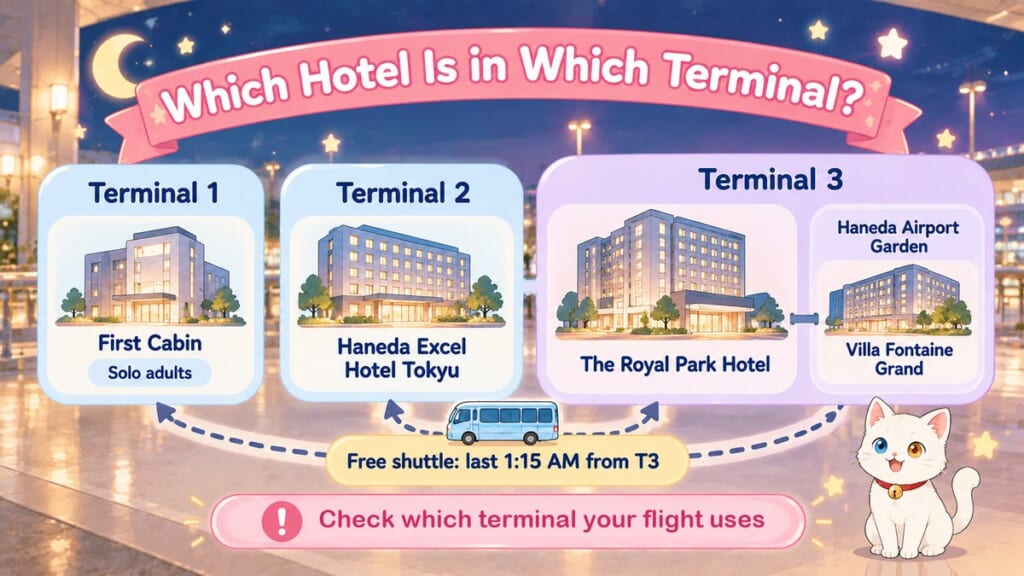
 An airport hotel is the simplest choice when you arrive after the last train and don’t need to be in central Tokyo that night. You can leave your longer journey until morning, but you must book the right hotel for the terminal you can actually reach.
Hotels inside or connected to Haneda
| Hotel | Location | Good for | Photo | Booking |
|---|---|---|---|---|
| Villa Fontaine Grand Haneda Airport | Terminal 3, connected via Haneda Airport Garden | Couples, families, late-night arrivals |  |
|
| The Royal Park Hotel Tokyo Haneda | Terminal 3, landside departure level | Travelers wanting to remain in Terminal 3 |  |
|
| Haneda Excel Hotel Tokyu | Terminal 2 | Travelers using Terminal 2 or able to transfer there |  |
|
| First Cabin Haneda Terminal 1 | Terminal 1, arrival level | Solo adult travelers | — |
Villa Fontaine Grand Haneda Airport — for staying close to Terminal 3
Tip: enter your dates and number of guests first — Agoda only shows rooms and prices after that.
Check Villa Fontaine Grand on Agoda
Villa Fontaine Grand’s standard check-in begins at 3:00 PM, and the hotel also advertises a special MY24h accommodation plan. Don’t assume a normal booking includes the same flexible conditions.
The Royal Park Hotel Tokyo Haneda — check which hotel you’re booking
Tip: enter your dates and number of guests first — Agoda only shows rooms and prices after that.
Check The Royal Park Hotel Haneda on Agoda
The Royal Park Hotel has an entrance on Terminal 3’s third-floor departure level, in the general public area. This is the one to look for if you’re entering Japan and want to stay after clearing immigration.
Do not confuse it with The Royal Park Hotel Tokyo Haneda Transit. The transit hotel is located inside the restricted international airside area and isn’t available to passengers who have entered Japan.
The regular hotel’s stated check-in time begins at 3:00 PM. Confirm that your reservation is for the public-area hotel and that it can accommodate your arrival time.
Haneda Excel Hotel Tokyu — convenient when Terminal 2 works for you
Tip: enter your dates and number of guests first — Agoda only shows rooms and prices after that.
Check Haneda Excel Hotel Tokyu on Agoda
Because the hotel is in Terminal 2, the terminal shuttle timetable matters. If you won’t be outside arrivals until after the last shuttle, check how you’ll reach the hotel before selecting it.
First Cabin Haneda Terminal 1 — for solo travelers
First Cabin Haneda T1 (Official)
First Cabin provides individual cabin-style accommodation at Terminal 1’s arrival level. Its rooms are designed for one person, and the accommodation is divided into separate male and female areas.
The facility asks travelers aged 12 or younger not to use it, so it isn’t my family recommendation.
Its standard check-in starts at 2:00 PM. At night, access is through the designated nighttime entrance near bus stop 8 on the first-floor arrivals level.
6. Stay Just Outside Haneda Airport
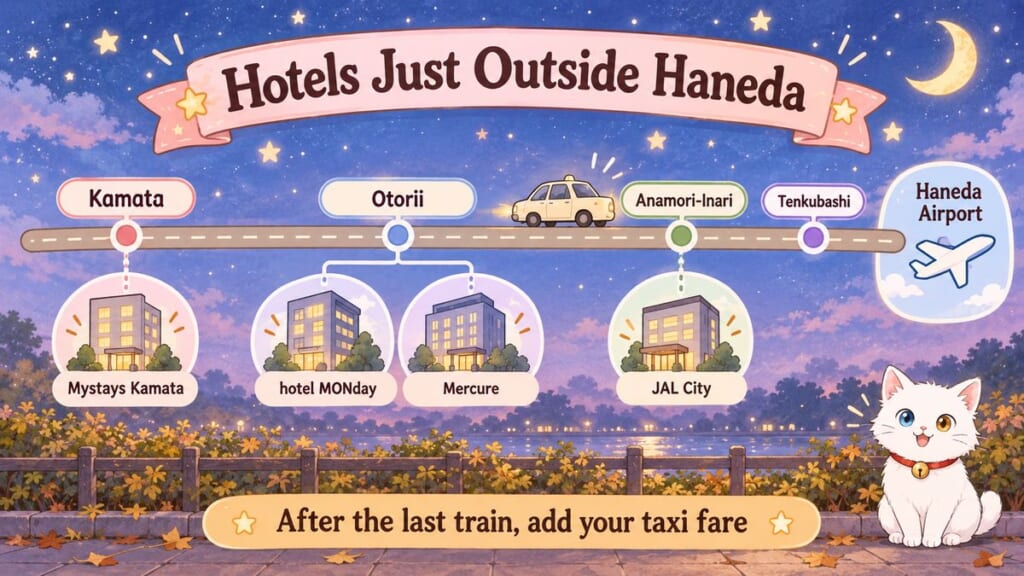
 A hotel just outside Haneda can cost less than a connected airport hotel, but after the trains stop, you need to include your taxi ride. The room with the lowest listed rate isn’t necessarily the least expensive complete plan.
Hotels outside the terminals
| Hotel | Location | Good for | Photo | Booking |
|---|---|---|---|---|
| hotel MONday Haneda Airport | Otorii | Travelers comparing airport-area rooms |  |
|
| Hotel JAL City Haneda Tokyo | Anamori-Inari (Keikyu Line) | Travelers wanting an airport-area hotel |  |
|
| Mercure Tokyo Haneda Airport | Otorii | Couples and travelers considering the hotel’s airport shuttle |  |
|
| Hotel Mystays Kamata | Kamata | Travelers comparing room costs with an overnight taxi |  |
hotel MONday Haneda Airport in Otorii and Hotel JAL City Haneda Tokyo near Anamori-Inari Station are two airport-area options to compare. Check the exact address, room occupancy, and late-night taxi cost before booking.
Mercure Tokyo Haneda Airport — check the shuttle hours
Tip: enter your dates and number of guests first — Agoda only shows rooms and prices after that.
Check Mercure Haneda Airport on Agoda
Mercure Tokyo Haneda Airport is in Otorii and advertises a free airport shuttle. That sounds helpful, but a shuttle’s existence doesn’t mean it will meet a flight arriving after midnight.
If the last shuttle has already left, treat the journey as a taxi transfer and compare the combined cost.
Hotel Mystays Kamata — compare the full overnight cost
Tip: enter your dates and number of guests first — Agoda only shows rooms and prices after that.
Check Hotel Mystays Kamata on Agoda
For example, Agoda’s October 21, 2026 comparison for a November 18, 2026 stay showed a two-adult, one-room, lowest-room-category tax-inclusive rate of ¥14,199 (about $92) for this hotel. Under those same search conditions, Villa Fontaine Grand Haneda Airport was ¥25,607 (about $165).
These are two-adult rates, not family-room quotes, and exclude airport transport. If you’re traveling with children, check room occupancy and compare the total room-plus-taxi cost before booking.
7. Arriving Late With Kids or Lots of Luggage
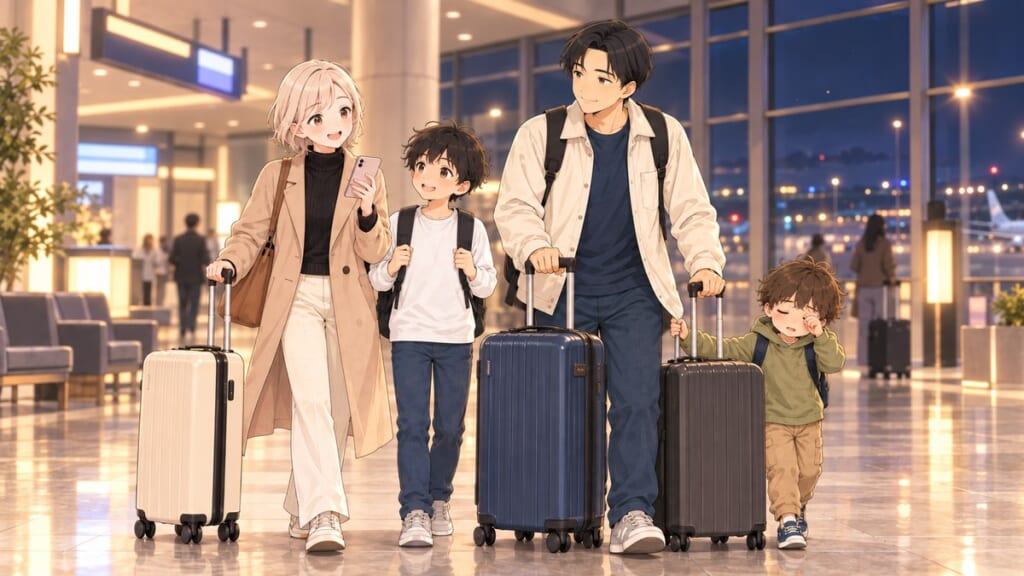
For a family with young children and several suitcases, I’d choose a suitable pre-booked transfer or a family-sized airport hotel room over a tight final-train connection.
 As a mother, I’d rather have the first night’s arrangements settled before leaving home than make transportation decisions with sleepy children beside me.
Make sure everyone and every suitcase will fit
Klook’s Haneda transfer listings include different vehicle capacities:
| Vehicle | Listed passenger capacity | Listed luggage capacity |
|---|---|---|
| 4-seater | 3 passengers | 2 pieces |
| 7-seater | 6 passengers | 4 pieces |
| 10-seater | 9 passengers | 9 pieces |
A family of four with four suitcases should look carefully at the 7-seater or another appropriately sized vehicle, rather than assuming a standard car will fit.
These are the listed capacity figures, not a guarantee for every combination of luggage sizes, strollers, and child seats. Check the vehicle’s actual capacity before booking.
Child seats: what you should know
In Japan, taxis are legally exempt from the usual child-restraint requirement that applies to private cars. That legal exemption doesn’t mean a child seat offers no safety benefit.
When my own children were little, I took them in taxis without child seats — something that feels ordinary in many Japanese families. I’m not recommending that you do the same, though. If you want a child seat, book a vehicle with a suitable restraint in advance, rather than expecting to find one at the taxi rank.
Klook lists child seats as an optional addition to its airport transfers. Confirm the child’s age and size requirements, seat availability, and any extra charge before paying.
Where families should sleep
Of the hotels in this guide, Villa Fontaine Grand Haneda Airport, The Royal Park Hotel Tokyo Haneda, and Haneda Excel Hotel Tokyu are reasonable starting points when searching for family accommodation. But a hotel’s name appearing here doesn’t mean every room sleeps four. If you’re arriving at Terminal 3, Haneda Excel Hotel Tokyu in Terminal 2 is practical only if you can catch the free inter-terminal shuttle, which last departs Terminal 3 at 1:15 AM, or arrange another reliable way to reach the hotel.
Enter the actual number and ages of your children when searching. Look at the permitted occupancy, bed arrangement, and any extra-bed conditions before booking.
First Cabin’s single-person cabins and age restrictions make it unsuitable for the family plan discussed here. The airport’s overnight bathing facility also has restrictions for very young children, as explained below.
For broader family travel arrangements, see my practical guide to Japan with kids. If you’d prefer to start your Tokyo stay in a family-sized room farther into the city, see my guide to Tokyo hotels for a family of 4.
8. Waiting for the First Train at Haneda
 Waiting for the first train may work for a solo adult, but I wouldn’t make it the default family plan. Some travelers say they’ve waited on airport benches until morning, though that doesn’t guarantee a comfortable seat or an accessible overnight waiting area.
When do the first trains start?
The first departures listed in the October 2026 timetables are:
| Station and operator | First departure |
|---|---|
| Terminal 3 — Tokyo Monorail | 5:09 AM |
| Terminal 3 — Keikyu | 5:26 AM |
| Terminals 1 & 2 — Keikyu | 5:23 AM |
Check your actual travel date and the first connecting train to your final destination.
Haneda’s terminals do not all have identical overnight access arrangements. Don’t assume you can enter or remain in any terminal building throughout the night.
Is there anywhere to bathe or rest?
Izumi Tenku no Yu (Official, Japanese)
 Izumi Tenku no Yu is a bathing facility at Haneda Airport Garden, connected to Terminal 3. It offers an alternative to remaining in an ordinary airport waiting area, but it’s not a hotel-room substitute for everyone.
Its published bath operating hours are 12:30 PM until 10:00 AM the following day, with cleaning between 10:00 AM and 12:30 PM.
As of October 2026, admission is ¥4,800 (about $31) for adults and ¥2,000 (about $13) for children aged four through elementary-school age. Staying between 1:00 AM and 5:00 AM adds an overnight charge of ¥4,000 (about $26) per adult or ¥2,000 (about $13) per child.
That means an adult remaining during the overnight surcharge period would pay ¥8,800 (about $57), based on those published charges.
Children aged three or younger and children wearing diapers cannot enter. Guests under 18 must be accompanied by a guardian after 11:00 PM.
FAQ
What happens if I land in Haneda at 1am?
If your flight lands at 1:00 AM, you’ve already missed the last regular trains, which leave shortly after midnight. Choose a taxi, pre-booked transfer, or airport hotel, or catch a late-night bus if its route and departure time work for you.
Can I stay overnight at Haneda Airport?
Yes, you can book an airport hotel, but public waiting areas are different. Confirm which terminal areas remain accessible overnight before planning to wait there.
Is there a sleeping pod in Haneda Airport?
First Cabin at Terminal 1 offers single-person cabins with separate male and female areas. It’s for solo travelers, not families with young children.
How late do trains run from Haneda Airport?
According to the October 2026 timetables, the last trains generally leave around 12:05–12:13 AM, depending on the station, operator, and destination. Check both the airport departure and your final connecting service for your travel date.
What happens if I check-in to a hotel at 2am?
Book the hotel night beginning on the previous calendar date, and confirm that the hotel will accept your 2:00 AM arrival. A booking starting that same morning normally doesn’t give you immediate room access.
9. Which One Should You Pick? A Simple Rule
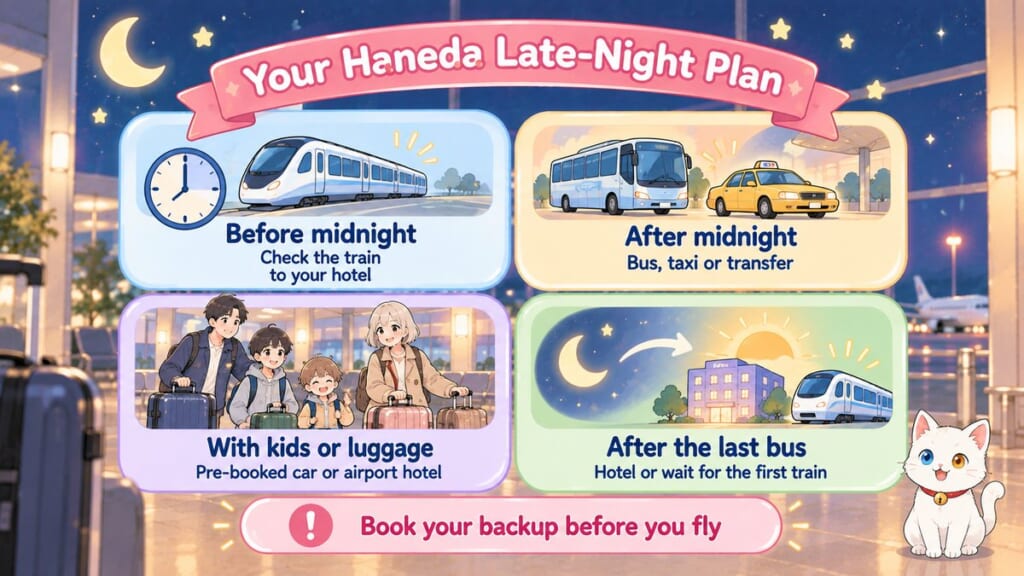
- Outside arrivals before midnight: Check whether the train can take you all the way to your hotel, including transfers.
- Outside arrivals after midnight, traveling alone or as a couple: Take a late-night bus if the schedule and destination match; otherwise choose a taxi, reserved transfer, or airport hotel.
- Arriving with children or several suitcases: Choose a correctly sized pre-booked vehicle or a suitable airport hotel room.
- Arriving after the late-night buses have stopped: Head to your reserved accommodation by car, stay at the airport hotel you’ve booked, or consider waiting for the first train only if the overnight facilities meet your needs.
If you’re still planning the rest of your trip, my 7-step guide to planning a first trip to Japan can help you organize the next steps. For choosing where to stay after that first night, see my guide to Shinjuku vs Shibuya vs Tokyo Station.
Are you arriving at Haneda after midnight? Tell me your landing time, how many people you’re traveling with, and where you’re hoping to stay in Tokyo. I’d love to hear which part of the late-night journey you’re still trying to work out.
I hope this guide has answered one of your questions and helped you feel a little closer to Japan.
May your Japan journey be filled with wonderful discoveries and memories you’ll treasure for years to come.
See you in the next guide.


Comments