- GRAN Tenku in 30 Seconds: Who It’s Worth It For
- What Is the GRAN Tenku? (And Why Older Guides Say “Tenku”)
- The Four Cars: Which Seat Should You Book?
- Prices Compared: GRAN Tenku vs. Regular Limited Express vs. Express Train
- The Koyasan World Heritage Ticket Trap: Why It Doesn’t Cover the GRAN Tenku
- Schedule: Two Round Trips a Day, and the Days It Doesn’t Run
- How to Book in English (and When Tickets Go On Sale)
- Luggage: Suitcases on the Train, Cable Car and Bus
- Day Trip or One Night? Two Sample Plans With the GRAN Tenku
- Choosing a Temple Stay (Shukubo): What to Expect and How Early to Book
- Koyasan With Kids: What a Japanese Mom Would Check First
- When to Go: Autumn Leaves, Winter Cold, and Spring
- FAQ
GRAN Tenku in 30 Seconds: Who It’s Worth It For
Disclosure: This article contains affiliate links. If you book through one, I may earn a small commission at no extra cost to you.
You don’t need a sightseeing train to reach Koyasan. GRAN Tenku costs ¥3,130 (about $20) one way from Namba to Koyasan Station in cars 1 or 2, including the cable car; an ordinary express costs ¥1,430 (about $9), so the sightseeing upgrade adds ¥1,700 (about $11).
- Worth it: you want the journey itself to be part of your day, with scenery and reserved seats.
- A good family option: you can book suitable seats together and work around the two departures from Namba.
- Choose another train: flexible timing or traveling with large suitcases matters more; regular non-running days are Wednesdays and the second and fourth Thursdays, subject to holiday exceptions.
- Skip the meal package: you need vegetarian meals or other dietary adjustments; cars 1 and 2 remain options.
My choice would be GRAN Tenku outbound, with a flexible return. The regular Limited Express Koya is only ¥600 (about $4) cheaper, but it leaves Namba just twice a day on weekdays, so it isn’t much more flexible.
This guide draws on Nankai’s official information and concerns reported by travelers; I haven’t ridden GRAN Tenku myself. As a mother living in Osaka, I’m focusing on what I’d check before booking for my family.
Official prices below are for September 2026. Dollar amounts use a fixed conversion of USD 1 = JPY 155, Sept 2026, rounded and shown as “about”; they aren’t live exchange rates.
| What you want to book | Where to look |
|---|---|
| GRAN Tenku express ticket, cars 1 and 2 | GRAN Tenku ticket on Klook / Nankai official booking site |
| Gran Seat, car 4, with a meal | Nankai official booking site (car 4) |
| Koyasan World Heritage Ticket | World Heritage Ticket on Klook / Nankai official digital ticket |
| Temple stay | Ekoin on Agoda / Koyasan Shukubo Association |
| Guided day tour from Osaka | Small-group day tour on Klook |

What Is the GRAN Tenku? (And Why Older Guides Say “Tenku”)
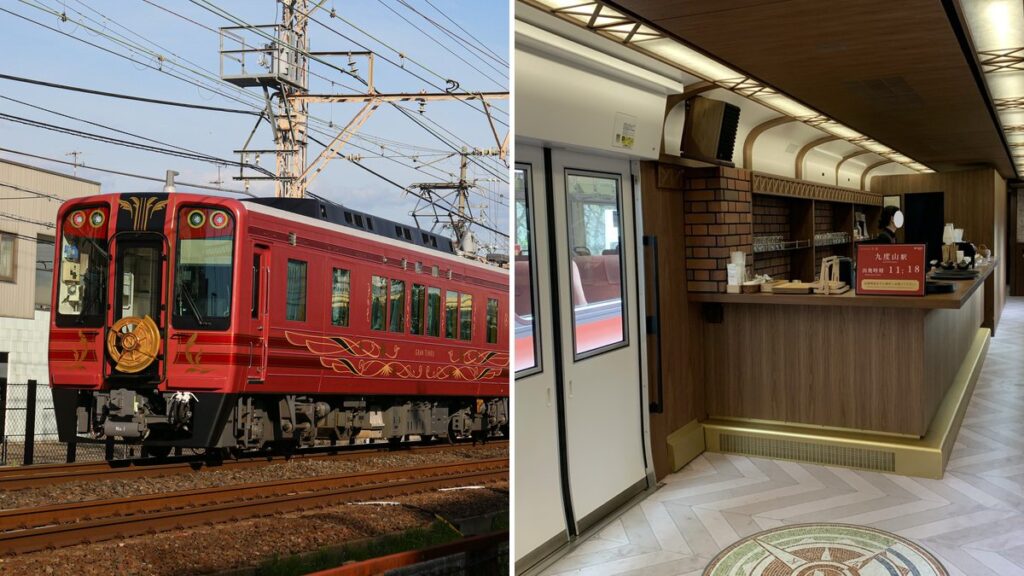
GRAN Tenku is Nankai’s sightseeing train from Namba in Osaka to Gokurakubashi, the railway connection for Koyasan. The train journey takes around 90 minutes, followed by a cable-car ride of about five minutes to Koyasan Station.
That isn’t your arrival at a temple’s door. Allow time to change to the cable car, then take a local bus toward the temples or your accommodation; the train’s advertised journey time doesn’t cover those connections.
GRAN Tenku began service on April 24, 2026.
 The earlier Tenku ran between Hashimoto and Gokurakubashi and ended regular service on March 20, 2026. Advice about boarding “Tenku from Hashimoto” may describe that previous service, so match the train name and date before using an older itinerary.
In Namba, look for Nankai’s dedicated Platform 0. If you’re coming from Kyoto, plan your connection to the Nankai station before reserving the morning train; for other sightseeing-train ideas, see 8 Kansai Trains Worth Paying Extra For.
The Four Cars: Which Seat Should You Book?
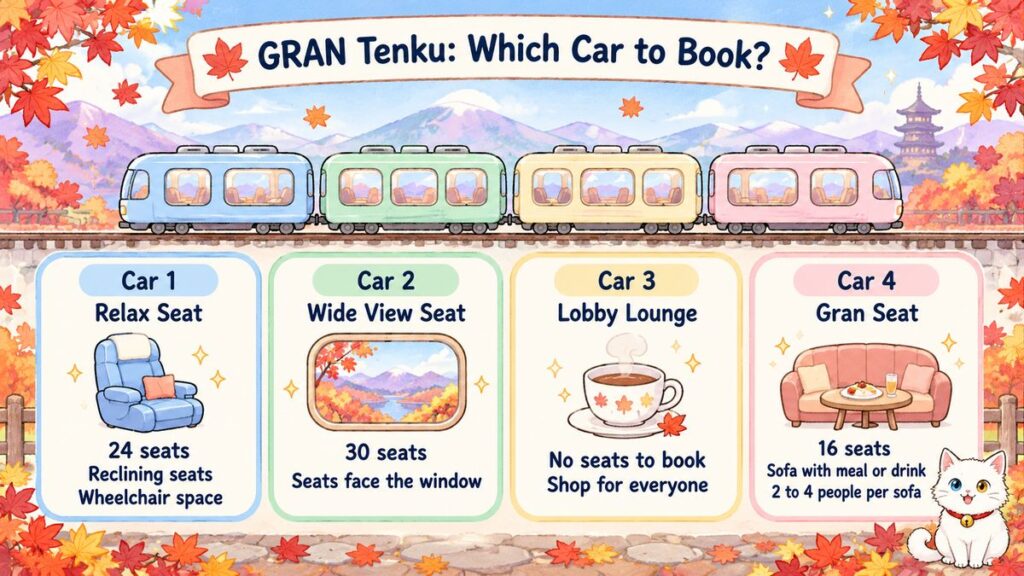
Start with how you want to spend the journey: reclining, looking directly out of the window, or sharing a meal. You don’t need the most expensive car to make the train part of your holiday.
| Car | Who it suits |
|---|---|
| 1: Relax Seat — 24 seats | Choose reclining seats if comfort comes first; this car also has a wheelchair space. |
| 2: Wide View Seat — 30 seats | Choose window-facing seating if watching the scenery is your main reason for booking. |
| 3: Lobby Lounge — no passenger seating | All passengers can use the lounge’s shop; this isn’t a car you book as your seat. |
| 4: Gran Seat / Gran Seat Plus — 16 seats | Choose a sofa seating unit for a couple or group who want a meal or one-drink package; each unit seats up to four and requires at least two passengers. |
Gran Seat packages include the train fare, unlike tickets for cars 1 and 2. Choose the package and passenger count together, because the sofa-unit arrangement affects the cost per person.
 Car 4 has no children’s menu, halal menu, vegetarian menu, or individual allergy adjustments: everyone receives the same menu. If that won’t work for your family, choose cars 1 or 2 instead of paying for a meal you cannot use.
The autumn and winter menu applies to journeys from October 1, 2026. Check the menu for your departure before selecting the meal package.
Prices Compared: GRAN Tenku vs. Regular Limited Express vs. Express Train
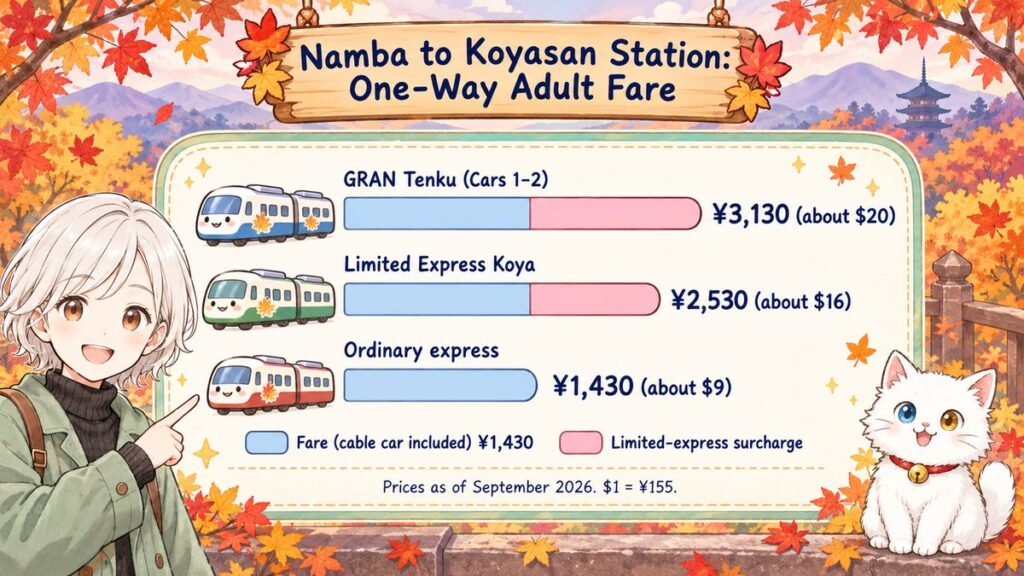
For cars 1 and 2, you pay for two separate things: the journey itself and your reserved place on GRAN Tenku. The basic fare to Koyasan Station includes the cable car, but not buses around Koyasan.
The following comparison is for one adult traveling one way from Namba to Koyasan Station. Train times end at Gokurakubashi; add the cable-car ride and connection time.
| Train | Basic fare including cable car | Additional limited-express ticket | Total | Train journey |
|---|---|---|---|---|
| GRAN Tenku, cars 1 and 2 | ¥1,430 (about $9) | ¥1,700 (about $11) | ¥3,130 (about $20) | Around 90 minutes, depending on departure |
| Limited Express Koya | ¥1,430 (about $9) | ¥1,100 (about $7) | ¥2,530 (about $16) | About 90 minutes |
| Ordinary express | ¥1,430 (about $9) | None | ¥1,430 (about $9) | About 95–100 minutes; usually change at Hashimoto |
Limited Express Koya isn’t a frequent alternative: on weekdays only two trains a day run from Namba to Gokurakubashi, and several weekend departures are suspended in winter. Most ordinary expresses terminate at Hashimoto, where you change to a local train for Gokurakubashi.
The child’s GRAN Tenku surcharge is ¥850 (about $5), with the child’s basic fare separate. Up to two accompanying preschool children per adult or child passenger can travel without a fare or surcharge when they don’t occupy a seat and sit on an adult’s lap; child-only bookings aren’t permitted.
Boarding without a reservation and buying an available seat onboard adds ¥300 (about $2). Reserving ahead also lets you check whether the seats your family needs are actually available.
Car 4 uses package pricing. The adult ranges below depend on how many passengers share the sofa unit; four passengers give the lowest per-person price.
| Car 4 package | Price per adult |
|---|---|
| Morning / afternoon tea | ¥11,230 (about $72) to ¥12,730 (about $82) |
| Lunch | ¥13,430 (about $87) to ¥14,930 (about $96) |
| One drink | ¥5,510 (about $36) to ¥7,010 (about $45) |
Gran Seat Plus adds ¥3,000 (about $19) per sofa unit, not per person. These packages include the train fare; don’t add the cars 1 and 2 surcharge again. The package covers the fare all the way to Koyasan Station, cable car included.
The Koyasan World Heritage Ticket Trap: Why It Doesn’t Cover the GRAN Tenku
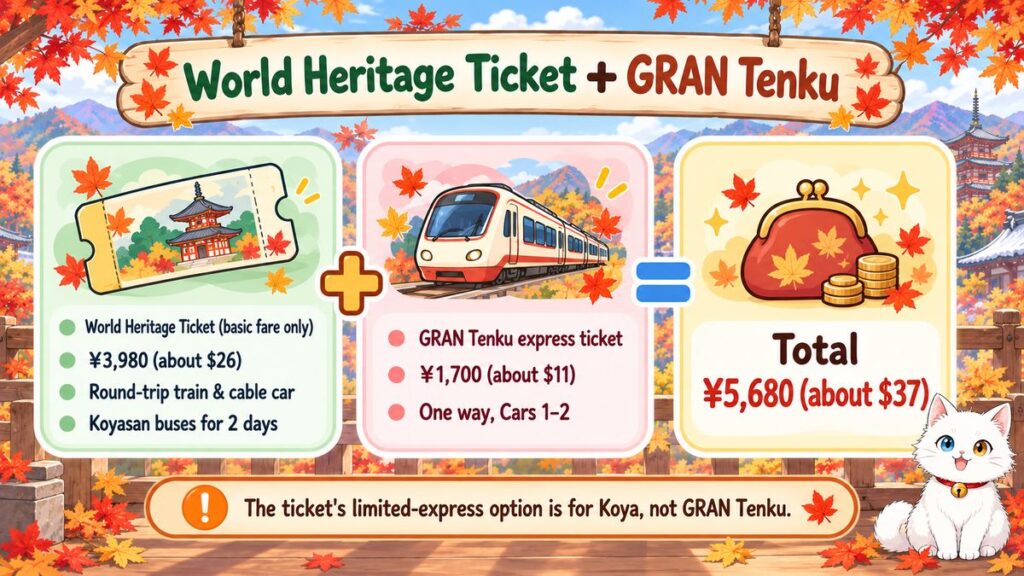
The Koyasan World Heritage Ticket can cover your basic fare on GRAN Tenku, but it doesn’t include the train’s special surcharge. That distinction is what matters when you see a pass described as including a limited-express ticket.
The pass gives you a return rail journey to Koyasan Station, including the cable car, eligible local buses for two days, and discount coupons for temple admissions and other facilities. It is valid for two consecutive days, making it an option for either a day trip or an overnight stay.
There are versions with and without an outbound limited-express ticket. The included limited-express journey is on Koya, not GRAN Tenku; buying that version doesn’t reserve a GRAN Tenku seat.
For an adult departing Namba and using GRAN Tenku in car 1 or 2 outbound, the combination is:
- Buy the basic-fare-only digital pass for ¥3,980 (about $26).
- Separately reserve the outbound GRAN Tenku surcharge ticket for ¥1,700 (about $11).
- Your combined cost is ¥5,680 (about $37), covering the return basic rail fare, cable car, eligible buses for two days, and GRAN Tenku in one direction.
For the return, use an ordinary train without another limited-express supplement. If you choose Koya or GRAN Tenku back, buy the appropriate additional ticket; the return basic fare is already covered.
Families should check the official digital ticket: its child version is ¥2,000 (about $13). The Klook listing checked for this guide did not offer a child ticket, so don’t assume you need to buy adult passes for everyone.
A basic-fare-only digital version from Kansai Airport is also available for ¥4,880 (about $31). If you’re considering car 4, compare separately because its package already includes a train fare; this combination is designed for cars 1 and 2.
Schedule: Two Round Trips a Day, and the Days It Doesn’t Run
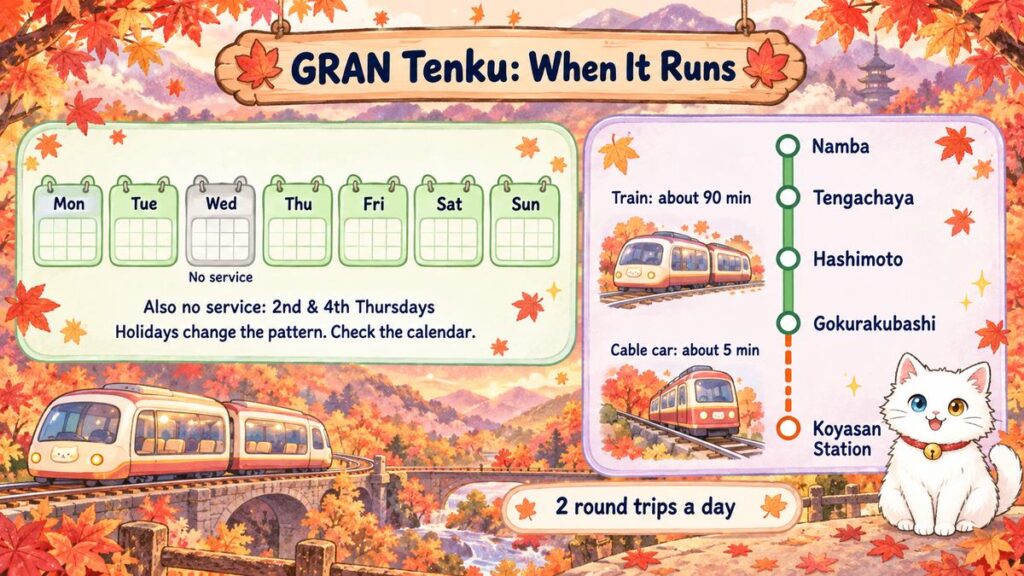
Check the operating calendar before booking a temple stay around this train. GRAN Tenku makes two round trips daily when running, with regular days off on Wednesdays and the second and fourth Thursdays of each month.
If Wednesday is a public holiday, the train runs that day and does not run the following Thursday. It also runs when the second or fourth Thursday is a public holiday, so use the date-specific calendar rather than relying only on the weekday.
| Service | Weekday timetable |
|---|---|
| No. 1, toward Koyasan | Namba 09:00 → Gokurakubashi 10:30 |
| No. 3, toward Koyasan | Namba 12:45 → Gokurakubashi 14:20 |
| No. 2, toward Osaka | Gokurakubashi 10:46 → Namba 12:13 |
| No. 4, toward Osaka | Gokurakubashi 14:58 → Namba 16:28 |
Weekend and holiday times can differ by a few minutes. Confirm the departure shown for your travel date, particularly when connecting from Kyoto or the airport.
Stops are Namba, Shin-Imamiya, Tengachaya, Sakaihigashi, Kongo, Kawachinagano, Rinkandenentoshi, Hashimoto, Kudoyama, and Gokurakubashi. From Kansai Airport, take Nankai toward Osaka and change at Tengachaya or Shin-Imamiya; don’t assume you must go all the way to Namba first. The airport express takes about 40 minutes from Kansai Airport to Tengachaya; for No. 1, which leaves Tengachaya at 09:05, I’d take a train that arrives around 08:45 rather than cutting it to a few minutes.
If you’re staying in Osaka before Koyasan, my guide Kansai Airport to Namba: Is the Rapi:t Worth It? covers the airport-to-Namba decision. I’d keep the morning sightseeing train separate from an uncertain flight-arrival schedule when traveling with children.
How to Book in English (and When Tickets Go On Sale)
You can book GRAN Tenku in English through Klook for cars 1 and 2, or through the official booking site. Car 4 isn’t offered in that Klook listing; use the official car 4 booking page for Gran Seat packages.
Official sales open at midnight Japan time, 30 days before travel counting the travel date itself. The exception is buying two car 4 sofa units together, when sales open 40 days ahead; follow the booking calendar’s counting so you don’t miss the opening date.
Bookings for cars 1 and 2 close three minutes before departure. Car 4 meal plans close at 23:59 four days before travel, while one-drink plans close at 23:59 the previous day.
For cars 1 and 2, the official process is:
- Open the official GRAN Tenku booking site and choose your date, direction, train, and car.
- Enter the passengers and select available seats. Up to eight passengers can be booked together, but cars 1 and 2 cannot be combined in one transaction.
- Pay by credit card and keep the electronic ticket accessible on your phone; follow its display instructions, with no station exchange required.
- Arrange the separate basic fare using a ticket-machine ticket, an IC card such as ICOCA, or the World Heritage Ticket.
Before payment, the site asks you to sign in or create an account (Google, Facebook, or email); there’s no guest checkout.
At the station, cars 1 and 2 work differently from car 4. For cars 1 and 2, you go through the ticket gate with your IC card or basic-fare ticket, and keep the electronic express ticket ready on your phone. For car 4, a QR ticket appears on your phone from 03:00 on the travel day, and you scan it at the dedicated gate.
All seats are reserved, but you may sit beside other passengers in cars 1 and 2. Check the actual seat map before paying if sitting together matters.
For official bookings in cars 1 and 2, permitted date, train, and seat changes can be made up to twice if spaces are available. Changing between cars 1 and 2, or moving to car 4, requires cancellation and rebooking; car 4 also requires rebooking for date or plan changes.
Cars 1 and 2 allow free cancellation until 23:59 on the purchase date; after that, the charge is 30%, and the cancellation deadline is three minutes before departure, not departure itself. Car 4 has separate cancellation charges of 20–50% before departure and no refund after departure; read your package’s schedule before paying. Klook bookings follow the terms shown on Klook.
For same-day travel, Namba’s second-floor service center, Gokurakubashi Station, and Koyasan Station accept reservations for cars 1 and 2 only. Nankai says these station-arranged reservations are paid onboard without the additional onboard-purchase fee; car 4 requires advance online booking.
Luggage: Suitcases on the Train, Cable Car and Bus
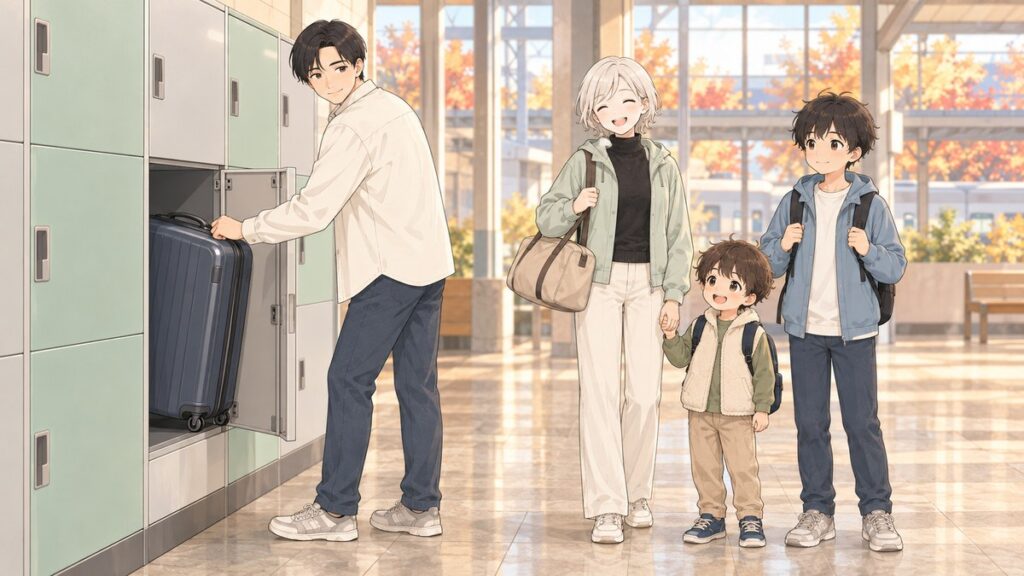
Plan this journey around a small bag if you can. Nankai describes limited luggage space, including overhead racks in car 1 and space near seats; car 4 has no dedicated area for large luggage.
You also have the cable car and local bus after the train. A bulky suitcase can make those transfers awkward when services are busy, even if you managed to fit it beside your seat.
For a day trip, leave your suitcase in a Namba locker, with a backup if large lockers are full: Coin Lockers Full in Japan? What to Do Next. For an overnight stay, send the suitcase to your next hotel and carry what you need for the temple stay; check delivery timing first in my luggage forwarding guide.
Day Trip or One Night? Two Sample Plans With the GRAN Tenku
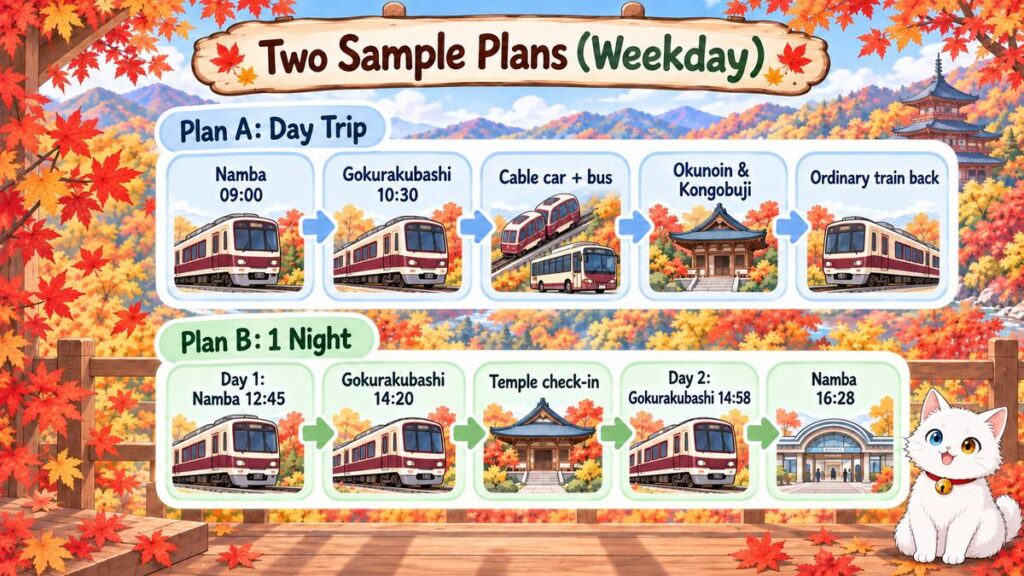
Choose a day trip for sightseeing without an overnight commitment, or stay if the temple’s evening and morning routine interests you. These weekday examples leave the late-afternoon return flexible for day-trippers and use the afternoon train after an overnight stay.
Plan A: GRAN Tenku out, an ordinary train back
Take No. 1 from Namba at 09:00, reaching Gokurakubashi at 10:30. Continue by cable car and bus, then focus your visit on Okunoin’s approach and Kongobuji rather than filling the day with extra stops.
Return later by regular Limited Express Koya or an ordinary train, checking the bus and cable-car connection as well as the railway departure. GRAN Tenku’s return departures at 10:46 and 14:58 make using it both ways restrictive for a day trip. In the current timetable, Limited Express Koya leaves Gokurakubashi at 16:47 on weekdays (16:25 on weekends and holidays), and local trains to Hashimoto, where you change for Namba, leave about every 20–40 minutes into the evening. With children, I’d aim to leave Gokurakubashi before 18:00.
Plan B: Afternoon arrival and a temple stay
On day one, take No. 3 at 12:45 from Namba and reach Gokurakubashi at 14:20. Continue to your temple for its check-in window, commonly 15:00–17:00, and an early shojin ryori dinner, the Buddhist vegetarian meal traditionally served at temple lodgings.
On day two, optional morning prayers may begin around 06:00, depending on the temple. Have breakfast, check out, and explore before returning for No. 4 at 14:58 from Gokurakubashi, arriving in Namba at 16:28.
Check that both travel dates are operating days before booking this version. Look at an individual temple listing such as Ekoin on Agoda and verify the meal plan and arrival deadline, rather than relying on a broad “Koya” hotel search.
If you’d prefer an English-speaking guide to organize the day, consider this small-group Koyasan and Okunoin day tour from Osaka. The itinerary uses bus transport from central Osaka, with an 08:00 meeting time in Shinsaibashi, and GRAN Tenku isn’t part of it.
Choosing a Temple Stay (Shukubo): What to Expect and How Early to Book
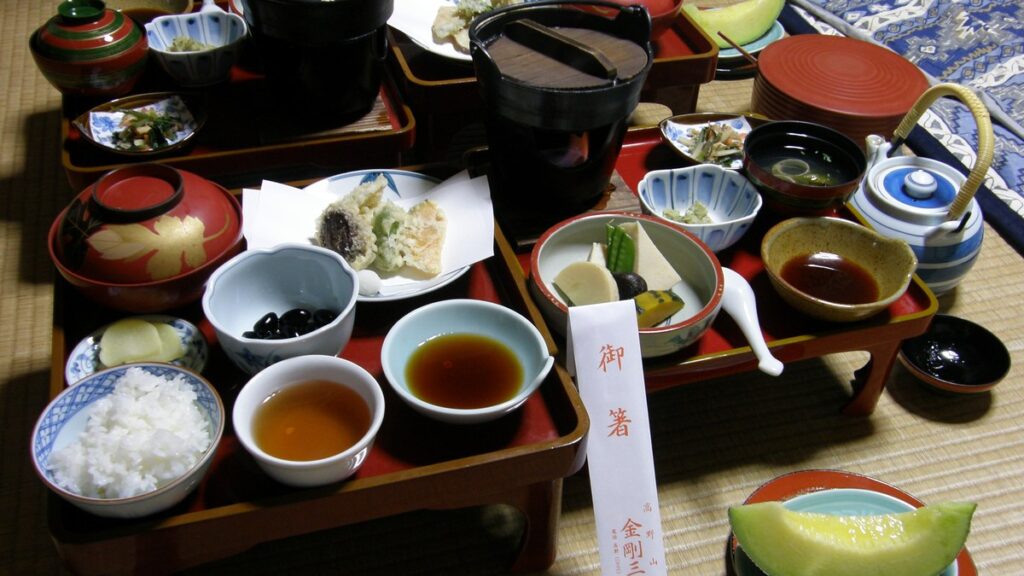
Choose a shukubo for the opportunity to stay at a working temple, with its meals and daily rhythm. Koyasan has 117 temples, 52 of which offer temple lodging, but room facilities and booking conditions aren’t identical.
The official planning range is ¥15,000–¥25,000 (about $97–$161) per person for a night with dinner and breakfast in a Japanese-style room with shared bath and toilet facilities. Rooms with a private toilet, or a private bath and toilet, fall in a broader range of ¥20,000–¥70,000 (about $129–$452); treat these as guidance, not a quote for a particular temple.
Check-in is commonly 15:00–17:00 and check-out 09:00–10:00. Dinner is early, morning prayers are optional, and any curfew or quiet hours depend on the temple: check your temple’s rules before planning an evening out.
You can compare an English Agoda listing such as Ekoin with the official Koyasan Shukubo Association booking service. Agoda supports card-based booking, but payment timing and cancellation depend on the plan; on either site, confirm “dinner and breakfast included” for the exact room you select.
For an autumn stay, I’d aim to book two to three months ahead and secure the room before the train’s booking window opens. If you’re already planning this November, check availability now rather than waiting for train tickets. When I searched Agoda on September 23, 2026, only three to five Koyasan properties still showed a room for two on mid-November weekdays.
A private toilet may matter more to your family than a particular temple name. If the shared facilities or early routine don’t suit you, make Koyasan a day trip; Kyoto Autumn Ryokan With a View offers other Kansai overnight ideas, not accommodation necessarily near Koyasan.
Koyasan With Kids: What a Japanese Mom Would Check First
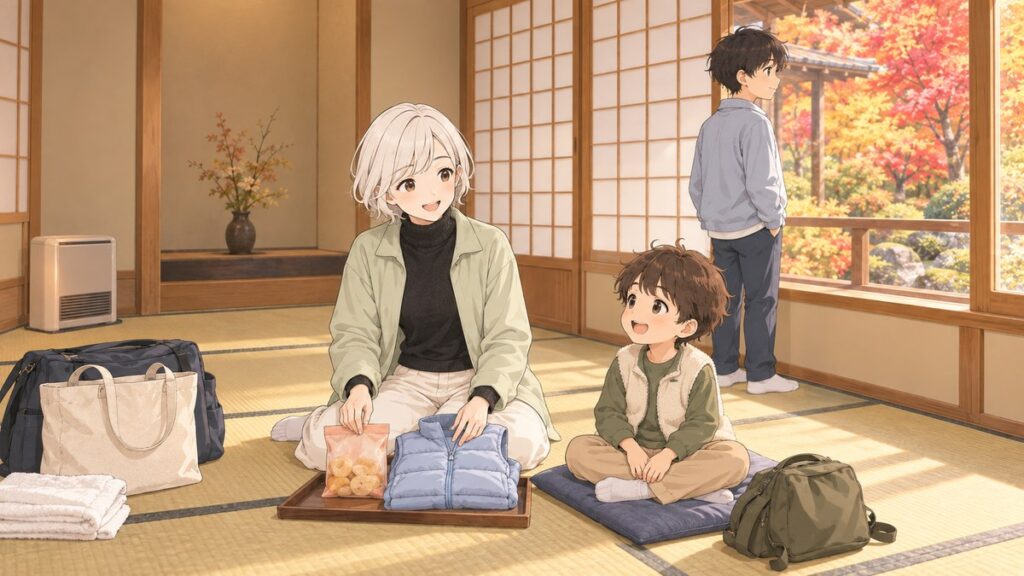
 I’d check dinner, the toilet arrangement, and nighttime comfort before choosing a temple by its photographs. Children may find shojin ryori unfamiliar, and evening food options can be limited, so bring familiar snacks for the stay and check the temple’s food rules.
For cars 1 and 2, the child’s train surcharge is ¥850 (about $5), plus the applicable basic fare; qualifying preschool children on an adult’s lap travel free. Decide whether lap travel will actually be comfortable for your family before choosing that option.
Temple rooms and corridors can feel cold, and many room types have shared toilets. Sound can also carry between rooms, so ask about heating and room arrangements rather than assuming every shukubo has the same facilities.
A stay may fit school-age children who are comfortable with quiet evenings and unfamiliar meals. If your baby wakes crying at night, or your toddler needs a flexible dinner and bedtime, a day trip with accommodation elsewhere may put less pressure on everyone.
Morning prayers are optional; you don’t need to wake a small child just to complete the experience. For the wider family itinerary, Japan with Kids: A Japanese Mom’s Practical Guide covers the practical planning beyond this Koyasan visit.
When to Go: Autumn Leaves, Winter Cold, and Spring
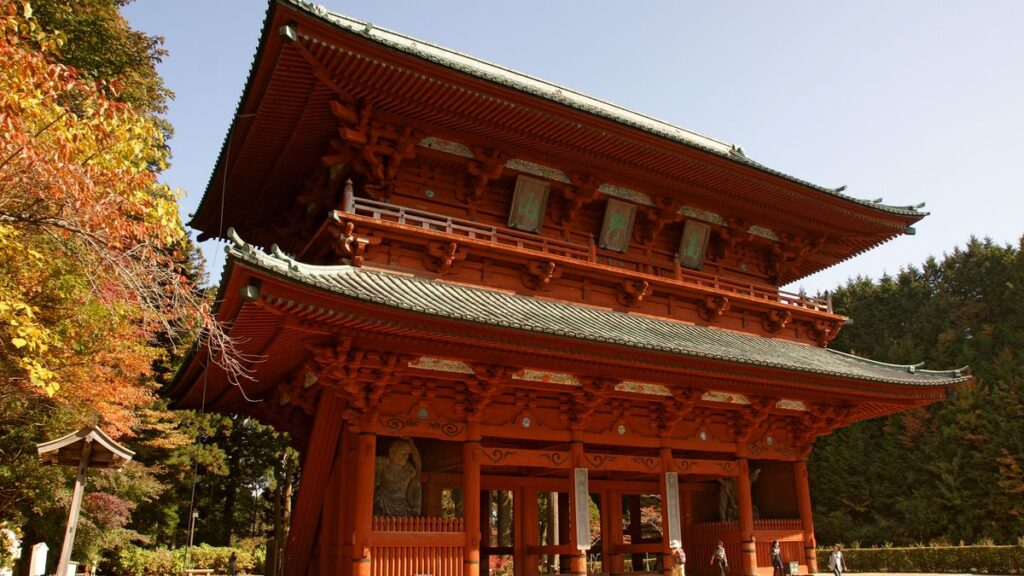
For autumn color, plan around late October to early November, often near the first week of November, with the timing shifting each year. Book your temple early, then reserve GRAN Tenku when sales open; a weekday doesn’t guarantee a quiet visit.
Keep some breathing room in your temple visits and connections during foliage season. My guide to avoiding crowds in Japan offers practical ways to reduce crowd pressure, and what to wear in Japan in November helps with layers for the trip.
Winter brings a different visit: January and February are the coldest months, and temperatures can fall below freezing. Koyasan can be much colder than Osaka, so check your temple’s heating arrangements and pack for the mountain, using my Japan winter clothing guide.
Snow can make the temple grounds beautiful, but warmth and transport need attention too. Winter cable-car engineering closures have occurred in past years; check Nankai service information before departure rather than assuming normal operation.
Spring is another option if autumn doesn’t fit your dates, with cherry blossoms offering a seasonal reason to visit. Check local flowering updates rather than applying Osaka’s timing, and consider dates before Golden Week if your itinerary allows.
FAQ
Can I use the JR Pass?
No: GRAN Tenku runs on Nankai, not JR, and neither the nationwide JR Pass nor regional JR Kansai passes cover this train, the Koyasan cable car, or local Nankai Rinkan buses. For the rest of your itinerary, see Is the JR Pass Worth It?.
Is there vegetarian food?
Car 4 doesn’t offer a vegetarian menu or meal substitutions, so choose cars 1 or 2 if its meal package doesn’t suit you. Temple dinners are traditionally shojin ryori, but tell your temple your specific dietary requirements before booking and confirm ingredients, including stock, rather than assuming a label covers every need.
Can I use an IC card (ICOCA/Suica)?
Yes, you can pay the basic rail and cable-car fare with a supported IC card such as ICOCA or Suica. For cars 1 and 2, the GRAN Tenku limited-express ticket is separate; tapping your card doesn’t reserve a seat.
What if the cable car isn’t running?
Check Nankai’s notice for your date: replacement buses have been provided for some past closures, but don’t assume the same arrangement will apply. Follow the current connection and travel-time guidance at Nankai’s service information page.
To fit Koyasan around the rest of your Osaka or Kyoto stay, continue with my 7-step Japan trip planning guide. Decide on the overnight stay first, then match the train date, seat, and tickets to that plan.
Check GRAN Tenku Tickets on Klook
Would you ride GRAN Tenku, or keep it simple with an ordinary express? Tell me in the comments.
I hope this guide has answered one of your questions and helped you feel a little closer to Japan.
May your Japan journey be filled with wonderful discoveries and memories you’ll treasure for years to come.
See you in the next guide.


Comments