
The leaves have their own forecast
“Are the leaves at their peak yet?”
Come autumn, that question starts popping up in Japan. And here’s something you might not expect: Japan has autumn leaves forecasts, much like weather forecasts, to help people figure out when the colors will be at their best.
 I check them every year, too. Living in Japan doesn’t mean I automatically know when the leaves will turn red. I still have to look it up!
Welcome to episode 13 of Little Things in Japanese Life, where I share the little things that make everyday life in Japan interesting.
The Japanese word for autumn leaves is koyo, and the colorful season doesn’t arrive everywhere at once. Weather forecasters such as the Japan Weather Association and Weathernews publish predictions for when the leaves will reach their peak.
 These forecasts are updated several times throughout autumn as conditions change. Meanwhile, the Japan Meteorological Agency observes seasonal changes in plants, including the reddening of maple leaves and the yellowing of ginkgo leaves.
North to south, mountains to cities
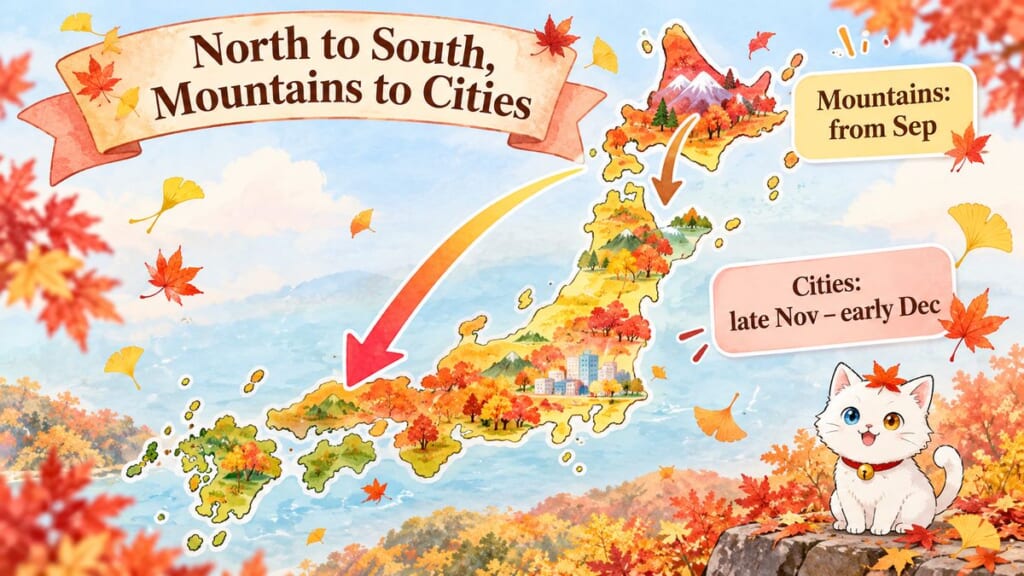
Japan’s autumn colors travel in a general direction: from north to south, and from high mountains down toward cities and lower elevations.
 It’s almost the opposite of the spring cherry blossom front, which generally moves northward.
In Hokkaido’s high mountains, autumn colors can begin appearing around September. As the weeks pass, the colorful foliage gradually spreads through other regions and toward lower elevations.
By late November to early December, the leaves in urban areas of Tokyo, Kyoto, and Osaka are often reaching their most colorful period. These are general seasonal patterns, though, not guaranteed dates for every tree or location.
If you’re planning to visit higher elevations early in autumn, it’s worth checking the temperatures and packing accordingly. My guide to what to wear in Japan in autumn can help.
Why Japan does it this way
The timing has a lot to do with temperature. Cooler autumn weather helps trigger the changes that turn green leaves into shades of red, orange, and yellow.
For iroha maples (a type of Japanese maple), a common rule of thumb is that coloring begins when nighttime lows drop below about 8°C (46°F) and speeds up below about 5°C (41°F), though timing varies by tree and location.
Japan stretches a long way from north to south and has plenty of mountains. Because temperatures differ so much between regions and elevations, the peak season can be more than two months apart from one place to another.
And that’s part of the fun. Instead of thinking of autumn as one short event, you can follow its colors from place to place.
Momijigari: “hunting” for red leaves
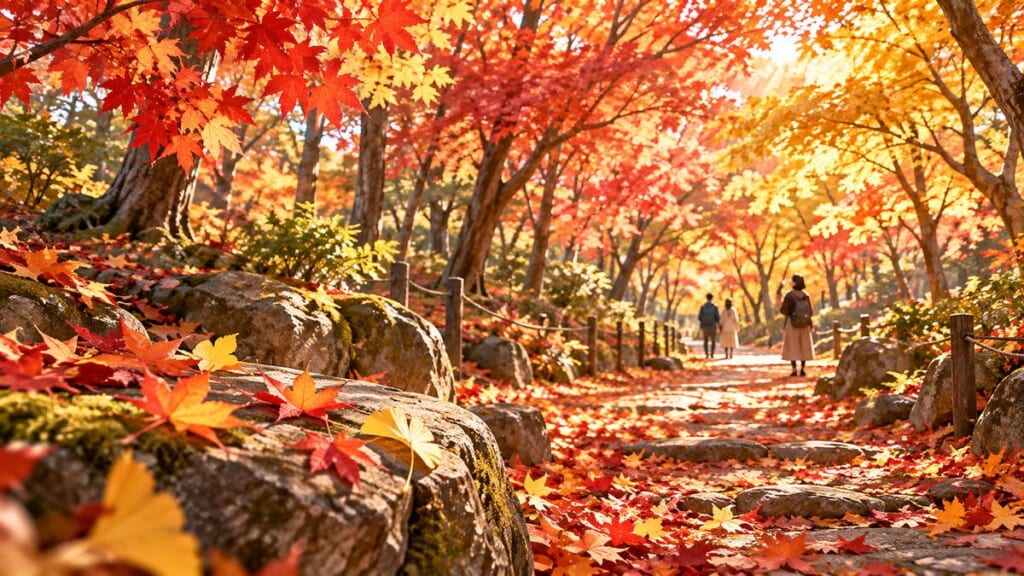
There’s a lovely Japanese word for going out to enjoy the autumn leaves: momijigari (紅葉狩り).
The word momiji often refers to colorful autumn leaves, especially those of maple trees. And gari means “hunting.”
Wait, hunting leaves? Are they hiding somewhere?
Not quite. Momijigari means going out to admire the beautiful autumn foliage, rather than hunting or collecting something.
There are several theories about why the word “hunting” became part of the expression. One explanation compares searching for beautiful leaves in the mountains to looking for prey, while another connects it with the old custom of picking up branches or leaves to admire them.
Whatever its exact origin, enjoying the changing leaves has been part of Japanese autumn life for centuries.
 Of course, well-known foliage spots can get crowded, particularly on weekends around peak season. If you prefer a quieter outing, looking beyond the most famous destinations may give you more options.
How locals check
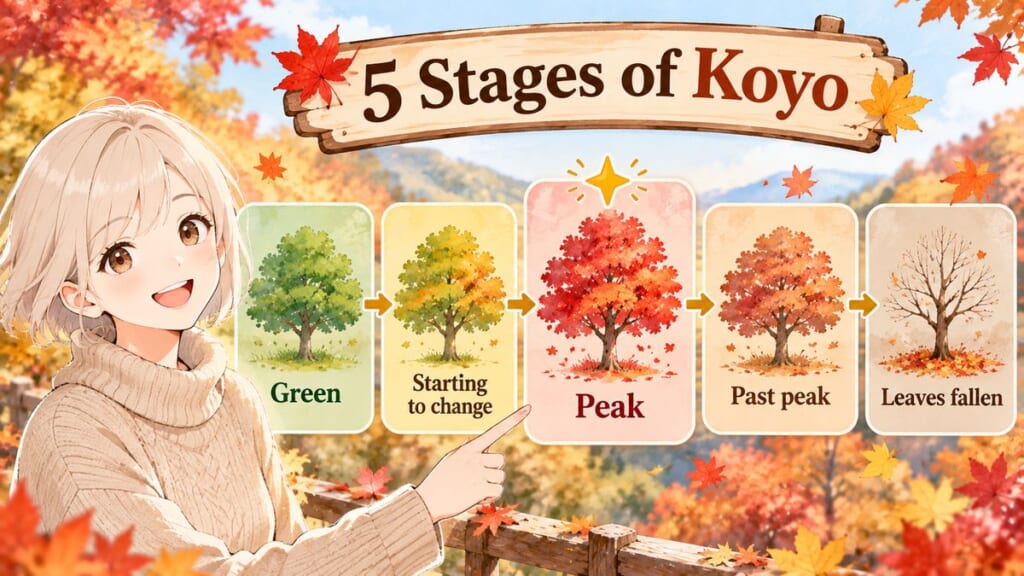
When I want to know if the autumn leaves are ready, I look at the news and websites. The useful part isn’t just the predicted peak date — it’s the current stage of the leaves.
Japanese foliage websites often show a simple progression for individual locations. Here’s how to understand the five stages you may see:
- Green (青葉): The leaves are still green, so the autumn colors haven’t really begun.
- Starting to change (色づき始め): The first yellow, orange, or red shades are appearing.
- Peak (紅葉見頃): The leaves are at their recommended viewing stage, with the seasonal colors on display.
- Past peak / fading (色あせ始め): The colors are beginning to fade as the season moves on.
- Leaves fallen (落葉): Many of the leaves have dropped, and the main viewing period is over.
 That third stage, migoro (見頃), is the one to look for. It means the best time to see something, and in autumn, it’s the little word everyone hoping to catch the colorful leaves wants to find.
You might see one location marked “Starting to change” while another is already at “Peak.” That’s why checking the status of the place you actually want to visit is more helpful than relying on a general forecast for an entire city.
And you don’t have to read Japanese to get started.
For an English-language forecast, see the JNTO Autumn Leaves Forecast, which uses information from the Japan Weather Association. For the five-stage color status, check Japanese foliage websites that show current conditions for individual locations.
Forecasts can change, so check the latest foliage status shortly before your visit.
Planning your trip around it
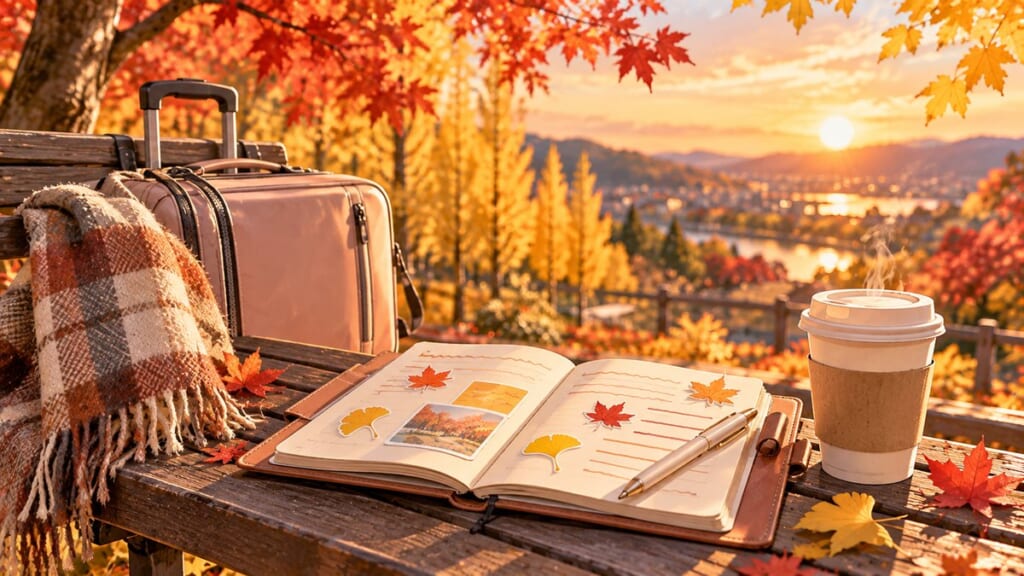
If you’re visiting Japan in late November or early December, you may have a good chance of seeing autumn colors in the cities. Tokyo, Kyoto, and Osaka often have beautiful foliage around that period.
But if your trip is earlier in autumn, don’t give up on finding red leaves. Mountain destinations and northern regions generally change color sooner, so you can look for places already approaching their peak.
 I’ve gone out to see the autumn leaves with my family, too. It’s one of those seasonal outings that makes me look forward to autumn.
- Flexible dates: Check the predicted peak for individual locations, then choose your travel dates.
- Fixed dates: Look for places expected to have colorful leaves during your stay.
Here are three ways to make the most of your autumn trip:
- Pack for the season: my guide to what to wear in Japan in November
- Stay among autumn colors: my guide to Kyoto autumn ryokan with a view
- Enjoy the scenery by train: my guide to scenic trains in Japan in autumn
The leaves don’t follow our calendars perfectly, do they? But maybe that’s what makes catching them at just the right moment feel a little special.
When do the leaves usually start changing color where you live? I’d love to hear about your autumn season in the comments.
Thanks for reading! Next time, let’s peek into another little corner of life in Japan.
See you in the next episode.


Comments