
- You Can Still Get It Back: The 4 Steps in Order
- Step 1: Contact the Place You Left It
- Step 2: Don’t Know Where? Japan’s Police Lost-and-Found System
- Step 3: Already Home? How to Ask From Abroad
- Step 4: Getting It Shipped Overseas — 3 Ways
- How WASULUCK Works
- What Can’t Be Shipped: Batteries, Liquids and Valuables
- Lost Your Passport or Wallet? That’s a Different Process
- Before You Check Out: A 30-Second Lost-Item Check
- FAQ
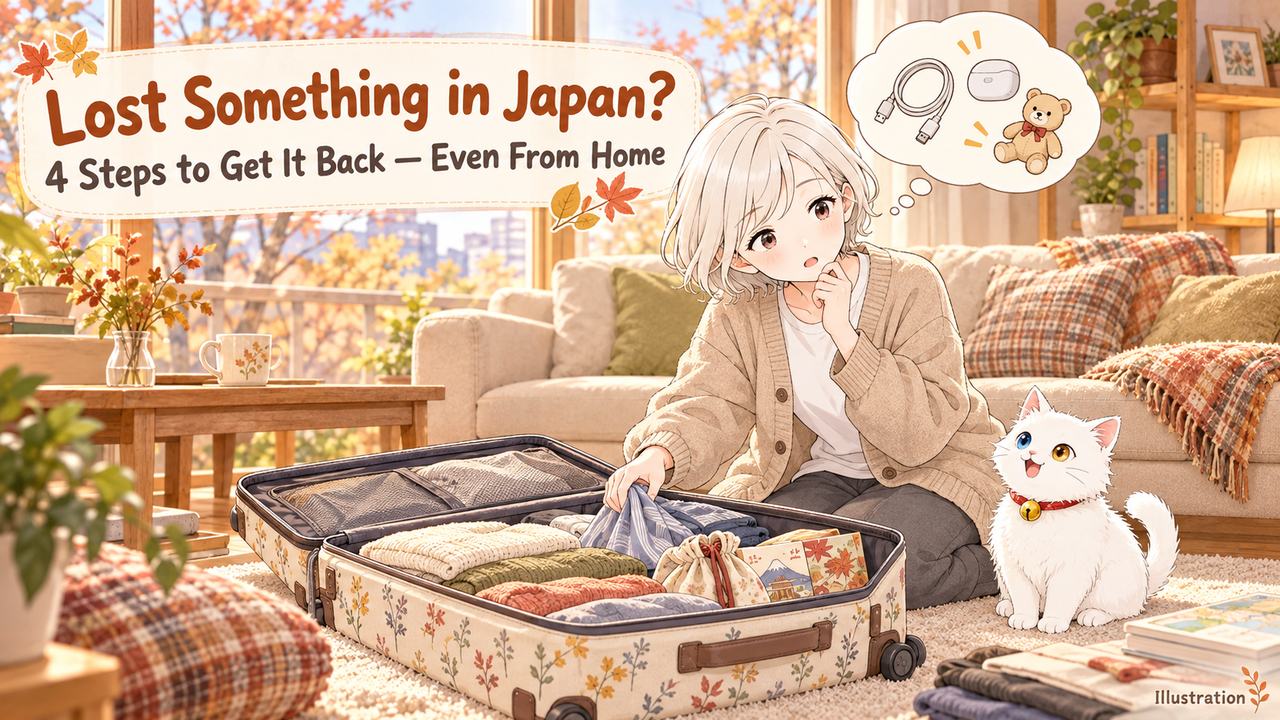
You Can Still Get It Back: The 4 Steps in Order
You’ve opened your suitcase at home, and something you packed for Japan is missing. If it’s been found and is still being held, you may be able to get it back from abroad. Start with these steps, in order.
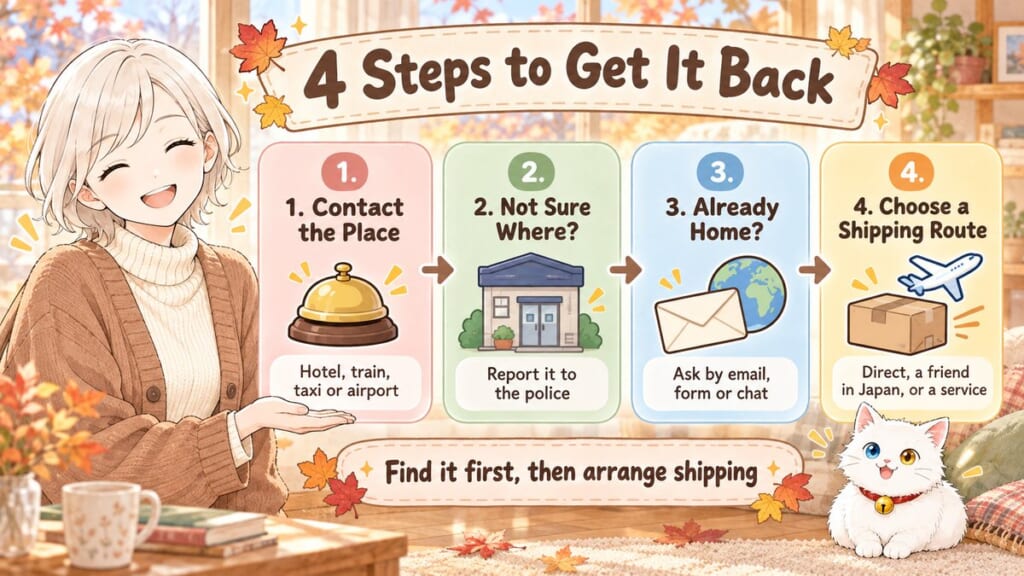
The 4 steps
- Contact the place you left it: your hotel, transport operator, taxi company or airport.
- Contact the police if the location is unclear: file a Lost Property Report while you’re in Japan.
- Ask from abroad if you’re already home: use email, a form or chat, with a detailed description.
- Once it’s found, choose a shipping route: directly from the facility, through someone in Japan or through a delivery service.
 Finding your item and arranging its shipment are separate procedures. I’ve put together this guide using each operator’s official lost-and-found information, so you can work through both.
Left it at a hotel and already home?
This is where I’d start. WASULUCK is a Japanese service that ships items left at hotels to travelers overseas. You apply yourself in English, the hotel sends the item to WASULUCK within Japan, and WASULUCK handles the export paperwork and international shipping. I explain each step in the WASULUCK section below.
Step 1: Contact the Place You Left It
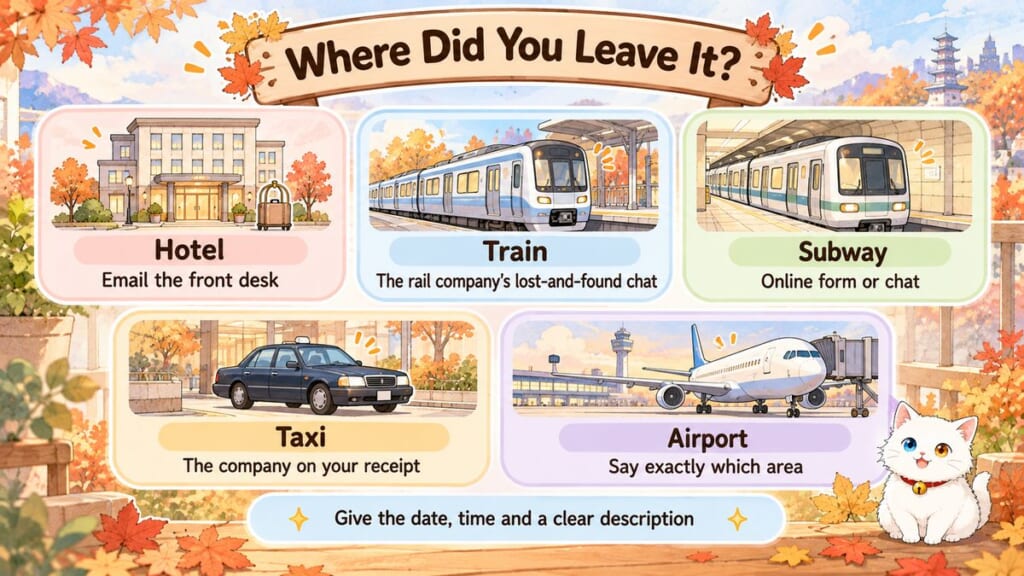
Contact the place where you last remember having the item. A charger beside your hotel bed belongs with the front desk; a bag on a train belongs with the company operating that train. Give the date, approximate time and a description that distinguishes your item from similar ones.
 The contact details below are current as of October 2026. All opening and response hours are Japan time; chat submission hours can be longer than the hours when staff reply.
| Where you left it | How to contact | What to know |
|---|---|---|
| Hotel | Email or call the hotel’s front desk. | Include the reservation name, stay dates and room number. |
| JR East | find chat, open for submissions 24 hours; station staff; JR East Infoline: +81 50 2016 1603. | Station storage periods vary; items later move to designated police stations. |
| JR West | find chat; Lost and Found Hotline: +81 6 6133 4146, 9:00–19:00 daily; select 2. Multilingual support includes English; calls are charged. | Return shipping is within Japan only, at your expense. |
| JR Central | find chat, open for submissions 24 hours; telephone: +81 50 3772 3910, 9:00–17:00; select 3. | Items cannot be collected from the Lost & Found Center itself; follow the advised return arrangements. |
| Tokyo Metro | Lost and Found Inquiry Form; station staff if you’re nearby. | Items usually move through Iidabashi’s center before transfer to police; confirm the current location. |
| Toei Subway | Chat: submissions 24 hours, replies 9:00–22:00; Customer Center: +81 3 3816 5711, 9:00–20:00 daily, with multilingual support. | If chat finds no match, staff search again the following day once. |
| Taxi | Call the company on your receipt; for Tokyo taxis, the association offers find chat. | Company storage is usually about a week before police transfer, with differences between operators. |
| Narita Airport | Dedicated chat: submissions 24 hours, replies 9:00–21:00; Airport Information: +81 476 34 8000, 24 hours. | Chat excludes some areas, including after international-flight security and before customs. |
| Haneda Airport | find chat; Information Center: +81 3 5757 8111, domestic inquiries 9:00–20:00, listed international areas 24 hours. | The relevant contact depends on where in the airport you left it. |
| Kansai International Airport | English lost-property inquiry form; Airport Information: +81 72 455 2500, 24 hours. | Tell staff the location so they can direct you to the responsible office. |
 For a taxi, your paper receipt is particularly useful: it identifies the company to contact. If you booked with GO, open the ride history and use “Lost and Found” if that button appears; otherwise, use “Call the taxi company.” Describe the ride’s pickup and drop-off points as well as the item.
For an airport inquiry, describe the exact area rather than just naming the airport. Narita’s chat, for example, covers only certain locations. If you were transferring between Kansai Airport and the city, check which part of the journey you last had the item on; my Kansai Airport access guide lays out each route.
Step 2: Don’t Know Where? Japan’s Police Lost-and-Found System
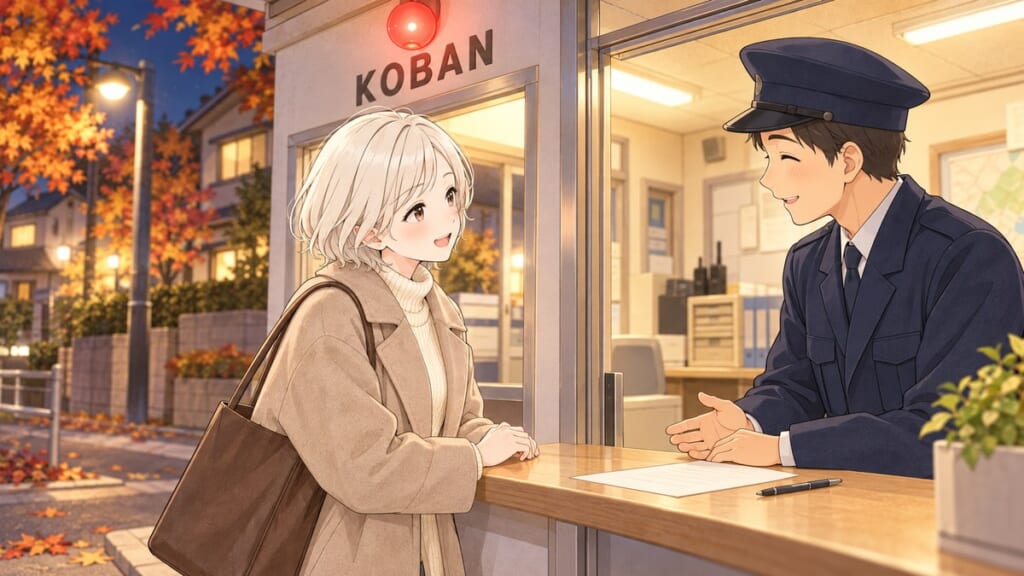
If you can’t identify the location, report the loss at a police station or a koban, a neighborhood police box. Ask to file a Lost Property Report, called an ishitsu-todoke in Japanese. The Tokyo Metropolitan Police Department explains the process in English.
If you’re leaving Japan before the item is found, give the police the details of a contact in Japan. The Tokyo police’s guidance says they can contact that person if your property is handed in. Ask your contact’s permission first, and keep the report details for later inquiries.
 Why Japan does it this way: People who find an item can hand it to a neighborhood police box, and Japan’s Lost Property Act provides a three-month holding period after it is reported to police. Items found on trains or in taxis can also reach police after the operator’s own storage period. These reporting and storage arrangements give you another place to check when the original facility no longer has your item.
The three-month period starts when the found item is reported to police, rather than when you notice it’s missing. Collect it within the applicable deadline: in Tokyo, ownership can then pass to the finder or the Tokyo Metropolitan Government, while items containing personal information are discarded.
From November 9, 2026, Japan’s police plan to accept Lost Property Reports online through the National Police Agency website, and to let you search found items across several prefectures at once.
The Tokyo police’s return-by-post guidance gives no overseas-shipping procedure. If you’re abroad, ask the holding office about a recipient or representative in Japan, then arrange the onward shipment through Step 4.
Step 3: Already Home? How to Ask From Abroad
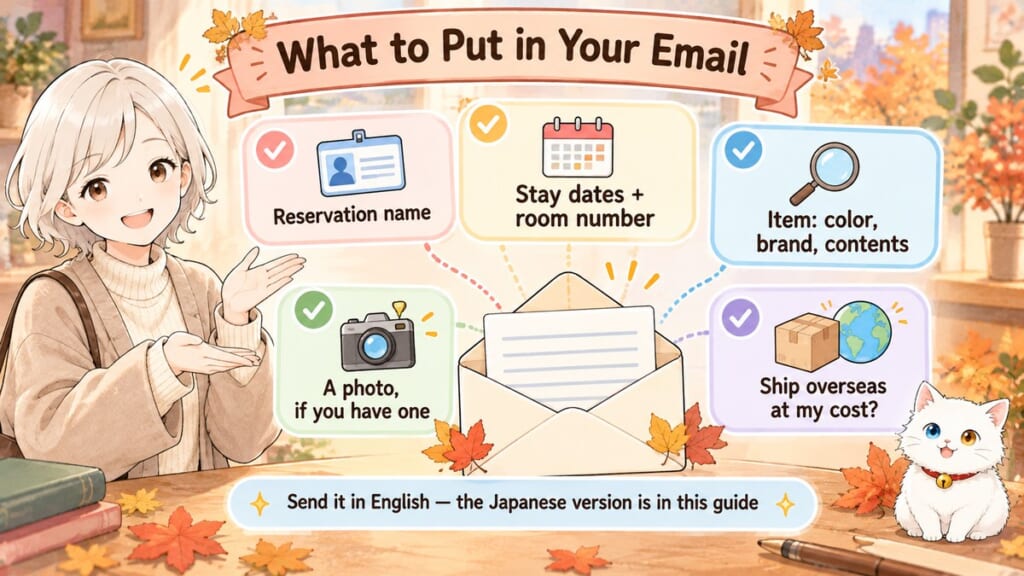
Start with a written inquiry if you’re already home. It lets you describe the item carefully and gives staff a message they can refer to while checking. You can copy the hotel template below and replace each bracketed field.
 For a train or taxi inquiry, replace the stay details with your journey details. For a bag, describe its contents as well as its color and brand; for any item, attach a photo if you have one. Those details help staff distinguish it from another similar object.
English email template
Subject: Lost item inquiry — [Reservation name], [Check-out date]
Dear [Hotel name and branch] Front Desk,
I stayed at your hotel under the reservation name [Full name]. My check-in date was [Date], my check-out date was [Date], and my room number was [Room number / Unknown].
I may have left [Item] in [Location]. It is [Color, brand and distinguishing details], and it contains [Contents / Not applicable]. [I have attached a photo / I do not have a photo].
Could you please check whether it has been found? If it has, please hold it while I arrange its return, and let me know your storage deadline.
I have already returned to [Country]. Can you ship the item overseas at my expense? If that is not possible, can you send it to a forwarding address within Japan? Please let me know the procedure and payment method.
Please reply to [Email address]. Thank you for your help.
[Full name]
Japanese version to send to the hotel
件名:忘れ物のお問い合わせ —[予約者名]、[チェックアウト日]
[ホテル名・支店名]フロントご担当者様
[予約者の氏名]の名前で宿泊しました。チェックイン日は[日付]、チェックアウト日は[日付]、部屋番号は[部屋番号/不明]です。
[場所]に[品物]を忘れた可能性があります。特徴は[色・ブランド・見分けるための特徴]、中身は[中身/該当なし]です。[写真を添付しています/写真はありません]。
届いているかご確認いただけますでしょうか。見つかっている場合は、返送の手配をする間、保管をお願いいたします。保管期限もお知らせください。
すでに[国名]へ帰国しています。送料を私が負担して、海外へ発送していただくことは可能でしょうか。難しい場合は、日本国内の転送先住所へ発送していただくことは可能でしょうか。手続きと支払い方法をお知らせください。
ご返信は[メールアドレス]へお願いいたします。お手数をおかけしますが、よろしくお願いいたします。
[氏名]
Keep any inquiry or reference number with your original message. Replies follow Japan’s working hours, so allow for the time difference. If you receive no reply, wait a few days and resend the same details; an available chat or inquiry form is another route.
Tokyo Metro’s FAQ says its telephone line cannot be reached from abroad, so use its form. If your travel eSIM is data-only, it has no telephone number for a callback; tell staff that email or chat is your contact route. My guide to the best eSIM for Japan explains the difference between data access and telephone service.
Step 4: Getting It Shipped Overseas — 3 Ways
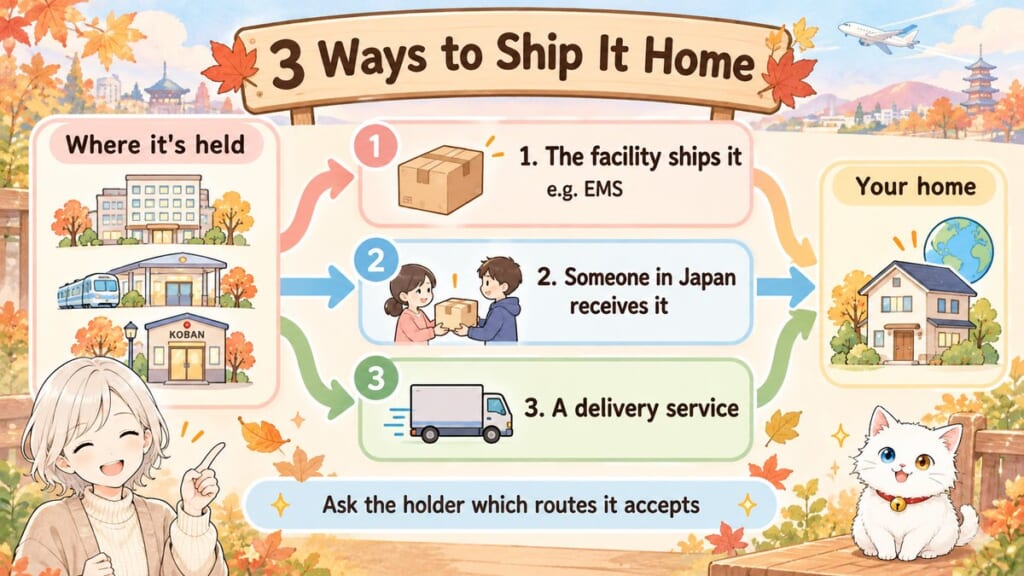
Once your item has been identified, the facility holding it and the person or company sending it overseas may be different. Ask the holder which release or shipping arrangements it accepts, then choose a route that works for your destination and item. The three options below handle the return; locating the item belongs with Steps 1–3.
Option 1: The facility ships directly. Ask whether it can send the item internationally, for example by EMS, Japan Post’s express international mail service. Whether it agrees depends on the facility. You pay the shipping costs and agree on the payment method with staff.
Option 2: Someone in Japan receives it for you. A friend or family member may collect the item as your representative or receive a domestic shipment, depending on the holder’s arrangements. Tokyo police accept a written authorization letter without requiring a particular format; railway operators have their own collection requirements. After receiving it, your contact can check postal restrictions and arrange an international shipment such as EMS.
Option 3: Use a delivery or forwarding service. WASULUCK provides a hotel-based return process, explained below. JR Central’s overseas-shipping guidance directs travelers to eBackHome. Confirm the chosen service’s requirements before arranging release of the item.
For a JR West item, its FAQ allows shipment to a forwarding company in Japan if that company accepts a parcel with the domestic shipping charge payable on delivery. Check that acceptance first, then give JR West the agreed Japanese address. The forwarding company separately handles the overseas leg under its own terms.
How WASULUCK Works
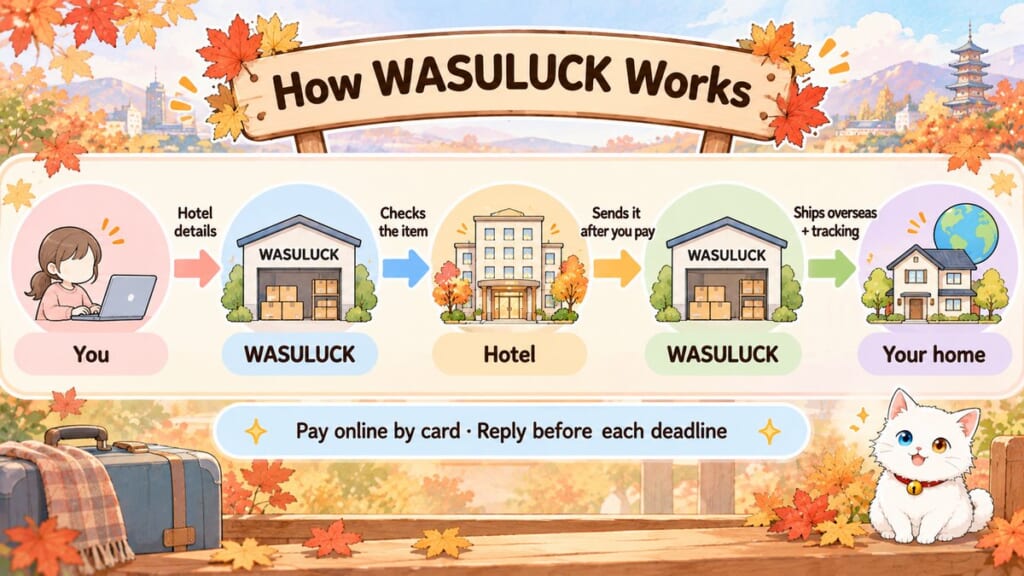
WASULUCK is a shipping option for an item held by a hotel. Its traveler instructions start with your hotel and stay details, and the hotel must cooperate by sending the item after payment. Use this process for a hotel-held item; ask other holders about their own return arrangements.
Why I recommend it for a hotel item:
- You can start from home in English. The instructions are available in eight languages, including English, and the process runs by email and online forms.
- The hotel’s part is simple. The hotel sends the item to WASULUCK within Japan; WASULUCK prepares the export documents, ships it overseas and sends you a tracking number.
- You see the cost before you commit. The quote shows the shipping cost and expected duration, and you can cancel after reviewing it.
- It has public backing in Osaka. In August 2025, the Osaka Convention & Tourism Bureau announced a business partnership with Lost Item Delivery, the company behind WASULUCK, to help foreign visitors with lost items.
The English instructions take you through the following stages:
- Open the instructions and send the starter email. The listed address is guestinfo.lid@gmail.com, which sends an automatic reply. Keep your delivery address and questions out of this starter email.
- Use the link in the reply to submit the hotel details. Enter the branch name, reservation name, check-in and check-out dates, room number, item name and additional information. WASULUCK contacts the named hotel to confirm whether the item is there; allow up to a week for that check.
- Complete the delivery-address form if the item is confirmed. Return it within two days of receiving it. Include the requested recipient details, item value and any customs or tax identifier required for your destination.
- Review the quote and choose a delivery plan. The quote gives the shipping cost and expected duration. Choose within five days; you can cancel after reviewing the quote.
- Pay online by credit card. Complete payment within a week of the payment email. The hotel then sends the item to WASULUCK.
- Wait for international dispatch. WASULUCK checks the contents, prepares export documents and ships the parcel overseas. It sends the tracking number after dispatch.
The quote combines the hotel’s domestic shipping cost, international shipping and the service fee, charged in Japanese yen. If you cancel after the parcel has moved from the hotel to WASULUCK, the domestic shipping cost applies. Cancellation closes once WASULUCK has dispatched it.
Keep the hotel’s storage deadline in view alongside the service’s response deadlines. An expensive item may be transferred to police if more than a week passes between the confirmation stage and completing payment; a hotel may also dispose of an item after its own storage deadline. Promptly completing the forms helps keep the agreed return process moving.
WASULUCK confirms the hotel’s holding status as part of arranging delivery; your initial search still starts with the hotel. Its email inquiries support multiple languages, while telephone inquiries are in Japanese. Destination-specific restrictions are checked with you during the arrangements.
What Can’t Be Shipped: Batteries, Liquids and Valuables
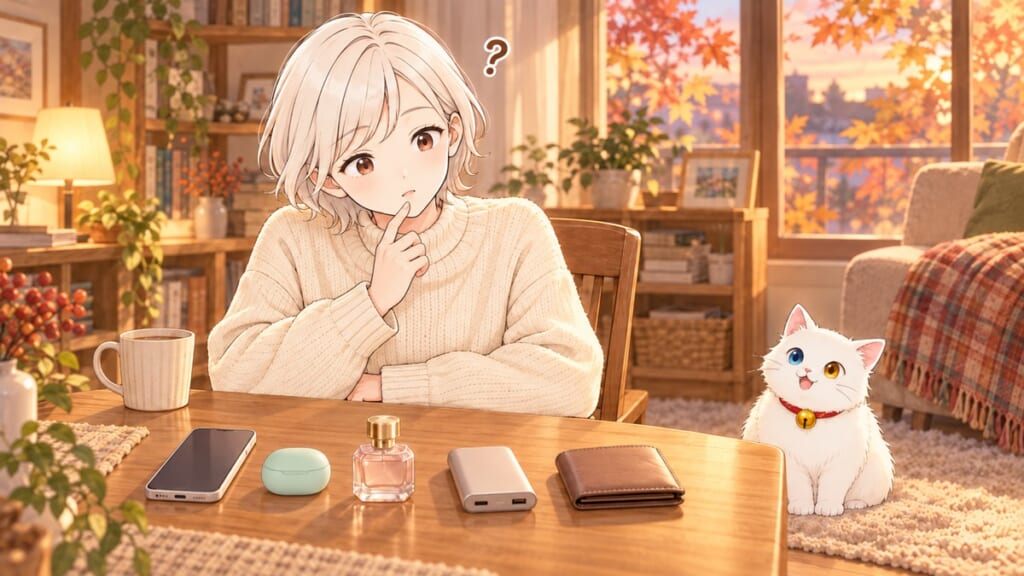
Check the contents before committing to a postal return. Japan Post permits some devices with installed lithium batteries, subject to battery limits and destination rules. A phone therefore needs a check of the actual device and destination.
For lithium batteries, all the conditions must be met: the batteries are installed in the equipment, their capacity is within the permitted limit, the parcel stays within the limit of four cells or two batteries, and the receiving country permits them. Loose batteries, or batteries simply packed alongside a device, cannot be sent by international post. Give the sender the model and battery information so they can check the applicable limits.
 Wireless earbuds and their charging case need particular attention: a case may be refused by international post. Describe exactly what was found, including the case, when you apply; delivery services may have different arrangements and need to check the complete item.
Flammable liquids, such as lighter fuel and paint, and compressed gases cannot go by international post. Other liquids require a check of their contents and destination restrictions. Give the exact product name rather than describing a toiletry only as “liquid.”
EMS cannot carry valuables as defined by Japan Post. If a wallet or other container has money or valuables inside, tell the sender about the contents before choosing a method. Postal parcels are checked by X-ray after acceptance, and prohibited contents can cause a parcel to be returned to the sender before it leaves Japan.
Lost Your Passport or Wallet? That’s a Different Process
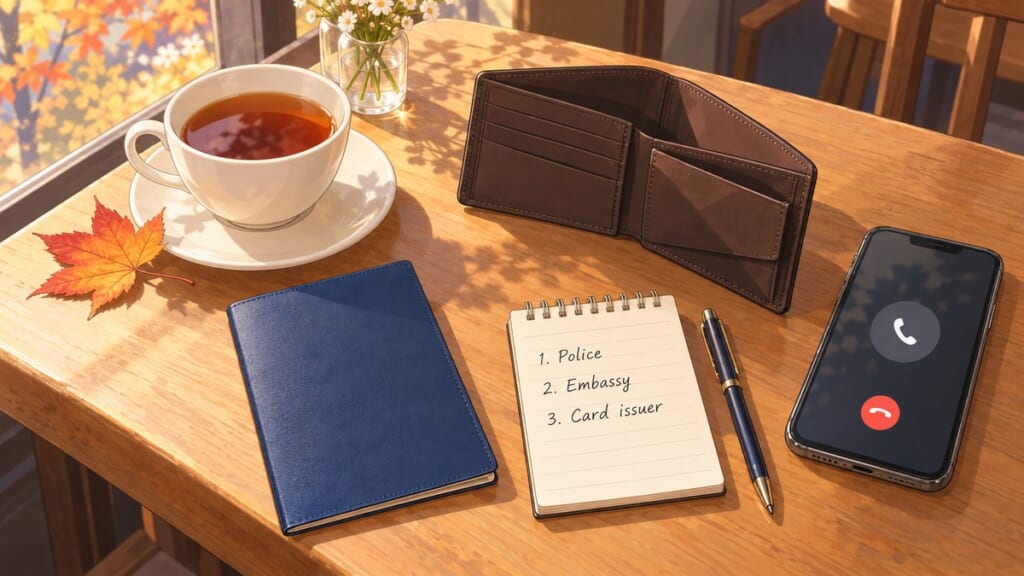
If your passport is missing while you’re in Japan, report it to the police and ask for documentation of the report. Contact your country’s embassy or consulate promptly to arrange a replacement passport or, where available, emergency travel documents. Check its appointment instructions and tell staff when you need to travel.
Some countries invalidate a passport once it is reported lost, even if it is later found. If it turns up after you have reported it, ask your embassy or passport authority about its status before attempting to use it. Let the consular office guide the document process alongside your search.
For a missing credit card, contact the issuer immediately using the number printed on the card, if you have a record of it. Mastercard also offers help outside the United States at +1 636 722 7111, available 24 hours; Visa lists contacts through its country menu. Start the card-protection process while the wallet search continues.
For another kind of travel trouble, my guide to getting sick in Japan covers what to do when you feel unwell in Japan. Keep the relevant official contact details with your travel information so you can reach them when needed.
Before You Check Out: A 30-Second Lost-Item Check
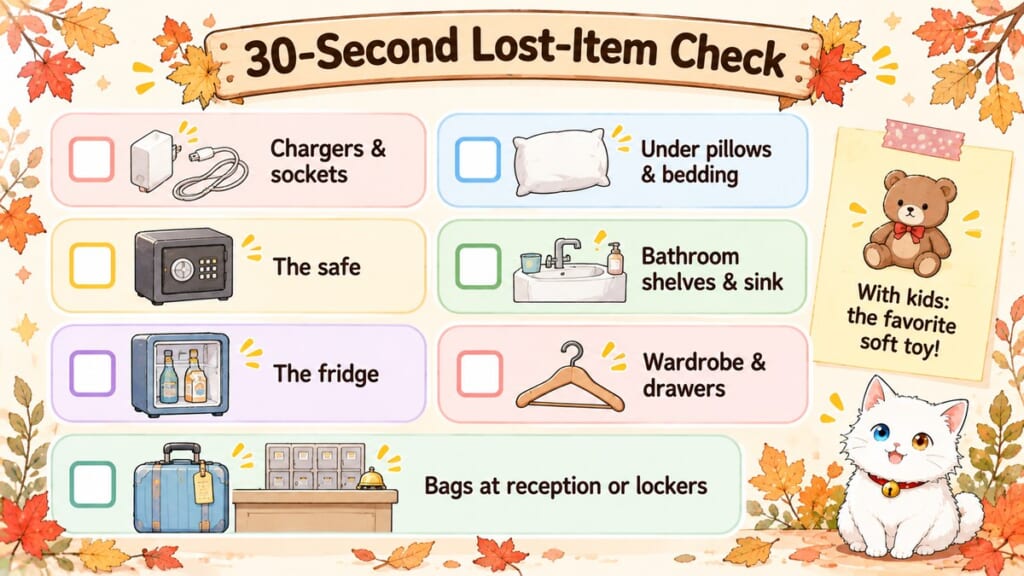
Before you close the room door, scan the places where small belongings settle. Use this short check after the bags are packed, while you can still see the surfaces around you.
- Check sockets and chargers beside the bed and desk.
- Lift pillows and look around the bedding.
- Open the safe and check inside.
- Look through the bathroom shelves and sink area.
- Check the refrigerator.
- Check the wardrobe, hangers and drawers.
- Account for bags left at reception or in a locker.
 With children, a favorite soft toy deserves its own check before you leave the room. A charger can disappear behind furniture just as easily, so follow the cable all the way to the socket.
Include any separate luggage-storage location in that final check; my guide to full coin lockers in Japan covers storage alternatives. For your next stay, my guide to Tokyo hotels for a family of 4 helps you plan a room for everyone and their belongings.
FAQ
Can I still get my item back after I’ve left Japan?
Yes, if it has been found, is still held and can be returned through an available route. Contact the holder from abroad, confirm its deadline and arrange direct shipping, a recipient in Japan or a suitable delivery service.
Will a Japanese hotel ship my item overseas?
Some hotels may agree; ask your own hotel’s front desk about international shipping and payment. If it can send only within Japan, ask whether it will cooperate with your chosen recipient or hotel-return service. If the hotel doesn’t ship overseas, WASULUCK is the route I’d try first: you apply in English, and the hotel only needs to send the item to WASULUCK within Japan.
Do I need to speak Japanese?
You can start with an English inquiry through an available form, chat or hotel email address. The Japanese template above gives you the same request to send if needed; language support depends on the particular office.
How long does it take?
Ask for the expected delivery time with your shipping quote. For WASULUCK, the procedure deadlines are listed in the section above, and the shipping estimate comes with the quote.
What if it isn’t found?
Ask the operator whether records should be checked again or whether the item may have moved to police. If WASULUCK’s hotel check finds no item, it closes the case; incorrect hotel details can be corrected and submitted again through its form.
For your next visit, my Japan trip planning guide brings the planning steps together. Keep a copy of your booking details and important contacts where you can access them after returning home.
Have you ever left something behind in Japan? Tell me in the comments.
I hope this guide has answered one of your questions and helped you feel a little closer to Japan.
May your Japan journey be filled with wonderful discoveries and memories you’ll treasure for years to come.
See you in the next guide.




Comments