
- Quick Answer: Hinoki or Rubber?
- Why Your Cutting Board Matters for Your Knife
- Hinoki vs Rubber, Side by Side
- Japanese Hinoki Cutting Boards to Order Online
- Japanese Rubber Cutting Boards: Asahi and More
- How to Care for Hinoki and Rubber Boards
- How We Use Cutting Boards at Home in Japan
- Buying a Cutting Board in Japan
- Frequently Asked Questions
- Which Cutting Board Would I Choose?
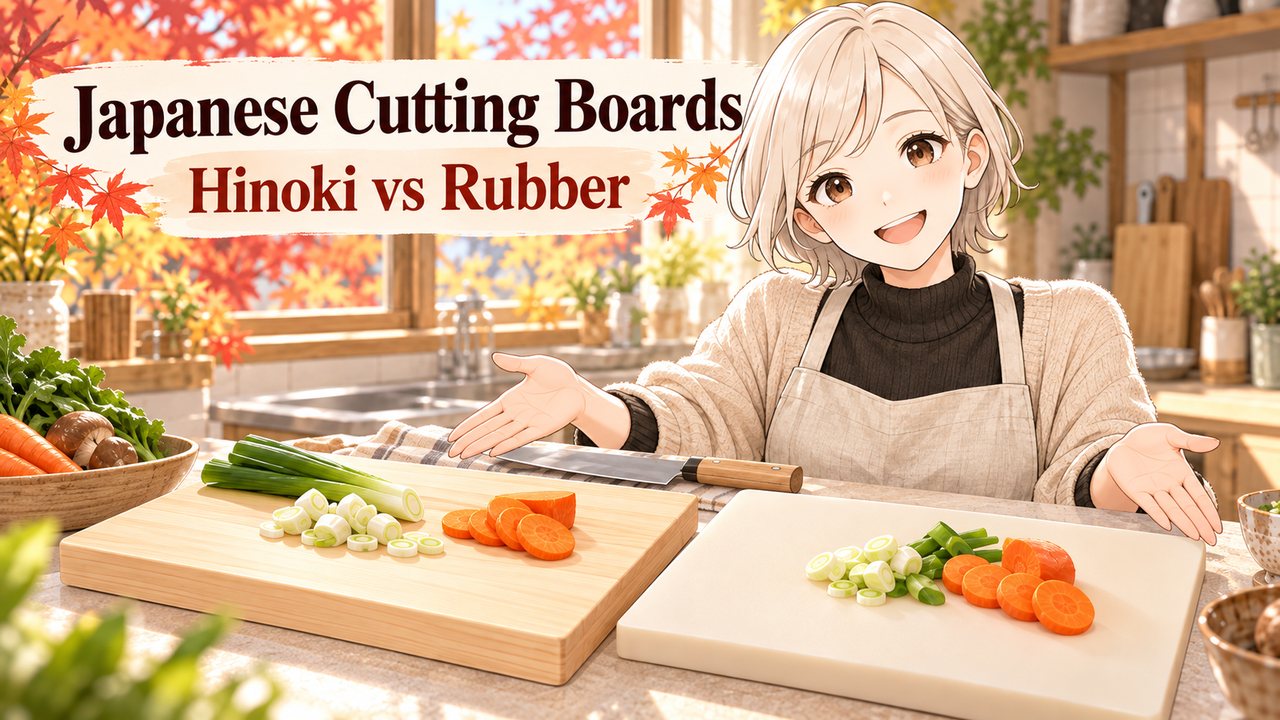
Quick Answer: Hinoki or Rubber?
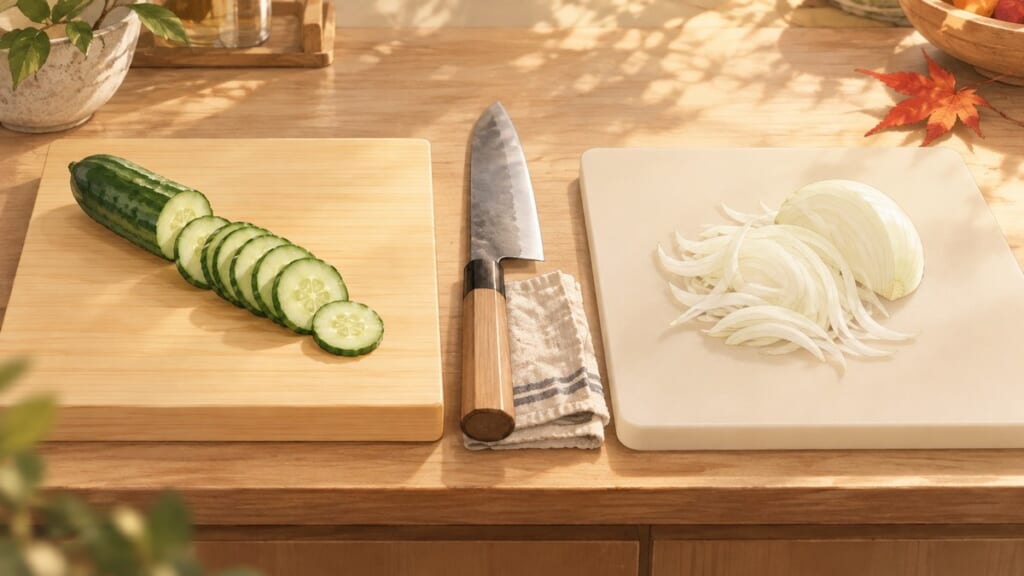
Your knife feels great in your hand, but what happens when its edge meets your cutting board? If you’ve been chopping on glass, stone, or another very hard surface, the board may be working against the blade you’re trying to protect.
Two Japanese options worth looking at are hinoki (Japanese cypress wood) and synthetic rubber. Both are relatively gentle on knife edges, but they fit different kitchens.
Choose hinoki if you want a lighter board, enjoy the natural scent of wood, and don’t mind a little extra care. Choose synthetic rubber if you prefer a board that tolerates approved kitchen bleach and is less prone to warping.
 Neither material automatically wins. Four of the five boards in this guide aren’t dishwasher-safe. NOBODA RUBBER Raba is the exception.
| What matters | Hinoki wood | Synthetic rubber |
|---|---|---|
| Knife-edge feel | Soft, slightly yielding surface | Resilient, slightly yielding surface |
| Weight | Generally lighter; Shun Medium is 595 g (about 1.3 lb) | Often heavier; Asahi HOME L is 1.3 kg (about 2.9 lb) |
| Daily care | Wet before use, hand-wash, dry thoroughly | Hand-wash; approved bleach can be used on the featured models |
| Warping | Can warp with moisture changes | Generally more resistant, but excessive heat can cause warping |
| Dishwasher | Not allowed for the three featured boards | Asahi HOME: No / NOBODA Raba: Yes |
| Odors and stains | Pre-wetting helps limit staining; natural wood needs careful drying | Stains and odors still need attention; follow each model’s cleaning instructions |
| Good for | People who enjoy natural wood and lighter boards | People who want bleach-friendly cleaning and fewer worries about warping |
At home, hinoki is my main cutting board. I’ve also used a synthetic rubber board, and I liked how the knife felt against both surfaces.
If you’re undecided, I’d start with how much space you have and how you like to clean up after cooking. Then take a look at the hinoki options and rubber options below.
As an Amazon Associate, I earn from qualifying purchases.
Quick picks — Amazon US


Shun Hinoki Cutting Board (Medium) — Hinoki, my first pick to consider


Kai Seki Magoroku Hinoki AP5221 — Thicker hinoki, 20 mm


YAMASAN KYOTO UJI Hinoki (Small) — Hinoki for a compact kitchen


Asahi Cookin’ Cut HOME (L) — Synthetic rubber, bleach OK


NOBODA RUBBER Raba (L) — Thinner rubber, dishwasher-safe
Why Your Cutting Board Matters for Your Knife
A cutting board isn’t just somewhere to put your vegetables. It’s the surface your knife edge meets over and over again, and that repeated contact matters.
 Knives with thin, hard edges, including many Japanese-style kitchen knives, can be more vulnerable to chipping when they hit very hard surfaces. A slightly yielding board gives the edge a more forgiving place to land.
That doesn’t mean every plastic cutting board is bad. Softer plastic boards can be perfectly reasonable choices, while very hard surfaces deserve more caution.
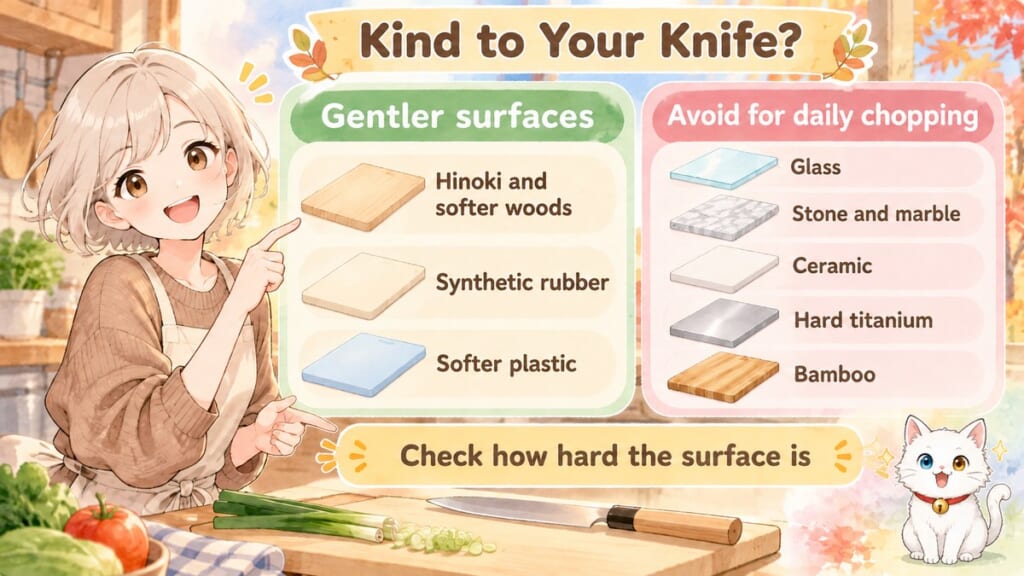
| More forgiving surfaces | Surfaces to avoid for regular chopping |
|---|---|
| Hinoki and other suitable softer woods | Glass |
| Cutting boards made from suitable synthetic rubber | Stone and marble |
| Softer, knife-friendly plastic | Ceramic |
| — | Hard titanium |
| — | Bamboo |
You don’t need to replace a board just because it isn’t made of hinoki or rubber. First, check whether the surface is particularly hard, whether the board stays stable while you work, and whether it’s still in good condition.
And remember, a knife-friendly board is only part of looking after your knife. If you’re curious about Japanese knife construction and where a knife is actually made, I’ve covered that separately in my guide to checking whether a Japanese knife is really made in Japan.
Hinoki vs Rubber, Side by Side
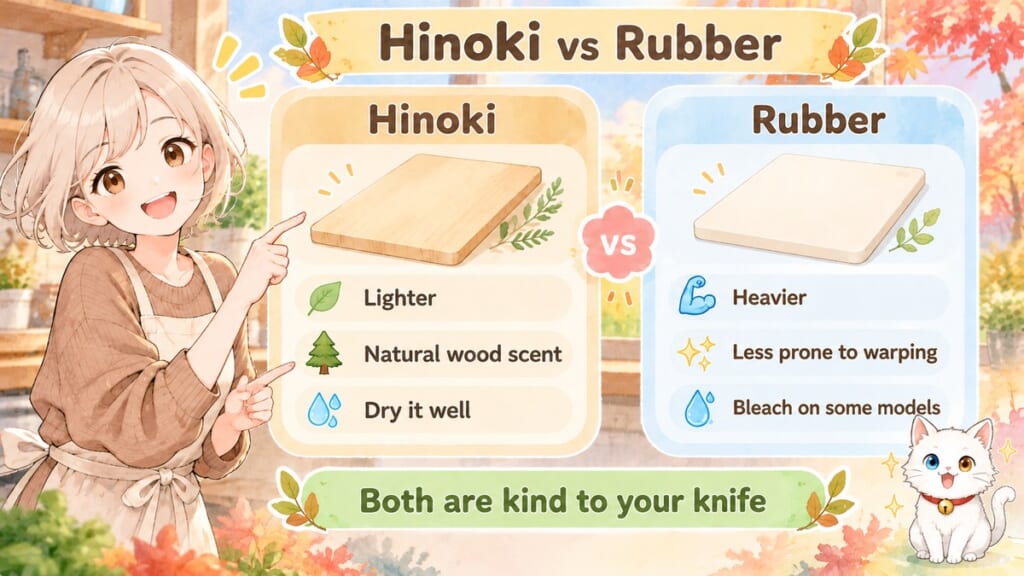
Hinoki and synthetic rubber have something important in common: both can offer a comfortable cutting surface without the unforgiving contact of glass or stone.
I’ve used both at home, and the feeling of the knife against each board was pleasantly soft. That experience is part of why I think the more useful question is about everyday convenience, not which surface wins a contest.
Hinoki: Light, Fragrant, and Naturally Soft
Hinoki is a type of Japanese cypress that has long been valued for its natural fragrance and workable wood. Its relatively soft surface makes it appealing for people who want a board that feels gentle under a knife.
The Shun Medium hinoki board, for example, weighs 595 g. That makes it a practical candidate if you frequently lift your board to wash it, move it around your counter, or put it away after cooking.
 There’s a trade-off, though. Wood responds to moisture, and a hinoki board can curve or warp if conditions cause it to dry unevenly.
You also need to wet the featured hinoki boards before use and let them dry properly afterward. Shun’s instructions recommend a mild detergent, towel-drying, and air-drying away from direct sunlight.
Kama-Asa’s Kiso hinoki board instructions specifically say to avoid bleach. That’s a useful reminder that wood and rubber shouldn’t automatically share the same cleaning routine.
Synthetic Rubber: Resilient and Easier to Sanitize with Approved Products
Synthetic rubber boards are appealing when you want some give under your knife but prefer cleaning options that include kitchen bleach.
Parker Asahi’s Cookin’ Cut HOME is a good example. Its L size measures 400 × 230 × 13 mm and weighs 1.3 kg, so it’s substantially heavier than Shun’s 595 g Medium hinoki board.
Synthetic rubber boards are generally less prone to warping during normal use than natural wood, but that doesn’t make them heatproof.
 Heat resistance and dishwasher rules are model-specific. Asahi HOME requires hand-washing, while NOBODA Raba is dishwasher-safe. I’ll go through the details in the care section.
What About Size?
Before choosing a material, measure the counter space where you actually prepare food. Then check your sink, drying area, and storage space.
A board that looks wonderfully spacious online may be awkward to wash in a smaller sink. A compact board can be easier to handle, but you still need enough room to cut comfortably.
For reference, the featured YAMASAN hinoki board is about 36 × 22 cm, while Asahi HOME L is 40 × 23 cm. Those few centimeters can matter when your kitchen is already crowded.
If you use a stand or a narrow gap for storage, check the board’s thickness too. The five featured boards range from 8 mm to 20 mm thick.
Japanese Hinoki Cutting Boards to Order Online

If you’re leaning toward hinoki, I’d start with these three Made in Japan options listed on Amazon.com. They offer different dimensions and designs, so you can choose according to the space you have.
1. Shun Hinoki Cutting Board Medium — My First Pick to Consider
Shun Hinoki Cutting Board Medium (DM0816) is the first one I’d look at for a general-purpose hinoki board.
It measures 15.75 × 10.75 × 0.5 inches (approximately 40 × 27 × 1.3 cm) and weighs 595 g. Shun lists Japan as its country of origin and identifies the hinoki wood as FSC-certified.
Shun is the Kai Group’s Japanese knife brand, with products distributed in the US through Kai USA. You don’t need a Shun knife to use it; what matters is the forgiving cutting surface.
The Medium size offers a generous cutting area without being exceptionally thick. If you’re looking for something smaller or larger, Shun also offers Small and Large hinoki versions with Japan listed as their origin.
You’ll need to wet the board before use, wash it by hand, and dry it away from direct sunlight. Shun also provides instructions for dealing with stains and mild curving, which I’ll explain in the care section.
I like this as a starting point if you want a familiar knife brand, clear manufacturer care instructions, and a lighter board for everyday cooking.
Shun Hinoki Cutting Board, Medium (DM0816)
Made in Japan. 15.75 × 10.75 × 0.5 in, 595 g. Wet before use; hand wash. Sold by Amazon.com.
Prices change often — please check the latest price on each store.
2. Kai Seki Magoroku Hinoki AP5221 — A Thicker Wooden Option
Kai Seki Magoroku Hinoki Cutting Board AP5221 is another Made in Japan option from Kai.
Its dimensions are 390 × 240 × 20 mm (approximately 15.4 × 9.4 × 0.8 inches). Compared with Shun Medium, it’s slightly shorter and narrower, but thicker.
One detail that distinguishes the AP5221 is the resin coating along its sides. That’s a product-specific feature rather than something to expect from every hinoki board.
The listing calls for hand-washing, so don’t choose this model expecting dishwasher convenience. Its 20 mm thickness also matters if you store cutting boards in a narrow rack.
This is worth considering if you’d prefer a thicker hinoki board in a fairly conventional rectangular size. Check your available drying and storage space before deciding.
Kai Seki Magoroku Hinoki Cutting Board AP5221
Made in Japan. 390 × 240 × 20 mm with resin-coated sides. Hand wash only.
Prices change often — please check the latest price on each store.
3. YAMASAN KYOTO UJI Hinoki Small — For a More Compact Kitchen
YAMASAN KYOTO UJI Japanese Hinoki Cutting Board Small offers a smaller footprint among these three choices.
It measures approximately 36 × 22 × 1.5 cm (14.17 × 8.66 × 0.59 inches). The Amazon listing identifies it as Made in Japan and specifies hand-washing only.
The dimensions make it worth considering when you have limited counter space or don’t want a particularly wide board. It’s still large enough to be a serious candidate for ordinary food preparation, depending on what you usually cut.
YAMASAN KYOTO UJI Hinoki Cutting Board, Small
Made in Japan. About 36 × 22 × 1.5 cm — good for a compact kitchen. Hand wash only.
Prices change often — please check the latest price on each store.
If you want a larger hinoki alternative, Yoshihiro Hinoki Cutting Board Anti-Twist Core Large is another Made in Japan option. It measures 40 × 24 × 2.5 cm and uses Kochi-grown hinoki with a maple core designed to help resist twisting.

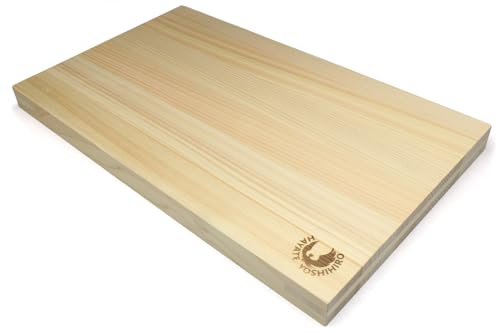
Yoshihiro Hinoki Anti-Twist Core Cutting Board
Made in Japan from Kochi hinoki with a maple core. Several sizes — check the one you choose.
Prices change often — please check the latest price on each store.
And if choosing the right cutting surface has made you curious about the knife itself, see my guide to checking whether a Japanese knife is really made in Japan.
Japanese Rubber Cutting Boards: Asahi and More
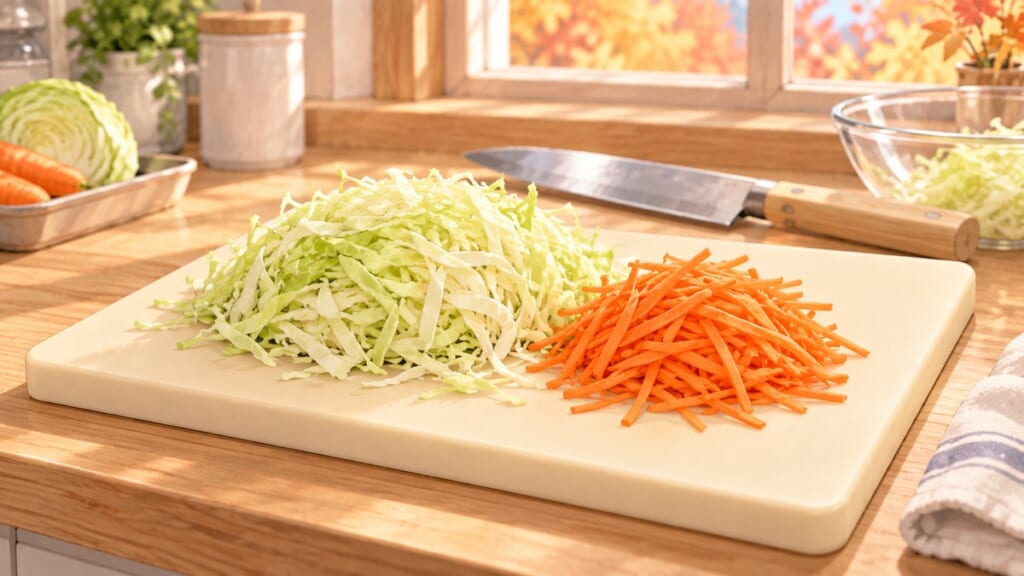
If you’d rather have a synthetic rubber board, these are the two Japanese-made models I’d compare first.
Both offer a knife-friendly cutting surface and manufacturer-approved bleach cleaning. They differ in thickness, dimensions, and heat-resistance instructions, so don’t treat them as interchangeable.
4. Asahi Cookin’ Cut HOME — A Substantial Everyday Board
Asahi Cookin’ Cut HOME (L) is made by Parker Asahi, a Japanese manufacturer with a history of cutting-board production dating to 1965. Its headquarters and factory are in Fukaya, Saitama Prefecture.
The L version measures 400 × 230 × 13 mm (approximately 15.7 × 9.1 × 0.5 inches) and weighs 1.3 kg.
The manufacturer permits kitchen bleach for cleaning but says not to leave the board soaking in it for long periods. Hot-water disinfection is also permitted under specific conditions: use water at 90°C or below and apply it to both sides, rather than immersing the board in boiling water.
Asahi HOME isn’t dishwasher-safe. Parker Asahi warns that high dishwasher temperatures can soften the material and cause warping.
If you’re comfortable hand-washing and want the option of bleach-based cleaning, this model is worth considering.
Asahi also offers an M version (380 × 210 mm, 1.1 kg) and an LL version (420 × 250 mm, 1.5 kg). If L seems a little too large, measure your counter before automatically choosing the biggest one.
Asahi Cookin’ Cut HOME, L (synthetic rubber)
Made in Japan by Parker Asahi. 400 × 230 × 13 mm, 1.3 kg. Bleach OK; no dishwasher.
Prices change often — please check the latest price on each store.
5. NOBODA RUBBER Raba L — A Thinner Rubber Option
NOBODA RUBBER Raba Cutting Board L (NBD003) is another Made in Japan synthetic rubber board.
It measures 370 × 245 × 8 mm (approximately 14.6 × 9.6 × 0.3 inches). Compared with the 13 mm Asahi HOME L, its thinner design may be interesting if board thickness is an important consideration in your kitchen.
NOBODA’s official specifications permit kitchen bleach and state heat resistance up to 130°C for 30 minutes. In October 2025, NOBODA also announced that the board can go in the dishwasher.
I’d look at NOBODA if you prefer a thinner board and want the rubber material’s cleaning flexibility. Compare its 8 mm thickness with Asahi’s 13 mm before choosing.
NOBODA RUBBER Raba Cutting Board, L (NBD003)
Made in Japan. 370 × 245 × 8 mm, matte black. Bleach OK and dishwasher-safe.
Prices change often — please check the latest price on each store.
You may also encounter Hasegawa and Tenryo Hi-Soft when searching for Japanese professional cutting boards. They’re names associated with professional kitchen boards, but the specific models considered for this guide weren’t found in the Amazon.com listings checked in October 2026.
Compare All Five Japanese Cutting Boards
| Product | Material | Size | Thickness | Dishwasher | Bleach |
|---|---|---|---|---|---|
|
|
Hinoki wood | 40 × 27 cm | 13 mm | No | Not specified |
|
|
Hinoki wood | 39 × 24 cm | 20 mm | No | Not specified |
|
|
Hinoki wood | Approx. 36 × 22 cm | Approx. 15 mm | No | Not specified |
|
|
Synthetic rubber | 40 × 23 cm | 13 mm | No | Yes, no prolonged soaking |
|
|
Synthetic rubber | 37 × 24.5 cm | 8 mm | Yes | Yes |
Bleach instructions are model-specific, so follow the manual for your board.
Before ordering, check the exact product model, Made in Japan information, current availability, and delivery options for your address. Marketplace listings can change, even when the product name stays the same.
How to Care for Hinoki and Rubber Boards
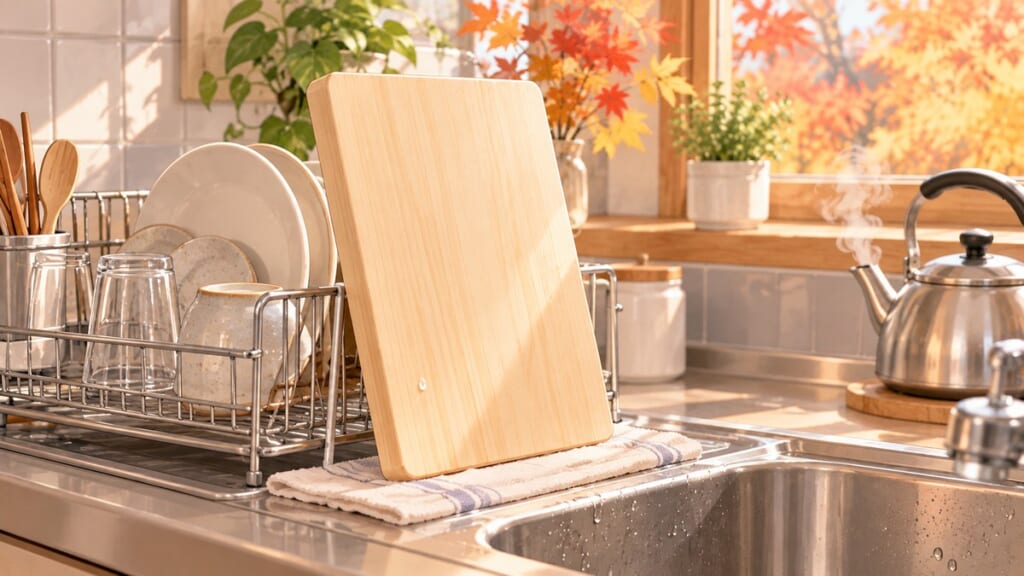
At home, I wash my cutting board and stand it upright to dry. I also occasionally pour hot water over it, but that personal routine isn’t a substitute for the temperature and cleaning instructions supplied with a particular board.
Caring for a Hinoki Cutting Board
For Shun’s hinoki board, start by wetting the surface with water before each use. This helps resist staining by preparing the wood surface before food touches it.
After use, wash with a mild detergent and dry the board with a towel. Let it finish air-drying away from direct sunlight; don’t put it in the dishwasher.
Shun suggests rubbing a cut lemon across a stain. It also explains that if the board begins curving, you can turn it over and use the other side until it flattens again, repeating as needed.
For Kama-Asa’s Kiso hinoki boards, the manufacturer specifically advises against bleach. Natural resin may also appear in the wood, which is described as a characteristic of hinoki rather than automatically a product defect.
The important habit is to avoid leaving a wooden board wet for long periods. If you enjoy a simple wash-and-dry routine and have space to let the board dry properly, hinoki can fit comfortably into everyday cooking.
Caring for an Asahi Synthetic Rubber Board
Asahi HOME has different care instructions, particularly when it comes to disinfecting the surface.
You can use kitchen bleach, but don’t leave the board soaking for extended periods. For hot-water disinfection, Parker Asahi specifies water at 90°C or below, applied to both sides.
 Don’t place the board in boiling water, and don’t use a dishwasher or dish dryer. The manufacturer warns that excessive heat can soften the material and cause it to warp.
So even though the board is rated to 100°C, the 90°C hot-water limit is the one to follow.
Caring for a NOBODA Raba Board
NOBODA’s specifications permit kitchen bleach and list heat resistance at 130°C for up to 30 minutes.
NOBODA confirms that RUBBER Raba is dishwasher-safe, including boards purchased before the policy change. Follow NOBODA’s instructions for this model rather than borrowing the cleaning rules from another rubber board.
Whichever material you choose, clean the cutting surface after preparing food, pay attention to any cuts or damage that could trap food residue, and let the board dry properly before storage.
How We Use Cutting Boards at Home in Japan
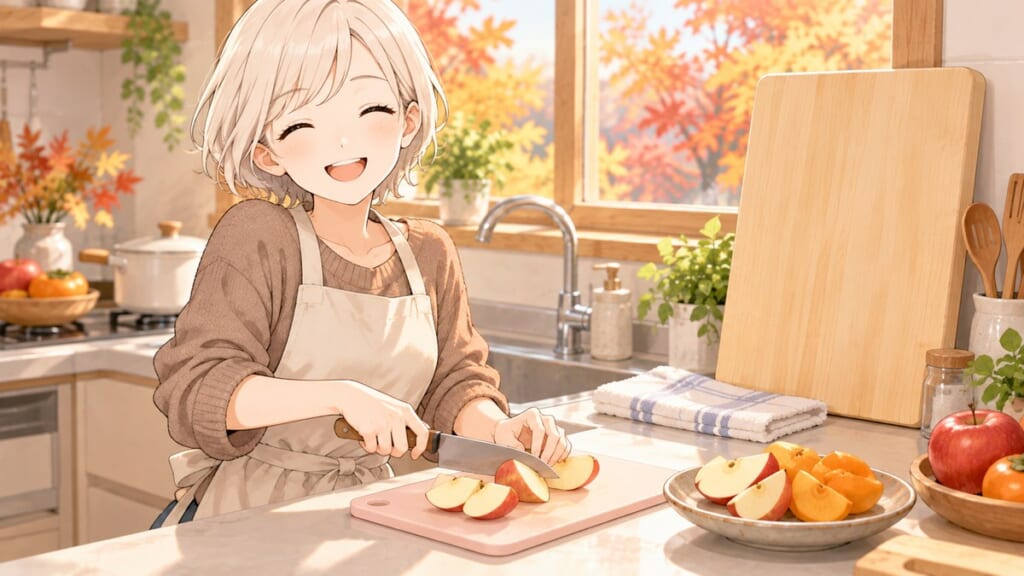
In my kitchen, I use a hinoki cutting board for most of my cooking. I chose it because I like the softer feeling when the knife meets the wood, and I haven’t had any particular problems using it.
 I also keep a small cutting board from a 100-yen shop. It’s handy when I just want to cut some fruit without getting out the larger board.
I bought my hinoki cutting board at an ordinary home-improvement store or supermarket in Japan. You don’t have to visit a specialist knife shop to find wooden cutting boards here.
Why Japan Does It This Way
Many Japanese homes have compact kitchens, where counter space, sink size, and somewhere to dry a cutting board all matter. Washing a board and standing it upright to dry is a familiar routine, while hinoki itself has a long history of use in Japanese buildings and baths. That connection with everyday materials helps explain why hinoki feels at home in a Japanese kitchen, though it doesn’t mean everyone here uses the same kind of board.
Some households also choose separate boards for different food categories, such as raw meat or fish and vegetables, to help manage cross-contamination.
For me, the extra small board is simply about convenience.
Buying a Cutting Board in Japan
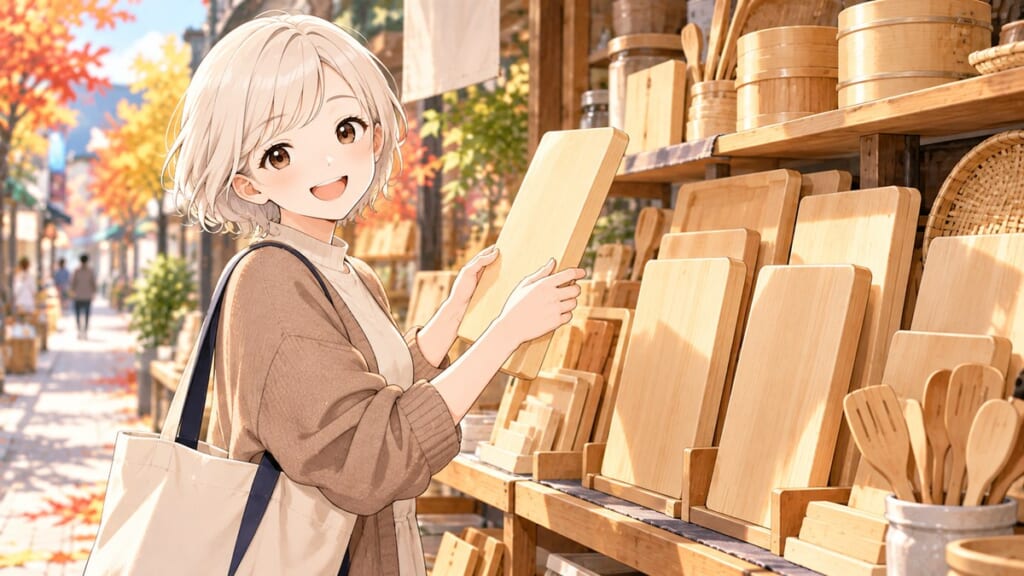
If you’re visiting Japan and would rather choose a cutting board in person, two places worth knowing are Kappabashi in Tokyo and Sennichimae Doguyasuji in Osaka.
Tokyo: Kama-Asa in Kappabashi
Kama-Asa is a kitchenware shop in Tokyo’s Kappabashi area, at 2-24-1 Matsugaya, Taito City.
It offers Kiso hinoki cutting boards, including a Mini measuring 31 × 17 × 3 cm. Larger sizes include 36 × 24 × 3 cm and 42 × 28 × 3 cm.
The boards are made with carefully selected Kiso hinoki wood and come with specific care instructions: wet before use, avoid bleach, and don’t put them in a dishwasher. The shop also explains that natural resin may appear in the wood.
A 3 cm-thick board is quite different from the thinner models in the earlier comparison. If you’re planning to bring one home, check both the dimensions and how comfortably you can pack it.
Osaka: Taruko Goto Shoten in Doguyasuji
In Osaka’s Sennichimae Doguyasuji shopping street, Taruko Goto Shoten is a specialist store for wooden and bamboo goods.
Established in 1930, the shop carries wooden cutting boards. Ask about the particular board’s material and care requirements before buying.
Before You Pack a Cutting Board
A cutting board may look compact on a shop shelf, but remember to allow room for its full length, width, and thickness in your luggage.
Weight matters too, especially if you’re already bringing home other kitchen tools.
For wooden products, check the official import and customs guidance for your destination before traveling. The rules may depend on the material and the condition of the product, so don’t rely on a general statement that wooden kitchenware is always allowed.
Useful official starting points include:
- United States: USDA APHIS — Traveling with Agricultural Products
- Australia: Department of Agriculture, Fisheries and Forestry
- Canada: Canadian Food Inspection Agency (CFIA)
- United Kingdom: GOV.UK — guidance on bringing goods into the UK
If you’re also shopping for other items in Japan, my Japan tax-free shopping guide explains the tax-free shopping process.
For planning how to move your purchases during your trip, see my luggage forwarding guide. And if you’re still organizing the whole journey, my 7-step Japan trip planning guide is a useful place to start.
Frequently Asked Questions
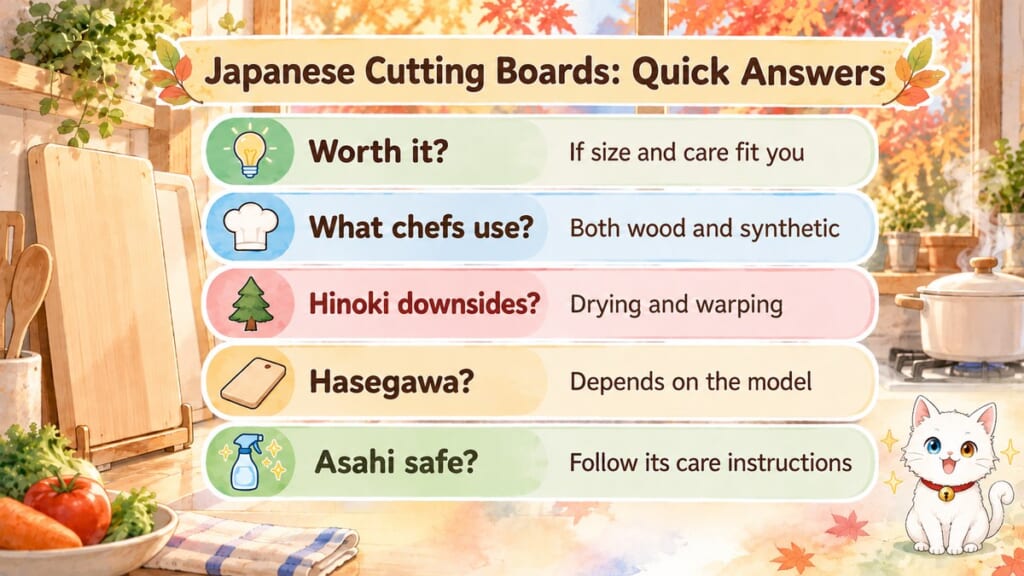
Are Japanese cutting boards worth it?
Yes, if the material, dimensions, and care requirements suit the way you cook. Japanese-made hinoki and synthetic rubber boards offer knife-friendly options, but a good softer plastic board may also meet your needs without requiring a change.
What cutting board do Japanese chefs use?
There isn’t one board every Japanese chef uses. Both wooden and synthetic boards are common, and Hasegawa is a name you’ll often see mentioned for professional synthetic boards. For a home kitchen, choose based on your own space and cleaning routine.
What are the downsides of using a hinoki cutting board?
Hinoki needs careful drying, can warp with changes in moisture, and the featured models aren’t dishwasher-safe. Kama-Asa also advises against bleach for its Kiso hinoki board and notes that natural resin may appear, so make sure you’re comfortable with those characteristics before buying.
Is a Hasegawa cutting board worth it?
Hasegawa is a name you’ll often see mentioned for professional cutting boards, but value depends on the exact model, size, and how you plan to use it. The specific models considered here weren’t found in the checked Amazon.com listings, so Asahi HOME and NOBODA Raba are more practical options to explore within this guide.
Are Asahi cutting boards safe?
Parker Asahi produces synthetic rubber cutting boards in Japan and has a manufacturing history dating back to 1965. For safe everyday handling, follow the exact Asahi HOME instructions for washing, bleach, heat, and storage; the material and country of origin alone don’t establish every health-related safety claim.
Which Cutting Board Would I Choose?
I’d choose hinoki if I wanted a lighter, natural wooden cutting surface and was happy to wash and dry it by hand. That’s the choice I use most in my own kitchen.
I’d look at Asahi HOME or NOBODA Raba if I wanted a synthetic rubber board with manufacturer-approved bleach cleaning. I’d decide between them by measuring my counter and sink, checking thickness, and reviewing the care instructions.
The nice thing is that you don’t have to replace every tool in your kitchen at once. Start with the surface your knife meets every day, find one that feels right for your routine, and enjoy cooking with it.
If you’re curious about more everyday Japanese products, visit my Japan Finds page. And for another piece of Japanese kitchen equipment, you might enjoy my Zojirushi rice cooker guide.
Have you tried a hinoki or synthetic rubber cutting board? I’d love to hear which one you prefer, especially what you like about using it in your kitchen.
I hope this guide has answered one of your questions and helped you feel a little closer to Japan.
May your Japan journey be filled with wonderful discoveries and memories you’ll treasure for years to come.
See you in the next guide.




Comments