Tax-free shopping sounds like the easiest win of your whole Japan trip. Show your passport, skip the 10% consumption tax, done. Then you look closer — minimum spend per store, sealed bags you’re not allowed to open, different rules for snacks and sweaters — and suddenly it feels less like a discount and more like a test.
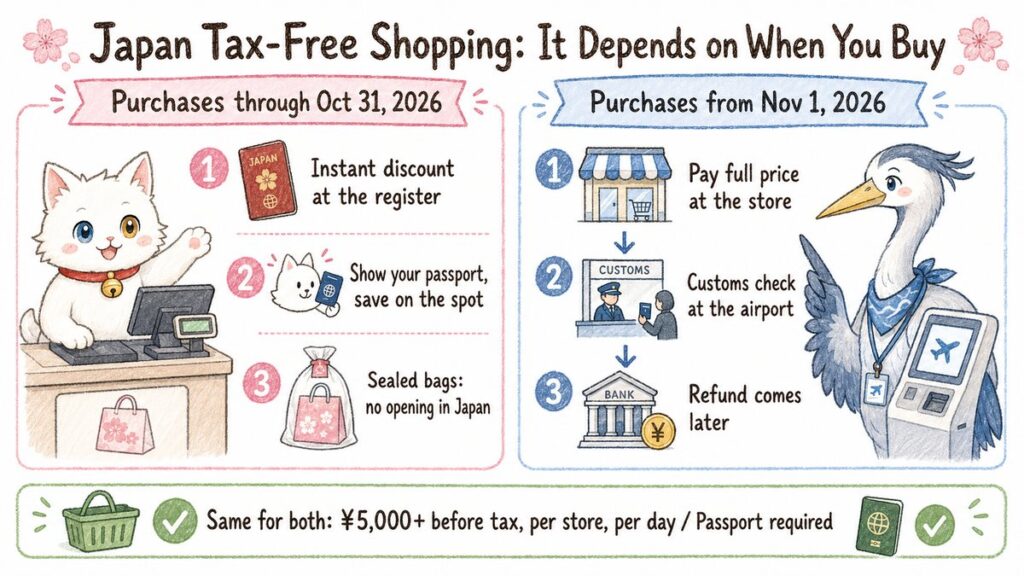
And 2026 adds one more twist. For purchases made on or after November 1, Japan switches to a refund system: you’ll pay the tax-inclusive price, complete customs confirmation before checking your baggage when you leave Japan, and receive the refund through the store or its refund partner. If your trip spans that date, purchases made before and after November 1 will follow different rules.
So let me untangle it for you. In this guide, you’ll find what qualifies, how much you need to spend, what actually happens at the store and at the airport, and what the November change means for your trip. I’ll also tell you something most guides won’t — sometimes tax-free shopping isn’t worth the hassle, and I’ll show you how to tell.
Shopping on or before October 31, 2026? → The current instant-discount system applies to those purchases.
Shopping on or after November 1, 2026? → The new refund system applies — see What Changes on November 1, 2026?
Does your trip span both dates? → The system is determined by the date of each purchase, so you may have purchases under both sets of rules.

- Who Can Shop Tax-Free in Japan?
- How Much Do You Need to Spend?
- What Do You Need for Tax-Free Shopping?
- How Tax-Free Shopping Works Before November 1, 2026
- What Changes on November 1, 2026?
- Is Tax-Free Shopping Actually Worth It?
- How Tax-Free Shopping Works at Different Stores
- At the Airport: What to Do Before and After November 2026
- Common Tax-Free Shopping Mistakes
- Quick Tax-Free Shopping Checklist
- FAQ: Japan Tax-Free Shopping
- Final Thoughts
Who Can Shop Tax-Free in Japan?
 Tax-free shopping is mainly available to non-residents who entered Japan within the past six months under Temporary Visitor status. If you entered Japan as a tourist, that will usually be you. A short business trip may also qualify if your passport shows Temporary Visitor status. People living in Japan on work, student, or other resident visas are not eligible, even if they plan to take the goods overseas.
 Japanese citizens may also qualify if they have lived outside Japan for two years or more. They need an original Certificate of Overseas Residence (zairyu shomei) issued by a Japanese embassy or consulate, or an officially issued Copy of the Supplementary Family Register (koseki no fuhyo). The document must have been issued no earlier than six months before their most recent entry into Japan, and photos or ordinary photocopies are not accepted. If this applies to you or someone in your group, arrange the document before traveling.
Not sure which group you’re in? Open your passport and find the landing sticker. If it says “Temporary Visitor,” you’re eligible — and the staff at the tax-free counter will check the same sticker, so there’s no need to memorize the rules yourself.
How Much Do You Need to Spend?
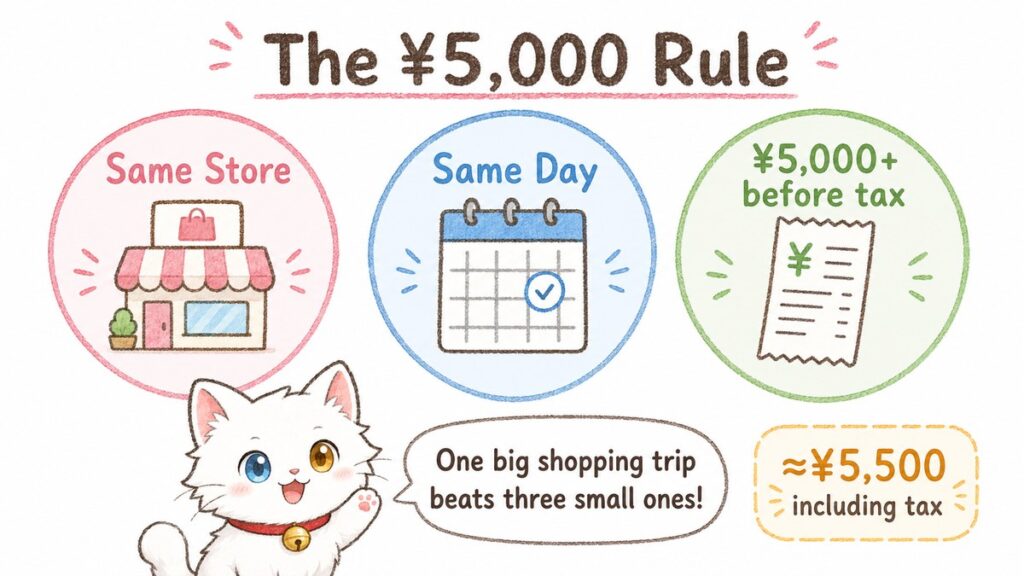
The magic number is ¥5,000 (≈$33) before tax, spent at one store on one day. Including tax, that’s roughly ¥5,500 (≈$36) for most goods, or around ¥5,400 (≈$35) if everything in your basket is food and snacks taxed at 8%. If your total at a single store doesn’t reach ¥5,000 (≈$33) before tax, tax-free simply doesn’t apply there.
Prices are in yen, with rough dollar figures at about ¥154 to the dollar (September 2026). Exchange rates move, so treat the dollars as a ballpark.
 The “one store, one day” part is stricter than many travelers expect. You can’t add up receipts from different shops, and you can’t combine today’s shopping with tomorrow’s — even at the same store. Buy ¥3,000 (≈$20) of souvenirs at one drugstore and ¥3,000 (≈$20) at another, and neither qualifies.
There’s one helpful exception: large shopping malls, outlets, and department stores often run a shared tax-free counter. There, receipts from participating shops inside the same complex can be combined to reach the minimum — so three small purchases can add up to one tax-free claim. Look for a “Tax-Free Counter” sign on the floor guide, or ask at the information desk.
 And a practical tip from the family shopper in me: if you know you’ll buy snacks, cosmetics, and medicine anyway, get them in one big drugstore or Don Quijote run instead of little stops here and there. Same shopping list — but now it clears the line. If it’s summer, add a pack of Japanese cooling body sheets to that run — one of my favorite cheap finds.
What Do You Need for Tax-Free Shopping?
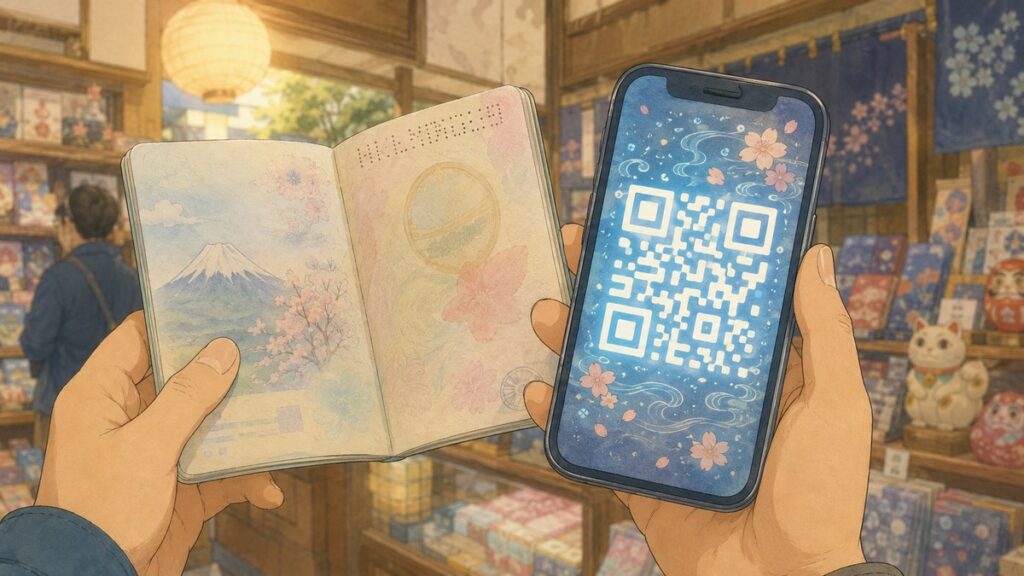
The packing list is short: your original passport. Tax-free purchases are registered to you personally, so the store needs to confirm your eligibility on the spot. A photo or ordinary photocopy of your passport is not accepted. At participating stores, a Visit Japan Web tax-free QR code may be used instead.
 If you’ve set up Visit Japan Web — the official online service many travelers already use for immigration and customs — there’s a second option. The service can generate a tax-free QR code, and some stores scan that instead of your passport. It’s convenient when it works: no handing your passport across the counter.
The catch is the word “some.” Plenty of shops haven’t adopted the QR system yet, and you often won’t know until you’re standing at the register. So the reliable rule is this: on any day you plan to shop tax-free, carry the real passport, and treat the QR code as a bonus rather than a replacement.
One reassuring detail from someone who lives here: visitors to Japan are legally required to carry their passports anyway. So you’re not taking a special risk by bringing it shopping — you’re just following the rule you were already supposed to follow, with a discount as a reward.
How Tax-Free Shopping Works Before November 1, 2026
Until October 31, 2026, tax-free shopping works on a simple principle: you receive the tax saving when you shop. Show your passport, and the applicable consumption tax — usually 10%, or 8% for qualifying food and non-alcoholic drinks — is removed or refunded at the store. Depending on the store, this happens in one of two ways — either the discount is applied directly at the register, or you pay full price first and collect the tax back at the store’s own tax-free counter before you leave the building. Department stores usually use the counter system.
The complicated part comes after you pay, because the current rules split purchases into two categories. “General goods” — clothes, bags, electronics, toys — are yours to use right away. Wear the new sweater out of the store if you like. “Consumables” — food, drinks, cosmetics, medicine — are different: they’re sealed into a special plastic bag at the register, and opening that bag inside Japan is against the rules.
One small exception: if neither category reaches ¥5,000 (≈$33) on its own but the combined total does, the store may process the items together. Under the current system, the general goods are then treated like consumables too, which means the whole purchase must be specially packaged and kept unopened in Japan.
That sealed bag trips up more travelers than anything else in the system. The face masks you bought for the flight home, the snacks you wanted to try at the hotel — once they’re in the tax-free bag, they stay there until you’ve left Japan. If you want to enjoy some of it during your trip, the fix is simple: buy what you’ll use now separately at the regular register, with tax, and keep the tax-free haul for your suitcase.
Consumables also have a spending cap under the current rules: ¥500,000 (≈$3,255) per store, per day. For most families that’s not a real limit — but if you’re planning a serious cosmetics haul, it’s there. Both the sealed bag and the cap disappear in November, and that’s exactly what the next section covers.
What Changes on November 1, 2026?
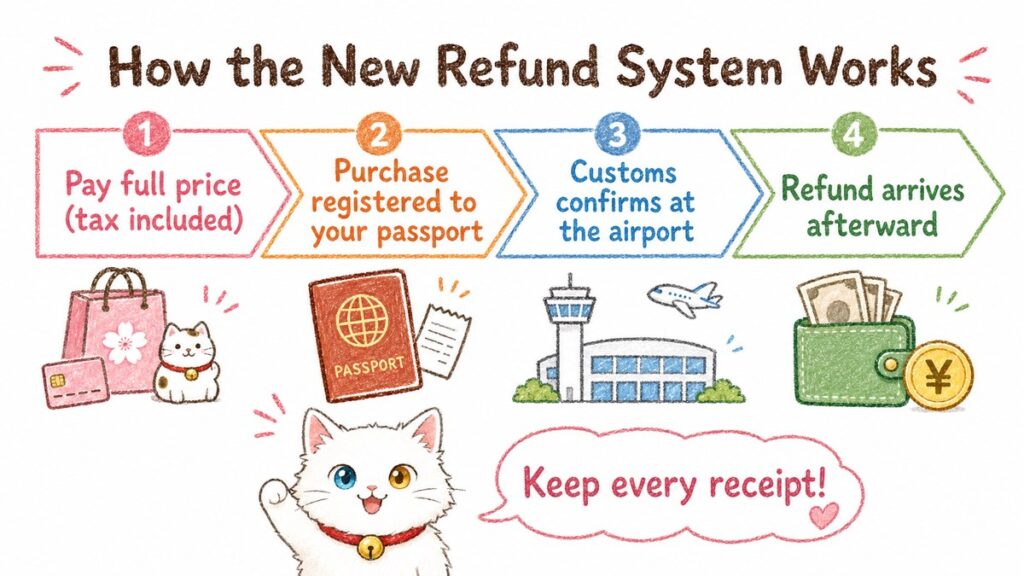
The change in one sentence: for purchases made on or after November 1, 2026, you’ll pay full price and get the tax back when you leave Japan. From that date, stores stop deducting the tax at the register for new purchases. You pay the tax-inclusive price, your purchases are registered for tax-free treatment, and at the airport, customs confirms you’re actually taking the goods out of the country. After that confirmation, the store — or a refund company working on its behalf — returns the tax to you.
Read somewhere that the new system has already started? It may just be the counter. Plenty of stores — department stores especially — have used a “pay full price, collect the tax at the counter” flow for years, and that is the current system, not the November change. The tell: with the in-store counter, your refund is finished before you leave the building.
Heads-up: November 1 is when the law changes — but some stores may switch to the new refund method earlier. So don’t be surprised if a store already asks you to pay the tax-included price and claim the refund at departure, even before that date.
In exchange, some of the fussiest rules disappear. Special packaging is no longer required, and the old division between general goods and consumables is abolished. However, opening the packaging does not mean you can eat or use the goods in Japan and still receive the refund. You must have every item included in each tax-free purchase record with you at customs. If even one item from that transaction is missing, the entire purchase may become ineligible for a refund. The ¥500,000 (≈$3,255) cap also disappears, but the goods must still leave Japan with you within 90 days of purchase.
| Purchases through Oct 31, 2026 | Purchases from Nov 1, 2026 | |
|---|---|---|
| When you save | Instantly at the register | Refund after customs confirmation at departure |
| Sealed bags for consumables | Yes — no opening in Japan | Gone |
| General goods vs. consumables | Two categories, different rules | One category |
| ¥500,000 (≈$3,255) cap on consumables | Yes | Gone |
| Minimum spend | ¥5,000 (≈$33) before tax, per store, per day | Same |
| Customs confirmation within 90 days of purchase | Not required — savings handled at the store | Required before departure |
If your trip includes purchases made on or after November 1, the biggest practical difference is your budget. A ¥30,000 (≈$195) pre-tax shopping haul of 10%-taxed goods will cost ¥33,000 (≈$215) at the store, and you will need to wait until customs confirmation before the refund can be processed. And one honest note: there is no single nationwide refund method — the timing, the method, and any handling fee depend on the store or its refund partner, so check the refund terms when you buy. I’ll update this guide as more details are announced. In the meantime, official announcements — including English leaflets on the new refund method — are published on the Japan Tourism Agency’s tax-free site.
By the way, the tax-free overhaul is just one of several changes hitting travelers this year — the departure tax and some entry fees went up too. I’ve rounded them all up in my guide to what’s changing for Japan travel in 2026.
Is Tax-Free Shopping Actually Worth It?
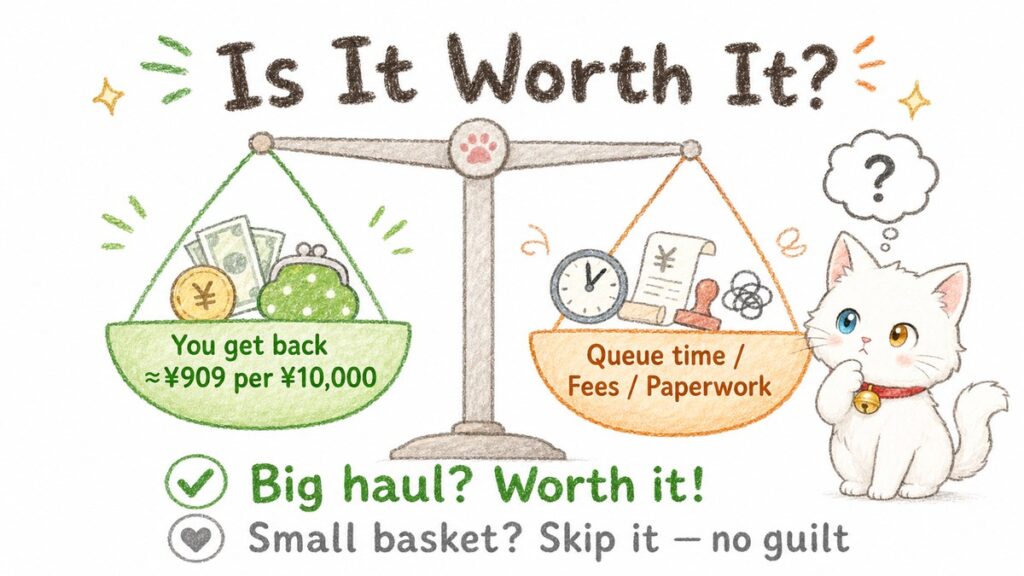
Here’s the question almost no guide asks: should you even bother? The honest answer is — not always. Tax-free shopping saves real money on big purchases, but it isn’t free. It costs time, a little planning, and sometimes a fee. So let’s do the math that most articles skip.
The 10% consumption tax sounds like a 10% discount, but on a tax-inclusive price tag the saving works out smaller. A ¥10,000 (≈$65) price tag with 10% tax inside contains about ¥909 of tax. If it’s food or snacks taxed at 8%, about ¥741. That’s your actual maximum saving — before any fees. Some department stores also deduct a handling fee at their tax-free counter, which shaves the refund a little further.
Now the other side of the scale. The tax-free counter can mean a real queue, especially at tourist-heavy stores in the evening — and for purchases from November 2026, there’s airport paperwork on top. Lining up for fifteen minutes to get ¥700 back while your kids melt down next to the register isn’t a discount. It’s a part-time job.
 So here’s my honest rule of thumb. Planning a big haul — a year’s worth of cosmetics (say, restocking the Japanese sunscreens I keep going back to), gifts for the whole family, electronics — then absolutely use it: on a ¥50,000 (≈$325) spend, roughly ¥4,500 (≈$29) comes back. Buying ¥6,000 (≈$39) of snacks when the counter has no line — an easy win, go ahead. But when the purchase is small, the line is long, or your schedule is tight, skip it without guilt. The souvenirs taste just as sweet at full price.
How Tax-Free Shopping Works at Different Stores
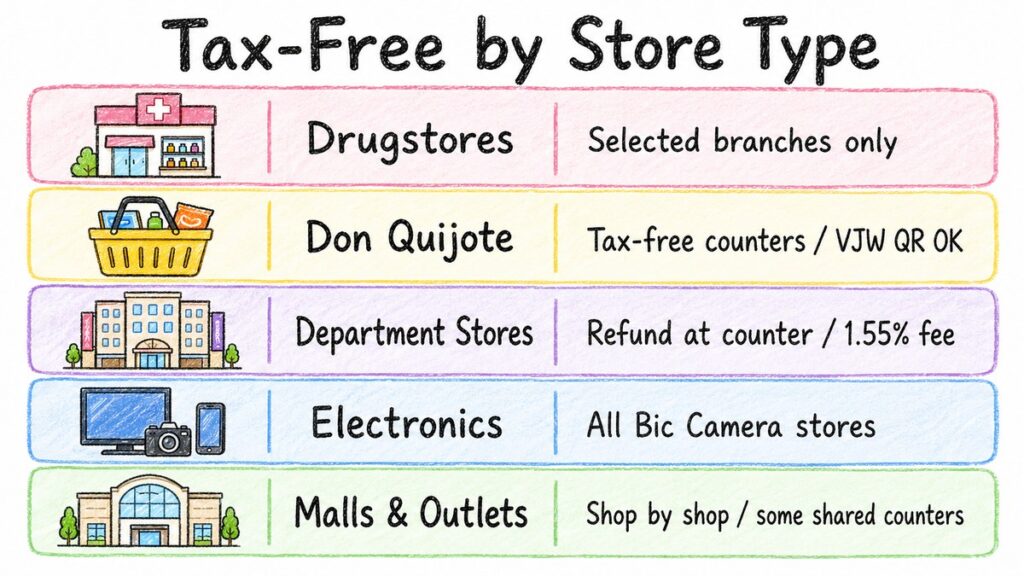
The national rules are the same everywhere, but what actually happens at the register varies more than you’d expect. Here’s the store-by-store picture under the current system.
Drugstores
 First surprise: tax-free service varies by branch. Matsumoto Kiyoshi, Welcia, Sugi, and other major chains offer it at selected locations, especially in cities and tourist areas, but you should not assume that every branch participates. Look for the “Tax-Free Shop” logo near the entrance or use the chain’s store locator before visiting. At participating branches, the paperwork happens at a dedicated register or counter — staff will point you to the right line.
Don Quijote
 Don Quijote is built with tax-free shoppers in mind: large branches have dedicated tax-free counters, and the chain officially supports the Visit Japan Web QR code to speed things up. The rules are the standard ones — same store, same day, original passport, no copies. Lines at busy tourist branches can get long late in the evening, so if you’re planning a big haul, earlier in the day is kinder to your feet.
Department Stores
Department stores do things differently from everyone else. You pay the regular tax-included price at each counter, then bring four things to the store’s tax-free counter the same day: your receipts, your passport, the goods themselves, and the credit card you paid with — in your own name. The counter refunds the tax, minus a service fee. At the major chains — Isetan Mitsukoshi, Takashimaya, and Daimaru — the service fee is 1.55% of the purchase price. This means your actual saving will be lower than the full consumption-tax amount shown on the receipt.
Two traps to know. The tax-free counter usually keeps shorter hours than the store itself, so don’t leave it for five minutes before closing. And if you entered Japan through an automated or face-recognition gate, check your passport: with no entry stamp inside, the counter can’t process your refund. Ask for a stamp at immigration before you leave the airport.
Electronics Stores
The big electronics chains are tourist-ready. Bic Camera offers tax-free shopping at all of its stores, handled at designated counters inside. Tax-free service is also available at many Yodobashi Camera locations, but check the individual store page before visiting. Electronics count as general goods under the current system, so your new camera can come out of the box the same day. Shelf prices include tax — the saving appears when they process your passport at checkout.
Shopping Malls and Outlets
At malls and outlets, the default is shop-by-shop: each boutique handles its own tax-free paperwork when you pay, and the ¥5,000 (≈$33) minimum applies per shop. Some complexes make life easier with a consolidated counter — Aeon Malls process their own supermarket floors at the service counter, and some buildings let you combine receipts from participating specialty shops in one stop. It varies by facility, so thirty seconds at the information desk can save you three separate queues.
One last reminder: everything above describes the current system. For purchases made from November 1, 2026, register discounts end, and each chain will announce its own refund flow. I’ll update this section as those details come out.
At the Airport: What to Do Before and After November 2026
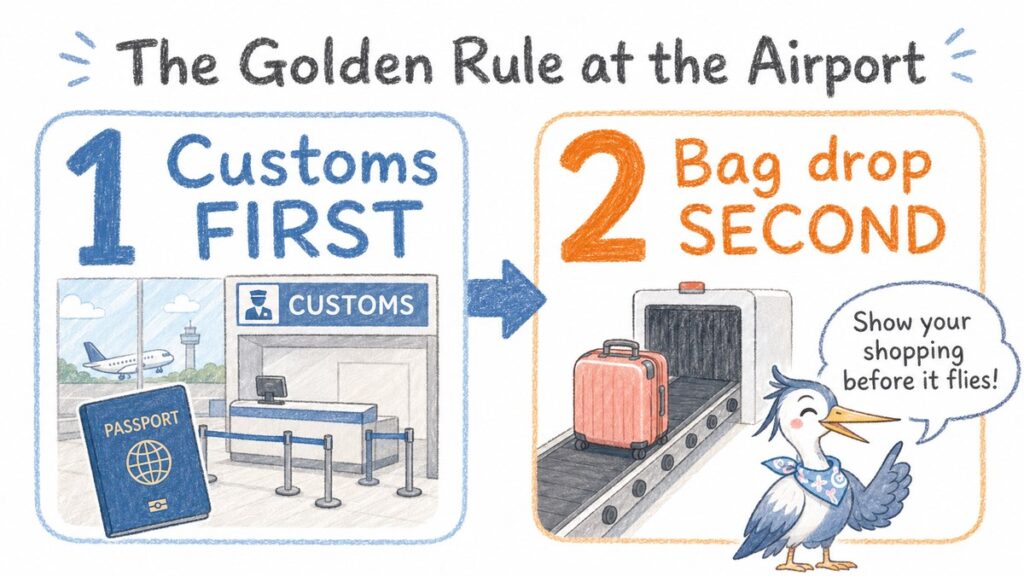
The airport is where tax-free either wraps up quietly or turns stressful. Which one you get depends on when you made your purchases — and on where you packed them.
If You Bought Tax-Free Items on or Before October 31, 2026
Under the current system, your saving is already complete because the tax was removed or refunded at the store. When departing Japan, you are still required to present your passport to customs. Customs may ask to inspect the tax-free goods, including sealed consumables. Keep the packages sealed, make sure every tax-free purchase leaves Japan with you, and keep checked-luggage items accessible until any required inspection is complete.
If You Buy Tax-Free Items on or After November 1, 2026
For purchases made on or after November 1, 2026, the airport becomes an essential part of the process. Before checking any baggage, go to a tax-free procedure terminal in the international departure lobby and scan your passport. A Green result means the customs confirmation is complete. A Red result means you need to bring your purchases to the designated customs inspection area and show them to an officer.
At Narita, Haneda, Kansai, Chubu, Fukuoka, New Chitose, and Naha airports, travelers may also be able to complete this step through Visit Japan Web while connected to the designated Wi-Fi in the international departure lobby. Whichever method you use, keep every tax-free item accessible until the procedure is complete.
As for the money: Japan has confirmed the customs procedure, but there is no single nationwide refund method. Depending on the store or its refund partner, the refund may go to a credit card, bank account, or app, or it may be paid in cash after customs confirmation. The exact timing, method, and any handling fee depend on the retailer, so check the refund terms when you make the purchase. And budget extra time, especially in the first months of the new system, while travelers and airport staff are all learning it together.
What If Tax-Free Items Are in Your Checked Luggage?
 Here’s the trap that catches families: customs needs to be able to see your purchases, and that has to happen before your suitcase disappears onto the conveyor belt. If your tax-free shopping is packed deep inside a bag you’re about to check, the order matters — go to customs first, complete the confirmation, then hand over the bag.
The family-friendly version: back at the hotel, pack every tax-free item into one packing cube or bag near the top of a single suitcase. At the airport, one parent handles the customs stop while the other manages the kids and the carry-ons. Ten minutes of packing strategy the night before saves thirty stressful minutes at the airport.
Kitchen knives are one of the most popular tax-free buys. Before you spend, here is how to tell whether a Japanese knife is actually made in Japan.
Common Tax-Free Shopping Mistakes
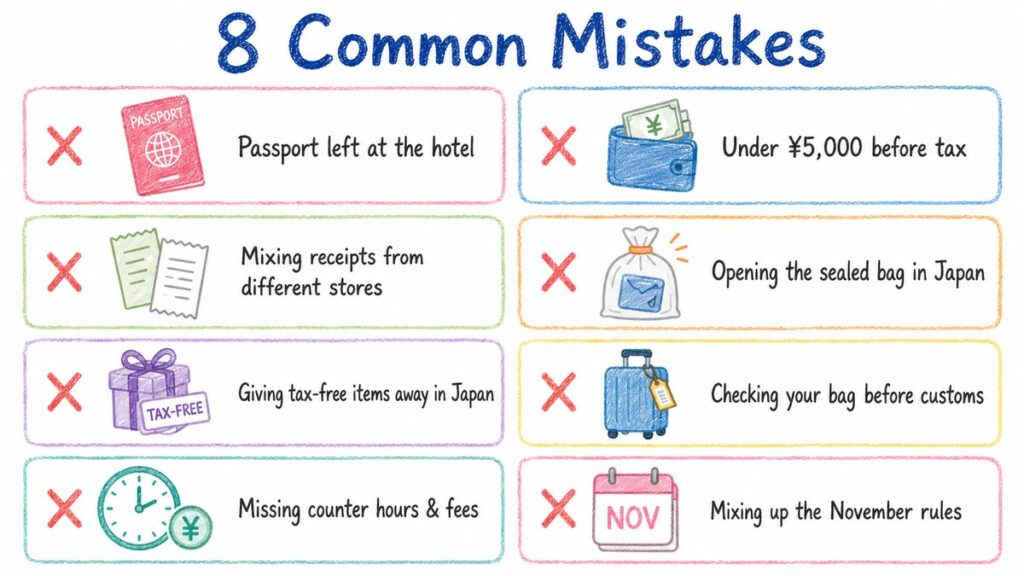
 Most tax-free troubles are the same handful, trip after trip. Here they are, each with its fix.
Leaving your passport at the hotel. No passport, no tax-free — and a photo won’t rescue you. On shopping days, the passport rides along.
Not reaching ¥5,000 (≈$33) before tax. Remember the real-world line is about ¥5,400 (≈$35)–5,500 including tax. If you’re close, add one more item — or consolidate your shopping at one store instead of three.
Trying to combine receipts from different stores. It only works at complexes with a shared tax-free counter. Ask at the information desk before you start shopping, not after.
Opening the sealed bag while still in Japan. Under the current system, that breaks the condition of the exemption — customs can charge you the tax at departure. Buy your “eat it tonight” snacks separately at the regular register.
Giving tax-free purchases away in Japan. Tax-free goods have to leave the country with you. A gift for a friend who lives in Japan should be bought at the regular register, tax included.
Checking your bag before the customs stop. The order is customs first, conveyor belt second. Once the suitcase is gone, so is your proof.
Not checking counter hours and fees. Department-store tax-free counters usually close earlier than the store, and a 1.55% service fee comes off the refund at the big chains. Neither is a dealbreaker — but both are better known in advance.
Mixing up the before-and-after-November rules. Older blog posts — and plenty of this year’s social media advice — may describe the wrong system for your dates. When something you read contradicts something else, check which side of November 1, 2026 it’s talking about — and remember the system follows the date of purchase, not your travel dates.
Quick Tax-Free Shopping Checklist
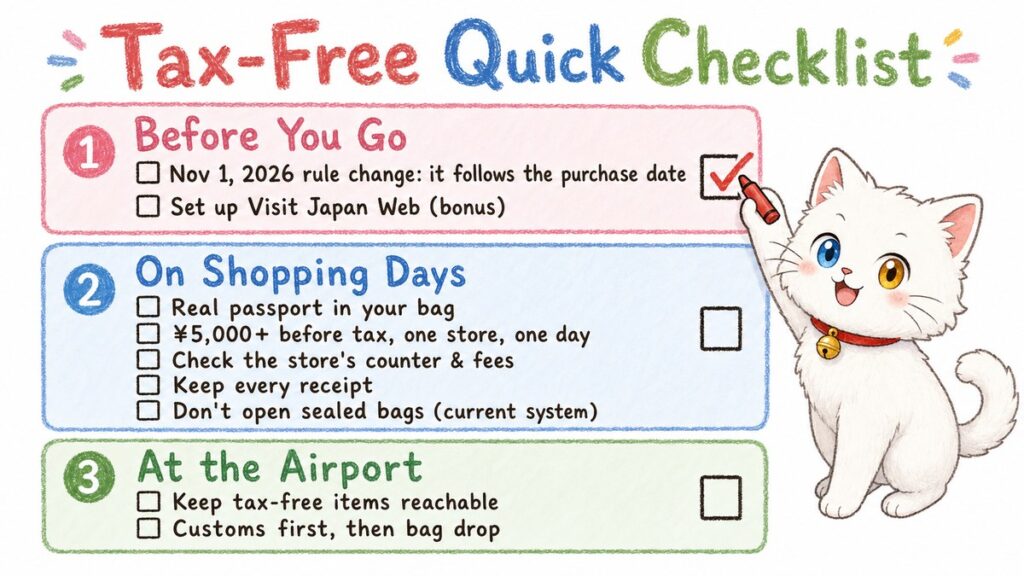
This is the part to screenshot.
Before you go
- Check when you will shop: purchases made on or before October 31 and purchases made on or after November 1, 2026 follow different systems
- If your trip spans November 1, keep track of which purchases were made under each system
- Set up Visit Japan Web if you haven’t (bonus, not required)
On shopping days
- Passport in your day bag — the real one
- Aim for ¥5,000 (≈$33) before tax at one store, one day (≈¥5,500 (≈$36) with tax)
- Check the store’s system: register or counter, fees, counter hours
- Keep every receipt
- Current system only: sealed bags stay sealed until you’ve left Japan
At the airport
- Tax-free items packed where you can reach them, not buried
- If they’re in a bag you plan to check: customs first, then bag drop
- Everything you bought tax-free flies home with you
FAQ: Japan Tax-Free Shopping

Can I use a photo or copy of my passport?
No — stores need the original. Some shops accept the Visit Japan Web tax-free QR code instead, but since you can’t predict which ones, carry the passport itself.
Can I combine receipts from different stores?
Not at regular stores. The exception is a mall or department store with a shared tax-free counter, where participating shops inside the same building can be combined.
Can I use tax-free cosmetics or food during my trip?
Under the current system, consumables are specially packaged and must remain unopened until you leave Japan. From November 1, 2026, the special packaging requirement disappears, but you still cannot eat or use up goods in Japan and receive a refund for them. Every item included in the tax-free purchase record must be available for customs confirmation and leave Japan with you.
Do I get my refund at the airport?
Before November 2026, there is normally nothing to collect at the airport because the tax saving was handled at the store. For purchases made on or after November 1, customs confirms that the goods are leaving Japan. The refund is then provided by the store or its refund partner. It may be paid at the airport after confirmation or returned later by credit card, bank transfer, or an app, depending on the retailer.
Can I put tax-free items in checked luggage?
Yes, but for purchases made on or after November 1, 2026, you must complete the customs confirmation before handing the bag to the airline. Keep the items accessible until the procedure is complete. Customs first, bag drop second.
Does tax-free mean everything is 10% cheaper?
Not quite. On a tax-included price tag, the tax inside is about 9.1% (or 7.4% for items taxed at 8%), and department stores deduct a 1.55% service fee on top. Real savings, but smaller than the “10%” headline.
What exactly changes in November 2026?
One sentence: for purchases made on or after November 1, 2026, the instant discount at the register is replaced by a refund paid after customs confirms your departure. The full details are in the What Changes on November 1, 2026? section above.
Final Thoughts
Tax-free shopping in Japan is a genuinely nice perk — once you know the rules, it’s ten quiet minutes of paperwork in exchange for real savings on a big haul. The key is matching your knowledge to your purchase dates. For purchases through October 31, 2026: save at the register and guard that sealed bag. For purchases from November 1: pay in full, complete the customs step at the airport, and check the store’s refund terms when you buy.
And if your shopping stays small, you have my full permission to skip the whole thing. The point of your trip is the trip — not the receipts.
Planning the rest of your trip? My guides to Japan’s 2026 travel changes and choosing between Suica and Pasmo cover the other money questions travelers ask most.
Planning to buy an appliance while you’re here? Check the voltage first — Japanese models are built for 100V. I explain what to buy instead in my honest guide to Japanese rice cookers.
Now I’m curious about your side of the world — does your country offer tax refunds to visiting tourists, and is the paperwork simpler or messier than Japan’s? I’d love to hear about your experience in the comments below.
I hope this guide has answered one of your questions and helped you feel a little closer to Japan. May your Japan journey be filled with wonderful discoveries and memories you’ll treasure for years to come.
See you in the next guide.


Comments