
- The 30-Second Answer: Which Store to Pick First
- Itoya vs Loft vs Hands: What Each Is For
- Pick a Store by What You Want to Buy
- Tokyo Stationery Stores: Ginza, Shibuya & More
- Osaka: Where to Buy Stationery (Umeda & Namba)
- Kyoto: Where to Buy Stationery
- Looking for Hobonichi or a Traveler’s Notebook?
- Tax-Free Stationery: What Changes in Nov 2026
- How a Japanese Mom Buys Stationery
- Getting It Home: Ink, Bags & Forwarding
- Buy in Japan, or Reorder on Amazon Later?
- FAQ
The 30-Second Answer: Which Store to Pick First
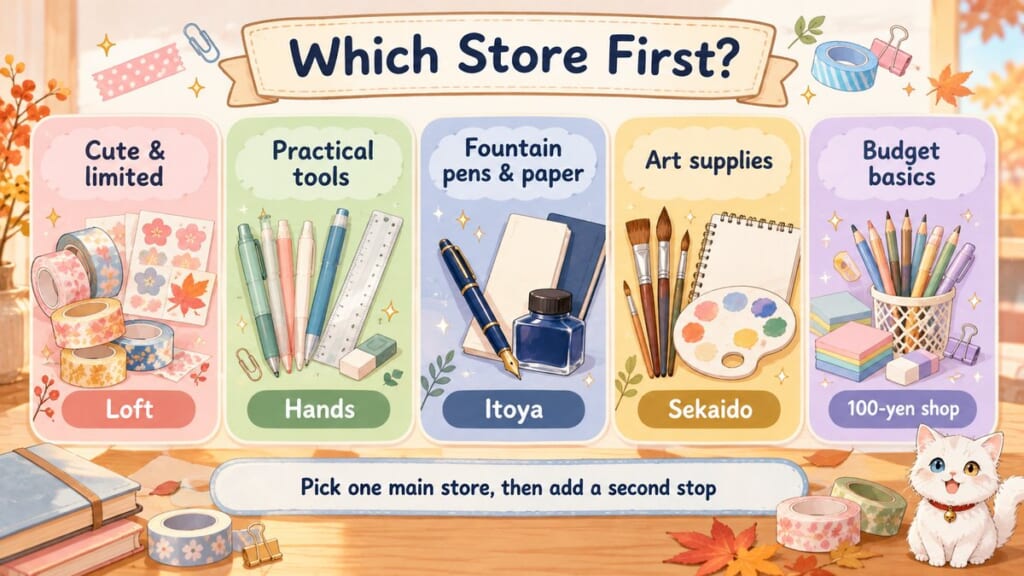
You have a few hours for stationery shopping, but your saved map already has more shops than you can visit. Start with Loft for a first visit, Hands (formerly Tokyu Hands) for writing feel and practical tools, or Ginza Itoya for fountain pens, ink, and writing paper.
 If I were taking an overseas friend to just one store, Loft would be my first choice for cute stationery, limited items, and souvenir browsing. For a friend who loves comparing pens and precise tools, I also recommend Hands.
| Your priority | Pick this store | Why it fits |
|---|---|---|
| Everyday stationery, cute designs, limited items | Loft | An easy starting point for stationery and small gifts. |
| Practical tools and household goods too | Hands | Writing supplies alongside useful tools for daily life. |
| Fountain pens, ink, letters, and paper | Ginza Itoya, G.Itoya | Dedicated departments help you browse by interest. |
| Art supplies | Sekaido, Shinjuku | A specialist destination for drawing and painting supplies. |
| Budget basics, bulk purchases, wrapping | Shimojima, Asakusabashi; 100-yen shops | Packaging supplies or small everyday essentials. |
| Simple stationery | Muji | Straightforward designs for everyday use. |
| A particular planner or Traveler’s Notebook | The brand’s own shops; see below | Start with the exact range you want. |
 Choose your main store before adding a second stop. With one to three hours, leaving time to compare a few favorites is more enjoyable than rushing through every saved shop.
For a one-hour visit, keep your list to the things you most want to choose in person. With more time, add a specialist only when it offers something different from your first stop.
Itoya vs Loft vs Hands: What Each Is For
The difference is what you want to spend your time choosing. Itoya puts specialist stationery departments at the center; Loft and Hands include stationery within a wider selection of everyday goods.
| Store | What kind of store? | Main strengths | Choose it when… |
|---|---|---|---|
| Itoya | Stationery specialist; G.Itoya has 12 floors with different themes | Fountain pens, ink, paper, correspondence | You want to concentrate on stationery departments. |
| Loft | Lifestyle store with stationery | Cute designs, planners, limited items, small gifts | You want an enjoyable first browse and souvenirs. |
| Hands | Lifestyle store with DIY, tools, and stationery | Practical writing supplies, precision tools, household goods | You care about how a pen or tool works. |
 I’ve visited both Loft and Hands, and I think the enjoyment is slightly different. Loft is my choice for discovering a cute sticker or small souvenir; Hands suits the person interested in writing feel, drafting tools, and useful things for home.
For a mixed shopping list, start with the item you care about most. A notebook cover you love and a ruler with the markings you need are different reasons to choose a store.
Pick a Store by What You Want to Buy
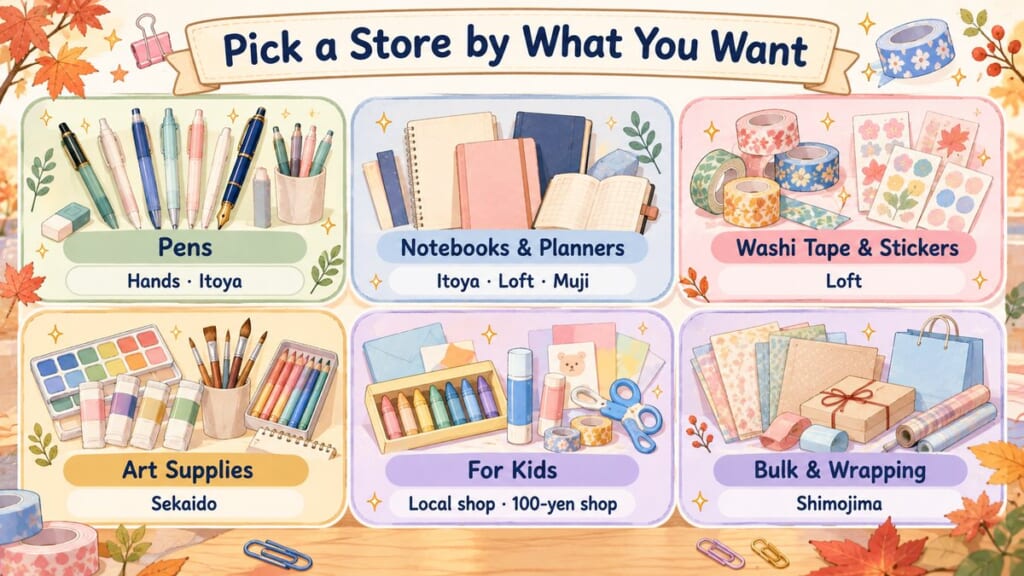
- Pens: Hands is my pick for comparing practical writing tools. At Ginza Itoya, head to 3F for fountain pens and ink, or 5F for everyday writing instruments and notebooks.
- Notebooks and planners: At Itoya, browse planners and organizers on 4F and everyday notebooks on 5F. Loft suits a broader browse, while Muji fits a preference for simple designs. For a particular Hobonichi or Traveler’s Notebook, use the brand-specific table below.
- Washi tape and stickers: Start at Loft if decorating a journal is your priority. For paper projects beyond your planner, Itoya’s 8F has Japanese paper, origami, and wrapping materials, while 2F has writing paper, envelopes, and cards.
- Art supplies: Sekaido’s Shinjuku flagship is the specialist choice for a shopping list built around drawing or painting. If your day is already in Ginza, Itoya’s 7F brings together paints, colored pencils, art supplies, and paper.
- Children: Everyday school supplies are a reason to browse a local stationery shop or 100-yen shop. K.Itoya, the separate building behind G.Itoya, has a children’s department on 2F; letting your child choose one useful thing can give the visit a clear purpose. my guide to Japan with kids
- Budget and bulk: Shimojima’s Asakusabashi flagship suits wrapping supplies and a longer shopping list, while 100-yen shops are a starting point for small basics. Check the pack quantity against what you’ll actually use before filling your basket.
Tokyo Stationery Stores: Ginza, Shibuya & More
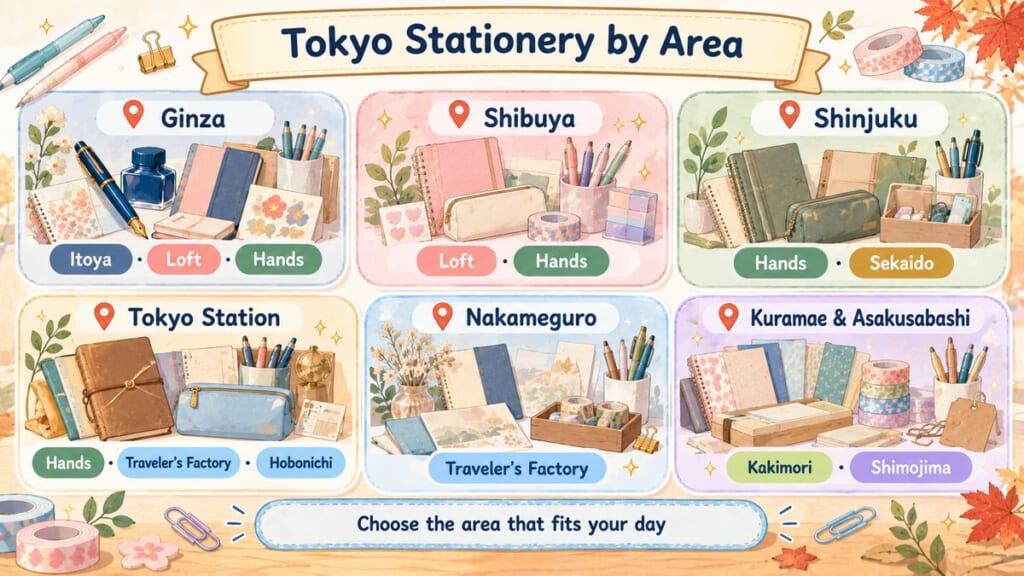
Pick the neighborhood that already fits your day. Ginza gives you Itoya, Loft, and Hands; Shibuya works for Loft plus Hands at Shibuya Scramble Square; Shinjuku pairs practical stationery with Sekaido’s art supplies.
Hours as of October 2026. Check the store’s own page before setting out, especially around holidays.
| Store | Nearest station and walk | Hours | Useful detail |
|---|---|---|---|
| Ginza Itoya, G.Itoya | Ginza A13: about 3 min; Ginza-itchome: about 1 min | Mon–Sat 10:00–20:00; Sun/holidays 10:00–19:00 | Choose your department before exploring. |
| Ginza Loft | Ginza-itchome: about 1 min; Ginza: about 3 min; Yurakucho: about 4 min | Mon–Sat/holidays 11:00–21:00; Sun 11:00–20:00 | Tax-free counter on 3F. |
| Shibuya Loft | Shibuya Metro A3: about 5 min; JR Hachiko Exit: about 10 min | 11:00–21:00 | A first stop for cute stationery. |
| Hands Shibuya Scramble Square | Shibuya Station; Scramble Square 10F | 10:00–21:00 | The Scramble Square branch. |
| Hands Shinjuku | JR Shinjuku New South Exit: about 2 min; Shinjuku-sanchome: about 3 min | 10:00–21:00 | Takashimaya Times Square 2–8F; tax-free counter 5F. |
| Hands Ginza | JR Yurakucho: about 3 min | 11:00–21:00 | Marronnier Gate Ginza 1, 5–9F. |
| Hands Tokyo | Direct access from Tokyo Station | 10:00–20:00 | Daimaru Tokyo, 8–10F. |
| Sekaido Shinjuku flagship | Shinjuku-sanchome C4: about 1 min; JR Shinjuku: about 7 min | 9:30–20:00; New Year closures | Focus on drawing and painting supplies. |
| Traveler’s Factory Nakameguro | Nakameguro: about 3 min | 12:00–20:00; closed Tue, except holidays | A dedicated Traveler’s Notebook stop. |
| Traveler’s Factory Station | Tokyo Station B1, just outside Marunouchi Underground North Gate | 10:00–21:00 | Outside the ticket gates. |
| Kakimori, Kuramae | Walk from Kuramae Station | 11:00–18:00; closed Mon, including holidays | A separate stop for writing supplies. |
| Shimojima Asakusabashi flagship | Asakusabashi: about 1–2 min | Mon–Sat 9:30–19:00; Sun/holidays 10:00–17:30; irregular closures | Wrapping and bulk-shopping stop. |
| TOBICHI Tokyo | Jimbocho A9: about 5 min | 11:00–19:00; irregular closures | Hobonichi’s own shop; tax-free service. |
| Hobonichi Techo Store, Tokyo Station | Gransta Tokyo B1, inside the ticket gates | Check the store page | Opened September 16, 2026. |
 The Udagawacho Hands Shibuya store closes on November 15, 2026; Hands Shibuya Scramble Square remains a separate shopping option.
For a short visit, choose Ginza or Shibuya for variety, Shinjuku for art supplies, or a dedicated stop in Nakameguro or Kuramae for a specific interest. If you’re still choosing a hotel base, my Shinjuku vs Shibuya vs Tokyo Station guide helps connect shopping with the rest of your trip.
Osaka: Where to Buy Stationery (Umeda & Namba)

Umeda Loft is the easy choice around Umeda: Hanshin Umeda Main Store, 6F, about one minute from Umeda Station, open 10:00–20:00. Namba Loft, on 5F of Namba Parks right by Nankai Namba Station, keeps 11:00–21:00 hours.
For the practical-tools side of your list, Hands Shinsaibashi is open 10:00–20:00 on 9–11F of Shinsaibashi PARCO, directly connected to Shinsaibashi Station. I’ve also visited Loft and Hands in Osaka, so you can make the same purpose-based choice here.
Fountain-pen shoppers can consider Ikeman Semba, directly connected to Sakaisuji-Hommachi Station’s Exit 9. Its official information advertises tax-free shopping and same-day pen engraving; ask about the pen and lettering you want. Check its hours before you go.
Kyoto: Where to Buy Stationery
For Kyoto, choose between a broad stationery browse and Japanese paper goods. Kyoto Loft occupies 4–6F of Mina Kyoto at Kawaramachi Sanjo, about five minutes from Kyoto Shiyakusho-mae or Keihan Sanjo Station, and opens 11:00–21:00.
Kyukyodo’s Kyoto flagship on Teramachi, north of Anekoji, suits writing paper, postcards, washi, and incense. It opens 10:00–18:00 and closes January 1–4; start here if paper for letters is the souvenir you want to take home.
For your travel journal, Traveler’s Factory Kyoto is on 1F of Shinpuhkan, directly connected to Karasuma Oike Station, open 11:00–20:00. Pick the stop that matches your list, leaving the rest of the day for Kyoto itself.
Looking for Hobonichi or a Traveler’s Notebook?
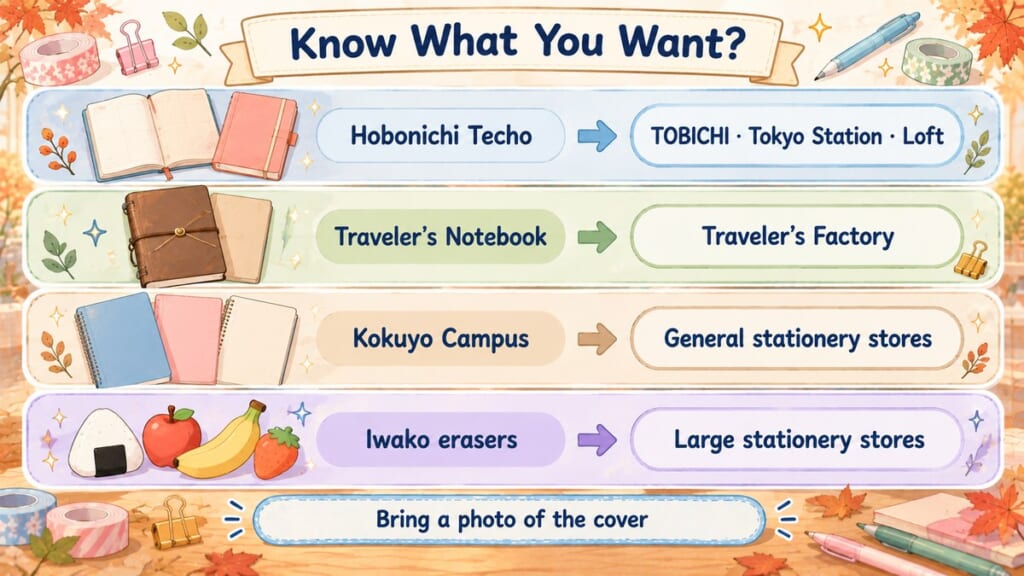
If you already know the item, start with its brand and model name. A picture of the cover or packaging helps you ask for the right size, ruling, or edition.
| What you’re looking for | Where to start | What to know |
|---|---|---|
| Hobonichi Techo | TOBICHI Tokyo; Hobonichi Techo Store, Tokyo Station; Loft and official stockists | Tokyo Station’s shop is inside the ticket gates; use Hobonichi’s stockist list for other options. |
| Traveler’s Notebook | Traveler’s Factory: Nakameguro, Tokyo Station, Kyoto, Narita Airport; official stockists | Ask the relevant branch about location-specific items. |
| Kokuyo Campus | General stationery departments | A familiar everyday notebook range; match the size and ruling. |
| Iwako erasers | Large stationery and variety stores; stock varies by branch | Ask for Iwako by name, and check the shape series you want. |
 Traveler’s Factory is a useful destination for location-specific editions. Check the individual product’s sales locations before making a special journey.
Tax-Free Stationery: What Changes in Nov 2026
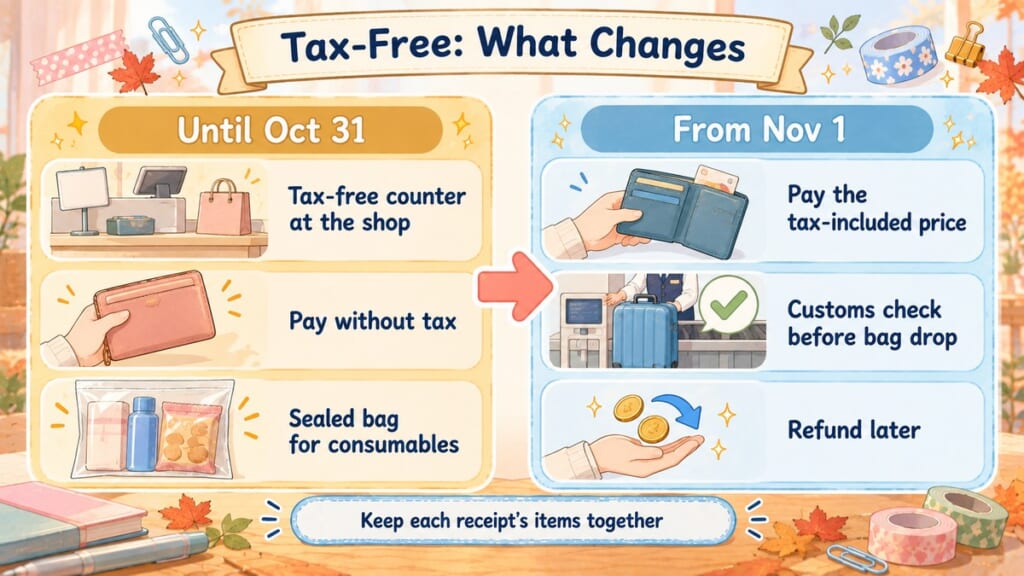
Your purchase date decides which system applies. For an eligible visitor shopping at a participating store, the starting threshold is ¥5,000 (about $32) before tax at the same store on the same day; dollar estimates use a fixed USD 1 = JPY 155 conversion as of October 2026.
Through October 31, 2026
Complete the shop’s tax-free procedure that day. Hands expresses the threshold in its published example as ¥5,500 (about $35) including tax; consumables use sealed, tamper-evident packaging that you keep closed in Japan.
Loft lists a 1.55% processing fee under this system. Bring your original passport, purchases, receipts, and, if you paid by card, the card matching your passport name to its counter that day.
From November 1, 2026
Pay the tax-inclusive price, then complete customs confirmation at the departure airport or port within 90 days of purchase. Use the passport terminal before checking in your bags; the shop or its refund provider refunds the tax afterward.
Have every tax-free item from each receipt with you. One missing item makes that entire receipt ineligible for a refund; keeping purchases grouped by receipt makes the departure check easier.
Special sealed packaging ends, but food or cosmetics consumed in Japan remain ineligible for a refund. Ask the store about its refund method and fees, and use my Japan tax-free shopping guide for the full departure procedure.
For Itoya, ask the store whether tax-free service is available for your purchase. If the refund affects your buying decision, settle that question before paying.
How a Japanese Mom Buys Stationery
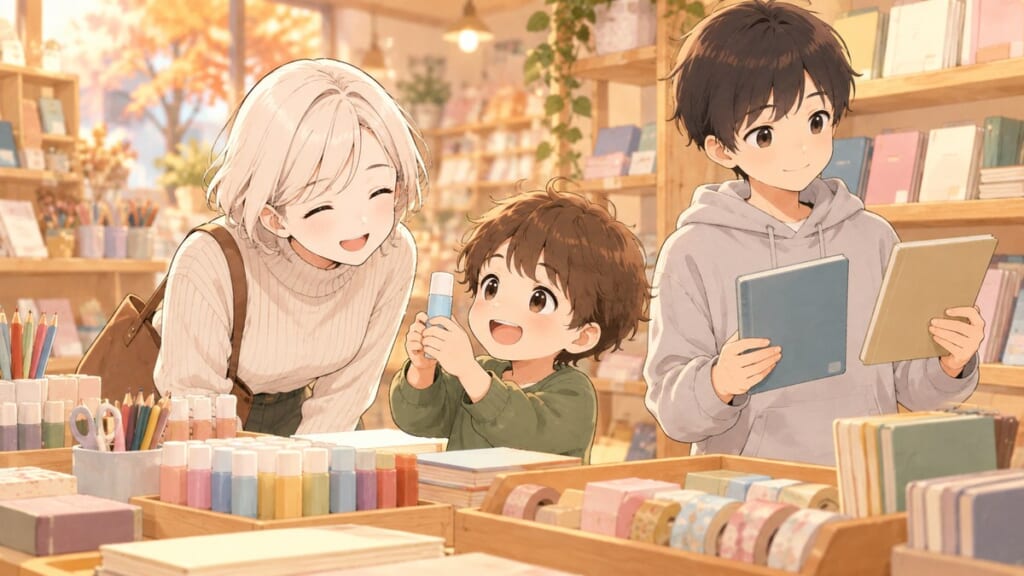
For everyday pens, notebooks, glue, and washi tape, I shop at supermarket and drugstore stationery sections, nearby stationery shops, and online, including Amazon. For my children’s school supplies and the start of a new school term, I use local stationery shops, supermarkets, and 100-yen shops.
That gives these shops a different role in your trip. Loft, Hands, and Itoya are destinations for browsing and choosing something you like; a neighborhood shop or supermarket helps you pick up the familiar thing you need.
Why does this work in Japan? Stationery is part of daily life, which helps explain the shelves in supermarkets and drugstores. If you forget a basic pen or notebook, a supermarket or convenience store near your hotel is often a useful place to look.
Getting It Home: Ink, Bags & Forwarding
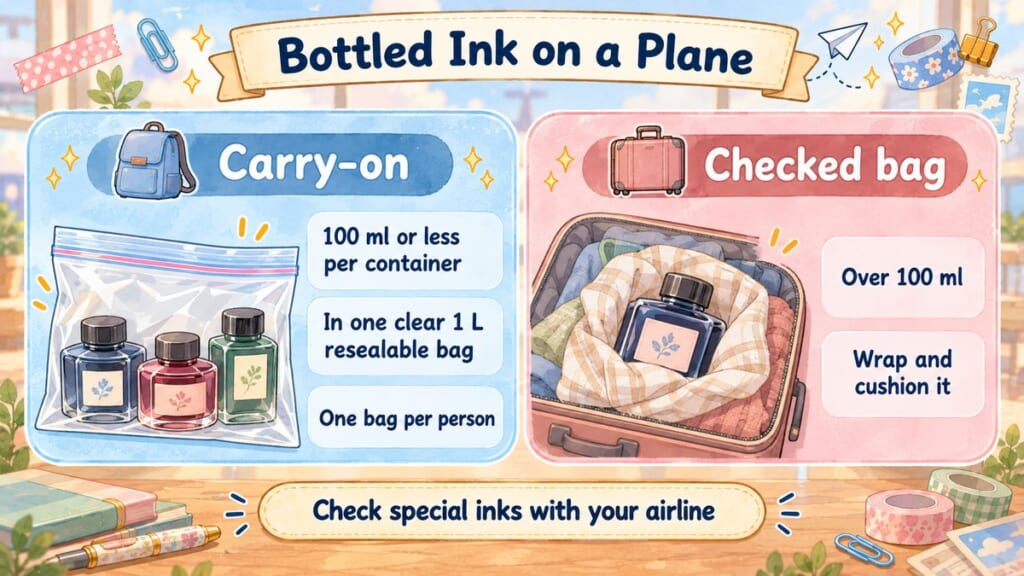
Plan for bottled ink under the international-flight liquid rules. For cabin baggage, containers must hold 100 ml or less, all fitting inside one transparent, resealable bag of no more than 1 liter per person.
 A larger container belongs in checked baggage under the liquid-volume rules, even when partly empty. Check your particular ink with the airline if its ingredients raise a dangerous-goods question; these volume limits alone don’t establish whether an ink can fly. Bag bottles and cushion them with clothing when packing them in your suitcase.
Notebooks and paper add weight, so choose your extra carrying space before your last shopping day. A foldable bag from my Japan travel accessories guide can help organize the overflow; my luggage forwarding guide explains sending luggage ahead within Japan. Keep tax-free purchases accessible for the airport check described above.
Buy in Japan, or Reorder on Amazon Later?
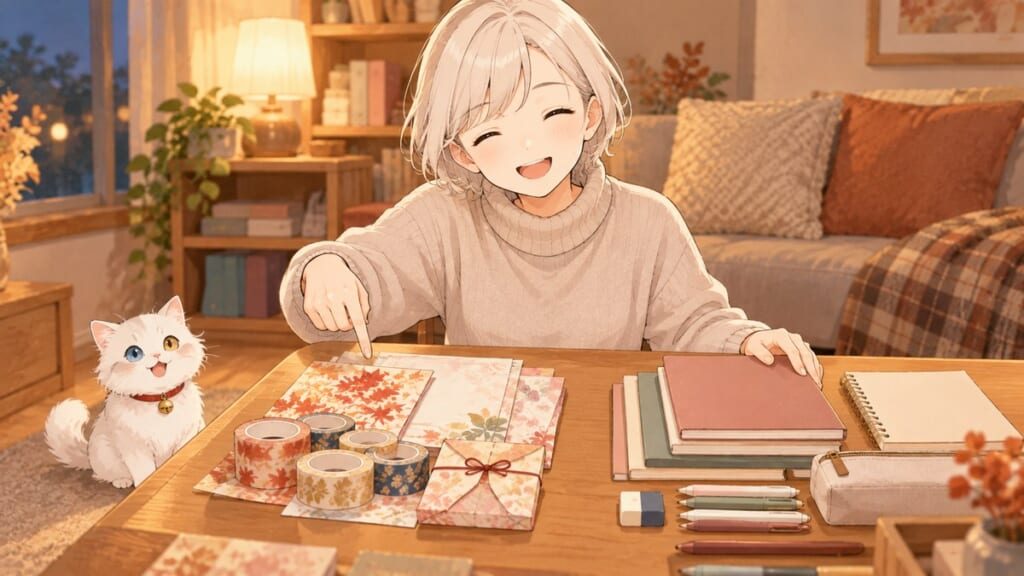
Use three questions before buying: can you get the same item at home, is it exclusive to Japan or this store, and how much space or weight will it add? Five things worth considering for your suitcase are store-exclusive pens, limited washi tape, unusual ink colors, distinctive writing paper, and notebooks unavailable at home.
For everyday writing, these five Japanese-brand options give you a starting point for reordering on Amazon.com. Match the model, tip size, and paper format to the item you enjoyed in Japan, then check delivery to your country.
As an Amazon Associate, I earn from qualifying purchases.
uni-ball Jetstream 0.7 mm black pens, 12-pack give you a supply of black pens for your travel diary and the everyday notes that follow it.


uni-ball Jetstream 0.7 mm Black, 12-pack
Smooth black ballpoint pens for a travel diary and everyday notes. Outside the US, the Amazon Japan button links to the Japanese 10-pack of Jetstream 0.7 mm black.
Prices change often — please check the latest price on each store.
Zebra Sarasa Clip 0.5 mm black pens, 12-pack suit a planner or notebook where you want to keep using the same tip size and ink color.


Zebra Sarasa Clip 0.5 mm Black, 12-pack
Gel pens for keeping the same tip size and ink color in a planner. Outside the US, the Amazon Japan button links to the Japanese Sarasa Clip 0.5 mm black, 8-pack.
Prices change often — please check the latest price on each store.
Pilot Juice 0.5 mm pens, 12-color set let you assign different colors to trip notes, appointments, or journal headings.


Pilot Juice 0.5 mm, 12-color set
Gel pens in 12 colors for trip notes, appointments, and journal headings.
Prices change often — please check the latest price on each store.
Kokuyo Campus B5 notebooks, five-pack with 6 mm ruling provide lined pages for language study or planning your next visit.
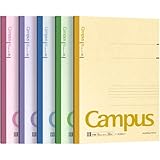
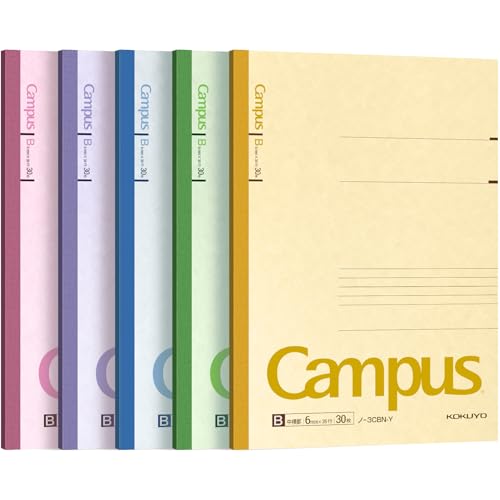
Kokuyo Campus B5 Notebooks, 5-pack
Lined notebooks with 6 mm ruling for study or planning. Outside the US, the Amazon Japan button links to the Japanese 5-pack of dot-lined Campus B5 notebooks.
Prices change often — please check the latest price on each store.
Midori MD Notebook A5, blank gives you unruled pages for combining handwritten memories with sketches.
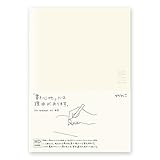

Midori MD Notebook A5, Blank
Unruled pages for handwritten memories and sketches. Outside the US, the Amazon Japan button links to the MD Notebook A5 blank.
Prices change often — please check the latest price on each store.
FAQ
Where is the best place to buy stationery in Japan?
Loft is my first recommendation for a broad introduction to stationery and small souvenirs. Choose Hands for practical tools, or Ginza Itoya for fountain pens, ink, and paper departments.
What is the biggest stationery store in Japan?
Ginza Itoya’s G.Itoya is a 12-floor building with themed floors, making it a substantial destination for stationery browsing. For planning your visit, choose the departments you want to see rather than relying on a size ranking.
Where can I buy cheap stationery in Japan?
Start with 100-yen shops for budget basics and Shimojima in Asakusabashi for wrapping supplies and bulk shopping. Compare pack quantities and choose what you need for home.
Does Osaka have a good stationery shop?
Yes: Umeda Loft and Namba Loft suit a first browse, while Hands Shinsaibashi fits practical stationery and household goods. Ikeman Semba is another option for fountain-pen shoppers.
Where to buy stationery in Kyoto?
Choose Kyoto Loft for variety, Kyukyodo’s Kyoto flagship for Japanese paper and correspondence, or Traveler’s Factory Kyoto for your travel journal. Their locations fit different parts of a central Kyoto day.
For one first stop, choose Loft; use luggage forwarding within Japan if your bags become awkward, and reorder everyday favorites on Amazon after returning home. Fit that shopping stop into my 10-day Japan itinerary on a budget or my 7-step guide to planning your first trip to Japan.
Tell me in the comments which stationery item you’re hoping to find in Japan. A pen, a notebook, or something for your journal?
I hope this guide has answered one of your questions and helped you feel a little closer to Japan.
May your Japan journey be filled with wonderful discoveries and memories you’ll treasure for years to come.
See you in the next guide.


Comments