Your suitcase is heavy, your child is tired, and “Osaka” on your hotel booking doesn’t tell you which airport train to take. For Kansai Airport to Osaka, start with your hotel’s neighborhood, then decide how much luggage you want to handle yourself.

- Quick Answer: Pick by Where You’re Staying
- Your 5 Options Out of KIX at a Glance
- Going to Namba, Dotonbori or Shinsaibashi
- Going to Umeda or Osaka Station
- Going to Kyoto
- Going to Nara
- Why Local Families Don’t Choose by Speed
- Limousine Bus Luggage: How Many Bags, and How the Tag System Works
- The Family-of-4 Math: Per-Person Fares vs One Flat Price
- Landing Late or Flying Out Early
- Tickets Made Simple: ICOCA (Not Suica), Haruka Discount, Rapi:t Machines
- Don’t Want to Carry Bags at All? Send Them Ahead
- FAQ
- YUU’s Final Thoughts
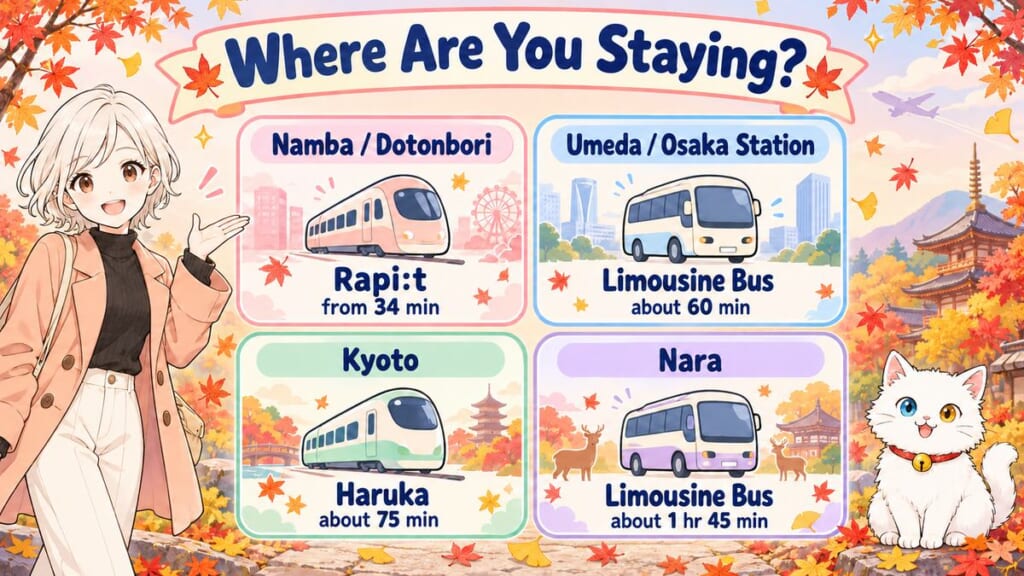
Quick Answer: Pick by Where You’re Staying
| Where you’re staying | Easiest starting choice | Adult one-way estimate | Travel time | Transfers |
|---|---|---|---|---|
| Namba / Dotonbori | Rapi:t | About ¥1,670 (about $11) | From 34 min | None — direct to Nankai Namba |
| Umeda / Osaka Station | Limousine Bus, if its stop suits your hotel | ¥1,800 (about $12) | About 60 min; varies by stop | None — direct to your bus stop |
| Kyoto | Haruka | ¥2,200 (about $14), eligible visitor ticket | About 75 min | None — direct to Kyoto Station |
| Nara | Limousine Bus to JR Nara | ¥2,400 (about $15) | About 1 hr 45 min | None — direct to JR Nara |
 Families with lots of luggage: jump to “The Family-of-4 Math” below before booking.
Disclosure: This article contains affiliate links. If you buy through one, I may earn a small commission at no extra cost to you.
In a hurry? Here are the booking links from this guide:
- Haruka discount ticket — for eligible foreign-passport visitors, to Osaka or Kyoto (Klook)
- Rapi:t ticket — reserved seats to Nankai Namba (Klook)
- Limousine Bus voucher — Osaka, Kyoto, Nara and more (Klook)
- Private car from KIX — a quote for your hotel address and luggage (Klook)
- Near the airport: Hotel Nikko Kansai Airport / Kansai Airport Washington Hotel (Agoda)
Prices and timetables change, so check the booking page before you buy.
Still choosing where to stay in Kansai? See Tokyo and Kyoto hotels with a spa and autumn ryokan with garden views in Kansai.
Prices and service information are September 2026 planning estimates and may change; check official fares and timetables before departure. Dollar amounts use a fixed September 2026 conversion of US$1 = ¥155, rounded for convenience.
Times cover the main airport ride, not immigration, baggage collection, waiting, or the final trip to your hotel. A direct ride to a station still leaves that last part to arrange, so check the hotel’s actual entrance on a map.
Your 5 Options Out of KIX at a Glance
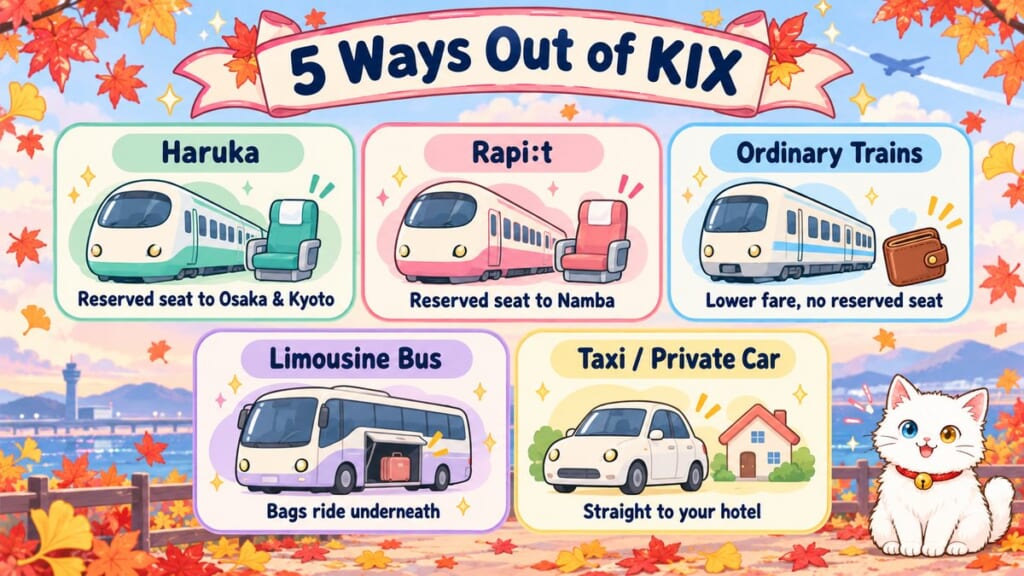
Haruka is JR’s airport limited express serving Osaka and Kyoto. It suits you if a reserved train seat and a station near your hotel matter more than the lowest fare.
Rapi:t is Nankai’s all-reserved-seat airport train to Namba. Choose it for a straightforward Namba arrival with a seat assigned in advance.
Ordinary trains include the Nankai Airport Express and JR Kansai Airport Rapid. They suit travelers who can manage their bags and prefer to avoid a limited-express supplement; seats aren’t reserved.
Limousine Bus means an airport coach, with suitcases carried in the luggage compartment below. It suits you when the arrival stop is convenient and putting the bags down matters more than avoiding road traffic.
A taxi or private transfer can take you to your hotel’s address. It suits a family wanting fewer luggage handoffs, provided the booked vehicle fits everyone and every bag.
Before comparing prices, remove any option that leaves an awkward final journey. A cheap ticket to the wrong side of a large station isn’t necessarily the easiest arrival with children.
Going to Namba, Dotonbori or Shinsaibashi
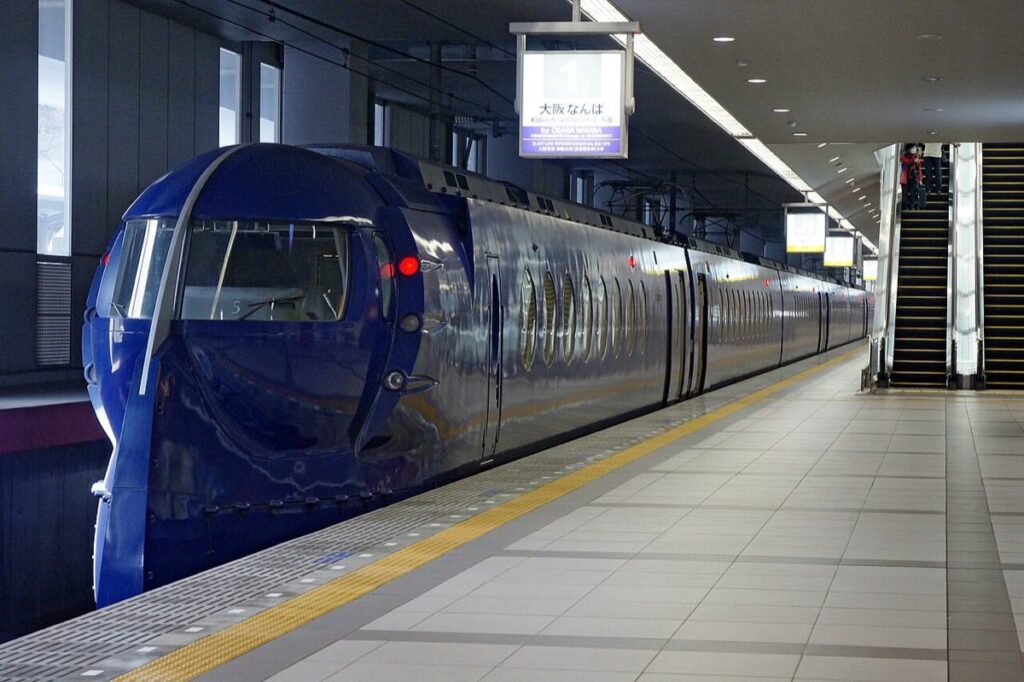
Choose Rapi:t if you want reserved seats to Nankai Namba; choose the Airport Express if price matters more. Both serve Namba, but neither takes you directly to every Dotonbori or Shinsaibashi hotel.
The Airport Express takes about 45 minutes and costs about ¥970 (about $6), with no limited-express supplement. Rapi:t’s regular-seat supplement is ¥700 (about $5), giving an estimated standard total of ¥1,670 (about $11); the practical upgrade is knowing which seat is yours.
Rapi:t can take as little as 34 minutes, but that isn’t every departure’s journey time. It runs roughly every 30 minutes, so compare the next departure as well as the time on the train.
A few years ago, I took a regular seat because my child wanted to ride Rapi:t, and the carriage was almost empty and quiet. I loved its round windows and color.
For the Airport Express, a seat isn’t guaranteed, and you’ll need to manage your bags throughout the ride. If standing while watching a child would be difficult, the reserved-seat option deserves more weight than a small difference in arrival time.
The Limousine Bus to OCAT is another choice: ¥1,400 (about $9), taking about 50 minutes. Check OCAT against your hotel rather than treating all “Namba” arrival points as the same place.
My separate guide, Kansai Airport to Namba: Is the Rapi:t Worth It?, covers the train in more detail. Here, the decision is simply reserved seat, lower fare, or a more convenient bus stop.
Going to Umeda or Osaka Station
For Umeda, compare the Limousine Bus stop with your hotel’s entrance first. A convenient stop can save you from moving large cases through the station area after the main journey.
The bus costs ¥1,800 (about $12) and takes about an hour to some Osaka Station-area stops, with extra time depending on the stop and traffic. Check the stops served by your particular departure before buying.
The JR Kansai Airport Rapid is the lower-cost rail option in this guide, at about ¥1,180 (about $8) and about 70 minutes. Some services run via Tennoji to Osaka Station without a change; check your departure, and remember that ordinary seating isn’t reserved.
Haruka is worth considering when you want a reserved train seat instead. The eligible visitor ticket to Osaka costs ¥1,800 (about $12), so the bus and this discounted train ticket start at the same adult fare.
That makes your hotel location the useful tie-breaker. Choose the bus for a helpful stop and less bag handling during the ride, or Haruka when the rail arrival works better; choose the rapid if you can comfortably manage your luggage and want to spend less.
Going to Kyoto
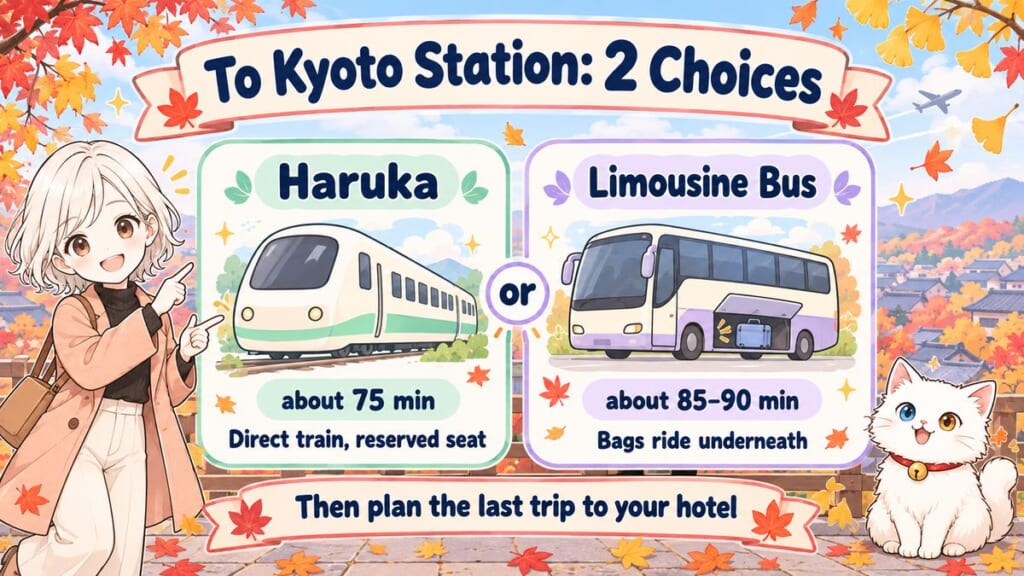
Choose Haruka for a direct train to Kyoto Station: about 75 minutes, with an eligible visitor ticket at ¥2,200 (about $14). For booking details, see Kansai Airport to Kyoto: Is the Haruka Express Worth It?.
The Limousine Bus reaches Kyoto Station’s Hachijo side in about 85–90 minutes for ¥2,800 (about $18). It is an alternative if handing over your suitcases makes the journey easier; either way, plan the final trip from Kyoto Station to your hotel.
Going to Nara
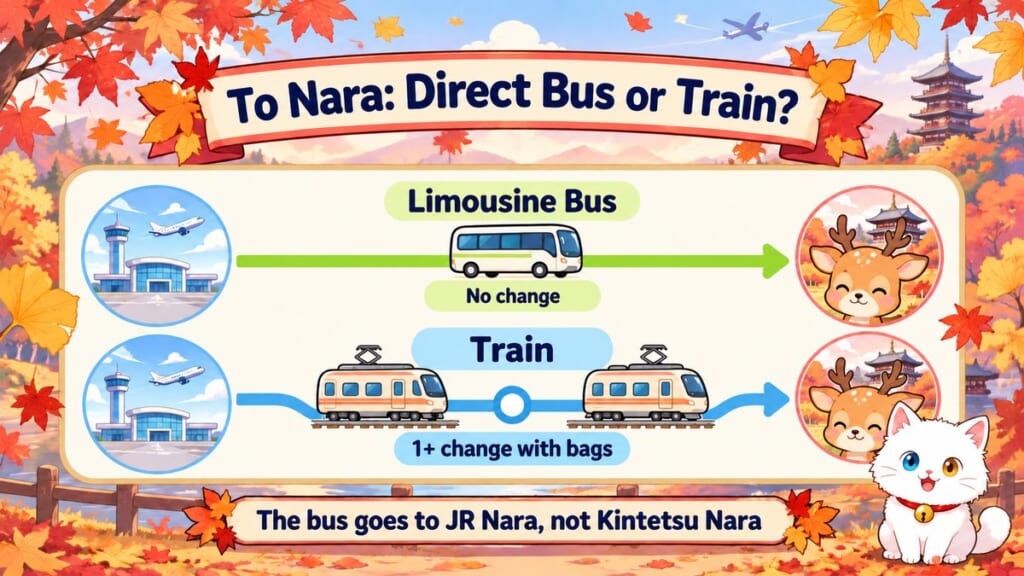
For a luggage-heavy arrival, start by checking the direct Limousine Bus to JR Nara. The adult fare is ¥2,400 (about $15), and staying on one vehicle removes a station transfer with your cases.
Check the exact arrival stop, especially if your hotel directions mention Kintetsu Nara. The current KATE timetable shows airport departures reaching JR Nara but skipping Kintetsu Nara, so those station names aren’t interchangeable when planning your arrival.
Rail is still a reasonable alternative if the bus wait is long or your hotel suits a train route better. You’ll need a connection, so compare the full journey to the relevant Nara station, including the walk between platforms, rather than just the first train out of KIX.
For parents, the useful question is whether everyone can move their luggage at that connection. If one adult will be holding a child and the other handling both suitcases, a direct bus can justify a longer wait.
Why Local Families Don’t Choose by Speed
For my family, luggage and children matter more than saving a few minutes. When I go to KIX with my family, I go by car: our own car, a lift, or a taxi.
The bags are heavy, and train travel can be tiring with children. Once I add up the individual train fares for my family, the difference can feel smaller for our own journey; that doesn’t mean an airport taxi to central Osaka or Kyoto will cost almost the same for you.
A route planner can show a fast connection without showing how it feels to find a lift while keeping a small child close. Count the moments when you must lift, move, or gather your bags, as well as the minutes on the timetable.
If you’re bringing a stroller, think about who can handle it while the other adult manages the cases. Stroller in Japan: Do You Really Need One? helps with that decision, and Japan with Kids: A Japanese Mom’s Practical Guide covers the wider family-travel questions.
 Why Japan does it this way: having staff load an airport coach and match luggage to claim tickets can help boarding run smoothly and reduce mix-ups.
Limousine Bus Luggage: How Many Bags, and How the Tag System Works
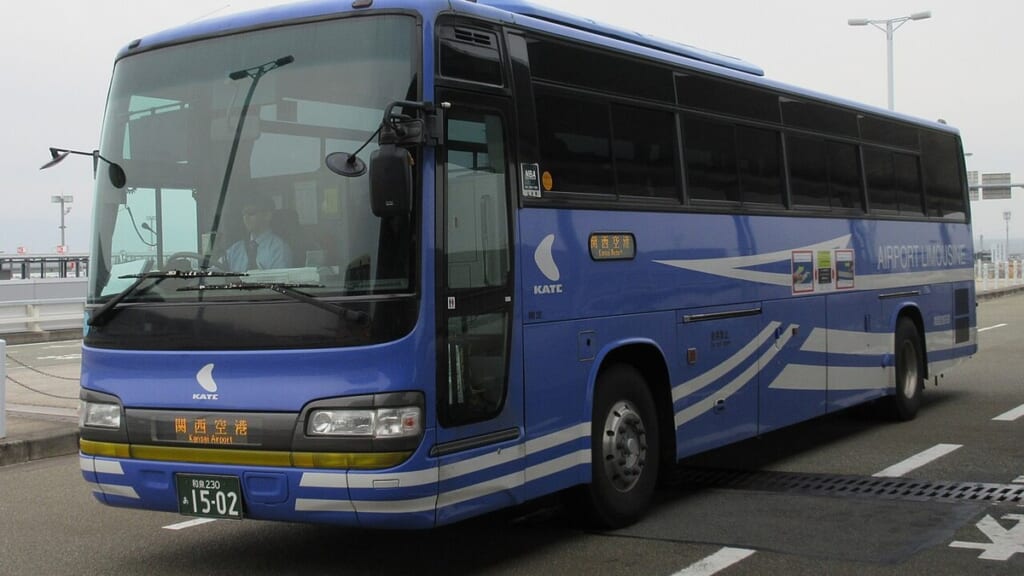
The Limousine Bus can be easier with big cases, but check the combined allowance before choosing it. KATE allows up to two checked pieces per person, totaling no more than 30 kg and 0.25 m³, with no piece longer than 2 m.
Those are combined weight and volume limits, not allowances for each case. Two bags can meet the piece limit and still exceed the weight limit, so count and weigh what you actually plan to bring.
When I used a limousine bus, a staff member loaded my suitcase underneath and gave me a claim tag. For departures from KIX, KATE’s instructions say checked bags receive tags and are returned in exchange for the corresponding claim tickets.
- Buy your ticket before boarding, or follow your voucher’s redemption instructions.
- At the correct stop, give the staff the bags you are checking into the luggage compartment.
- Keep the matching claim ticket somewhere accessible during the ride.
- At your destination, exchange it for your luggage and check that the bags are yours.
For the airport departures covered here, boarding is first come, first served; a full bus means waiting for another departure. Buying a voucher isn’t the same as reserving a place on a particular bus.
 Don’t check fragile items such as wine bottles into the luggage compartment. KATE also doesn’t carry bags without a passenger, so use a delivery service if you want the suitcases to travel separately.
A stroller checked into the luggage compartment counts as one of your two permitted pieces. Folding wheelchairs can be carried in the compartment; contact KATE in advance about an electric wheelchair.
Soft bags such as backpacks, bags that cannot stand upright, valuables, and fragile electronics cannot go in the luggage compartment. Keep them with you instead.
The Family-of-4 Math: Per-Person Fares vs One Flat Price
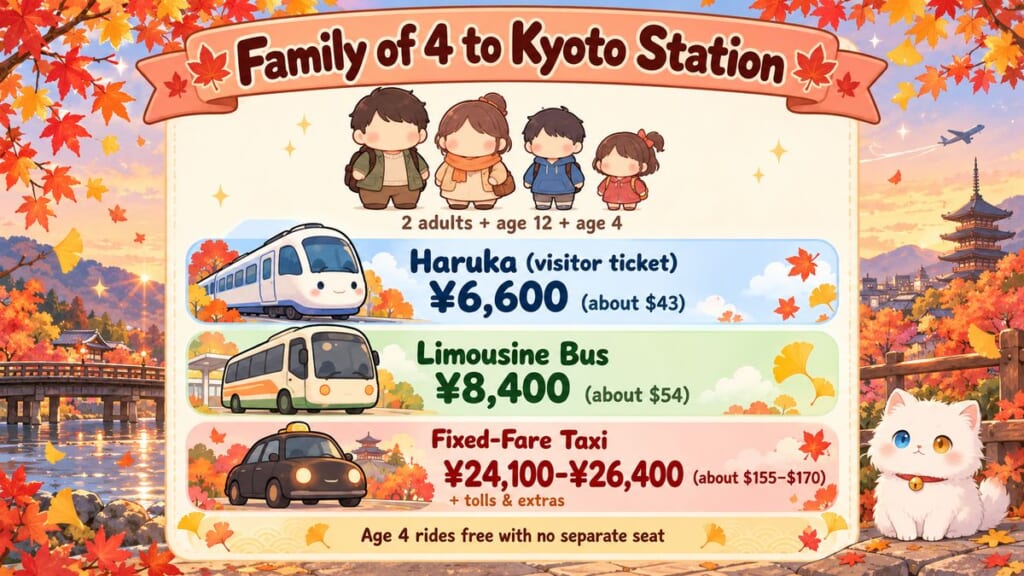
Add up your family’s tickets before comparing them with one vehicle quote. The example below is two adults, a 12-year-old counted at the adult fare, and a four-year-old traveling without a separate reserved train seat or bus seat.
This is a visitor-family example, not a calculation for my own children’s school status. Ordinary railway and KATE rules have an exception for 12-year-old elementary-school pupils, while the HARUKA visitor ticket lists its own age bands; check the ticket rules that apply to your child.
| Option | Namba: family total | Kyoto: family total | What the figure assumes |
|---|---|---|---|
| Airport Express | About ¥2,910 (about $19) | — | Three adult fares; four-year-old travels free under accompanied-child rules |
| Rapi:t | About ¥5,010 (about $32) | — | Three standard adult regular-seat tickets; no separate seat for four-year-old |
| Limousine Bus | ¥4,200 (about $27), OCAT | ¥8,400 (about $54), Kyoto Station | Three adult fares; four-year-old uses no separate seat |
| Haruka visitor ticket | — | ¥6,600 (about $43) | Three eligible adult tickets; no separate reserved seat for four-year-old |
| MK fixed-fare taxi | ¥14,800 (about $95), Naniwa Ward example, plus extras | Kyoto Station area: ¥24,100–¥26,400 (about $155–$170) depending on the exact area | One suitable vehicle; address and extra charges must be checked |
| Private car | Quote for your hotel and luggage | Quote for your hotel and luggage | Confirm the total for all four passengers |
Train and bus totals are the applicable fare per person multiplied by the paying passengers, using September 2026 figures.
MK highway tolls are extra: about ¥2,000 (about $13) for Osaka and about ¥4,000–¥4,500 (about $26–$29) for Kyoto. A 20% late-night surcharge applies from 22:00 to 05:00, and pickup at KIX also incurs an airport parking charge of ¥1,000 (about $6).
Children aged 6–11 generally pay child fares, but “half price” can involve rounding and ticket-specific rules. JR and Nankai generally allow up to two accompanied preschool children per paying adult or child; a preschooler occupying a separate reserved seat needs the appropriate child tickets.
KATE’s rule is different: one accompanied preschool child may travel free without occupying a seat, with a child fare for an additional preschooler or a separate seat. If your four-year-old needs their own bus seat, the totals become ¥4,900 (about $32) to OCAT or ¥9,800 (about $63) to Kyoto.
Even with several paying passengers, the public-transport figures here remain well below a car’s base fare. The difference narrows as you add paying passengers and any onward transport, but this example doesn’t show a taxi becoming equally cheap.
MK’s Namba-area example applies to Naniwa Ward, not every hotel advertised as “Namba,” and highway tolls are extra. A seat count also doesn’t prove that four people and all their cases will fit, so ask for a vehicle-specific quote including any applicable supplements.
The extra money buys a different journey: fewer transfers and delivery to the hotel’s address. Decide whether that is worth it for your family after comparing complete totals, not a single train fare with a car’s headline price.
Landing Late or Flying Out Early
Choose a backup before your flight if you land late. Your scheduled landing time isn’t the time you’ll reach the bus stop or railway platform, especially with checked bags.
These are weekday last-departure guidelines as of September 2026, for buses from Terminal 1 and trains from Kansai-airport Station on the Terminal 1 side; check the official timetable before departure.
- Limousine Bus: Kyoto Station 23:20; Osaka Station (Umeda) 23:45, plus a 00:15 late-night bus (cashless only, ¥2,700 (about $17)); OCAT 21:25; JR Nara 21:45.
- Rapi:t: 23:00; Nankai Airport Express: around 23:55.
- Haruka to Kyoto: 22:16; JR Kansai Airport Rapid: 23:09.
 The 00:15 bus leaves after midnight, on the following calendar day. Check your onward journey too; reaching Osaka doesn’t automatically solve the final trip to your hotel.
For Terminal 2, add the transfer to the railway station on the Terminal 1 side. The free shuttle runs between Terminal 2 and Aeroplaza, with a stated ride of about 7–9 minutes; waiting and walking come on top.
Kyoto buses also have Terminal 2 departures, so check your route before automatically heading for the train station. A blank space in the Terminal 2 timetable means that particular departure doesn’t stop there.
If the last useful connection is too tight, consider a hotel near the airport. For an early departure, work backward from your airline’s check-in requirement and terminal, not just the takeoff time.

Photo: Agoda.
Hotel Nikko Kansai Airport is connected to the airport complex, making it the more direct of these two options for staying on the airport island. If your flight uses Terminal 2, allow for the terminal transfer rather than assuming the hotel is beside your check-in desk. Flying out early? My guide to where to stay before an early flight from KIX matches the hotel to your departure time.

Photo: Agoda.
Kansai Airport Washington Hotel is on the Rinku Town side, across the water. Before booking a late arrival or early departure, confirm how you’ll get between the hotel and your terminal at the time you need.
Tickets Made Simple: ICOCA (Not Suica), Haruka Discount, Rapi:t Machines
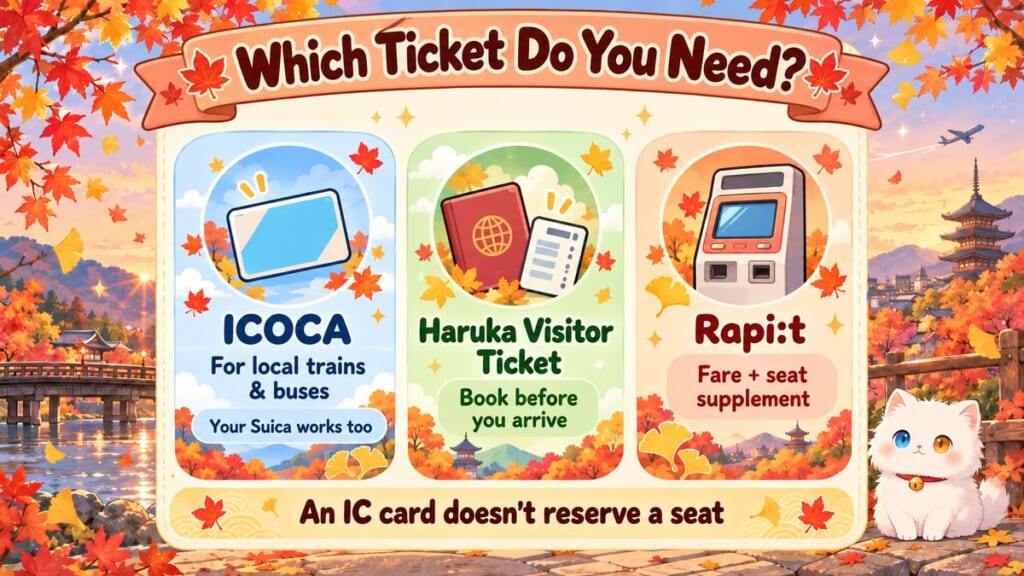
For a physical transport card bought at KIX, look for ICOCA. You can buy it at JR Kansai-airport Station, reached from the second floor of Terminal 1, at the ticket machines or the ticket office.
If you already have a working Suica, keep using it for compatible local journeys in Osaka; you don’t need to buy ICOCA just because you’ve arrived in Kansai. Suica isn’t the physical card sold by the local railway counters here, but the different name doesn’t make yours unusable.
An IC card doesn’t by itself reserve a limited-express seat. For Haruka or Rapi:t, make sure you also have the necessary limited-express ticket, or a product covering the complete journey.
The HARUKA One-way Ticket is for travelers holding a foreign-government-issued passport and entering Japan as a Temporary Visitor. For the paper-ticket version described here, buy before arriving in Japan through JR-WEST ONLINE TRAIN RESERVATION or an authorized overseas seller. WEST QR is a separate product sold through travel agencies; follow your seller’s purchase conditions. Japanese nationals aren’t eligible for either version.
JR’s online sales open one month before travel. Follow your booking’s collection instructions and reserve your seat before boarding. If an overseas travel agency issues an exchange order (E-TICKET) for a paper ticket, exchange it in Japan within three months of its issue date. That deadline is for collecting the ticket, not a three-month travel period.
If your booking supplies a QR product, follow that product’s instructions instead of assuming a paper-ticket exchange is required. Check what you bought before joining a queue, and keep the booking instructions available on your phone.
Klook.comI bought my Rapi:t ticket from a station machine for that family ride. For a standard purchase, remember that the fare and the regular-seat supplement are separate components, even when sold together; compare the complete price when looking at online offers.
Nankai’s own ticketless service has a different supplement price from the standard station purchase used in this guide. Avoid buying only a supplement and assuming it includes the underlying fare.
For the card comparison, see Suica vs Pasmo for Tourists. If you’re planning how much cash to keep available during your trip, use How Much Cash to Bring to Japan alongside your chosen ticket’s payment instructions.
Don’t Want to Carry Bags at All? Send Them Ahead
If carrying the cases is the main problem, consider sending them from the airport to your accommodation. Luggage forwarding, often called takkyubin, lets you choose transport for the people rather than for the suitcases.
Check the delivery date, acceptance deadline, and whether your accommodation can receive bags before handing anything over. Don’t assume airport delivery means same-day arrival, and keep the things your family needs until delivery in a smaller bag.
Start with Luggage Forwarding in Japan: Is It Worth It? to decide whether that trade-off works for your stay. If you only need temporary storage after reaching the city and station lockers are full, Coin Lockers Full in Japan? covers alternatives. To book a spot before you arrive, Bounce has partner shops near Osaka Station (Umeda) and Kyoto Station. Booking through these links takes 5% off automatically.
Find Luggage Storage Near Osaka Station (Umeda) on Bounce (5% Off)
Other stations: Tokyo · Shinjuku · Kyoto
FAQ
Is the limousine bus or the train better with big suitcases?
The bus is often easier when its stop is close to your hotel and your bags meet the allowance, because the cases travel underneath. Choose the train if its arrival point works better or avoiding road traffic matters more; a reserved seat doesn’t remove the need to move your bags through the station.
Can I use Suica in Osaka?
Yes, you can use Suica for compatible local train and bus journeys in Osaka. You don’t need another card simply because the local card is called ICOCA, but limited-express travel still needs the appropriate additional ticket.
What’s the cheapest way from Kansai Airport to Osaka?
Among the standard options compared here for Namba, the Nankai Airport Express is the lowest-priced at about ¥970 (about $6). For Umeda, compare the direct JR rapid route instead, because a cheap Namba ticket may leave you paying for another journey across Osaka.
Still choosing a hotel area? My where to stay in Osaka guide compares Namba, Umeda and Shin-Osaka by the station you’ll actually use.
YUU’s Final Thoughts
The best way from Kansai Airport is the one you can manage all the way to your hotel. Start with the address, count your bags and paying passengers, then choose how much handling you’re comfortable doing after the flight.
I choose a car for my own family’s airport trips, but a direct train or well-placed bus stop may suit yours better. Once this arrival is settled, How to Plan Your First Trip to Japan: 7 Steps can help you put the rest of your trip in order.
Check the Limousine Bus Voucher on Klook
Now I’m curious about your side of the world — when you land somewhere new, do you head straight for the train, the airport bus, or a car to the door? Tell me in the comments below. I read every single one!
I hope this guide has answered one of your questions and helped you feel a little closer to Japan.
May your Japan journey be filled with wonderful discoveries and memories you’ll treasure for years to come.
See you in the next guide.




Comments