
- Quick Answer: What to Wear in Japan in November
- November Weather in 5 Cities: Sapporo to Fukuoka
- Early November vs. Late November: 5°C Makes a Difference
- The Layering Formula for November
- Trains and Shops Are Heated: Plan to Take a Layer Off
- Dressing for Autumn Leaves and Evening Illuminations
- Shoes and Socks for Temples, Gardens, and Rain
- Don’t Overpack: Buy It in Japan (Uniqlo Sizing Tips)
- November in Japan with Kids
- Japan November Packing List
- FAQ
- Final Thoughts: What to Wear in Japan in November
Quick Answer: What to Wear in Japan in November
 November in Japan is a month for layers, not one heavy coat. For Tokyo, Kyoto, and Osaka, start with a long-sleeve top, add a light knit or cardigan, and bring an outer layer you can easily take off indoors.
Early November is mild enough for a light jacket on many days, while late November can feel much colder, especially after sunset. By then, a lightweight packable down jacket is much more useful. Add comfortable walking shoes and a large scarf, and you’ll be able to adjust without carrying a bulky winter coat all day.
If your trip covers both early and late November, pack for the colder end of your itinerary. You can always remove a layer on warmer afternoons or inside heated trains and shops.
Disclosure: This article contains affiliate links. If you buy through one, I may earn a small commission at no extra cost to you.
- Packable down jacket / late-November outer layer that folds into your bag
- Thermal base layer set / extra warmth for cold mornings and evenings without much bulk
- American Trends oversized scarf / the easiest layer to add or remove
- Hokkairo stick-on body warmers / for evening illuminations
- Skechers GO WALK Joy waterproof sneakers / long walking days and rain
- Kyoto night maple day trip (Klook) / Kinkaku-ji, Arashiyama, and the lit-up Sagano train
November Weather in 5 Cities: Sapporo to Fukuoka
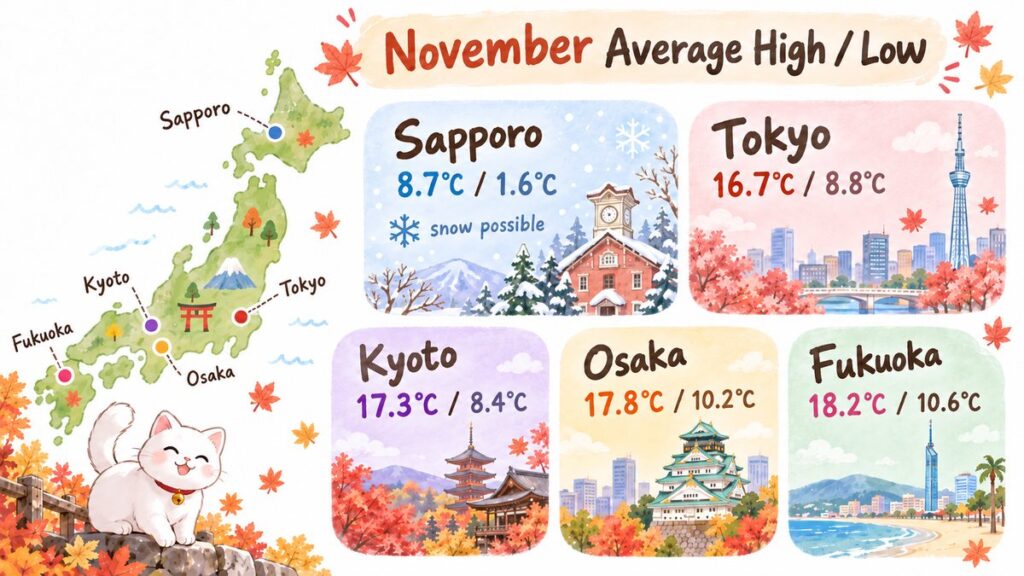
 The biggest mistake you can make is packing one “Japan in November” outfit for every city. Sapporo is already in a very different season, while Fukuoka and Osaka are a little milder.
Here are the Japan Meteorological Agency’s 1991–2020 November normals:
| City | Average High | Average Low | Precipitation | Days with 1 mm+ Rain |
|---|---|---|---|---|
| Sapporo | 8.7°C / 47.7°F | 1.6°C / 34.9°F | 113.8 mm | 14.6 days |
| Tokyo | 16.7°C / 62.1°F | 8.8°C / 47.8°F | 96.3 mm | 7.4 days |
| Kyoto | 17.3°C / 63.1°F | 8.4°C / 47.1°F | 73.9 mm | 6.3 days |
| Osaka | 17.8°C / 64.0°F | 10.2°C / 50.4°F | 72.5 mm | 6.2 days |
| Fukuoka | 18.2°C / 64.8°F | 10.6°C / 51.1°F | 91.4 mm | 8.5 days |
For a Tokyo–Kyoto–Osaka trip, think cool autumn days and colder mornings and evenings rather than full winter clothing. Fukuoka follows a similar pattern, with slightly higher November averages.
Sapporo needs a different suitcase plan. Its November average high is only 8.7°C (47.7°F), the average low is 1.6°C (34.9°F), and the monthly snowfall total is 30 cm. If Sapporo is part of your itinerary, use the winter additions in the packing list below rather than relying on the same layers you pack for Tokyo.
Early November vs. Late November: 5°C Makes a Difference
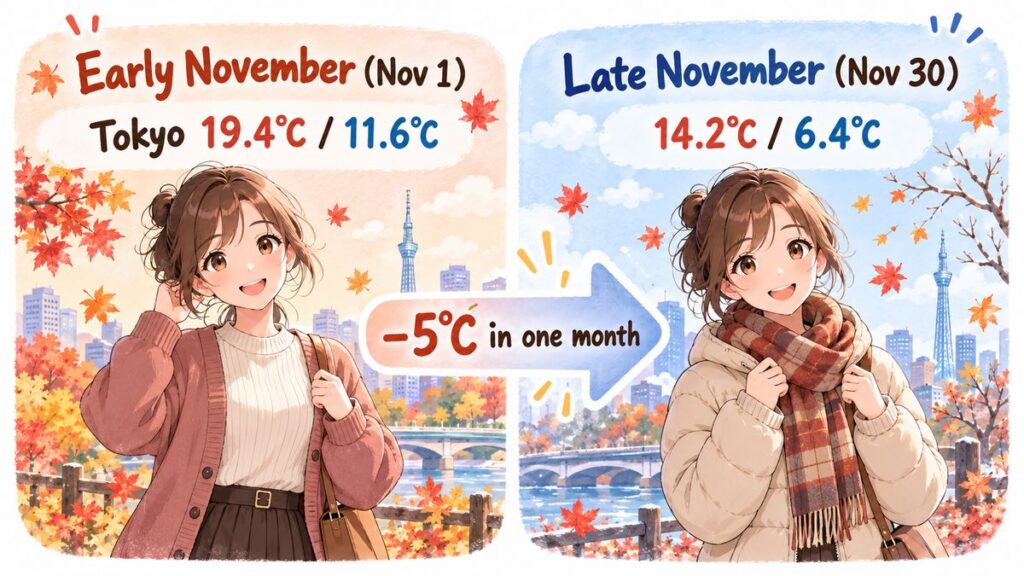
 Your travel dates matter almost as much as your destination. In Tokyo, the normal daily high falls from 19.4°C (66.9°F) on November 1 to 14.2°C (57.6°F) on November 30 — a drop of just over 5°C in the same month.
The lows change too. Tokyo goes from 11.6°C (52.9°F) on November 1 to 8.9°C (48.0°F) on November 15 and 6.4°C (43.5°F) by November 30.
Kyoto and Osaka show the same pattern. Kyoto’s normal temperatures move from 19.5°C/10.2°C (67.1°F/50.4°F) in early November to 15.3°C/6.5°C (59.5°F/43.7°F) in late November. Osaka goes from 20.0°C/12.1°C (68.0°F/53.8°F) to 15.9°C/8.4°C (60.6°F/47.1°F).
That gives you a simple packing rule: for an early-November trip, start with a light jacket. For a late-November trip, a lightweight down jacket becomes much more useful, particularly in the morning and evening.
If your itinerary stretches across both parts of the month, pack for the colder dates and make each layer removable. It’s much easier to take off a cardigan than to discover at night that the jacket in your suitcase isn’t warm enough.
The Layering Formula for November
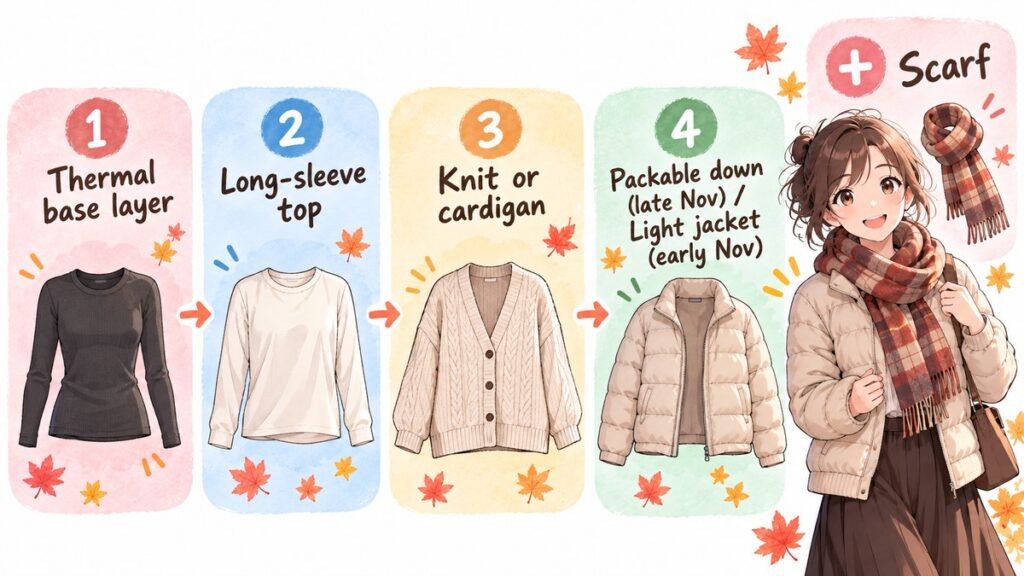
 The easiest November outfit is one you can change without going back to your hotel. Think of it in layers: a thin thermal base layer, a long-sleeve top, a knit, cardigan, or fleece, then an outer jacket. Finish with a scarf that can come on and off in seconds.
In early November, that outer layer can be a light jacket. In late November, switch it for a lightweight packable down jacket. You don’t necessarily need to wear every layer at once; the point is to have choices as the temperature changes through the day.
Is November trench-coat weather? Late-November evenings in Tokyo, Kyoto, and Osaka can get close to the kind of weather when you’ll be glad to have that level of outer layer, especially if you’re outside for a while. A scarf or thin thermal layer gives you more flexibility than relying on the coat alone.
Is a thick sweater too much? It can be less convenient if it leaves you with nowhere to go when a train or restaurant feels warm. A thinner knit or cardigan over a long-sleeve top is easier to remove and carry.
You don’t have to give up skirts or dresses either. Pairing them with thicker tights gives you another way to dress warmly while keeping the outfit you want for photos and evenings out.
As a mom, I prefer clothing systems that let you fix the problem in a minute. If you’re cold, add the scarf or middle layer; if you’re warm, take one off.
Trains and Shops Are Heated: Plan to Take a Layer Off
 A jacket that feels perfect outside may feel like too much once you step onto a heated train or into a department store or restaurant. That’s why “How warm is it?” isn’t the only question to ask when choosing your November coat. You also need to ask, “What will I do with it when I take it off?”
Choose an outer layer that you can hold comfortably on your lap or fit into your bag. A packable down jacket works especially well later in the month because it can handle colder outdoor periods without becoming a large, awkward item once you go inside.
This also changes how you should think about the layers underneath. If your sweater is extremely warm and your coat is warm too, you may end up carrying the coat while still feeling hot. A long-sleeve top plus a removable cardigan gives you another step between “coat on” and “coat off.”
The same idea applies to your large scarf. Wrap it around your neck while you’re outdoors, then remove it before you start overheating on the train.
For a day that includes sightseeing, trains, shopping, and dinner, flexibility matters more than wearing your warmest combination from breakfast onward. You want every layer to earn its place in your bag.
Dressing for Autumn Leaves and Evening Illuminations
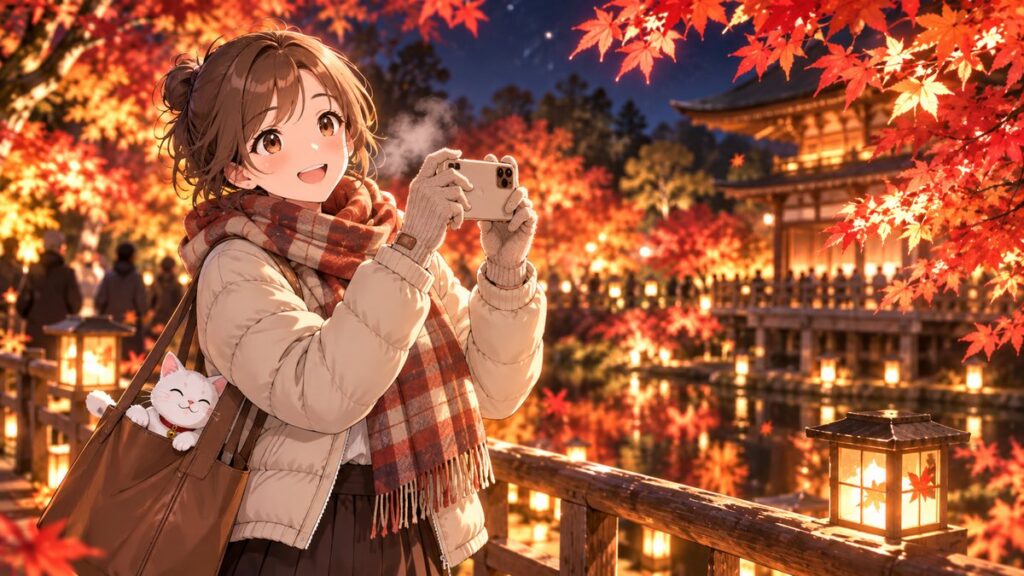
 Autumn-leaf sightseeing has one hidden cold-weather problem: you may spend a lot of time standing still. Looking at the trees, waiting for your family, taking photos, or watching autumn-leaf light-up events (illuminations) don’t warm you up the way continuous walking does.
That becomes more noticeable after sunset. In Tokyo, sunset is at 16:28 on November 30, and evening illuminations take place after the daylight is gone. Dress one step warmer for the evening portion of your day than you would for an afternoon spent walking.
Protecting your neck and hands can make that adjustment easy. Bring your large scarf, add gloves for colder evenings, and keep adhesive body warmers for nights when you expect to spend a long time outside. You can also buy adhesive body warmers in Japan if you decide you need them after you arrive.
If your autumn-leaf plans take you into mountains or higher elevations, don’t use the city temperatures in the table as if they apply everywhere. Those locations can be colder, so check the forecast for the actual place before you leave.
The goal isn’t to dress for winter all day. It’s to avoid reaching the prettiest part of your evening and realizing all of your warm layers are back at the hotel.
If you would rather not plan the evening part yourself, this Kyoto night maple day trip from Osaka or Kyoto covers Kinkaku-ji, free time in Arashiyama, and an evening ride on the Sagano Romantic Train through the lit-up autumn leaves. November departures start mid-month and it has free cancellation up to 24 hours before, so it is easy to book early and adjust later. Dress for the train ride at night, not for the afternoon at Kinkaku-ji.
Shoes and Socks for Temples, Gardens, and Rain
Choose your shoes for walking first and for outfits second. A November day in Japan can include stations, temple grounds, gardens, shopping streets, and plenty of time on your feet, so shoes that already feel comfortable are more useful than something you hope will become comfortable during the trip.
A pair of waterproof walking sneakers can handle long walking days and wet weather. Tokyo averages 7.4 days in November with at least 1 mm of precipitation, so November isn’t a month when you need to assume rain every day, but some rain protection is still useful.
Also remember that you may need to take your shoes off at temples, ryokan, and some restaurants. Shoes that come off easily make those moments simpler, and this is definitely the trip to check your socks before leaving the hotel — no surprise holes.
Boots can work if they’re comfortable, but repeated lacing, buckling, or pulling them on and off may become annoying on days with several shoe-removal stops. Ease matters.
If long sightseeing days leave your feet tired, I’ve put the recovery options in my sore-feet recovery guide rather than adding more items to this packing list.
Don’t Overpack: Buy It in Japan (Uniqlo Sizing Tips)
 You don’t need to prepare for every possible November temperature before you fly. Thermal base layers, lightweight down jackets, and scarves can be added after you arrive at stores such as Uniqlo and GU, including locations around major stations.
That gives you permission to pack a little lighter. If the weather turns colder than you expected, you can add one useful layer instead of bringing several “just in case” pieces from home.
One caution: Japanese clothing sizes can feel smaller than you expect, so try items on when possible rather than choosing only by the letter on the tag. This matters especially when you’re buying a layer that needs to fit comfortably over other clothes.
If you’re shopping during your trip, the eligibility and purchase rules for tax-free shopping are explained in my Japan tax-free shopping guide.
Packing lighter also becomes easier if you plan to do laundry. Many business hotels have coin-operated laundry facilities, and detergent can be found at drugstores and convenience stores, so you don’t need a completely different outfit for every day of your trip.
November in Japan with Kids
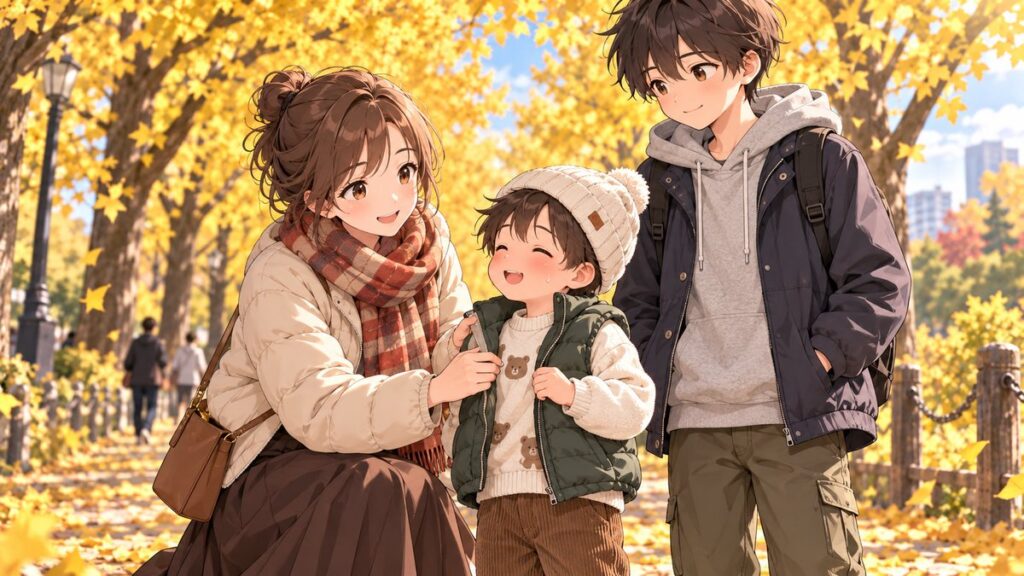
 Kids can be tricky to dress in November because they may feel hot while they’re running around and cold soon after they stop. Instead of one thick layer, use pieces that are quick to open or remove, such as a front-opening cardigan, jacket, or vest.
For a child riding in a stroller, bring a blanket that you can add when they’re sitting still. A child walking beside you is generating much more body heat than a child sitting and watching the scenery, even when they’re in the same place.
Lip balm and moisturizer are handy to have in your day bag. Keep them somewhere easy to reach rather than at the bottom of your suitcase.
In many Japanese families, layering children is practical for exactly this reason: you can adjust their clothes without changing the whole outfit. For more on strollers, trains, meals, and everyday logistics, see my Japan with kids guide.
Japan November Packing List
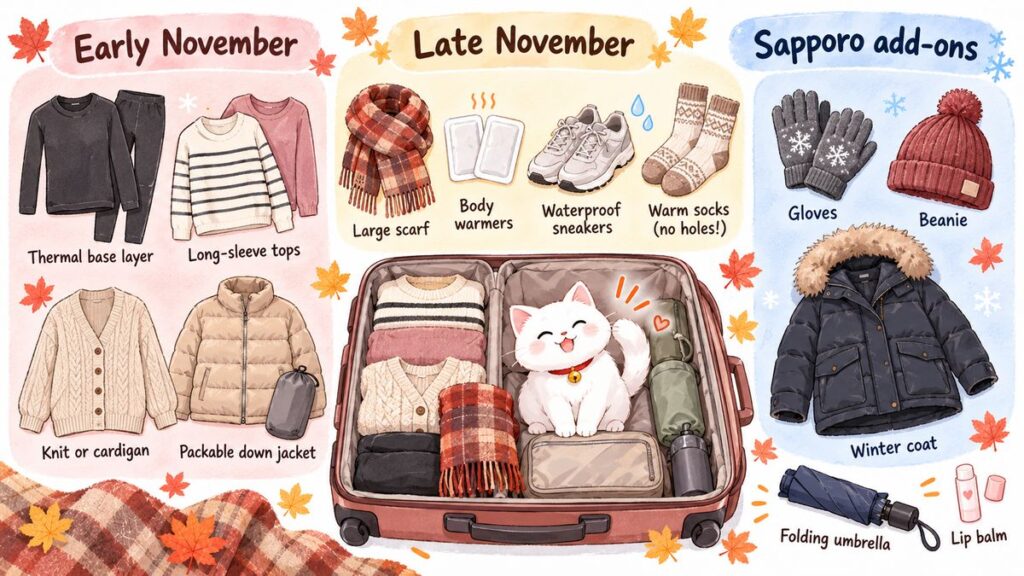
 You don’t need a completely different wardrobe for every city. Start with the block that matches your dates, then add the Sapporo items only if that city is actually on your itinerary.
Early November: Tokyo, Kyoto, Osaka, and Fukuoka
- Long-sleeve tops
- Light knit or cardigan
- Light jacket
- Comfortable pants, skirt, or dress
- Tights if you plan to wear skirts or dresses
- large scarf for quick temperature adjustments
- waterproof walking sneakers for long sightseeing days and rain
- Comfortable socks that you’re happy to wear when your shoes come off
Late November: Tokyo, Kyoto, Osaka, and Fukuoka
- Long-sleeve tops
- Knit, cardigan, or fleece as a middle layer
- thermal base layer set for colder mornings and evenings without adding much bulk
- packable down jacket as your main late-November outer layer
- large scarf for your neck outdoors and as a lap covering when useful
- adhesive body warmers for evening illuminations and long periods standing outside
- waterproof walking sneakers
- Tights for skirts and dresses
- Gloves for colder evenings
Add These for Sapporo
- Winter-ready outerwear
- Thermal base layers
- Warm middle layers
- Scarf and gloves
- Footwear suitable for the conditions in the forecast
Don’t pack all three sections. Choose the one that matches your dates and destination, then leave enough room in your suitcase to remove a layer during the day — and perhaps to bring something home.
FAQ
Is Japan cold in November?
In Tokyo, Kyoto, and Osaka, November is cool rather than consistently winter-cold, but mornings and evenings become noticeably colder as the month goes on. Tokyo’s normal high falls from 19.4°C (66.9°F) on November 1 to 14.2°C (57.6°F) on November 30, so your exact dates matter.
Do I need a down jacket in Japan in November?
For an early-November trip to Tokyo, Kyoto, or Osaka, a light jacket may be enough when combined with removable layers. For late November, a lightweight packable down jacket is a much more useful choice, especially for mornings, evenings, and time spent standing outdoors.
How many outfits should I pack for 10 days in November?
You don’t need 10 completely different outfits. Pack repeatable layers that work together and plan to do laundry during the trip; many business hotels have coin-operated laundry facilities.
Does it rain a lot in Japan in November?
For Tokyo, November averages 7.4 days with at least 1 mm of precipitation. You don’t need to pack as though every day will be rainy, but water-resistant or waterproof walking shoes are useful if rain appears in the forecast.
Does it snow in Sapporo in November?
Yes, snow is already part of November conditions in Sapporo. The November normal is 8.7°C (47.7°F) for the high and 1.6°C (34.9°F) for the low, with a monthly snowfall total of 30 cm, so pack for winter conditions rather than using the Tokyo packing list.
Final Thoughts: What to Wear in Japan in November
 For most November trips through Tokyo, Kyoto, and Osaka, you don’t need a huge suitcase or one very heavy coat. You need layers that work together: long sleeves, a removable middle layer, an outer jacket suited to your dates, comfortable shoes, and something warm for your neck.
Check two things before you close your suitcase: when in November you’re traveling and where you’re going. Early November and late November aren’t the same, and Sapporo needs a different plan from the main Tokyo–Kyoto–Osaka route.
Then remember the part that’s easy to forget while packing at home: you’ll move between cool outdoor air and heated trains, shops, and restaurants. If every warm layer can come off easily, November becomes much easier to dress for.
Check the packable down jacket on Amazon
What to Read Next
Still choosing where to stay in November? See three ryokan where the autumn view comes to your room.
If your travel dates are closer to the beginning of autumn, see What to Wear in Japan in October for the broader autumn packing guide.
If your trip continues into colder weather, my winter packing guide will help you decide when to switch to a true winter wardrobe.
Still planning the trip itself? Use my 10-day Japan itinerary with real prices for a practical itinerary, or start with my seven-step Japan planning guide to work through the whole Japan-planning process in order.
What do you wear in November where you live? Tell me in the comments what a “cold day” means in your country and how you dress for it.
I hope this guide has answered one of your questions and helped you feel a little closer to Japan. May your Japan journey be filled with wonderful discoveries and memories you’ll treasure for years to come.
See you in the next guide.



Comments