A straightforward visit to a neighborhood clinic in Japan can cost less than ¥10,000, but that is not a guaranteed tourist price. A traveler who visited a clinic in Kyoto paid ¥8,200 in February 2025. Hospital care, tests, after-hours treatment, interpretation, and visitor-specific pricing can make the bill higher.
Before thinking about cost, check the medicines in your luggage. Japan restricts some ingredients, and the correct procedure depends on the exact medicine, concentration, quantity, and legal category.
This guide explains how to check medication, when a yakkan shoumei is needed, where to seek care, and how payment works. It covers the process, not which treatment or medicine to use.

- Before You Fly: The Medicines You Cannot Bring
- Yakkan Shoumei: When You Actually Need It
- What to Pack Instead
- At the Drugstore: How to Read the Shelf
- Clinic or Hospital? How to Tell
- What It Actually Cost: A Real Example
- Finding a Clinic That Speaks English
- Do You Need Travel Insurance?
- If It’s an Emergency
- Final Thoughts
Before You Fly: The Medicines You Cannot Bring
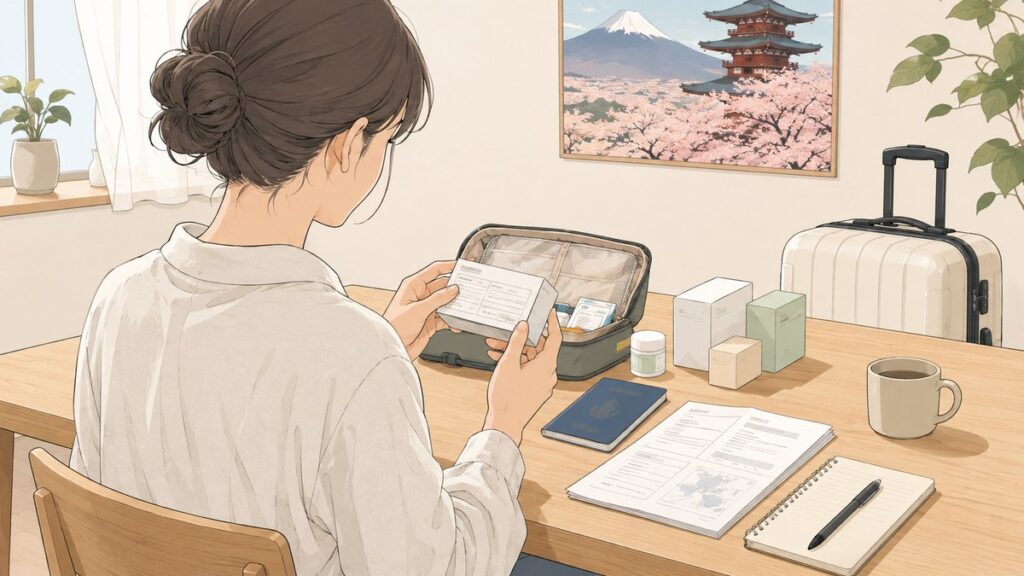
 Check the active ingredient and concentration, not just the brand. A foreign prescription does not make a medicine legal at Japanese customs.
Two examples show why the exact ingredient matters:
| Example | What travelers need to know |
|---|---|
| Products containing pseudoephedrine | Japan’s controlled-substances list excludes products containing 10% or less pseudoephedrine from the stimulant-raw-material category. Above 10%, it is treated as a stimulant raw material and may be brought into Japan only when prescribed for that traveler and approved in advance by Japan’s Narcotics Control Department. Formulations sold under the same brand can differ, so the brand name alone is not enough. |
| Medicines containing amphetamine, including Adderall | Amphetamine cannot be imported by an individual traveler, even for medical treatment. Import Confirmation does not create an exception. Do not extend this rule to every ADHD medicine with a similar name: lisdexamfetamine, including Vyvanse, is handled through a separate advance-permission process. |
This is not a complete list. The U.S. Embassy and Consulates in Japan state that they do not maintain a comprehensive prohibited-medicine list. If your medicine is not named above, do not treat its absence as permission.
Check the Ministry of Health, Labour and Welfare’s traveler information and use the contact for your arrival airport. As checked in September 2026, yakkan@mhlw.go.jp covers Narita, Haneda, and several other entry points; kiyakuji@mhlw.go.jp covers Kansai, Chubu, Fukuoka, Naha, and others. Include the ingredient, strength, dose, form, quantity, and arrival airport.
Controlled substances, including narcotics and stimulant raw materials, are handled separately by Japan’s Narcotics Control Department. Ask about the exact product; its purpose alone is not enough.
My Visit Japan Web guide covers immigration and customs, but completing it does not confirm that a medicine is permitted.
Yakkan Shoumei: When You Actually Need It
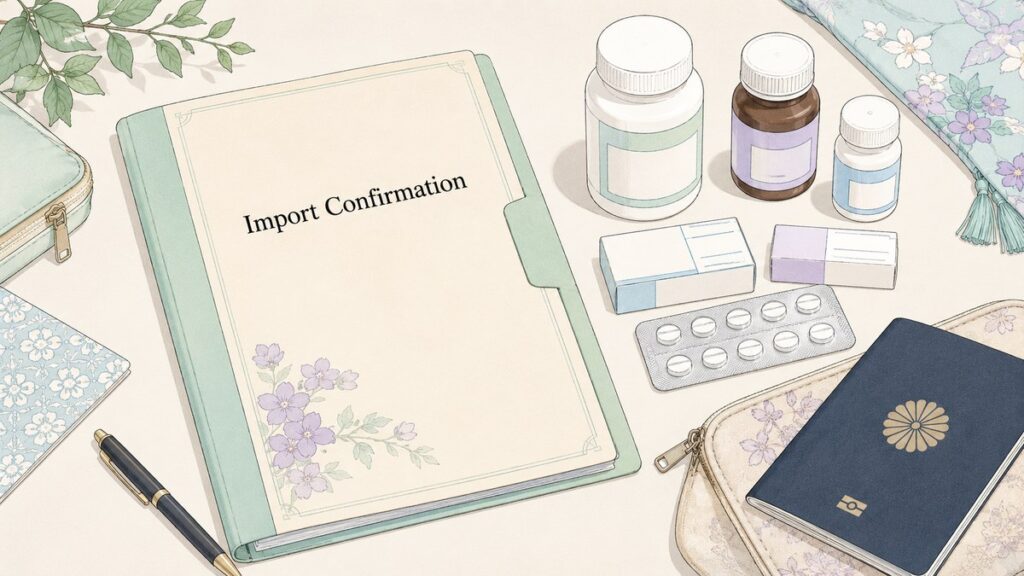
 Travelers still search for yakkan shoumei, but the current term is Import Confirmation, or Yunyu Kakunin-sho. It covers certain quantities of otherwise permitted medicines or medical devices, not prohibited substances.
The Ministry gives these general limits for otherwise permitted products brought without Import Confirmation:
| Category | General quantity limit |
|---|---|
| Poison, deadly poison, and prescription medicine | Up to a one-month supply |
| External-use medicine, excluding poison, deadly poison, and prescription medicine | Up to 24 units per item |
| Injectable medicine and the syringe used for it | Up to a one-month supply, only when carried as a pre-filled syringe or self-injection kit |
| Other medicine and quasi-drug | Up to a two-month supply |
| Cosmetics | Up to 24 units per item |
These quantity rules do not make a prohibited ingredient legal.
If you exceed the quantity limit for an otherwise permitted ordinary medicine, apply through the official system before departure, receive the Import Confirmation, and carry it for customs. A prescription or doctor’s letter cannot override Japanese law.
Import Confirmation does not cover narcotics or stimulant raw materials; they follow the Narcotics Control Department’s separate process. Amphetamine is prohibited and cannot be imported by an individual traveler. If you are unsure how patches, ointments, eye drops, injectables, syringes, or an ingredient are classified, use the appropriate official contact before traveling.
What to Pack Instead
 If your usual medicine is prohibited, speak with its prescriber before traveling. Ask about an appropriate plan, then confirm any proposed replacement with Japan’s Ministry of Health, Labour and Welfare. Do not stop, switch, or substitute a prescription on your own.
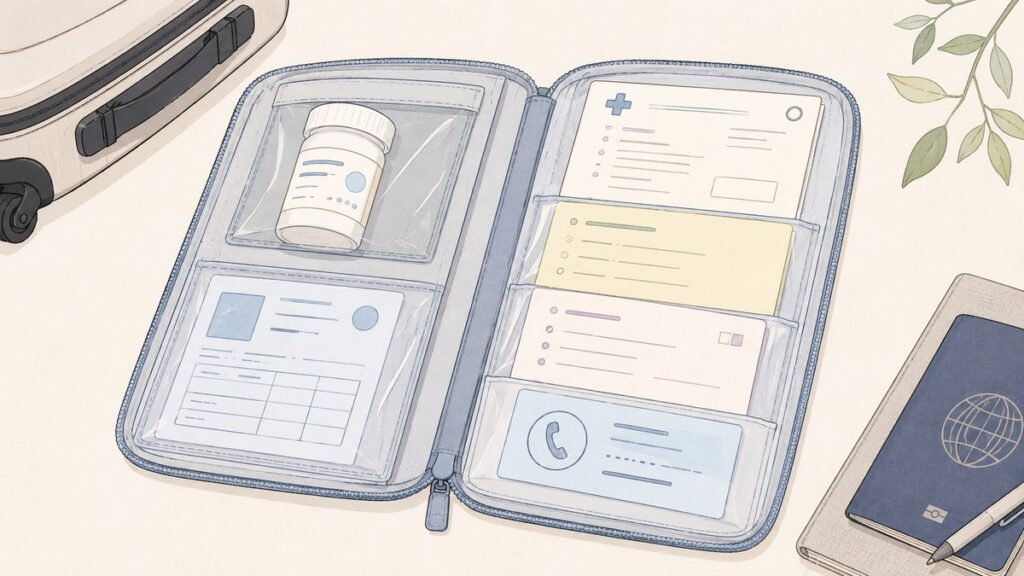
Pack a clear paper trail. Keep permitted medicines in their original labeled containers with a prescription copy or doctor’s letter. List the active ingredient, strength, dose, condition, and allergies. Keep Import Confirmation with the medicine, not in checked luggage. At reception, an ingredient list is more useful than a photo of an unfamiliar brand.
 This is not a temperature threshold or advice to wait. If you are unsure about a child’s condition at any temperature, use an official consultation service or seek emergency help.
When my children become ill away from home, I usually begin by watching their condition. If an individual symptom becomes difficult for them, I may ask a pharmacist about an over-the-counter product for that symptom. When one was seriously unwell with a fever close to 40°C, I went to an emergency hospital, where a doctor examined the child and prescribed medicine to use as needed. This is my experience as a parent in Japan, not a rule for deciding when a child needs care.
For ordinary walking fatigue rather than an illness, my Japan sore-feet recovery guide covers practical comfort options. It is not a substitute for medical care when you need a doctor.
At the Drugstore: How to Read the Shelf
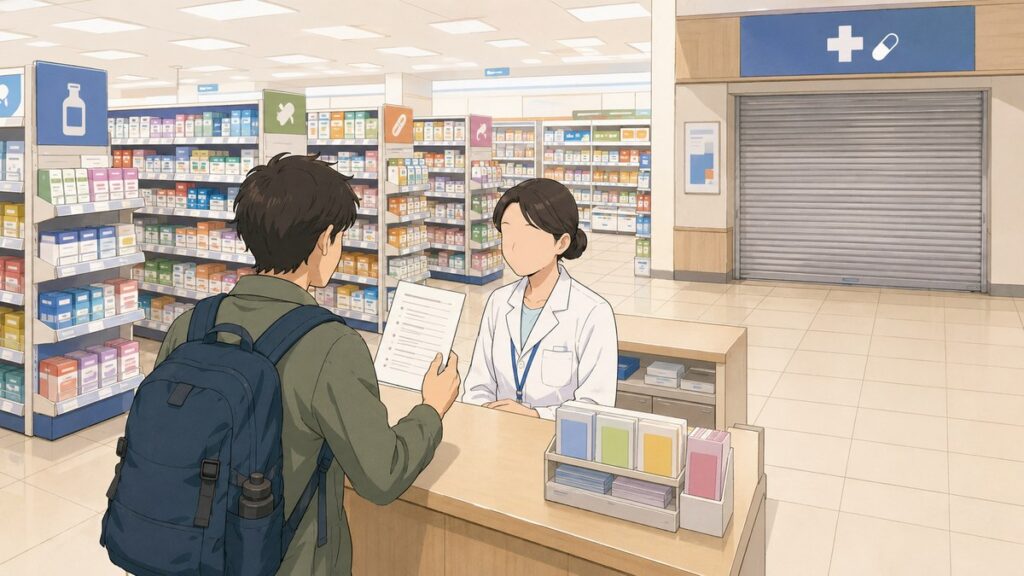
Show the pharmacist or registered sales clerk your ingredient list, age, allergies, and other medicines rather than choosing by package color or translated marketing.
Japan’s official visitor guide says some medicines cannot be sold when the pharmacist is absent. Even inside a 24-hour supermarket, the medicine section may be closed behind a shutter. The building being open does not mean every medicine is available. Ask, “Could I speak with the pharmacist?” and confirm the ingredients, age limits, and instructions before buying.
From what I see in Japanese pharmacies, overseas visitors often buy Salonpas, Cabagin, Biofermin, Bio-Three, Pabron, EVE, Bufferin, eye drops, Ryukakusan, and Alinamin. This is an observation, not a recommendation, and I am not suggesting what any of them should be used for. Ask the pharmacist whether a product is suitable for you.
Drugstores also mix medicines, quasi-drugs, supplements, cosmetics, and daily necessities in the same building. If you’re shopping beyond the medicine aisle, my Japanese drugstore skincare guide explains that part of the store separately.
Clinic or Hospital? How to Tell
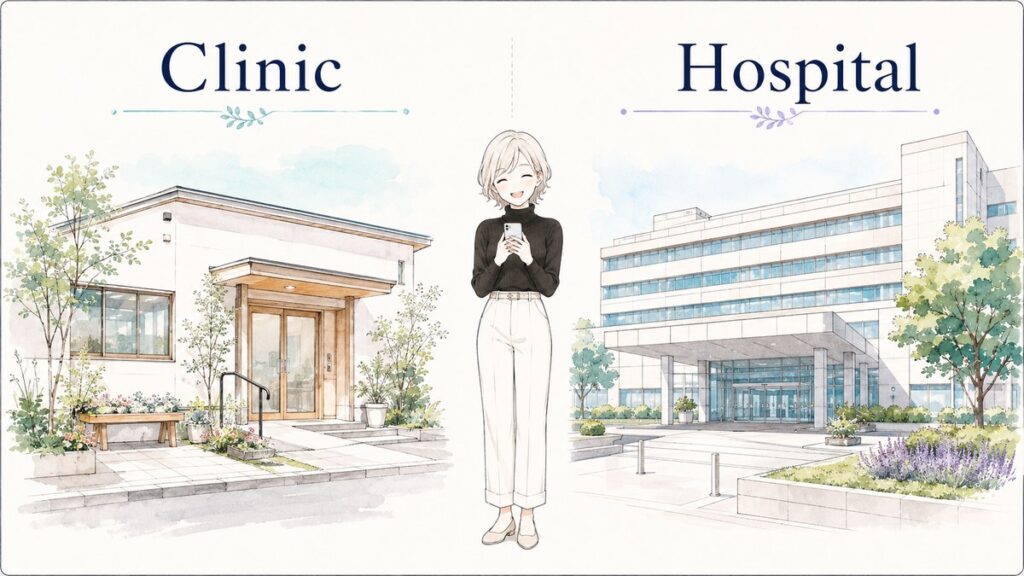
 Travel stories often cover hospitals but skip neighborhood clinics. One traveler found almost nothing about a simple clinic visit. The two should not share one price estimate.
A clinic—often kurinikku or iin—provides outpatient care during set hours. You check in, see a doctor, pay, and take a prescription to a pharmacy unless it is dispensed there. Most visits end with returning to your accommodation unless the clinic refers you elsewhere.
A hospital is larger and may offer broader testing, specialist care, or inpatient treatment. Some provide emergency care, but not every hospital accepts walk-in emergencies. Confirm before going unless an ambulance is arranging transport. A hospital visit does not automatically mean admission; outpatient, emergency, and inpatient care have different costs.
Japan’s official “Guide for when you are feeling ill” gives a practical framework without asking travelers to diagnose themselves:
| Situation | First practical step |
|---|---|
| You need a doctor and it can wait for regular opening hours | Contact a clinic or general hospital before going. |
| You need help outside regular hours | Look for the regional after-hours service or ask the Japan Visitor Hotline where to go. |
| A clinic says you need tests or hospital care | Follow the referral or instructions the clinic gives you. |
| You believe it is an emergency or cannot get to care safely | Call 119 for an ambulance. |
This is a route, not medical judgment. If urgency is unclear, use an official consultation service, your insurer, or the Japan Visitor Hotline. Never use an online article to rule out emergency care.
Take your passport, medicine and allergy list, insurance details, and payment method. Call first to ask whether the clinic sees short-term visitors, has English support, and can give a general estimate. Many clinics take cash, and pharmacies may bill separately. Keep the receipts, prescription, itemized statement, and medical certificate your insurer requires. An English receipt may cost extra, so ask before payment.
A clinic visit may involve only consultation and pharmacy bills. Hospital or emergency care may add tests, procedures, after-hours service, specialists, or admission. The bills are not interchangeable.
What It Actually Cost: A Real Example
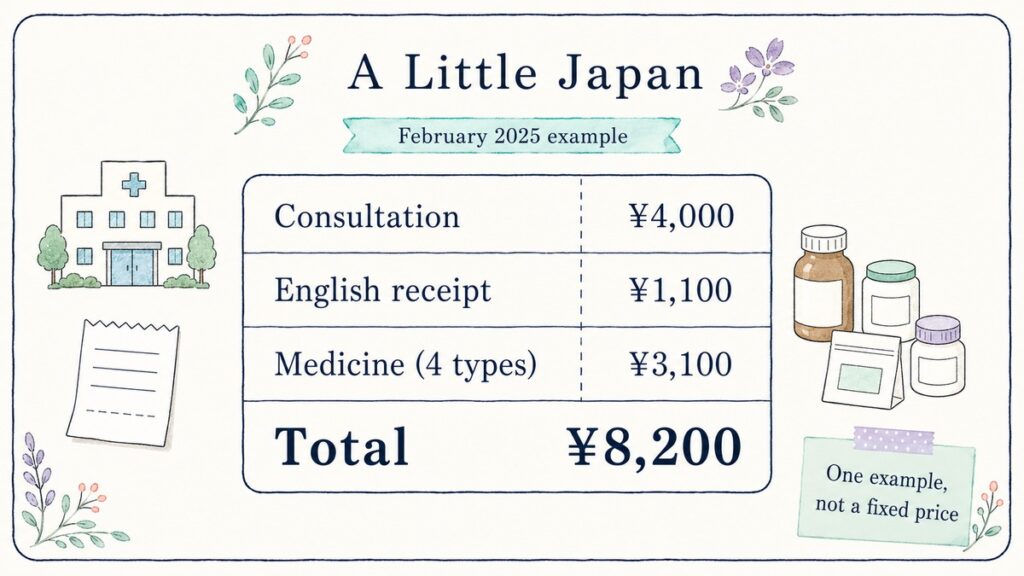
A traveler who saw a doctor at a neighborhood clinic in Kyoto in February 2025 shared the following receipt publicly. This was not my experience, and it should not be treated as a guaranteed tourist price.
| February 2025 expense | Amount |
|---|---|
| Clinic consultation | ¥4,000 |
| English receipt | ¥1,100 |
| Four medicines from the pharmacy | ¥3,100 |
| Total | ¥8,200 |
 This February 2025 receipt shows one clinic visit below ¥10,000. It also shows two easy-to-miss costs: a separate pharmacy bill and a possible fee for an English document. It is one record, not a standard price.
Several hospital, clinic, and medical-assistance websites reviewed in August 2026 quoted about ¥25,000–¥50,000. Those figures may include hospital care, tests, after-hours service, interpretation, administration, or broader treatment; the Kyoto record was a limited clinic visit.
The February 2025 record also showed the public-insurance amounts: ¥1,530 for the clinic and ¥930 for medicines, or ¥2,460 total. For many insured residents, public insurance covers 70% of covered care.
That does not make a visitor’s bill the exact 100% equivalent of the insured fee. Short-term visitors are outside Japanese public insurance and pay the provider’s entire self-pay charge.
The February 2025 ¥8,200 record does not show what tariff another provider will apply. A Ministry of Health, Labour and Welfare survey for fiscal 2019, published in 2020, mainly covered hospitals. Most respondents used ¥10 or ¥11 per point, while some hospitals serving more international patients used higher rates or charged separately for interpretation. This helps explain why clinic and international-patient hospital bills can differ. Ask reception for an estimate when possible.
Before leaving, request the documents your insurer needs. In February 2025, this traveler paid ¥1,100 for an English receipt, so ask about cost and timing.
Finding a Clinic That Speaks English
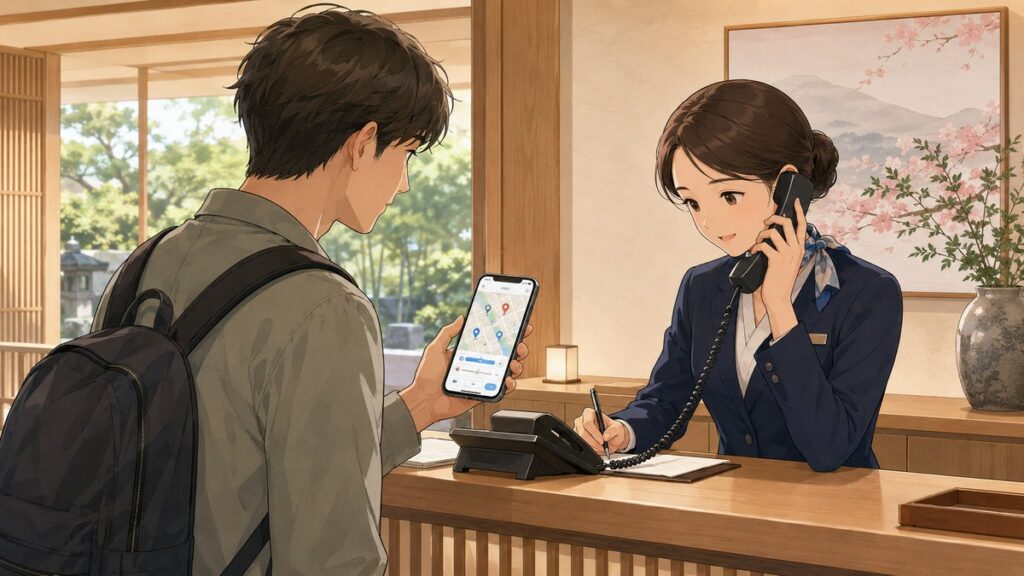
 Start with Japan’s official Guide for when you are feeling ill, which filters by area, language, and department. For a child, try Pediatrics with English. Confirm hours and language support directly.
The Ministry of Health, Labour and Welfare’s Medical Information Net, or Navii, also searches by department and foreign-language support, including facilities open now, on holidays, or at night.
Before traveling across town, ask whether the clinic can see a short-term visitor today, has English support, and requires cash. A hotel or insurer may help make contact.
Many neighborhood clinics open around 8:00 or 9:00 a.m. until noon, close through lunch, then reopen around 3:00 p.m. Every clinic sets its own hours. The February 2025 Kyoto traveler woke at 11:30 a.m., missed the morning window, and waited much of the day for reopening.
For help locating care, the Japan Visitor Hotline operates 24/7 in English, Chinese, and Korean at 050-3816-2787. It provides information but generally does not offer three-way interpretation or book appointments.
Do You Need Travel Insurance?
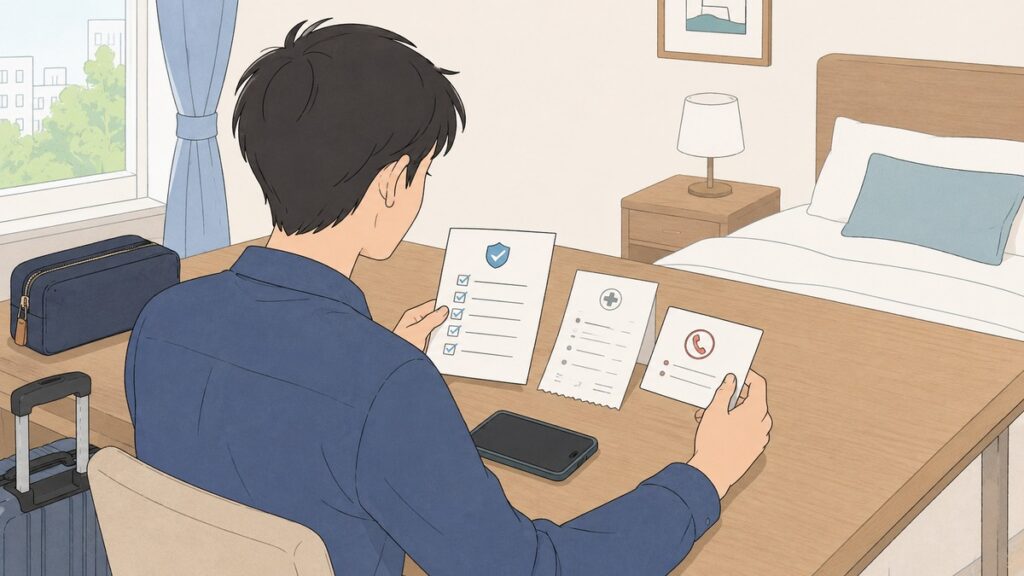
 Yes. The February 2025 visit cost ¥8,200, but insurance is for unpredictable costs such as emergency care, surgery, hospitalization, transport, or changed plans.
Check whether the insurer arranges cashless payment or requires you to pay and claim later. Its assistance line may direct you to an English-speaking or cashless partner. Japan’s official guidance notes that conditions vary and some clinics may not accept cards.
Check the deductible, pre-existing-condition and medicine rules, assistance number, required documents, and how a chronic condition affects coverage. For credit-card insurance, confirm activation conditions and medical limits.
There are no affiliate links here. Choose a policy whose exclusions you understand and whose assistance number you can reach when unwell.
If It’s an Emergency
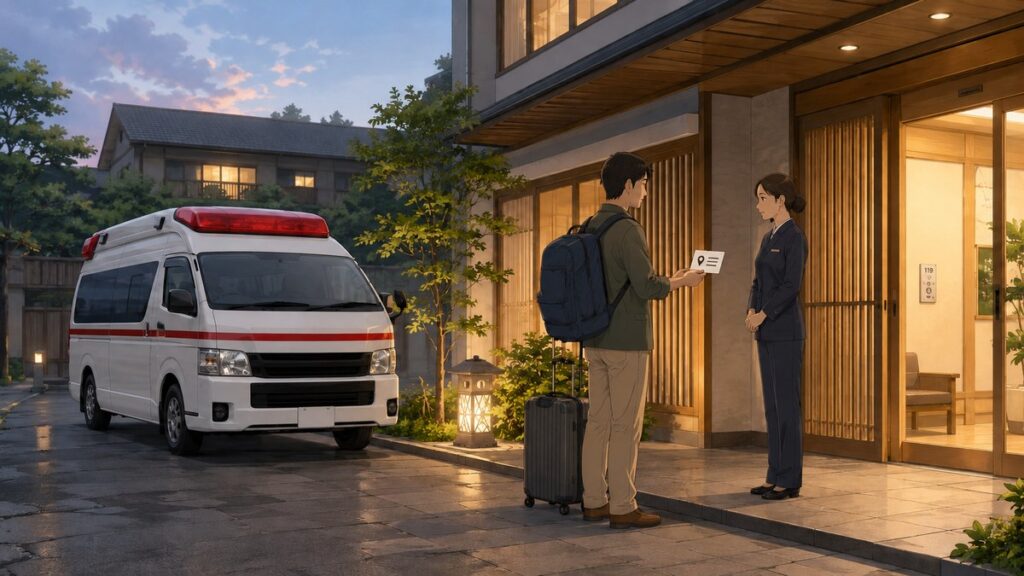
If you are unsure whether to call an ambulance, Japan has two telephone consultation services:
| Number | What it is for |
|---|---|
| #7119 — Kyukyu Anshin Center | Advice on whether to call an ambulance or seek hospital care. It operates only in participating areas. |
| #8000 — Children’s Medical Telephone Advice | Advice about a child during nights and holidays. It connects to the prefectural service, whose hours vary. |
English support varies by area and may use a different number from the general consultation service. For example, Hyogo’s #7119 service and its direct number, 078-331-7119, support 22 languages. In Okayama, the general direct number for #7119 is 086-222-7119, while foreign-language consultation uses 0120-347-096. Ishikawa provides a separate foreign-language number, 03-6735-7942, for its child medical consultation service. Check the current official page for where you are staying. Do not assume every #7119, #8000, or direct number offers English.
Short # numbers may not connect from some IP-phone or 050 services. If that happens, use the ordinary direct number published by the local government.
A data-only eSIM has no ordinary cellular voice service, so do not rely on it to call #7119, #8000, or 119. Keep one verified voice option: home-SIM roaming, a hotel phone, or help from someone nearby. Some devices or active lines have separate emergency features, but availability depends on the device, carrier, location, and conditions. Check your setup before traveling and whether your connectivity includes voice as well as data.
Call 119 for an ambulance. Give your location first—the hotel name and address, station exit, shop, or landmark—then say someone is sick or injured. If you cannot call, show someone this sentence:
救急車を呼んでください。
Kyūkyūsha o yonde kudasai.
Please call an ambulance.
Use this phrase if you need someone nearby to make the call.
The ambulance crew arranges a receiving hospital, so you may not be able to choose it. Take your passport, medicine and allergy list, and insurance details if ready, but do not delay the call.
For urgent travel help that does not require an ambulance, call the 24/7 Japan Visitor Hotline at 050-3816-2787. It supports English, Chinese, and Korean but does not replace 119.
The ambulance response and the hospital bill are separate matters. Examination, tests, medicine, and treatment provided by the hospital will be billed. Request receipts and medical documents once the situation is under control.
Final Thoughts
Keep three questions separate: Is each ingredient permitted? Where should you seek help? Which payment and insurance documents will you need?
The February 2025 Kyoto receipt was under ¥10,000, not a price guarantee. Insurance covers larger risks; use the appropriate MHLW or Narcotics Control Department contact for your medicine.
Use my Japan trip planning guide to put the rest of your preparation in order.
What would you want to know before seeing a doctor in another country? If you have visited a clinic while traveling, tell me what surprised you most in the comments.
I hope this guide has answered one of your questions and helped you feel a little closer to Japan.
May your Japan journey be filled with wonderful discoveries and memories you’ll treasure for years to come.
 See you in the next guide.

Comments