Getting from Kansai Airport to Kyoto looks simple on a map — until you start comparing the Haruka Express, airport buses, regular trains, and booking sites that all seem to show different prices for the same ride.
Here’s the short version: a special tourist-only ticket brings the Haruka — the fastest, most comfortable option — down to 2,200 yen for Kyoto, which makes it cheaper than the airport bus. It even includes a reserved seat.
In this guide, I’ll walk you through the 2026 fares, exactly how to buy the discount ticket before you fly, and one time-sensitive reason (hint: it’s pink and has whiskers) to ride the Haruka sooner rather than later. And because no train is perfect for everyone, I’ll also tell you honestly when a different option makes more sense.

Disclosure: This article contains affiliate links. If you book through one, I may earn a small commission at no extra cost to you.
In a hurry? Here’s the one link you need:
- Haruka e-ticket on Klook — Kansai Airport to Kyoto without the ticket line
Prices and seats change by date — check yours before you land.
- Just Landed at KIX — Now How Do You Get to Kyoto?
- Kansai Airport to Kyoto by Haruka: Route, Time, and Stops
- Haruka Fares in 2026: The Discount Ticket Changes Everything
- How to Buy the HARUKA One-way Ticket
- Hello Kitty Haruka: Ride It While You Can
- Haruka vs. Bus vs. Regular Train: The Honest Comparison
- Going to Namba Instead? Meet the Rapi:t
- Haruka FAQ: Quick Answers Before You Board
- The Verdict: Should You Take the Haruka?
Just Landed at KIX — Now How Do You Get to Kyoto?

After a long flight, you finally land at Kansai International Airport. Your legs are stiff, your suitcase feels heavier than it did at home — and Kyoto, the city you’ve been dreaming about, is still about 100 kilometers away.
Here’s the good news: there’s a direct express train called the Haruka that takes you from the airport to Kyoto Station in about 80 minutes, with zero transfers. You roll your suitcase off the plane, onto the train, and relax until you hear the word “Kyoto.”
The tricky part is everything around it. Regular fare or discount ticket? Reserved or non-reserved seat? Isn’t the airport bus cheaper? Search results are full of conflicting prices, and many of them are simply outdated.
So let me help. I live in Japan, and below I’ll sort out the current fares, the tourist discount that makes the Haruka cheaper than the bus, and the honest cases where it’s not your best choice.
Kansai Airport to Kyoto by Haruka: Route, Time, and Stops
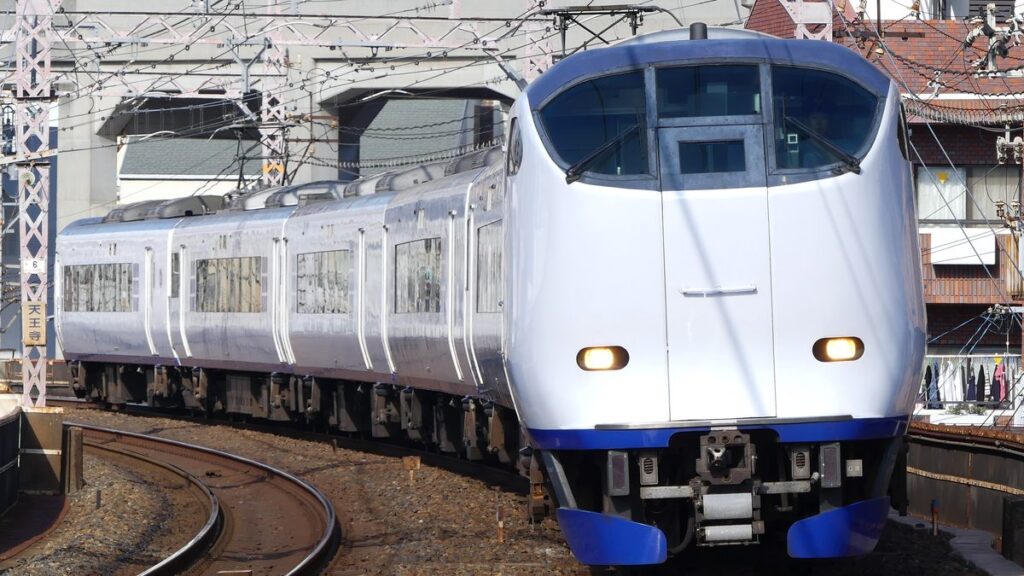
Photo: MaedaAkihiko, CC BY-SA 4.0, via Wikimedia Commons
The Haruka is JR West’s airport express — a train that runs directly from Kansai Airport to Kyoto Station in about 80 minutes. It usually departs about every 30 minutes during the daytime, with wider gaps early in the morning and late at night.
The main stops for Kyoto-bound travelers are Kansai Airport, Tennoji, Osaka, Shin-Osaka, and Kyoto, although some services make additional stops along the way. Either way, you stay in your seat — no figuring out which platform to transfer at with a 25-kilogram suitcase in tow.
 Here’s a detail even many guidebooks haven’t caught up with: since March 2023, the Haruka stops at Osaka Station’s underground Umekita platform. If your hotel is in the Umeda area, you now have a direct ride from the airport — something that simply wasn’t possible before.
 The train itself is built for this exact trip. Unlike regular commuter trains, the Haruka has luggage storage areas, toilets, and onboard Wi-Fi, which makes a real difference after a long flight. It also still has non-reserved cars, which are becoming rare on express trains in the Kansai area. With a regular ticket, a reserved seat costs 530 yen more than a non-reserved one — but hold that thought, because the tourist ticket in the next section includes a reserved seat at no extra charge.
Haruka Fares in 2026: The Discount Ticket Changes Everything
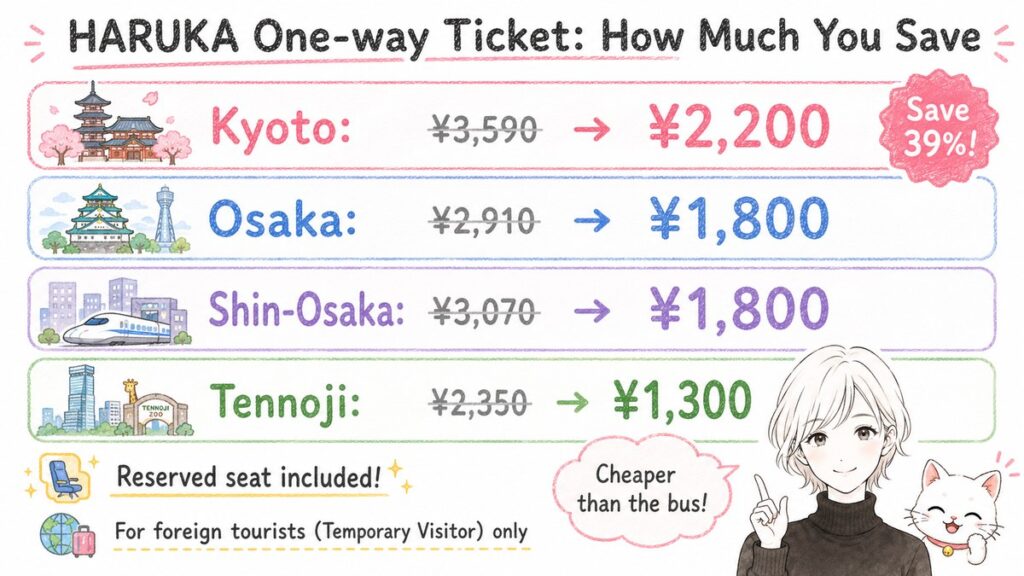
Let’s be honest: at the regular fare, the Haruka is not cheap. A reserved seat from Kansai Airport to Kyoto costs 3,590 yen, and even the non-reserved car is 3,060 yen. That’s where most travelers stop reading — and miss the best deal at the airport.
 Because here’s the thing: JR West sells a special HARUKA One-way Ticket exclusively for foreign tourists, and it drops the Kyoto fare to 2,200 yen. That’s about 39% less than the normal-season reserved-seat fare — and yes, the discount ticket includes an ordinary reserved seat at no additional charge, subject to availability. As a spoiler for the comparison section: it’s also cheaper than the airport bus.
Fares are in yen, with rough dollar figures at about ¥154 to the dollar (September 2026). Exchange rates move, so treat the dollars as a ballpark.
| Destination | Regular reserved fare (normal season) | HARUKA One-way Ticket |
|---|---|---|
| Kyoto | ¥3,590 (≈$23) | ¥2,200 (≈$14) |
| Osaka | ¥2,910 (≈$19) | ¥1,800 (≈$12) |
| Shin-Osaka | ¥3,070 (≈$20) | ¥1,800 (≈$12) |
| Tennoji | ¥2,350 (≈$15) | ¥1,300 (≈$8.50) |
A quiet bonus for the Kyoto ticket: it also covers onward JR travel to selected stations in Kyoto City, including Nijo, Saga-Arashiyama, Inari, and Yamashina, as long as you don’t make a stopover. If your hotel is near Kyoto Station you won’t need this, but if you’re headed straight to Arashiyama or Fushimi Inari, it’s a nice surprise.
 Now, the conditions. The ticket is available only to holders of a foreign passport who entered Japan with “Temporary Visitor” status — Japanese citizens aren’t eligible, including those who permanently live overseas. (Residents like me aren’t eligible either, so enjoy it for me!) It’s one-way only, and getting off at a station outside the covered section makes the ticket invalid.
One small note on the regular fares: reserved-seat charges vary by travel date — 200 yen less during off-peak periods, 200 yen more during peak periods, and 400 yen more on the busiest dates. Non-reserved fares don’t change seasonally, and neither does the discount ticket. One more reason the tourist ticket is the simpler choice.
Already traveling with the nationwide JR Pass? The Haruka is a JR limited express, so your pass covers it — reserved seats included. See my JR Pass guide to check whether that pass fits your route.
How to Buy the HARUKA One-way Ticket
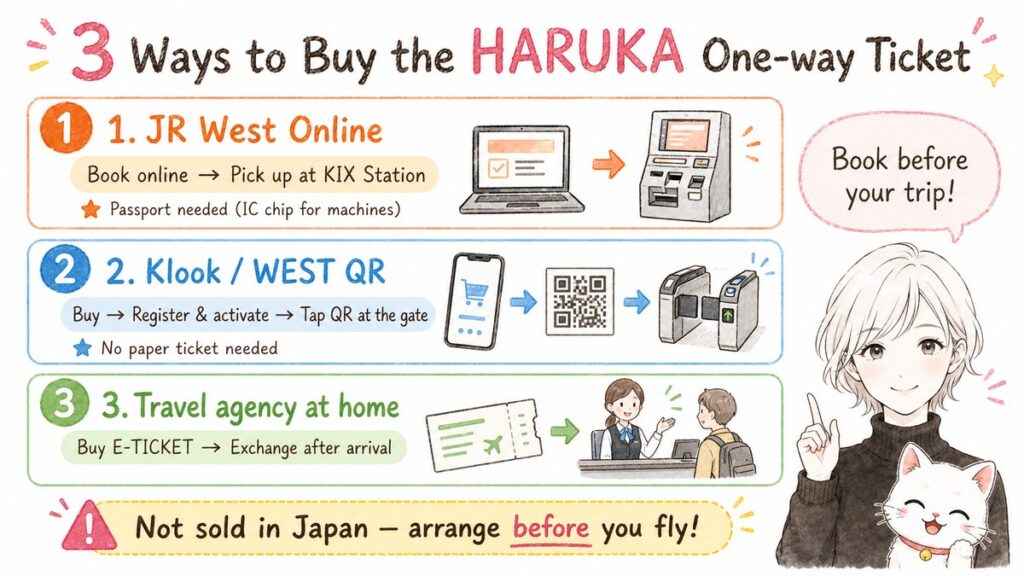
First, the single most important rule: you cannot simply buy this discounted ticket at the station after arriving in Japan. It has to be arranged in advance — online or through an eligible overseas travel agency. Here are your three ways to do it.
 Option 1: Book online with JR West. Reserve on the JR-WEST ONLINE TRAIN RESERVATION site (credit card payment only), then collect the ticket after you arrive. At the ticket machine or ticket office you’ll need your reservation number, the 4-digit identification number you set, the credit card you paid with, and your passport. One detail worth knowing: ticket machines require a passport with an IC chip — if yours doesn’t have one, head to the ticket office instead.
Option 2: Buy through Klook (WEST QR ticket). Travel platforms like Klook sell Haruka tickets in a newer “WEST QR” format. After purchasing, you register the voucher on the WEST QR website and activate it on your travel day; you can then scan the live QR code at the gate without exchanging anything for paper. You’ll need an internet-connected smartphone — screenshots can’t be used — but after 12 hours of travel, “no pickup line” is worth a lot.
One practical note: the QR code is generated live on the website, so your phone needs an internet connection when you show it at the gate — if your Japan data plan isn’t sorted yet, my eSIM comparison guide can help.
 Check current prices for the Haruka e-ticket on Klook
Option 3: Arrange it through a travel agency at home. Some overseas travel agencies sell Haruka exchange orders (E-TICKETs) that you swap for the ticket after arrival. If you’re already booking tours through one, it can be convenient to keep everything in one place.
One boarding note before you go: Kansai-airport Station is located next to Terminal 1. The Haruka doesn’t depart from Terminal 2 — if you land there, take the free shuttle bus to the Terminal 1 / Aeroplaza area first.
Hello Kitty Haruka: Ride It While You Can
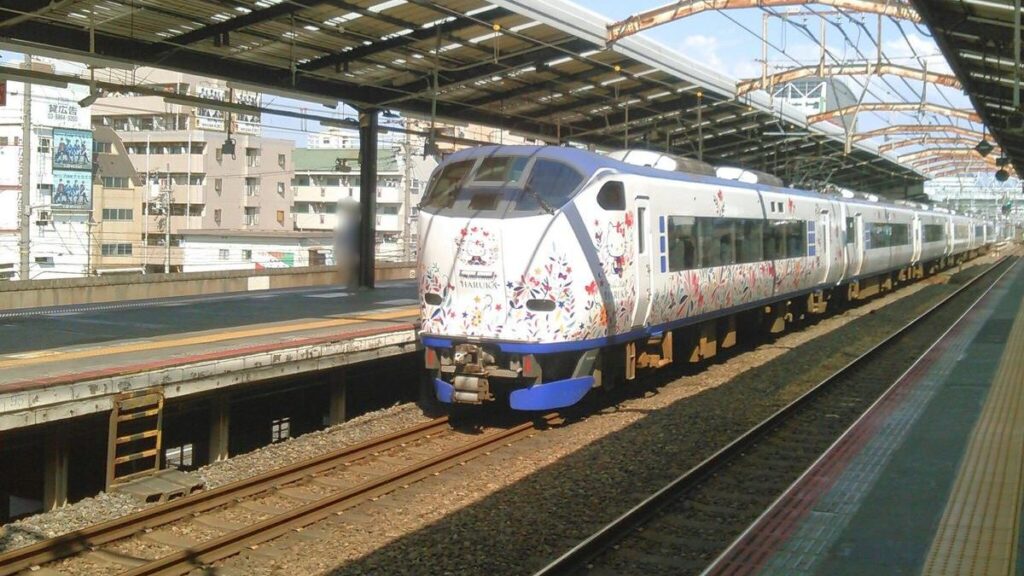
Photo: Tze Chiang Hao, CC BY 4.0, via Wikimedia Commons
 Here’s something most travel guides haven’t caught up with yet — and it’s time-sensitive. Some Haruka trains run as the “Hello Kitty Haruka,” wrapped nose to tail in pink Kitty artwork. JR West says the Hello Kitty wrapping will be gradually withdrawn by around summer 2027.
If that timeline sounds familiar, it’s because the Hello Kitty Shinkansen already made its last run in May 2026. One by one, these character trains are quietly retiring. So if a pink airport express sounds like the perfect start to your Japan trip — or the perfect way to win over a tired, cranky child after a long flight — this is genuinely a “ride it while you can” situation.
A few practical notes. There’s no extra charge for a Hello Kitty–wrapped train — it runs with the same tickets and fares as the regular Haruka. But the wrapping isn’t sold as a separate ticket type, and a specific design can’t be guaranteed, so think of it as a happy surprise rather than something to plan your day around.
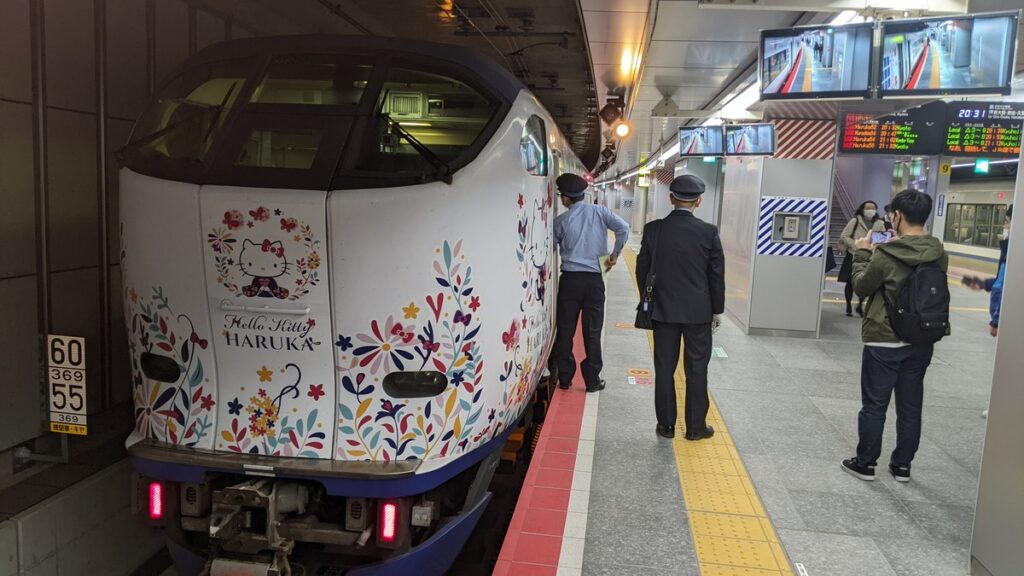
Spotted at Osaka Station’s Umekita platform. Photo: Mr.Churasan, CC BY-SA 4.0, via Wikimedia Commons
And yes — this is coming from a Japanese mom whose kids would absolutely lose their minds over a giant pink train. Some things are universal.
Haruka vs. Bus vs. Regular Train: The Honest Comparison
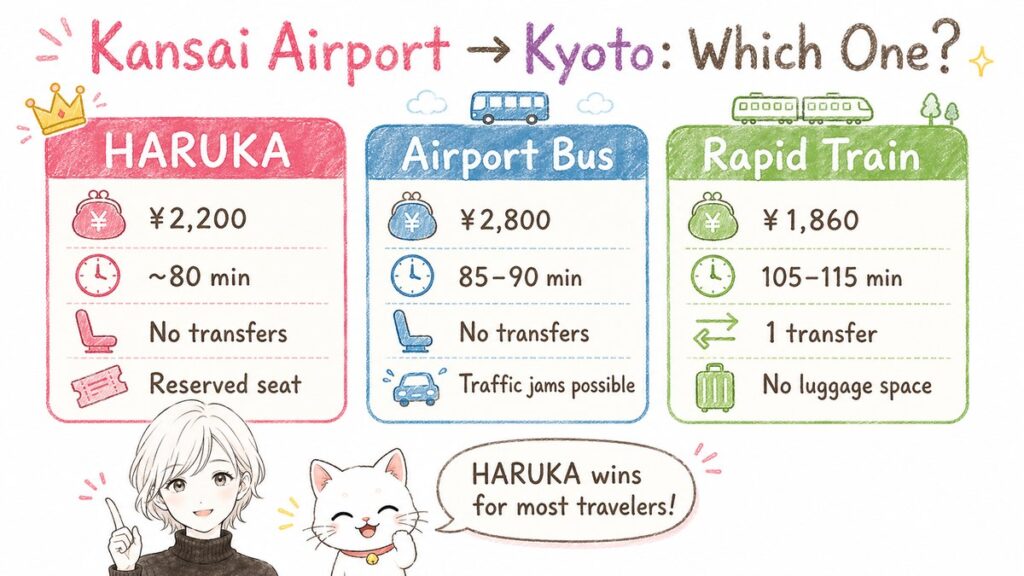
Let me put the three realistic options side by side. For most tourists, this table settles the debate quickly.
| Option | Price | Time | Transfers |
|---|---|---|---|
| Haruka (One-way Ticket) | ¥2,200 (≈$14) | ~80 min | None |
| Airport limousine bus | ¥2,800 (≈$18) | ~85–90 min | None |
| Rapid train (+ transfer) | ¥1,860 (≈$12) | ~105–115 min | 1 |
With the discount ticket, the Haruka is cheaper than the bus, a little faster, and immune to traffic jams. For most short-term visitors heading to Kyoto Station or another covered JR station, the discounted Haruka is the strongest all-round choice.
To be fair, the rapid train is the cheapest at 1,860 yen. Saving 340 yen may be worthwhile on a very tight budget, but you give up the reserved seat, the dedicated luggage space, and the direct ride — all during your jet-lagged first hours in Japan.
One honest exception: if you can’t use the tourist discount — say, you’re a resident like me — the regular Haruka fare of 3,590 yen makes the 2,800-yen bus genuinely worth considering, especially if your hotel is near a bus stop.
What if you land late at night? The last Haruka for Kyoto currently leaves Kansai Airport at about 10:16 p.m. — but don’t book an airport hotel just yet: the Kyoto-bound bus currently runs later, with the final departure at 11:20 p.m., arriving at Kyoto Station around 12:25 a.m. If you’ve missed even that, the airport has hotels and 24-hour areas — a short sleep and the first train out at dawn is honestly not a bad way to start a trip. Timetables change, so double-check the official Haruka timetable and the airport bus timetable before a late arrival.
Going to Namba Instead? Meet the Rapi:t
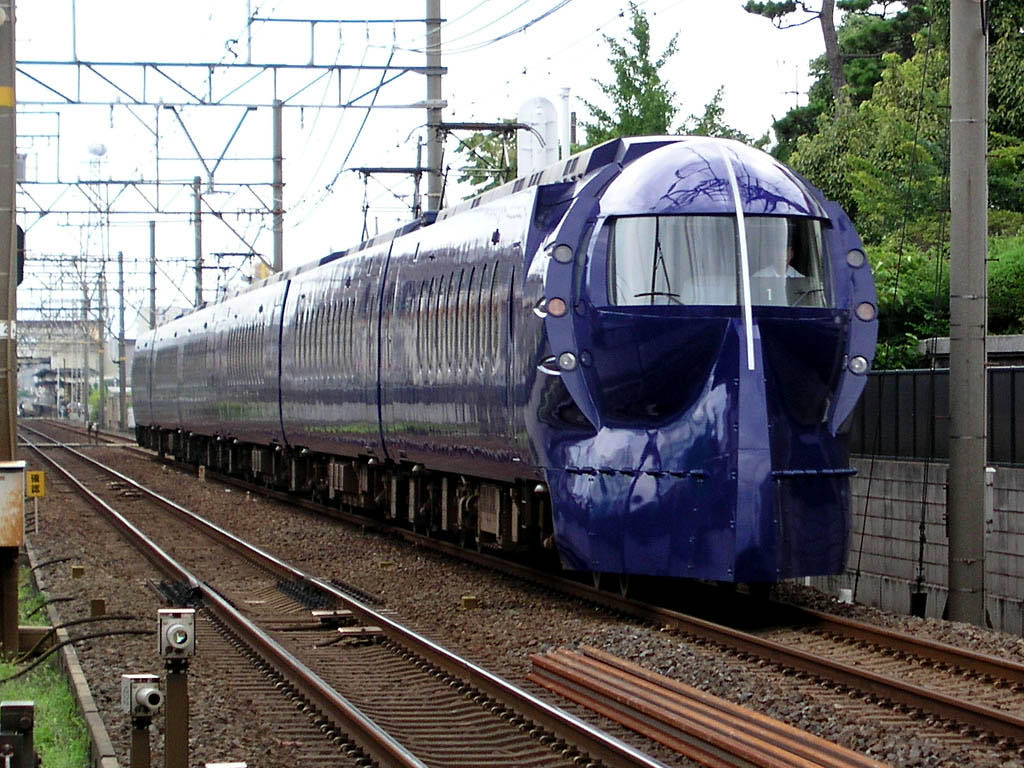
The Haruka isn’t the answer for everyone — and this is where a lot of travelers buy the wrong ticket. It all depends on where in Osaka you’re staying.
 The simple rule: if you’re headed to Kyoto, Umeda (Osaka Station), Shin-Osaka, or Tennoji, take the Haruka. If your hotel is in Namba, Shinsaibashi, or the Dotonbori area, there’s a better train for you — the Rapi:t, Nankai Railway’s airport express. It’s a deep-blue, retro-futuristic train that looks like it drove out of a 1960s anime, and it runs directly to Nankai Namba Station, making it much more convenient for Namba and Dotonbori than taking the Haruka and transferring.
I’ve written a full guide to the Rapi:t — fares, discount tickets, and whether it’s worth it — right here:
Kansai Airport to Namba: Is the Rapi:t Worth It? (2026 Fare Guide)
One ticket-buying tip that saves real money: don’t buy a Haruka ticket “just in case” if Namba is your destination. JR and Nankai share the same airport station area, but they use separate ticket gates located next to each other — so decide by your hotel’s location first, then buy.
Planning a Universal Studios Japan day while you’re in Osaka? Park queues eat far more time than any airport-train decision — my USJ Express Pass guide breaks down whether skipping the lines is worth the price.
The Haruka drops you at Kyoto Station, so a hotel near the station lets you leave your suitcase and start the day right away — useful when you land in the afternoon and check-in is still hours off. Compare Kyoto hotels on Agoda.
Haruka FAQ: Quick Answers Before You Board
Is the Haruka a shinkansen (bullet train)?
No — it’s a limited express that runs on regular tracks. No shinkansen serves Kansai Airport, so the Haruka is the fastest rail option you’ll find there.
Do I need to reserve a seat on the Haruka?
With the HARUKA One-way Ticket, an ordinary reserved seat is included at no extra charge (subject to availability), and you can also simply use the non-reserved cars. With a regular ticket, a reserved seat costs 530 yen more.
Can I buy the HARUKA One-way Ticket after arriving in Japan?
No. It isn’t sold within Japan — book it online via JR-WEST ONLINE TRAIN RESERVATION or through an eligible overseas travel agency before you arrive.
Does the Haruka leave from Terminal 2?
No. Kansai-airport Station is next to Terminal 1. From Terminal 2, take the free shuttle bus to the Terminal 1 / Aeroplaza area first.
Can I take large luggage on the Haruka?
Yes — the train has luggage storage areas on board, which is one of its biggest advantages over regular commuter trains.
Can I use the HARUKA One-way Ticket from Kyoto to Kansai Airport?
Yes, it’s sold for both directions — but the same rule applies: arrange it in advance, because it can’t be purchased within Japan.
The Verdict: Should You Take the Haruka?
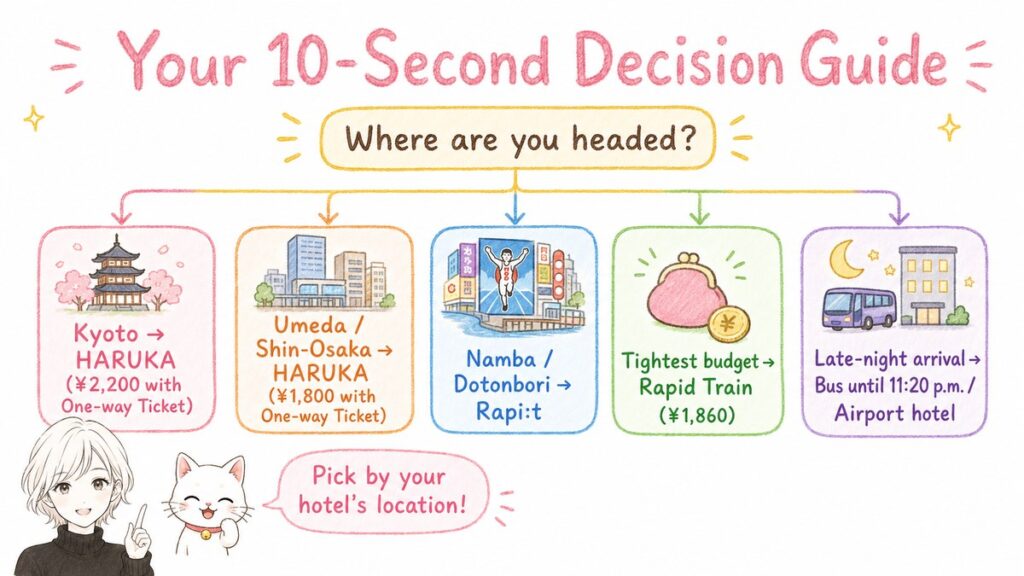
Let’s bring it all together. Here’s your 10-second decision guide:
- Heading to Kyoto, Umeda, Shin-Osaka, or Tennoji → Haruka, with the One-way Ticket (2,200 yen to Kyoto, reserved seat included — cheaper than the bus)
- Heading to Namba or Dotonbori → the Rapi:t instead
- Traveling on the tightest possible budget and don’t mind a transfer → rapid train, 1,860 yen
- Landing late at night → the Kyoto bus runs until 11:20 p.m.; after that, airport hotel and the first train out
For most Kyoto-bound travelers, the Haruka with the discount ticket is the strongest all-round choice on price, speed, and comfort — and if a pink Hello Kitty train happens to pull in, consider it a sign your trip is off to a very good start.
Check Haruka Ticket Prices on Klook
 Now I’m curious about your side of the world — what’s the ride from the airport like in your country? A sleek express train, a bus stuck in traffic, or a taxi driver with strong opinions? Tell me in the comments below. I read every single one!
I hope this guide has answered one of your questions and helped you feel a little closer to Japan. May your Japan journey be filled with wonderful discoveries and memories you’ll treasure for years to come.
See you in the next guide. 
Check Kyoto Hotel Prices on Agoda
What to Read Next
- Kansai Airport to Namba: Is the Rapi:t Worth It?
- Is the JR Pass Worth It in 2026?
- Best eSIM for Japan: Tested & Compared
- Japan on a Budget: 10-Day Itinerary & Real Costs
- Want to reach Kyoto hands-free? Luggage Forwarding in Japan: Is It Worth It?
- 8 Kansai Trains Worth Paying Extra For (2026): Comfortable Seats, Great Views, and How to Book Each One



Comments