
- The 30-Second Answer: Which Town, Which Bath
- Three Kinds of “Private Onsen” in Japan
- Is Your Room Bath Real Hot Spring Water?
- From Tokyo: Hakone — Rooms With Their Own Bath
- From Tokyo: Izu — Sea Views and Quieter Towns
- From Kyoto or Osaka: Arima, About an Hour Away
- From Kyoto: Arashiyama and Yunohana Onsen
- A Bit Farther but Worth Knowing: Kinosaki
- Tattoos: What to Ask Before You Book
- With Kids or a Baby: What to Check
- How to Find One Before It Sells Out
- Price Ranges by Area and Bath Type
- Dinner, Check-In and a Ryokan Night
- How Our Family Would Pick
- FAQ
The 30-Second Answer: Which Town, Which Bath
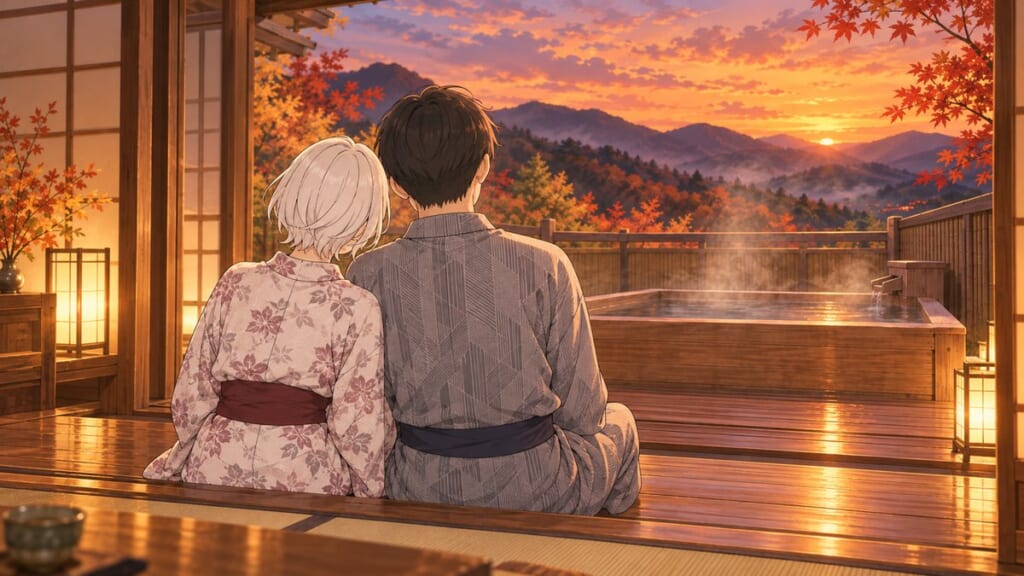
 You want an evening soaking together, but “private onsen” listings leave you wondering which bath is yours and whether you can secure a time slot. Start with Hakone from Tokyo, Arima from Osaka, or Arashiyama and Yunohana from Kyoto; allow more travel time for Izu or Kinosaki. “Private onsen” can mean an in-room bath, a reserved bath, or a bath you use when free, and an in-room tub may use ordinary heated water.
 I once stayed with my husband in a room with an open-air bath. I loved being able to bathe together and go back as often as I liked, whenever I wanted.
Use the table to choose your area, then the three starting points below to narrow your room search. I picked these using each inn’s official information.
Table A. Choose your starting point and onsen town
| From → area | Travel guide | Bath options in this selection | One-night range | Suits you if… |
|---|---|---|---|---|
| Shinjuku → Hakone | About 80 min to Hakone-Yumoto; onward travel for Gora or Sengokuhara | In-room open-air; reserved private baths | ¥45,517–¥69,645 (about $294–$449) | You want one night added to Tokyo |
| Tokyo → Izu | Shuzenji: about 126 min by Odoriko; Ito: about 1 hr 40 min by Odoriko (direct) | In-room baths; free, unreserved family baths | ¥46,493–¥102,581 (about $300–$662) | You want a separate town stay |
| Osaka → Arima | About 60 min by bus; about 60–80 min by train, depending on route | Reserved private baths; selected rooms with baths | ¥69,999–¥87,602 (about $452–$565) | You’re adding a night from Osaka |
| Kyoto → Arima | About 75 minutes by bus from Kyoto Station’s Hachijo exit | Reserved private baths; selected rooms with baths | ¥69,999–¥87,602 (about $452–$565) | You prefer a direct bus |
| Kyoto → Arashiyama | About 20 min to Saga-Arashiyama, then local transfer | Selected rooms with open-air baths; reserved private bath | Sold out on our check dates | You want to combine Kyoto sightseeing |
| Kyoto → Yunohana | About 20 min to Kameoka + about 20 min by reserved shuttle | In-room open-air; reserved private bath | ¥64,100 (about $414), weekday only | You can plan around a shuttle |
| Kyoto / Osaka → Kinosaki | About 2 hr 30 min / 2 hr 40 min by limited express | In-room heated-water baths; reserved hot-spring baths | ¥137,260–¥157,060 (about $886–$1,013) | You have time for a longer detour |
Times cover the stated routes, not your hotel door to the ryokan door. Ranges use Table D’s basis: two adults, one night, dinner and breakfast.
Disclosure: This article contains affiliate links. If you book through one, I may earn a small commission at no extra cost to you.
Quick booking list: the 10 inns in this guide (Agoda)
- Hakone (from Tokyo): Shinanoki Ichinoyu, Hakone Suimeisou, Gora Kadan
- Izu (from Tokyo): Laforet Ito Onsen Yunoniwa, Oni no Sumika
- Arima (from Osaka or Kyoto): Ginsuiso Choraku, Taketoritei Maruyama
- Near Kyoto: Sumiya Kihoan (Yunohana), Arashiyama Onsen Hanaikada (Arashiyama)
- Kinosaki: Nishimuraya Hotel Shogetsutei
Room prices change daily. Open the exact room name to check its bath, and read the cancellation terms before you pay.
Three places to start
One inn from Tokyo, one from Kyoto or Osaka, and one close to Kyoto.

From Tokyo: Hakone Suimeisou
Two minutes on foot from Hakone-Yumoto; the official FAQ identifies its open-air room baths as 100% hot spring water.
Tip: enter your dates and number of guests first — Agoda only shows rooms and prices after that.

From Kyoto or Osaka: Ginsuiso Choraku
Reservable gold- and silver-spring baths, a stated private-bath option for tattooed guests, and dinner served in your room.
Tip: enter your dates and number of guests first — Agoda only shows rooms and prices after that.

From Kyoto: Sumiya Kihoan
Rooms described as having free-flowing hot-spring baths, reached via Kameoka and a reserved shuttle.
Tip: enter your dates and number of guests first — Agoda only shows rooms and prices after that.
Photos: Agoda. Room prices change daily — the full list is below.
For planning around busy sightseeing stops, see my guide to avoiding crowds in Japan.
Three Kinds of “Private Onsen” in Japan
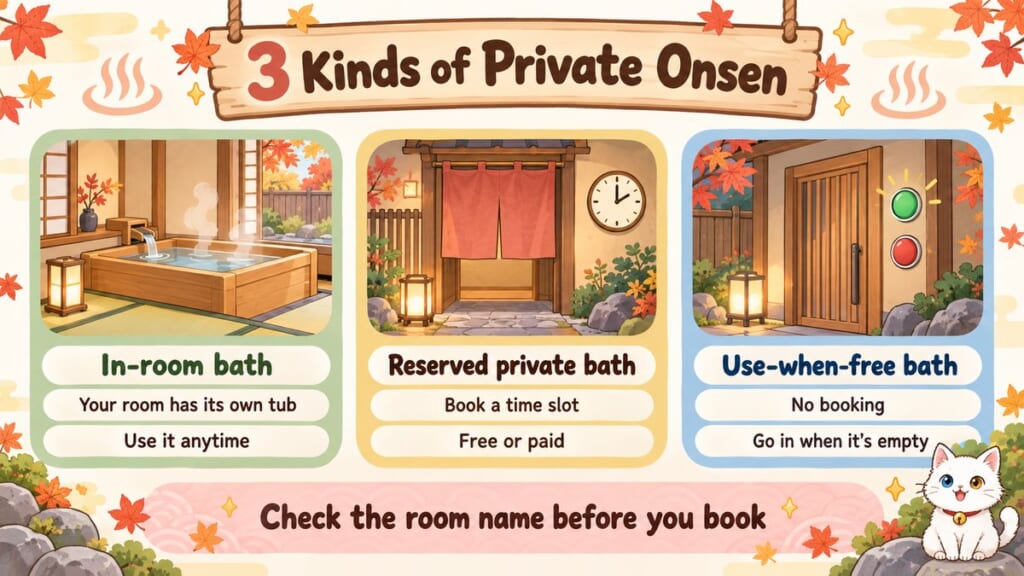
Choose how you want to use the bath before choosing a room. An in-room bath gives you flexibility; a reserved bath gives your party an agreed time; an unreserved bath depends on availability.
Table B. Three ways to bathe privately
| Type and Japanese label | Hot spring water? | Extra charge | How you use it | Suits you if… |
|---|---|---|---|---|
| In-room open-air bath: 客室露天風呂, kyakushitsu rotenburo | Check the exact room on the inn’s official site | Included in that room’s rate | Yours during the stay; check operating hours | A couple or family wants flexible timing; confirm tattoo permission |
| Reserved private / family bath: 貸切風呂 / 家族風呂 | Check the specific bath | Free or paid | Reserve ahead or at check-in; fixed slot | A couple or family wants a planned session; confirm tattoo permission |
| Private / family bath used when free | Check the specific bath | Laforet’s example is free for guests | Enter when vacant; no reservation | Your party can wait or try again; confirm tattoo permission |
 Kashikiri is the Japanese word used for exclusive-use booking, as in 貸切風呂. At one ryokan, I booked a bath time at reception during check-in, and it was free for overnight guests.
Oni no Sumika puts the private bathing space in your room. Hakone Suimeisou, Ginsuiso Choraku, Sumiya Kihoan and Nishimuraya Hotel Shogetsutei offer paid reserved baths.
Laforet Ito Onsen Yunoniwa offers free family baths used when vacant. Taketoritei Maruyama allocates free slots by reservation after check-in, first come; Gora Kadan offers a free 40-minute session that guests can reserve; ask the inn when to book. For bathing basics, see my Japanese onsen guide.
Is Your Room Bath Real Hot Spring Water?
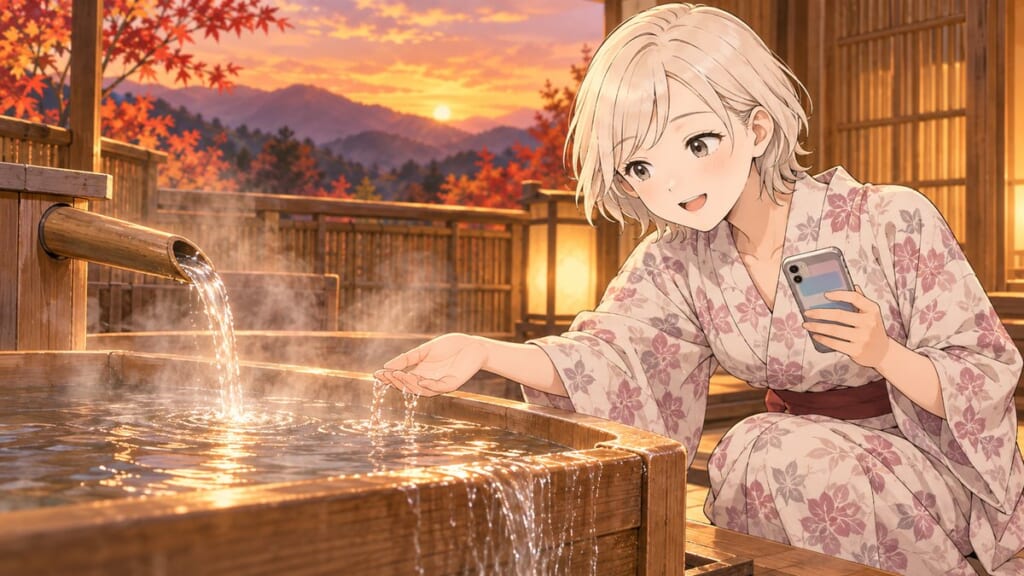
Read the description of your exact room and bath. A photograph shows the tub; the inn’s wording tells you what fills it.
| Japanese term | What it tells you |
|---|---|
| 源泉かけ流し | Source water flows through without recirculating used bathwater. |
| 循環 | Water is recirculated. |
| 加水 | Water is added. |
| 加温 | The water is heated. |
| 引き湯 | Spring water is brought from its source to the property. |
Read these details together rather than treating one label as a quality ranking.
Hakone Suimeisou says its open-air room baths use 100% hot spring water, while ordinary Japanese-room baths use heated water; the inn also describes its hot springs as combining free-flowing supply with circulation and filtration. Shinanoki Ichinoyu specifies recirculation for its guest-room open-air baths, and Sumiya Kihoan describes its selected room baths as free-flowing. Nishimuraya Hotel Shogetsutei identifies its room baths as ordinary heated water and its reserved private baths as hot spring water.
Taketoritei Maruyama explicitly describes its private baths as not free-flowing.
Why Japan does it this way: Shogetsutei explains that Kinosaki uses ordinary heated water in individually occupied spaces such as guest-room open-air baths to protect the town’s public baths and hot-spring resources. You can choose the room for privacy and reserve the separate spa for an onsen soak.
 Check five details before booking:
- The exact room name.
- Whether its water is hot spring water.
- The flow, circulation and added-water/heating description.
- Who has exclusive use.
- Any booking slot or extra fee.
Keep the room name beside the bath description as you compare Agoda options.
From Tokyo: Hakone — Rooms With Their Own Bath
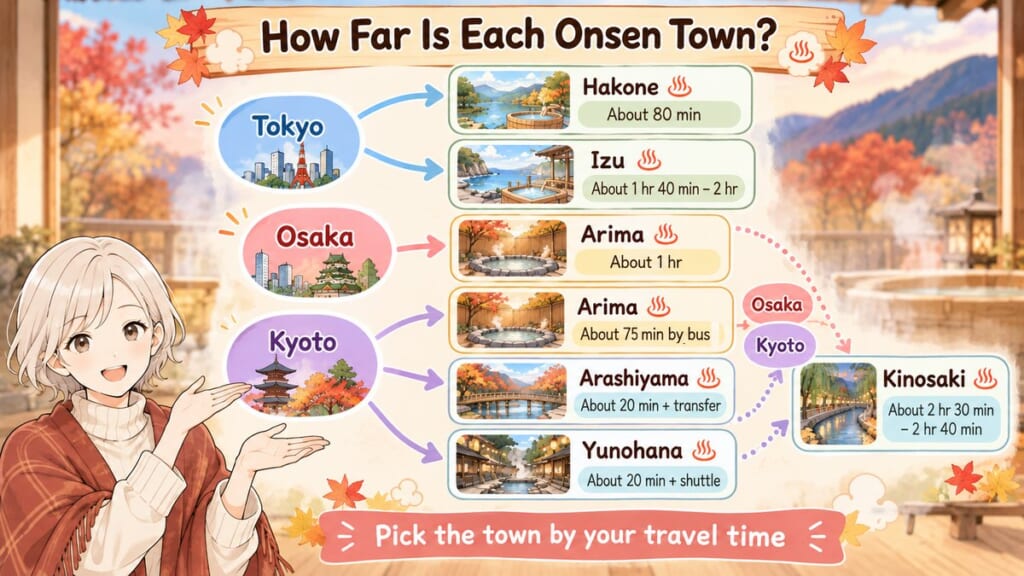
Hakone is a practical first search for one night from Tokyo. Odakyu’s direct Romancecar takes about 80 minutes from Shinjuku to Hakone-Yumoto, with waiting and onward travel separate.
Yumoto keeps the arrival simple, especially with a station-side inn. It suits you if getting to the bath matters more than adding another transfer.
Gora means continuing beyond Yumoto. Gora Kadan can collect guests who call on arrival at Gora Station; allow about 40 minutes for the Hakone Tozan train.
Sengokuhara adds a bus leg: Shinanoki Ichinoyu lists about 25 minutes from Yumoto, then a one-minute walk from its stop. Choose it if that connection fits your afternoon; keep Lake Ashi as a separate area to consider in the wider Hakone route.

Photo: Agoda.
Shinanoki Ichinoyu: budget-friendly to mid-range, with a room bath
Shinanoki Ichinoyu has numerous room categories with open-air baths, using recirculated hot spring water. It also sells rooms without baths and has no separate reservable private bath, so choose the room category carefully. Ask the inn about tattoos and your children’s accommodation conditions; its communal-bath rule permits opposite-sex bathing only for preschool children.
Shinanoki Ichinoyu Official Site
Tip: enter your dates and number of guests first — Agoda only shows rooms and prices after that.
Check Shinanoki Ichinoyu on Agoda
Photo: Agoda.
Hakone Suimeisou: mid-range, two minutes from the station
Hakone Suimeisou offers 17 rooms with open-air hot-spring baths and two paid reservable open-air baths. A private session costs ¥2,200 (about $14) for 50 minutes, including tax, with advance reservations by email or phone. Infants may use its bathing facilities; ask about tattoos, and expect a private dining room when booking an open-air-bath room.
 Bath fees here and below are dated October 18, 2026; dollar estimates use ¥155 to the US dollar, rounded to whole dollars, as of October 2026. Overnight price ranges remain in Table D.
Hakone Suimeisou Official Site
Tip: enter your dates and number of guests first — Agoda only shows rooms and prices after that.
Check Hakone Suimeisou on Agoda

Photo: Agoda.
Gora Kadan: a splurge with a separate free private session
Gora Kadan offers open-air-bath rooms and a separate free 40-minute, free-flowing hot-spring bath session for guests. For a private bath in your room, ask the inn whether it uses hot spring water. Ask about tattoos and family room conditions; children still in diapers cannot use the communal bath.
Tip: enter your dates and number of guests first — Agoda only shows rooms and prices after that.
For a Hakone itinerary, see my 10-day Japan itinerary on a budget.
From Tokyo: Izu — Sea Views and Quieter Towns
Izu is worth a separate town stay if you can allow the journey. Oni no Sumika lists Tokyo–Shuzenji by Odoriko at about 126 minutes, followed by a taxi or local bus. Laforet’s route changes at Atami onto the Ito Line; the direct Odoriko takes about 1 hour 40 minutes to Ito. For these two stays, focus your search on the bath arrangement and room layout.

Photo: Agoda.
Laforet Ito Onsen Yunoniwa: budget-friendly, with unreserved family baths
Laforet Ito Onsen Yunoniwa is eight minutes on foot from Ito Station. Its three free, free-flowing family baths are available around the clock when vacant. Premium rooms have in-room baths supplied from its own spring; ask whether your room’s bath is indoor or open-air. The family-bath page permits tattoos only when covered by two 8 × 10 cm stickers; ask about children.
Laforet Ito Yunoniwa Official Site
Tip: enter your dates and number of guests first — Agoda only shows rooms and prices after that.
Check Laforet Ito Yunoniwa on Agoda

Photo: Agoda.
Oni no Sumika: a splurge with bathing space in every room
Oni no Sumika has nine rooms with private bathing facilities, including open-air and semi-open-air options supplied with Shuzenji hot spring water. The official site says bathing time is unrestricted and included in the stay; choose your preferred layout by room name. Ask about tattoos and children’s ages before booking; ask about the water system if free-flowing water matters to you.
Tip: enter your dates and number of guests first — Agoda only shows rooms and prices after that.
From Kyoto or Osaka: Arima, About an Hour Away
From Osaka, allow about an hour by the JR-based rail route, or about 80 minutes via Hankyu/Hanshin; buses take about 60 minutes. From Kyoto Station’s Hachijo exit, the bus takes about 75 minutes.
Kinsen (gold spring) is brown, with iron and salt; ginsen (silver spring) is clear, and includes carbonated and radon springs. Choraku’s reserved baths offer both, which makes a focused bathing night possible between city stays. If you’re coming from my guide to Kyoto hotels for a family of 4, compare the children’s room conditions as carefully as the route.
Photo: Agoda.
Ginsuiso Choraku: mid-range, with a clear reserved-bath option
Ginsuiso Choraku offers a 50-minute gold- and silver-spring private session for ¥5,500 (about $35), including tax. Its FAQ directs tattooed guests to this paid bath, and dinner is served in your room. Its Choyoan room has a silver-spring open-air bath, and the Shiki residence (13+) has gold-spring open-air baths. Ask about main-building children’s conditions.
Ginsuiso Choraku Official Site
Tip: enter your dates and number of guests first — Agoda only shows rooms and prices after that.
Check Ginsuiso Choraku on Agoda

Photo: Agoda.
Taketoritei Maruyama: mid-range to splurge, with dinner elsewhere
Taketoritei Maruyama offers eight free private baths, reserved after check-in for 45 minutes, and calls them tattoo-friendly. Its FAQ says 2026 dinner reservations are already closed and dinner service will permanently end on December 30, 2026, so plan around breakfast and dinner elsewhere.
Rooms named Silver Onsen have silver-spring baths. From January 2027 the inn plans to serve breakfast only (¥4,400 / about $28, including tax, reserved in advance). Ask about children’s conditions.
Taketoritei Maruyama Official Site
Tip: enter your dates and number of guests first — Agoda only shows rooms and prices after that.
Check Taketoritei Maruyama on Agoda
From Kyoto: Arashiyama and Yunohana Onsen
These areas fit a Kyoto-based trip without the longer Kinosaki journey. Hanaikada lists Kyoto–Saga-Arashiyama at about 20 minutes; Sumiya Kihoan lists Kyoto–Kameoka at about 20 minutes plus a reserved shuttle of about 20 minutes. Room-bath categories may sit higher in an inn’s range, so compare the exact room with a standard room plus a private session.
Photo: Agoda.
Sumiya Kihoan: mid-range, with free-flowing room baths
Sumiya Kihoan lists six rooms with free-flowing open-air hot-spring baths. Its separate reserved bath costs ¥3,000 (about $19), excluding tax, for 45 minutes, reached by a two- to three-minute gravel path. Children stay in specified room categories and have dinner in their room because the dinner dining room excludes children; ask about tattoos and whether that bath uses the same hot spring water.
Tip: enter your dates and number of guests first — Agoda only shows rooms and prices after that.

Photo: Agoda.
Arashiyama Onsen Hanaikada: mid-range, alongside Kyoto sightseeing
Arashiyama Onsen Hanaikada has two hot-spring open-air-bath rooms plus two in its separate Sankai-an accommodation, and a reserved open-air bath. Its reserved open-air bath costs ¥2,200 (about $14), including tax, for 40 minutes, with advance reservation required; the room baths use 100% Arashiyama hot spring water. Children’s meals are available; ask about ages and tattoos. The inn is five minutes on foot from Hankyu Arashiyama; its Saga-Arashiyama pickup requires a call that day and depends on availability.
Tip: enter your dates and number of guests first — Agoda only shows rooms and prices after that.
 If an autumn garden view is your priority, three different inns appear in my guide to autumn ryokan with garden views in Kansai. Use that selection alongside your bath requirements.
A Bit Farther but Worth Knowing: Kinosaki
Kinosaki takes longer to reach than the other towns here. Shogetsutei lists about 2 hours 30 minutes from Kyoto on the Kinosaki limited express and about 2 hours 40 minutes from Osaka on the Kounotori, with seat reservations required. Its walkable circuit of public bathhouses gives you another reason to linger; check the official Kinosaki site for which ones are open on your dates.
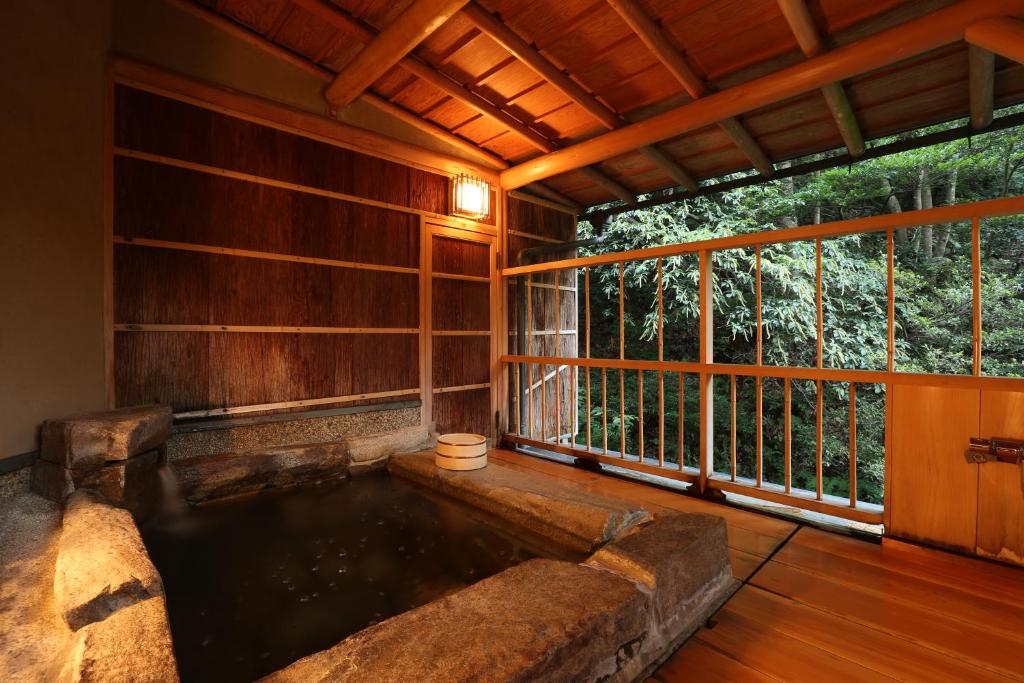
Photo: Agoda.
Nishimuraya Hotel Shogetsutei: toward splurge, with a separate private onsen
Nishimuraya Hotel Shogetsutei suits you if you distinguish the heated-water room bath from the hot-spring private spa. The reserved spa costs ¥8,800 (about $57), including tax, per room for 70 minutes and up to four guests, for overnight guests only. Ask about tattoos and children’s bathing conditions, and arrange your station transfer; walking takes about 25–30 minutes.
Tip: enter your dates and number of guests first — Agoda only shows rooms and prices after that.
Tattoos: What to Ask Before You Book
Match the question to your tattoo and the bath you plan to use. Among these ten inns, the stated policies here are Laforet’s two-cover-sticker condition, Choraku’s paid private-bath option, and Taketoritei’s tattoo-friendly private baths; ask the other seven directly.
 For a small coverable tattoo, ask which covering is accepted and where. If clothes cover it but you prefer private bathing, ask about shared showers and the route to the bath; for visible face, neck or arm tattoos, explain their location in writing before booking and keep the reply.
You can send these three lines, replacing the brackets. Name the exact room or private bath you want:
I have tattoos on [body areas], approximately [size], which [can/cannot] be fully covered.
May I use [room name / private bath name], and are there any rules for shared showers, corridors or other shared areas?
Please confirm any covering requirements and whether I need to reserve that bath in advance.
For general tattoo and bathing questions, see my Japanese onsen guide. Use the inn’s answer to choose your booking.
With Kids or a Baby: What to Check
A bath your family can use together can simplify the evening, provided the room and bathing rules suit your children. Bathing together feels normal to me as a Japanese parent, and it’s part of home life in my family. At ryokan baths with my children, I paid attention to hot water, slippery floors and steps, and consideration for other guests.
Table C. Questions for a family booking
| Check | What to ask or confirm |
|---|---|
| Age limits | Are children of your exact ages accepted in this room and bath? Choraku’s Shiki residence is 13+. |
| Bath depth and access | How deep is it, are there steps, and can the door to the bath be secured against unsupervised access? |
| Water temperature | What is the bathing temperature, and can staff adjust it? |
| Bed-sharing and bedding | What does each child’s booking include, and is extra bedding available? |
| Dinner | What can children eat, and where? Sumiya Kihoan places families in room-dining arrangements. |
| Bathing with a parent of another sex | What rule applies to each bath? Shinanoki’s communal-bath limit is preschool age. |
| Diapers | May a baby use this specific bath? Suimeisou permits infants; Gora Kadan excludes diapered children from its communal bath. |
Start with the inn’s official family conditions, then send the unanswered questions with your children’s ages. For the city portion of your stay, see my guide to Kyoto hotels for a family of 4.
How to Find One Before It Sells Out
Start with the town and exact room, so you can compare the same stay across booking pages. This five-step search keeps the bath you want at the centre.
- Choose the town using Table A and your available travel time.
- Search Agoda for ryokan and private-bath descriptions, then open the room names and inclusions.
- Check the inn’s official site for that room’s bath type, water and reservation conditions.
- Try Japanese filters on Jalan, Rakuten Travel or Ikyu: 客室露天風呂 means an open-air bath attached to the room; 貸切風呂 means an exclusive-use bath. I use 客室露天風呂 when searching Japanese booking sites; these terms can help you find options missed by an English search.
- Check your intended dates early, especially weekends, New Year, cherry-blossom season, autumn leaves and Golden Week.
On our December check dates, Gora Kadan and Hanaikada were already fully booked on Agoda.
 Cancellation terms can differ between Agoda and the inn’s site, so compare the specific plans. To travel to the ryokan with less luggage, see my guide to luggage forwarding in Japan.
Price Ranges by Area and Bath Type
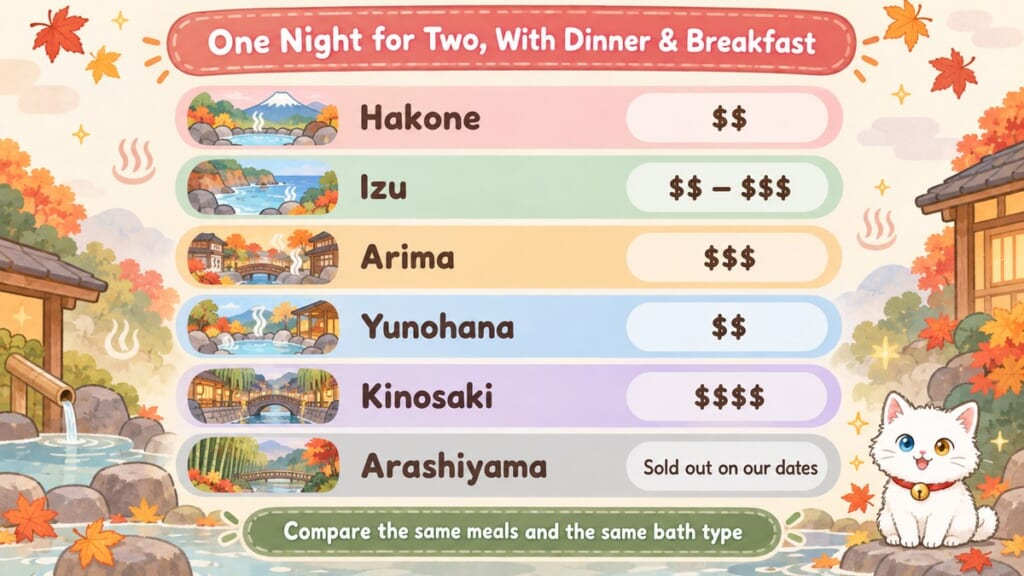
Compare a room for two with the same meals included. The bath category, dinner, room size and night before a holiday are the details to compare when one plan costs more.
Table D. One night for two, with dinner and breakfast
| Area | Range we found (total for two) | What the range covers |
|---|---|---|
| Hakone | ¥45,517–¥69,645 (about $294–$449) | Shinanoki Ichinoyu and Hakone Suimeisou, mostly rooms with an open-air bath; Gora Kadan was sold out on both dates |
| Izu | ¥46,493–¥102,581 (about $300–$662) | Low end: a standard room at Laforet; high end: a villa with its own baths at Oni no Sumika |
| Arima | ¥69,999–¥87,602 (about $452–$565) | Standard rooms at Ginsuiso Choraku; Taketoritei Maruyama is excluded because it serves no dinner |
| Yunohana | ¥64,100 (about $414), weekday only | A room without an open-air bath at Sumiya Kihoan; Saturday was sold out |
| Arashiyama | Sold out on both dates | Hanaikada |
| Kinosaki | ¥137,260–¥157,060 (about $886–$1,013) | Standard Japanese-style rooms at Nishimuraya Hotel Shogetsutei |
Basis: Agoda prices checked on October 19, 2026, logged out, for two adults sharing one room on a weekday (Tuesday, December 8, 2026) and a Saturday (December 12, 2026), dinner and breakfast included. Totals include taxes and fees; private-bath fees are extra. Prices change daily, so treat these as a guide.
Laforet and Shogetsutei list room-only options, Suimeisou’s main building and Taketoritei Maruyama have no-dinner plans, and Oni no Sumika lists a breakfast plan; ask the others directly. Choose the meals and bath time you actually want; paying more alone tells you little about how well the stay fits you.
For a city-based splurge with spa facilities, compare my guide to Tokyo and Kyoto hotels with a spa. Keep the bath you want in view when comparing those stays.
Dinner, Check-In and a Ryokan Night
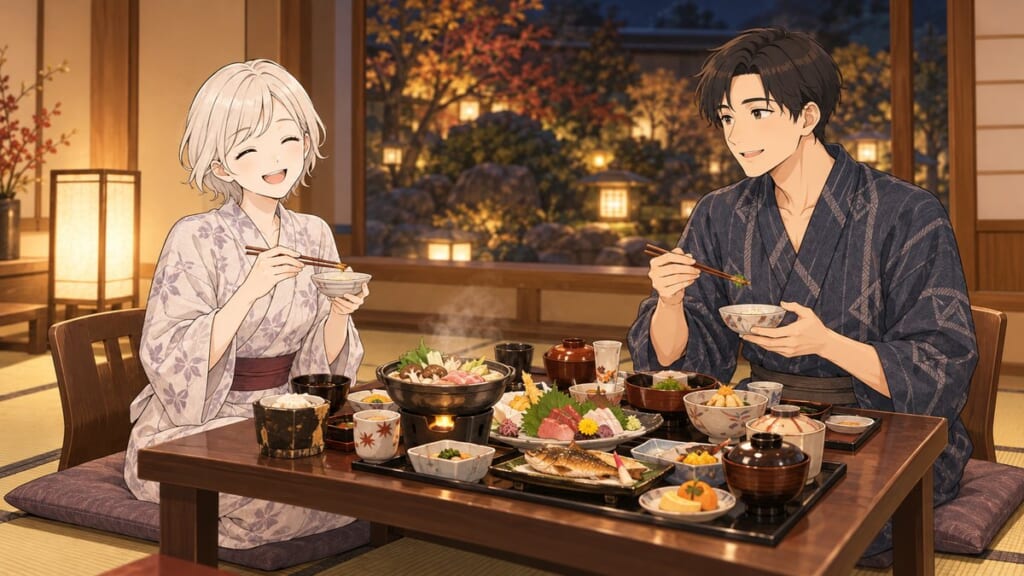
Plan your arrival around dinner and the bath reservation. Several inns here start check-in at 15:00, while Choraku and Suimeisou start at 14:00; dinner commonly begins in the 18:00–19:00 range, with each inn setting its own slots.
Choraku cannot provide dinner for arrivals at or after 20:00, and Hanaikada asks dinner guests to arrive by 19:00. Contact the inn if delayed, and ask reception about bath slots when checking in: Choraku recommends advance arrangements and prioritises bath-inclusive plans, while Taketoritei takes reservations after check-in.
If this is your first ryokan night, ask staff to write down your dinner, bath and breakfast times. Confirm checkout too: Laforet’s standard rooms finish at 10:00 and its premium rooms at 11:00.
How Our Family Would Pick
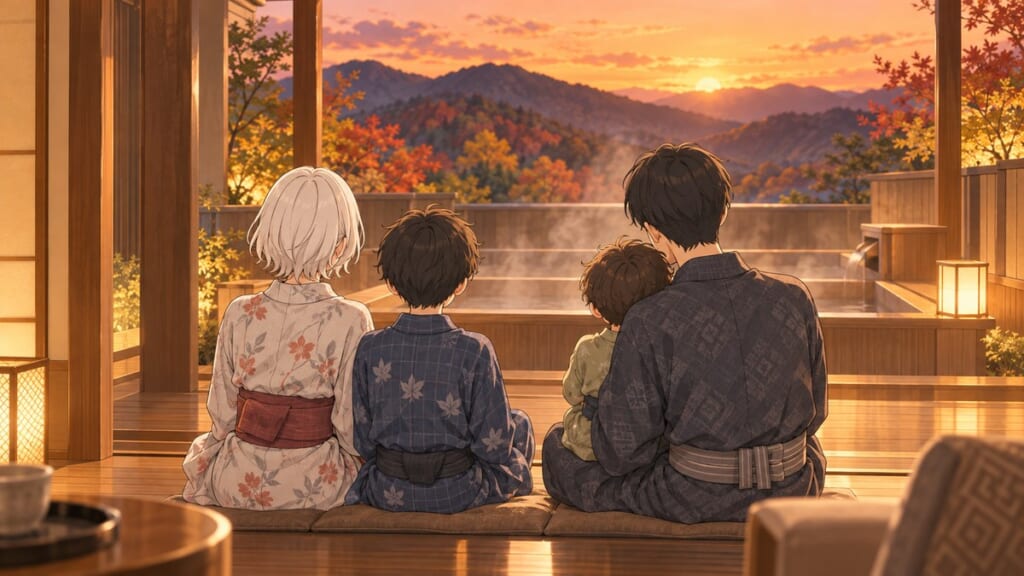
For my family, the first decision would be the departure city and travel time, then the bath arrangement, then the conditions for everyone coming along. A confirmed slot can suit a planned evening; a room bath gives more freedom to return when you feel like it. Check the children’s conditions or tattoo permission before committing to that room.
 What I loved about the open-air room bath with my husband was being able to bathe together whenever I wanted. Bathing together is familiar in my family, too, so that shared time would matter more to me than choosing the most expensive room.
Fit the night into the rest of your route with my 7-step guide to planning a first trip to Japan. Leave enough time at the inn to enjoy the bath you’ve chosen.
FAQ
What is a “private onsen,” exactly?
It usually means a hot-spring bath reserved for your party, either attached to your room or used separately. Listings also use “private bath” for ordinary heated-water tubs, so check the exact room’s water and booking arrangement.
Are private onsens expensive?
Your total depends on the area, room category and meals; some inns include private-bath sessions in the stay. On our December check dates, dinner-and-breakfast totals for two ran from about ¥45,000 ($294) in Hakone to over ¥137,000 ($886) in Kinosaki. See Table D.
Can I use a private onsen if I have tattoos?
It depends on the inn and the specific bath. Read its policy and obtain written confirmation for your tattoos before booking.
Can I use a private onsen without staying overnight (day use)?
Some facilities offer day use, but this guide focuses on overnight stays. Hakone Suimeisou and Sumiya Kihoan state that standalone day-use bathing is unavailable.
Can small children or babies use the bath in our room?
Ask the inn about your children’s exact ages and that room’s bath. Use Table C to check access, temperature, diapers, meals and bedding before choosing a plan.
Which onsen town are you thinking about? Tell me in the comments.
I hope this guide has answered one of your questions and helped you feel a little closer to Japan.
May your Japan journey be filled with wonderful discoveries and memories you’ll treasure for years to come.
See you in the next guide.
Comments