
- Quick List: The Kendamas I’d Actually Give
- Why a Kendama Makes a Good Gift (and Who It’s For)
- Kendama in Japan: What Kids Actually Do With It
- What “JKA Certified” and “Made in Japan” Really Mean
- Comparison Table: Which Kendama Should You Buy?
- My Picks, One by One
- What Age Is a Kendama For?
- Honest Downsides (Please Read This Before You Buy)
- How to Make Sure You’re Getting the Real Thing
- If You’re Coming to Japan: Where to Buy One
- FAQ
- Final Thoughts
Quick List: The Kendamas I’d Actually Give
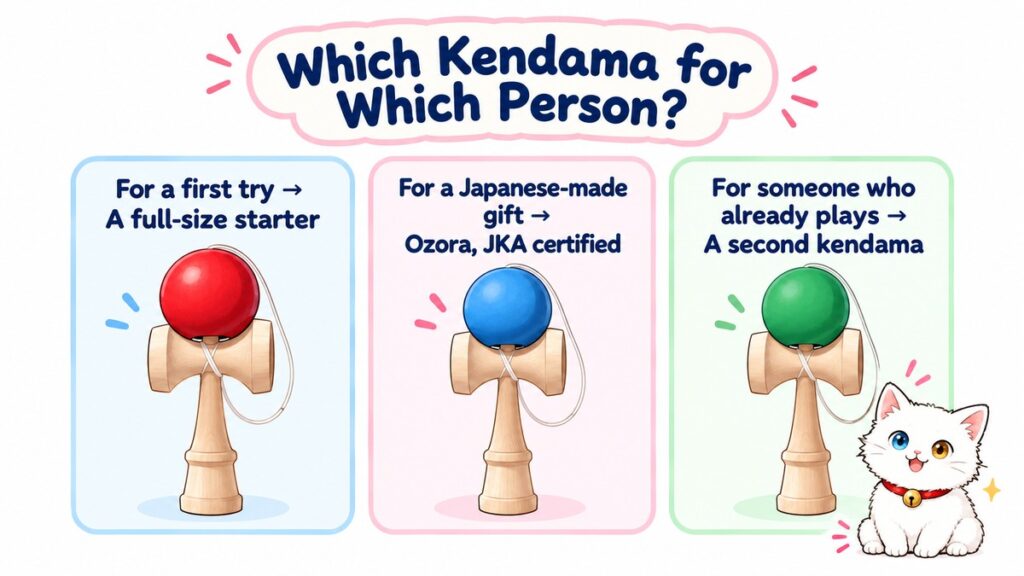
 Choose Ozora if you want a Japanese-made gift, Duncan if you’re keeping the budget small, or the two-pack if you want to learn together. For someone who already plays, I’d first ask what they own.
Disclosure: This article contains affiliate links. If you buy through one, I may earn a small commission at no extra cost to you.
-
Ozora Kendama by Yamagata Koubou
My pick for a Japanese-made, JKA-certified gift with a clear connection to its maker.
-
A lower-cost first try, provided you’re happy with a mystery color.
-
For siblings, friends, or a parent and child who want their own kendamas.
-
A possible second kendama for someone whose interest has already stuck.
Why a Kendama Makes a Good Gift (and Who It’s For)
 A kendama suits someone who enjoys trying again until a small movement finally works. You lift a tethered ball and catch it on a cup or the spike, so even a simple catch gives you something to work toward. It needs no batteries, can fit in a roomy pocket, and gives you something to practice on your own.
You don’t have to turn it into a serious hobby. In a Reddit post, a Christmas recipient described the excitement of landing a first trick and carrying the toy around to practice, treating it as a new fidget. That pleasure in picking it up again is a lovely part of giving a skill toy.
It may be a poor fit for someone who wants instant success or doesn’t enjoy repeating a movement. A child who tends to swing toys around will also need close guidance before playing independently. As a mum, I’d think about how your child handles a missed attempt before choosing the prettiest ball.
Kendama in Japan: What Kids Actually Do With It
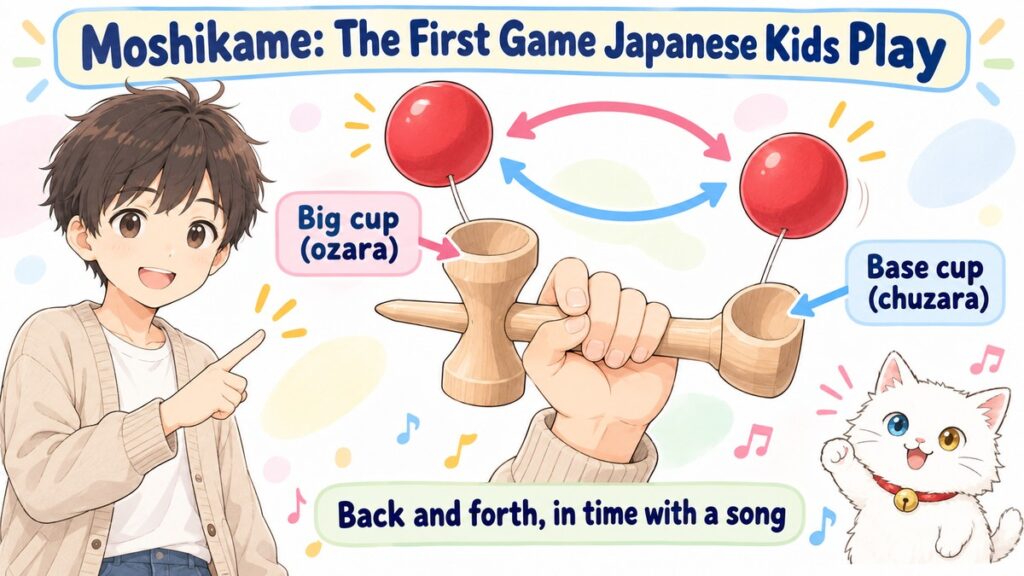
 Kendama can give your recipient a small connection to children’s play in Japan. One familiar activity is moshikame: moving the ball back and forth between the big cup and the base cup, called the middle cup in Japanese, in time with a song. The challenge is keeping that rhythm going.
A parent living in Japan wrote on Reddit that everyone at their son’s elementary school learned kendama, beginning with moshikame to the song “Usagi to Kame.” It’s a little story you can share when you give the toy: children learning to keep a ball moving to music.
The Japan Kendama Association, or JKA, has a list of nine introductory tricks called nyumon-kyu. Your child doesn’t have to aim for the spike right from the start. A first gift can begin with these introductory challenges rather than the trick that looks most impressive.
Nagai in Yamagata Prefecture calls itself the home of kendama, and the toy is used in local elementary school lessons and community classes. It’s also where Yamagata Koubou makes kendamas. For someone who likes knowing where a gift comes from, that link to a working craft and local play is part of Ozora’s appeal.
What “JKA Certified” and “Made in Japan” Really Mean
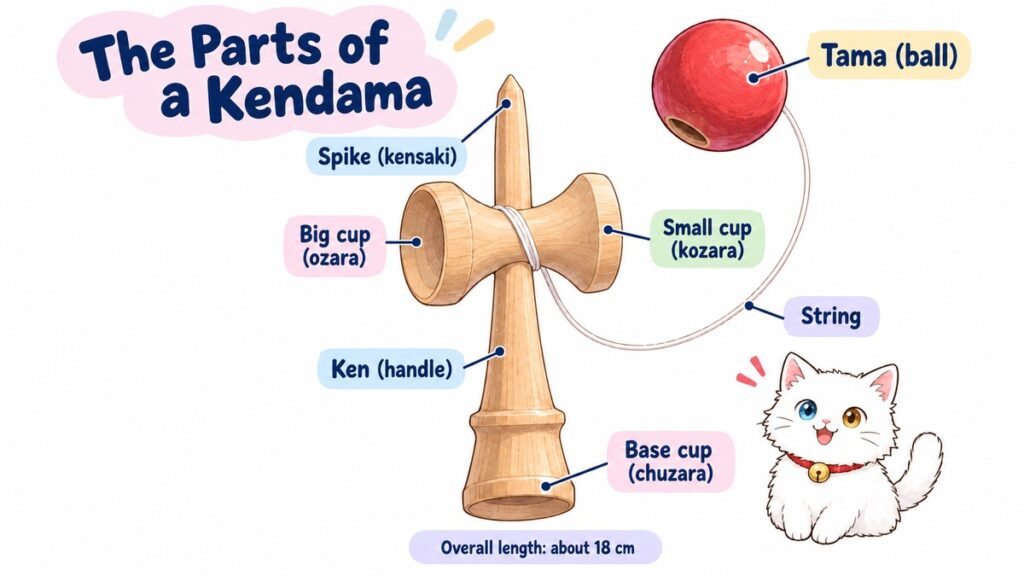
 Look for these as separate pieces of information. “Made in Japan” tells you where the kendama was made; “JKA certified” means the finished kendama has passed the association’s certification inspection for its competition standard. Use origin to choose the story behind your gift, and certification to check its suitability for official JKA activities.
JKA-certified kendamas are used for the association’s official competitions and grading sessions. Yamagata Koubou is a JKA-certified manufacturer, and the standard Ozora in this guide is a certified model. Check the certification of the particular model you’re buying.
Repainting or reshaping a certified kendama after buying it takes it outside that certification. An overseas brand’s description of “competition size” or “competition size and weight” is separate from JKA certification. For a gift intended for everyday play, start with the recipient’s interests and the kind of kendama they want to learn with.
For authenticity, check that the item matches the maker and origin advertised. A Japanese-made Ozora and a genuine kendama from another brand offer different reasons to choose them. I also explore how to check a product’s origin in my guide to whether a Japanese knife is actually made in Japan.
Comparison Table: Which Kendama Should You Buy?
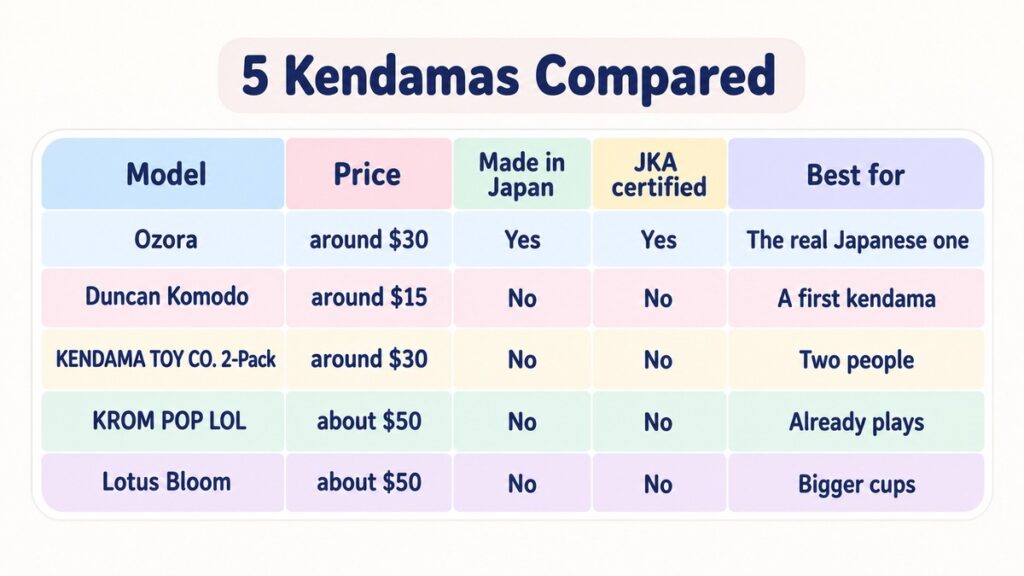
 Start with the person in the last column, then check the budget. These are approximate Amazon.com prices as of September 9, 2026.
| Model | Price | Made in Japan | JKA certified | Best for |
|---|---|---|---|---|
| Ozora | around $30 | Yes | Yes | Someone who wants the real Japanese one |
| Duncan Komodo | around $15 | No | No | A first kendama on a small budget |
| KENDAMA TOY CO. 2-Pack | around $30 (two) | No | No | Siblings, or a parent and child together |
| KROM POP LOL | about $50 | No | No | Someone who already plays |
| Lotus Bloom | about $50 | No | No | Big cups, easier landings |
Prices change, so check Amazon for the current price before ordering.
My Picks, One by One
The Real One: Ozora by Yamagata Koubou
 Ozora is the one I’d choose when the gift’s Japanese origin matters most. Yamagata Koubou makes it in Nagai, and the standard model gives you both Japanese manufacture and JKA certification. That makes the reason for choosing it easy to explain when you hand it over.
The maker lists beech and cherry wood, an overall length of 18 cm, and a pass in the Japan Toy Association’s safety testing. Its traditional shape is the main trade-off: some players find the cups less forgiving than modern designs.
Choose it for someone who values its origin and is happy to learn patiently. You can find that Japanese-made gift here:
Ozora Kendama by Yamagata Koubou
The Easiest Start: Duncan Komodo
Duncan Komodo is my lower-cost starting point if you’re curious about kendama but unsure the interest will last. Its beechwood construction and advertised competition size and weight give you a full-size introduction. At around $15 as of September 9, 2026, it keeps the first purchase small.
The gift detail to notice is “Mystery Color.” You don’t choose the color for that listing, so it isn’t the right order if your child has their heart set on a particular one.
This model is made outside Japan and has no JKA certification. If your priority is trying the toy on a small budget and you’re happy to let the color be a surprise, consider:
Two at Once: KENDAMA TOY CO. 2-Pack
The two-pack makes sense when your gift is really an invitation to play together. Siblings, friends, or a parent and child can each hold a kendama and practice without taking turns with the same toy. At the September 9, 2026 reference prices, its cost per kendama is lower than that of the single Ozora listed here.
I like that practical reason for choosing a set. You can spend time learning alongside a child instead of making the gift feel like something they have to master alone.
The set is made outside Japan and has no JKA certification. Check the listing’s age guidance and exactly what’s included before you order:
A Second Kendama for Someone Who Already Plays
KROM POP LOL is an option for someone who already enjoys kendama and would welcome another one. KROM is a Danish brand, and this model uses beechwood. It’s made outside Japan and has no JKA certification.
Ask what your recipient owns before choosing. For a second kendama, I’d want to know what they hope to try next and whether there’s a particular feel or shape they’re interested in.
If larger cups are the priority, Lotus Bloom Kendama is another option recommended for more forgiving landings.
For a recipient specifically interested in KROM, check the exact listing and current price here:
What Age Is a Kendama For?
 Around six is a starting point for considering the standard Ozora: its manufacturer lists it for ages six and up, and its overall length is 18 cm. That age guidance belongs to Ozora alone. For the other models, check the manufacturer’s age information on the product page before buying.
Players disagree about full-size kendamas for younger children. In a Reddit discussion about children aged six and eight, some thought a smaller kendama might fit better, while others pointed to very young children using standard sizes in competitions. If you can let your child hold one before buying, you can see how the size feels without guessing from a photograph.
After checking the product’s age guidance, think about comfortable handling, following instructions, and willingness to repeat a missed catch. I’d put more thought into patience than grip strength when deciding whether your child will enjoy the gift. Watching how they respond to a simple repeated challenge is more useful than choosing by age alone.
If a family trip is also on your calendar, my guide to Japan with kids can help with the travel side of your plans. You can start enjoying a Japanese toy together at home long before you pack.
Honest Downsides (Please Read This Before You Buy)
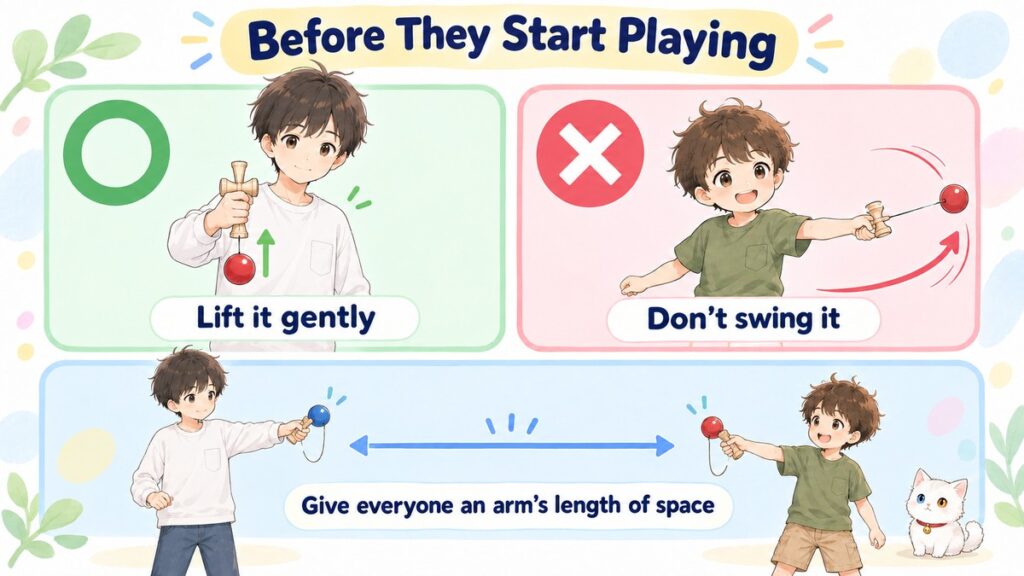
The wooden ball can hurt if it hits someone. In a discussion involving school and camp instructors, the recurring advice was to teach children to lift it gently rather than swing it around. Start with space between players and an adult nearby, and make that gentle upward movement the first thing you teach.
Ozora’s traditional shape can also make early practice feel demanding. Some enthusiasts describe its smaller cups as harder to learn with than modern shapes. If quick cup catches matter more than Japanese manufacture, let that priority guide your choice.
Some unbranded listings receive poor feedback, so read comments about the exact model you’re considering. Separate complaints about the toy from complaints about delivery, and check what buyers say arrived in the box. Clear product details make that comparison easier when you’re buying a gift you haven’t handled yourself.
I’ve kept this guide to five products so you can make a manageable comparison. Kendama USA, Sweets Kendamas, and Sol Kendamas also have official shops you can browse. If your recipient already has a favorite brand, asking about it is a useful place to start.
How to Make Sure You’re Getting the Real Thing
Check the seller and the exact product before you place the order. Read the product details alongside the photographs so you know what you’re selecting. For Ozora, look for agreement between the maker, model, and stated Japanese origin.
- Read “Sold by” to see who is selling the item, then “Ships from” to see who dispatches it. These can be different businesses.
- Look for Yamagata Koubou in the Ozora product details, alongside the relevant model, Japanese origin, and certification information. If details conflict, ask for clarification before buying.
- Check the selected variation, quantity, expected delivery, and return terms. This matters especially for a holiday gift and for a listing with a mystery color.
- When it arrives, compare the item and packaging with your order before wrapping it. If something is wrong, keep the packaging, photograph the mismatch, and use the order’s available help or return options.
A Reddit contributor reported receiving a different item even from an official-shop order. Opening the delivery before gift day gives you time to spot a mix-up and contact the seller. For other presents you can order from home, see my Japanese gift guide for people who aren’t traveling to Japan.
If You’re Coming to Japan: Where to Buy One
 You can look in large stores such as Loft and Yodobashi, as well as specialist shops. Travelers have reported buying kendamas at Loft in Kyoto, Ozora at Yodobashi in Kyoto, and kendamas at specialist shops in Tokyo. Stock changes, so check before making a special trip; seeing one in person also helps you judge its size.
As of September 9, 2026, the maker’s published domestic reference is around ¥2,480 before tax for a standard solid-color Ozora, alongside around $30 on Amazon.com. If you aren’t coming to Japan, you can use the Amazon option in this guide. If you are, see my tax-free shopping guide for the rules relevant to your visit.
FAQ
What does “kendama” mean?
The name combines ken, meaning sword, and tama, meaning ball. On the toy, ken refers to the wooden handle assembly and tama to the ball attached by the string.
Is kendama hard to learn?
Expect missed catches while you learn to control the ball. Start with a cup catch rather than treating the spike as your first test, and choose practice you enjoy repeating.
Is kendama good for your brain?
Kendama uses hand-eye coordination, but that isn’t the same as evidence that it improves your brain or treats a condition. JKA also runs activities for older adults under the name “health kendama”; that describes an activity, not a guaranteed health benefit.
What’s the difference between a kendama and a yoyo?
A kendama involves catching a tethered ball on cups or a spike. A yoyo spins on an axle with a string wound around it, so the movement and tricks are different.
Can adults play kendama?
Yes, you can begin as an adult and practice at your own pace. You don’t need a child to justify choosing one as your holiday present.
How do I keep the paint from chipping?
Avoid unnecessary knocks when carrying or storing it, and follow the maker’s care instructions. To preserve JKA certification, leave the original paint and shape intact.
Final Thoughts
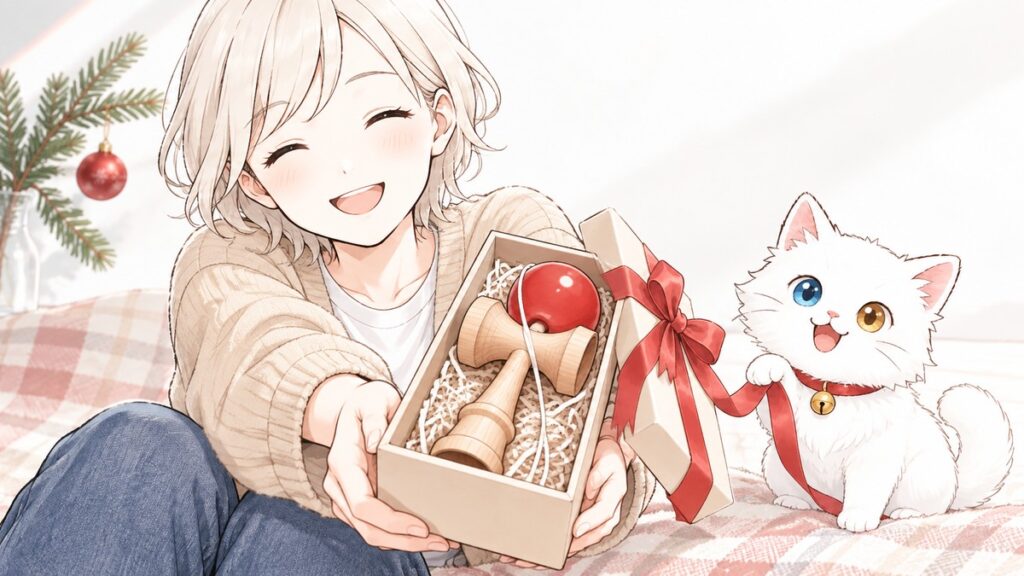
 I’d give Ozora when its Japanese origin is part of the present, and choose by budget or shared play when that matters more. Before you wrap it, check that the item matches your order and that the age guidance suits your recipient. Then give them time to enjoy learning, with a little encouragement for the first catch.
Check the Ozora kendama (Made in Japan) on Amazon
What to Read Next
For more gifts to enjoy at home, see my Japanese gift guide and my guide to checking a Japanese knife’s origin.
If a visit is part of your plans, continue with my guide to traveling with kids or my guide to planning your Japan trip.
 Now I’m curious about your side of the world — does your country have its own version of this toy (a bolero, a bilboquet, a cup-and-ball)? Tell me in the comments below. I read every single one!
I hope this guide has answered one of your questions and helped you feel a little closer to Japan.
May your Japan journey be filled with wonderful discoveries and memories you’ll treasure for years to come.
See you in the next guide.



Comments