You type “Japanese knife” into Amazon, and suddenly every dark handle, Damascus pattern, and samurai-sounding name looks authentic. It is not that simple. Some are Japanese-made knives from established makers; others are Japanese-style knives made by companies based elsewhere.
That does not automatically make the second group bad. It does mean you should know what you are buying. This guide shows you how to check the origin for yourself and choose a real Japanese knife that fits an ordinary home kitchen—not a restaurant fantasy.
Disclosure: This article contains affiliate links. As an Amazon Associate I earn from qualifying purchases. If you buy through one, I may earn a commission at no extra cost to you.
In a hurry? Everything in this guide, in one list:
- Kai Seki Magoroku Damascus Santoku — Japan-made Damascus, the price-performance star
- Tojiro Classic Chef Knife — best-value knife actually made in Japan
- Misono UX10 Santoku — the pro-kitchen favorite
- Shun Classic 8″ Chef’s Knife — the classic gift pick, made in Seki
- Shapton whetstone set — every Japanese knife needs one
Buying in Japan instead? Kappabashi and Seki shops let you hold the knife first — the links above are for shopping from home.
- Short on Time? Here Is the Honest Answer
- The “Japanese” Knife Brands You Should Check More Closely
- What Japanese Home Kitchens Actually Use
- The Real Japanese Knives Worth Buying
- Don’t Forget the Whetstone (and the Right Cutting Board)
- Buying in Japan Instead?
- The Japanese Knife Gift Superstition
- FAQ
- Final Thoughts
Short on Time? Here Is the Honest Answer
For this guide, I do not treat imarku, SHAN ZU, or Dalstrong as clearly documented Japanese-origin brands. SHAN ZU says its knives are made in Yangjiang, China, while Dalstrong describes a Canadian founding and manufacturing in China. imarku says it was founded in Japan in 1949, while its U.S. trademark record lists a Shenzhen company as the original applicant and registrant. This is an origin classification, not a judgment of cutting performance.
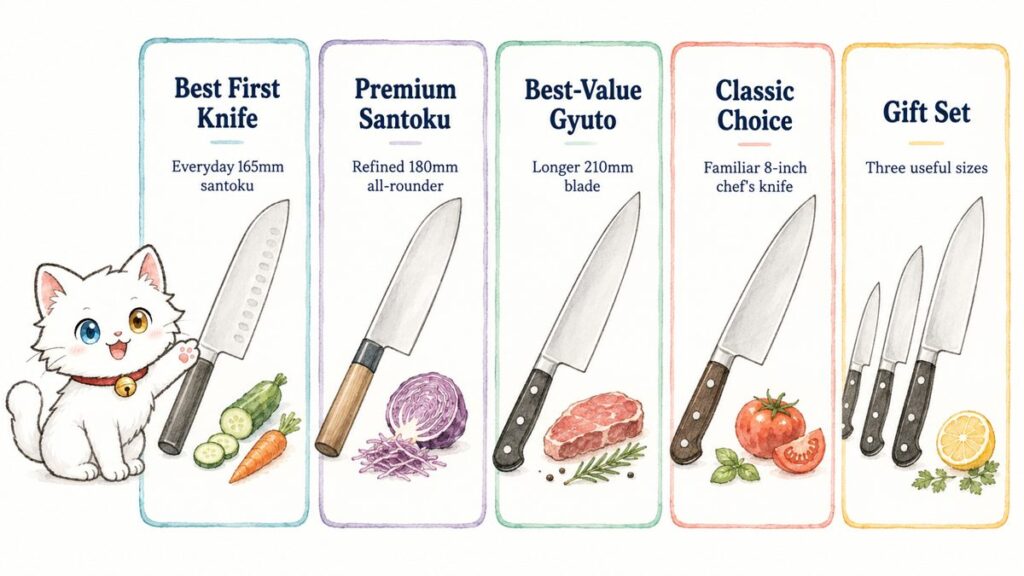
If you want a genuine Japanese-made knife, start with one of these five. My easiest recommendation for most first-time buyers is the Kai Seki Magoroku Damascus Santoku. Choose the Misono if you want a premium santoku, the Tojiro if you prefer a longer gyuto, or Shun if you want a familiar premium brand and gift-ready presentation.
| Best for | My pick | Type | Tier |
|---|---|---|---|
| Most first-time buyers | Kai Seki Magoroku Damascus Santoku 165mm | Santoku | Budget pick |
| Premium santoku | Misono UX10 Santoku 180mm | Santoku | Premium |
| Best-value longer blade | TOJIRO CLASSIC F-808 Chef Knife 210mm | Gyuto | Mid-range |
| Familiar premium choice | Shun Classic 8″ Chef’s Knife | Chef’s knife | Premium |
| A serious cooking gift | Shun Classic 3-Piece Starter Set DMS300 | Set | Premium |
- Check the Kai Seki Magoroku Damascus Santoku on Amazon
- Check the Misono UX10 Santoku on Amazon
- Check the TOJIRO CLASSIC Chef Knife on Amazon
- Check the Shun Classic 8″ Chef’s Knife on Amazon
- Check the Shun Classic 3-Piece Starter Set on Amazon

The “Japanese” Knife Brands You Should Check More Closely
The word Japanese can describe a blade shape, steel, style, or technique. It does not always identify the company or where the finished knife was made.
imarku’s current site says it was founded in Japan in 1949. However, the U.S. trademark record lists Shenzhen Bolton Technology Co., Ltd. as the original applicant and registrant; the mark was filed in 2016 and registered in 2017. Because these public sources do not establish a consistent Japanese origin, check the country of origin for the exact product rather than relying on the brand story. (imarku’s statement, U.S. trademark record)
SHAN ZU says its knives are made in Yangjiang, China. Dalstrong says it was founded in Toronto in 2014, and its manufacturing explainer describes production in China. I therefore treat both as non-Japanese-origin brands, even when a knife uses Japanese steel or design. (SHAN ZU, Dalstrong)
“Made in China” does not mean poor quality. A knife should also be judged by its steel, heat treatment, grind, handle, quality control, and support. The narrower point is that marketing language cannot prove Japanese origin.
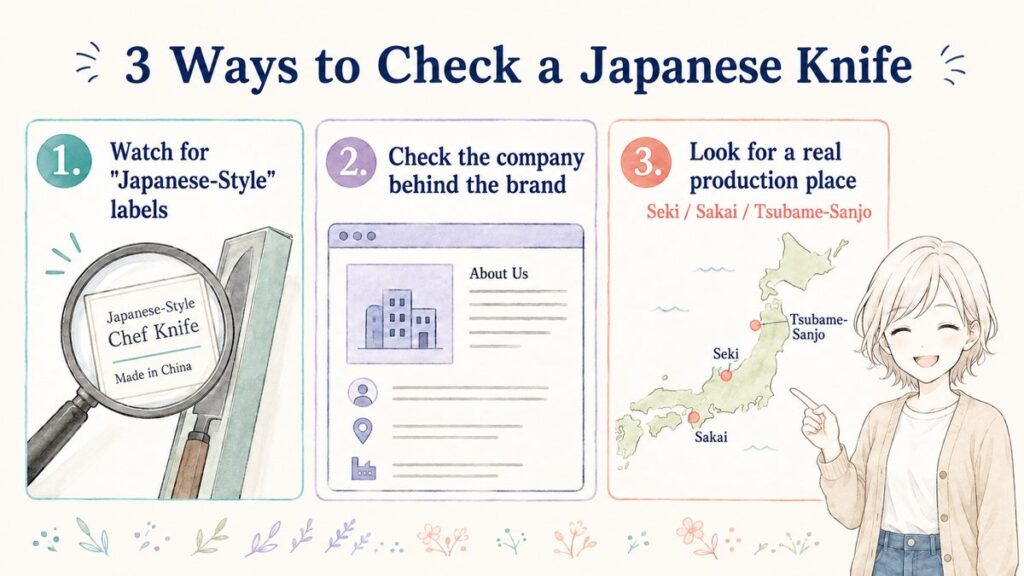
1. Treat “Japanese-Style” as a Check-the-Label Signal
“Japanese-style chef’s knife” usually describes inspiration or shape, not guaranteed origin. Look for “Made in Japan” on the finished knife—not only “Japanese steel,” “Japanese design,” or “Japanese technology.”
2. Check the Company Behind the Brand
Open the brand’s About, Contact, Terms, or company-information page. Look for the legal company name, headquarters, factory, and trademark owner. A named factory is stronger evidence than a romantic brand story.
3. Look for a Real Production Place
Established Japanese makers often tell you where the work happens. Shun identifies Seki City in Gifu Prefecture. Misono lists its head factory in Seki. TOJIRO identifies Tsubame-Sanjo in Niigata Prefecture, while Sakai Takayuki is associated with Sakai in Osaka Prefecture.
Those city names alone are not proof. A traceable company, factory, consistent model number, and clear origin statement together form much stronger evidence.
What Japanese Home Kitchens Actually Use
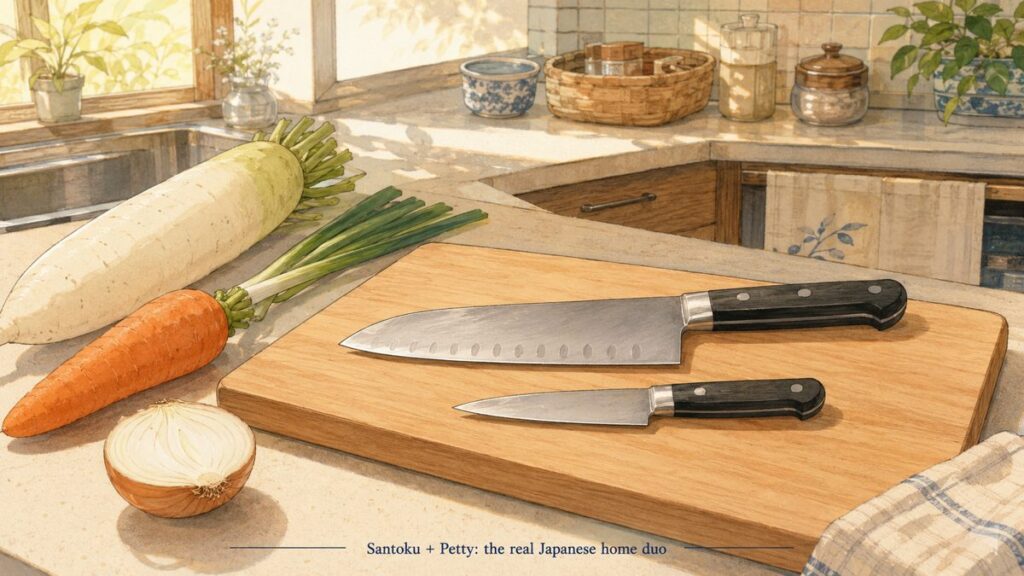
In many Japanese homes, the main knife is a santoku, not a long gyuto. Kai describes the santoku as the most widespread knife in Japanese households, and TOJIRO recommends it as the first knife for someone who wants one versatile blade for meat, fish, and vegetables.
A blade around 165–180mm is easy to control on the smaller cutting boards and worktops common in Japanese kitchens. Its flatter edge suits push-cutting and straight chopping, while its shorter length feels less intimidating when you are preparing a quick family dinner. A petty knife is the natural second knife for fruit, trimming, peeling, and small jobs.
That is why my first recommendation here is a santoku. A 210mm gyuto or 8-inch chef’s knife still makes sense if you already like a Western rocking motion, cut large ingredients, or want more slicing length. But you do not need the longest blade to get an authentic Japanese-knife experience.
This is also the same reason a good Japanese rice cooker can remain useful long after a trip: the best Japanese kitchen tool is the one that quietly fits your real routine. my honest guide to Zojirushi rice cookers
The Real Japanese Knives Worth Buying
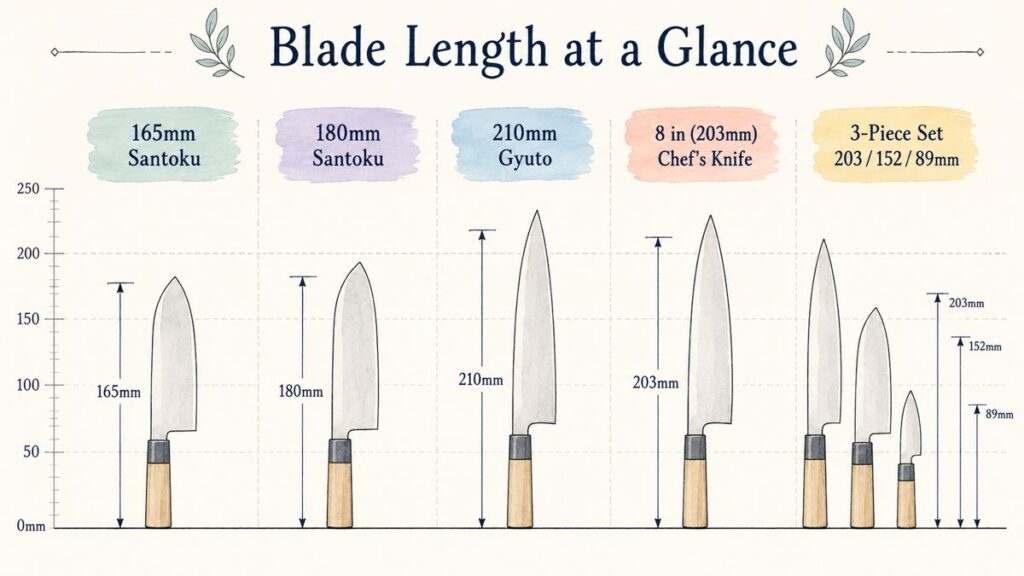
These five picks are made in Japan by identifiable Japanese makers. I compared their manufacturer specifications, origin, shape, care requirements, and suitability for a home cook upgrading from an inexpensive Western knife.
Sharpening schedules are not directly comparable. Kai and TOJIRO suggest once or twice a month depending on use. Shun suggests regular honing—often weekly at home—and says true sharpening may be needed only about yearly. These are different care systems, not proof that one edge lasts twelve times longer.
| Knife | Steel | Blade length | Edge | Dishwasher | Published maintenance guide | Best for |
|---|---|---|---|---|---|---|
| Kai Seki Magoroku Damascus Santoku AE5200 | High-carbon stainless cutting steel with stainless cladding | 165mm | Double bevel; left/right use | No | Kai: whetstone 1–2 times/month, adjusted for use | First real Japanese knife |
| Misono UX10 Santoku No.781 | EU high-purity stainless special steel | 180mm | Double bevel | Not stated; hand wash recommended | No fixed Misono interval found; sharpen when performance drops | Premium santoku buyer |
| TOJIRO CLASSIC F-808 Chef Knife | VG10 core with 13-chrome stainless cladding | 210mm | Double bevel | Avoid; maker cautions against dishwasher heat | TOJIRO: 1–2 times/month as a general guide | Longer blade at good value |
| Shun Classic DM0706 | VG-MAX core, 69-layer Damascus construction | 203mm / 8 in. | Double bevel, 16° each side | No | Hone about weekly; many home cooks sharpen about yearly | Familiar premium chef’s knife |
| Shun Classic Starter Set DMS300 | VG-MAX core, 69-layer Damascus construction | 203mm, 152mm, 89mm | Double bevel, 16° each side | No | Same Shun guide as above | Gift or complete upgrade |
Specifications checked against official pages from Kai, Misono, TOJIRO, and Shun in August 2026. “No” or “Avoid” reflects maker guidance; where dishwasher compatibility is not published, hand washing is listed as the safer care choice.
1. Kai Seki Magoroku Damascus Santoku 165mm — Best First Japanese Knife
Feature: This Japanese-made santoku has a 165mm double-bevel blade, high-carbon stainless cutting steel with stainless cladding, and a laminated reinforced-wood handle.
Best for: Choose it for vegetables, boneless meat, and fish if you do not want a long professional blade. The size suits smaller hands, boards, and everyday family cooking.
Merit: You get the common Japanese household shape, a traceable maker, Damascus finish, and right- or left-handed use.
Watch out: The wood-based handle and fine edge do not belong in the dishwasher, and the blade should not be twisted through frozen food or bones. Hand wash, dry immediately, and use a wood or soft synthetic board.
Check the Kai Seki Magoroku Damascus Santoku on Amazon
2. Misono UX10 Santoku 180mm — Premium Santoku Pick
Feature: Misono makes the UX10 No.781 at its Seki factory. It is a 180mm santoku in EU-made high-purity stainless special steel, larger than the 165mm Kai.
Best for: Choose it if a santoku suits your style and you want one premium knife. Its extra length helps with cabbage, squash, and larger batches.
Merit: Stainless steel is easier to manage than reactive carbon steel, while Misono’s named Seki factory makes the provenance easy to trace.
Watch out: Premium does not mean maintenance-free. Hand washing is the safe choice, and the 180mm blade may feel large if you currently use a very short supermarket knife.
Check the Misono UX10 Santoku on Amazon
3. TOJIRO CLASSIC F-808 Chef Knife 210mm — Best-Value Gyuto
Feature: Many stores still call this “Tojiro DP,” but its current official name is TOJIRO CLASSIC F-808. It has a 210mm double-bevel VG10-core blade, stainless cladding, and a full-tang laminated handle.
Best for: Choose it if you like an 8-inch Western chef’s knife and want similar reach in a Japanese gyuto. It suits larger boards, vegetables, and slicing.
Merit: The clear specification and VG10-clad construction balance edge performance with easier rust care. It is my value pick for a 210mm gyuto.
Watch out: The longer point needs more counter space and more careful storage. TOJIRO recommends regular whetstone care, so do not buy it if you want a knife you can ignore for years.
Check the TOJIRO CLASSIC Chef Knife on Amazon
4. Shun Classic 8″ Chef’s Knife — Familiar Premium Choice
Feature: Shun’s Seki-made DM0706 has a 203mm VG-MAX-core blade, 69-layer Damascus construction, and a double-bevel 16-degree edge on each side. Its Pakkawood handle suits either hand.
Best for: Choose it for an established name, clear U.S. support, and a chef’s-knife profile rather than a santoku.
Merit: Shun publishes detailed care information and offers U.S. sharpening support. The curved belly feels familiar to Western-knife users.
Watch out: The fine, hard edge is less forgiving of twisting, bones, frozen food, sinks, and dishwashers than a soft Western workhorse. Use it as a precision cutter, not a cleaver.
Check the Shun Classic 8″ Chef’s Knife on Amazon
5. Shun Classic 3-Piece Starter Set DMS300 — Best Gift
Feature: Confirm DMS300 because Shun sells similarly named sets. It contains the DM0706 8-inch chef’s knife, DM0701 6-inch utility knife, and DM0700 3.5-inch paring knife, all with VG-MAX cores and Damascus cladding, in a gift-suitable box.
Best for: Choose it for a serious new kitchen, a complete upgrade, or a major occasion. Three sizes cover large, medium, and in-hand tasks.
Merit: Every knife has a clear job, making it more useful than a large block of specialty shapes. The matching design feels complete.
Watch out: It is a substantial commitment, and three delicate knives create three maintenance responsibilities. If the recipient will use a dishwasher or cut on glass, give one Kai santoku plus a proper board instead.
Check the Shun Classic 3-Piece Starter Set on Amazon
If your preferred knife is unavailable, the Sakai Takayuki 33-Layer Gyuto and all-stainless GLOBAL G-2 are also worth checking. If the Shun board is unavailable, consider the YAMASAN KYOTO UJI hinoki board.
Don’t Forget the Whetstone (and the Right Cutting Board)
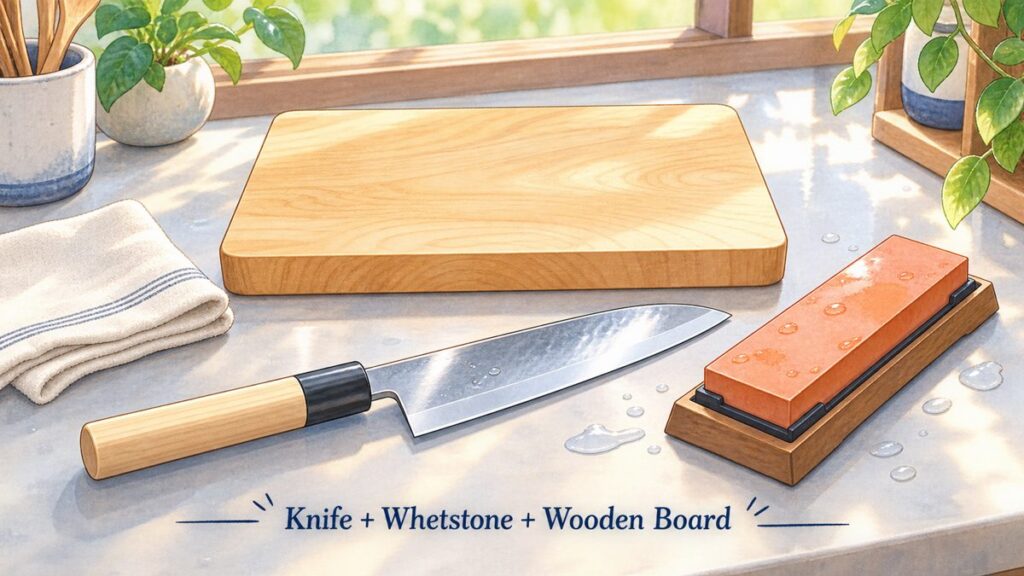
A Japanese knife is not a buy-it-and-forget-it tool. For a beginner, a medium #1000 whetstone is the useful starting point for restoring an ordinarily dulled edge.
Shapton Ha No Kuromaku stones are color-coded, and the case doubles as a holder. The Amazon “A-Set” I found combines an orange #1000 working stone with a #5000 finishing stone.
Check the Shapton Ha No Kuromaku whetstone set on Amazon
Your cutting board matters just as much. Glass, stone, ceramic, and hard titanium surfaces can be brutal on a fine edge. Shun specifically recommends medium-soft wood such as hinoki because it gives slightly under the blade, helping the edge last longer.
The Shun Medium Hinoki Cutting Board uses Japanese-grown cypress and fits a normal home kitchen. Wet it before use, wash gently, towel-dry, and keep it out of the dishwasher. It also pairs naturally with a Shun knife gift.
Check the Shun Hinoki Cutting Board on Amazon
A Shun honing steel can realign a slightly rolled edge between sharpenings, but it does not replace a whetstone. Shun’s guide suggests light honing around once a week for regular home use and true sharpening when honing no longer restores performance.
Check the Shun Premier Honing Steel on Amazon
Buying in Japan Instead?
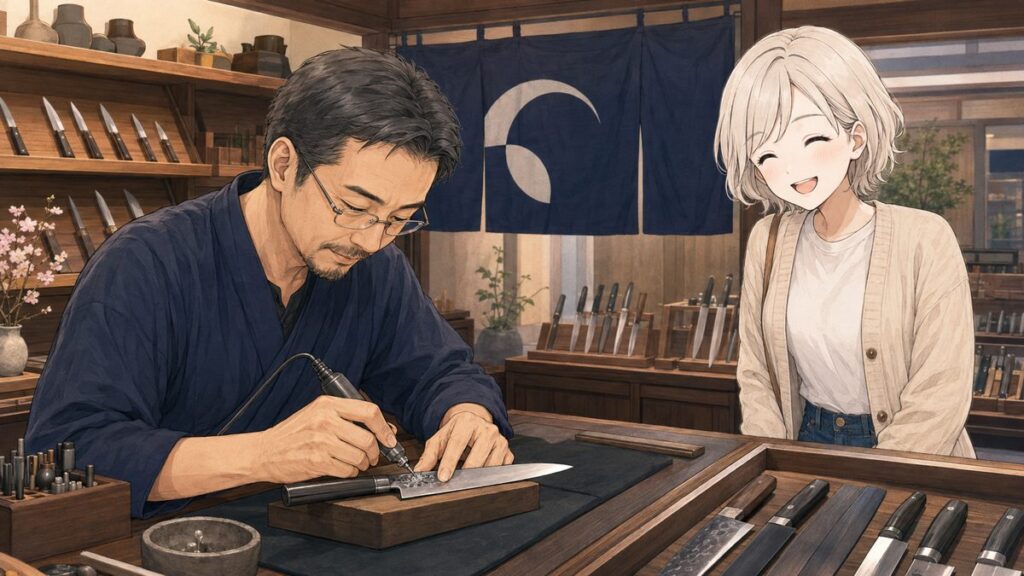
Buying in Japan is worthwhile if you want to hold the knife, compare handle shapes, or ask about engraving. Shops in Sakai, Seki, and Tokyo’s Kappabashi kitchenware district may offer same-day engraving for free or a small fee, but service, timing, and supported characters vary.
Left-handed cooks should say so before buying a traditional single-bevel knife; the five main picks above are double-bevel, but many deba and yanagiba are made for one side and left-handed versions may cost more or require an order.
Most importantly, a kitchen knife cannot go in your carry-on: wrap it securely and place it in checked baggage, then confirm your airline and destination-country rules. For eligible purchases, see my tax-free shopping guide.
The Japanese Knife Gift Superstition
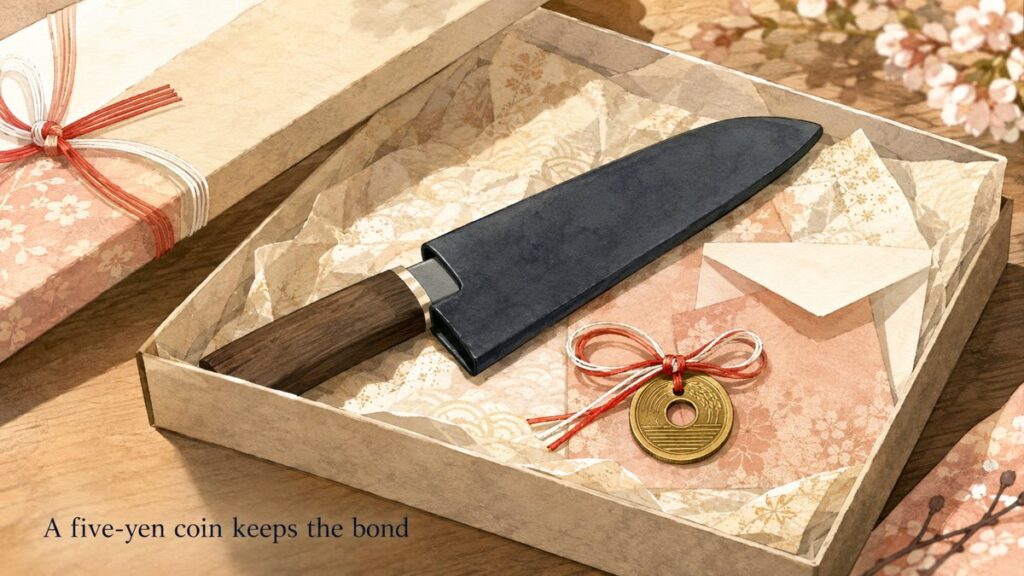
In Japan, you may hear that giving a knife can symbolically “cut” a relationship. One traditional workaround is for the recipient to give the giver a small coin—sometimes a five-yen coin—so the knife is treated as something they bought rather than a blade they received for free.
The five-yen coin is especially fitting because go-en can also suggest a good connection or relationship. Customs and interpretations vary by family and region, and many people do not worry about this at all. Still, adding a coin and a short explanation can turn an anxious superstition into a warm part of the gift story.
The Shun DMS300 set fits this section naturally: it looks like a gift, arrives as a useful three-knife collection, and gives you room to include a five-yen coin or another small coin from your country.
FAQ
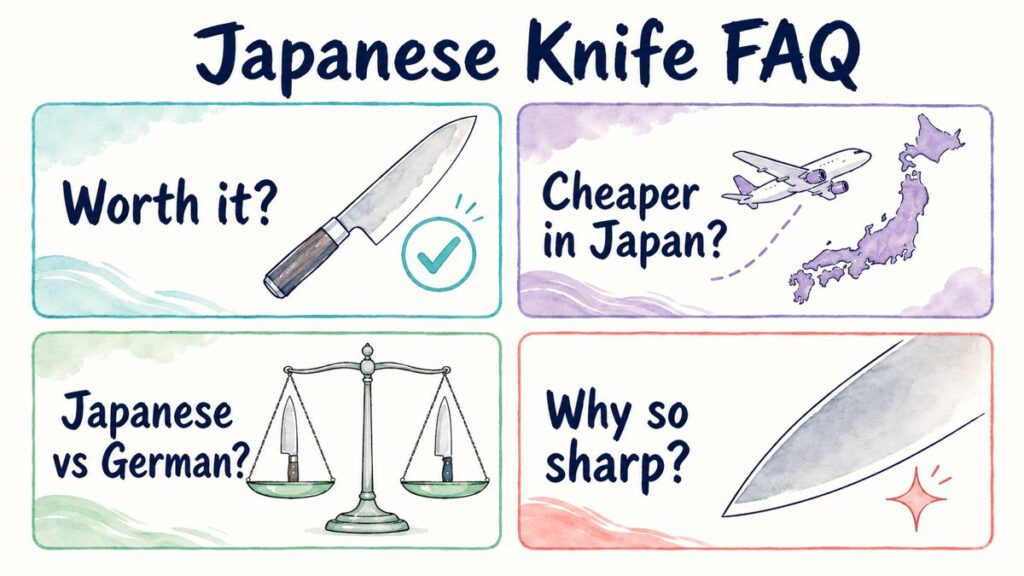
Are Japanese Knives Worth It?
Yes, if you value a thinner, sharper-feeling edge and will hand wash, dry, store, and sharpen it properly. No, if you need a dishwasher-safe tool for frozen food, bones, or rough shared-kitchen use. A genuine Japanese knife earns its value through precise everyday work, not through the country name alone.
Are Japanese Knives Cheaper in Japan?
Sometimes, especially for domestic models, but not always after tax, exchange rates, luggage space, and warranty support. Buying in Japan is most valuable for selection, handle feel, engraving, and specialist advice. Compare the exact model number rather than assuming every Japan price will be lower.
Japanese vs. German Knives: Which Is Better?
Japanese knives are generally thinner, lighter, harder, and sharpened to a finer edge. German knives are generally heavier, softer, and more tolerant of rocking, honing, and small mistakes. Choose Japanese for precision and lighter control; choose German for a tougher, more forgiving workhorse.
Why Are Japanese Knives So Sharp?
The combination of harder blade steel, a thinner blade geometry, and a more acute edge angle can reduce resistance as the knife passes through food. That sharpness comes with a tradeoff: a fine hard edge can chip if you twist it, hit bone, or use a hard board.
Final Thoughts
The safest first choice for most home cooks is the Kai Seki Magoroku Damascus Santoku 165mm: it is genuinely made in Japan, practical in size, traceable to an established Seki maker, and easier to approach than a long professional blade. Choose the Misono UX10 if you want a premium santoku, the TOJIRO F-808 if you want a 210mm gyuto, or Shun if familiar support and gift presentation matter most.
Whatever you choose, check the company, factory location, exact model number, and finished knife’s country of origin. Then give the edge a soft board, a whetstone, and a little care. That is how a beautiful Japanese knife becomes a tool you actually enjoy using for years.
If a trip to Japan is part of your plans — perhaps with a stop in a knife town like Seki or Sakai — my step-by-step trip planning guide will help you put the whole journey together. step-by-step Japan trip planning guide
Do people in your country give knives as gifts—and is there a coin tradition or superstition around them? I would love to hear about it in the comments.
I hope this guide has answered one of your questions and helped you feel a little closer to Japan. May your Japan journey be filled with wonderful discoveries and memories you’ll treasure for years to come.
See you in the next guide. 



Comments