
As an Amazon Associate I earn from qualifying purchases.

- Practicing Trumpet at Home Is Harder Than It Looks
- Meet the Brass Gear Home Mute, Born in Hiroshima
- How It Works: A Tiny Soundproof Room, Not a Plug
- How Much Quieter Does It Get? The Honest Numbers
- Why It Feels Different to Play
- How to Put It On (Official Demo Video)
- Home Mute vs. Other Practice Mutes
- Will It Fit Your Trumpet? Check Before You Buy
- How to Buy It From Outside Japan
- Who It’s For (And Who Should Pick Something Else)
- FAQ
- Final Thoughts from YUU
Practicing Trumpet at Home Is Harder Than It Looks

You finally have time to practice, but someone is sleeping and your trumpet can be heard through the wall. Japan’s Brass Gear Home Mute is worth considering if you want quieter practice with less change to blowing feel and pitch; if maximum sound reduction is your priority, compare other practice mutes first.
A good fit if:
- You want less resistance and fewer pitch changes during muted practice.
- You can practice during the day or early evening, within your building’s rules.
- You have a compatible trumpet and can accept extra weight at the bell.
Choose something else if:
- You need very strong sound reduction for a thin-walled room late at night.
- You play a cornet, flugelhorn, trombone, or an incompatible trumpet.
- Your first priorities are low cost and minimal added weight.
Buying shortcuts: Home Mute on Amazon US for US shoppers; Home Mute at TC Gakki for buyers outside the US; Home Mute on Amazon Japan (Japan addresses only) for delivery in Japan.
TC Gakki describes an unmuted trumpet as roughly 100–120 dB, depending on how it is played and measured. That helps explain why finding a practice window can be harder than finding the motivation to play. For a parent buying for a child in a school band, the same question comes first: where can regular practice fit into family life?
Meet the Brass Gear Home Mute, Born in Hiroshima
Brass Gear Home Mute, model BG-HM01, comes from Fukuyama in Hiroshima Prefecture. The manufacturer’s launch announcement dates its first sales to March 6, 2024. It is a passive practice mute, so you do not need batteries or an electronic monitoring system to use it.
I watched the September 27, 2026 episode of Gacchiri Monday!! (TBS; がっちりマンデー!!), and the demonstration of the mysterious black box stayed with me. Hearing the sound before and after it was attached was what caught my attention.
The program presented a company with no employees beyond its president, who had played trumpet for 26 years. Its follow-up reported that sales had grown from a few hundred units a year earlier to around 3,000.
On the official English page, trumpeter Jonathan Powell says, “It’s a game changer!”
 Why Japan does it this way: Apartment living, neighbors within earshot, and active school wind bands make home practice a familiar concern in Japan. Yamaha SILENT Brass and Best Brass are two Japanese approaches to that problem; Home Mute offers another, covering the outside of the bell. It belongs in the same Japanese-products series as my guide to vacuum flasks, where the starting point is an everyday inconvenience.
How It Works: A Tiny Soundproof Room, Not a Plug
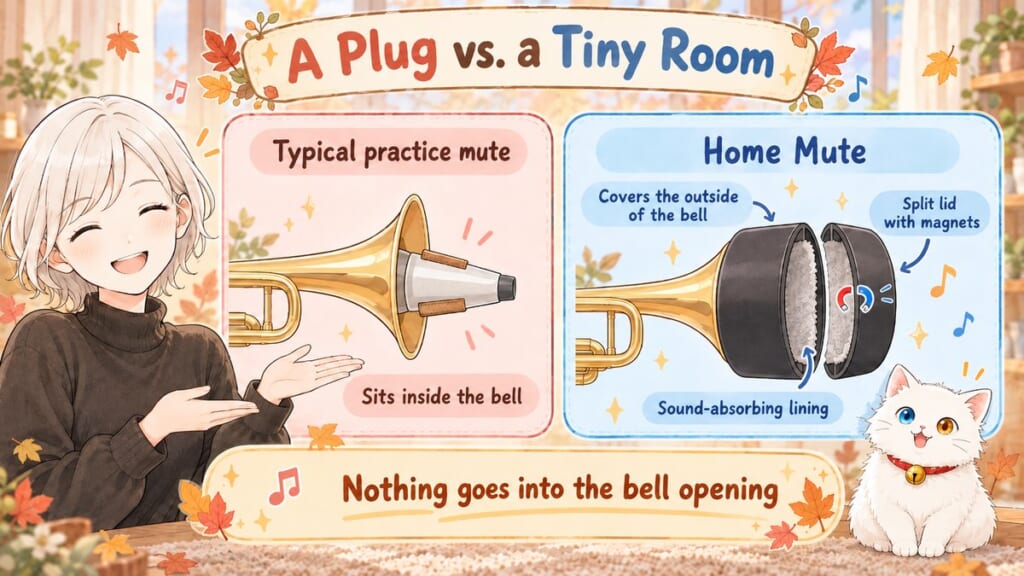
Home Mute surrounds the bell rather than placing a plug inside it. Many conventional practice mutes sit within the bell and narrow the path through which air and sound leave, which can increase resistance and alter pitch. The size of that change depends on the mute and instrument; it is not identical across products.
Brass Gear describes its alternative as a small soundproof room around the bell. The ABS-resin body measures 135 mm across and 113 mm high, with sound-absorbing material inside. You still hold and play your own trumpet, but the enclosure reduces the sound radiating into the room.
The mounting system has a split lid joined by neodymium magnets. You remove the lid, position its two halves around the bell, then screw the body onto it. Nothing is inserted into the bell opening, which is the key difference to look for in the diagram.
How Much Quieter Does It Get? The Honest Numbers
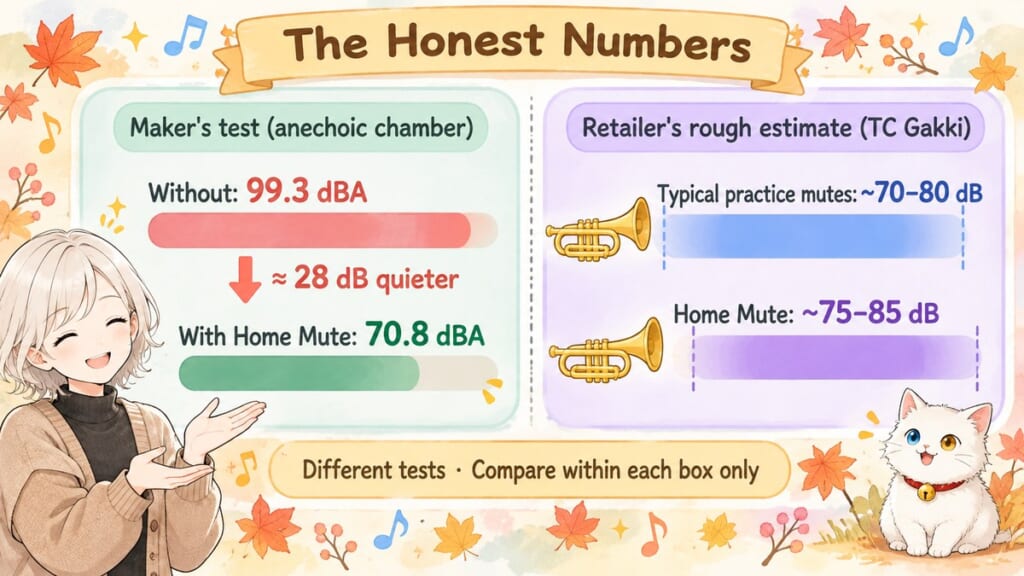
The manufacturer’s published test measured 99.3 dBA without Home Mute and 70.8 dBA with it, a reduction of 28.5 dB, or roughly 28 dB. The test took place in an anechoic chamber, with the meter 120 cm in front of the device. Each figure was a five-second average sound level, called Leq.
 Those conditions matter because a reflective bedroom is not an anechoic chamber. Your instrument, playing volume, room, and listener’s position can all change the result.
TC Gakki gives a different, practical estimate: around 75–85 dB with Home Mute, compared with roughly 70–80 dB for typical practice mutes. Its explanation is that Home Mute is a little louder. These are the retailer’s rough estimates.
Everyday sounds such as conversation and a vacuum cleaner can help you picture a noise scale, but their measured levels also vary. The useful conclusion is that Home Mute makes a trumpet considerably quieter while leaving audible sound.
 If very low noise is essential, compare stronger sound-reduction options before buying. For a shared home, I would settle on a daytime practice window first, then judge how much sound reduction that room needs.
Why It Feels Different to Play
Home Mute’s main attraction is reducing the change in how your trumpet responds when muted. Brass Gear’s official wording is that its design significantly reduces differences in blowing feel and deterioration of pitch.
On trumpet forums, the complaints about practice mutes that come up again and again are stuffy resistance and low notes that drift sharp. If your current mute feels stuffy, you may find yourself pushing harder or adjusting notes to compensate. That is the problem this outside-the-bell design aims to address. On the manufacturer’s site, trumpeter Takayuki Kawamura particularly praises its handling of the low-register pitch problems he associates with conventional practice mutes.
For a returning player, or someone working on basic exercises after work, the question is whether quieter practice still resembles the playing you want to develop. A comfortable response may make the compromise easier to live with.
Muted practice need not replace open practice whenever you have a suitable place for it. Combining the two gives you opportunities to check your normal sound and response. If you are following lessons, ask your teacher how muted sessions should fit your routine.
How to Put It On (Official Demo Video)
Brass Gear’s official English video shows Home Mute in use, which makes the parts easier to picture than a product photo does. Attaching it takes three steps.
First, unscrew the lid from the main body and separate its two magnetically joined halves. Keep the body supported while you prepare the lid. Next, place the lid halves around the trumpet’s bell and make sure they are held together by the magnets.
Finally, screw the main body onto the mounted lid. Brass Gear warns against overtightening the connection because it can damage the threads. Follow the demonstration and check that the parts are properly joined before playing.
 The process may take a little time until it becomes familiar, especially if you are used to simply inserting a mute. It also adds about 188 g at the bell. That extra weight is worth considering if holding your trumpet already feels tiring; a short first session gives you time to get used to the setup.
Home Mute vs. Other Practice Mutes
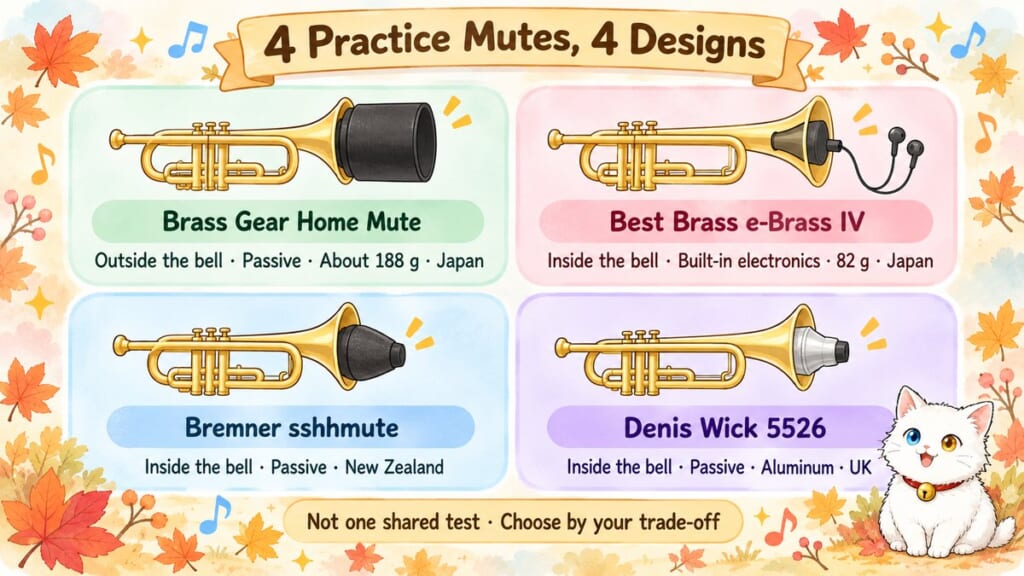
Choose by the compromise you are willing to make: sound reduction, playing response, weight, or budget. These four options use different designs, and the published figures below are not results from one shared test.
| Practice mute | Design and published details |
|---|---|
| Brass Gear Home Mute | Outside-the-bell enclosure; passive; approximately 188 g in the current manufacturer specification. |
| Best Brass e-Brass IV | Japanese design with built-in electronics; 82 g; manufacturer-stated reduction of approximately 30–35 dB. |
| Bremner sshhmute | New Zealand passive practice mute; manufacturer emphasizes minimal back pressure. |
| Denis Wick 5526 | UK-made aluminum passive practice mute for trumpet or cornet. |
If you arrived looking for the familiar Yamaha SILENT Brass SB7X-2, that generation has been discontinued. Yamaha’s later lineup is the SBJ series, including SB7J for trumpet and cornet; check the current model offered in your market.
For maximum quiet, compare high-attenuation mutes, including electronic monitoring systems, first. Electronics let you hear a monitored signal but do not themselves guarantee that less sound escapes. If blowing feel and pitch are your main frustrations, Home Mute deserves a closer look; if cost comes first, compare simpler passive options.
Will It Fit Your Trumpet? Check Before You Buy
Measure your trumpet’s outside bell diameter before choosing Home Mute. The manufacturer gives a compatible range of 94–129 mm; TC Gakki recommends 115–129 mm. The manufacturer adds that the 94 mm lower end also covers piccolo trumpets.
Diameter is only one part of compatibility. The manufacturer also warns that nearby slides or other parts can interfere, even when the bell is within range. TC Gakki specifically excludes short cornets with tubing close to the bell, so send the retailer your exact trumpet model if you are uncertain.
The standard color is black, with limited-color versions also offered. Check fit first, then choose a color.
The manufacturer warns you to keep the product away from pacemakers and other medical devices affected by magnets, and to consult your doctor before use if you use such a device.
If you play cornet, flugelhorn, or trombone, use the alternatives above to find a model explicitly made for your instrument. Some brands offer several sizes, but their trumpet models are not automatically suitable for another instrument. This Home Mute guide covers the trumpet version only.
How to Buy It From Outside Japan
For US delivery, start with Amazon.com; for other destinations, TC Gakki is a useful direct-from-Japan route. Confirm fit before placing an international order, particularly if opening the package would affect your return options.
Amazon US: The listing for ASIN B0DQCJ6NKK shows “Brass Gear Home Mute” as the seller and Amazon as the shipper when checked in October 2026. Check both fields again before ordering, because sellers and fulfillment can change.


Brass Gear Home Mute (BG-HM01)
A passive practice mute that covers the outside of the bell. From Fukuyama, Hiroshima. Measure your bell before ordering.
Prices change often — please check the latest price on each store.
TC Gakki: Its English product page provides a purchase route from Japan, and its overseas policy specifies DHL shipping. New items cannot be returned after opening or use, and import duties are the buyer’s responsibility. Confirm that delivery is available to your address before paying.
Ikebe’s global store: The Home Mute listing is another option to check if your preferred seller has no stock. Availability changes, and its shipping information needs checking for your destination.
Amazon Japan: The Japan listing is sold by a third-party seller and can’t be shipped to the US (checked in October 2026). It is useful if you live in Japan or can arrange delivery during a visit. If a trip is part of your plan, my planning guide walks through the steps.
Check Home Mute on Amazon Japan (Japan addresses only)
The standard black model’s official Japanese list price is ¥21,780 (about $140), including Japanese tax, as of October 2026. Shipping is shown in the order process, and import duties depend on your country.
Who It’s For (And Who Should Pick Something Else)
Home Mute makes most sense when you want quieter daytime or early-evening practice without the same resistance or pitch frustrations you have with your current mute. That could be an adult returning to trumpet, a hobby player sharing a home, or a parent helping a school-band child establish a routine. The instrument still needs to fit, and the room still needs to tolerate audible practice.
 For hotel use, ask the property whether instrument practice is allowed before deciding that a mute solves the problem. A device that suits your living room may still disturb someone in the next hotel room. If the answer is no, ask about an appropriate practice space instead.
Choose another option if you need the strongest sound reduction, a lighter setup, or a lower initial cost. For late-night thin-walled rooms, even a high-attenuation or electronic system may be insufficient, so changing the time or place can matter more than changing the mute. Cornet and other brass players should choose a product designed for their instrument.
FAQ
Is the Home Mute completely silent?
No, you will still hear the trumpet. The official test measured 99.3 dBA falling to 70.8 dBA, while TC Gakki describes it as a little louder than typical practice mutes.
Does it change the pitch or feel of my trumpet?
Brass Gear says the design significantly reduces changes to blowing feel and pitch, rather than guaranteeing no change at all. Your trumpet and playing response still matter, so judge it alongside your normal open practice.
Can I buy it outside Japan?
Yes, Amazon US and Japanese retailers with international sales provide routes to buy it. Check your instrument’s fit, your destination’s delivery eligibility, and the seller’s return conditions before paying.
Final Thoughts from YUU

For another little piece of Japanese everyday life, you can also explore my guide to Japanese loungewear.
What makes home practice difficult for you: the noise, the resistance of your current mute, or finding the right time? Tell me in the comments; that detail helps explain which compromise you need to solve first.
I hope this guide has answered one of your questions and helped you feel a little closer to Japan.
May your Japan journey be filled with wonderful discoveries and memories you’ll treasure for years to come.
See you in the next guide.




Comments