
- What Is SAM-CS? A Flood Sheet From a Small Shizuoka Company
- How It Works: Why a Covered Car Floats
- Setting It Up: About 7 Minutes, One Person
- Tested in a Pool for 7 Days
- Sizes: M, L and 2L — and Why Big American Cars Won’t Fit
- Safety First: What This Sheet Can’t Do
- Can You Buy One Outside Japan? Ask the Maker
- FAQ
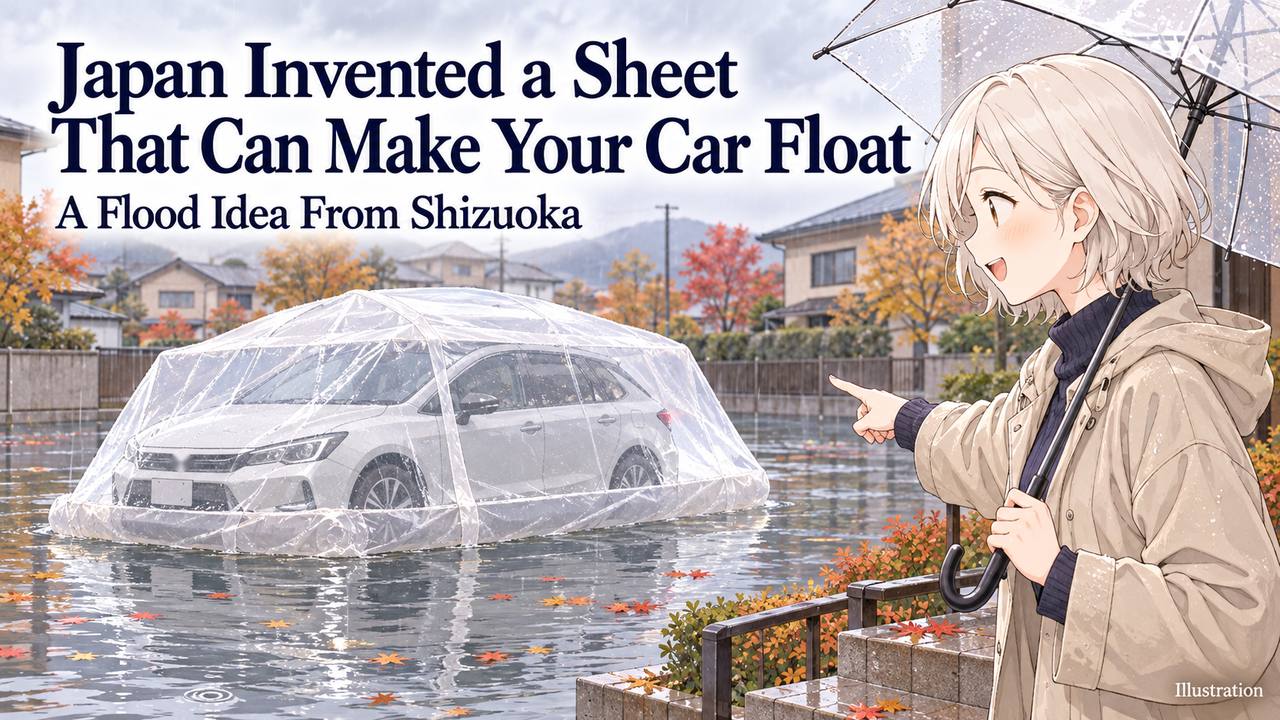
What Is SAM-CS? A Flood Sheet From a Small Shizuoka Company
Seeing a full-size car floating inside a sheet makes you look twice. SAM-CS wraps a parked car from underneath, then adds a cover over the whole vehicle. The idea is to keep water out so the covered car can stay afloat; the maker reports that a car floated in a pool for seven days.
For you as a car owner, the practical answer is more specific: it needs careful setup before flooding, your car must fit its size limits, and overseas shipping isn’t announced. Evacuation still comes first. I’ve put this guide together from the maker’s official Japanese information and Japanese news reports.
The maker is Onoda Sangyo, a Shizuoka company that builds houses and has also developed tsunami shelters. Based in Shimizu Ward, Shizuoka City, it was founded in November 1945. Japanese TV news has featured SAM-CS, and SoraNews24 covered it in English in September 2026.
 There is a local reason for this invention. Heavy rain and typhoons flood roads and parking areas in Japan, and the national transport ministry warns that water reaching a car’s floor can cause failures, while moving water can carry the vehicle away. The government’s hazard-map portal lets residents look up expected flooding around their homes. Japanese reporting links the sheet’s development to vehicle damage during the 2022 typhoon disaster; flooding in nearby Yaizu during Typhoon No. 10 in 2024 was another reminder of the same problem.
How It Works: Why a Covered Car Floats
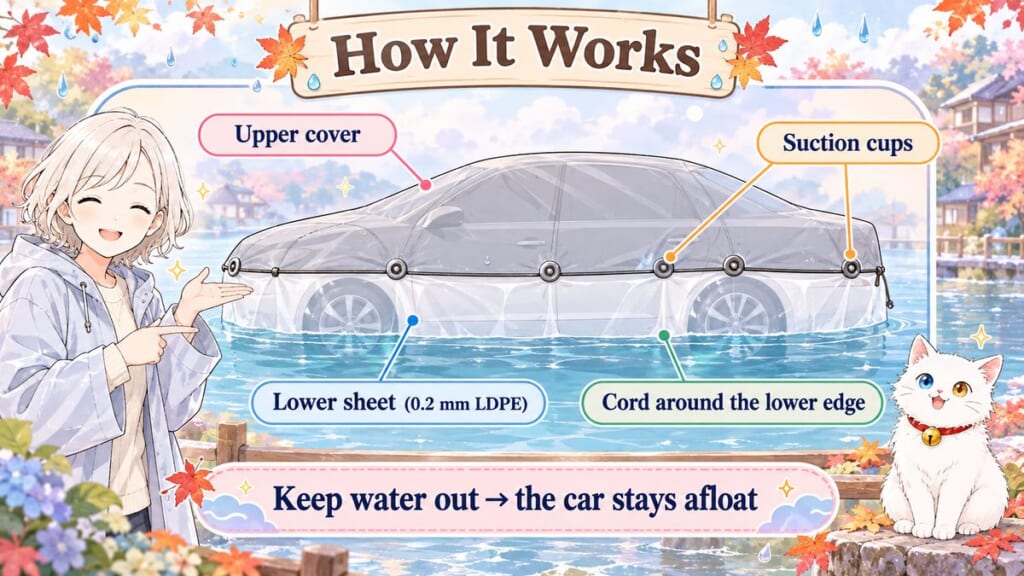
The two layers do different jobs. The lower sheet sits beneath the car and folds upward around it, held to the body with suction cups. It is made from 0.2 mm low-density polyethylene, usually shortened to LDPE; the upper cover is polyethylene and goes over the vehicle.
Ryosaku Onoda, the company’s chairman, explained the principle in a 2024 Shizuoka local news report. In his account, a car can initially float, but water gradually enters through gaps and it eventually sinks. Covering it is intended to keep that water out so it remains afloat.
 Think of a boat hull: the enclosed space displaces water, and keeping water outside is central to buoyancy. SAM-CS is listed by the maker as patent pending.
Setting It Up: About 7 Minutes, One Person
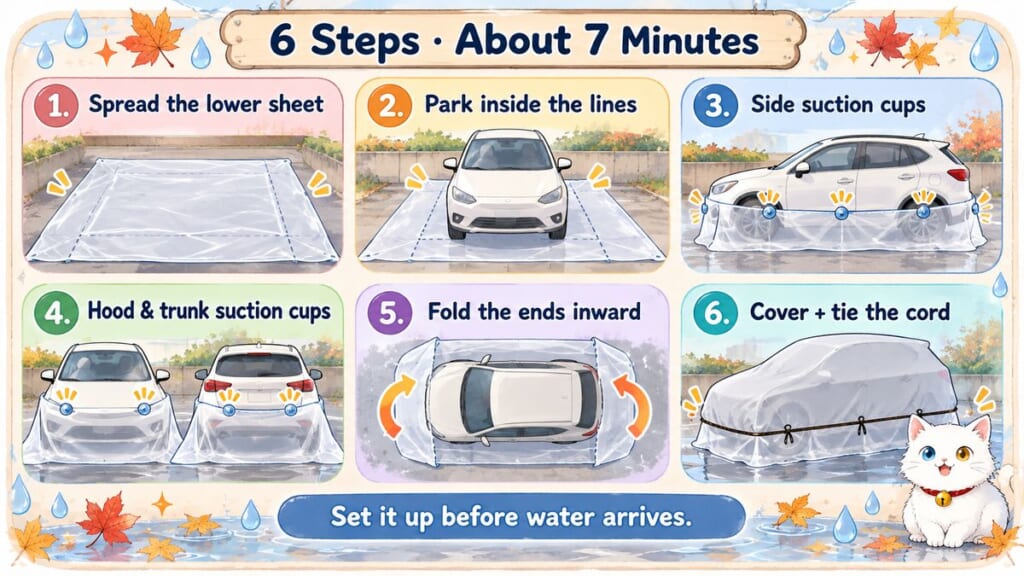
Setup takes about 7 minutes by the maker’s count; news reports put it at 5 to 10. That gives you a rough preparation time, rather than a reason to wait until water reaches your parking space. The sheet needs to be laid out and the car positioned before the wrapping begins.
Spread it on flat ground without gravel or sharp objects. Check the tires for trapped stones before driving onto it, and keep control of the sheet as you unfold it because wind can lift it. The maker’s six-step sequence is:
- Spread the lower sheet where you will park the car.
- Park in the center, inside the side guide lines and the front and rear stop lines.
- Attach the side suction cups to the left and right sides of the car.
- Attach the front and rear suction cups to the hood and trunk.
- Fold the front and rear ends of the sheet inward toward the center and secure them with the suction cups.
- Pull the upper cover over the whole car, then draw and secure the cord around its lower edge.
 Avoid turning the steering wheel back and forth while on the sheet: that can damage it. Position the car fully inside the marked lines, since incorrect placement can allow water in. Clean both the suction cups and their contact areas on the body so the cups can stay attached.
The whole package weighs about 5 kg, or 11 lb. Folded, it measures approximately 40 × 60 × 10 cm, about 16 × 24 × 4 in, and the maker describes it as compact enough for a car trunk. For everyday storage, those packed measurements are more useful than the dramatic image of a floating car.
Tested in a Pool for 7 Days
According to the maker, a car remained afloat in a pool for seven days. The company says the test period included heavy rain and strong winds, and the car did not sink.
A separate public demonstration was reported in July 2024 in Fujieda, Shizuoka Prefecture. It simulated a parking area flooded by heavy rain, with local-government disaster-prevention staff and other visitors watching. The report showed a car floating inside the sheet.
A real flood can bring currents and debris, so the reported duration should be read alongside the maker’s limits and installation precautions. The next useful question is whether your car even fits inside the available sizes.
Sizes: M, L and 2L — and Why Big American Cars Won’t Fit
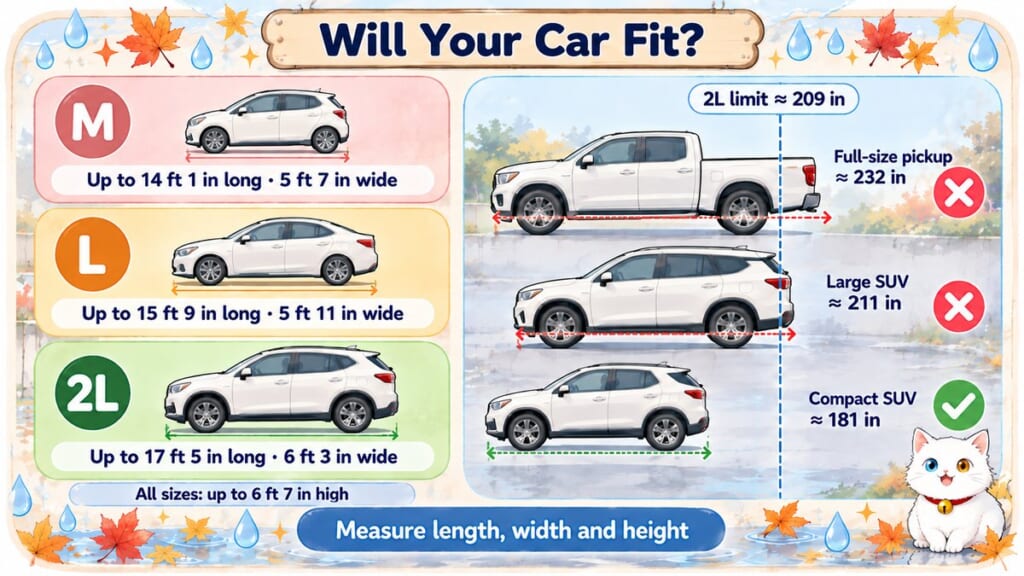
Some large pickups and SUVs exceed even the largest listed size. Japanese retail listings give these sizes as maximum vehicle dimensions, so you need to compare width, length and height together. The category labels are only a starting point.
| Size | Maximum vehicle width | Maximum vehicle length | Maximum vehicle height | General size guide |
|---|---|---|---|---|
| M | 1.7 m (5 ft 7 in) | 4.3 m (14 ft 1 in) | 2.0 m (6 ft 7 in) | Small and compact cars |
| L | 1.8 m (5 ft 11 in) | 4.8 m (15 ft 9 in) | 2.0 m (6 ft 7 in) | Midsize cars |
| 2L | 1.9 m (6 ft 3 in) | 5.3 m (17 ft 5 in) | 2.0 m (6 ft 7 in) | Larger cars |
The feet-and-inches figures are rounded; the metric limits are the reference for a close fit. In inches, 2L allows approximately 209 in of length and 75 in of width. A familiar model name can help you picture those limits, but its exact version still matters.
The 2026 Ford F-150 SuperCrew with a 5.5 ft bed is 232.0 in long and 79.9 in wide even excluding mirrors. It is about 23 in longer than the 2L limit and also too wide. The 2026 Chevrolet Tahoe is about 211 in long, so length alone puts it beyond 2L.
A standard 2026 Toyota RAV4 Hybrid is about 181 in long, 73 in wide and 67 in high. Those dimensions fall within 2L, while L’s approximately 71 in width limit is too narrow.
 The Japanese product listing excludes vehicles fitted with roof carriers or exterior accessories. Measure your car’s full length, width and height against the table, and ask the maker if any measurement is close to a limit.
Safety First: What This Sheet Can’t Do
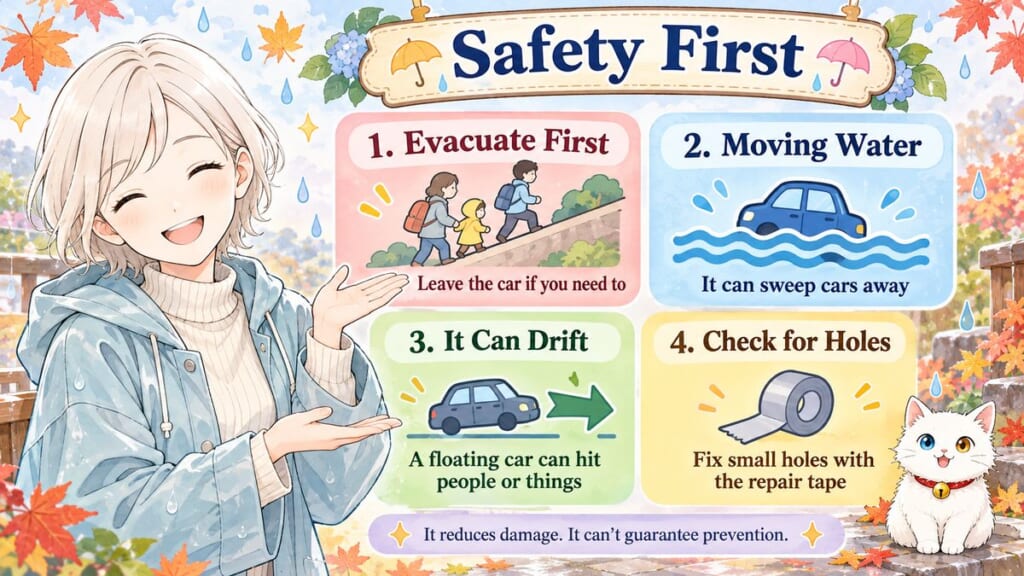
 Protecting a car must come after getting yourself and your family to safety. The maker describes SAM-CS as a product intended to reduce flood damage and explicitly says it cannot guarantee complete prevention. Plan any preparation early enough that it never delays evacuation.
Japan’s transport ministry warns that moving water can sweep a car away. A floating vehicle could drift into people, other cars or property, so staying afloat creates its own concern. News reports describe an optional anchoring strap intended to limit drifting.
Damage to the sheet also matters. The maker warns that holes can let water in and lead to the car sinking, and its care instructions specify the supplied repair tape for small holes. Inspect the material during preparation and deal with damage before use.
As a mother, my priority is getting everyone to safety, even if that means leaving the car behind. If you’re planning a visit to Japan, include heavy-rain and typhoon information in your preparations, too; my Japan Trip Planning Guide walks you through the steps.
Can You Buy One Outside Japan? Ask the Maker
As of October 2026, the maker’s published buying route is a Japanese inquiry form and telephone contact, with no overseas-shipping information. If you live abroad, treat international availability as unconfirmed. The practical next step is the maker’s Japanese-language inquiry page.
A Japanese online retailer, operated by a separate company, lists SAM-CS at ¥88,000 (about $568, at ¥155 to the dollar), including tax, with the same listed price for M, L and 2L as of October 2026.
The Amazon.co.jp listings were out of stock when checked for this guide in October 2026. For an overseas inquiry, include your country and your car’s dimensions so the maker can address both delivery and sizing.
For Japanese products you can explore without making a trip, see Japanese Gifts You Can Buy Without Going to Japan.
FAQ
Can it be used in moving floodwater?
The maker doesn’t describe it as a product for flowing water. Japan’s transport ministry warns that currents can sweep cars away; reports mention an optional anchoring strap, but evacuation should happen before flowing water puts you at risk.
How long can a car stay afloat?
The maker reports seven days in a pool, including days with heavy rain and strong winds. That is a reported test result, and the company does not guarantee complete prevention of flood damage.
Can you reuse it after a flood?
The maker describes the material as strong enough for repeated use, provided its condition is suitable. Remove debris with a broom or vacuum, avoid thinner and other solvent cleaners, and repair small holes with the supplied tape before reuse.
How big is it when packed?
It weighs about 5 kg (11 lb) and packs down to approximately 40 × 60 × 10 cm (16 × 24 × 4 in). The maker describes the package as small enough to store in a car trunk.
Does it fit my car?
Compare all three dimensions—length, width and height—with the table above, and follow the exclusion for roof carriers and exterior accessories. Large models such as the F-150 SuperCrew and Tahoe exceed even 2L; a standard RAV4-sized vehicle falls within its dimensional limits.
SAM-CS starts with a simple, interesting idea: keep water from entering, and a covered car can float. The details that turn that idea into a product are the lower sheet, the upper cover and the careful steps for fitting them around a particular vehicle.
In a flood, evacuation comes before protecting the car. Any decision about this sheet belongs in your advance preparations, with room for the maker’s limitations and the possibility that your vehicle won’t fit.
It also offers a look at how a small Japanese company approaches a problem close to home. If that side of Japanese products interests you, continue with Is Your “Japanese” Knife Actually Japanese? or explore everyday household tools in Zojirushi vs Thermos vs Tiger.
Another small Japanese maker took on a very different problem at home: a trumpet practice mute from Hiroshima that covers the bell instead of plugging it.
What would you want to know before considering a sheet like this for your car? Leave your question in the comments.
I hope this guide has answered one of your questions and helped you feel a little closer to Japan.
May your Japan journey be filled with wonderful discoveries and memories you’ll treasure for years to come.
See you in the next guide.



Comments